

site search
online catalog
ID’D DRAFTING SET – THE FAMED “BOY COLONEL” HENRY BERGWYN – 26th NC, KILLED AT GETTYSBURG ON JULY 1
Hover to zoom
$3,950.00
Quantity Available: 1
Item Code: 846-570
Shipping: Determined by Method & Location of buyer
To Order:
Call 717-334-0347,
Fax 717-334-5016, or E-mail
Henry “Harry” King Burgwyn, Jr. was known as the “Boy Colonel” because he attained that rank at the early age of twenty. He was perhaps the youngest colonel in the Confederate Army. Unfortunately, he never lived to see his twenty-second birthday.
Burgwyn was the son of Northampton County planter Henry King Burgwyn Sr. and New England native Anna Greenough. He was born in Jamaica Plains, Massachusetts, at his mother’s ancestral home. Capt. John G. Foster privately taught Burgwyn at the U.S. Military Academy since he was too young at fifteen to enter the institution. In 1857 Burgwyn enrolled at the University of North Carolina; he graduated in 1859. To further his education, he entered the Virginia Military Institute.
Burgwyn stayed briefly in Richmond with other VMI cadets following the start of the Civil War. In North Carolina as a captain, he instructed the Lafayette Light Infantry in drill at Camp Ellis, located at the original State Fairgrounds, and was sent to the mountains to raise a company. As a major, Burgwyn commanded Camp Crabtree near Raleigh. In August 1861, the Twenty-sixth regiment’s company officers elected the nineteen-year-old Burgwyn as lieutenant colonel, making him second in command behind Col. Zebulon B. Vance. Burgwyn’s regiment took part in operations in eastern North Carolina and in Virginia. With Vance’s election as North Carolina’s governor in August 1862, Burgwyn was promoted to colonel.
From August 1862 to May 1863, Burgwyn’s regiment fought in eastern North Carolina. In May the Twenty-sixth joined the Army of Northern Virginia. On July 1, 1863, at Gettysburg, the Twenty-sixth regiment took part in an assault on the position of the US Iron Brigade, through the Herbst Woods, that resulted in the death of Burgwyn. After ten color-bearers had fallen with the regimental flag, Burgwyn seized the colors. He cheered on his troops; the soldiers moved forward. A private took the colors from Burgwyn. After speaking with Lt. Col. John R. Lane, Burgwyn was struck by a bullet that passed through both lungs. He was buried at Gettysburg adjacent to land recently acquired by the American Battlefield Trust. In June 1867 Burgwyn was reinterred at Oakwood Cemetery in Raleigh.
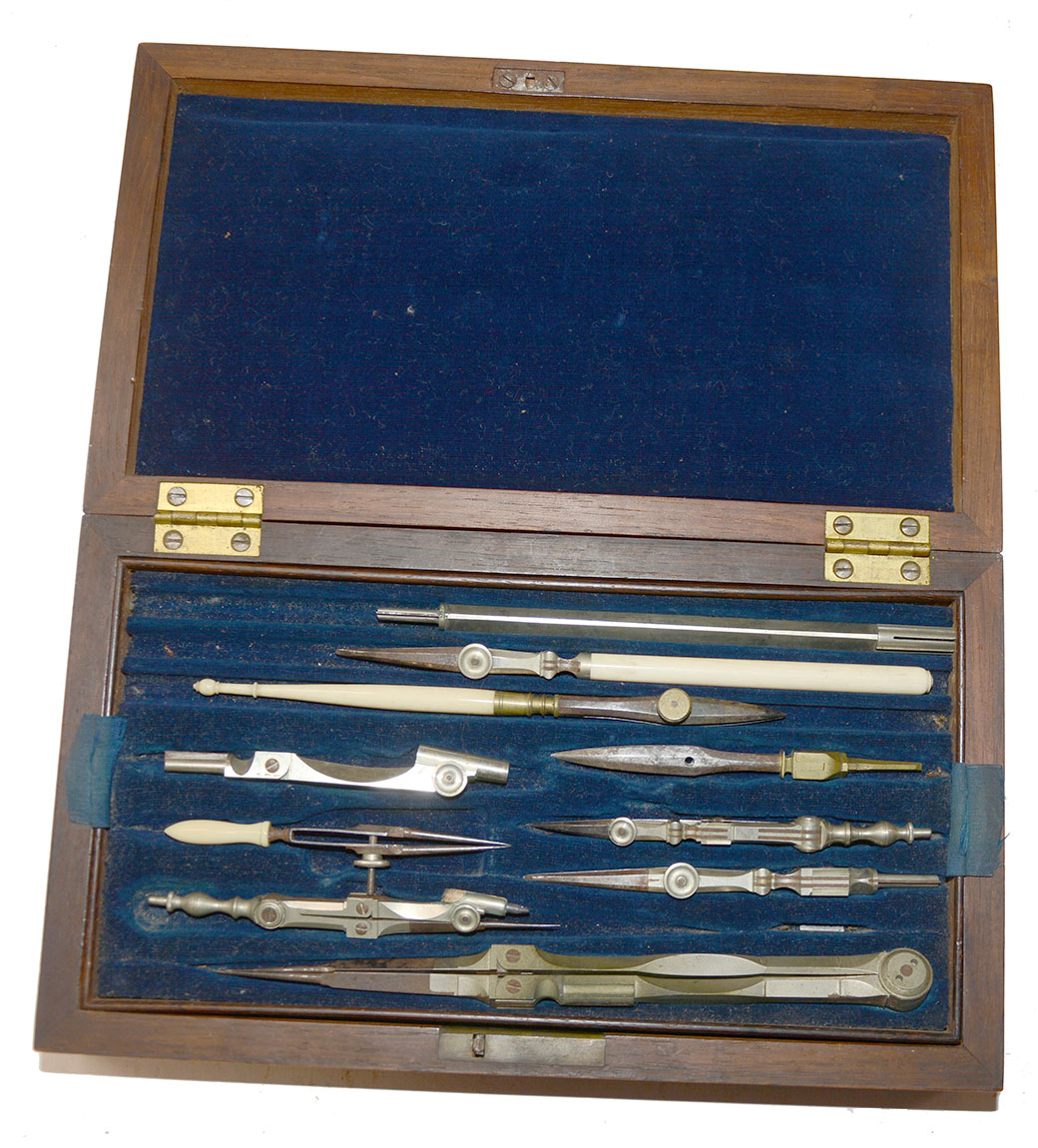
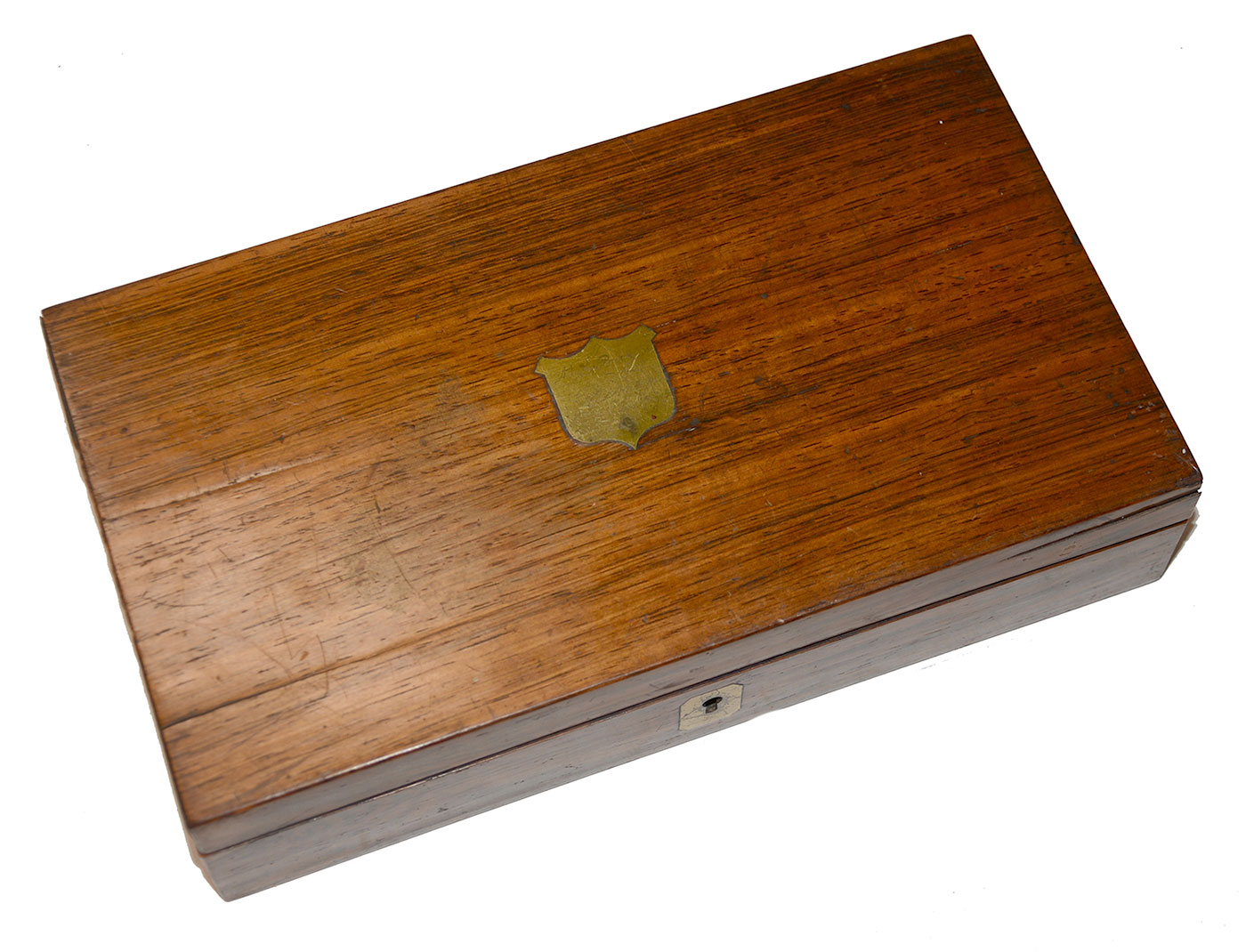
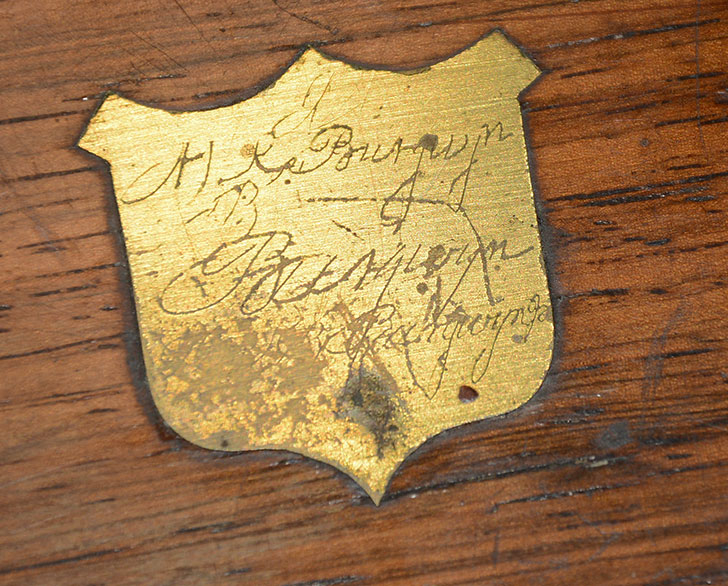
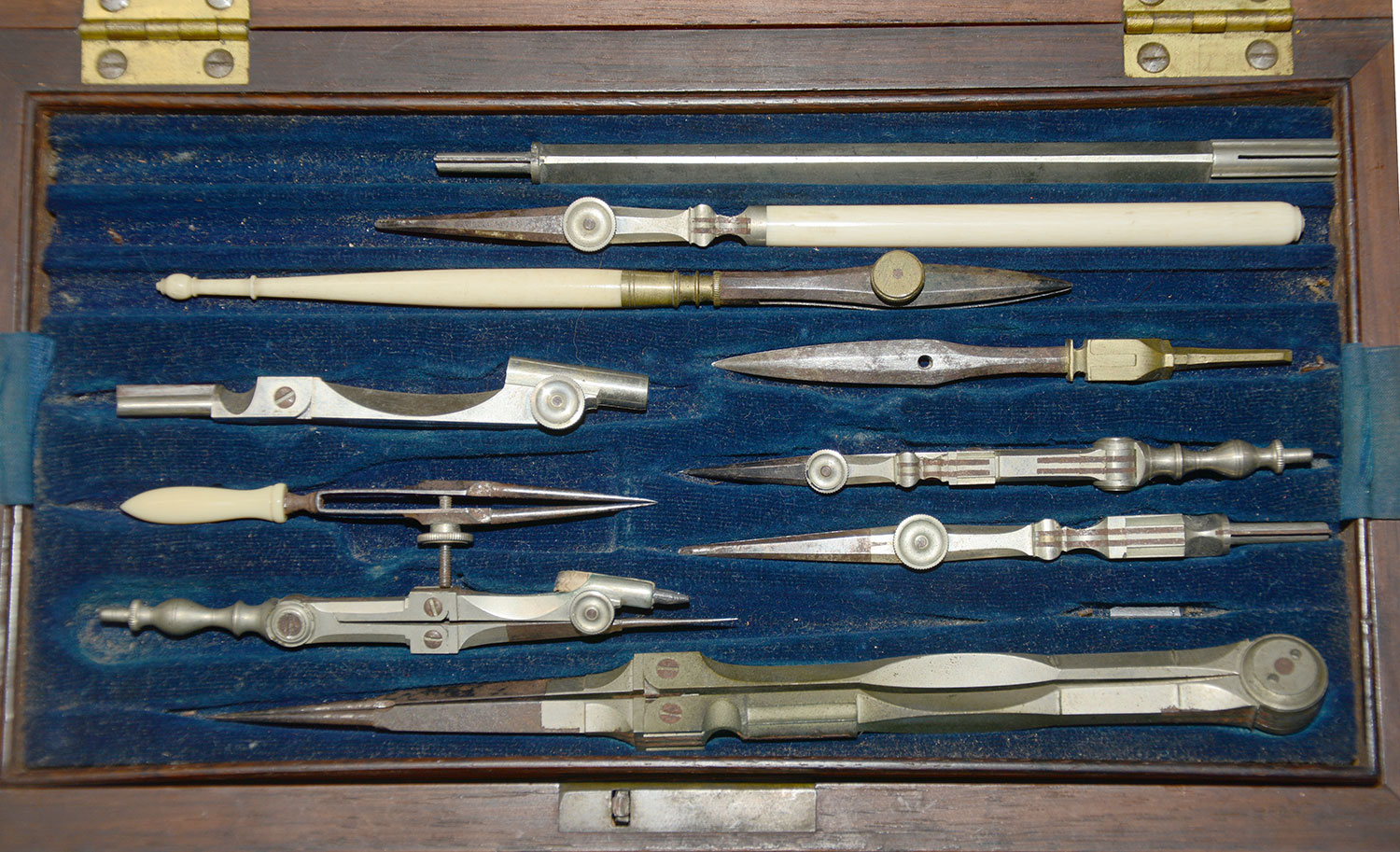
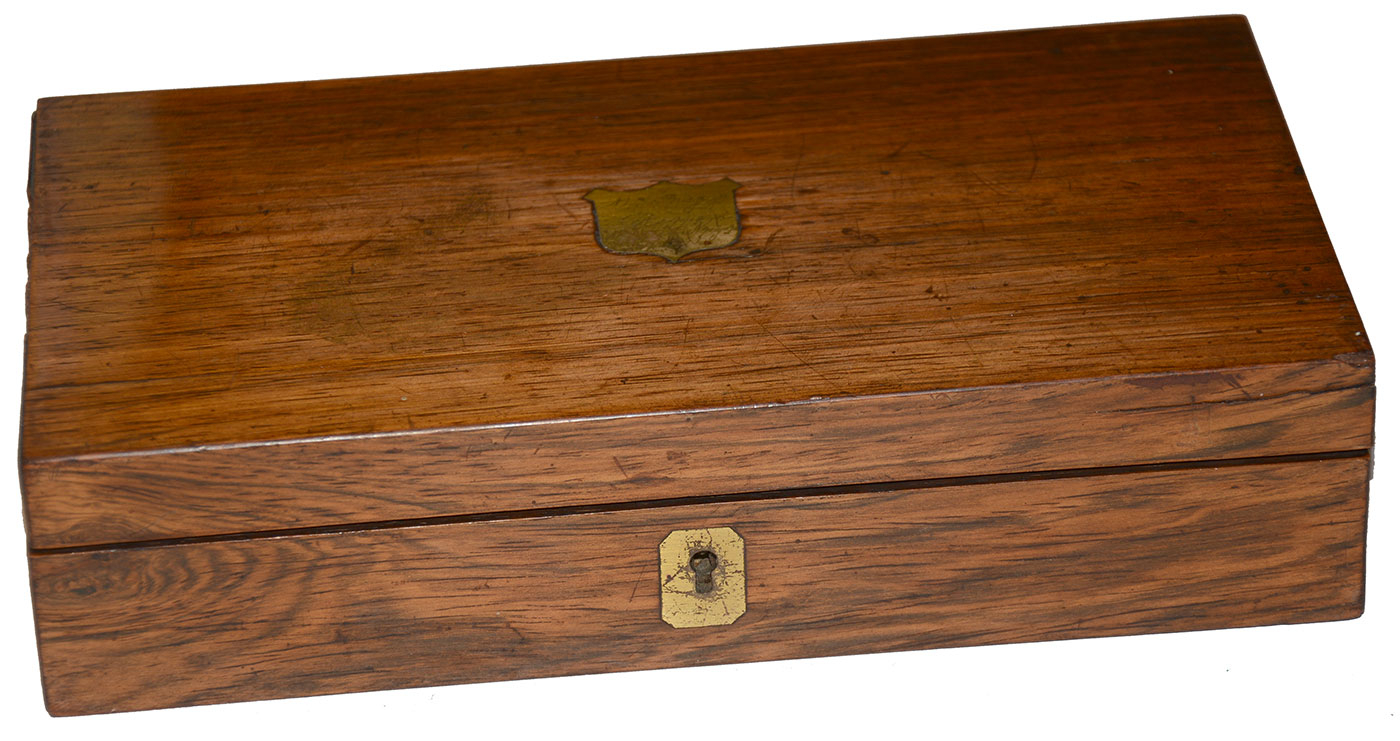
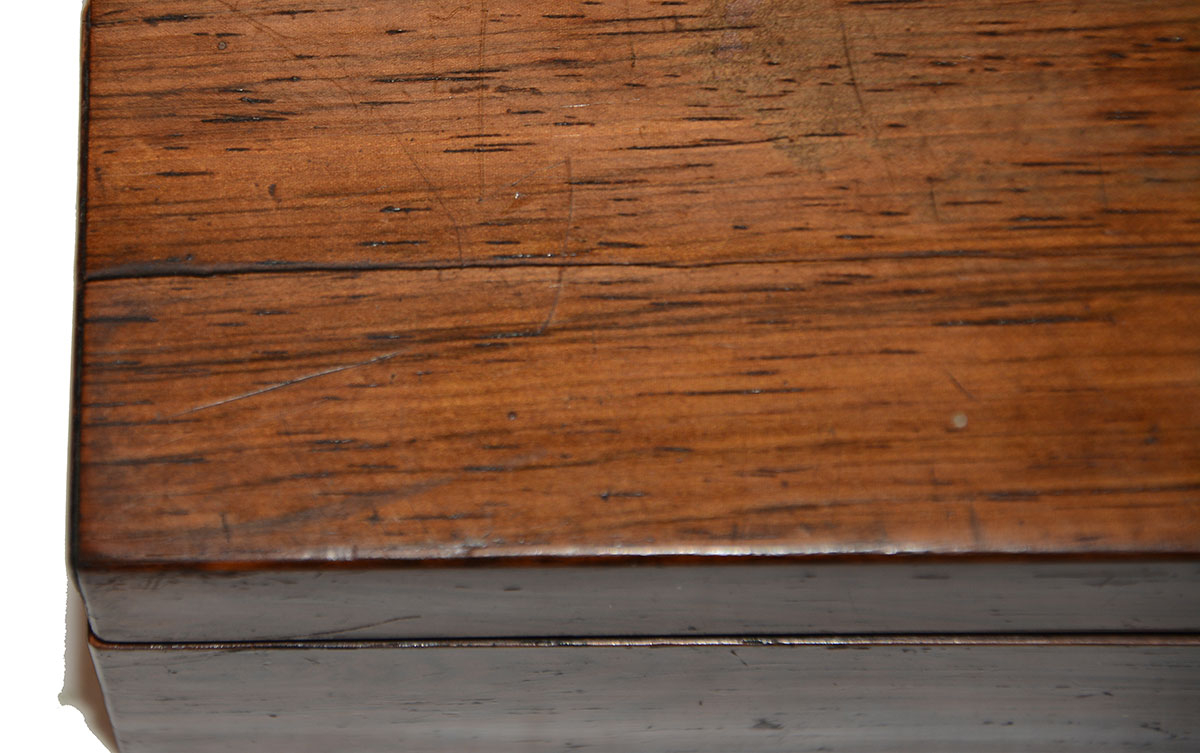
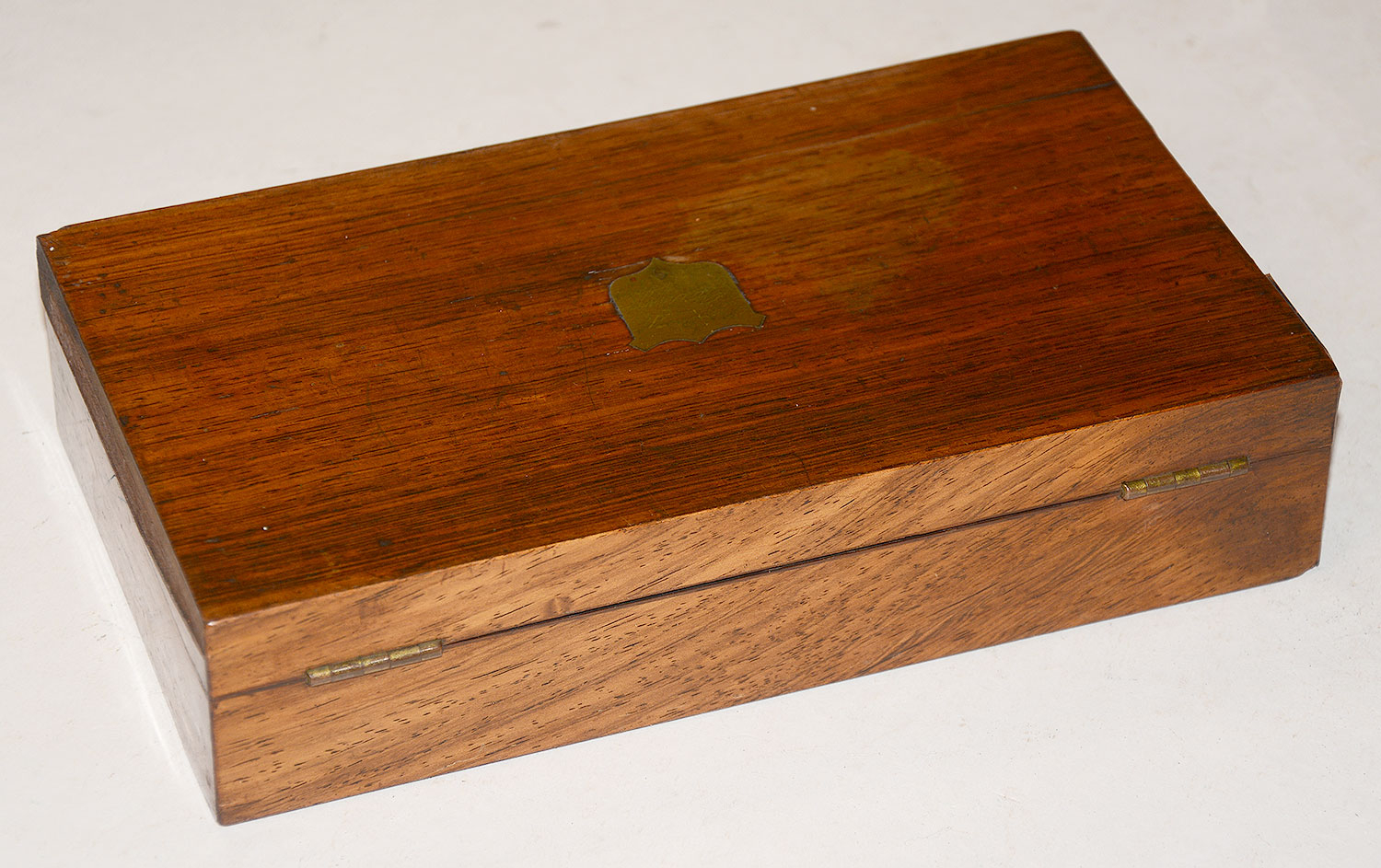
Presented is the young man’s drafting set in complete condition. The set is cased in a varnished wood box with a rich mahogany veneer, measuring 5” x 8.5”. An inlayed brass shield features his name as “H. K. Burgwyn”. The shield material and finish match the inlayed lock (missing key) and the pair of brass hinges that pivot to open and close the box. A small crack measuring 2” is noted at the upper front right edge of the box, following one of the joints between the fine wood pieces (box integrity remains sound). Cosmetically, the case shows light wear but remains in good condition, with very minor veneer loss along the upper left lid edge, a small missing panel on the right side of the lid, a slight crack in the veneer top at center measuring approximately 1.5”, and a lower crack in the veneer from left to right measuring approximately 3”. The interior of the case is in excellent condition, complete with all accessories and original blue velvet lining. Each drafting tool is in excellent condition given age, with light surface oxidation on some of the finer parts. The accompanying ivory handles are complete and show little yellowing.
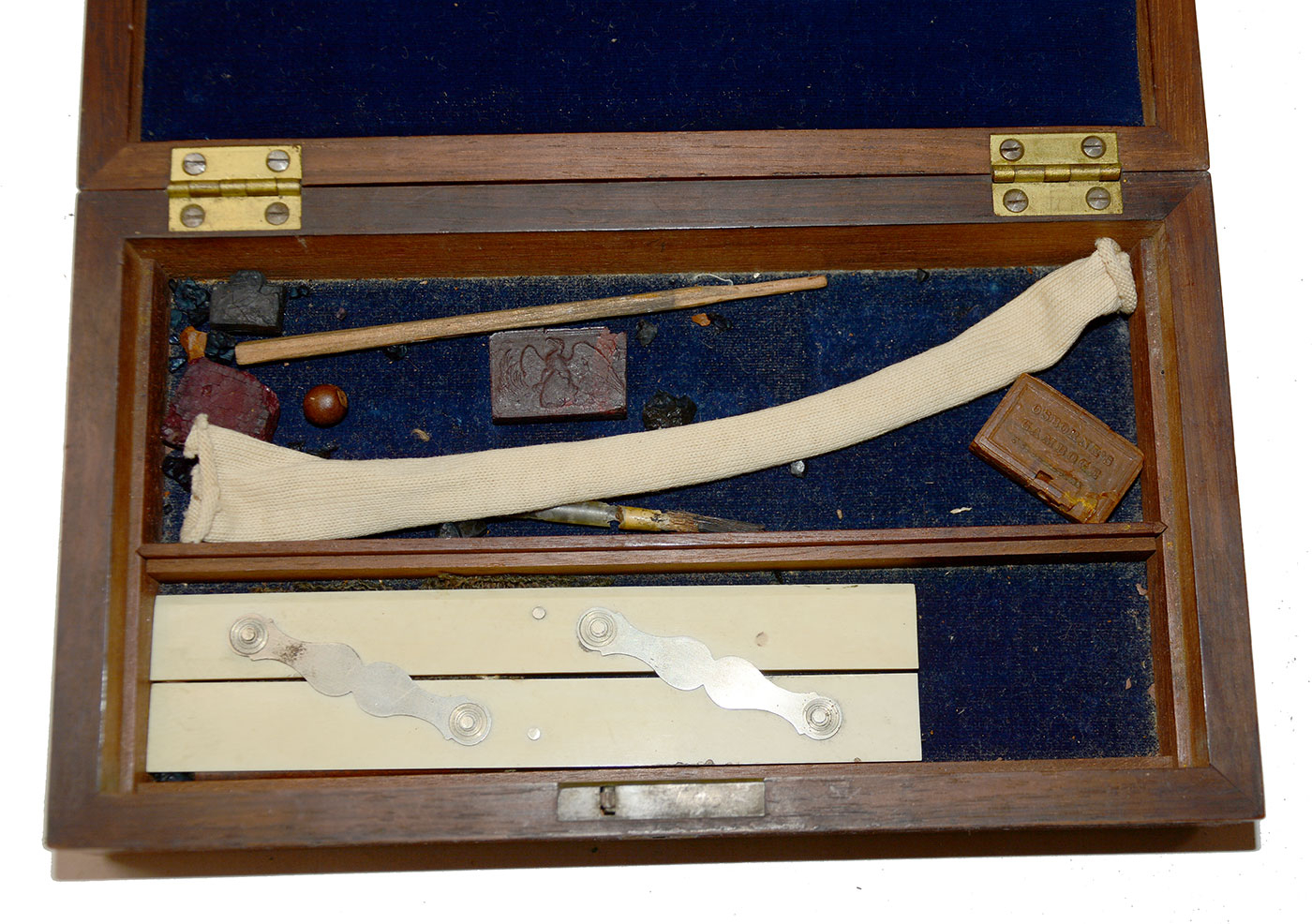
The drafting implements rest in a fitted wood tray, with blue silk lifting tabs and navy-blue silk lining. The tray lifts to reveal a lower compartment, divided at center with matching wood and lined with matching velvet. Contents include an adjustable straight edge implement, a square of jean cloth, pen, painting brush and head, cloth tube case, and blocks of pigment in various conditions (full block of red with eagle and Osborne’s of Philadelphia retail stamp), half-block of red, several small piece of black, and a mostly complete block of brown pigment from Osborne’s).
The bottom surface is covered in a burgundy velvet, leaving just under .5” uncovered border at the edges. A miniscule area of corner damage is noted at rear left (bottom of case).
A unique item, traced to one of Gettysburg’s most famous casualties - a remarkable piece for the collector of Confederate, North Carolina, and Gettysburg artifacts. [cm][ph:L]
~~~~~~~~~~~~~~~~~~~~~~~~~~~~~~~~~~~
THIS ITEM, AS WITH ALL OTHER ITEMS AVAILABLE ON OUR WEB SITE,
MAY BE PURCHASED THROUGH OUR LAYAWAY PROGRAM.
FOR OUR POLICIES AND TERMS,
CLICK ON ‘CONTACT US’ AT THE TOP OF ANY PAGE ON THE SITE,
THEN ON ‘LAYAWAY POLICY’.
THANK YOU!
Inquire About ID’D DRAFTING SET – THE FAMED “BOY COLONEL” HENRY BERGWYN – 26th NC, KILLED AT GETTYSBURG ON JULY 1
Most Popular
Historical Firearms Stolen From The National Civil War Museum In Harrisburg, Pa »
Theft From Gravesite Of Gen. John Reynolds »
Selection Of Unframed Prints By Don Troiani »
Fine Condition Brass Infantry Bugle Insignia »
Rare Identified 65Th Ny Sergeant’s Jacket, With Manscript Material: 1St U.s. Chasseurs »
featured item
CLOSE TO REGULATION VIRGINIA CONFEDERATE CAPTAIN'S FROCK COAT
The coat is made of mid- gray wool, possibly imported from England. It has full-length skirts ending in the typical and desirable raw edge. The sleeves have an 8 1/2-inch billow at the elbow. The dark blue wool standing collar is 1-1/2 inches high… (1268-060). Learn More »
site search