


site search
online catalog
Relics
Showing 101 to 105 out of 321
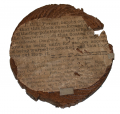
SLICE OF CONFEDERATE FLAG POLE FROM RICHMOND
Here is a 3/8” thick slice of wood that measures 4 ¼” in diameter. Glued to one side is the remains of an old, printed label: “Richmond, Va., May 20, 1890. I, C.L. Parker, hereby cer[tify] that… (1030-324). Learn More »
$625.00
Originally $780.00

KEPI CHINSTRAP AND SIDE BUTTONS FROM AN INDIAN WAR FRONTIER
This is a complete leather chinstrap from an army kepi or forage cap from excavations at Fort Pembina, ND. The chinstrap is a two-piece style with a fixed loop on the end of one strap and a fixed… (1052-486). Learn More »
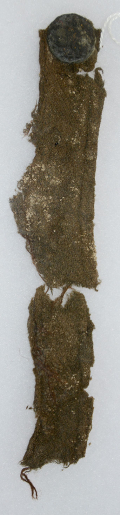
CIVIL WAR-INDIAN WAR UNIFORM COAT PIECE WITH BUTTON FROM FORT PEMBINA
This is part of the right lapel of a US army coat discarded by a soldier at Fort Pembina, ND, sometime between 1870 and 1895, and is from excavations in wet, anaerobic soil that has preserved leather… (1052-724). Learn More »
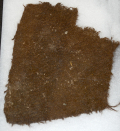
PIECE OF US ARMY BLANKET FROM FORT PEMBINA, NORTH DAKOTA
This piece of a US Army military issue blanket comes from excavations at Fort Pembina, ND, conducted on private property with the owner’s permission, a fort established in 1870 by troops of the 20th… (1052-616). Learn More »
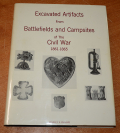
“EXCAVATED ARTIFACTS” BY STANLEY PHILLIPS
Full title of this hardcover volume is “EXCAVATED ARTIFACTS FROM BATTLEFIELDS AND CAMPSITES OF THE CIVIL WAR 1861-1865” by Stanley S. Phillips. Volume measures 8.5” x 11” and runs 220 pages… (1266-1053). Learn More »
Showing 101 to 105 out of 321
Most Popular
Historical Firearms Stolen From The National Civil War Museum In Harrisburg, Pa »
Theft From Gravesite Of Gen. John Reynolds »
Selection Of Unframed Prints By Don Troiani »
Fine Condition Brass Infantry Bugle Insignia »
featured item
RARE AMES MODEL 1847 SAPPERS & MINERS ARTILLERY MUSKETOON SWORD BAYONET-DATED 1847
These well-made sword bayonets were produced from 1847 through 1856 for the Springfield Model 1847 Sappers & Miners musketoon, of which only 830 total arms were manufactured. The bayonet is from the second contract of 300, as it does not have… (490-7261). Learn More »
site search