


site search
online catalog
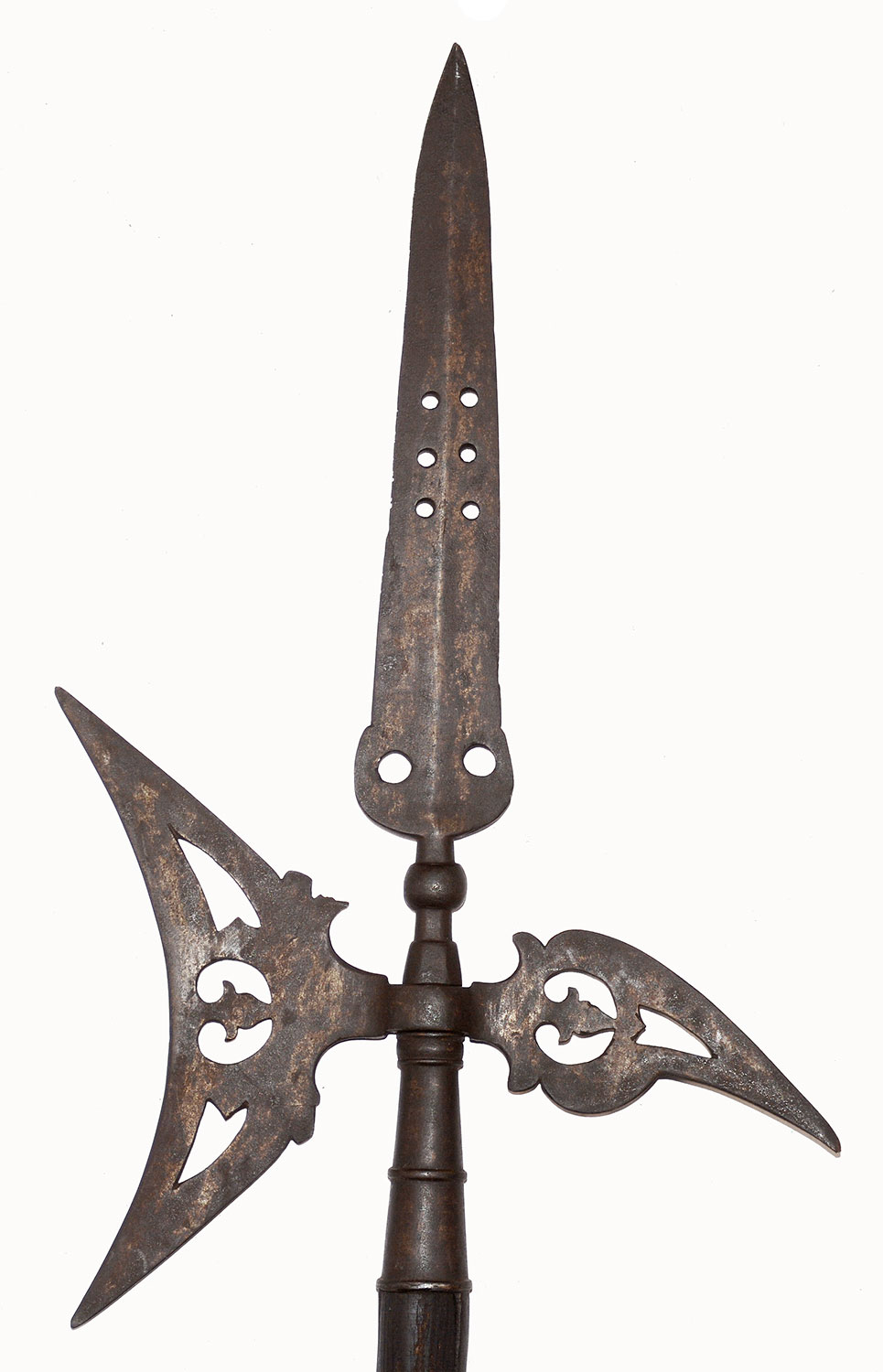
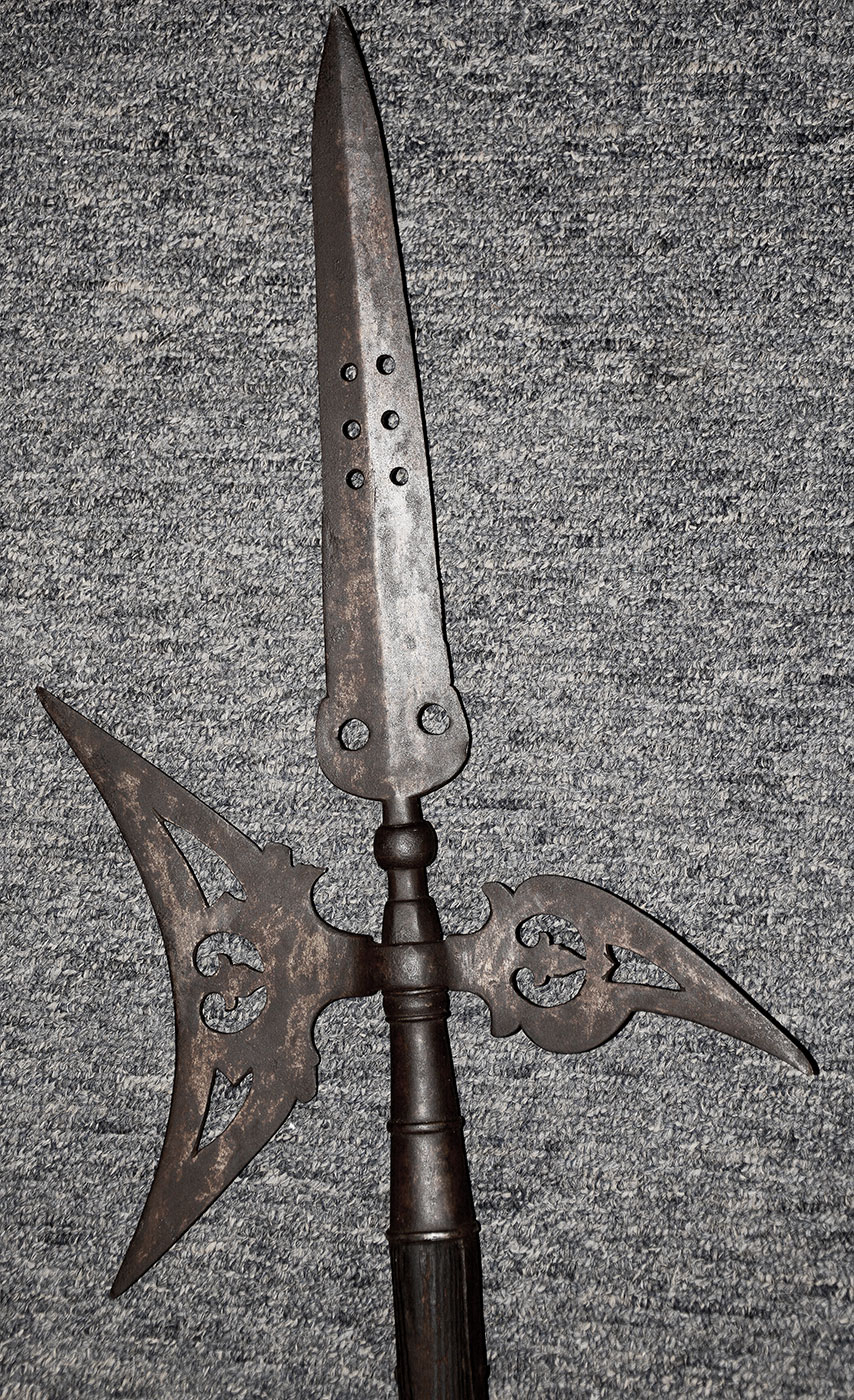
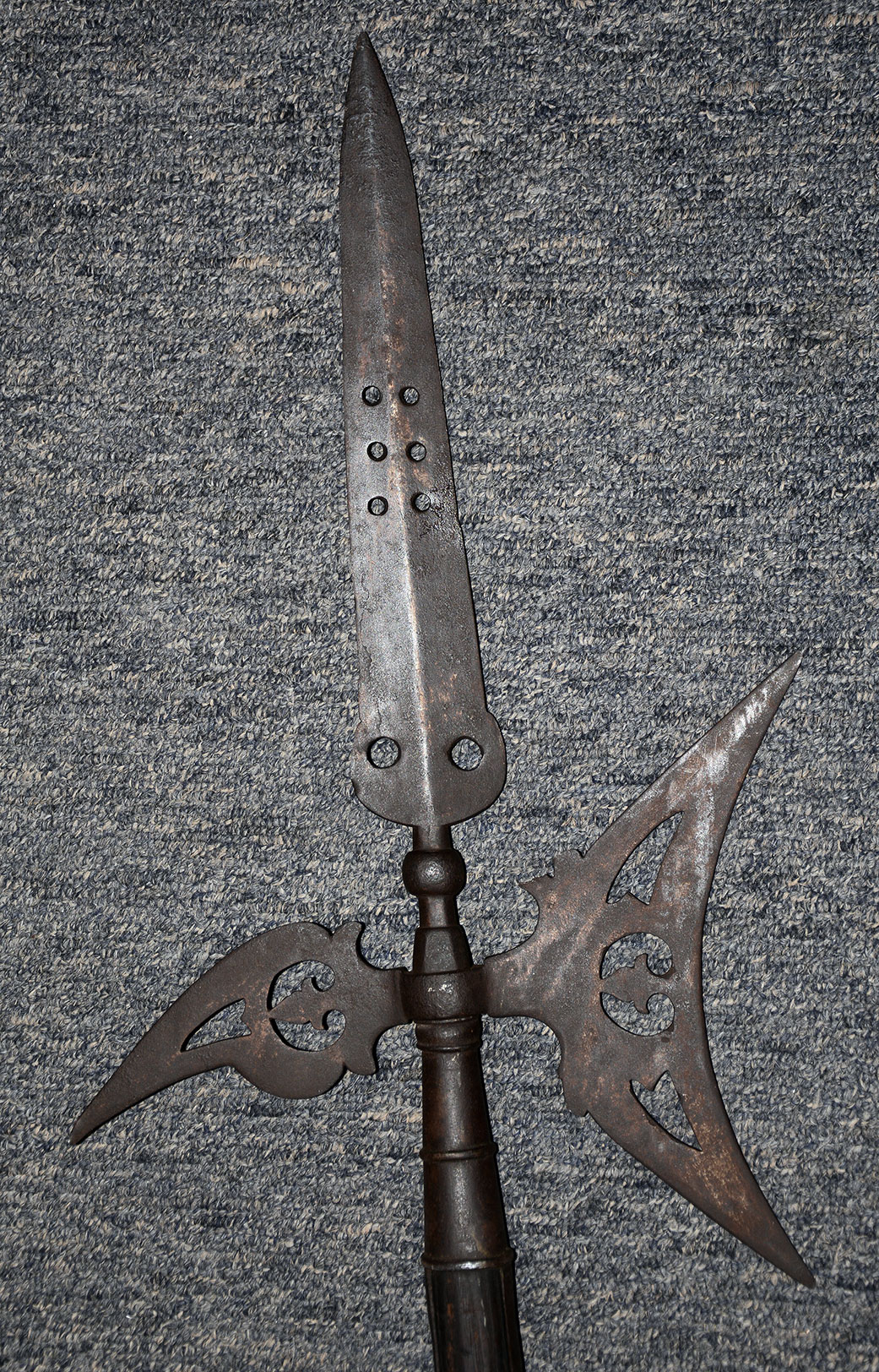
EXTREMELY RARE COLONIAL AMERICAN MADE "PIERCED HEAD WEEPING HEART" HALBERD
Hover to zoom



$6,500.00
Quantity Available: 1
Item Code: 1298-01
Shipping: Determined by Method & Location of buyer
To Order:
Call 717-334-0347,
Fax 717-334-5016, or E-mail
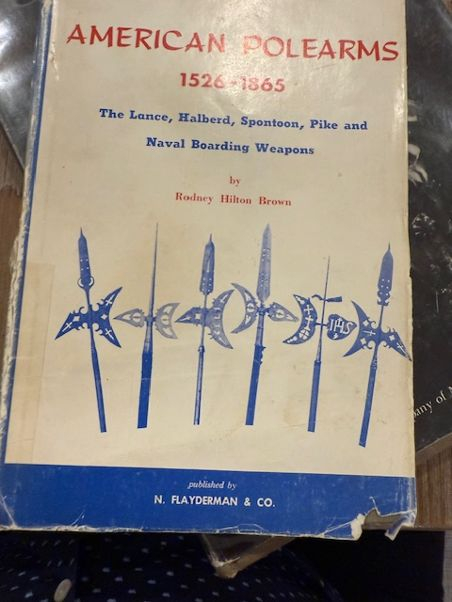
Perhaps the most desired artifacts of the French and Indian War and the early days of the American Revolution are the polearms. The two patterns most sought by experts and collectors are of the "Pierced Dagger" and "Weeping Heart" designs. These rare features can be seen on the front cover of the groundbreaking book American Polearms 1526 to 1865 by Rodney Hilton Brown.
Spontoons were carried by commissioned officers while the halberd was the designated pole arm of sergeants aka non-commissioned officers. Offered here is an extra fine complete and a rare sergeant's halberd actually made in the American Colonies prior to the Revolution.
The halberd was a pole weapon favored by European infantry from the 1400s to 1600s for its versatility and deadly effect. The word halberd comes from the German words Halm (staff) and Barte (axe). The halberd is, in fact, an axe that served multiple functions. The axe blade was used for hacking, the spike for thrusting, and the beak for piercing plate armor or for pulling a knight from his saddle. After about 1600, the halberd gradually became less functional and more ceremonial. Its large blade provided space for coats of arms, insignia and decorations and the halberd had become a ceremonial weapon. By end of the 17th century halberds were no longer sharpened and were a symbol of office. In the later part of the 17th century and well into the 18th century with the predominance of infantry long arms and the linear tactics that followed suit in European armies, the halberd became the requisite weapon of infantry company sergeants. The halberd was a useful weapon for sergeants not only to defend themselves but was also used to dress ranks, make sure muskets were aimed low, hack apart or pull apart defensive works, and as a measuring rod to layout encampments and even pull bodies into graves. Also, as an impressive weapon it made the sergeant appear larger than life, a person of authority. Despite its "ceremonial" or "authoritative" function it was still a deadly weapon in close combat. And contemporary reports exist of its bellicose wielding on battlefields both European and North American.
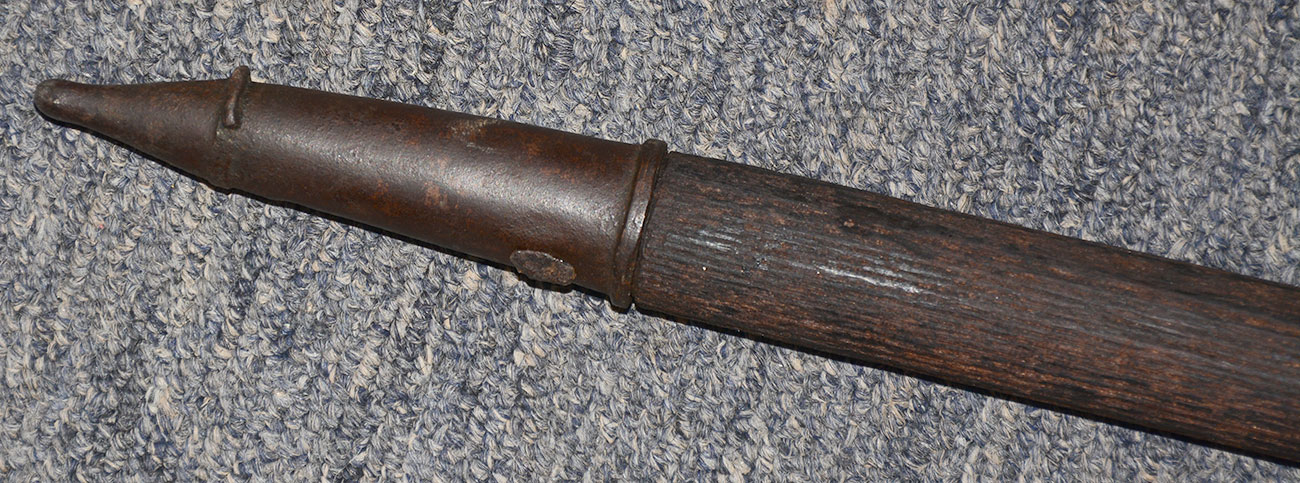
Offered here is a halberd of the "Pierced Head and Weeping Heart" style or form. These are uniquely North American and all date to the first half of the 18th century or earlier and all hail from New England. This particular superb condition and expertly wrought unmolested example was found recently in Boston Massachusetts. Vetted by and blessed by some of the best experts in the field this 100% unaltered weapon is on the original haft or shaft. It is 89 inches in total length from the cone shaped iron grounding iron which is 4 1/2 inches long and held fast by square cut nails to the spears tip. The wonderfully patinated oak or walnut pole itself is approximately 78 inches long. The iron top portion of the halberd consists of 3 bellicose (war like) elements: a spear point, a hatchet "crescent" front axe, and a rear "bill hook". The top element, the spear is 11 inches long, diamond in cross section and pierced with 8 holes. It is about 3 inches across at its pear-shaped base. The esthetically pierced front axe protrudes 5 inches from the haft and is 9 inches top to bottom. The "bill hook" on the rear is also beautifully pierced and protrudes 5 inches. The spear tip unscrews from its base and renders the head itself in 2 pieces; this facilitates cleaning and transportation. Long iron straps run down either side of the haft from the business end for 10 inches. These provide support and prevent an enemy blow from cutting the upper end of the haft.
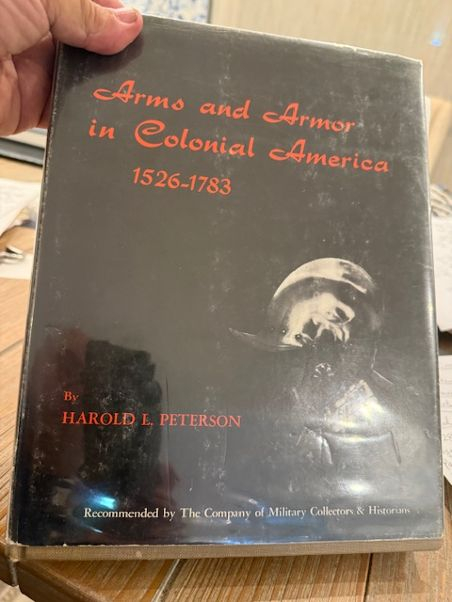
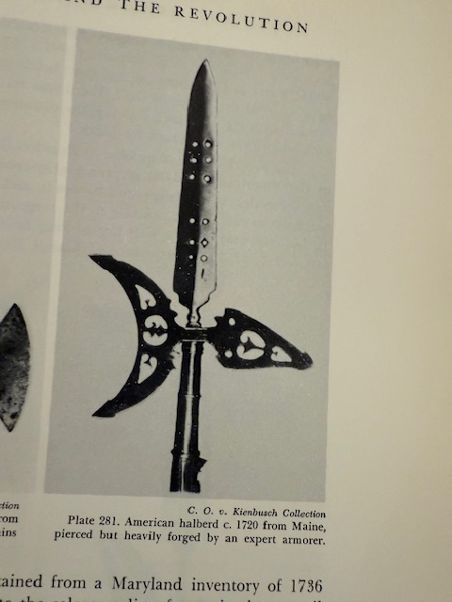
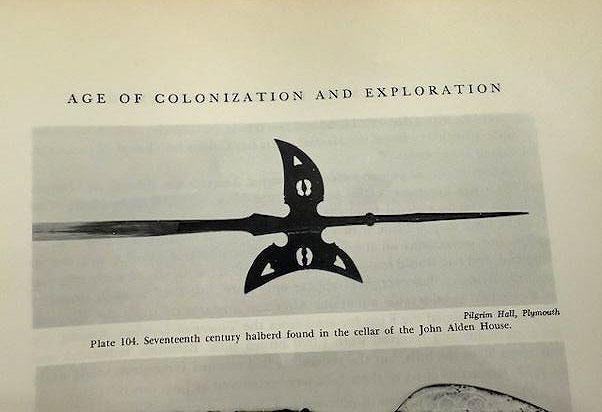
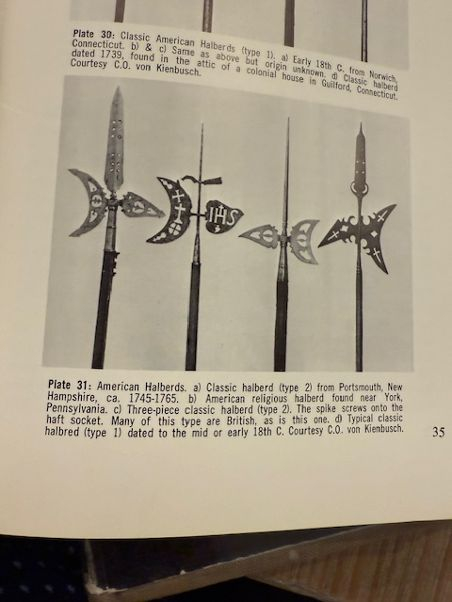
PARALLELS AND REFERENCES: Initially see our scans attached referencing the following: American Polearms 1526-1865 by Rodney Hilton Brown published by Norm Flayderman. On the cover and the 4th polearm of the left is of the type. Also, on page 35 of this classic book please refer to plate 31. This is certainly a product of the same maker as ours, but the illustrated one was found in Portsmouth New Hampshire. Also refer to Arms and Armor in Colonial America 1526-1783 by Harold Peterson. On page 283 plate 281 is a similar halberd found in Maine that Peterson observes was, "forged by an expert armorer". Prior to this on page 95 plate 104 he illustrates another of the ilk but 17th century that was "found in the cellar of the John Alden house, Pilgrim Hall, Plymouth Massachusetts".
This halberd made by a master colonial New England smith is of museum quality has to be one of the finest known if not the finest. [pe] [ph:L]
Extra shipping charge required.
~~~~~~~~~~~~~~~~~~~~~~~~~~~~~~~~~~~
THIS ITEM, AS WITH ALL OTHER ITEMS AVAILABLE ON OUR WEB SITE,
MAY BE PURCHASED THROUGH OUR LAYAWAY PROGRAM.
CLICK HERE FOR OUR POLICIES AND TERMS.
THANK YOU!
Inquire About EXTREMELY RARE COLONIAL AMERICAN MADE "PIERCED HEAD WEEPING HEART" HALBERD
Most Popular
Historical Firearms Stolen From The National Civil War Museum In Harrisburg, Pa »
Theft From Gravesite Of Gen. John Reynolds »
Selection Of Unframed Prints By Don Troiani »
Fine Condition Brass Infantry Bugle Insignia »
featured item
RARE “SNELL” SWORD BAYONET – M1841 RIFLE, CIRCA 1855
Scarce “Snell” or “ring-style” sword bayonet for the Mississippi Rifle. When it became evident that riflemen needed a bayonet to put them on equal footing with regular musket-armed infantry in close combat, several methods of attaching long… (490-7260). Learn More »
site search