

site search
online catalog
JULY 1864 ALS – CS GENERAL ISAAC R. TRIMBLE (WOUNDED AT GETTYSBURG) TO CAPT. MCHENRY HOWARD – BOTH OF WHOM WERE BEING HELD AS PRISONERS OF WAR

Hover to zoom


$2,250.00 SOLD
Quantity Available: None
Item Code: 2025-3323
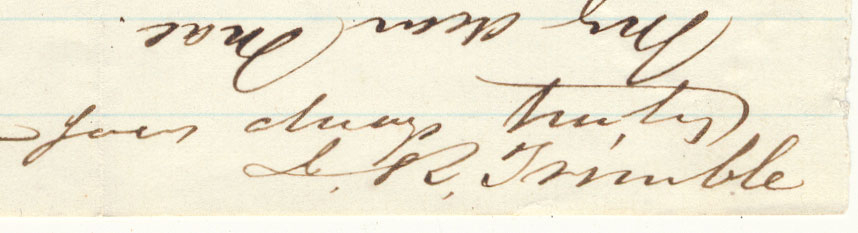
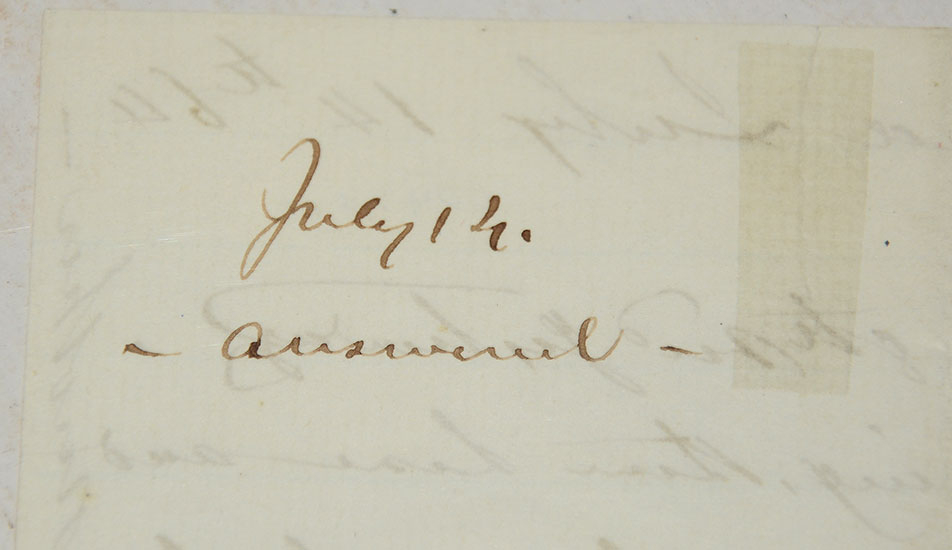
This one page letter is a fine war dated missive, in ink on 7 ¾” x 9 ¼” lined paper. Dated “Johnson’s Island, July 14th 1864”; Johnson’s Island was a large prison where Confederate officers were held, near Sandusky, OH. The letter is directed to Captain McHenry Howard, who was being held prisoner at Fort Delaware. Prisoners were only allowed to send letters that were one page in length.
The letter and cover are housed in a large Riker display box, along with modern color copies of artwork featuring a group of CS officers with Trimble pointed out; Johnson’s Island; and the cover of a book about Trimble. Affixed to the back of the bottom of the box is a typewritten transcription of the letter; a brief bio of Trimble from civilwardata.com; and a copy of a brief article about McHenry Howard.
Text of the letter is as follows:
“My dear Mac, I have yours of July 8th received yesterday. Letters do go slow, a day or so is lost examining them here, and a day also with you, but I often write letters ahead that do not go for some days & this may account for delay. I am flattered that you evince a desire to remain on my staff, but shall feel sorry if it turns out that you made any sacrifices to do so, for which you may not hereafter be fully compensated by military rank. Certainly you were right to draw pay as one of my staff, for you were the only aid I had or have since McKim & Hoffman died. So set your mind at rest as far as this matter goes. I prefer you to any other, and would rather have you. Archer, Steuart & Johnson have gone on a “jolly” trip and may see some sport more pleasant to be shot by a big gun than a musket in prison.” [Generals James Archer, George Steuart & Edward Johnson had been taken from prison and sent down to Charleston, SC where they were placed as “human shields” so that the Union would not shell the city. These men were called the ”Immortal 600”.]
“I am sorry that the change of your quarters has interrupted your very judicious plans for further study. Many officers here have become good French & German scholars & others are reviewing Latin, history, etc. It is a mistake & a wrong to lose the time in prison in vain regrets & idleness. The sense of making ourselves more useful is the only true antidote to the ills of confinement. I read, study, & work a great deal, and the time seems to pass swiftly.” [Interestingly, on Johnson’s Island the prisoners were allowed to go fishing and have gardens.] “I shall raise at least two dozen radishes, as many head of lettuce & a bushel of tomatoes, if the frost don’t kill them. I seldom hear from Alice & Molly now. I suppose they are busy with you & others. Write to me often & give me a page at a time any incidents of Genl. Winder’s life which I m preparing for his wife & mother.” [Trimble had been on Winder’s staff when he led the Stonewall Brigade.] “Yours always truly, I.R. Trimble”.
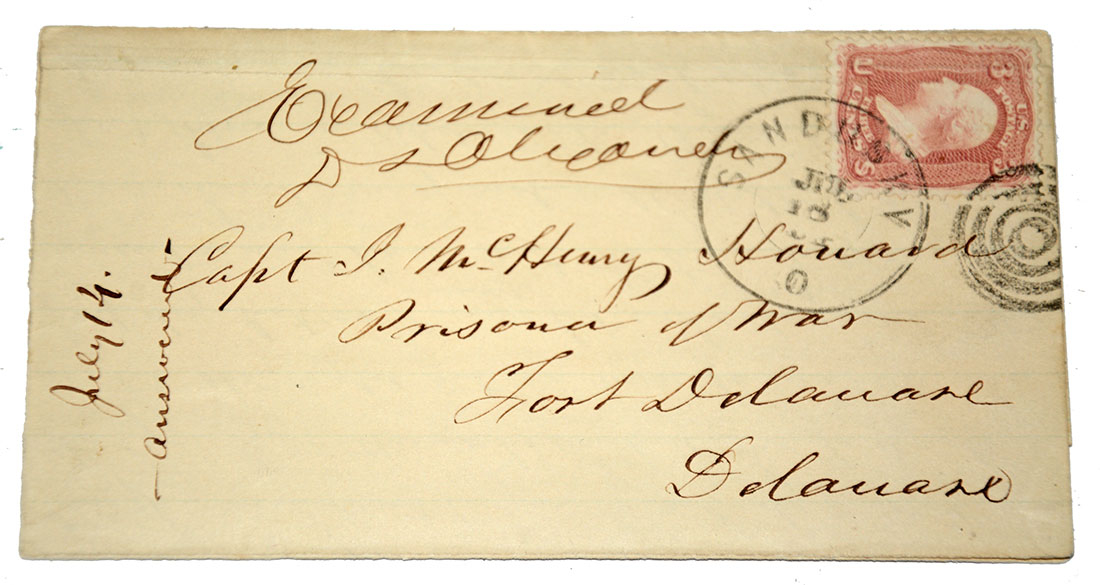
The cover which accompanies the letter is homemade, fashioned by Trimble from a letter that he had received from M.R. Hunter. There is a fine 3 cent Washington stamp and a “SANDUSKY, O. JUL. 18, 64” postmark. Written at the top in dark ink is, “Examined D.S. Alexander.” Alexander was a member of the 128th Ohio Volunteer Infantry stationed at Johnson’s Island. It is addressed to: “Capt. McHenry Howard / Prisoner of War / Fort Delaware / Delaware”.
Isaac Ridgway Trimble (May 15, 1802 – January 2, 1888) fought with distinction under Stonewall Jackson. At Gettysburg, Trimble assumed command of Gen. William Pender’s division when the latter was wounded. On July 3, 1863, Trimble was one of the three division commanders in Pickett's Charge. He stepped in to replace Maj. Gen. W. Dorsey Pender, of Lt. Gen. A. P. Hill's corps, who had been mortally wounded the previous day. Trimble was at a great disadvantage because he had never worked with these troops before. His division participated in the left section of the assault, advancing just behind the division led by Brig. Gen. J. Johnston Pettigrew (formerly by Maj. Gen. Henry Heth). Trimble rode his horse, Jinny, and was wounded in the left leg, the same leg hit at Second Bull Run. Despite feeling faint, the 61-year-old general was able to walk back to the Confederate line on Seminary ridge. His leg was amputated by Dr. Hunter McGuire, and Trimble could not be taken along with the retreating Confederates, because of fear of infection that would result from a long ambulance ride back to Virginia, so he was left under the care of a family in Gettysburg on July 6 as the army withdrew. Trimble complained bitterly that if his leg had been amputated at Second Bull Run, the bullet would have missed him on this occasion. He was treated in the Seminary Hospital at Gettysburg until August. Of the charge on the third day of Gettysburg, Trimble said: "If the men I had the honor to command that day could not take that position, all hell couldn't take it." Gettysburg marked the end of Trimble's active military career. He spent the next year and a half in Federal hands at Johnson's Island and Fort Warren. He was recommended for parole soon after capture, but former U.S. Secretary of War Simon Cameron recommended against it, citing Trimble's expert knowledge of northern railroads. In March 1865, Lt. Gen. Ulysses S. Grant ordered Trimble to be sent to City Point, Virginia, for exchange, but by the time he reached there, Robert E. Lee's army was already retreating in the Appomattox Campaign. Trimble was finally paroled in Lynchburg, Virginia, on April 16, 1865, just after Lee's surrender.
McHenry Howard was born on December 26, 1838 to Charles Howard and Elizabeth Phoebe Key Howard, the daughter of Francis Scott Key. A Marylander, he joined the 1st Maryland Regiment of the Confederate Army during the American Civil War. His brothers, Frank Key Howard, John Eager Howard, Charles Howard, James Howard, and Edward Lloyd Howard also served in the Confederacy. During his service, McHenry Howard was appointed as a 1st Sergeant, an Aid-de-Camp, and later as an Ordinance Officer in the staff under General George Steuart. He reportedly saw combat under the esteemed General Robert E. Lee, and the famous General “Stonewall” Jackson. In 1864, McHenry Howard was imprisoned at Fort Delaware, though he was released towards the end of the war. He later wrote of his accounts during the war, most notably in his 1914 Recollections of a Maryland Confederate Soldier and Staff Office. [LD][ph:L]
~~~~~~~~~~~~~~~~~~~~~~~~~~~~~~~~~~~
THIS ITEM, AS WITH ALL OTHER ITEMS AVAILABLE ON OUR WEB SITE,
MAY BE PURCHASED THROUGH OUR LAYAWAY PROGRAM.
CLICK HERE FOR OUR POLICIES AND TERMS.
THANK YOU!
Inquire About JULY 1864 ALS – CS GENERAL ISAAC R. TRIMBLE (WOUNDED AT GETTYSBURG) TO CAPT. MCHENRY HOWARD – BOTH OF WHOM WERE BEING HELD AS PRISONERS OF WAR
Most Popular
Historical Firearms Stolen From The National Civil War Museum In Harrisburg, Pa »
Theft From Gravesite Of Gen. John Reynolds »
Selection Of Unframed Prints By Don Troiani »
Fine Condition Brass Infantry Bugle Insignia »
Rare Identified 65Th Ny Sergeant’s Jacket, With Manscript Material: 1St U.s. Chasseurs »
featured item
SLOUCH HAT OF ARTILLERY OFFICER A.N. PARSON'S VI (6th) CORPS ARMY OF THE POTOMAC
This slouch hat has "IT", that is the look and feel of a hat worn in combat. The owner Lieutenant to Captain Augustine N. Parsons saw plenty of that in the 1st New Jersey Light Artillery, Battery A. NEW JERSEY 1ST LIGHT ARTILLERY (Three Years): This… (1268-546). Learn More »
site search