

site search
online catalog
ENSIGN HAZELTINE'S REGULATION COCKED HAT - HE DROWNED AT THE SINKING OF THE HOUSATONIC CAUSED BY THE SUBMARINE CSS HUNLEY
Hover to zoom
$9,500.00
Quantity Available: 1
Item Code: 1313-01
Shipping: Determined by Method & Location of buyer
To Order:
Call 717-334-0347,
Fax 717-334-5016, or E-mail
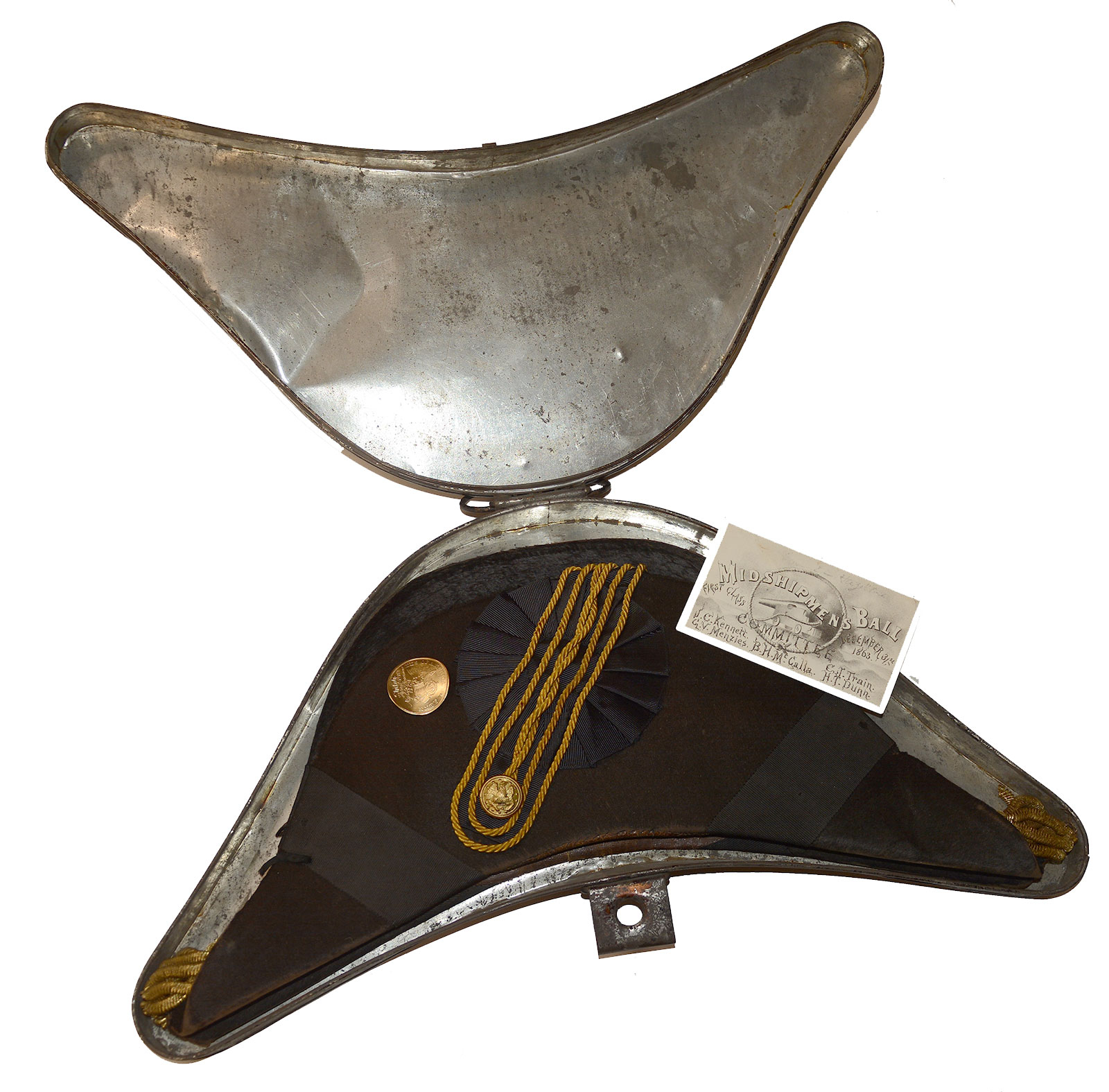
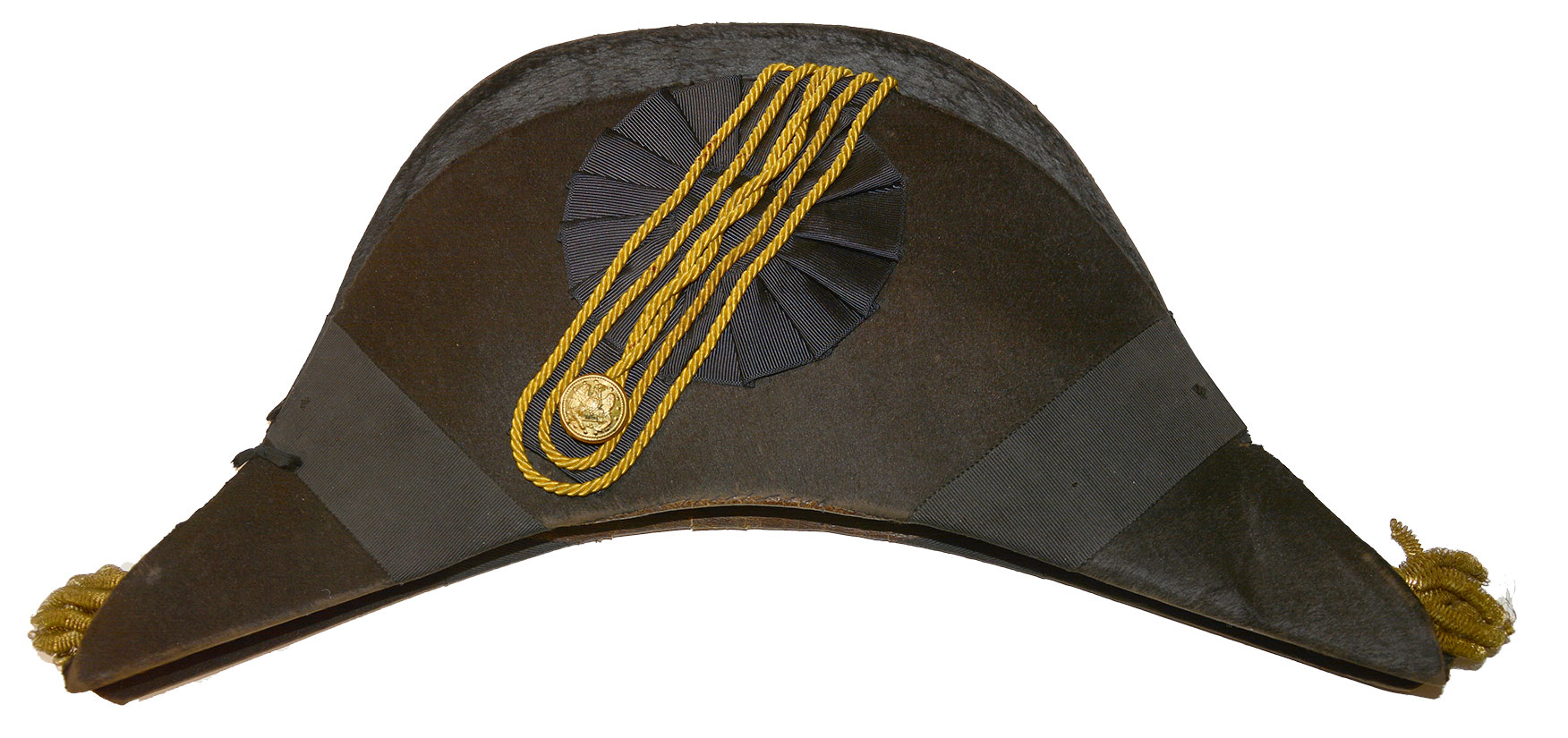
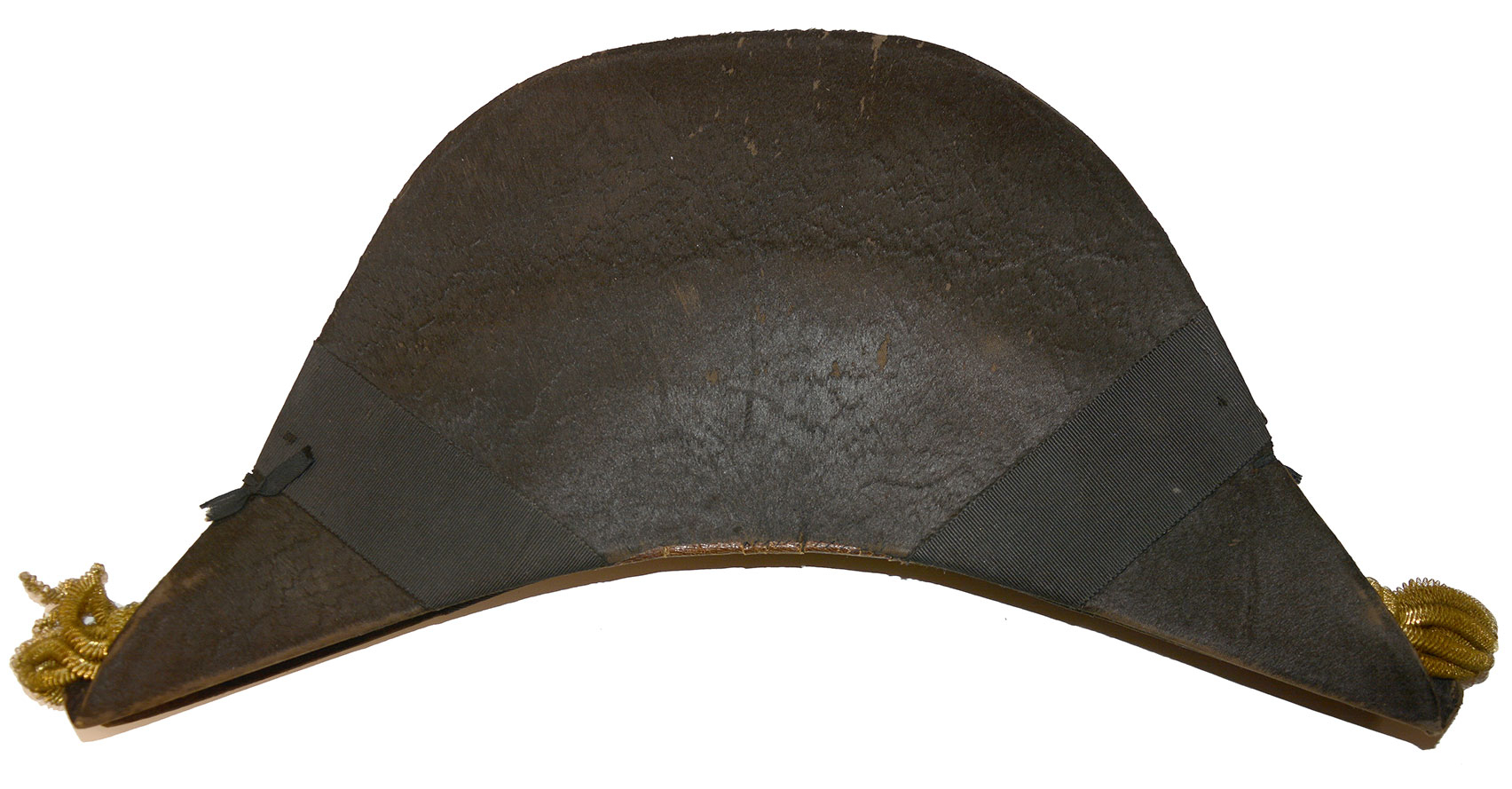
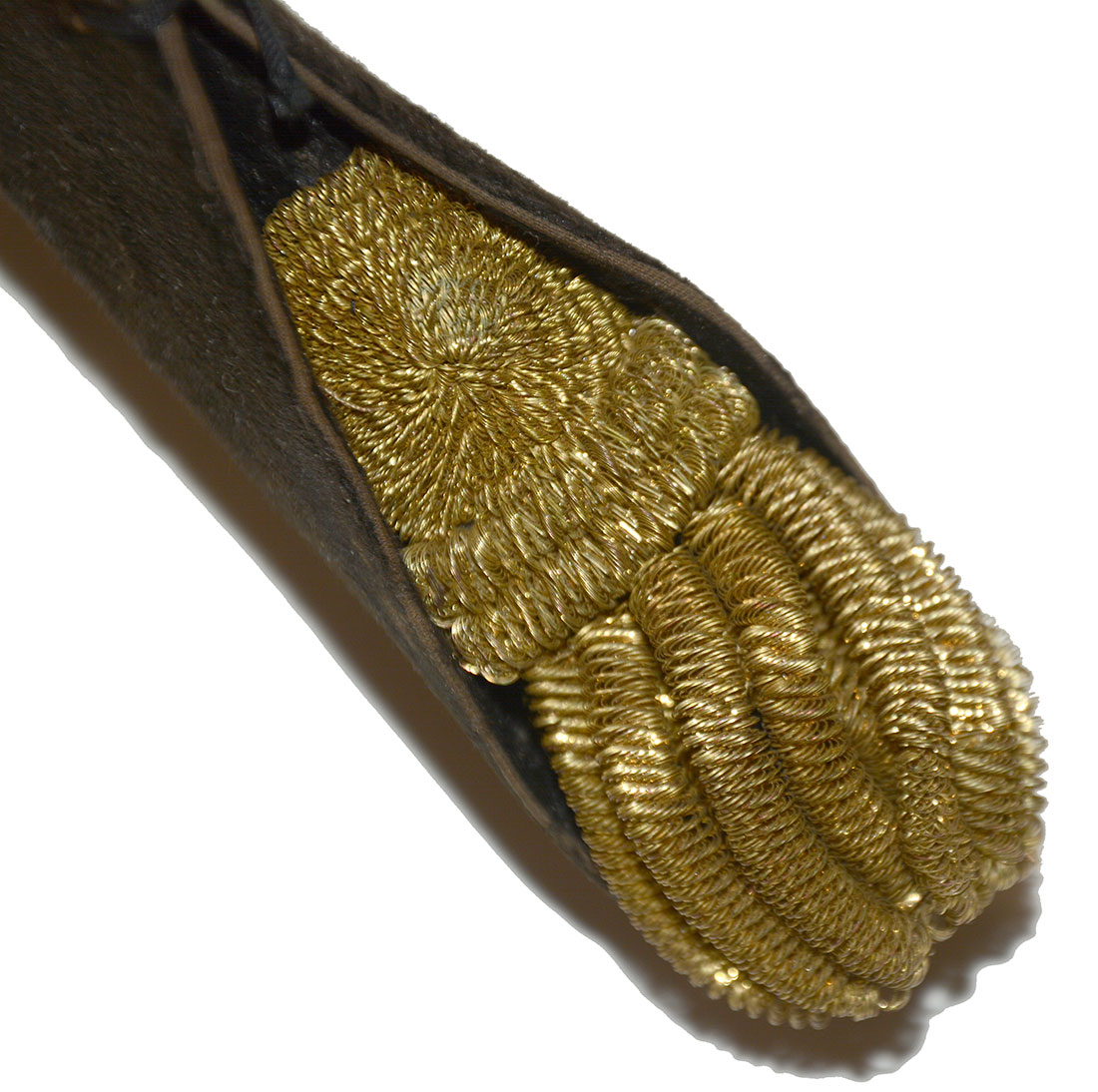
Offered is a regulation US Navy chapeau de bras (under the arm hat) also called a cocked hat. The cocked hat was worn for full-dress occasions both on land and at sea. It would have been worn on shipboard for Church Parade on Sundays, change of command ceremonies, visits to or from foreign ships, formal meals in the officer's mess, and for special occasions like government sanctioned holidays. This example was owned by Annapolis Naval Academy graduate Edward C. Hazeltine (or Haseltine). A Passed Midshipman come Ensign (Ensigns did not join the US Navy until 1862 to fill the need for a rank for graduates of the Naval Academy who had been called Passed Midshipmen). Sadly, soon after graduation he was dead; a victim of the submarine CSS Hunley.
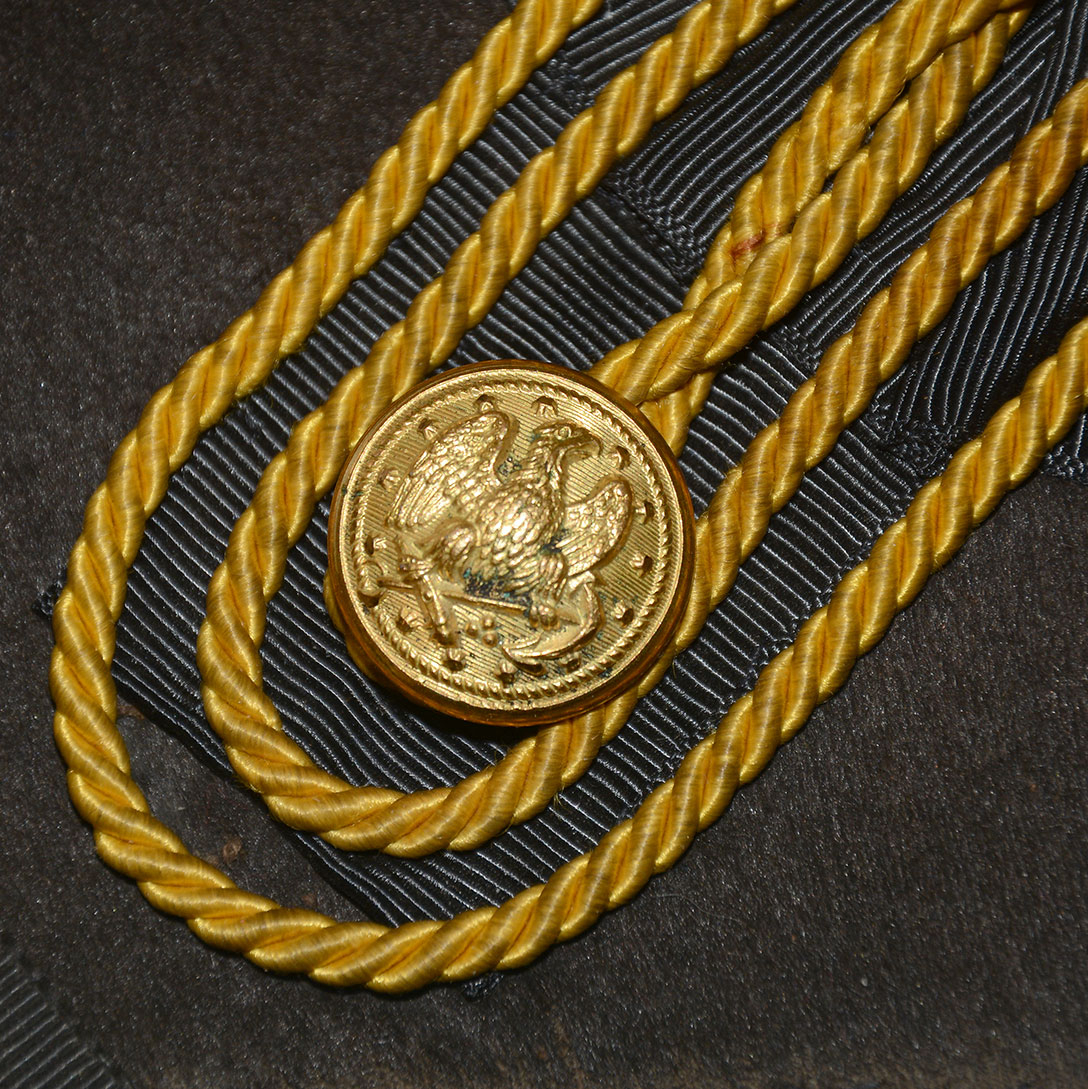
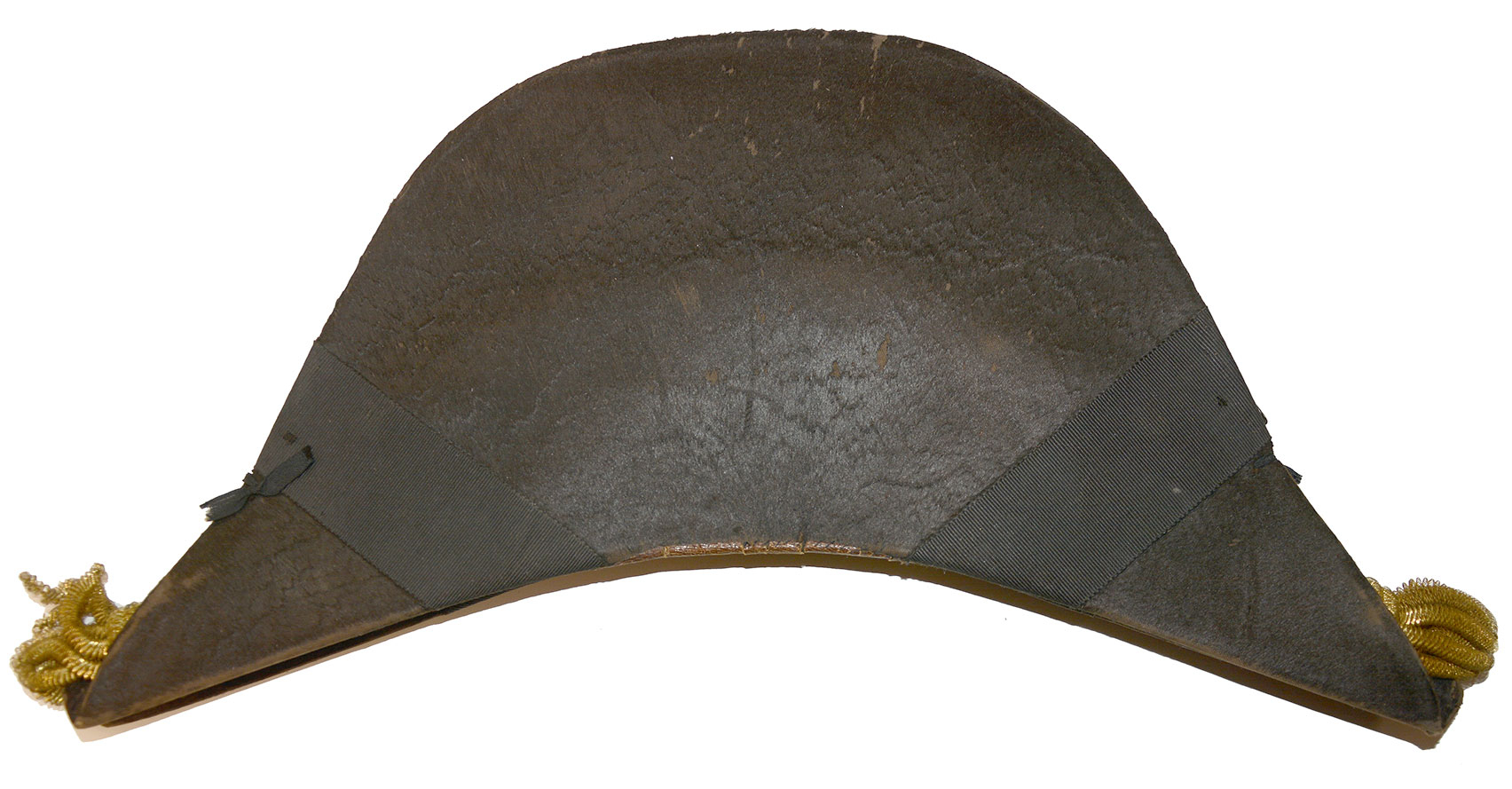
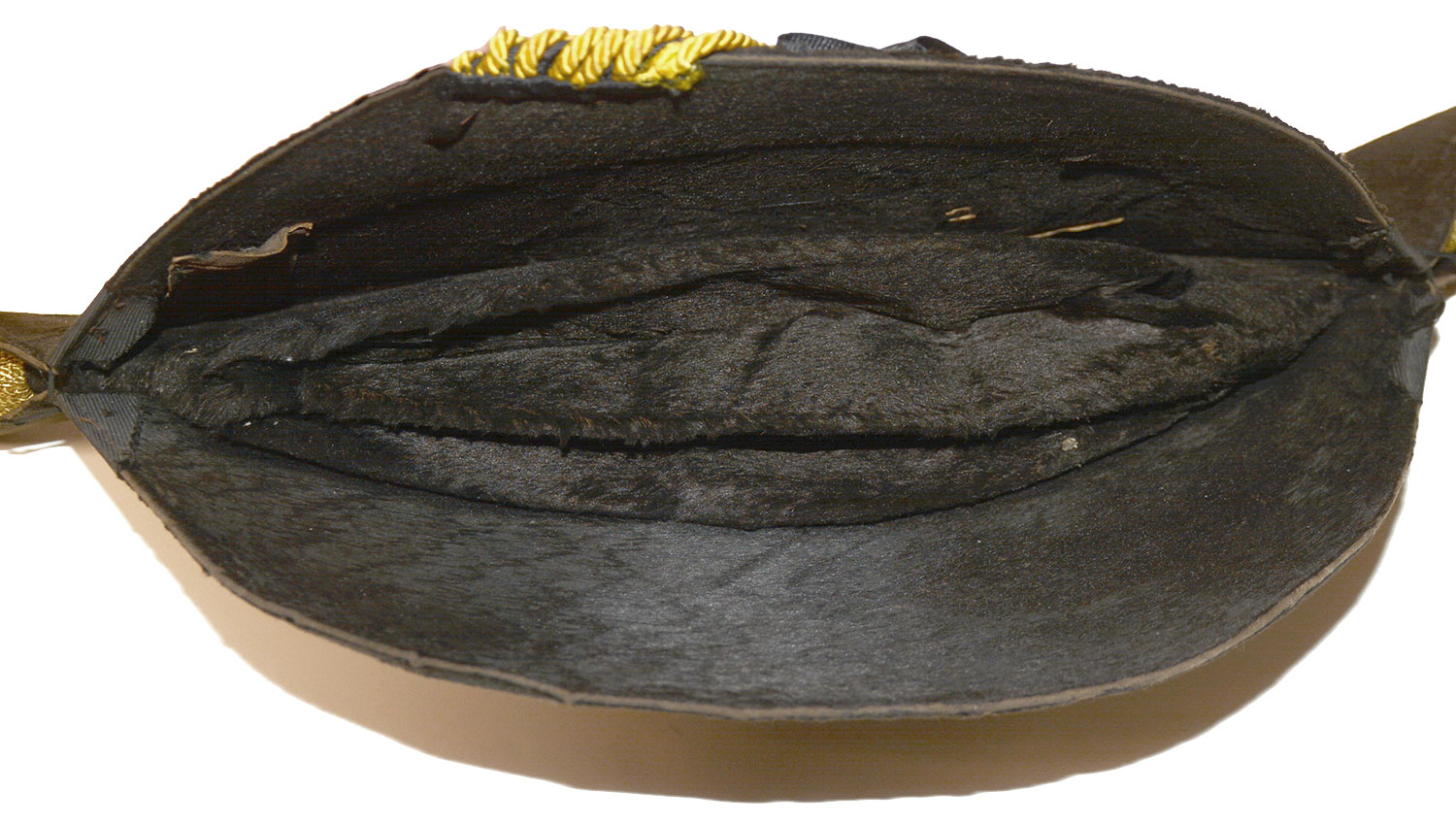
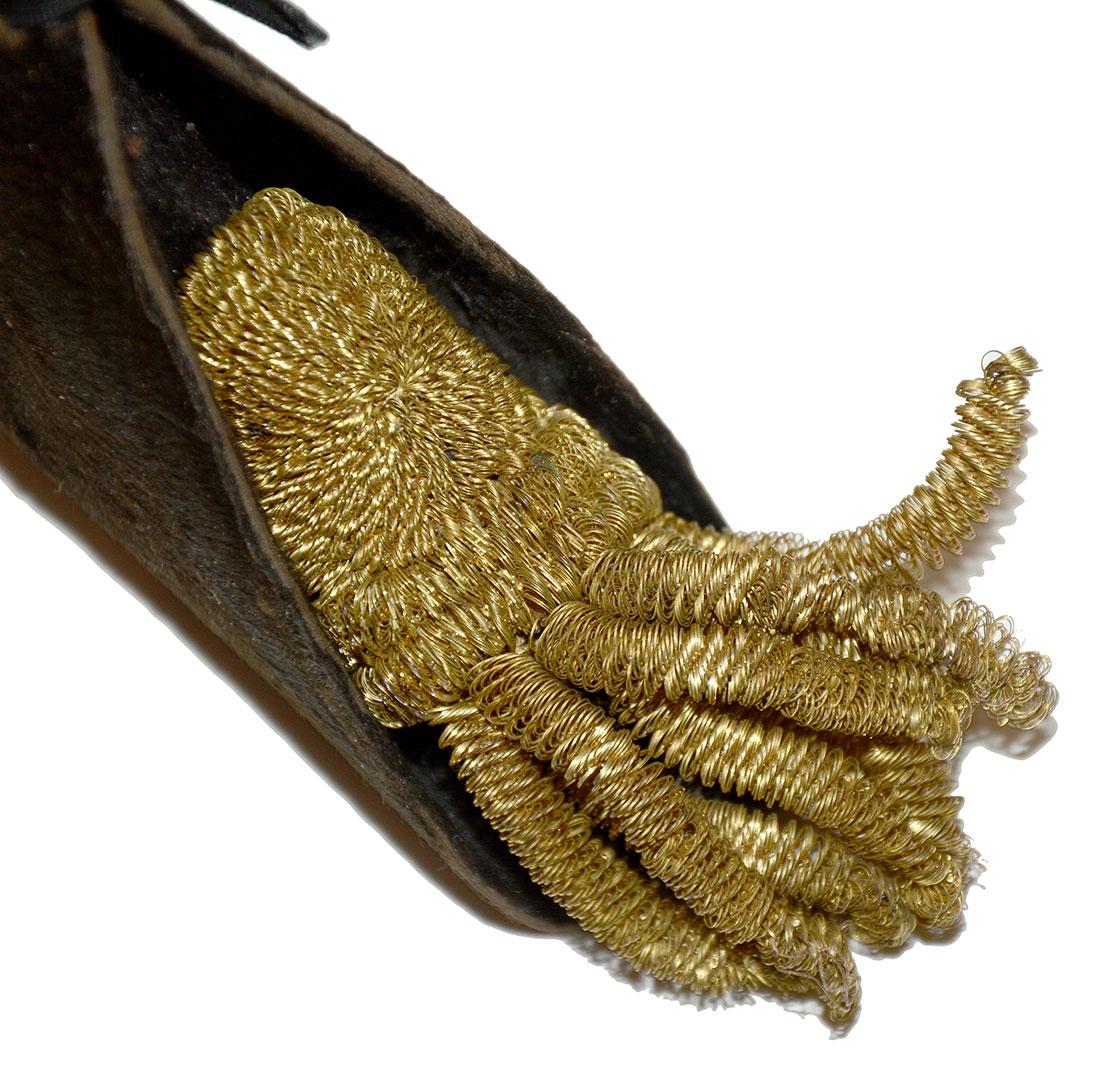
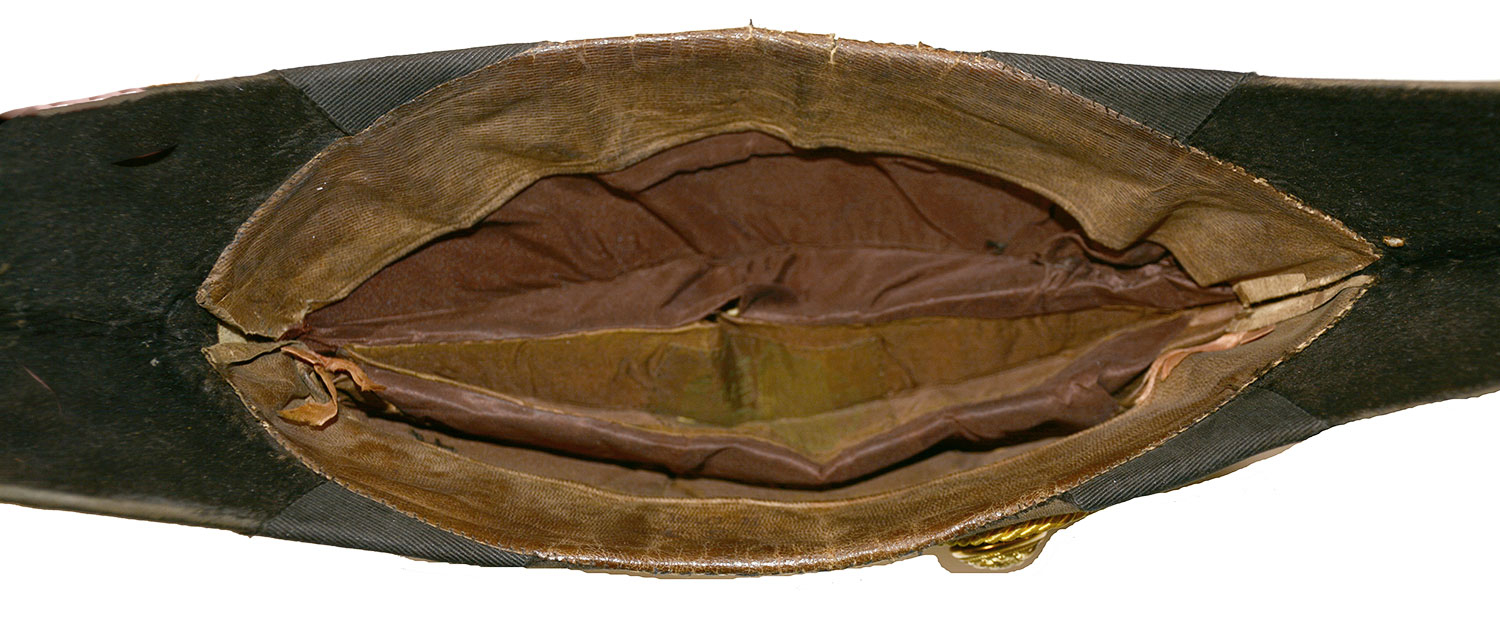
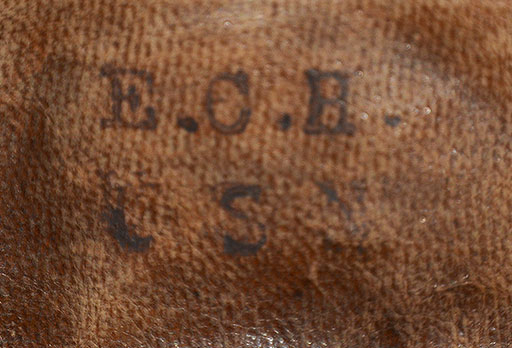
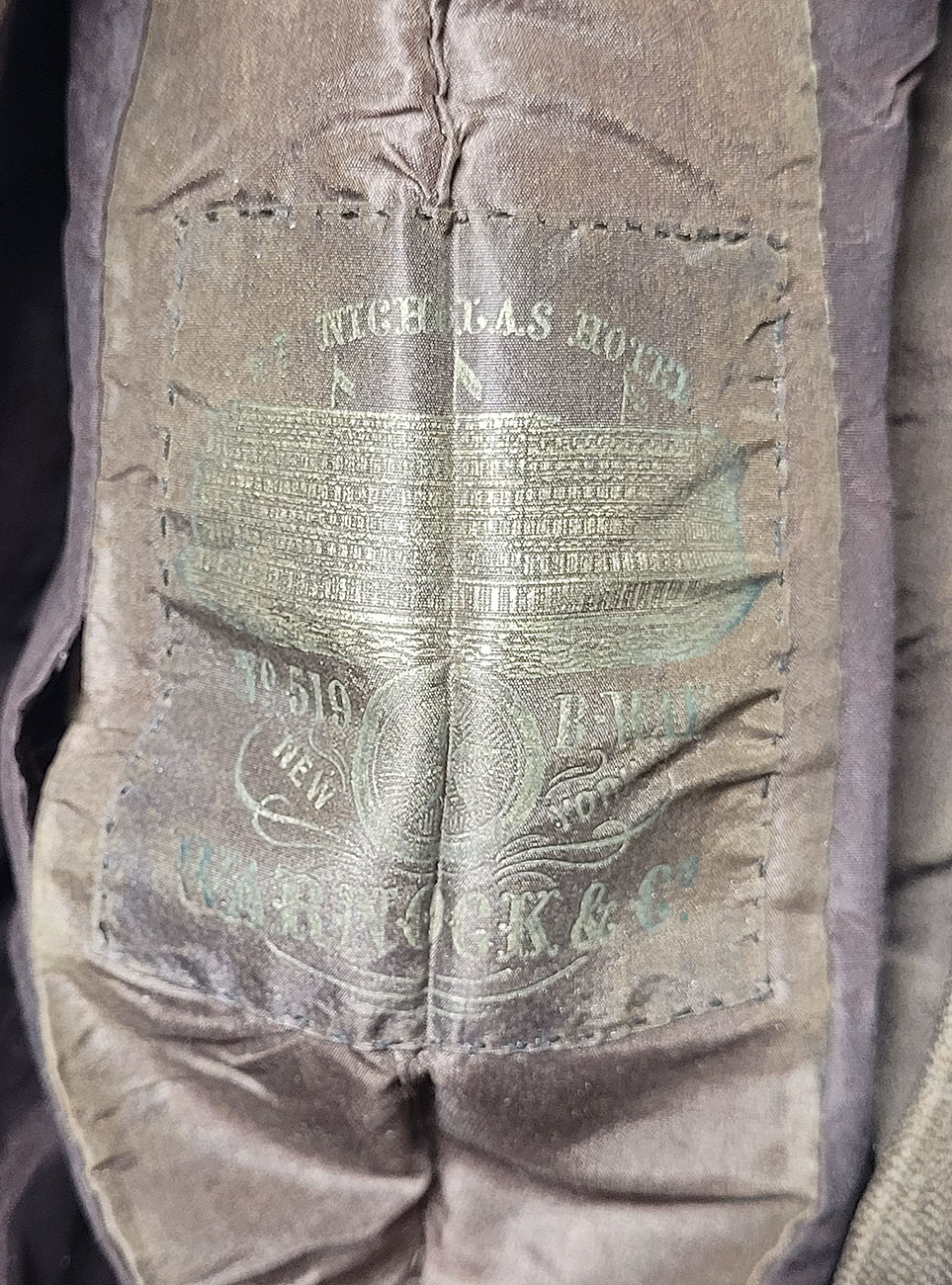
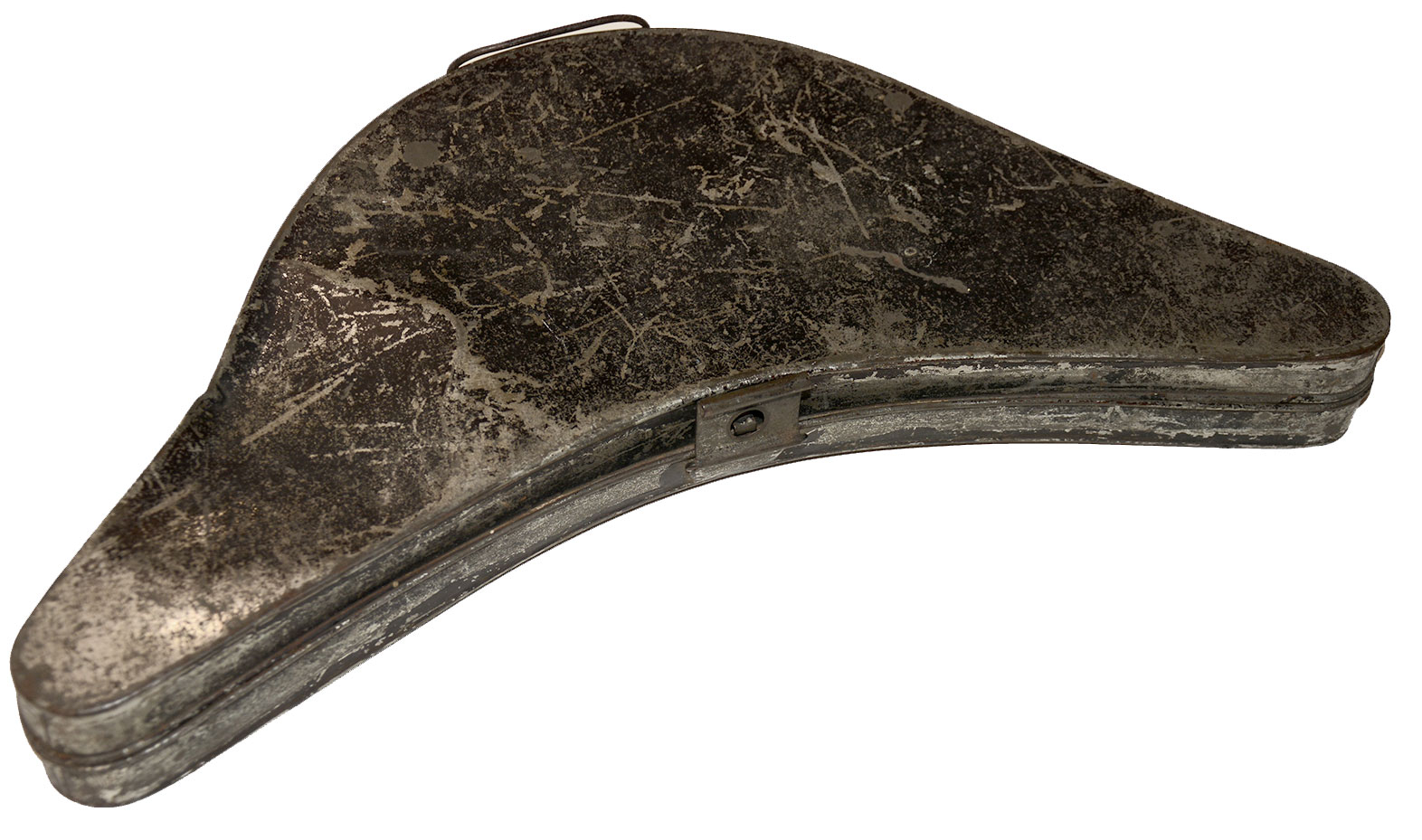
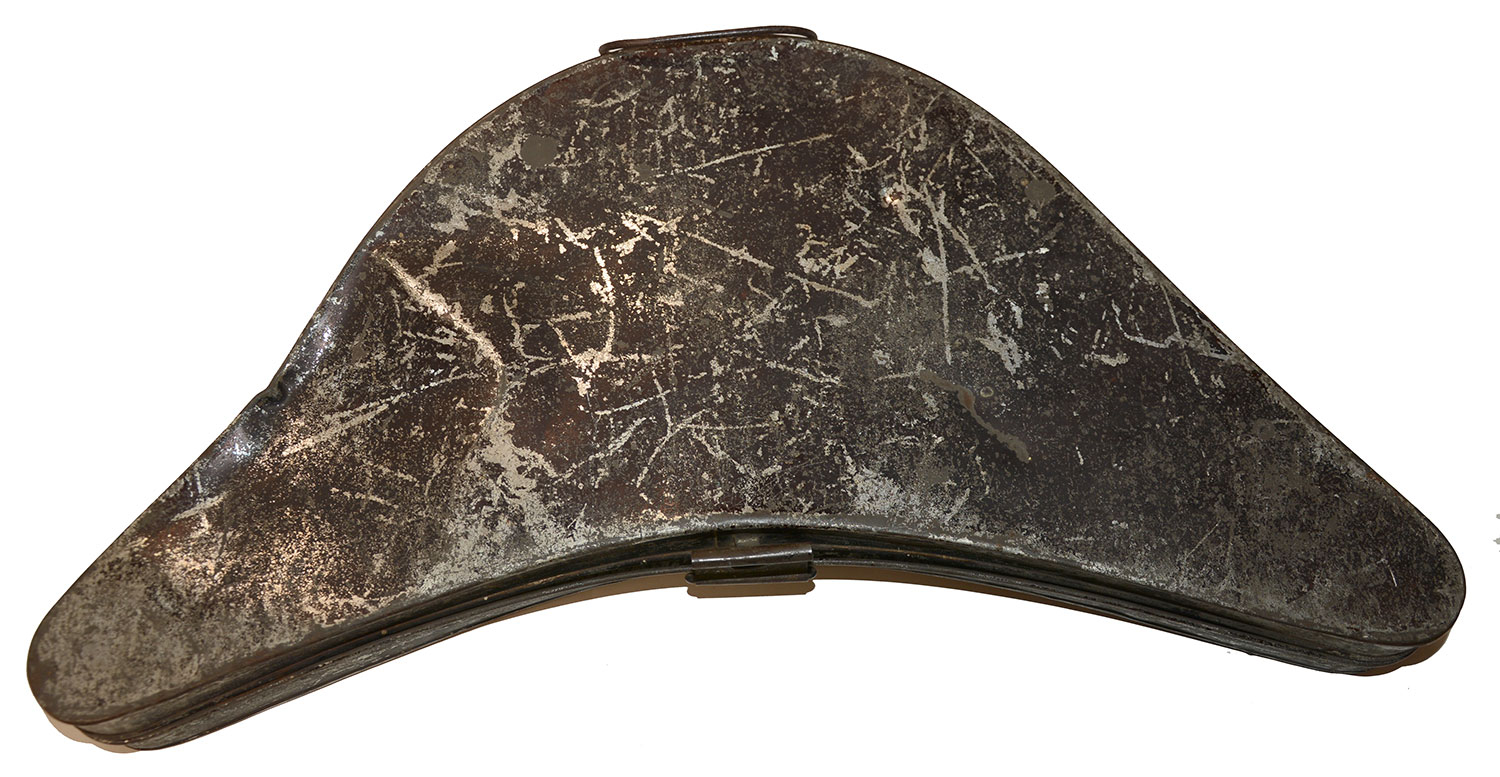
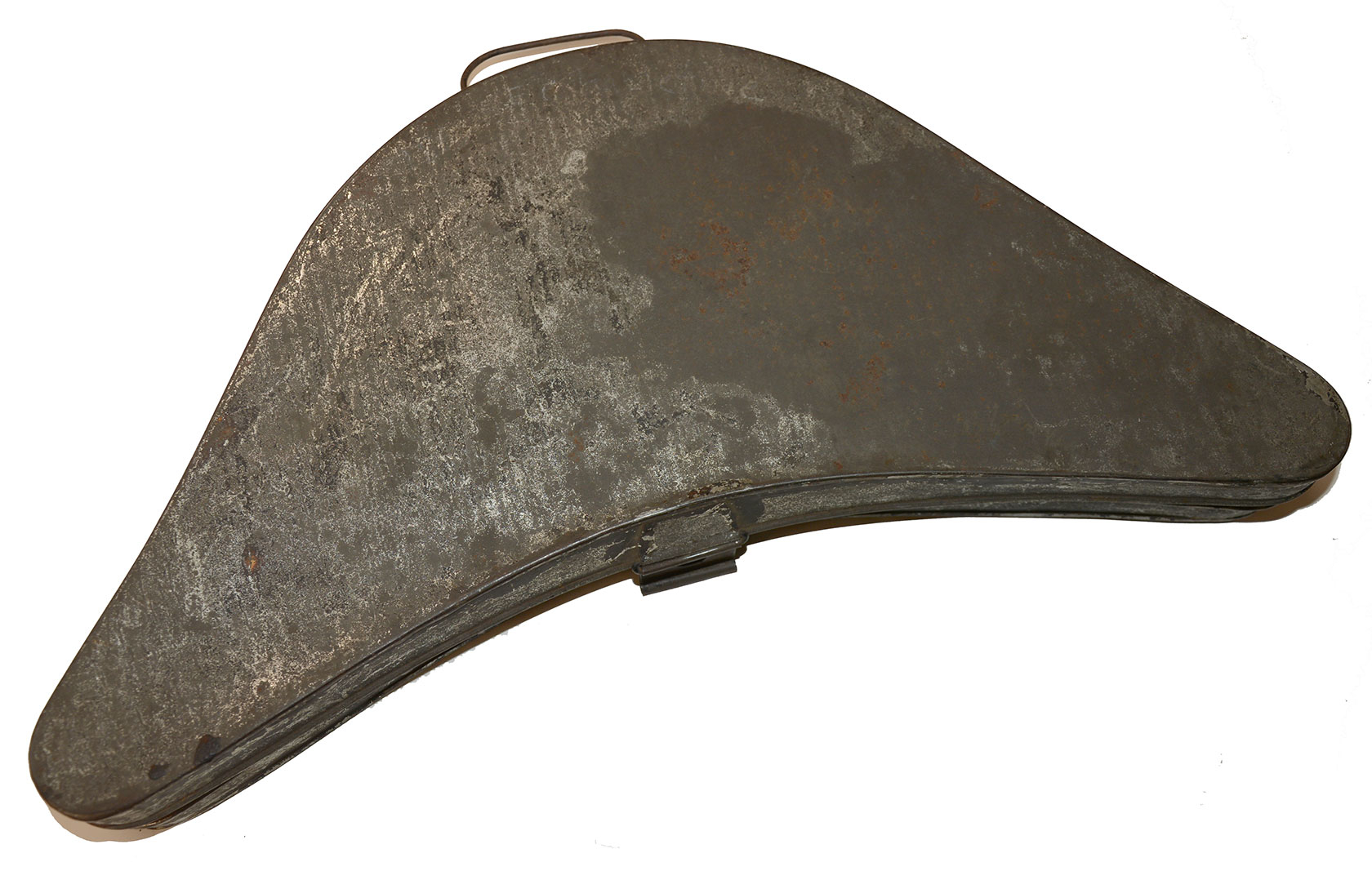
The rarely seen chapeau conforms perfectly to the US Naval Regulations of 1852. Not quite as high at 7 inches in the rear and 6 1/2 inches in front this fine beaver cocked hat has the look of those worn as far back as the War of 1812. Measuring 17 inches end to end the hat size is about7 1/4. There is a large black silk blend cockade that has a diameter of 4 3/4 inches. Two 2-inch-wide bands of this same black braid are found at either end of the base of the "tombstone-like" front of the hat. This wide braid is found on the back also. Two silk ties keep the hat pleasingly formed when worn. At each end of the cap is a 3 1/4-inch gold metallic tassel. From the crown of the cap 6 strands of twisted yellow cord descend 7 inches with the center cord intwined with another and encircling a gilt regulation US Naval officer's button made by Evans and dating late 1850s to 1864 in this case. The 2-inch-high leather sweat band is 100% intact and supple. Stenciled or perhaps very neatly inscribed is: "E.C.H." over "USN". The purple silk lining is 100% intact and is embossed in gold letters: "AT NICHOLAS HOTEL" over " No 519 B. WAY NEW YORK" over "WARNOCK & Co." (The hotel is there and also a medallion). The condition of this chapeau is excellent but shows plenty of "period" use with most of the beaver nap worn off in the exposed areas, while the internal unexposed portions retain the greater percentage of this nap as made. The rear bullion tassel is a little disheveled, but the front one is perfect. The Navy button has about 90% of its gilt intact. With the cocked hat comes its original tin carrying or storage case. It shows age and wear and several dents. But considering it may have been the victim of a torpedo explosion, the condition is very good.
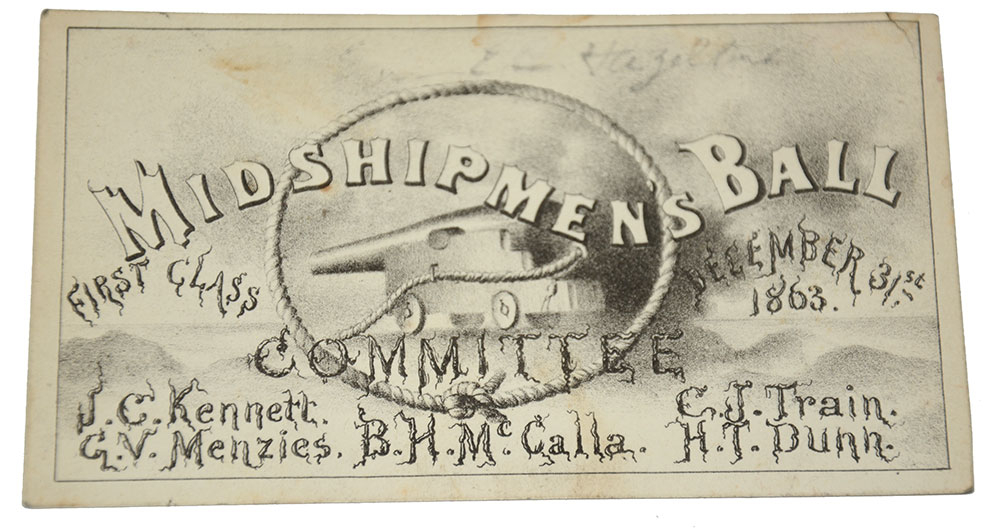
Hazeltine graduated Annapolis Naval Academy officially in 1863 and with the chapeau comes a finely engraved/printed card which may be in fact an invitation. It is for the "DECEMBER 31st, 1863, MIDSHIPMEN'S BALL" It also shows a large naval gun a rope with a sailor's knot, fortifications the words "FIRST CLASS" and "COMMITTEE" and the names of the organizers: "J.C. Kennett, G.V. Menzies, B.H. McCalla, C.T. Train. H.T. Dunn". All these "Commitee" (sic) members graduated with Hazeltine or soon after. In faded pencil on the card is written "Ensign E.C. Hazeltine". There is little doubt he wore this chapeau at this party. Less than 2 months after this happy event Hazeltine was dead! Please see this link (Edward C. Haseltine (1842-1864) - Find a Grave Memorial).
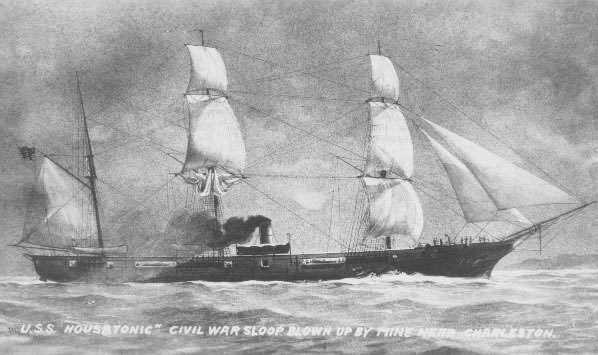
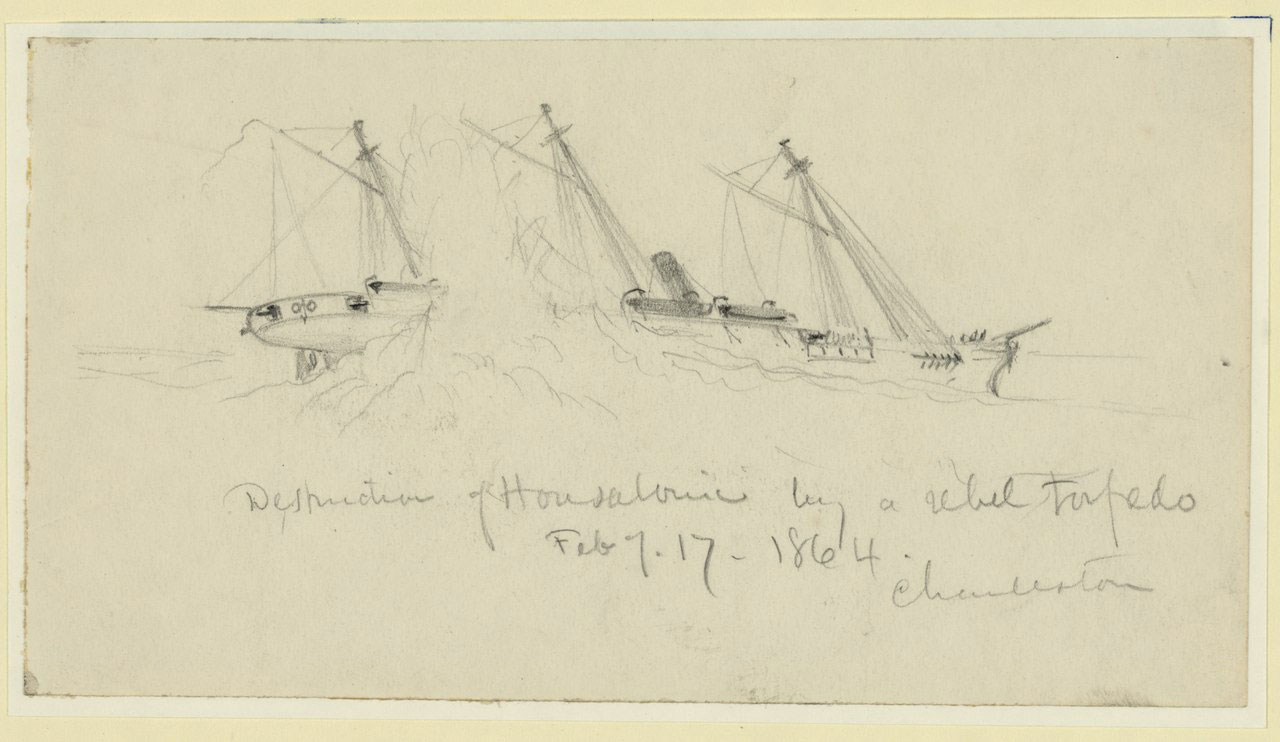
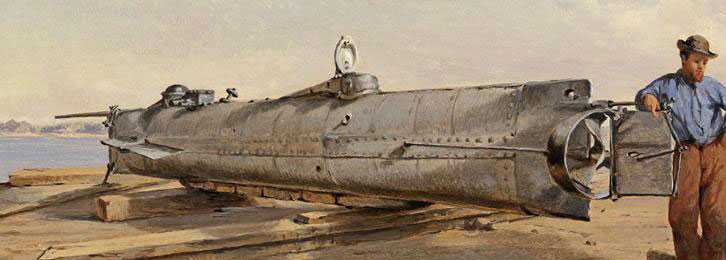
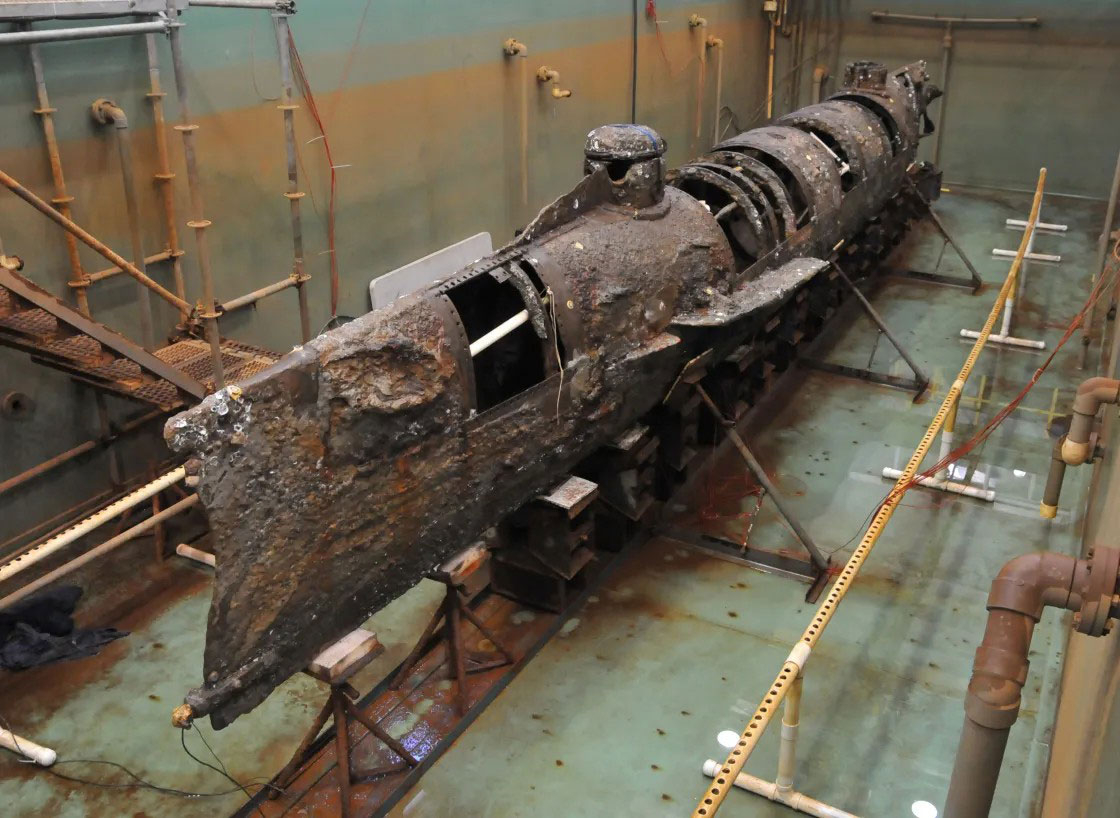
E.C. Hazeltine died as a direct result of an attack on his ship the USS Housatonic (Housatonic I (ScSlp)) by the Confederate submarine Hunley. The HL Hunley, simply known as Hunley, received her name from the financial backer of the project. The Hunley measured in at forty feet long, the hull only four feet three inches high, and could hold a crew of up to eight people: seven to work the hand-cranked screw propeller and the eighth to pilot. It had ballast tanks, hand pumps, two watertight hatches, and two conning towers. In July 1863, Hunley was ready for a demonstration in Mobile Bay, which went well. The submarine was shipped by rail to Charleston, South Carolina, where it arrived on August 12th. From here on, the submarine operated in the Confederate military going by the name CSS Hunley, though it was never officially commissioned into service. Horace Hunley continued with testing and operation. The submarine sank a total of three times. The first was on August 29th, when the submarine and its crew were about to make a dive in the harbor when an accident occurred that caused her to sink, killing five out of the eight crew. The boat was raised and put back into service. The second time was a few months later, on October 15th. The Hunley went under during a mock attack and never resurfaced. All hands were lost, including Horace Hunley himself. The boat would be raised once more. Now beginning her third cruise, the Hunley received its armaments. Initially, it was planned to have a torpedo (in the 19th century “torpedo” was another word for floating mine). The floating explosive charge was to be towed behind the submarine. As it approached an enemy ship, Hunley would dive under the ship and resurface on the other side, thus putting the ship in between the explosive and the submarine. This was declared too dangerous, so a spar torpedo was attached instead. A spar torpedo is a copper cylinder containing gunpowder, which was attached to the submarine's bow by a twenty-two-foot pole. The torpedo would be rammed into a ship and detonated one of two ways: mechanically as the submarine pulled away or on impact electronically. On the night of February 17, 1864, the HL Hunley made history as the first submarine to sink an enemy vessel. The USS Housatonic was a wooden-hulled, steam-powered sloop-of-war that carried twelve large cannons. She was stationed offshore in Charleston Harbor as part of the Union blockade. Lieutenant George E. Dixon was in command of Hunley, and the crew of eight successfully attacked Housatonic. Ramming the ship with the spar torpedo, it exploded and sank in five minutes. After the attack, Hunley did not return to base she and all her crew were drowned as collateral damage from the explosion of the Housatonic (Information thanks to the American Battlefield Trust). Here are three US Navy after action reports that describe and explain the Housatonic sinking. In all three Ensign E. C. Hazeltine death is mentioned:
U. S. S. CANANDAIGUA,
Off Charleston, S. C., February 18, 1864.
SIR: I have respectfully to report that a boat belonging to the Housatonic reached this ship last night at about 9:20, giving me information that that vessel had been sunk at 8:45 p. m., by a rebel torpedo craft. I immediately slipped our cable and started for her anchorage, and on arriving near it, at 9:35, discovered her sunk with her hammock nettings under water; dispatched all boats and rescued from the wreck 21 officers and 129 men. There are missing, and supposed to be drowned, the following-named officers and men:
Ensign EDWARD C. HAZELTINE, Captain's Clerk Charles O. Muzzey, Quartermaster John Williams, Second-Class Fireman John Walsh, Landsman Theodore Parker. Captain Pickering is very much, but not dangerously, bruised, and one man is slightly bruised.
Very respectfully, your obedient servant,
J. F. GREEN,
Captain. (USS Canandaigua)
FROM THE U. S. S. CANANDAIGUA,
Off Charleston, S. C., February 18, 1864.
SIR: I have the honor to make the following report of the sinking of the U. S. S. Housatonic, by a rebel torpedo off Charleston, S. C., on the evening of the 17th instant. About 8:45 p. m. the officer of the deck, Acting Master J. K. Crosby, discovered something in the water about 100 yards from and moving toward the ship. It had the appearance of a plank moving in the water. It came directly toward the ship, the time from when it was first seen till it was close alongside being about two minutes... The torpedo struck the ship forward of the mizzenmast, on the starboard side, in a line with the magazine. Having the after-pivot gun pivoted to port we were unable to bring a gun to bear upon her. About one minute after she was close alongside the explosion took place, the ship sinking stern first and heeling to port as she sank. Most of the crew saved themselves by going into the rigging, while a boat was dispatched to the Canandaigua. This vessel came gallantly to our assistance and succeeded in rescuing all but the following-named officers and men, viz, ENSIGN E.C. HAZELTINE, Captain's Clerk C. O. Muzzey, Quartermaster John Williams, Landsman Theodore Parker, Second-Class Fireman John Walsh. The above officers and men are missing and are supposed to have been drowned. Captain Pickering was seriously bruised by the explosion and is at present unable to make a report of the disaster.
Very respectfully, your obedient servant,
F. J. HIGGINSON,
Lieutenant. (USS Housatonic)
FLAG-STEAMER PHILADELPHIA,
Port Royal Harbor, S. C., February 19, 1864.
SIR: I much regret to inform the Department that the U. S. S. Housatonic, on the blockade off Charleston, S. C., was torpedoed by a rebel "David" [H. L. Hunley] and sunk on the night of the 17th of February about 9 o'clock. From the time the "David" was seen until the vessel was on the bottom a very brief period must have elapsed; so far as the executive officer (Lieutenant Higginson) can judge, and he is the only officer of the Housatonic whom I have seen, it did not exceed five or seven minutes. The officer of the deck perceived a moving object on the water quite near and ordered the chain to be slipped; the captain and executive officer went on deck, saw the object, and each fired at it with a small arm. In an instant the ship was struck on the starboard side, between the main and mizzen masts; those on deck near were stunned, the vessel begun to sink, and went down almost immediately. Happily, the loss of life was small: ENSIGN E.C. HAZELTINE, Captain's Clerk C. O. Muzzey, and three of the crew, Quartermaster John Williams, Second- Class Fireman John Walsh, and Landsman Theodore Parker. Two boats of the Housatonic were lowered and received all they could hold; the Canandaigua, which knew nothing of the catastrophe, sent her boats immediately on hearing of it, and took off the crew, who had ascended into the rigging.... I have attached more importance to the use of torpedoes than others have done and believe them to constitute the most formidable of the difficulties in the way to Charleston. Their effect on the Ironsides, in October, and now on the Housatonic, sustains me in this idea.... I have the honor to be, very respectfully, your obedient servant,
JNO. A. DAHLGREN
Rear-Admiral, Comdg. South Atlantic Blockdg. Squadron.
Hon. GIDEON WELLES,
Secretary of the Navy, Washington, D. C.
For a Civil War collector of Naval memorabilia this regulation US Navy Model 1852 Chapeau matches any relic from the RMS Titanic with a back story equally as stunning! A treasure! [pe][ph:L]
~~~~~~~~~~~~~~~~~~~~~~~~~~~~~~~~~~~
THIS ITEM, AS WITH ALL OTHER ITEMS AVAILABLE ON OUR WEB SITE,
MAY BE PURCHASED THROUGH OUR LAYAWAY PROGRAM.
CLICK HERE FOR OUR POLICIES AND TERMS.
THANK YOU!
Inquire About ENSIGN HAZELTINE'S REGULATION COCKED HAT - HE DROWNED AT THE SINKING OF THE HOUSATONIC CAUSED BY THE SUBMARINE CSS HUNLEY
Most Popular
Historical Firearms Stolen From The National Civil War Museum In Harrisburg, Pa »
Theft From Gravesite Of Gen. John Reynolds »
Selection Of Unframed Prints By Don Troiani »
Fine Condition Brass Infantry Bugle Insignia »
featured item
WORLD CLASS IDENTIFIED WOUNDED IN ACTION CIVIL WAR NORTH CAROLINA SOLDIER’S JACKET WITH BULLET HOLE FROM HIS WOUND AT THE WILDERNESS!
Formerly in the collections of the Texas Civil War Museum this world-class Confederate infantryman’s jacket worn by William B. Royal came directly out of the family in 2002, having been previously examined and recorded in 2000 while still in the… (814-69). Learn More »
site search