
site search
online catalog
PRESENTATION AMES M1850 OFFICER’S SWORD OF LT. JOHN SYMMS (“SIMMS,”) 10th CONNECTICUT, MORTALLY WOUNDED AT THE BATTLE OF KINSTON, NC, DECEMBER 14, 1862
Hover to zoom

$4,500.00
Quantity Available: 1
Item Code: 2024-1799
Shipping: Determined by Method & Location of buyer
To Order:
Call 717-334-0347,
Fax 717-334-5016, or E-mail
"I can only say, that I shall endeavor to merit the good opinion of the donors of this sword, and by God's help it shall never be disgraced." So responded Lt. John Symms on October 5, 1862, when presented with this sword about ten weeks before being wounded in action, a wound that resulted in his death in early January 1863.
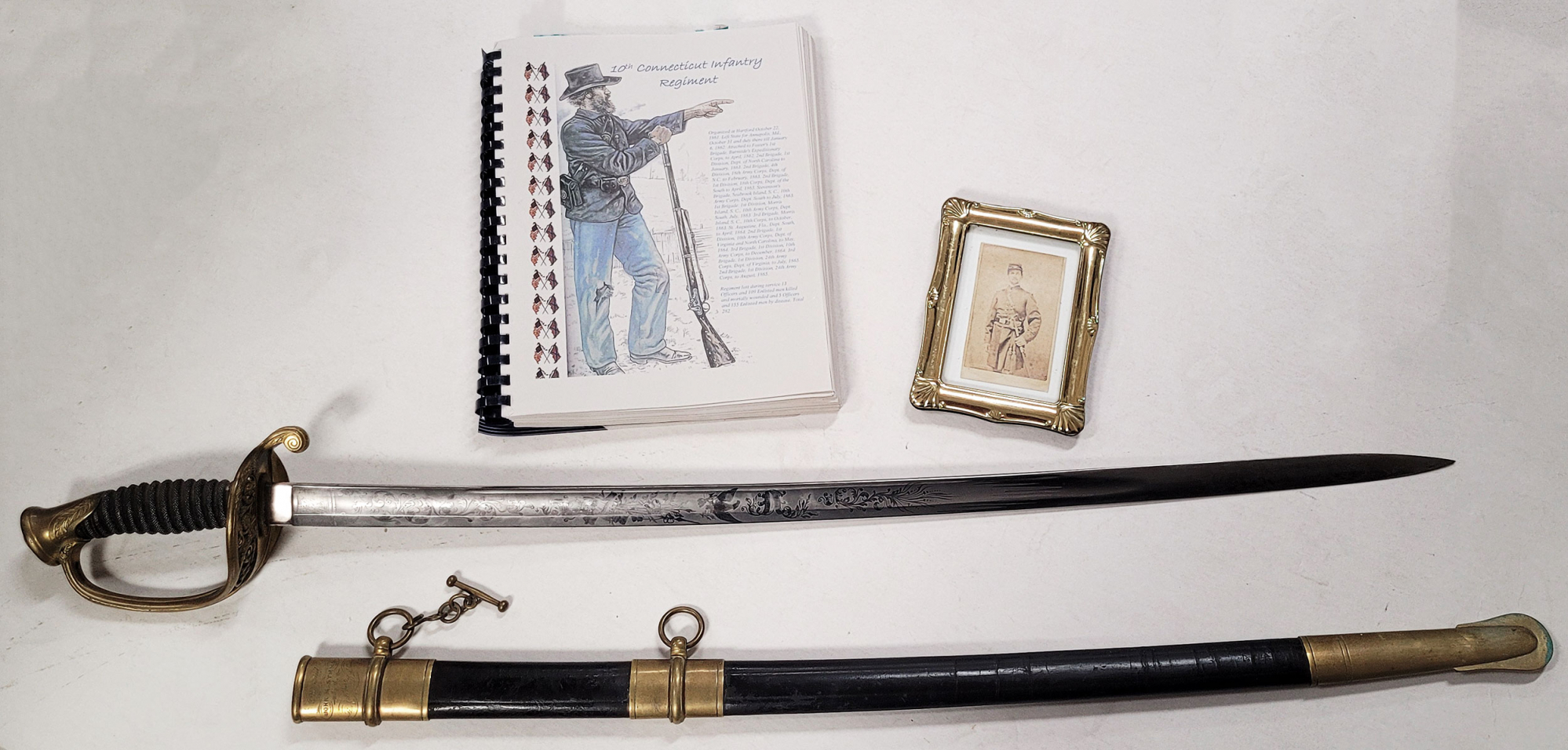
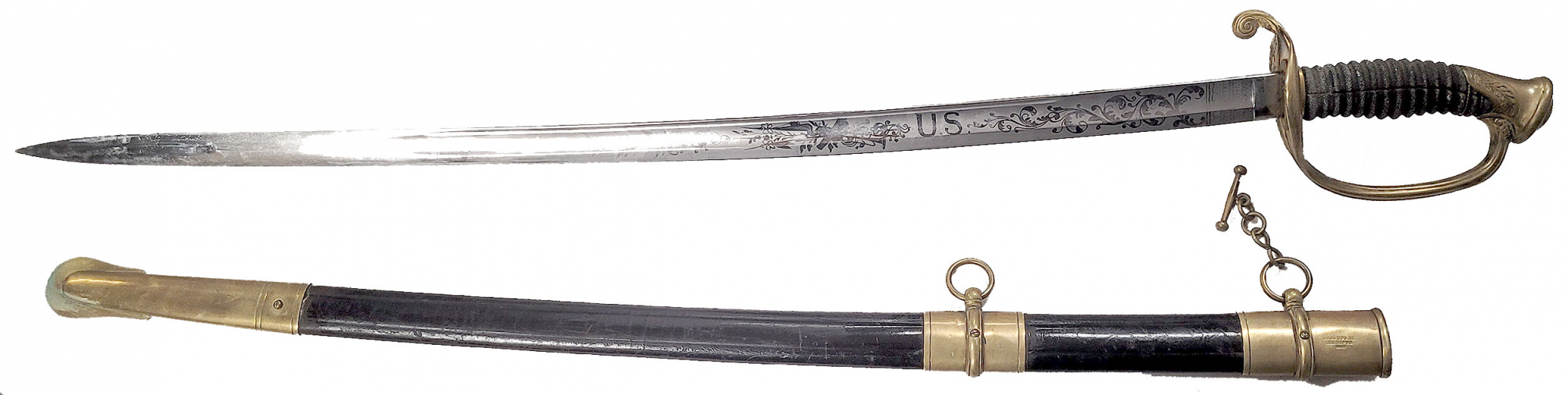
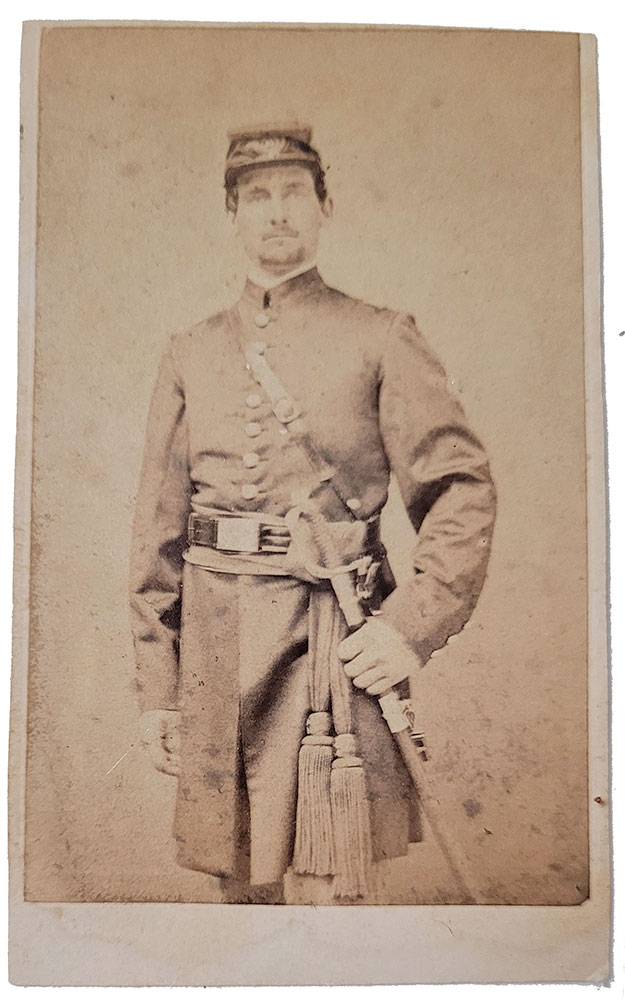
Symms’s Ames sword is in excellent condition, bears a great presentation inscription, and comes with an original CDV of him with the sword and copies of that one and another pose also with the sword, as well as an account of its presentation by the Sunday School where he taught. He served in two different regiments, seeing action first as a private in the 3rd Connecticut, a three-month regiment that fought at Bull Run, and then reenlisted, joining the 10th Connecticut, rising from Sergeant to Lieutenant, when he received this sword in early October 1862, and was mortally wounded at Battle of Kinston, NC, in December.
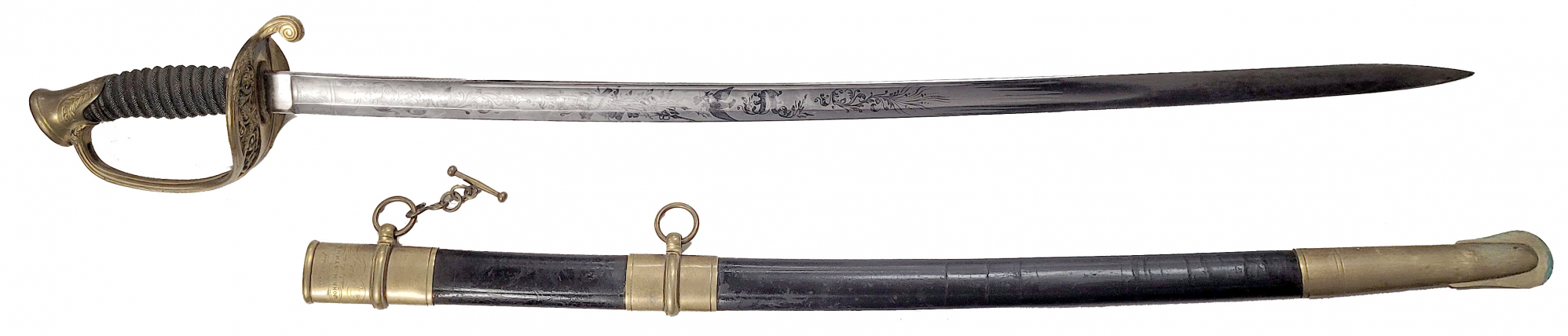
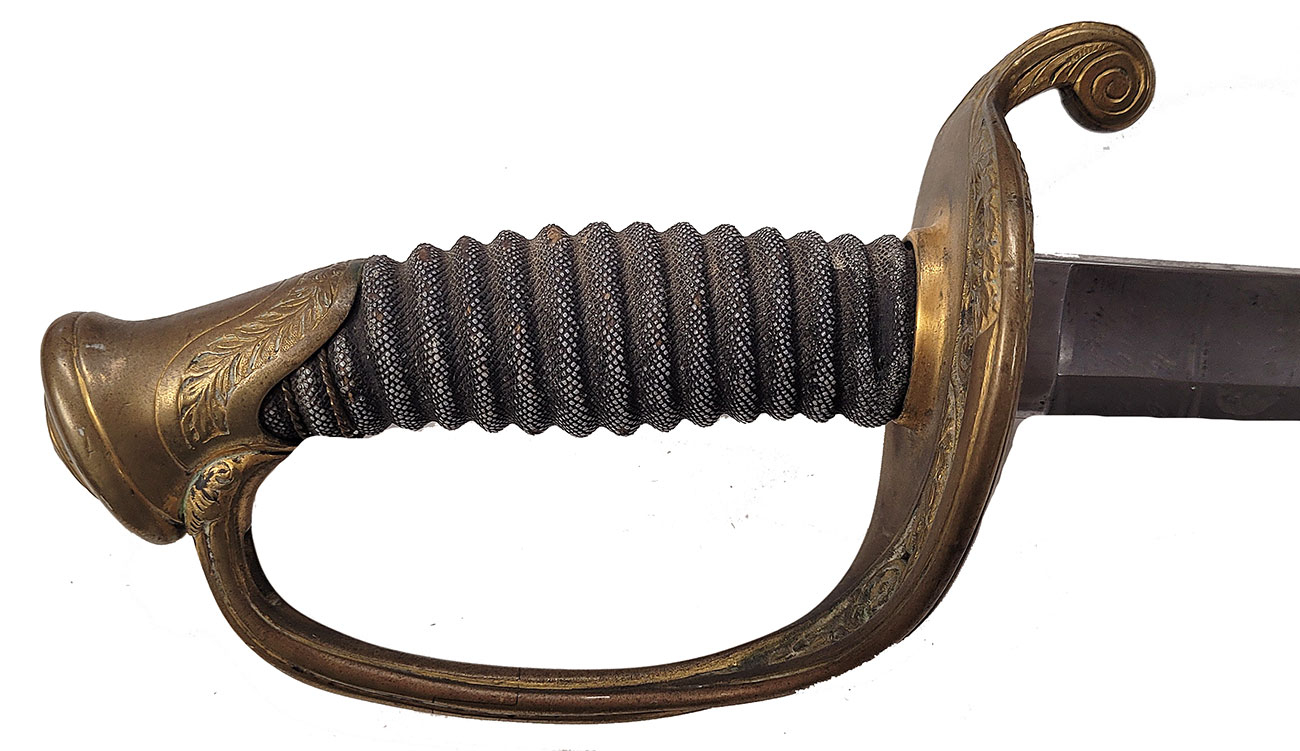
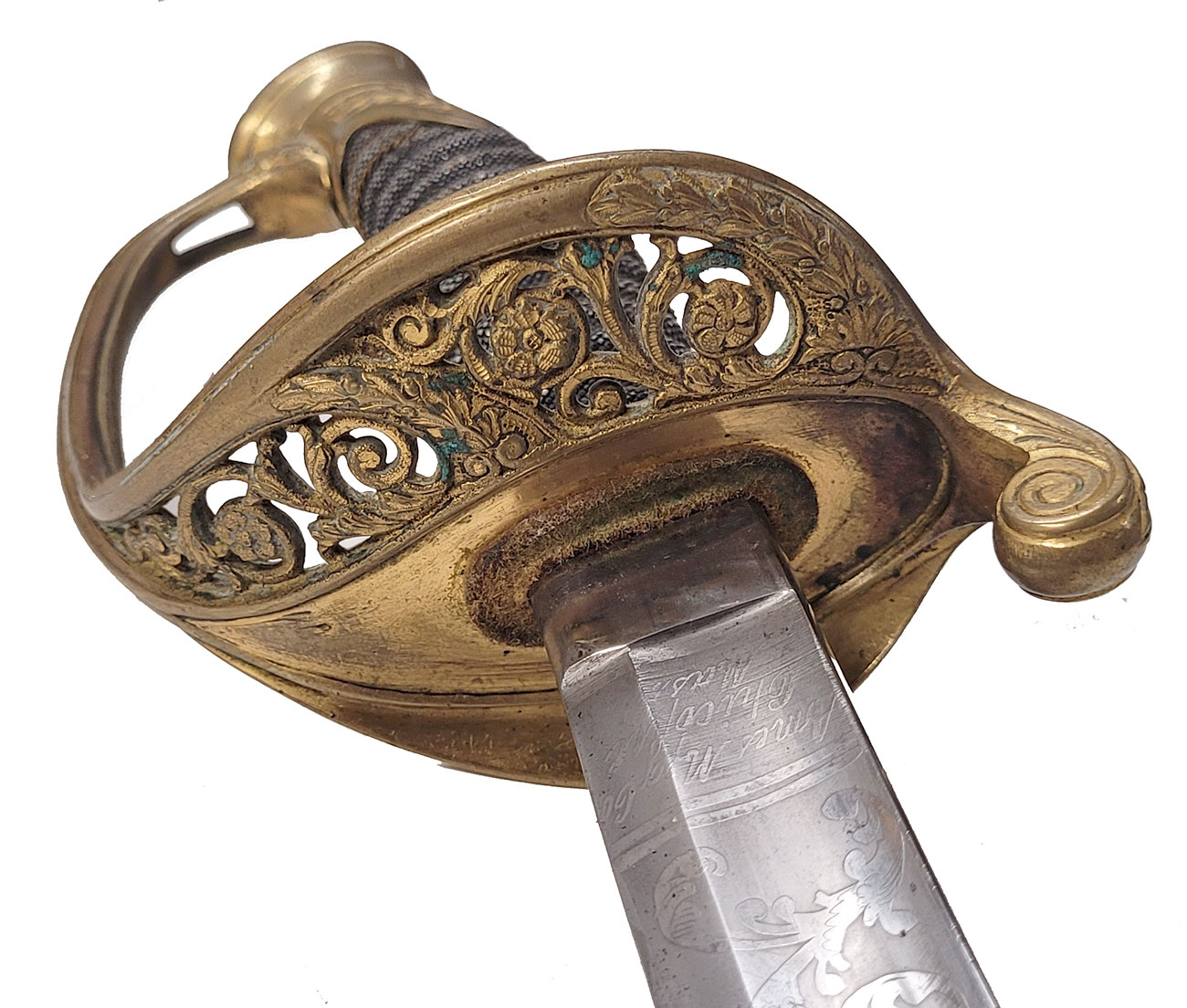
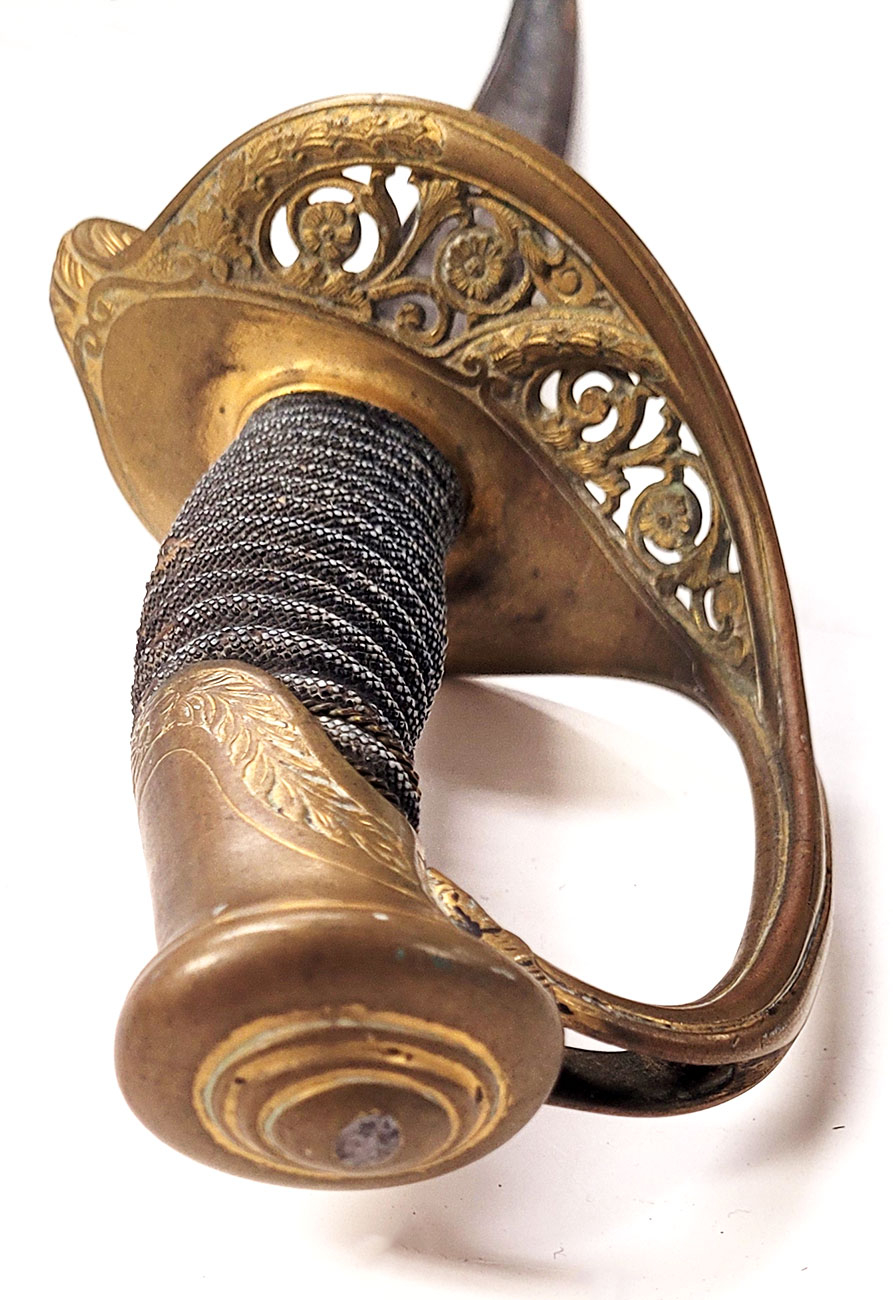
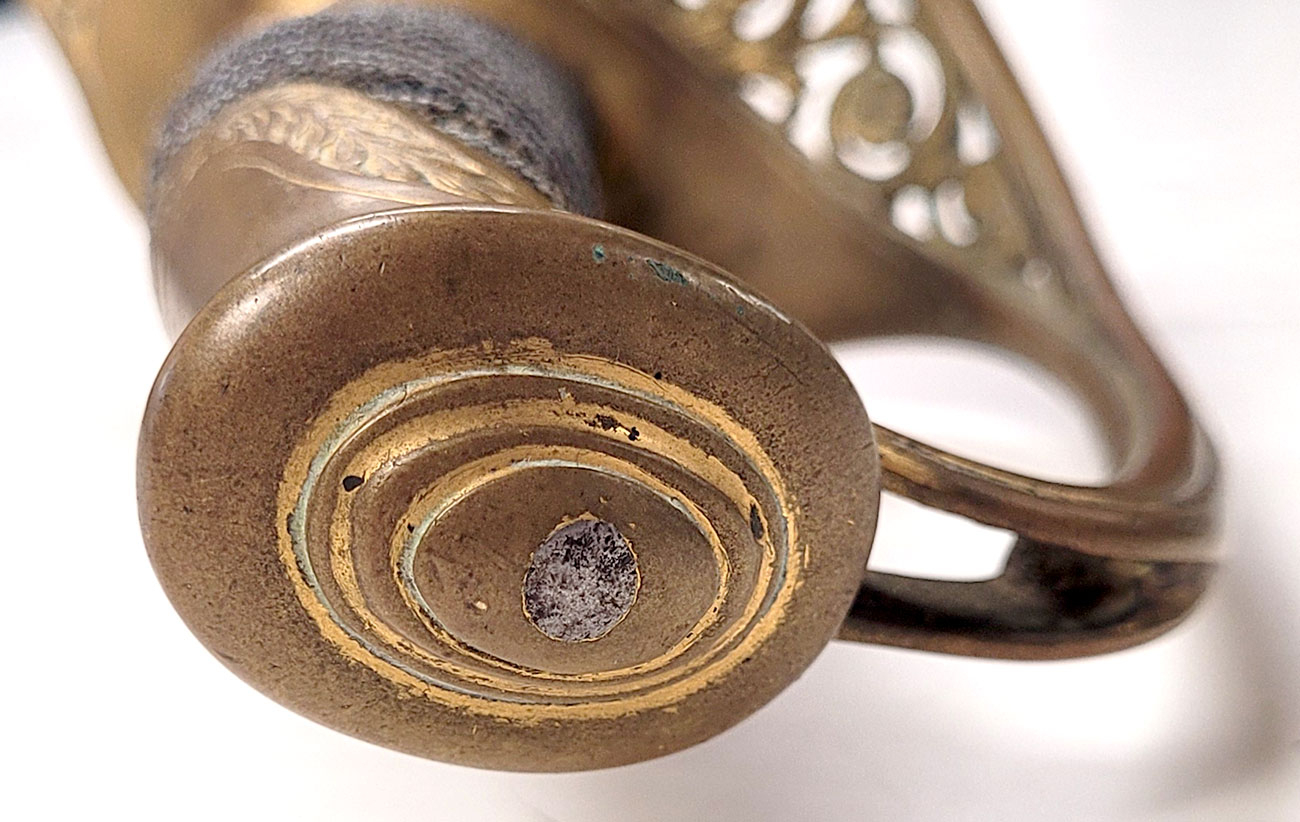
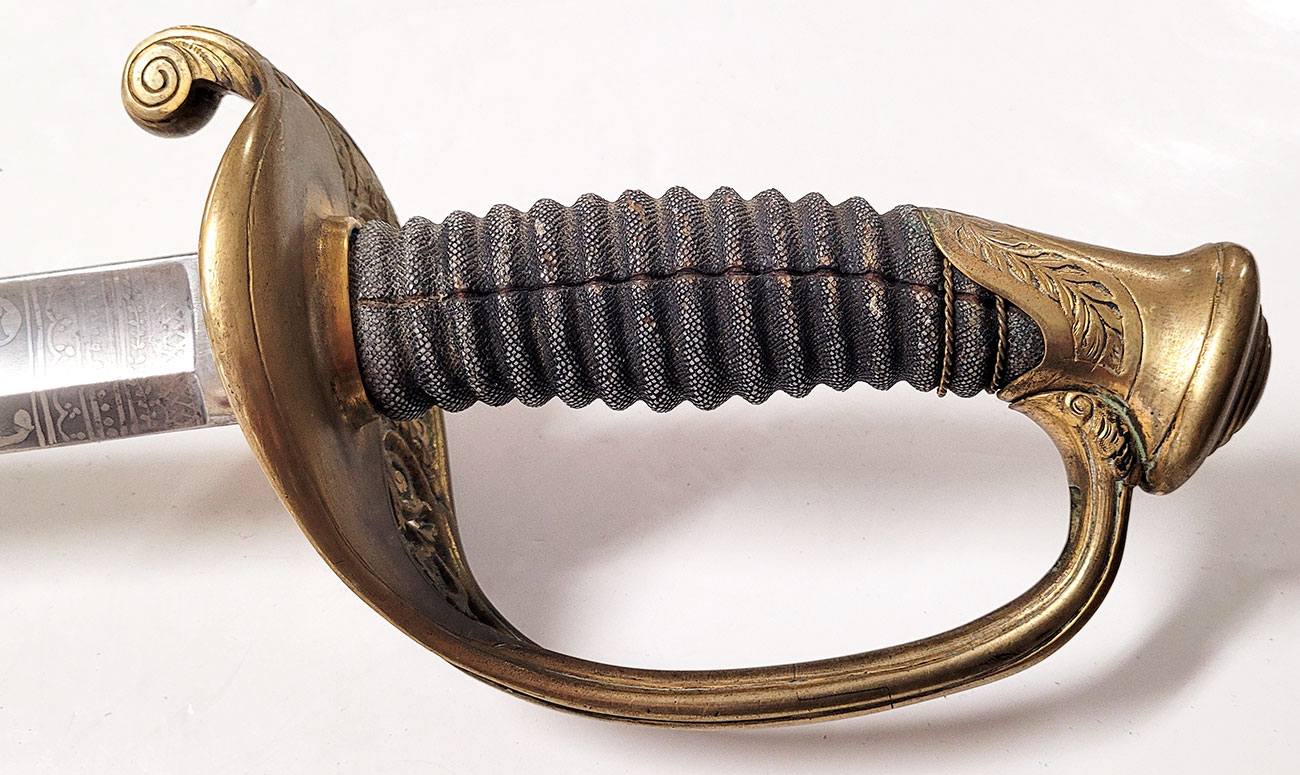
The sword is a Model 1850 Foot Officer’s sword, the regulation sword for lieutenants and captains serving on foot, in near excellent condition. The brass hilt has the standard gilt brass knucklebow and floral openwork guard with a gray sharkskin wrapped grip. The blade pad is in place on the underside of the guard. The brass has a pleasant, medium, aged patina, showing some small traces of gilt in recesses. The grip wrap is very good, showing just a typical shrinkage gap along the left side, missing just the twisted brass binding wire, but with nice surface and color to sharkskin and minimal wear.
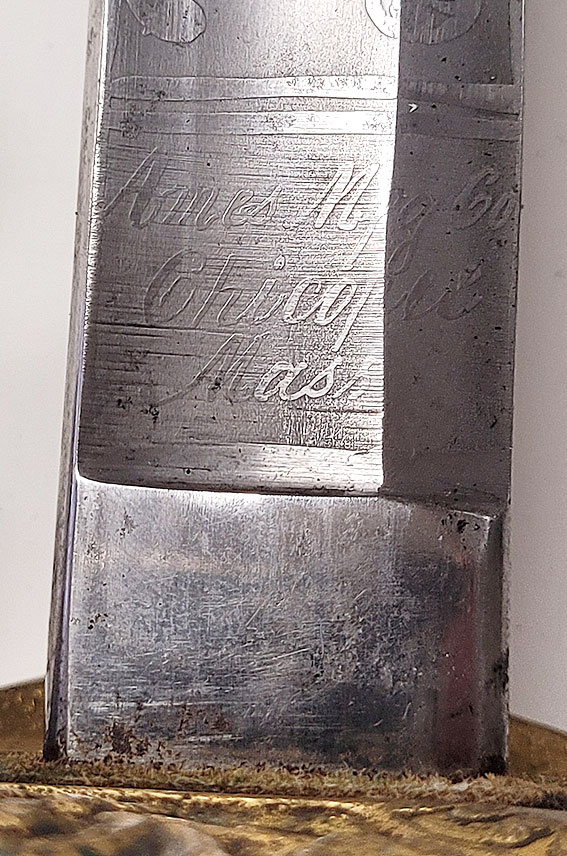
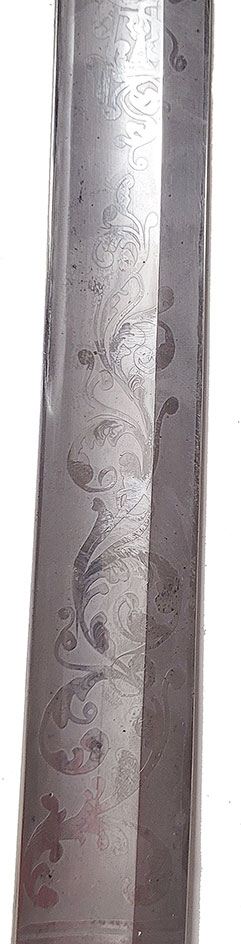
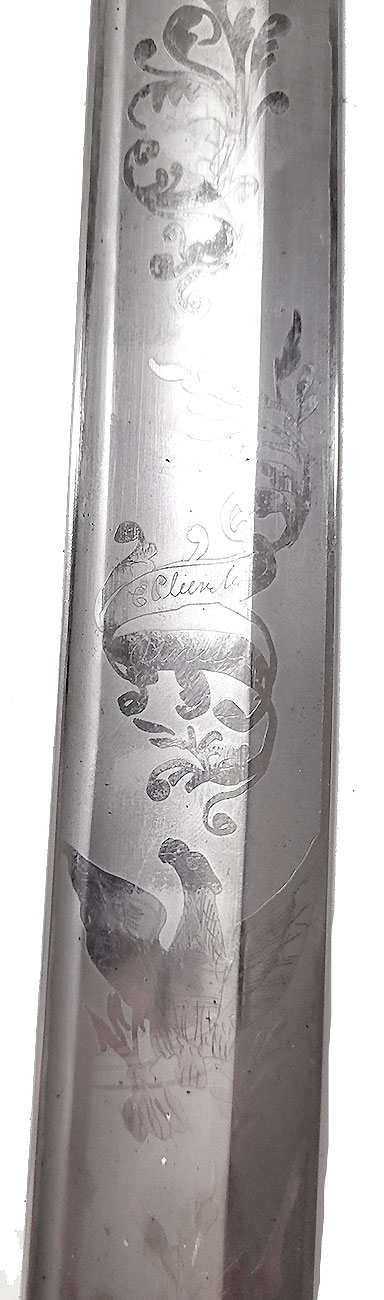
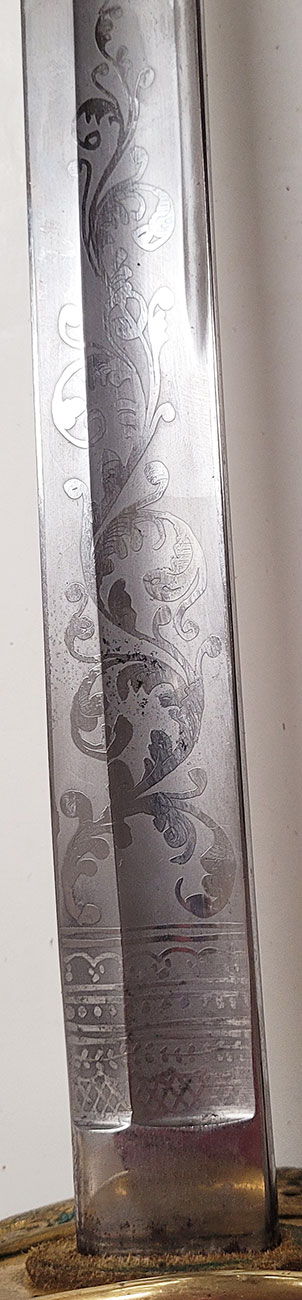
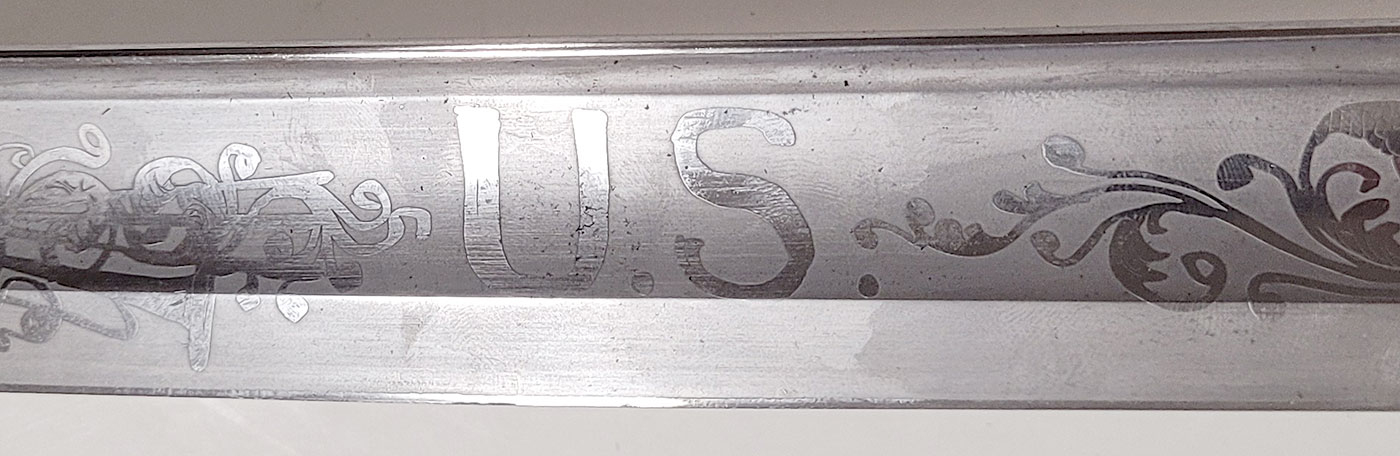
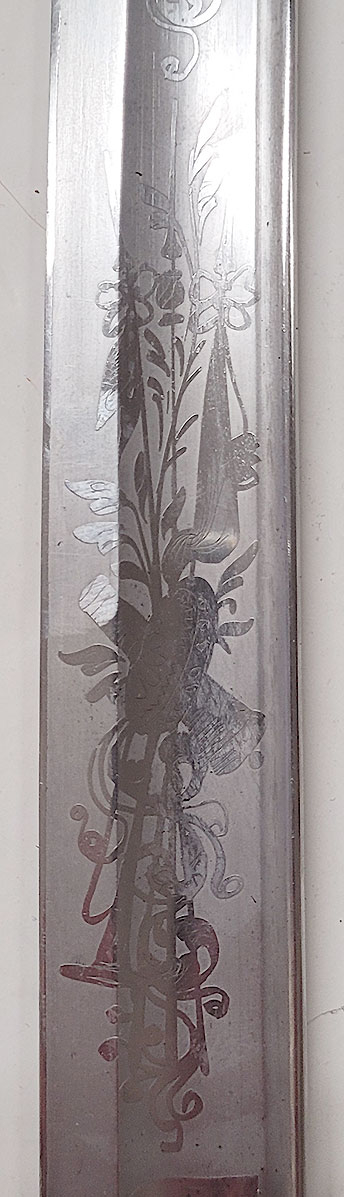
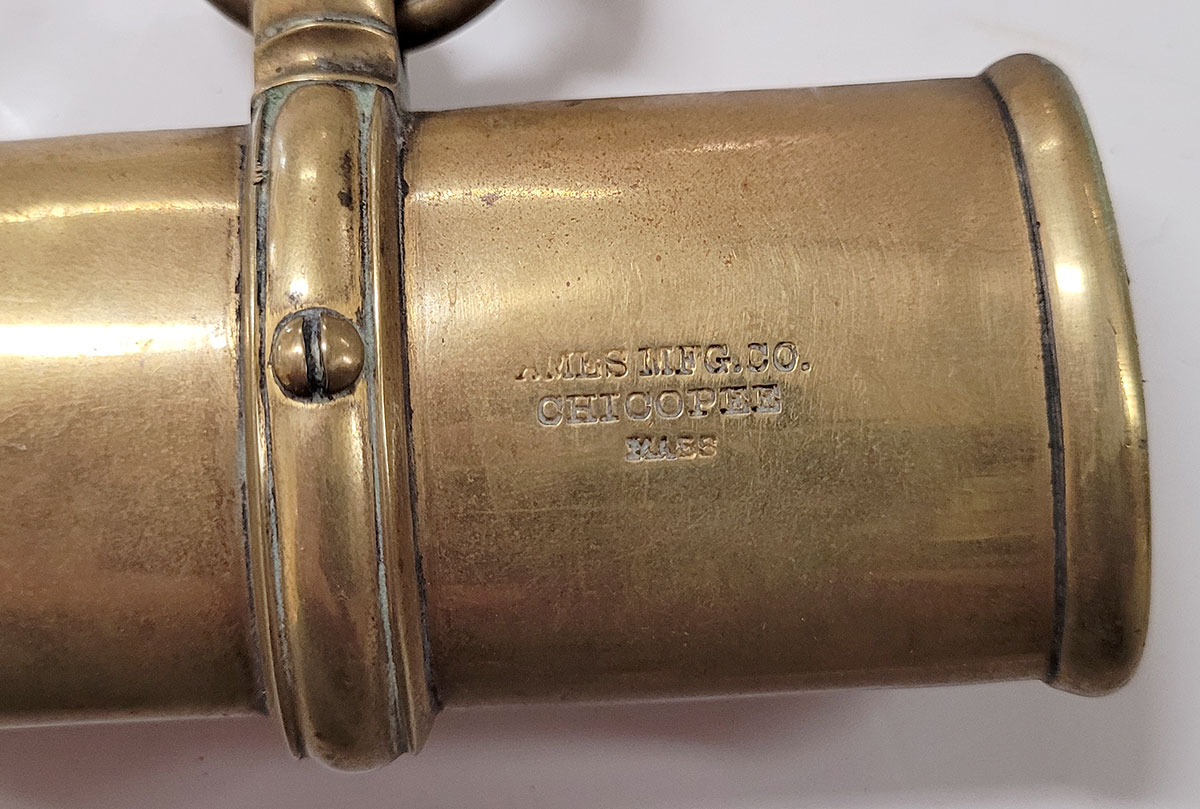
The blade is has a good edge and point, and vivid etched panels on both sides that end in flame or sunburst points. The obverse bears the etched Ames maker’s address just above the ricasso, reading “Ames Mfg. Co. / Chicopee / Mass” in script, followed by two lines above which leafy scrolls extend up the blade, following which is a tall trophy of arms, vine entwined, showing a cannon barrel, quiver and United States shield, above which pikes extend with flag cords and a narrow flag, pennant or guidon showing stars in the canton. The U.S. eagle with arrows and olive branch hovers above this with raised wings and a foliate E Pluribus Unum ribbon scroll overhead, with the panel concluding with a floral scroll and spray of thin leaves extending up the flame-like tips of the frosted ground. On the reverse the etching shows a latticework and dotted section just above the ricasso, followed by floral scroll and long leafy tendrils, above which is a block U.S., reading blade tip to hilt. Long, leafy tendrils then envelope another trophy of arms, this one showing a trumpet, shield and cannon barrel, behind which pikes with furled banners cross one another, with the panel ending with a series of floral scrolls and tendrils as on the obverse. The motifs on the whole are vivid, with minimal rubbing or spotting.
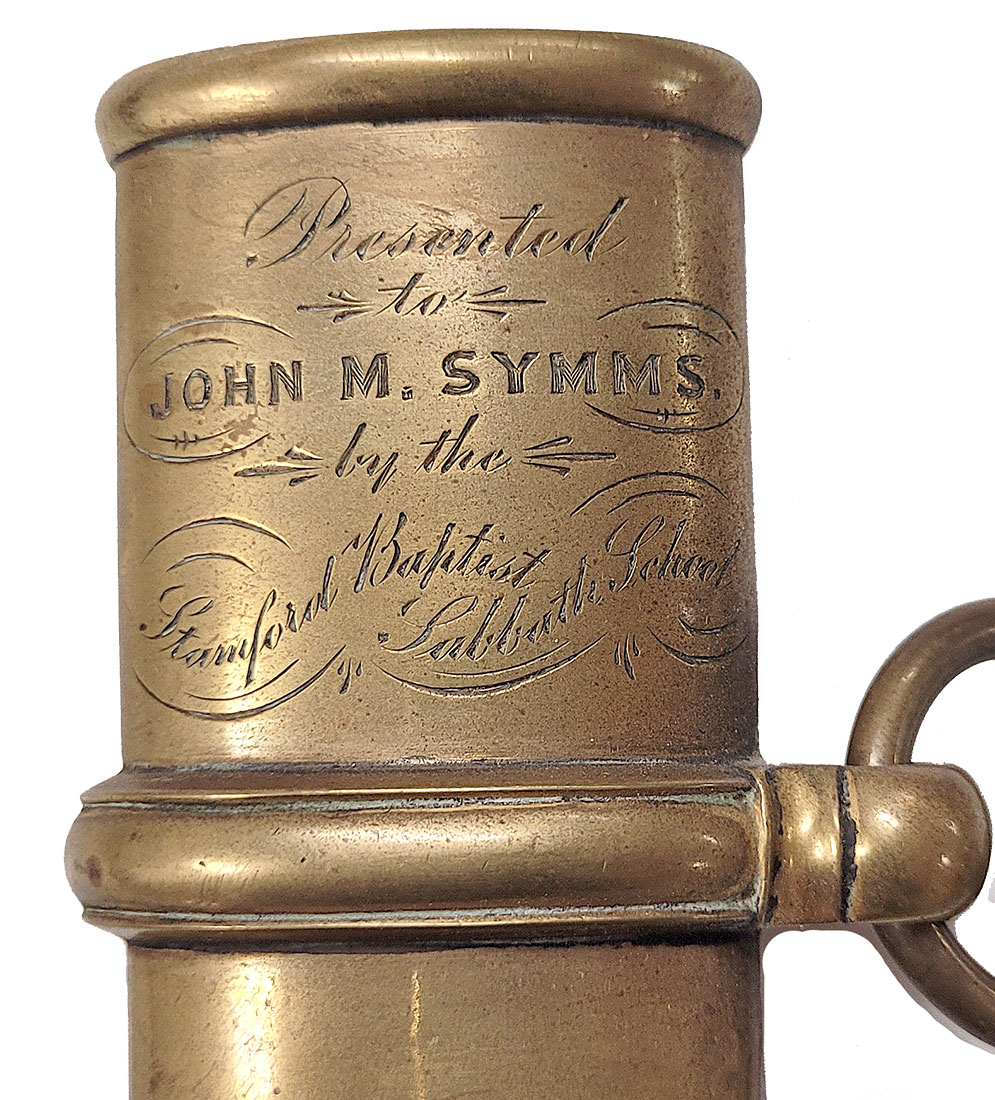
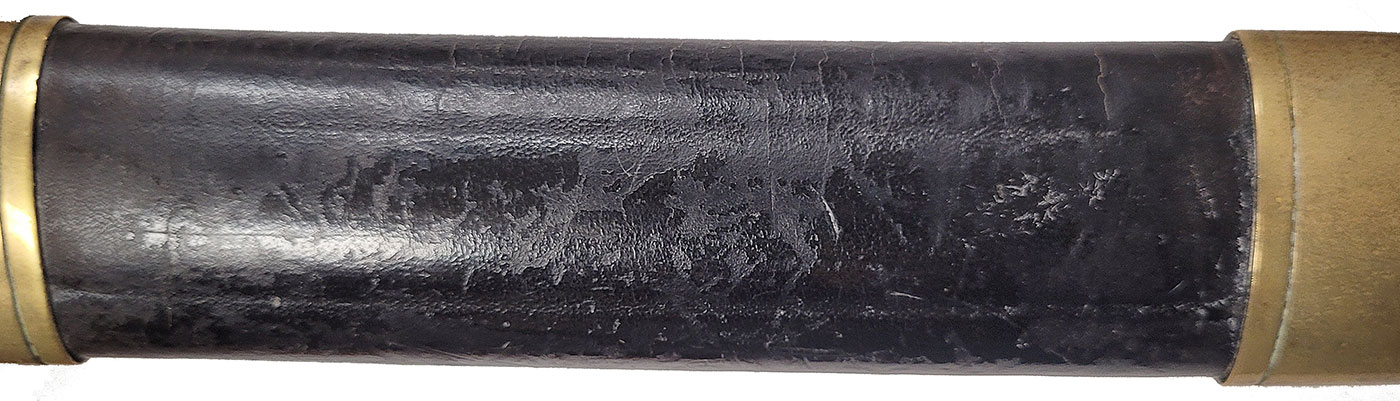
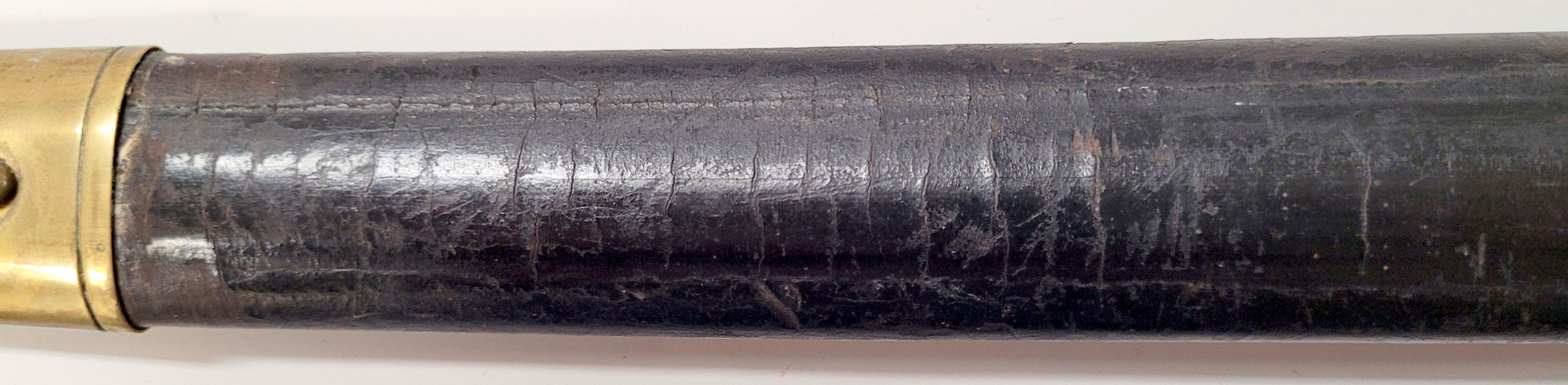
The scabbard is excellent as well, with the scabbard body firm and having a nice, smooth black finish. The brass mounts are all in place and match the hilt. The upper mount preserves a small brass T-bar on a short chain that would have served to carry the sword higher up on the hip than at the length of the sword slings. The upper scabbard mount is inscribed in a mix of block and script letters, with flourishes, “Presented / to / John M. Symms / by the / Stamford Baptist Sabbath School.”
Born 12/27/1837 in Newburgh, Orange County, NY, Symms (usually spelled Simms in the military records, contemporary sources, and even on his tombstone, and mistakenly called Simons in the record of the 3rd CT) was orphaned at a young age and left without close relatives. By the 1860 census he was living with the Riker family of Stamford, CT, working as a farm laborer and according to The Stamford Soldier’s Memorial, “had won for himself a good name as a faithful and trustworthy young man.” The Memorial quotes several testimonials made after his death: “’John Simms was a self-made man. He had none of the advantages which a finished education, or high social position gives, yet, by his manly deportment and strict integrity he had gained the esteem and good wishes of all who knew him.’ The Rev. P. S. Evans, his pastor, in the funeral sermon which he preached Feb. 1, 1863, thus testifies: ‘Our brother first became known to me in November, 1859, at which time he joined our church by letter. From the first he was loved and respected by all who knew him. * * * As a member of the church he was distinguished for manly earnestness and childlike humility. He was constant in his attendance. He labored with great self-distrust, but with scrupulous faithfulness in the Sabbath school…’”
Symms enlisted early in the army, enrolling at Stamford on 4/25/61 in the “Stamford Rifles,” which would be the nucleus of Company F of the 3rd Connecticut, a three-month regiment, and mustering in as a private on 5/14/61. Connecticut records for this enlistment list him as Simons, but the Stamford Memorial makes clear it is Symms (or “Simms” to them.) The company was disappointed not to be armed with Sharps rifles as promised but reportedly readily volunteered to go even if armed only with pitchforks. They left Stamford on April 18, rendezvoused at Hartford, drilled for a month, and left for Washington May 19, reaching the city May 23. They spent another month drilling at Camp Tyler near Falls Church and took part in a scouting expedition on June 30, taking two Confederate cavalrymen prisoner. On July 15 the regiment led the way for Keyes’s brigade, skirmishing for two days at Blackburn’s Ford, and in the main battle taking part in the advance up Henry Hill with the 2nd Maine, losing 5 killed, 16 wounded and 14 missing in the fighting, but reportedly keeping their formation in the retreat. They were mustered out at Hartford on August 12.
Symms reenlisted less than three weeks later, reportedly feeling the country needed men then more than ever and regarding the defeat at Bull Run as a disgrace that had to be avenged. He signed up again on 9/1/9/61, mustering in as a Sergeant, likely because of his prior service, on 10/9/61 in Co. G of the 10th Connecticut. He was promoted to First Sergeant 5/21/62 and is listed as present on all company muster rolls until the July-August roll, which shows he was sent back to Connecticut on recruiting duty at some point in that period. While home on recruiting duty he received a commission as 2nd Lieutenant in the same company on 9/18/62, and was formally presented with this sword on October 5, before returning to the front. The Memorial records the presentation: “On Sunday, October 5th, a service, similar to that reported in the Methodist Church, took place in the Baptist Church. The Sunday School of this church had purchased a sword for lieutenant John Simms, one of the teachers of the school. In his modest reply to the presentation speech, made by Mr. Evans, the pastor, he pledged what his friends found to be abundantly fulfilled in the brief service in which he was permitted to wield the sword. "I can only say, that I shall endeavor to merit the good opinion of the donors of this sword, and by God's help it shall never be disgraced."
Symms was wounded before he could be officially mustered in at that rank, a formality enabling him to receive pay and official rank from the date he had actually begun serving. (In a sad irony, just four days before his death he was promoted again, this time to 1st Lieutenant and officially transferred (on paper) to Company C, simply the army’s way of filling vacancies, and was again never officially mustered at that rank.) Two photos show him in his officer’s uniform. In both he shows off the sword- holding it high on his hip in one image and in the holding it drawn, point down in front of him at parade rest. (An original CDV of the first image is with the sword, with copy photos of both images.)
The 10th had mustered into service on 9/30/61, left the state 10/31/61 and joined Foster’s brigade of Burnside’s Division at Annapolis. It took part in the coastal expedition to North Carolina, fighting at Roanoke in February 1862, where it lost 56 in killed and wounded, and later lost 27 more in killed and wounded at Newbern in March. It took part in various actions during the summer, including capture of some Confederate works on the Roanoke River, and the Trenton and Tarboro expeditions with fighting at Rawles Mills, Hamilton and Williamstown, officially becoming part of Burnside’s 9th Corps in July. Symms is listed as again present on the company rolls for September-October 1862, indicating he likely returned soon after receiving the sword on October 5.
Lt. Symms was mortally wounded in the Battle of Kinston or Kinston Bridge on Dec. 14. Union forces under Gen. J.G. Foster moved from Newbern against the Wilmington and Weldon Railroad at Goldsboro with the intention of interrupting Confederate supply lines by destroying depots and a vital railroad bridge, and to support Burnside’s simultaneous offensive at Fredericksburg. At Kinston Foster’s forces attacked advanced Confederate lines defending a bridge across the Neuse River. When the attack stalled, the 13th Connecticut moved up from the rear, charged over two friendly regiment lying on the ground in front of them, joined a disordered front line and pressed home the attack in a half hour of intense fighting, forcing Confederates across the bridge, which had been set on fire, and trapping some on the near side, and then crossed themselves, leading to Foster’s occupation of the town the next day.
The regiment had carried about 360 officers and men into action. Symms was among the some 106 killed or wounded in the fighting, receiving a bullet in the right shoulder. A letter from a fellow officer soon after refers to him “doing poorly.” His ultimate fate was recorded more clinically in the Medical and Surgical History of the War. His wound was described as, “conoidal ball injured the head of the right humerus and glenoid cavity and lodged behind the scapula.” The treatment was, “removal of the head and neck of the humerus,” which was performed by Surgeon M.T. Newton of the 10th Connecticut a week after his wounding, on Dec. 20. Symms died on January 11, 1863, according to one medical report of “pyemia,” a form of sepsis, according to another he had been brought into the hospital on Jan. 8, “a few days subsequent to the operation of resection of the shoulder joint and died from exhaustion and shock.”
This is a telling memento of an officer, apparently alone in the world, but who made himself part of a community, was very well regarded, and made the ultimate sacrifice for his country. [sr] [ph:L]
~~~~~~~~~~~~~~~~~~~~~~~~~~~~~~~~~~~
THIS ITEM, AS WITH ALL OTHER ITEMS AVAILABLE ON OUR WEB SITE,
MAY BE PURCHASED THROUGH OUR LAYAWAY PROGRAM.
CLICK HERE FOR OUR POLICIES AND TERMS.
THANK YOU!
Inquire About PRESENTATION AMES M1850 OFFICER’S SWORD OF LT. JOHN SYMMS (“SIMMS,”) 10th CONNECTICUT, MORTALLY WOUNDED AT THE BATTLE OF KINSTON, NC, DECEMBER 14, 1862
Most Popular
Historical Firearms Stolen From The National Civil War Museum In Harrisburg, Pa »
Theft From Gravesite Of Gen. John Reynolds »
Selection Of Unframed Prints By Don Troiani »
Fine Condition Brass Infantry Bugle Insignia »
featured item
CIVIL WAR COMMODORE’S UNDRESS FROCK COAT OF SILAS H. STRINGHAM, USN: LEADER OF THE FIRST COMBINED OPERATION OF THE UNION NAVY AND ARMY IN THE CIVIL WAR; VICTOR OF THE BATTLE OF HATTERAS INLET BATTERIES
Fought on Aug. 28-29, 1861, little more than a month after the Union defeat at Bull Run, the capture of Forts Hatteras and Clark on the outer banks helped restrict Confederate blockade running, enabled further operations on the North Carolina coast,… (1179-504). Learn More »
site search