

site search
online catalog
SACK COAT, CAP, SWORD, RUBBER BLANKET, MARYLAND CAMP FLAG AND OTHER EFFECTS OF LIEUTENANT AND CAPTAIN CHARLES N. KUHN, WOUNDED IN ACTION AT CEDAR CREEK WHILE BRIGADE ACTING AIDE-DE-CAMP AT CEDAR CREEK
Hover to zoom

$25,000.00
Quantity Available: 1
Item Code: 282-463
Shipping: Determined by Method & Location of buyer
To Order:
Call 717-334-0347,
Fax 717-334-5016, or E-mail
Kuhn was born March 11, 1837. The 1880 census lists his occupation as house carpenter, which identifies him in the 1860 census at age 22, living in Westminster in the household of John and Sarah Kuhn, presumably his parents. He has no occupation listed, at that point, but John Kuhn was also carpenter, so the younger Kuhn was likely working with his father. The 1880 census categorizes him as “maimed, crippled, bedridden, or otherwise disabled” and lists him as having a “wounded leg,” which most likely refers to his (second) wartime wound. He applied for a pension in May 1865 and other sources indicate it never fully healed: his 1905 obituary states that he died, “from injuries received at Fisher’s Hill,” referring to the battle on Sept. 22, 1864, immediately following Third Winchester. Although present at both those battles (and cited in the Official Records for his performance at Fisher’s Hill,) he was actually wounded at Cedar Creek on Oct. 19.
Kuhn enrolled at Baltimore in the 6th Maryland, which was organized from Aug. 12 to Sept. 3, 1862, with his enrollment and muster as 2nd Lieutenant of Co. A dating Aug. 12, though he likely had a hand earlier in recruiting the company. He was promoted to 1st Lieutenant of the company as of Sept. 9, 1862, to fill a vacancy caused by promotion. He is listed as present on all muster rolls up to November-December 1863, when he is listed as absent, wounded, at the General Hospital in Alexandria, though with no date or place of wounding. The regiment up to that time had served in western Maryland, guarding the upper Potomac and in the Shenandoah Valley, serving in the 8th Corps and the Middle Department. They were posted at Harpers Ferry from December 1862 to March 28, 1863, when they moved to Berryville. Kuhn had been placed under arrest by Gen. Kenly at Harpers Ferry, with the charge unspecified, but was released to join his company when it marched.
The regiment saw action at Kelly’s Ford, Berryville, and Opequon Creek in June 1863, and fought in the Second Battle of Winchester at the beginning of the Gettysburg Campaign, but escaped the general defeat. They were assigned to the 3rd Corps on July 5, 1863, and took part in the pursuit of Lee, the fighting at Wapping Heights, the Bristoe Campaign, Kelly’s Ford, and Mine Run, where they were engaged on Nov. 27. This might have been the occasion of Kuhn’s first wounding. CWData lists a total of 10 killed and 23 wounded, which is likely incomplete, and indicates they were in some serious fighting.
That wound was apparently light: he was present with the regiment again on the January-February, 1864, muster roll. With the dissolution of the 3rd Corps in Spring 1864, the regiment transferred to the 6th Corps for Grant’s Overland Campaign in 1864, seeing heavy action at Wilderness, Spottsylvania, Cold Harbor, and Petersburg, until they were withdrawn in July to counter Early’s thrust at Washington and then pursue him into the Shenandoah, where they became part of Sheridan’s forces fighting Early. In this new assignment Kuhn was transferred on August 10 to brigade staff as Acting Aide-de-Camp to Col. Keifer, commanding the 2nd Brigade, 3rd Division, of the 6th Corps, into which the regiment then served. Kuhn was with the brigade through the climactic battle against Early at Cedar Creek.
Keifer does no mention Kuhn in his report of Opequon (Third Winchester, Sept. 19,) but does include him in his report of Fisher’s Hill, fought on Sept. 22 when Early tried to make a stand: “Capt. J.P. Dudrow, Lieut. Charles H. (sic) Kuhn, and Lieut. R.W. Wiley, acting aides-de-camp on my staff were conspicuous for bravery and good conduct. Their promptness in the delivery of orders, and skill and good judgment in carrying them out, entitle them to the highest praise.” (The mistake of Kuhn’s middle initial is likely a transcription error in setting the printed text.) At Cedar Creek Sheridan’s temporary absence shuffled subordinate assignments, with Keifer bumped up to division command and the brigade command given to Col. Ball, 112 OVI, who does mention Kuhn. The brigade was heavily engaged in the morning fighting, sometimes faced by the rear rank and thrown into confusion by fleeing troops from the 19th Corps breaking through their battle lines. Kuhn apparently came through that part of the engagement unscathed, but was wounded in the afternoon’s fighting, when the army made general advance: “Lieutenant Kuhn, Sixth Maryland, acting aide-de-camp on brigade staff fell seriously, if not mortally wounded in the afternoon.”
Kuhn was initially hospitalized at Martinsburg with a, “lacerated wound from 12 pdr solid shot rec’d in the action at Cedar Creek Va. Oct 19th 1864” according to a surgeon’s statement. This was later described as a “gunshot wound anterior part of the pelvis.” In any case, the wound hospitalized him for months and affected him the rest of his life. While still in hospital Kuhn received a promotion to Captain of Co. C as of November 17, 1864, and his captain’s straps likely date to that point. The regiment’s muster rolls for January-February 1865, list him as discharged (this would be as 1st Lieutenant) and awaiting muster at his new rank. He was officially relieved of duty at brigade AADC on March 3, 1865, and officially discharged from the army for disability from wounds on March 17, before being actually mustered in at his new rank, leaving it for army record-keeping to catch up only in 1889 to reflect a muster in as Captain as of November 17, 1864, and discharge as Captain in March 1865 by reason of wounds.
To what degree he was able to resume work as a carpenter is unclear. His obituary says that he, “was for many years an inspector in the Baltimore Custom House,” which may have been a political appointment to help him out, but he does seem to have been fairly active, serving as “a Mason and prominent member of the Grand Army of the Republic.” He died at home in Westminster, MD, Feb. 24, 1905. He left behind a widow, apparently a cousin, who appears in the household in 1880 along with him and his mother, but had no children.
The grouping includes the following items, mostly wartime, with a few GAR items, along with two wartime government crates that were modified into camp chests and were likely used to store many of the smaller items after the war.
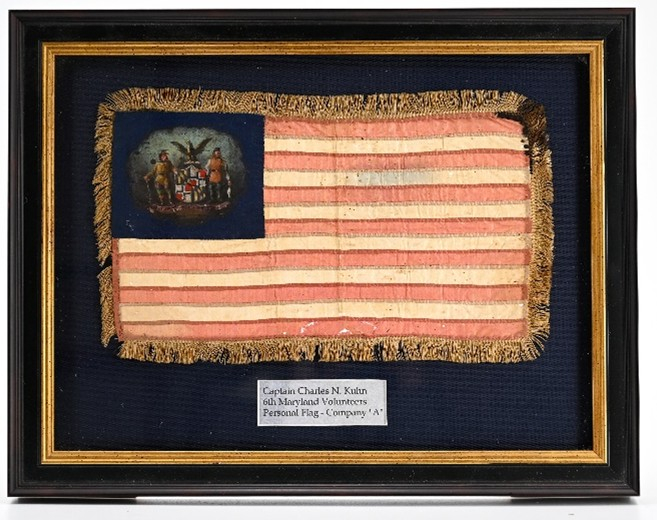
WARTIME MARYLAND STATE SEAL 35-STAR CAMP FLAG
Red, white and blue striped U.S. flag with the Maryland state seal painted in blue canton on the obverse and 35 gold five pointed stars on the canton on the reverse arranged in two concentric ovals of twenty and ten stars, with one at each outer corner of the canton and one at center. The flag measures 12 by 7.25 inches and is bordered on all four sides by a gold fringe. The condition is very good, with some small losses to the upper corner of the fly edge, affecting just a couple of inches along the top stripe and down along the very edge of the fly into the fourth stripe. The fringe is in place and discoloration indicates the corner may have gotten to close to a fire and been singed. Otherwise there is just expected slight fading to the red stripes, minor stains, and a few small holes in the bottom red stripe at center. The flag is matted and framed to display the entire obverse, but just the flag itself, omitting the fringe, on the reverse.
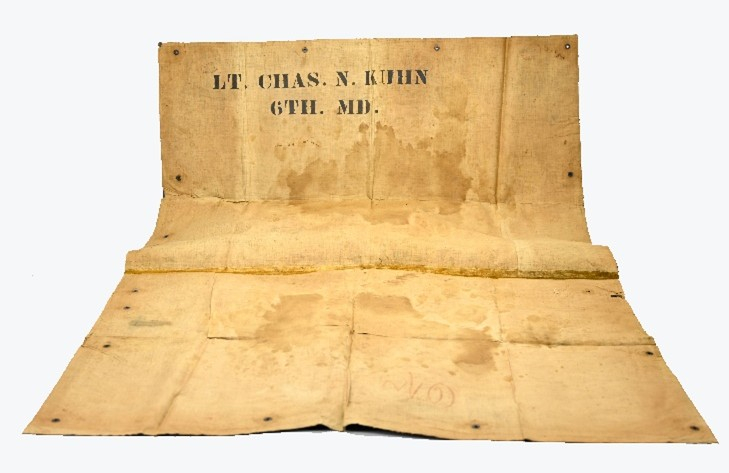
ISSUE RUBBER BLANKET
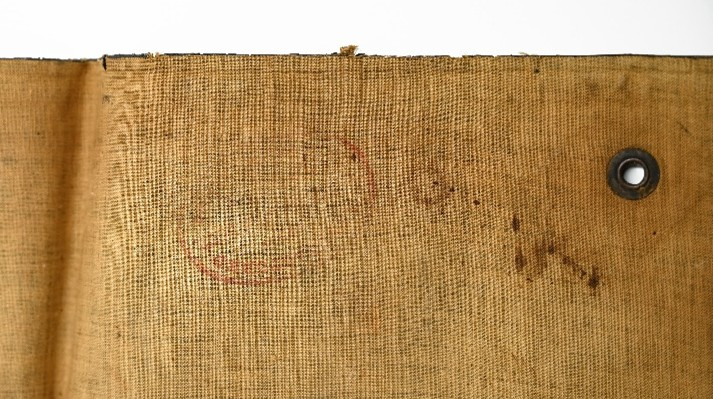
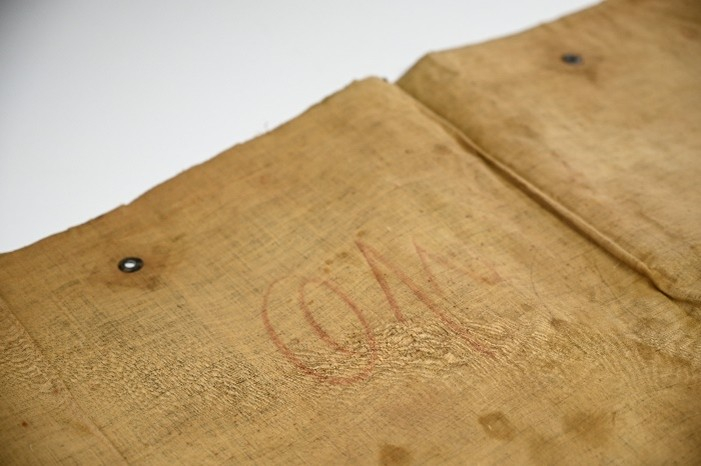
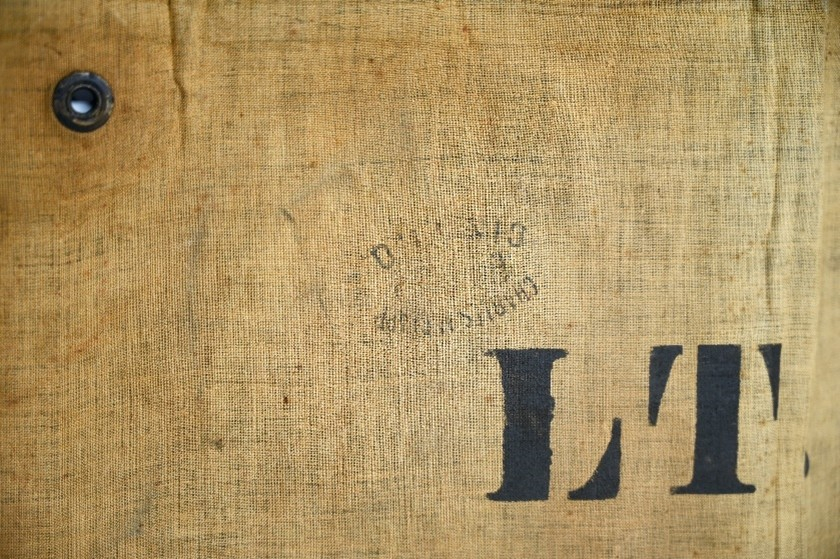
This is boldly stenciled “LT. CHAS. N. KUHN / 6TH. MD.” on the cloth lining, which also bears a partially legible manufacturer’s red oval ink stamp and the black inspection stamp of Charles M. Clapp, a Boston merchant in rubber goods who was appointed a U.S. government inspector of rubber blankets in the Quartermaster’s Department in Cincinnati. This follows one of several common patterns for army issed waterproof blankets in having not only evenly spaced grommets around the edges for lacing them together for tenting, but two sets of more closely spaced holes along one of the long sides so that it might be worn around the neck and over the shoulders.
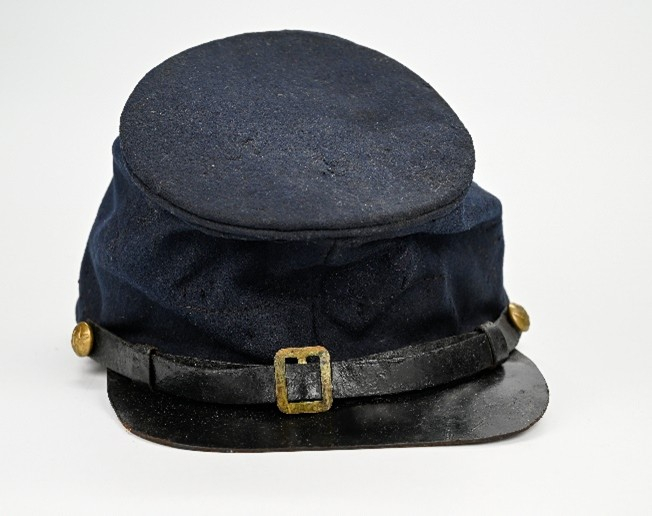
ISSUE FORAGE CAP WITHOUT INSIGNIA
As with the rubber blanket, this is an army-issue piece that Kuhn would have purchased from the Quartermaster for field use as both less expensive and less distinctive to an enemy. No insignia, moth nips to top. Loss of nap to rear. Partial M & G / No / N.Y. maker label. Good interior and sweatband, visor, chinstrap intact and firmly affixed. The Murphy and Griswold company name dates to July 21, 1863, indicating he purchased it after the regiment joined the Army of the Potomac.
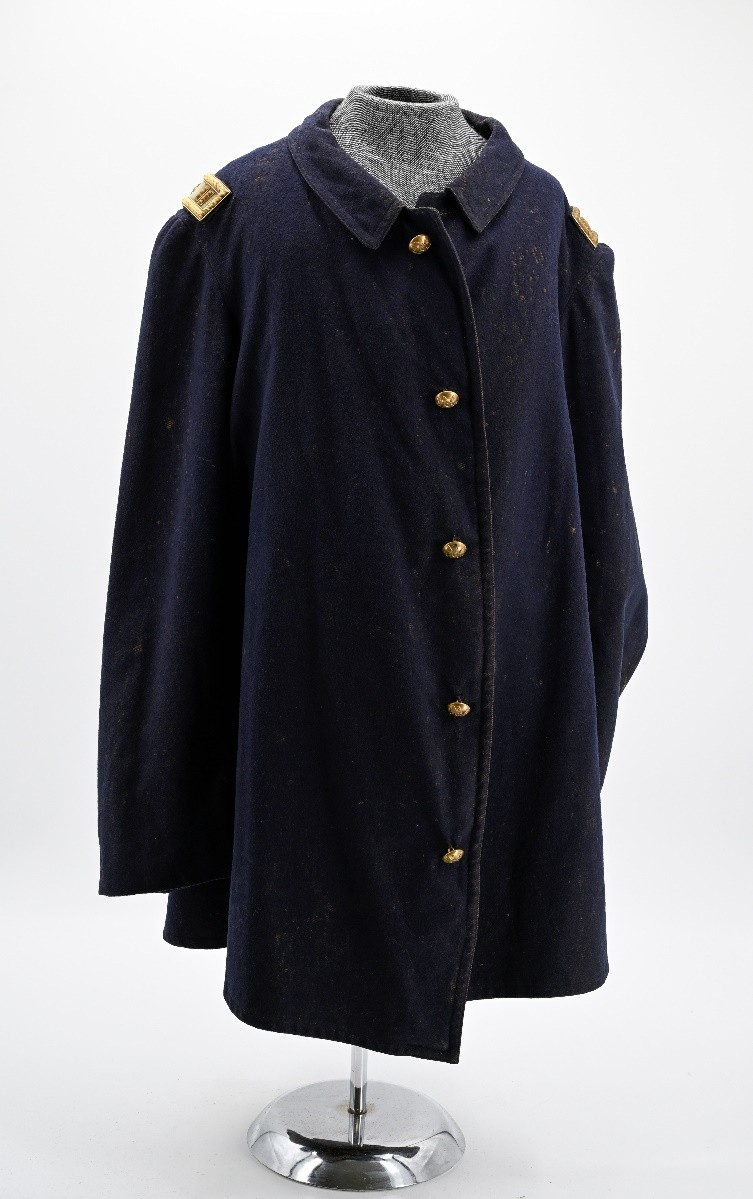
OFFICER’S SACK COAT
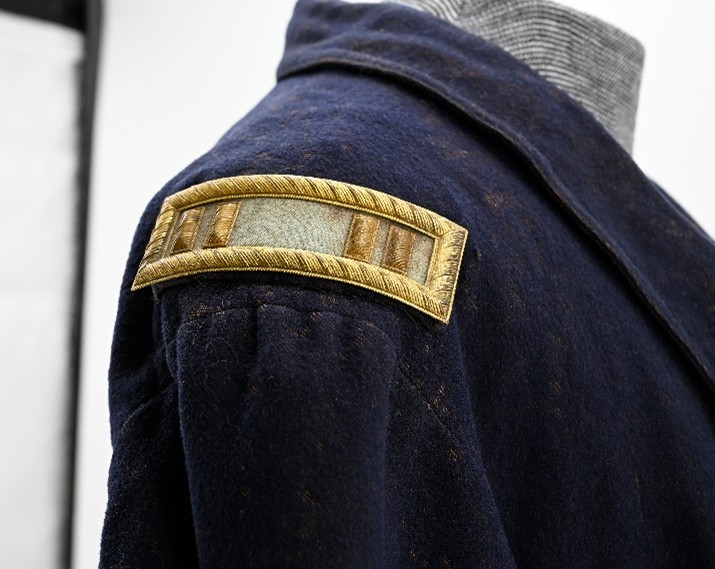
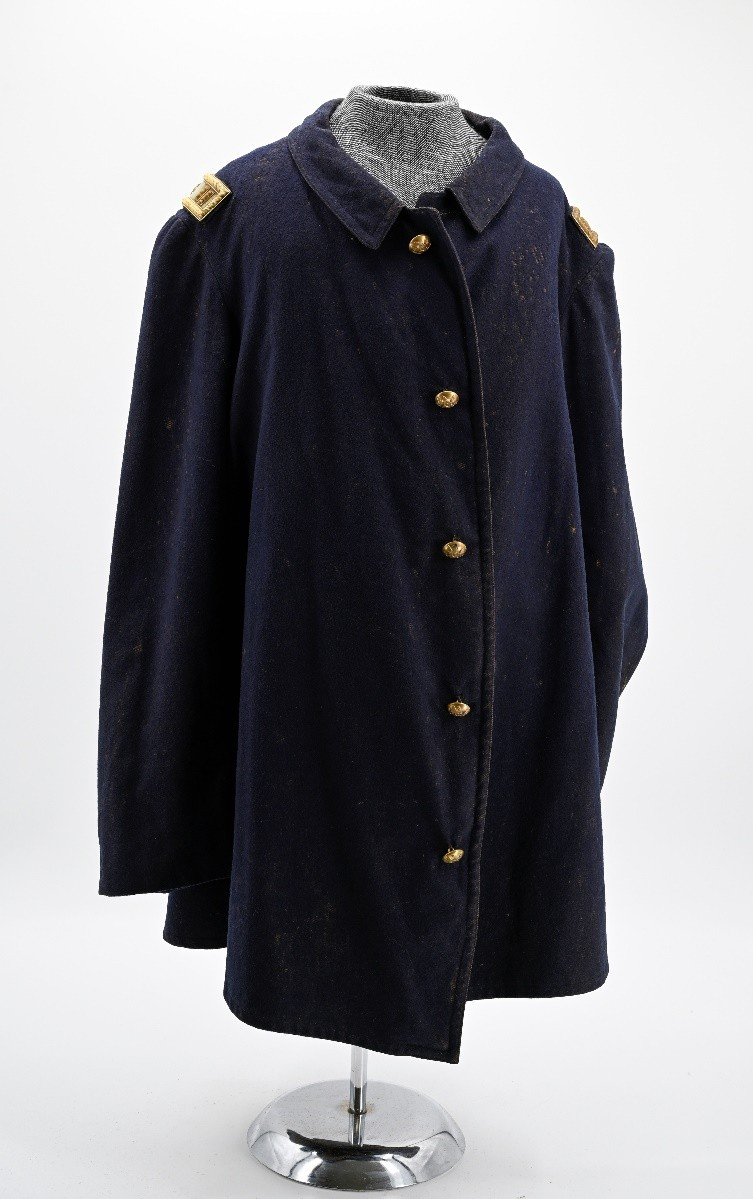
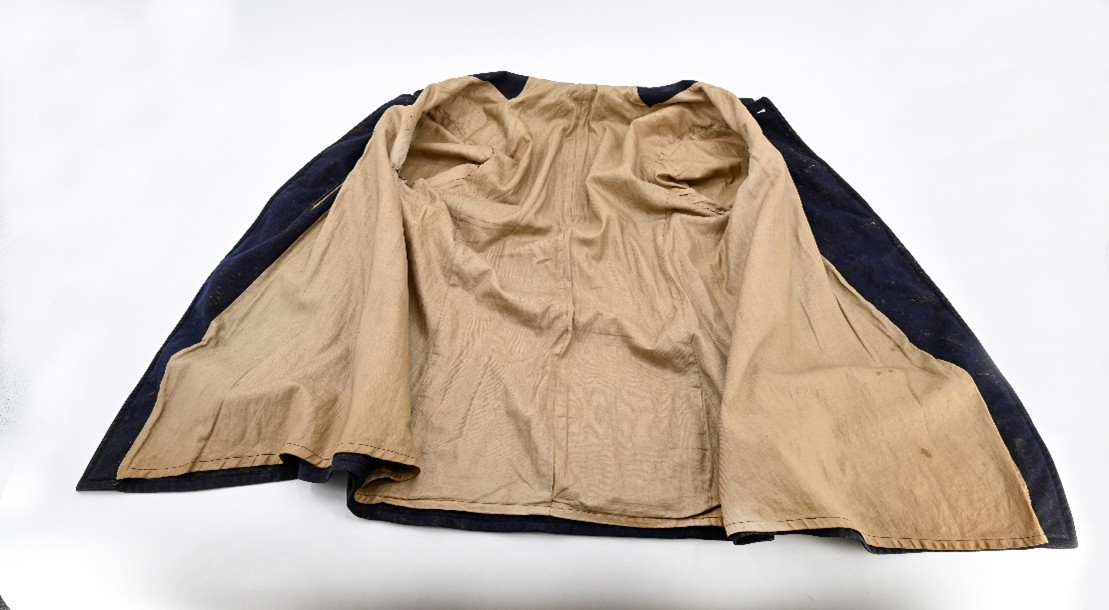
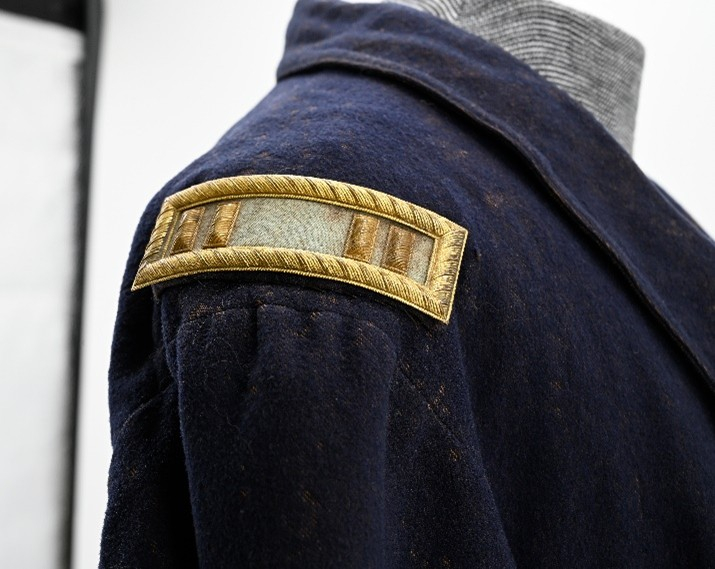
Sack coat, 5 button front with 2 on each cuff, CW Smith patent captain straps with light blue wool centers, slight stains, still a good amount of gilt. Body and sleeves lined in white, now cream color. Breast pocket inside lapel on left. The coat is typical of those used by line officers and would fit both his rank of lieutenant and captain. The captain’s straps would date to his promotion to captain in November 1864. (This date would be reflected in his commission from the state’s Governor even if he was not officially mustered in until later. Dates of muster-in was usually back-dated to reflect the effective date of the commission and the start of the officer’s performing of that duty.)
OTHER ITEMS: WARTIME AND G.A.R.
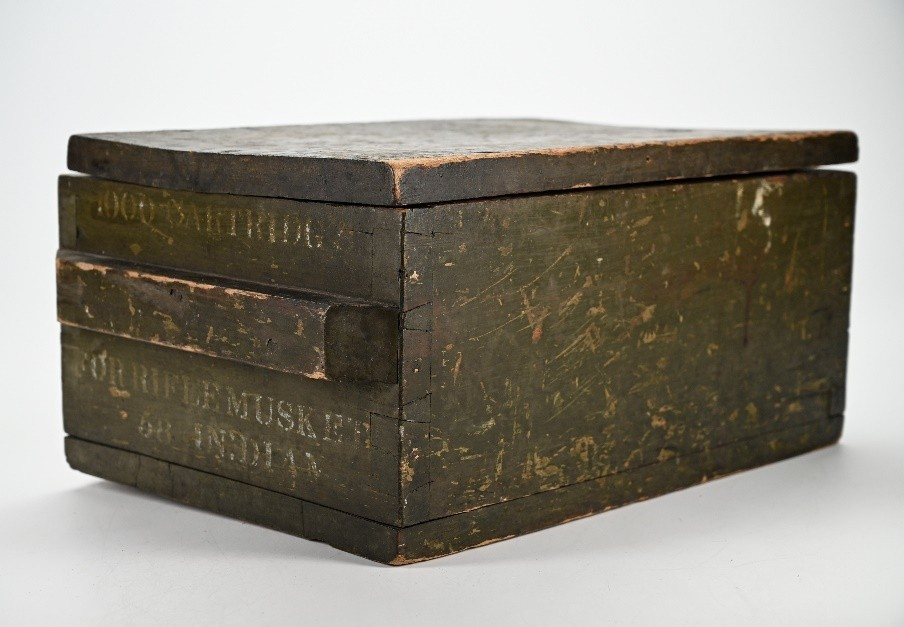
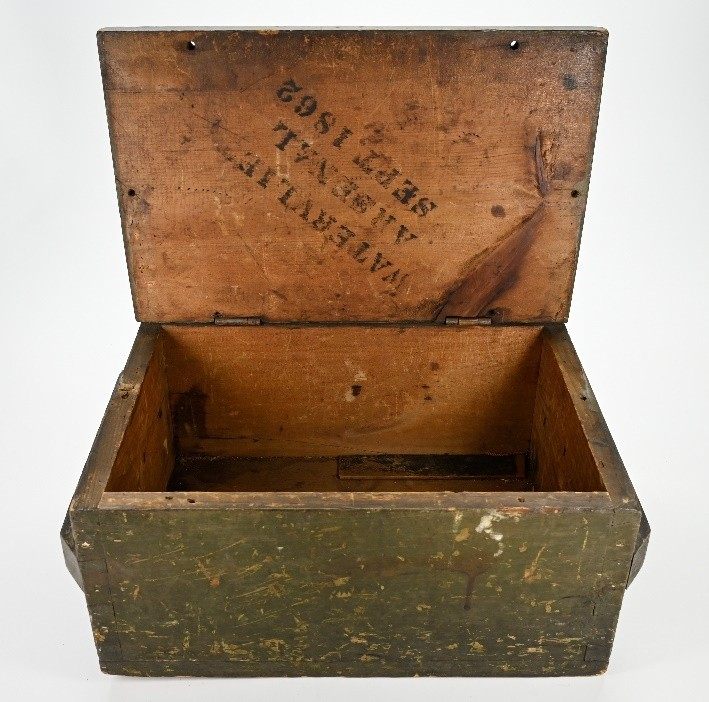
-Ammunition crate. Marked WATERVLIET / ARSENAL / SEPT 1862 inside lid. Olive drab Sept 1862 dated cartridge crate for 1000 CARTRIDGES / RIFLE MUSKET / .58 IN DIAM nice paint, handles intact, lid present attached by hinge. Typical of an officer’s use as a small camp trunk.
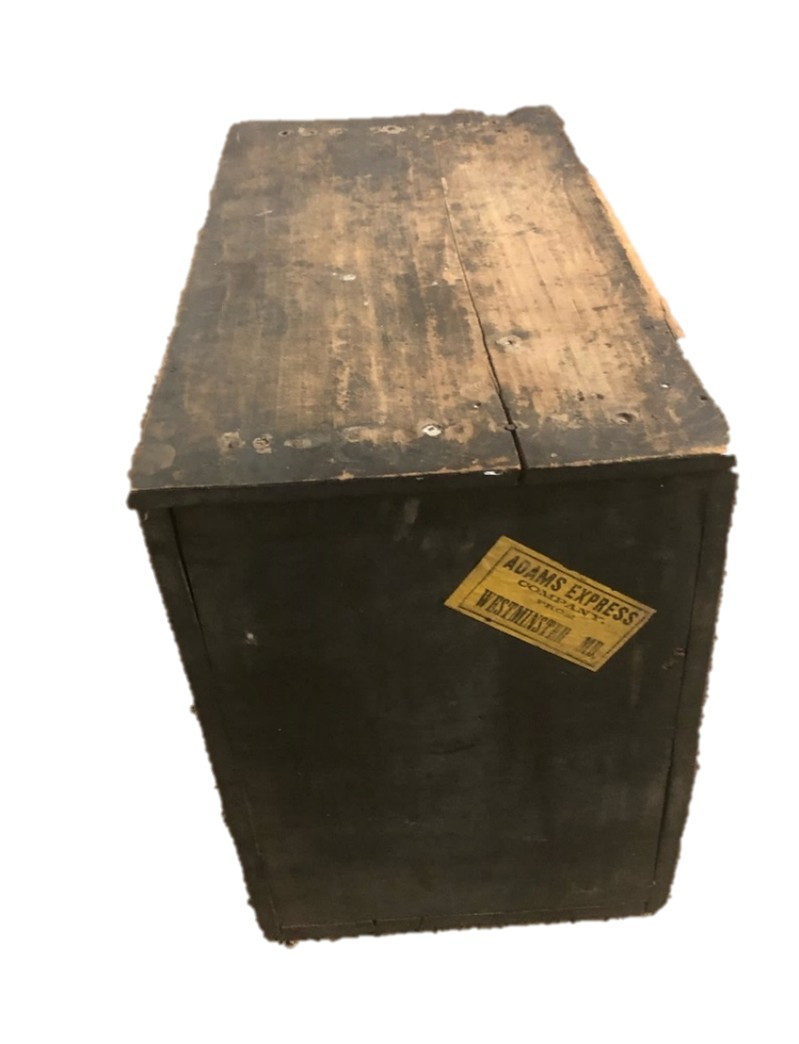
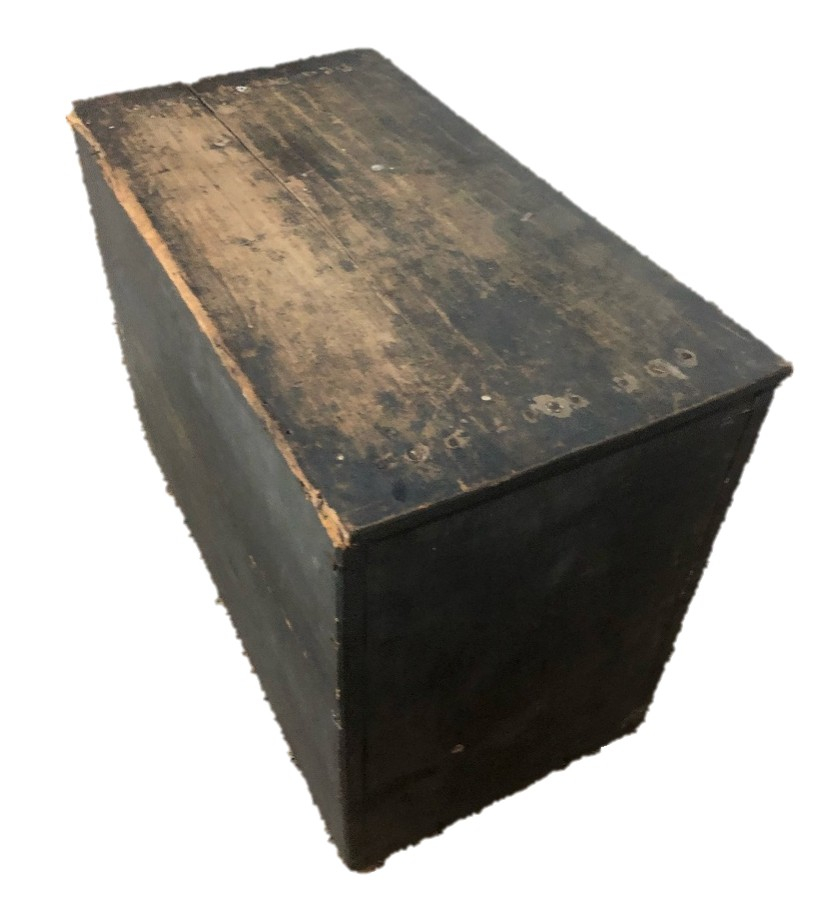
-Large crate, dark olive green likely repurposed from a government crate and then as a camp chest by adding hinges. “Adams Express Company from Westminster, MD” shipping label on one side.
-Crimson silk officer sash. Typical line officer’s sash. Some shredding above the knots minor wear spots and loss to some strands.
-Infantry captain’s strap, worn, tarnish to bullion, light blue
-Small size staff captain straps. Reflecting Kuhn’s continued official posting on brigade staff until March 1865.
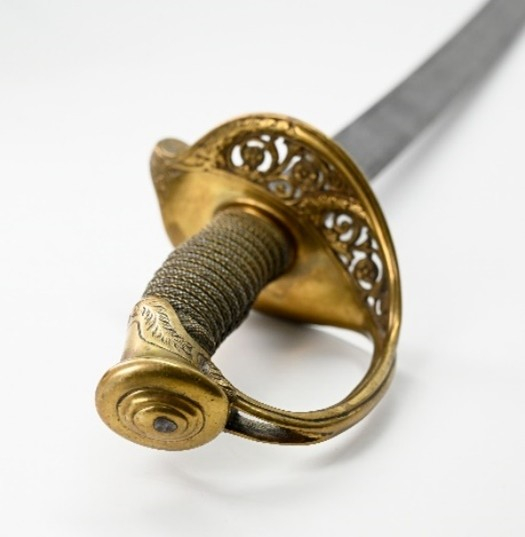
-M1850 foot officer’s sword. VG condition, no scabbard, good hilt with grip, wire and pad in place. Blade muted silver with some darker areas, but smooth metal.
-Axe & Butcher Knife
-Binoculars w/ Case, case missing lid. Binoculars have straight bridge
-Boot Remover with open star carved base
-Bottle of Bitters
-Candle (Only one is shown- there are 2 in the collection )
- brass Candle Stick
-tinned iron Canister
-Chess Board, handmade, with bone and wood pieces. Board warped, cracked
-Collapsible Cup
Mess cup with top
-Set of 4 Cups w/Storage Container, nice handles, officer’s mess style
-1845 Pronouncing Dictionary initials CNK and name Charles Kuhn in ink on fly leaf.
-Fishing Tackle, tin circular holder, fishing line inside.
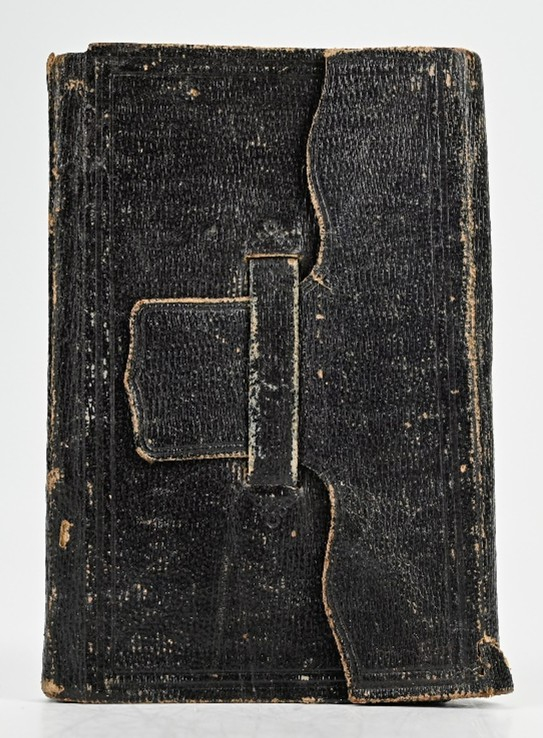
-Writing portfolio, embossed, brass latch CS 10 dollar bill inside.
-tin Funnel
-Glass hip Flask, leather cover top, tin cup bottom, screw top in place.
-white Kerchief
-tin coffee pot
-Mushroomed Bullet
-oil can
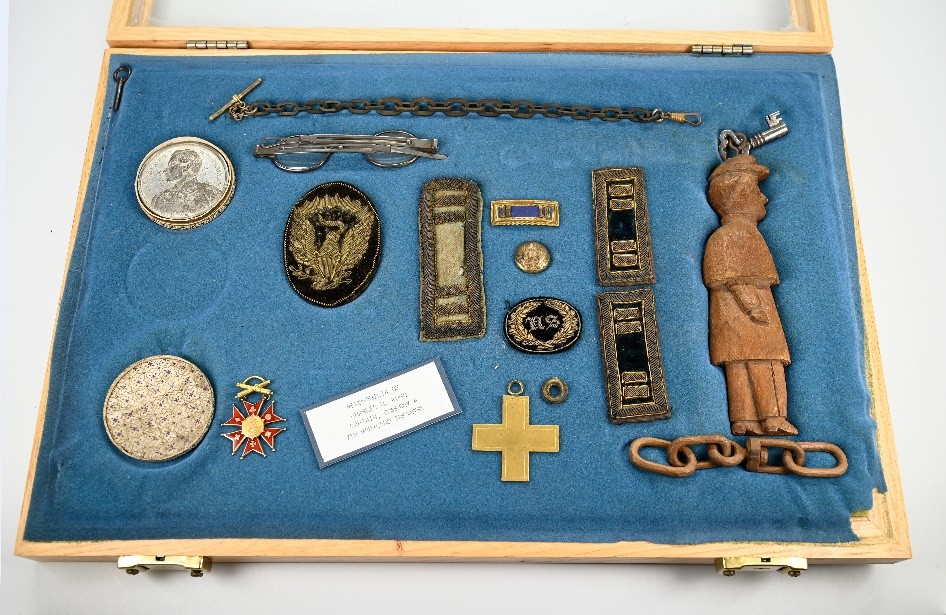
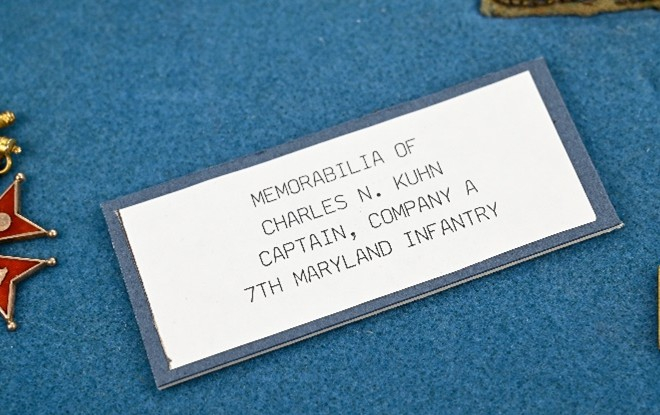
-Personal Effects display mount includes:
table medal of McClellan with pasteboard box, watch chain and key, carved soldier and chain (hospital work); glasses; Army of the Potomac Medal, no ribbon; Wartime infantry I button, small officers oval us hat insignia and dress hat side eagle, both embroidered. 6 Corps badge, likely GAR; GAR captain strap
-Pocket Watch, losses to enamel face. Case embossed, engraved, partial chain
-Razor Blade, folding straight razor, not hollow ground with wood box, Louie and Co. rust at base
-Spatula
-Tea kettle 1862 EB MANNINGS PATENT
-Housewife, pincushion stuffing coming out. Typical roll up with black waterproofed exterior.
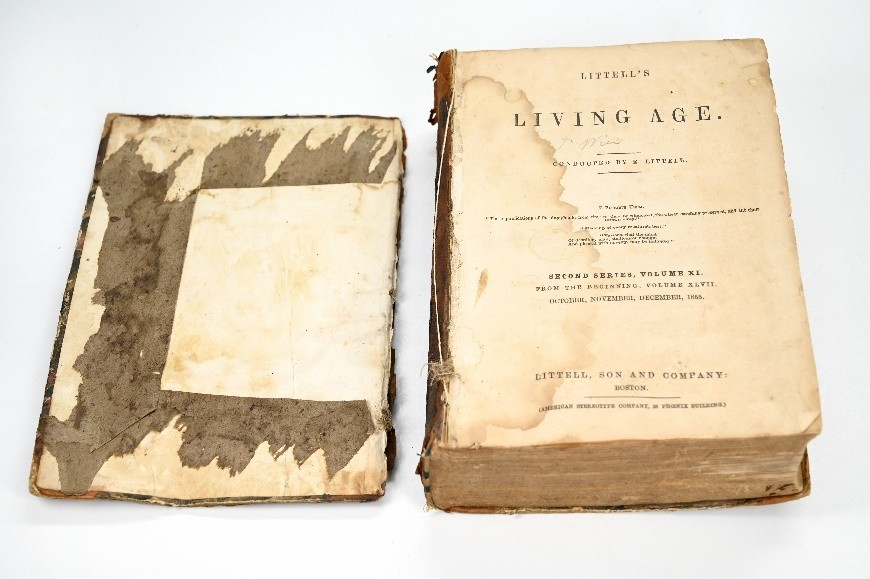
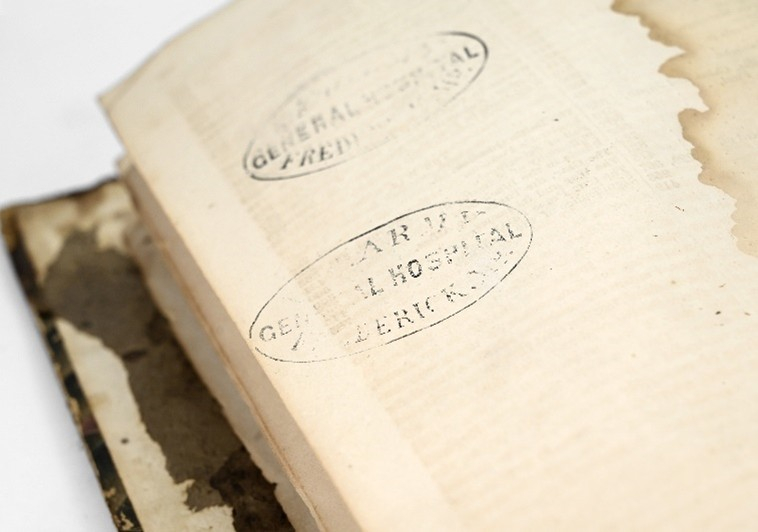
-Book from library of US Army General Hospital at Frederick MD, “Little’s Living Age” cover detached
-1861 pocket diary, minor stains, good
-wood pipe bowl and stem
-small velvet wallet with metal trim and clasp
-Holder for marking stamp. Wood handle with faint patent markings on top, metal holder at bottom with tightening screw for stamp, not present
-Painted toleware box for eating utensils, marked “forks” and “spoon” in gold on black. Four small stamped tinned iron spoons present. (Perhaps a postwar intrusion.)
-2 shot bags, Merchant shot works, Baltimore (Perhaps a postwar civilian intrusion.)
-Camp basin pierced with hole for hanging
-Two camp style frying pans
-1862-dated pocket new testament (American Bible Soc. NY) good cond with folding cover intact
-Cased double daguerreotype. Young man and older man, both in civilian clothes. -Thermoplastic case with breaks and losses.
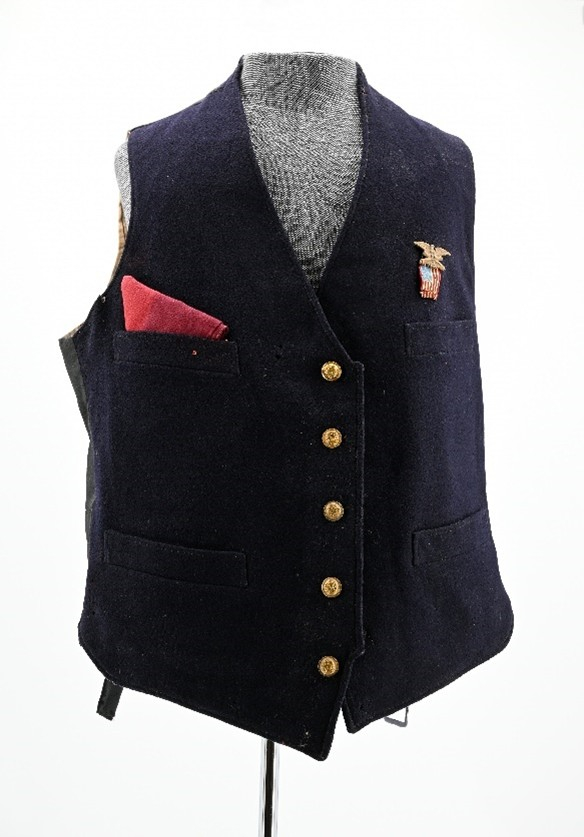
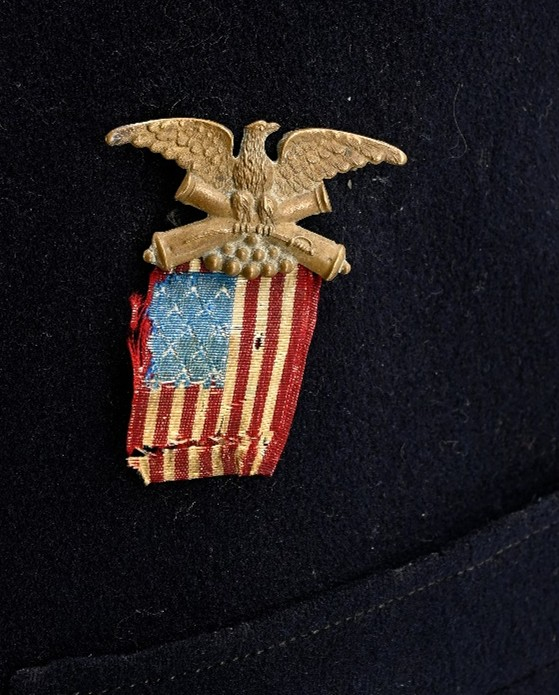
-GAR 5 button vest, roll collar, 4 pockets ext 1 interior. Red kerchief in one pocket. Top bar and partial flag ribbon of GAR badge affixed on wearer’s left breast. Lined interior lining, some perspiration stains on the back.
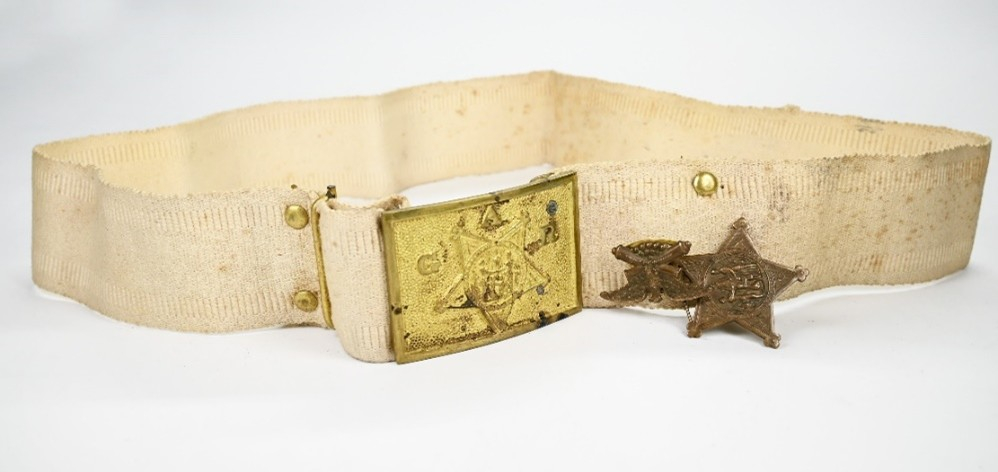
-White web GAR belt with GAR belt plate and attached GAR Medal
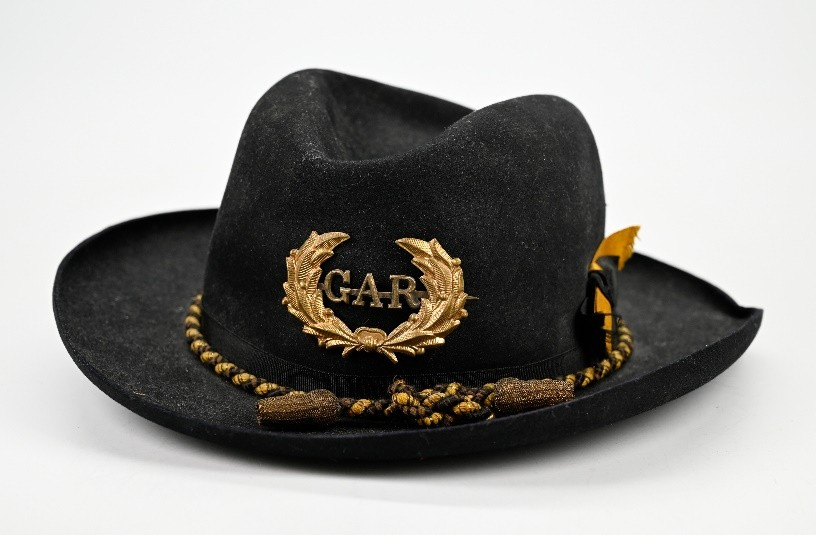
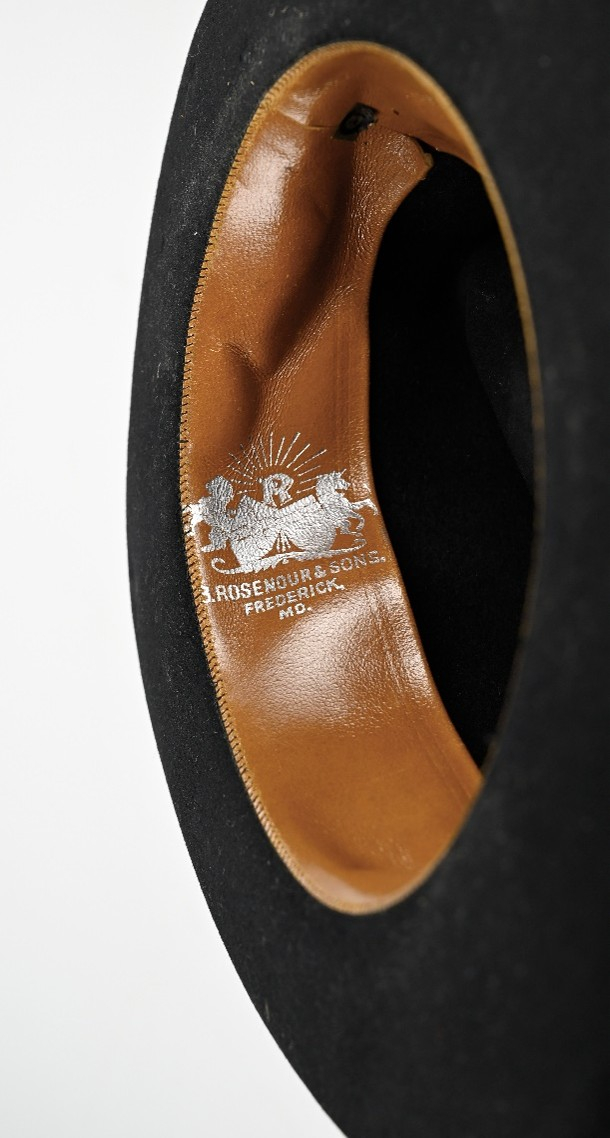
-GAR Hat, with metal badge and hat cord. Rosenour & Sons, Frederick, MD embossed sweat band. Dd
This is great officer’s archive with both historical and eye-appeal, and is of some depth. [sr][ph:L]
~~~~~~~~~~~~~~~~~~~~~~~~~~~~~~~~~~~
THIS ITEM, AS WITH ALL OTHER ITEMS AVAILABLE ON OUR WEB SITE,
MAY BE PURCHASED THROUGH OUR LAYAWAY PROGRAM.
CLICK HERE FOR OUR POLICIES AND TERMS.
THANK YOU!
Inquire About SACK COAT, CAP, SWORD, RUBBER BLANKET, MARYLAND CAMP FLAG AND OTHER EFFECTS OF LIEUTENANT AND CAPTAIN CHARLES N. KUHN, WOUNDED IN ACTION AT CEDAR CREEK WHILE BRIGADE ACTING AIDE-DE-CAMP AT CEDAR CREEK
Most Popular
Historical Firearms Stolen From The National Civil War Museum In Harrisburg, Pa »
Theft From Gravesite Of Gen. John Reynolds »
Selection Of Unframed Prints By Don Troiani »
Fine Condition Brass Infantry Bugle Insignia »
featured item
PENNSYLVANIA INFANTRY AND CAVALRY SOLDIERS’ ARCHIVE FROM THE WALLACE FAMILY: SOLDIER LETTERS, ARMED TINTYPE, RARE BLAKESLEE CARTRIDGE BOX FOR THE SPENCER, ETC.
This grouping contains 25 camp letters from eight Pennsylvania soldiers, along with miscellaneous covers, and minor post-war pension correspondence: Benjamin Wallace, Co. “D”, 11th PA Cavalry (15) David Wallace, Co. “A”, 165th PA Volunteers /… (2026-485). Learn More »
site search