


site search
online catalog
REGULATION US CONTRACT CIVIL WAR DRUM BY ERNEST VOGT OF PHILADELPHIA
Hover to zoom
$9,000.00
Quantity Available: 1
Item Code: 282-453
Shipping: Determined by Method & Location of buyer
To Order:
Call 717-334-0347,
Fax 717-334-5016, or E-mail
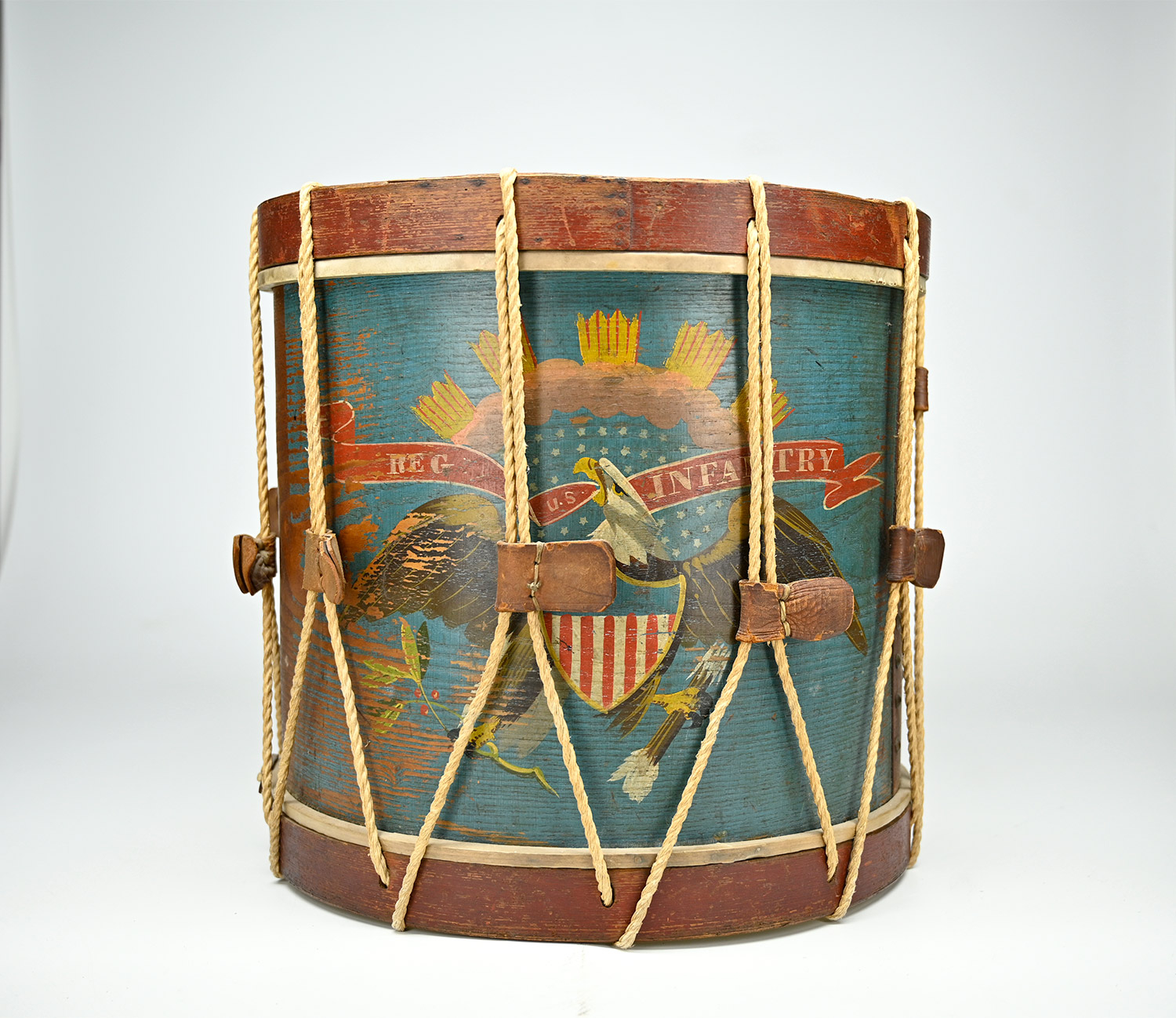
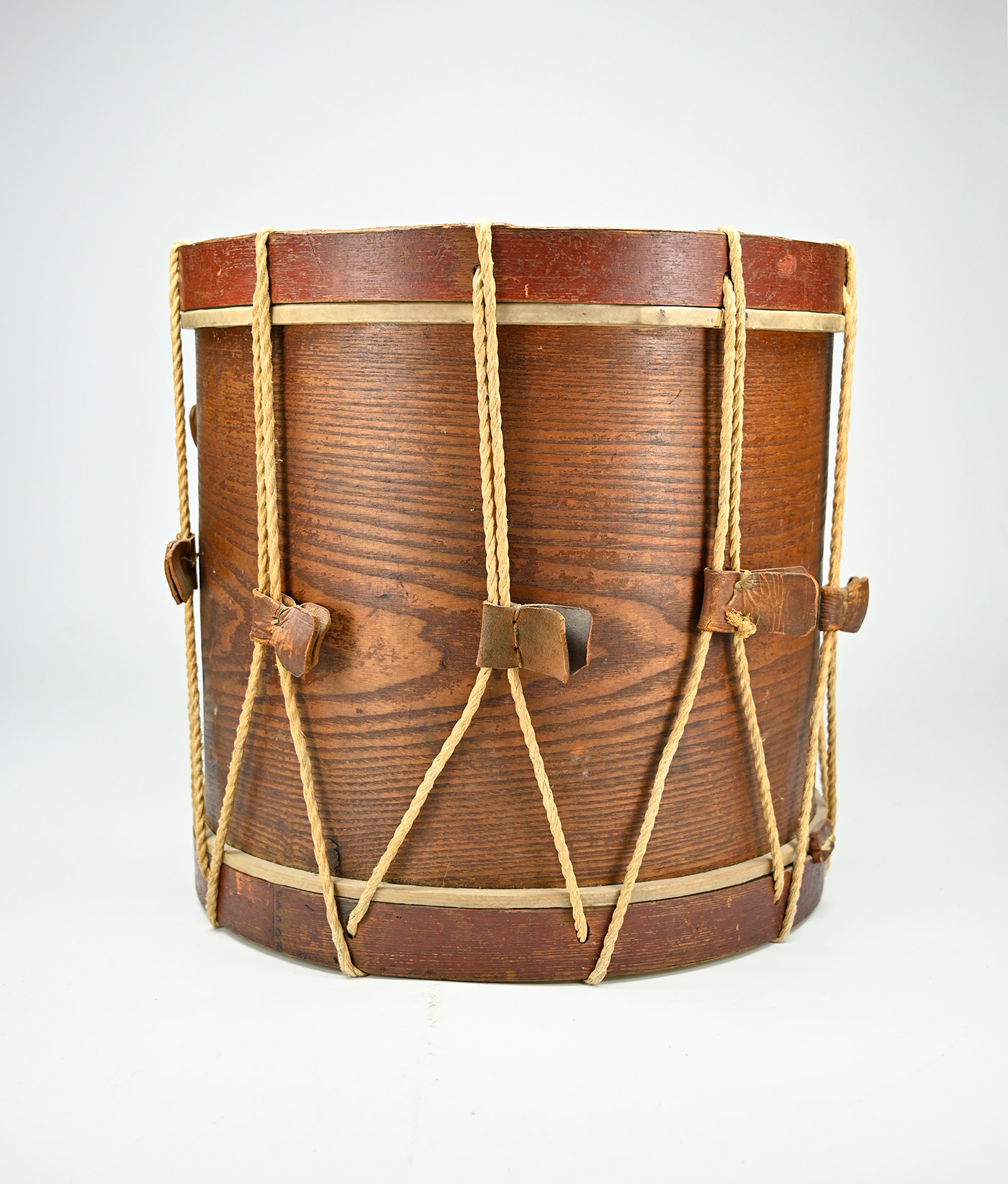
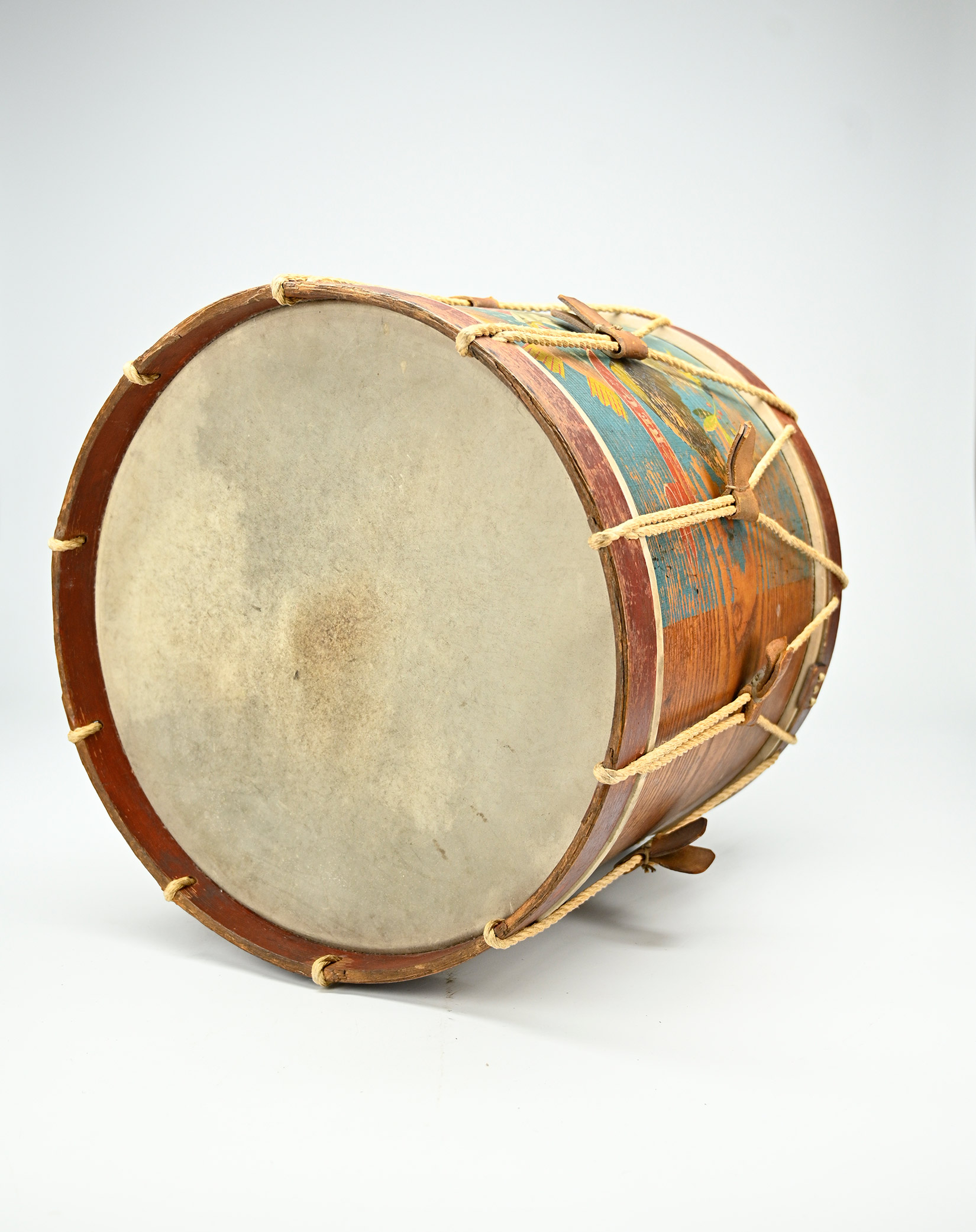
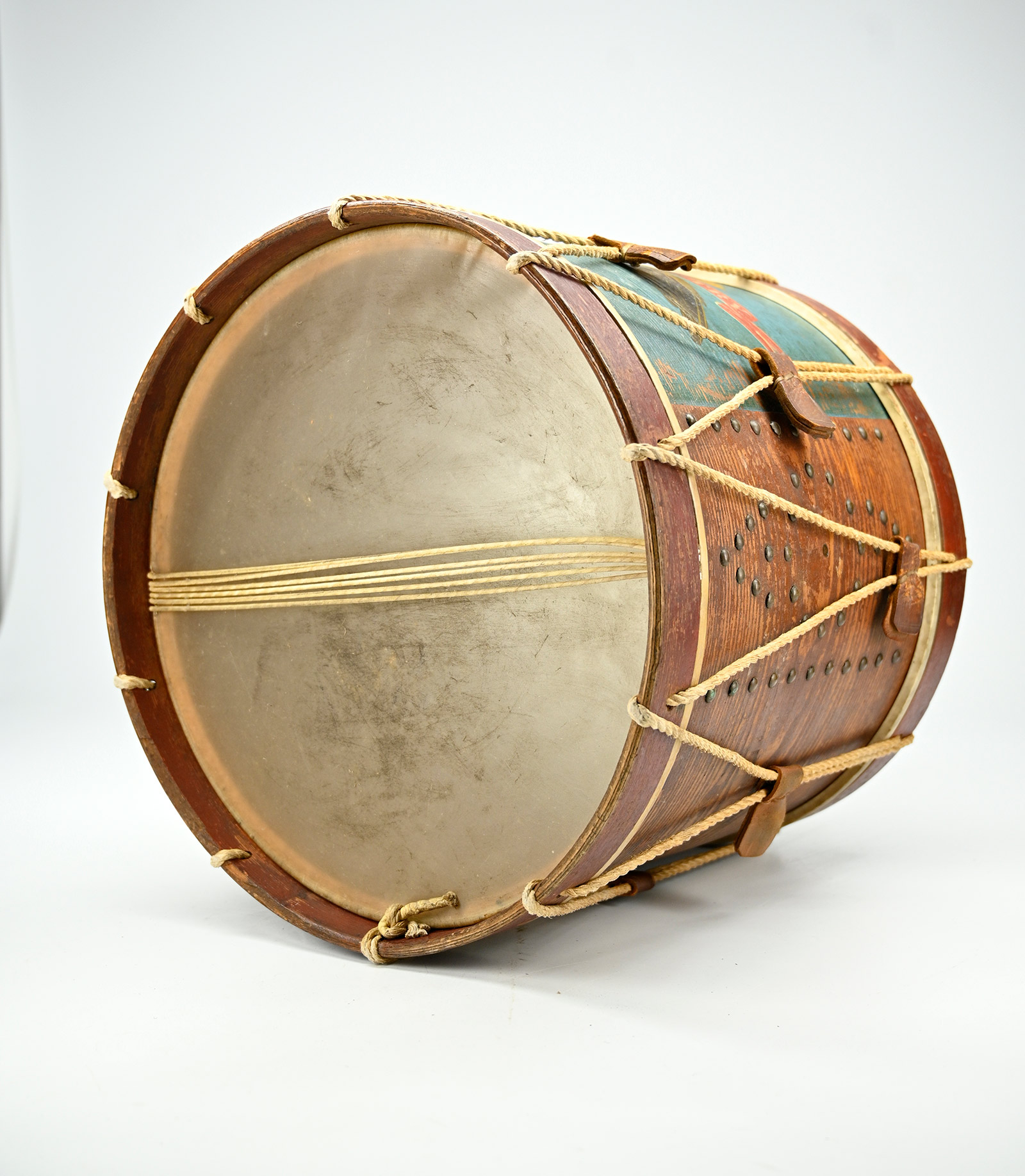
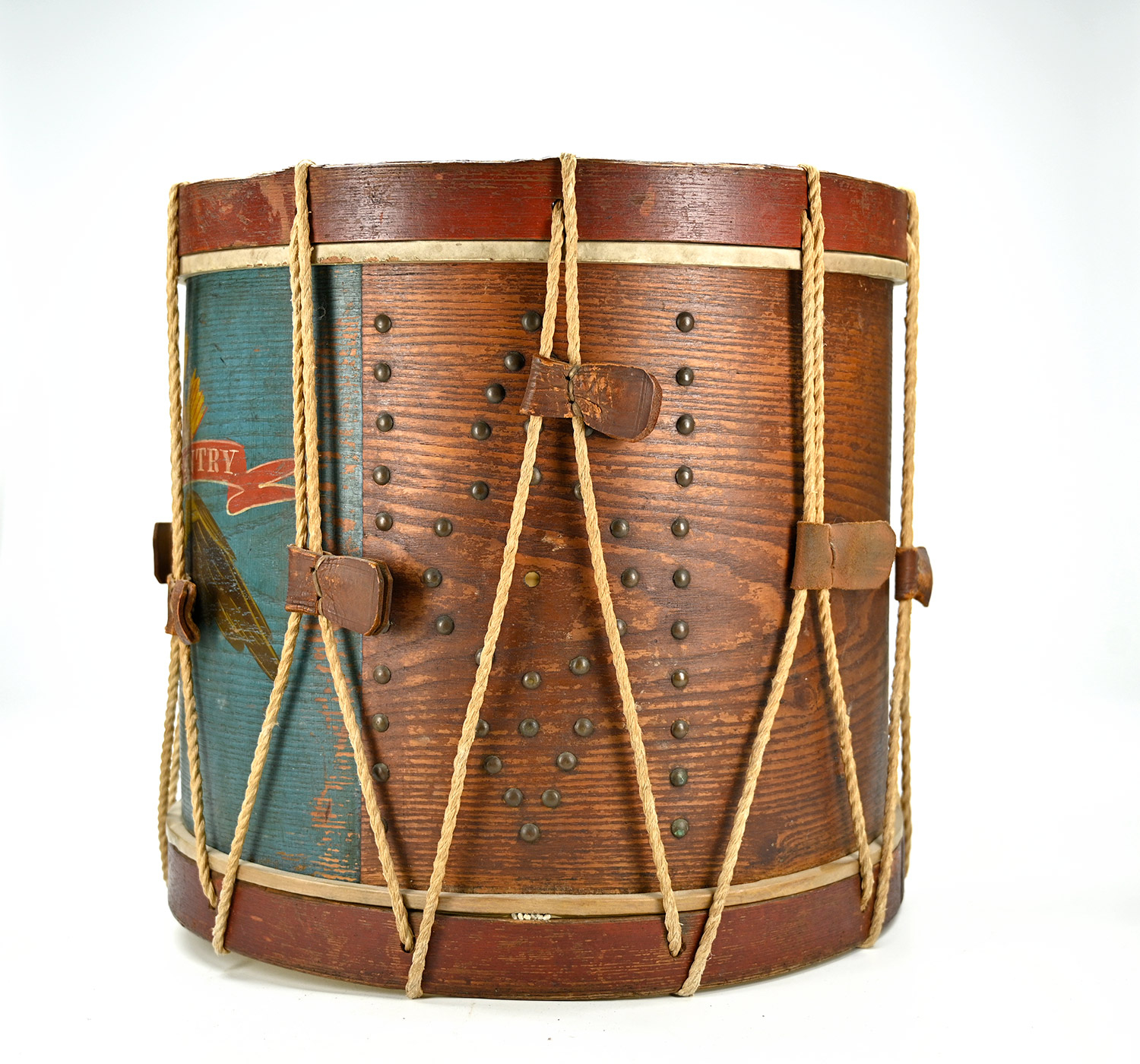
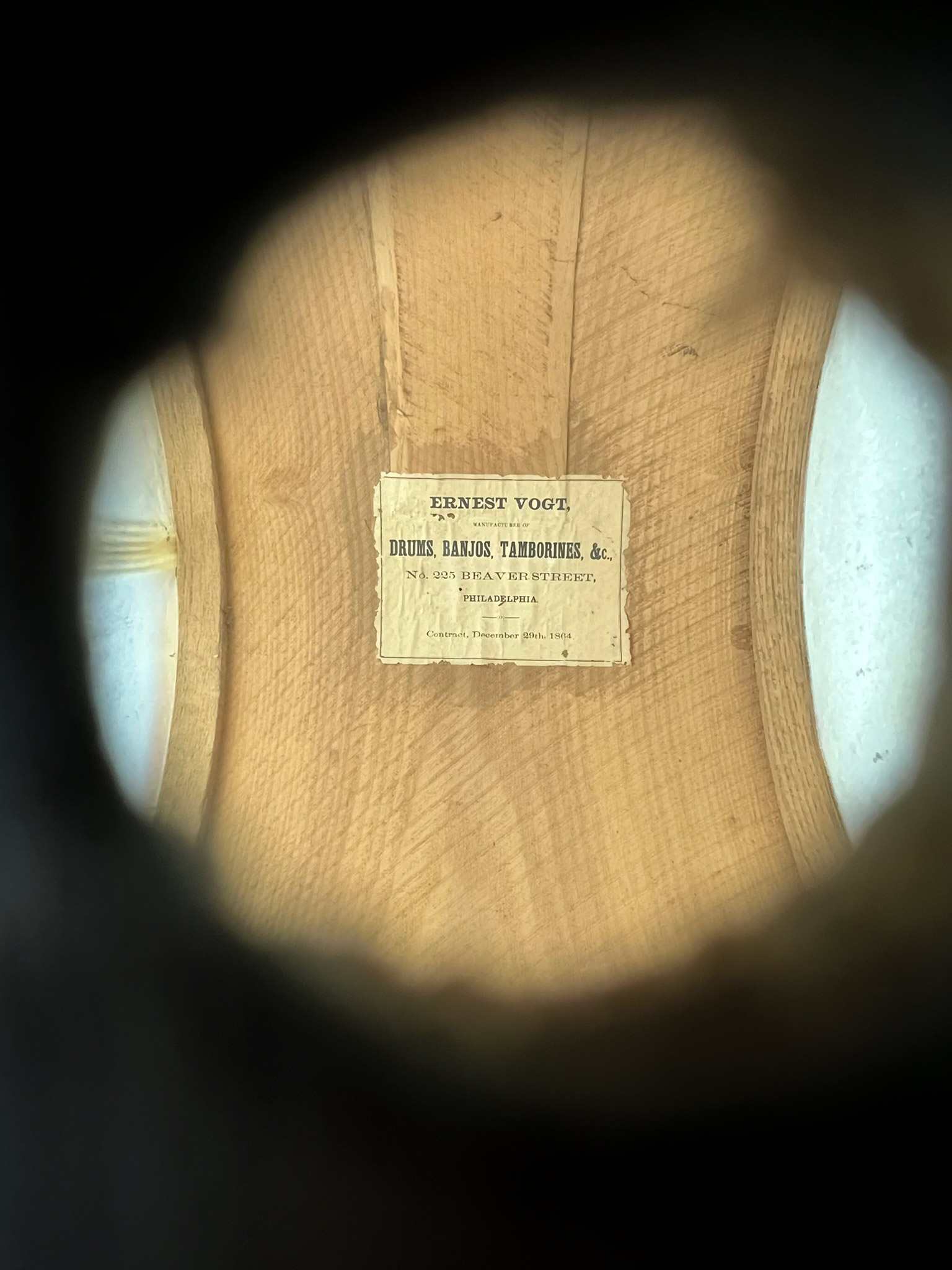
A very good example of the desirable Civil War “eagle drum” made and marked by Ernest Vogt of Philadelphia under an 1864 US government contract. They don’t get more “regulation” than this. Measuring 16-inches high and 16-1/4-inches in diameter overall (with 15-1/2-inch diameter shell- inner edge to inner edge of the hoops,) the drum has bright, original paint showing only minor wear, a full, very clear, original maker/contractor label inside, visible through the vent hole, and is complete with rims, heads, rope, tighteners, snare.
The painted eagle is regulation, centered on a rectangular light blue panel, depicting the arms of the U.S. The eagle spreads its wings beneath an arc of clouds behind which red-highlighted yellow bursts of sun rays herald the rising of the sun after a storm. The eagle bears a United States shield on its chest, clutches an olive branch in one claw and a bundle of arrows in the other, and flourishes a white-bordered red scroll bearing “REG[t] U.S. INFANTRY” in white.
The paint is bright and not muted, as is often the case, by age-darkening of a varnish overlay that often makes the blue a dull green. There is evident wear to the paint, mainly on the left edge of the panel, slightly affecting the eagle’s wing on that side, some of the olive branch and the eagle’s leg next to it, but the wear is largely to the blue background, leaving the motif largely unaffected. There is also the usual striation visible along the grain lines of the ash shell, but few losses. Please see our photos. The small white suprascript “t” at the end of “REGt.” on the ribbon scroll is rubbed and there is a small dark spot on the “G,” but the rest shows only minor rubs and is fully visible. We see no signs of any in-painting or restoration to the paint.
The maker’s label is fully intact and legible, viewable through the vent hole as usual. It reads: “ERNEST VOGT,/ MANUFACTURER OF / DRUMS, BANJOS, TAMBORINES, &C. / No. 225 BEAVER STREET, / PHILADELPHIA / Contract, December 29th, 1864.” Vogt’s contact called for 2,000 drums. Vogt is picked up in the 1860 census as a 30-year old piano maker in Philadelphia, born in Germany, with a wife and two children. Bazelon indicates he first shows up in Philadelphia listings in 1855 and an 1855 arrival date seems confirmed in passenger and immigration lists. Bazelon notes a George Vogt is listed Philadelphia in 1852, also as piano maker, suggesting a family connection that may have drawn him to the city. He had several business addresses over the year. Bazelon dates the 225 Beaver Street address as dating 1863-1865. He continued dealing in musical instruments after the war, but by 1870 is listed in the census as a cabinet maker. That listing also gives his age as 55, pushing his birthdate back to 1825, but we believe he is the Ernest Vogt buried in Bala Cynwyd, PA, born in 1831 and died Feb. 19, 1898.
The pattern of the eagle on the is drum is one of at least two noted on Vogt drums, indicating that he, like other Philadelphia makers, likely subcontracted the paint work, a combination of stencil and freehand, to local artisans, something not unexpected as rather specialized work and necessary to supply 2,000 drums. Some of the most notable differences in the two designs used by Vogt are in the eagle’s claws and bundle of arrows, with more subtle differences in the head, etc., but the simplest distinction may be in the use of five-pointed stenciled stars as here versus his use also of six-pointed stars created with simple crossed lines. We note that Soistmann drums show a similar pattern, indicating the two Philadelphia makers were using the same sub-contractor. We also note that it uses 36 stars, acknowledging Nevada’s official admission to the Union on Oct. 31, 1864.
The tack design on the overlap of the shell is also characteristic of Vogt: a circle of round-headed brass tacks rings the vent hole, which correctly lacks an insert, with a triangle or arrowhead of tacks set above and below, respectively pointing up and down, with the design bordered as usual with a vertical row of tacks to either side helping secured the overlap from top to bottom of the shell.
The rope and some of the leather tighteners were replaced, something not uncommon. The rims are original to the drum and show just minor rubs to the red paint and a little abrasion along the top edge, again, nothing unusual from handling and storage over many decades, and nothing egregious. The heads and snare are in very good condition, but show some light age stains and may be original to it as well, though often replaced on drums during their period of use.
Drummers provided a valuable service and were in the ranks throughout the war. As a cost-cutting measure bands tended to be restricted to brigade and higher-level organizations after late 1862, but company musicians, usually a drummer and a fifer to each infantry company, with an occasional bugler making his way in, served as a regimental “drum corps” to the end. They acted as morale boosters on parade and on the march and signaled the different daily routines of army life in camp and on campaign, usually being drawn off and attached to the medical staff when their units went into action, helping casualties off the field or tending to them in hospital.
For additional details on Vogt and Civil War drums in general, see Bazelon’s Directory, Vols. 1 and 2; Elrod’s Pictorial Hist. of CW Era Musical Instruments and Military Bands; Caba’s book on US Military Drums; articles on drums in the Magazine Antiques by Guthman and by Swanson, as well as recent online studies such as “Rudiments and Rope.”
This is a very strong example that could be the centerpiece of any Civil War display. [sr] [ph:L]
Extra shipping required.
~~~~~~~~~~~~~~~~~~~~~~~~~~~~~~~~~~~
THIS ITEM, AS WITH ALL OTHER ITEMS AVAILABLE ON OUR WEB SITE,
MAY BE PURCHASED THROUGH OUR LAYAWAY PROGRAM.
CLICK HERE FOR OUR POLICIES AND TERMS.
THANK YOU!
Inquire About REGULATION US CONTRACT CIVIL WAR DRUM BY ERNEST VOGT OF PHILADELPHIA
Most Popular
Historical Firearms Stolen From The National Civil War Museum In Harrisburg, Pa »
Theft From Gravesite Of Gen. John Reynolds »
Selection Of Unframed Prints By Don Troiani »
Fine Condition Brass Infantry Bugle Insignia »
featured item
REMARKABLE SWORD IDENTIFIED TO GEORGE WILLIAM GORDON (1801-1877), US CONSUL TO BRAZIL (1840-46) AND SLAVE TRADE OPPONENT
A remarkable sword manufactured by W.H. Horstmann & Co., New York after the Model 1834 US Revenue Cutter/Marine sword. Neatly engraved on the reverse folding guard, “Geo. Wm. Gordon / United States Consul”. Born on February 8, 1801 in Exeter,… (870-60). Learn More »
site search