


site search
online catalog
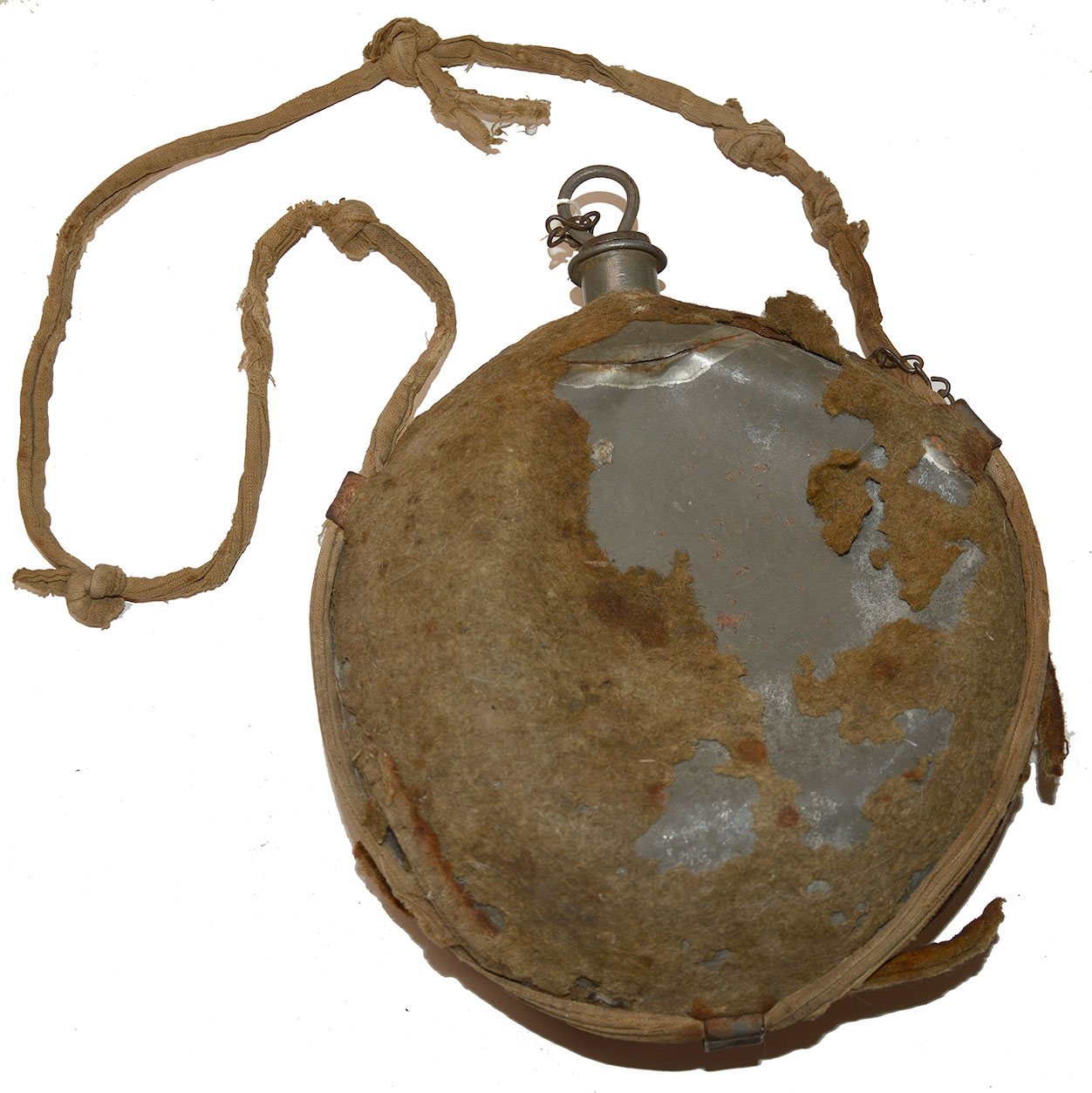
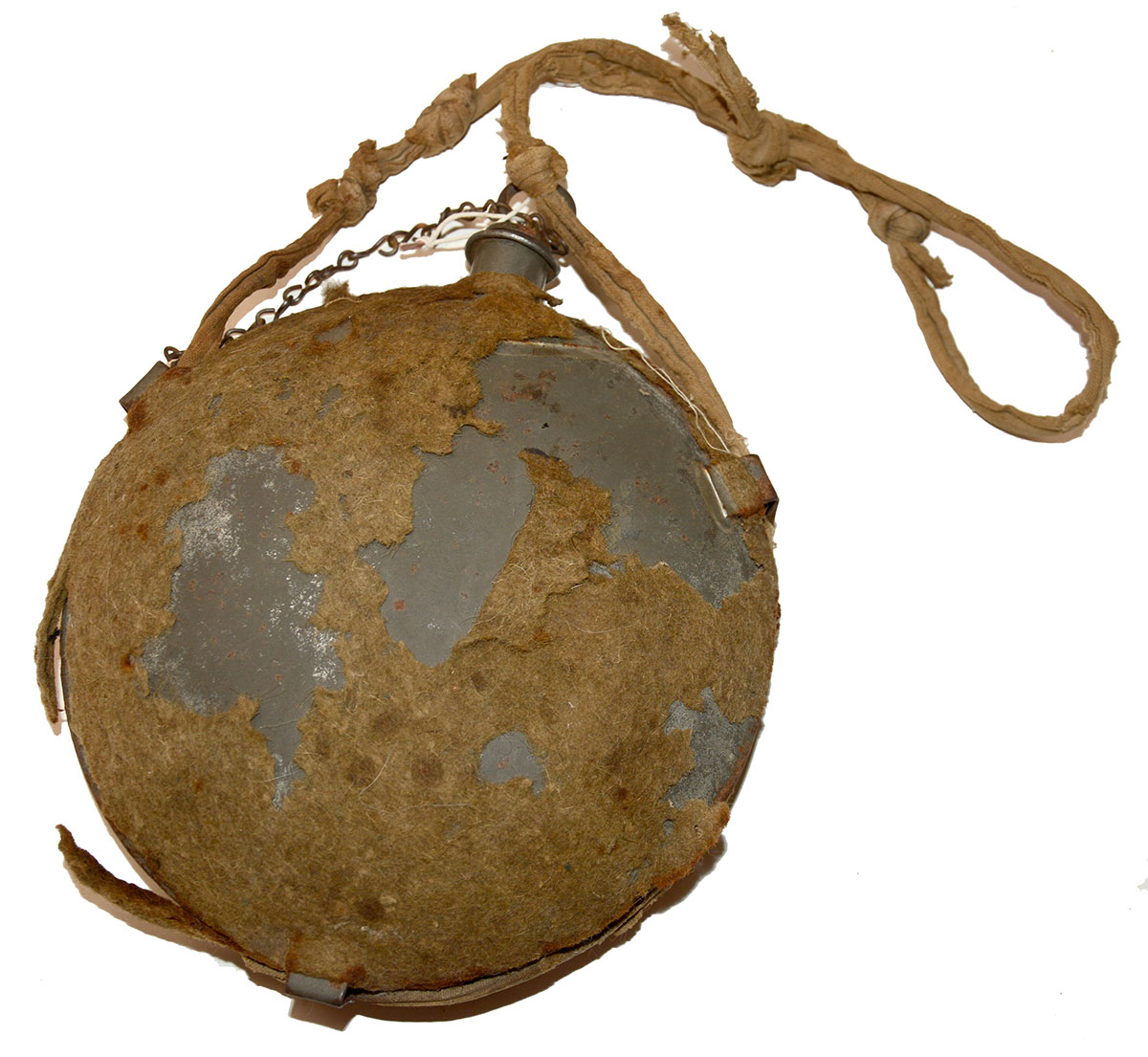
SMOOTHSIDED NEW YORK DEPOT PATTERN CANTEEN OF PERLEY WHITTIER, CO. K 24th MAINE
Hover to zoom
$595.00
Quantity Available: 1
Item Code: 1179-229E
Shipping: Determined by Method & Location of buyer
To Order:
Call 717-334-0347,
Fax 717-334-5016, or E-mail
This item comes from a grouping of items from Perley Whittier of the 24th Maine that included some very scarce material. The regiment was a nine-month unit that campaigned in the deep south and took part in the siege of Port Hudson, helping to open up the Mississippi. Perley served with them from muster in to muster out of the regiment. The grouping as a whole showed just expected and desirable signs of field use; two of the items had his name stenciled in them.
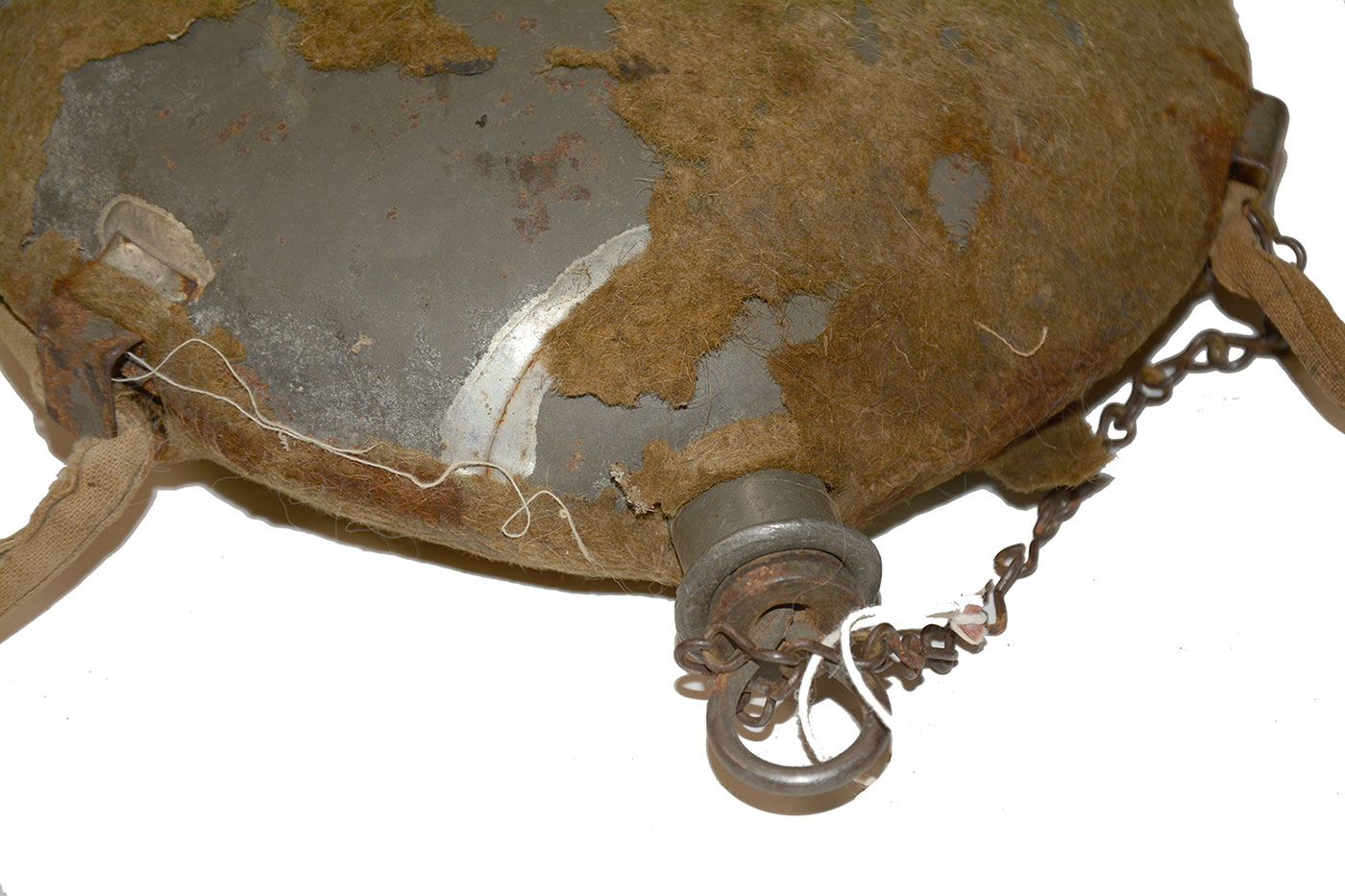
The canteen is a smooth-sided New York Depot pattern with stopper and chain in place. The strap was broken and knotted five times and is consequently shorter. The cover is brownish-gray wool, about 40% there, with a deep push to one side that has partially undone the soldered overlap of the spout collar on that side. A few small areas of bright tin remain. Most of the metal shows as gray with some crusty brown on the seam where it is exposed by losses to the cover.
Perley Whittier (1839-1918) is picked up in the 1860 census living and working on his parents’ farm in Vienna, Maine. He joined for duty and enrolled at age 23 on September 10, 1862, mustering in for nine-months’ service as a private in Company K of the 24th Maine at Augusta on Oct. 13. The muster roll covering Sept. 10 to Oct. 31 was apparently incomplete and his presence or absence is simply “not stated,” but he is listed as present on all subsequent bi-monthly rolls through June 1863 and mustered out with the company on Aug. 25, 1863.
Dyer summarizes their service as follows. The regiment was mustered in October 16, 1862, left State for New York City October 29, and was posted in “East New York” until January 12, 1863, when they moved to Fortress Monroe, Va., and from there to New Orleans, arriving Feb. 14, 1863. They moved to Bonnet Carre, La., Feb. 26 and were on duty there till May as part of the 3rd Brigade, 2nd Division, 19th Army Corps, Dept. of the Gulf. The took part in the following actions and campaigns: Expedition to Ponchatoula and Amite River March 21-30. Capture of Ponchatoula March 24. Amite River March 28. Expedition to Amite River May 7-21. Civiques Ferry May 10. Advance on Port Hudson May 21-24. Siege of Port Hudson May 24-July 8. Assaults on Port Hudson May 27 and June 14. Surrender of Port Hudson July 8. They were ordered home July 24, and finally mustered out August 25, 1863.
Whittier states in his pension file that he was never hospitalized while in the army, but was excused from duty at times because of sickness, disease or injury, claiming to have suffered from fever, ague, chronic diarrhea, and back pain from “putting up sandbags” in the entrenchments during the siege of Port Hudson and also to have been sick on his return home, missing the official mustering out ceremony of the regiment. Much of this he blamed on the southern climate and exposure, as did most sufferers at the time. The regiment’s Colonel chafed at delays in getting the regiment home when their term of service was about to expire, noting the vicissitudes of their service- they had been, “often under a severe fire” during the siege and were frequently called upon to “build roads and bridges. Nearly every night the men were ordered to work on earthworks and rifle pits,” and even after the surrender they were doing guard duty in the blazing sun. Whittier, himself, mentions being “obliged to sleep in the mud and water in the trenches without any shelter except a blanket . . .” in his pension file, though a later doctor’s certificate mentions malaria, or “malarial poisoning,” as a factor. Indeed, the regiment as a whole illustrates dramatically the fact that Civil War units lost far more men to sickness and disease than enemy bullets. They had left the state about 900 strong. Only 570 returned. At least 184 men had died of sickness or disease and another 100 or so had been discharged for disability. Indeed, numbers of sick were left behind in hospitals on the way home. Others died soon after reaching home. Battle casualties might have reached a dozen. (See Brian Swartz’s excellent 2022 online article on these points.)
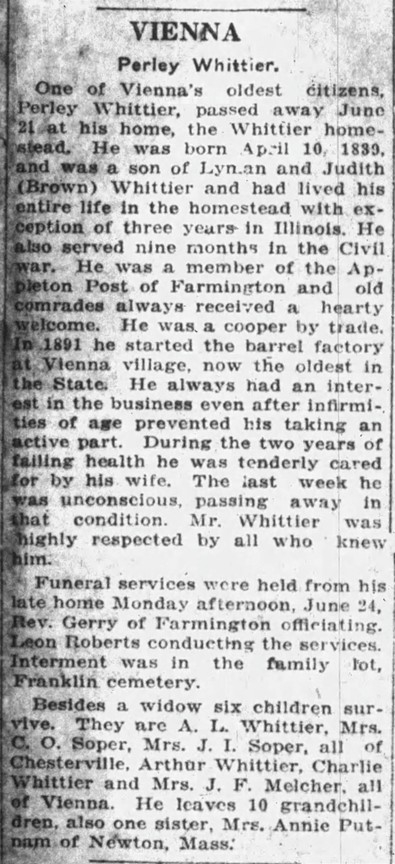
Whittier suffered a number of health problems after the war that he attributed to his army experiences, but preserved these pieces as mementos of his service. He spent nearly his entire life in Vienna, Maine, with the exception of three years in Illinois and his time in the army. By 1870 he was married and a cooper by occupation, a trade he followed the rest of his life. He seems to have had at least seven children and passed away in Chesterville, Maine in June 1918, survived by his wife and six of his children. He was interred in Vienna, where he had enlisted more than fifty-five years earlier.
This is an item from a great, untouched grouping that displays well and was formerly in the Texas Civil War Museum collection. [sr][ph:L]
~~~~~~~~~~~~~~~~~~~~~~~~~~~~~~~~~~~
THIS ITEM, AS WITH ALL OTHER ITEMS AVAILABLE ON OUR WEB SITE,
MAY BE PURCHASED THROUGH OUR LAYAWAY PROGRAM.
CLICK HERE FOR OUR POLICIES AND TERMS.
THANK YOU!
Inquire About SMOOTHSIDED NEW YORK DEPOT PATTERN CANTEEN OF PERLEY WHITTIER, CO. K 24th MAINE
Most Popular
Historical Firearms Stolen From The National Civil War Museum In Harrisburg, Pa »
Theft From Gravesite Of Gen. John Reynolds »
Selection Of Unframed Prints By Don Troiani »
Fine Condition Brass Infantry Bugle Insignia »
Rare Identified 65Th Ny Sergeant’s Jacket, With Manscript Material: 1St U.s. Chasseurs »
featured item
RARE ID’D FIELD PRESENTATION BUGLE JACOB KECK - 7TH NEW YORK, 9TH NYSM (83RD NY), 97TH NEW YORK
This handsome instrument is in exquisite condition and is professionally inscribed in cursive with the words, “Presented to / J. F. Keck, / By the Members of the / 9th N.Y.S.M / in the Field. / March 1864”. Very rarely were bugles or such musical… (2024-1443). Learn More »
site search