


site search
online catalog
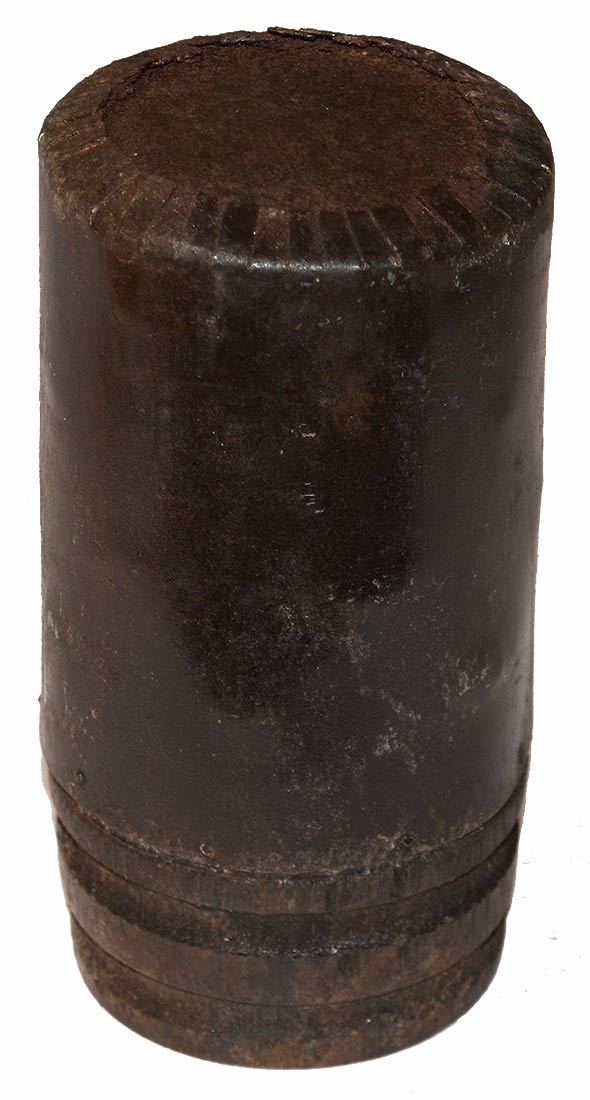
ORIGINAL NON-EXCAVATED 12-POUND CANISTER ROUND
Hover to zoom
$2,500.00 SOLD
Quantity Available: None
Item Code: 1130-06
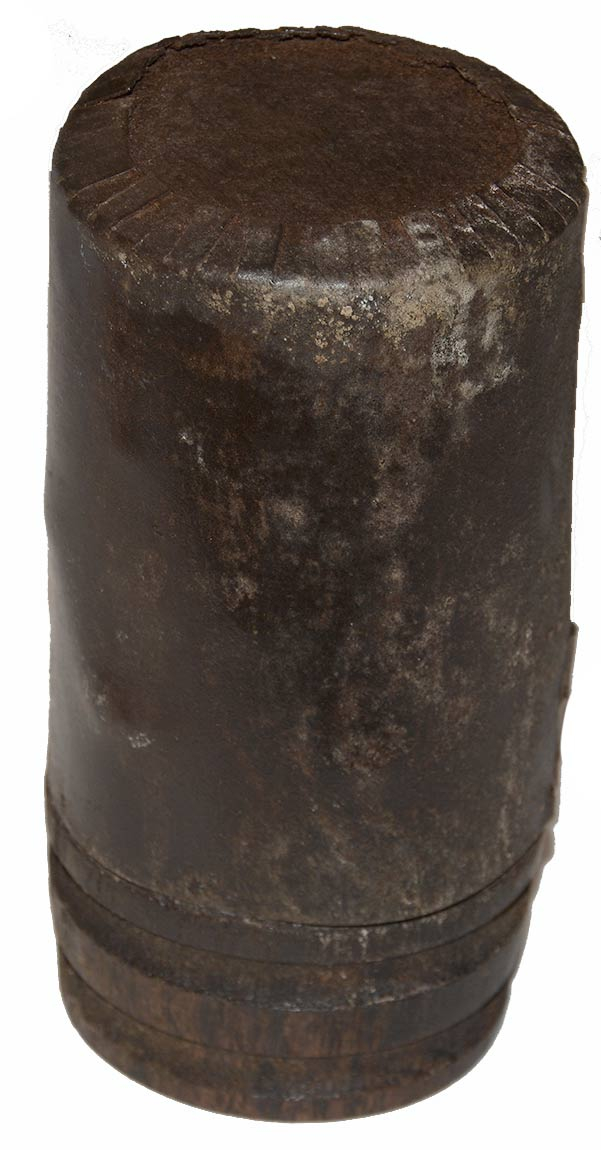
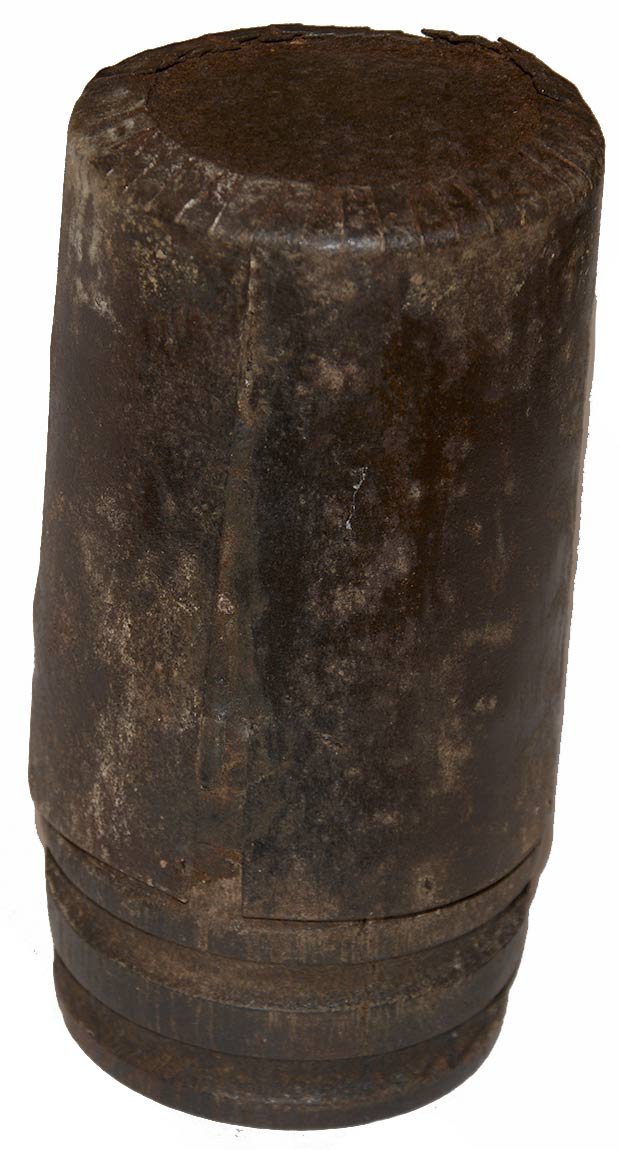
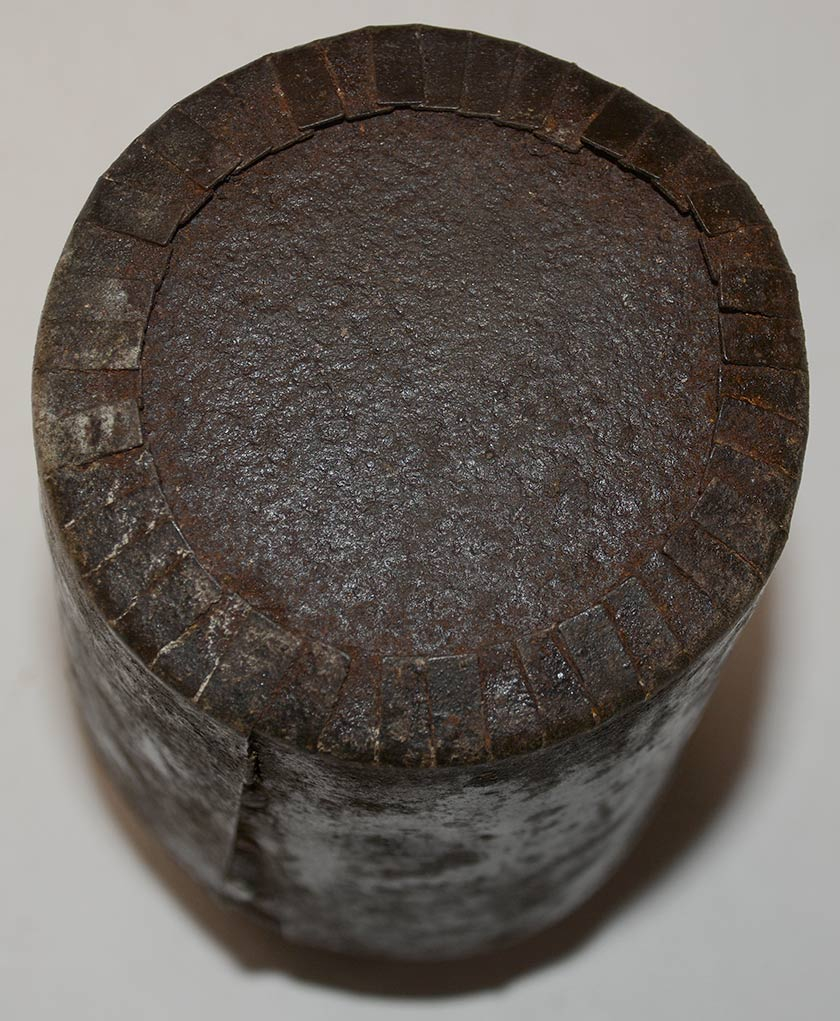
This is an original, non-excavated, complete, intact Civil War canister round for 12-pounder Napoleon, also known as the “Light 12-pounder Gun” or “Gun-Howitzer,” the smoothbore bronze cannon adopted in 1857 and one of main weapons of Civil War field artillery. This measures 3 ½ inches wide, and about 7 inches tall overall. The actual weight is about 7 pounds. These contain 27 iron balls about 1 ½ inches in diameter, held in a tinned-iron cylinder with iron top and bottom plates, and nailed at the lower side to a wood sabot at bottom that is grooved so that a powder bag with the propellant charge can securely be tied on to create a “fixed” round. The top edge of the body is cut to form small flanges that are bent over to secure the upper plate and contents.
The condition is excellent. The canister and sabot show a good deal of original lacquer, now slightly reddish, with rubbed areas showing light gray from the tinned iron beneath. The top plate shows some thin rust, but no holes or damage and the flanges are good. The wood sabot is very good as well. The seam is good, though we note the maker apparently miscalculated and had to insert a small piece at the very bottom edge to make the sides meet. This is an original, intact, surplus Civil War round. These are very hard to find in this condition. Most are assembled from excavated parts (not that there is anything wrong with that since it shows the internal construction- and one of those would display nicely next to this.)
Canister was the close-in and sometimes last-ditch anti-personnel round for Civil War artillery. At a distance artillery crews would fire case-shot at infantry- explosive shells filled with shrapnel balls that if timed right would explode over the heads and somewhat in front of enemy infantry sending not only the shell fragments, but the balls also, down into their ranks. As distance closed to about 400 yards, the gun crews would switch to non-explosive canister like this. Upon firing the cylinder would disintegrate with the balls effectively turning the gun into a giant shotgun. The range would be short enough the gun could be fired point-blank, with no elevation, though a careful gunner might try for a grazing round, striking the ground about halfway to the target to ricochet up at the same angle, leaving no dead space where a ball might go over the head of an advancing infantryman. In desperate situations a crew might resort to loading one canister round on top of another to increase its lethality. The classic artillery monument at Gettysburg bears the inscription, Double canister at ten yards,” reflecting the fighting at the height of Pickett’s Charge.
This is a very strong example of classic Civil War artillery round, frequently mentioned by veterans who had made assaults on enemy lines. [sr][ ph:L]
~~~~~~~~~~~~~~~~~~~~~~~~~~~~~~~~~~~
THIS ITEM, AS WITH ALL OTHER ITEMS AVAILABLE ON OUR WEB SITE,
MAY BE PURCHASED THROUGH OUR LAYAWAY PROGRAM.
CLICK HERE FOR OUR POLICIES AND TERMS.
THANK YOU!
Inquire About ORIGINAL NON-EXCAVATED 12-POUND CANISTER ROUND
Most Popular
Historical Firearms Stolen From The National Civil War Museum In Harrisburg, Pa »
Theft From Gravesite Of Gen. John Reynolds »
Selection Of Unframed Prints By Don Troiani »
Fine Condition Brass Infantry Bugle Insignia »
featured item
CAPTURED CONFEDERATE SECOND NATIONAL FLAG, UNUSUAL VARIATION WITH MADAUS LETTER, FROM A SOLDIER IN THE 59th NEW YORK
This 2nd National Confederate Flag was purchased in the 1980s by a well-respected Florida dealer/collector directly from descendants of the Union soldier who had kept it as a trophy. It comes with a 1988 letter on Milwaukee Public Museum letterhead… (1179-019). Learn More »
site search