


site search
online catalog
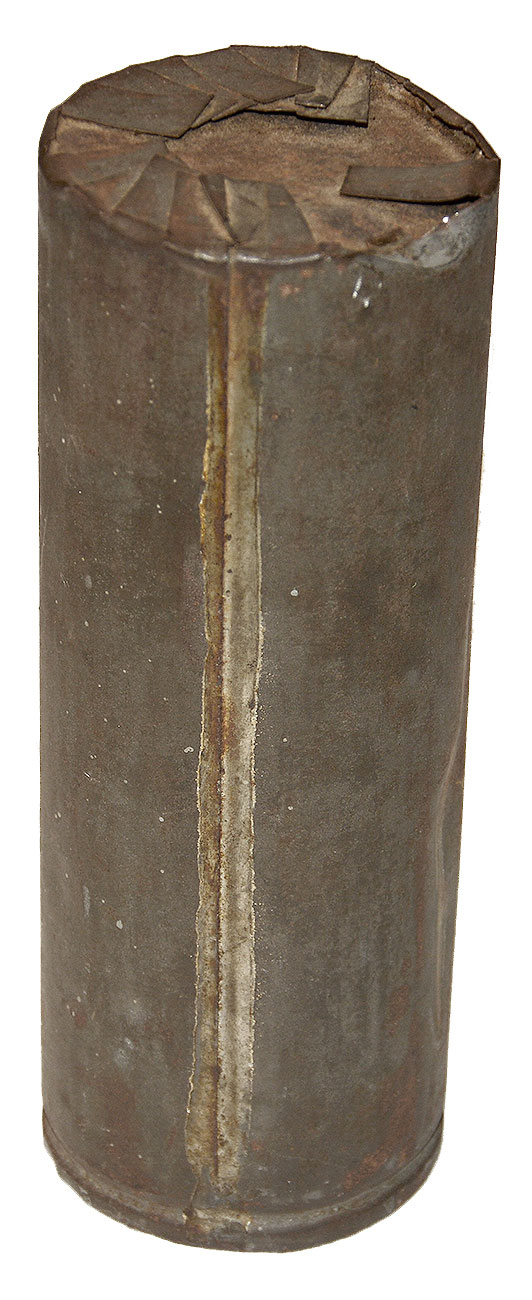
ORIGINAL CIVIL WAR NON-EXCAVATED 3-INCH HOTCHKISS CANISTER ROUND
Hover to zoom
$2,295.00 ON HOLD
Quantity Available: 1
Item Code: 1130-18
Canister was the close-in and sometimes last-ditch anti-personnel round for Civil War artillery. At a distance artillery crews would fire case-shot at infantry- explosive shells filled with shrapnel balls. At about 400 yards, the gun crews would switch to canister, tinned iron cylinders packed with lead or iron shot stabilized in sawdust, effectively turning the gun into a giant shotgun. In desperate situations a crew might load one canister round on top of another to increase its lethality. The classic artillery monument at Gettysburg bears the inscription, “Double canister at ten yards,” reflecting the close fighting at the height of Pickett’s Charge.
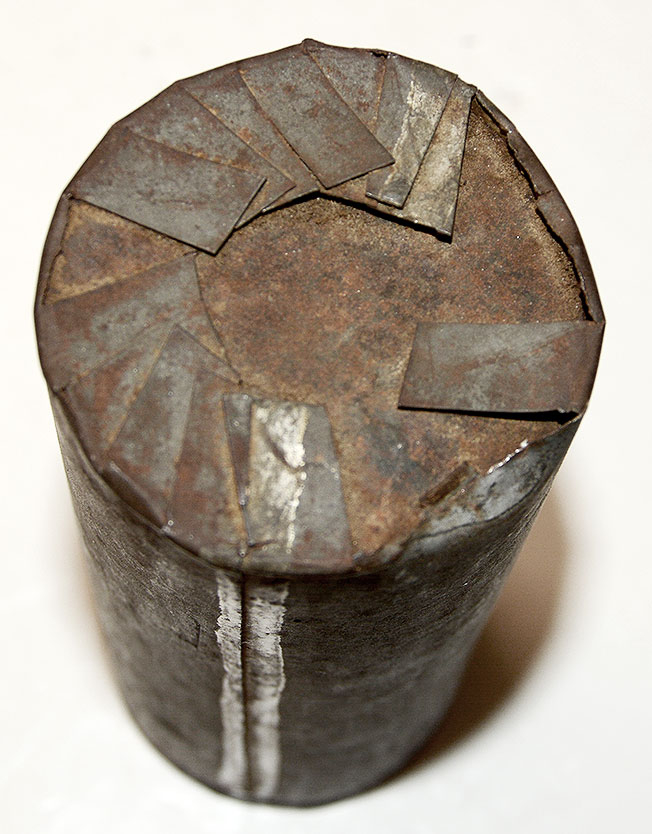
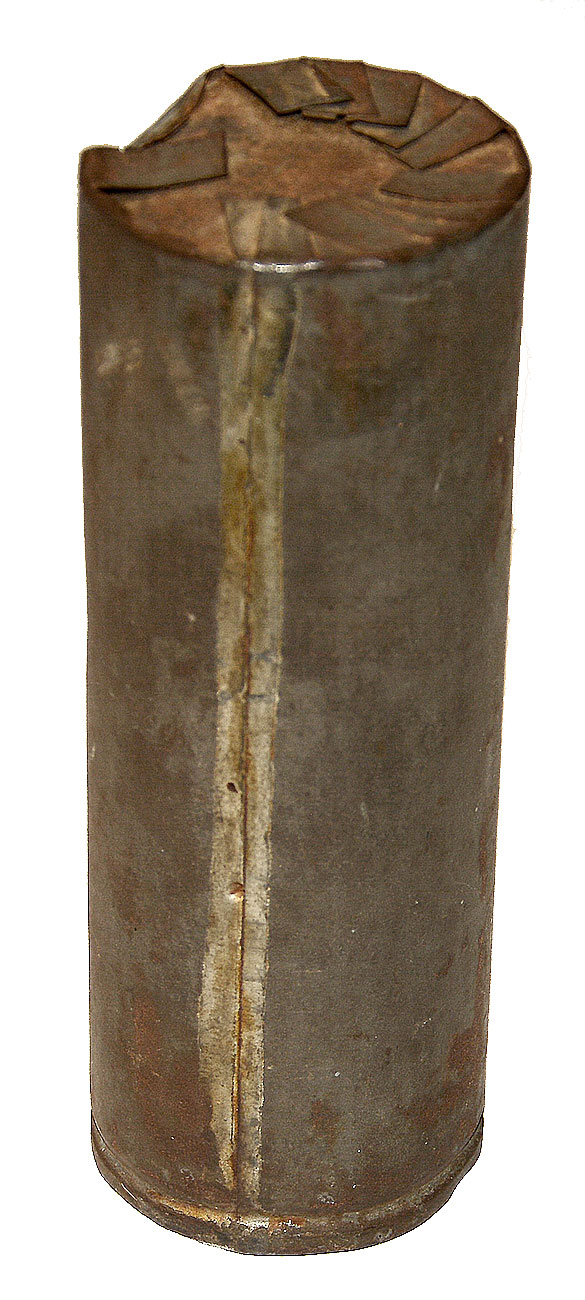
Measuring 2.9” in diameter and 8” tall, and weighing about 6 pounds, this is an original, non-excavated, complete, and marked Civil War canister round for the 3-Inch Ordnance Rifle and rates good for condition. The tinned iron case shows as a uniform gray with the soldered vertical seam a lighter, muted silver gray with some age stains. There are some rubs, but no significant areas where the tin rubbed off allowing the iron to oxidize. These canister rounds are made with an iron plate inserted in the top to hold the individual balls in place, with the iron plate in turn held down by cutting upper edge of the sides into flanges and folding them down to secure it. The iron plate is in place and shows just expected surface rust. Several of the flanges are missing, but a dozen remain, sufficient to hold the plate in place. These show some rubbing to the grayed tin coating, allowing some thin brown to show through. The missing flanges were probably broken off when the round was dropped, which also dented the upper edge of the case on one side. The dent is short and no attempt was made to straighten it since it helps retain the iron plate.
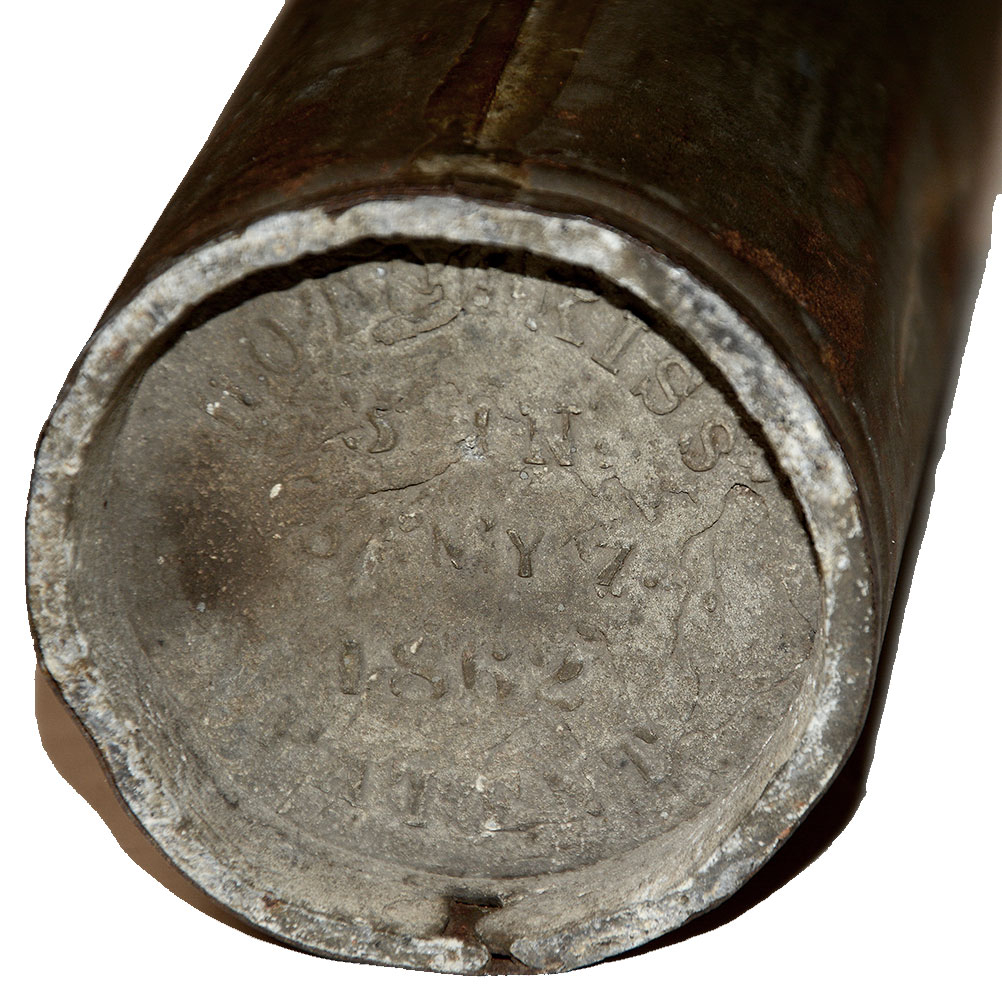
The cupped lead base with groove around the edge for securing a powder bag, is in place, secure, intact, and marked in narrow, raised letters on its underside: “HOTCHKISS / 3 IN. / JAN’Y 7. / 1862 / PATENT.” Some portions of these raised letters were chipped off by handling and storage over the years – a portion of the “3” and the “2” for instance, and others show oxidation, but they are largely legible and unambiguous. Please see our photos.
Hotchkiss’s patent (#34058, not “#34085,” a misprint in Dickey and George followed by other authors) was for the use of an interior case that had longitudinal divisions cut at an angle so at to resist outside pressure, but yield to internal pressure, hindering the case from being damaged and deformed in transportation or in moving across the grooves of the rifling, in Hotchkiss’s view thereby preventing a ball being wedged in the rifling, but permitting the case to separate easily on exiting the muzzle.
He also initially intended the cupped lead bottom (poured into the case in the manufacturing process) to obviate the need for a sabot for attachment of a powder bag. His initial proposal, however, was a bit too clever- the cupped bottom would contain a powder bag folded during transportation that could be extended and filled to make it a fixed round for use in the field, the bag having a plate to hold it within the cup by a screw and tying closed the open lower end. At some point before production, this was dropped and the base was given a simple groove, enabling a powder bag to be tied on in a more conventional way, but in keeping with the object of doing away with a separate sabot. Ironically, he made specific mention of the cupped base’s ability to “expand and fill the bore, like a Minie ball,” which was again a bit too clever, imparting a spin to the case and rotation of the balls inside when the base expanded and took the rifling, creating a wider and less effective dispersal, though at very close range and fired from several guns it may not have mattered much.
According to Dickey and George, the U.S. government purchased 100,372 of these rounds, making them a widely used, close-range, anti-personnel round. This is a very strong example of a classic Civil War artillery round, frequently mentioned by veterans who faced it in assaults on enemy lines or witnessed its terrible effects. [sr][ph:L]
UPS shipping required.
~~~~~~~~~~~~~~~~~~~~~~~~~~~~~~~~~~~
THIS ITEM, AS WITH ALL OTHER ITEMS AVAILABLE ON OUR WEB SITE,
MAY BE PURCHASED THROUGH OUR LAYAWAY PROGRAM.
CLICK HERE FOR OUR POLICIES AND TERMS.
THANK YOU!
Inquire About ORIGINAL CIVIL WAR NON-EXCAVATED 3-INCH HOTCHKISS CANISTER ROUND
Most Popular
Historical Firearms Stolen From The National Civil War Museum In Harrisburg, Pa »
Theft From Gravesite Of Gen. John Reynolds »
Selection Of Unframed Prints By Don Troiani »
Fine Condition Brass Infantry Bugle Insignia »
Rare Identified 65Th Ny Sergeant’s Jacket, With Manscript Material: 1St U.s. Chasseurs »
featured item
CONFEDERATE CAVALRY CAPTAIN’S FROCK COAT OF CAPT. EDWARD BIRD, “EFFINGHAM HUSSARS,” 2nd BATTALION AND 5th REGIMENT GEORGIA CAVALRY
This rare, identified, Confederate cavalry captain’s frock coat belonged to an officer who served from 1861 though 1865, rising from Captain to Colonel, with extensive action especially in Wheeler’s cavalry corps fighting against Sherman in the… (1179-232). Learn More »
site search