
site search
online catalog
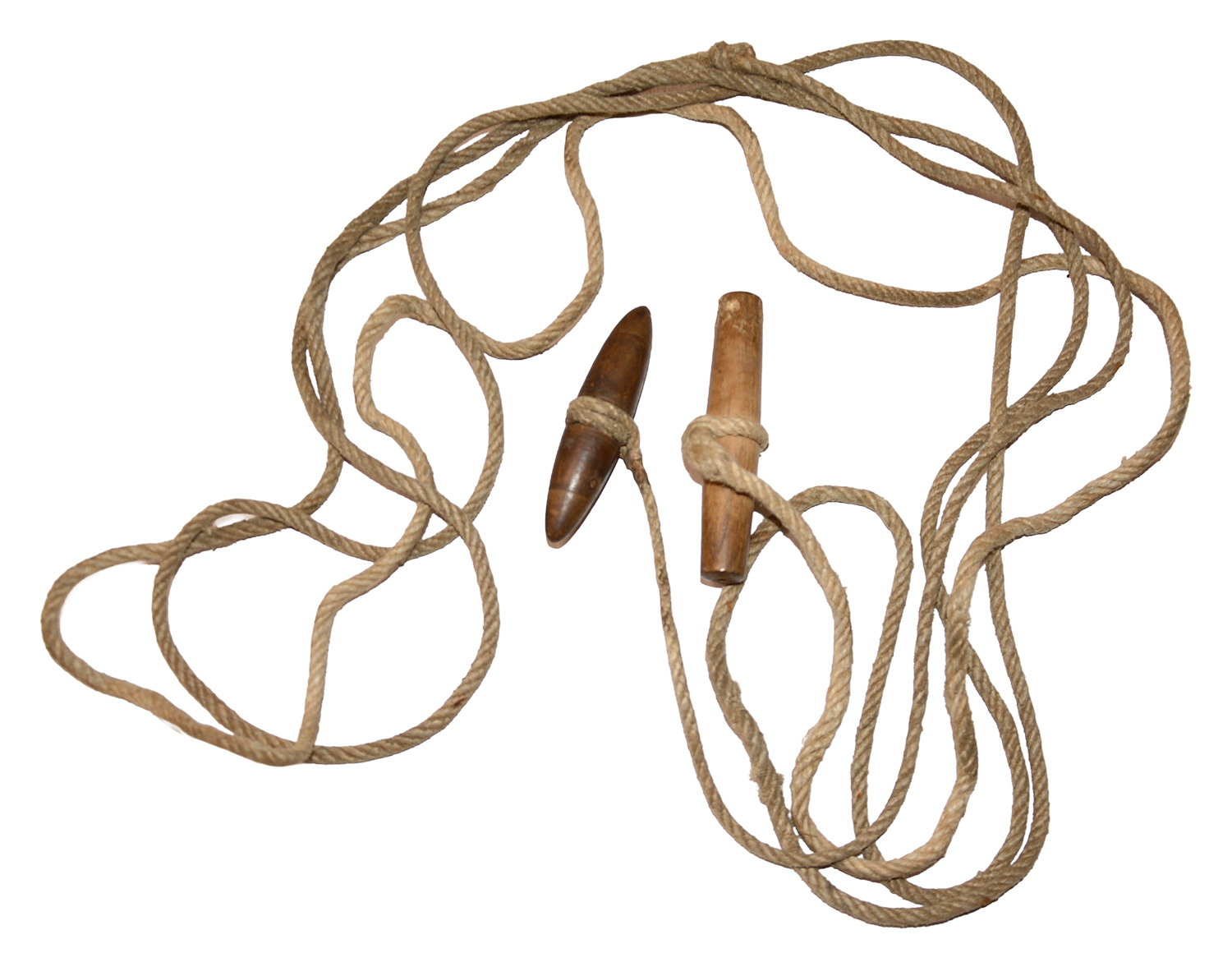
SPANISH AMERICAN WAR CANNON LANYARD GRIP FROM THE DEWEY'S FLAGSHIP
Hover to zoom
$350.00
Quantity Available: 1
Item Code: 2026-9249
Shipping: Determined by Method & Location of buyer
To Order:
Call 717-334-0347,
Fax 717-334-5016, or E-mail
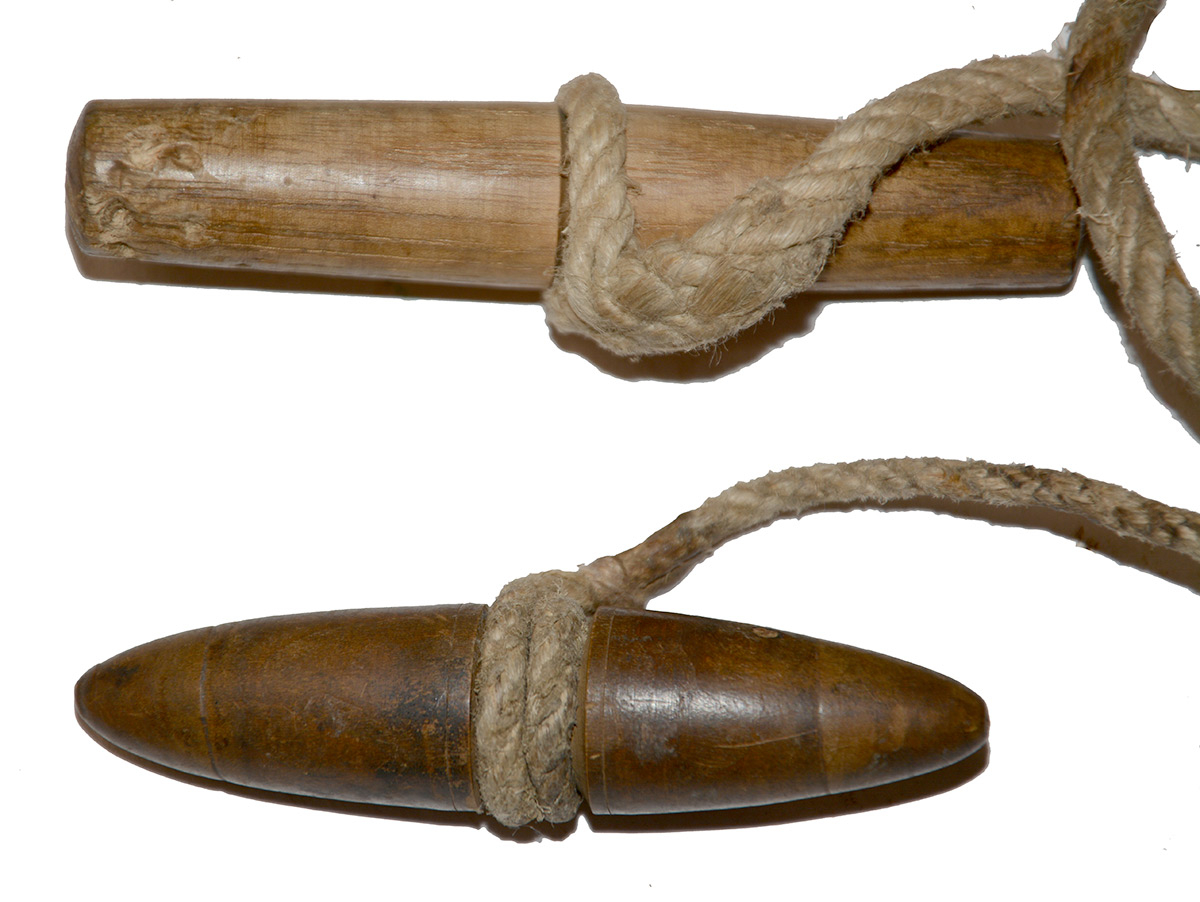
This unusual item has two turned wooden handles at either end of an approximately 15-foot-long linen rope. Its purpose was to facilitate ignition of the naval guns on US ships of war. This one in about perfect condition came out of a museum in mid-upstate New York. And was used on Admiral Dewey's flag ship the USS Olympia. It's moderately old museum tag reads "SPAN. AM. CANNON LANYARD GRIP. FROM THE USS OLYMPIA"
THE CRUISER: "Commissioned at Union Iron Works, San Francisco, California, on February 5, 1895, USS Olympia (Cruiser #6) departed to become the flagship of the Asiatic Fleet. Serving in the Spanish-American War, she participated in the Battle of Manila Bay, on May 1, 1898, where Commodore George Dewey stated his famous instruction, "You may fire when you are ready, Gridley". After the war, Olympia became as a training ship at the U.S. Naval Academy, then later as a reserve ship, and a barracks ship. During the early part of World War I, she patrolled the United States' eastern coast for U-boats. In April 1918, she steamed to assist the Russian civil war, along with aiding other countries in region. Reclassified as (CA-15) in July 1920, Olympia was again reclassified as (CL-15) in August 1921. That October, she brought back the remains of the Unknown Soldier for internment in Arlington National Cemetery. Decommissioned in December 1922 at Philadelphia, Pennsylvania, Olympia was reclassified as (IX-40) in June 1931 and now serves as a museum ship at Independence Seaport Museum, Philadelphia, Pennsylvania."
DEWEY: "George Dewey, the only officer of the US Navy ever to hold the rank of Admiral of the Navy, was born on 26 December 1837, in Montpelier, Vermont. On 23 September 1854, he was appointed Acting Midshipman from the first Congressional District of Vermont, and upon graduation from the US Naval Academy in June 1858, was warranted Midshipman, to date from 11 June of that year. He became a Passed Midshipman on 19 January 1861, and on 28 February of the same year he was warranted Master. His subsequent advancement was as follows: Lieutenant, 19 April 1861; Lieutenant Commander, 3 March 1865; Commander, 13 April 1872; Captain, 27 September 1884; Commodore, 28 February 1896; Rear Admiral, 11 May 1898; Admiral, 2 March 1899; and Admiral of the Navy on 24 March 1903 to date from 2 March 1899.
During the period 26 April 1861, until 30 August 1867, he had consecutive service on USS Mississippi, USS Brooklyn, USS Agawam, USS Colorado, USS Kearsarge, USS Canadiagua, and again USS Colorado. When detached from the latter he was directed to await orders of 1 October 1867, which returned him to the Naval Academy for a tour of duty which ended in September 1870. On 10 October 1870, he assumed command of USS Narragansett, and in February 1871 was transferred to command of USS Supply, hospital ship. On 27 July 1871, he was ordered to the Navy Yard, Boston, Massachusetts, and after five months' duty there and brief instruction at the Naval Torpedo Station, Newport, Rhode Island, he again commanded Narragansett from 1 March 1873 to August 1875.
Ordered on 25 August 1875, to report as Lighthouse Inspector, Second Naval District, at Headquarters in New York, New York, he served in that capacity until 1 August 1877, and as a member of the Lighthouse Board for eight months thereafter. On 1 May 1878, he became Secretary of the Lighthouse Board. On 18 October 1882, he was ordered to command USS Juniata and remained at sea from 25 October that year until July 1884, when he was ordered detached and to the Navy Department, Washington DC. Again, at sea, he commanded USS Dolphin from October 1884 until March 1885, when he transferred to command of USS Pensacola.
On 1 August 1889, he was commissioned Chief of the Bureau of Equipment, Navy Department, Washington DC. His term ended by resignation on 30 June 1893, when he again became a member of the Lighthouse Board. On 5 November 1895, he reported for duty as President of the Board of Inspection and Survey, Navy Department. On 30 November 1897, he was ordered to Asiatic Station and, proceeding by steamer, he assumed command on 3 January 1898, his flag in the protected cruiser, USS Olympia, Captain Charles V. Gridley, commanding. The Spanish-American War action at Manila, Philippine Islands, 1 May 1898, not only gave birth to the historical expression "You may fire when you are ready Gridley," but also liquidated the Spanish Fleet and installations in the Manila Harbor without loss of men to the US Fleet.
On 10 May 1898, Admiral (then Commodore) Dewey was given a vote of thanks by the Congress of the United States, and three days later was commissioned Rear Admiral, to date from 11 May 1898. That promotion was an advancement of one grade for "highly distinguished conduct in conflict with the enemy as displayed by him in the destruction of the Spanish Fleet and batteries in the harbor of Manila, Philippine Islands, May 1, 1898." He was relieved of command of Asiatic Station on 4 October 1899, and ordered to the Navy Department, Washington, where on 29 March 1900, he was designated President of the General Board.
An Act of Congress, 2 March 1899, created the rank of Admiral of the Navy. It provided that when such office became vacant either by death or otherwise, the office would cease to exist. On 24 March 1903, Admiral Dewey, who held the rank of Admiral since 8 March 1899, was commissioned Admiral of the Navy, with date of rank 2 March 1899, and became the only officer of the United States Navy who was ever so commissioned. He held the rank of Admiral of the Navy until his death in Washington, DC, on 16 January 1917.
The body of Admiral Dewey was interred in Arlington National Cemetery, Arlington, Virginia, on 20 January 1917. At the request of his widow, his remains were reinterred in the crypt of Bethlehem Chapel at the Protestant Episcopal Cathedral, Mount Saint Alban, Washington, DC, on 28 March 1925. Besides his widow, Mrs. Mildred McLean Dewey, Admiral Dewey was survived by his only son, George Goodwin Dewey.
Admiral Dewey earned the Civil War Medal; the Spanish Campaign Medal; the Philippine Campaign Medal; and the Dewey Medal (commemorating the Battle of Manila Bay). A destroyer, USS Dewey (DD-349), was named to honor Admiral of the Navy George Dewey. Built by the Bath Iron Works Corporation of Bath, Maine, she was launched on 28 July 1934, under the sponsorship of Miss Ann M. Dewey of Quechee, Vermont, great grandniece of Admiral Dewey. Dewey was placed in commission at the Boston Navy Yard on 4 October 1934 and earned thirteen battle stars for operations in the Pacific War Area during World War II."
This is a very historic artillery memento from the famous ship commanded by a national hero. [pe][ph:L]
~~~~~~~~~~~~~~~~~~~~~~~~~~~~~~~~~~~
THIS ITEM, AS WITH ALL OTHER ITEMS AVAILABLE ON OUR WEB SITE,
MAY BE PURCHASED THROUGH OUR LAYAWAY PROGRAM.
CLICK HERE FOR OUR POLICIES AND TERMS.
THANK YOU!
Inquire About SPANISH AMERICAN WAR CANNON LANYARD GRIP FROM THE DEWEY'S FLAGSHIP
Most Popular
Historical Firearms Stolen From The National Civil War Museum In Harrisburg, Pa »
Theft From Gravesite Of Gen. John Reynolds »
Selection Of Unframed Prints By Don Troiani »
Fine Condition Brass Infantry Bugle Insignia »
Rare Identified 65Th Ny Sergeant’s Jacket, With Manscript Material: 1St U.s. Chasseurs »
featured item
“SOFT TACK:” AERATED BREAD CRATE
This would make a nice addition to a camp, sutler, Sanitary Commission or even a hospital display. Constructed of thin, about ½” thick, unpainted, wide pine boards that are simply nailed together, this is about 18” X 13 ¾” X 12” and is… (1202-166). Learn More »
site search