

site search
online catalog
HANDWRITTEN APPOMATTOX PAROLE OF DAVID SECREST 42nd VIRGINIA
Hover to zoom
$1,850.00 SOLD
Quantity Available: None
Item Code: 1300-71
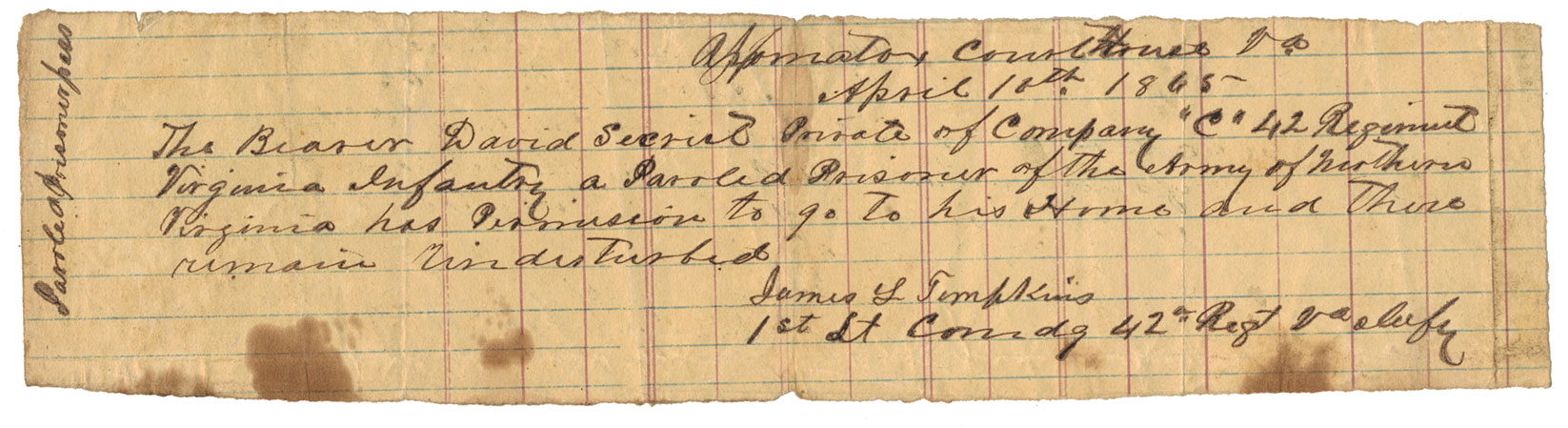
This Appomattox parole comes from the collection of historian and author Greg Coco, who illustrated it in his 2006 Civil War Times article on Appomattox paroles to illustrate a handwritten version of the parole or “parole pass” that was given out in addition to three printed variations, noting, “As sheer numbers overwhelmed the authorities, some officers issued handwritten paroles.” It is made out for Private David Secrest, Co. C, 42nd Virginia and signed by “James S. Tompkins / 1st Lt Comdg 42d Regt Va Infy.” The text follows the printed versions, which had the personal information filled in by hand, and reads: “Appomattox Court House, Va. / April 10, 1865 / The Bearer David Secrest of Company ‘C’ 42 regiment / Virginia Infantry a Paroled Prisoner of the Army of Northern / Virginia has Permission to go to his home and there / remain undisturbed.” The writer also followed the format of two of the three printed versions, adding the words “Paroled Prisoner Pass,” across the left end of the paper.
The paper for the pass was clearly removed from a ledger of some sort, having blue horizontal lines and red vertical lines, some single and some double, creating columns for accounting. It measures 9-1/2” wide and is cut slightly unevenly across the top and bottom, with the height varying between 2-1/4” and 2-1/2.” The text is fully legible and the ink dark brown. There are some stains along the bottom edge, but they do not affect the text. The pass was folded twice, horizontally. The folds at left and center show slightly on the face, but do not obscure the text.
In Coco’s file accompanying the pass, in addition to Secrest’s and Lt. Tompkins’s records, information on the regiment, etc., is a xerox copy of the parole with a pencil annotation indicating it had descended in the family to “Lenora Secrest Haynes Grandaughter of David Secrest & daughter of Rowland Hill Secrest and Ethel Fisher Secrest.” Rowland Hill Secrest (1887-1948) was one of at least nine children born to David Secrest by his wife, Susan.
Both Secrest and Tompkins appear in published lists of Appomattox paroles. Tompkins had been a lawyer before the war, joined the 42nd as a 3rd Lieutenant of Co. B in 1861 and failed of reelection when the regiment reorganized in April 1862, but reenlisted and was appointed a 2nd Lieutenant by November. He was acting Regimental Adjutant for a time in May 1863 and later promoted to 1st Lieutenant with rank from July 2, 1863. He commanded both Company B and several other companies at various times and was wounded at Fort Stedman on March 25, 1865, but remained with regiment, or returned to it quickly, and was in command of the regiment at Appomattox, signing paroles for the 44 men then left in the command.
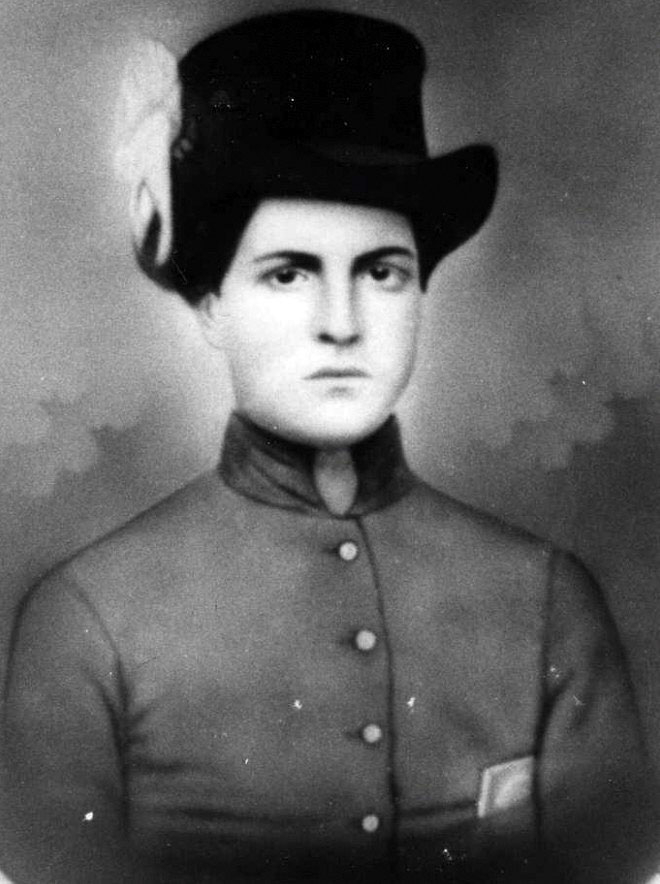
Secrest, listed in the Confederate service files and some other records also as Secrist, was born in Botetort County, VA, Sept. 13, 1842. The 1860 census picks him up at age 17 in Bedford County, listing himself as a farm laborer and living with his widowed mother and four younger siblings. He enlisted in Company C of the 42nd Virginia at Lisbon, Bedford County, May 18, 1861, for one year- the usual early war service period for Virginia troops, who would then be mustered into Confederate service and in Spring 1862 reorganized for more extended service. An older brother, Martin Van Buren Secrest, enlisted along with him- was later captured and entered U.S. service.) Entries from only few muster rolls are in his file, listing him. as present for Jul-Aug 1861, and Apr 30 -Oct 31, 1864; admitted to General Hospital Camp Winder at Richmond for a wound in the hand on July 1, 1862, and given a 25-day furlough on July 5. He is listed on receipt rolls (for clothing, etc.) for the 1st quarter of 1863 and for Feb, Sept, Nov, and Dec 1864. The Virginia Regimental Series lists him as present through Oct. 1861, in hospital at Staunton by 12/31/61, but back by 2/28/62. His wound in the hand on June 26, 1862, corresponds with the Battle of Beaver Dam Creek (Mechanicsville,) the first of the Seven Days Battles, but is said to be accidental. His furlough lasted through August 7 and he seems to have been in the ranks thereafter. They also list him as present 10/31/62-1/15/63 and 11/2/64-4/9/65, when paroled.
The regiment is the subject of a history by John Chapla in the Virginia Regimental History Series to which we refer interested parties for its full story. In summary, from other sources, the 42nd Virginia was organized at Staunton, Virginia, in July, 1861. It joined Burks’ brigade of Jackson’s division in the Army of the Valley District in December, seeing action in March at First Kernstown in and in Jackson's Valley Campaign. The NPS summary says their suffered 70 casualties at First Kernstown, lost 3 wounded at McDowell, and others at First Winchester. In June it became part of the Army of Northern Virginia, fighting at Cross Keys, Port Republic, and then Malvern Hill. In the campaign against Pope they fought at Cedar Mountain and Second Manassas, losing 62. This was followed by Chantilly, the taking of Harpers Ferry, and Antietam, where they fought in Jones’ brigade under Jackson, on the left, CWData reporting it suffered 6 killed, 37 wounded and 10 missing or prisoners. By other sources they lost they lost 26 men at Fredericksburg in December; at Chancellorsville, 11 killed, 86 wounded and 3 missing (according to CWData and 135 by other sources.) At Gettysburg as part of Ewell’s Corps, they fought on Culp’s Hill and losing 89 (16 killed, 47 wounded, and 24 missing) of 252 engaged (Laino.) In 1864 they were hard hit in the Salient at Spottsylvania, losing some 20 in killed and wounded, and more than 200 captured, with regiments in the brigade being consolidated. In June 1864 it went to the Shenandoah with Early, fighting there until December, when it returned to the main army at Petersburg at Richmond. As noted above, at Appomattox there were just 1 officer and 44 men left to surrender.
Secrest returned to Lisbon, resumed farming, married in 1866 and raised at least nine children. By 1910 the couple had moved to Big Lick, Roanoke County, with son Rowland, who is married and living nextdoor by the 1920 census, with wife and two children- including “Leola” age 4, which is likely a copyist error for Lenora (1915-2000,) who owned the parole.
This is an example of a handwritten Appomattox parole pass. See Coco’s article referenced above for details on the formats and also their importance in keeping Lee’s troops from dispersing into potentially troublesome armed bands, the effect that the promise that they could return home and be undisturbed had on some sort of reconciliation, and ultimately their significance to the aging veterans as testimonials they had stuck it out to the end. [sr][ph:L]
~~~~~~~~~~~~~~~~~~~~~~~~~~~~~~~~~~~
THIS ITEM, AS WITH ALL OTHER ITEMS AVAILABLE ON OUR WEB SITE,
MAY BE PURCHASED THROUGH OUR LAYAWAY PROGRAM.
CLICK HERE FOR OUR POLICIES AND TERMS.
THANK YOU!
Inquire About HANDWRITTEN APPOMATTOX PAROLE OF DAVID SECREST 42nd VIRGINIA
Most Popular
Historical Firearms Stolen From The National Civil War Museum In Harrisburg, Pa »
Theft From Gravesite Of Gen. John Reynolds »
Selection Of Unframed Prints By Don Troiani »
Fine Condition Brass Infantry Bugle Insignia »
Rare Identified 65Th Ny Sergeant’s Jacket, With Manscript Material: 1St U.s. Chasseurs »
featured item
EYE-CATCHING 1859-1861 VIRGINIA MILITIA GROUPING OF CAPT. J.Q.A. NADENBOUSCH, BERKELEY BORDER GUARDS, LATER COLONEL 2nd VA INFANTRY OM RECOMMENDATION OF LEE AND STONEWALL JACKSON
An historic and eye-catching Virginia officer’s group belonging to John Quincy Adams Nadenbousch while Captain of the “Berkeley Border Guards,” a militia company raised in response to the John Brown raid, present at the execution of Brown’s… (2025-3677). Learn More »
site search