

site search
online catalog
A NON-APPOMATTOX APPOMATTOX PAROLE AND OATH OF ALLEGIANCE: SERGEANT BENJAMIN H. WOODFORD, CO. E, 62nd VIRGINIA (MOUNTED) INFANTRY, WIA
Hover to zoom


$5,500.00 ON HOLD
Quantity Available: 1
Item Code: 1300-72
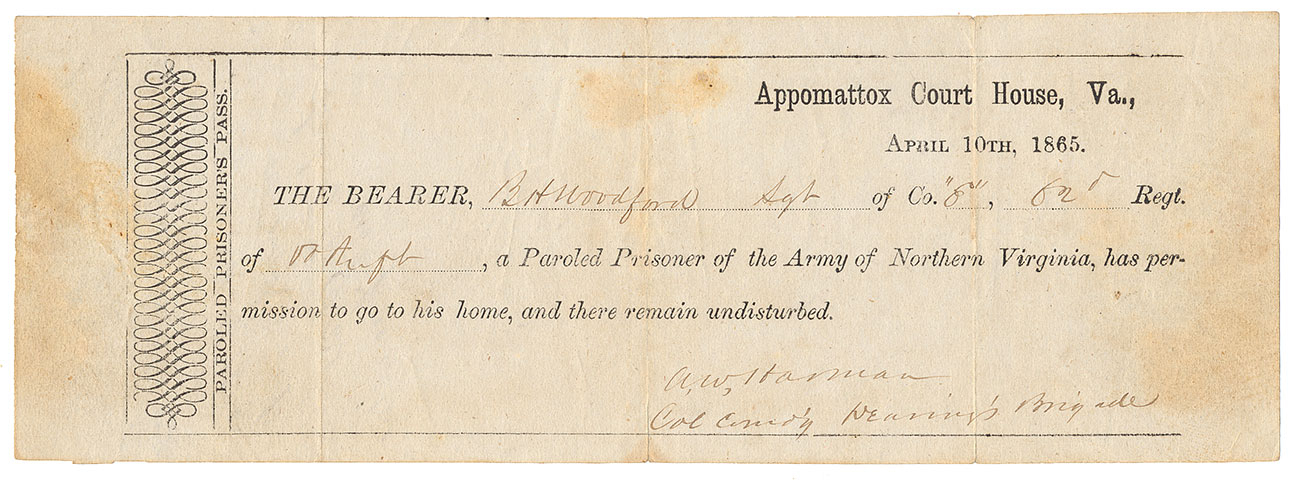
This comes from the collection of historian, scholar, and author Greg Coco, who pictured and discussed it in his 2006 Civil War Times article on Appomattox paroles. There he noted its slight differences from other Appomattox parole passes in lettering, size and design, but that whichever US “military office, post or district” printed it had taken great care to copy an original parole issued on the field at Appomattox, with Coco speculating it originated in an area “administered by General W.S. Hancock’s Middle Military Division, headquartered in Winchester, Va.” He also puts it in the context of a more general effort across the south to parole thousands of Confederates covered by various mass surrenders, so that “by and large during this turbulent time the majority of Southern soldiers still in service received some sort of final parole certificate that generally complied with terms given to the Army of Northern Virginia.”
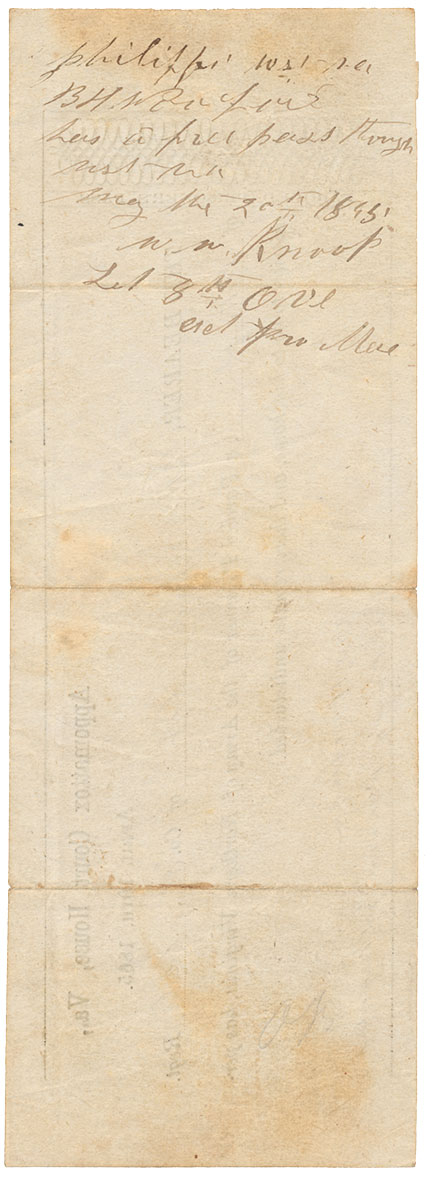
In this case, of course, it repeated those terms exactly and even used the date and place of those paroles issued to the Army of Northern Virginia, following the standard format of an Appomattox parole, datelined “Appomattox Court House, Va., April 10, 1865,” and printed with spaces for the soldier’s name and unit to be filled in. It measures 3” by 8-1/2” and has a printed design on the left edge with the words “PAROLED PRISONER’S PASS,” following one of two other known formats, and reads: “The bearer B.H. Woodford Sgt. of Co. “E”, 62d Regt. of Va Inft, a Paroled Prisoner of the Army of Northern Virginia has permission to go to his home and there remain undisturbed.” At bottom right it is signed by “A. W. Harman / Col. Comd’g Dearing’s Brigade.” The parole is in very good condition, fully legible, showing three shallow vertical folds with no separation lines or losses. Woodford clearly used this as a pass, as intended: the reverse bears a note reading, “Philippi West Va. / B.H. Woodford / has a free pass through / [US lines??] / May the 20th 1865 / W.W. Knoop / Lt. 8th OVC / act pro Mar.”
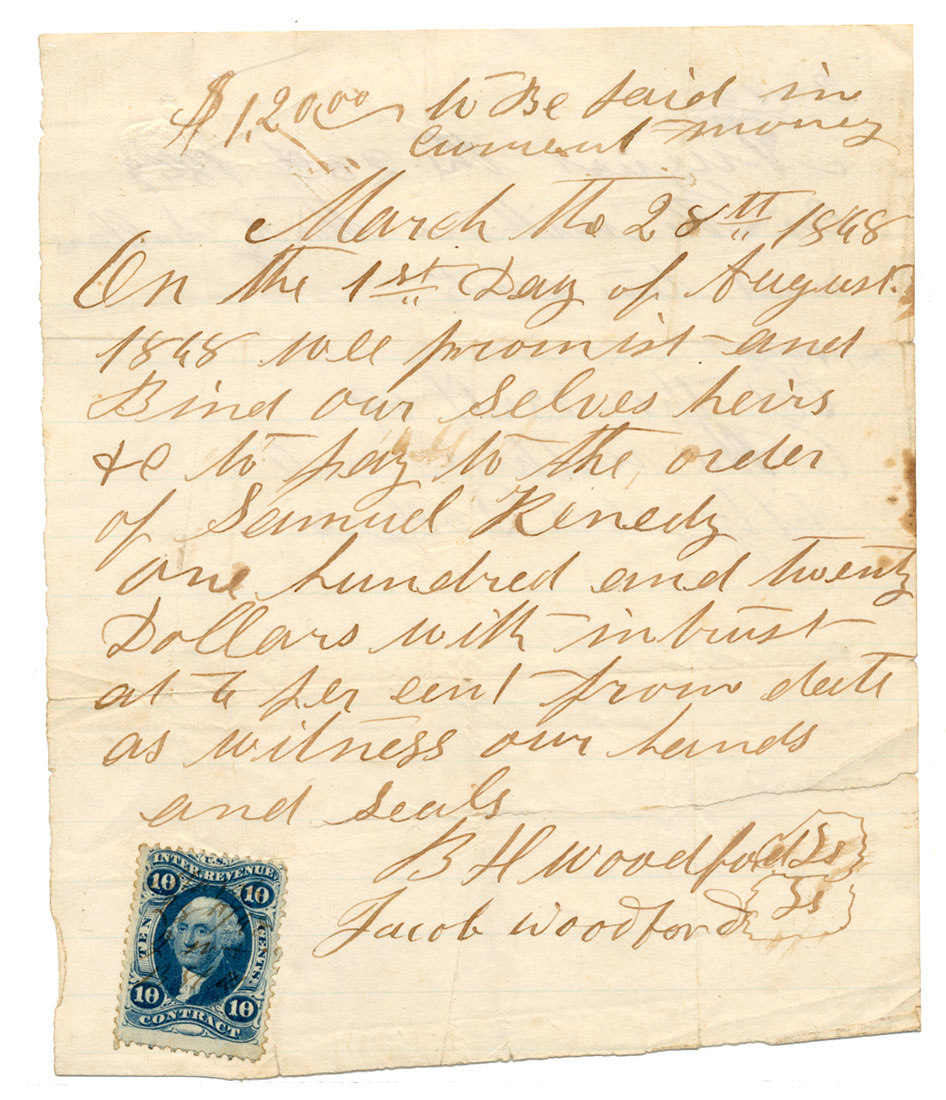
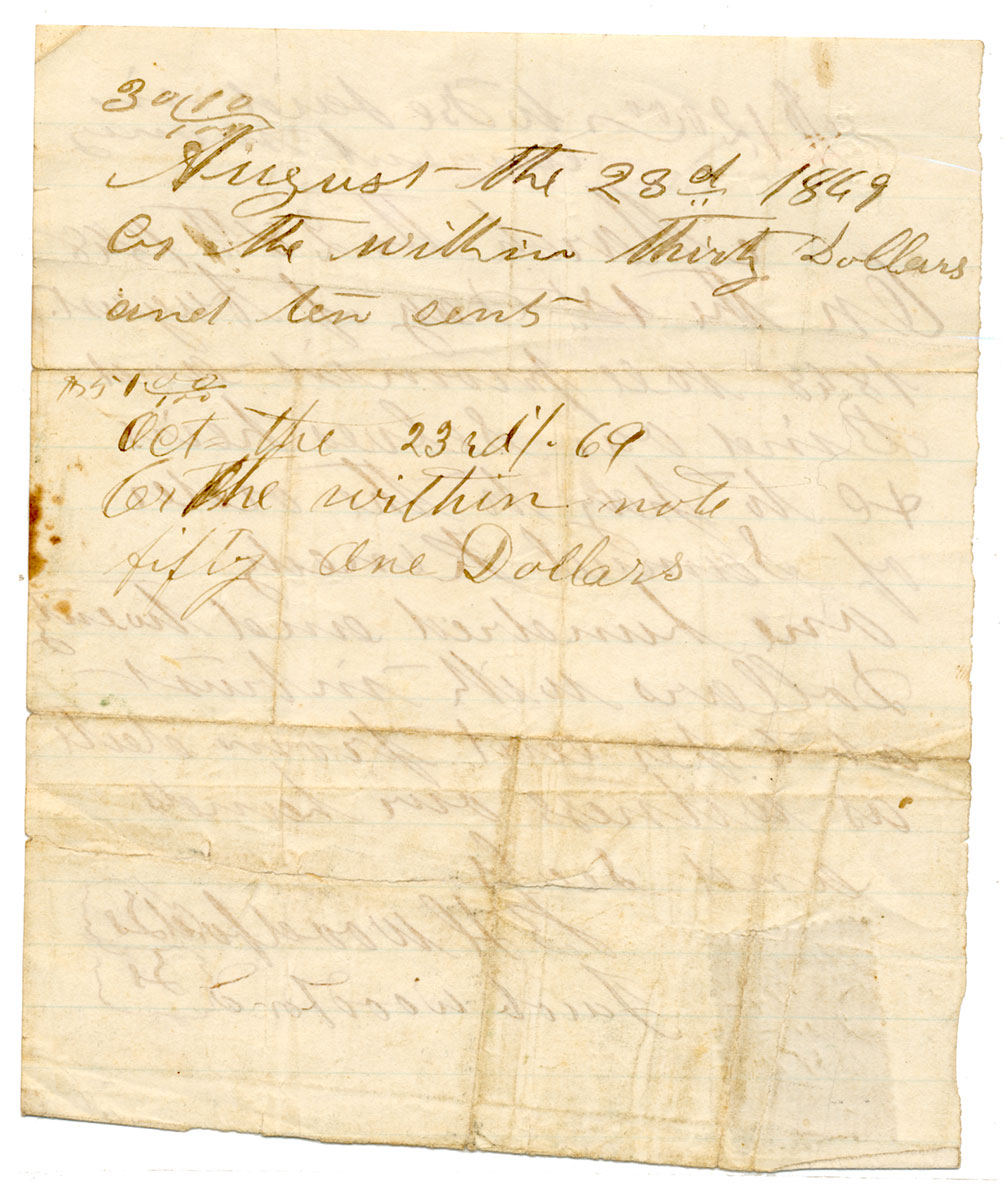
With the parole are three other documents: a page from a Woodford family bible listing marriages and births; an 1868 loan note signed by Woodford; and, the lower portion of his Oath of Allegiance to the US, signed by him, followed by a physical description, and attested as “Sworn to and Subscribed before me this 20th day of May 1865,” signed by the same Lt. Knoop of the 8th Ohio Cavalry as Acting Provost Marshal. It looks, then very much like Woodford used his parole pass to make his way to Philippi, where he took the Oath of Allegiance before Knoop, who then also signed his pass to go back through Union lines.
The collector from whom Greg Coco obtained the material thought the pass was likely printed and given out in April at Lynchburg. Maxwell’s 1899 History of Barbour County, however, says Woodford, “surrendered at Staunton to General Duval at the close of the war, after taking part in thirty battles.” This seems to be confirmed by the signature at the bottom of the pass of A.W. Harman as commander of Dearing’s brigade. Harman himself was paroled at Staunton on April 30, giving a likely date for Woodford’s parole, although it does not explain how Woodford ended up under his command, since the 62nd was not in Dearing’s brigade. Woodford, however, had been wounded in September 1864 and it is not clear when, if at all, he rejoined the 62nd. It may well be that although separated from the regiment, he recognized the value of a parole pass, made his way to Staunton and Harman simply obliged him, the parole-pass proving its value by enabling him to sign the Oath of Allegiance at Phillipi several weeks later. At least that is the current thinking here, though it is not impossible the pass could date a bit later if Harman had remained in the area for a time. Numerous Confederates, aware of Lee’s surrender and cut off from joining Johnston, even if they wanted to, took time deciding on a course of action. Rosser’s troops, for instance, did not surrender until May 10 at Staunton, and Duval, a loyal West Virginia officer, to whom the county history says Woodford surrendered, was on duty at Staunton at least until May 17, when someone tried to kill him.
Benjamin Holly Woodford was born May 2, 1843, in Virginia. The. 1850 census picks him up at age 7, with his family in District No. 5 of Barbour County in the western part of the state, later West Virginia. He is there also in subsequent census counts- the 1860 census listing his father as a farmer and both Benjamin and his younger brother as laborers, working for their father, we presume. In August 1862 he traveled south to Pocahontas County to join a company being recruited by Col. J.D. Imboden, enlisting on Aug. 29, 1862, and mustering in Aug. 29 as Second Sergeant of what was designated first as Company C and then Company E, with the regiment undergoing several title changes as well: the 1st VA Partisan Rangers, the 62nd VA Infantry, 62nd VA Mounted Infantry, as well at Imboden’s Partisan Rangers. A county history credits Woodford with participation in thirty engagements- a high number, but not impossible given the large number of instances when they suffered casualties of some sort according to CWData, mostly in the valley district.
By early 1863 Imboden had formed something of a brigade, with companies recruited as cavalry uniting with others to form the 18th VA Cavalry, one of his companies forming an artillery battery, and several infantry companies, including four from the 25th Virginia joining the 62nd regiment, which seems to have taken part as an infantry unit in the April-May raid by Imboden and “Grumble” Jones into western Virginia to gather recruits and supplies, destroy U.S. supply lines, attack garrisons, and hinder the movement toward statehood of the western counties. They saw some fighting, driving federals out of Beverly and Buckhannon, taking a U.S. wagon train, etc., creating consternation in Washington, but failed to keep their home counties in the Confederacy. The regiment seems to have been mounted soon after, perhaps with mounts captured in the raid, and then saw action in the Gettysburg Campaign when Imboden was tasked by Lee with getting the army’s immense wagon train of casualties from Gettysburg back to Virginia, which involved fighting at Greencastle and Williamsport.
In 1864 they were back in the Valley, serving at least part of the time, however, as a dismounted unit. This was the clearly the case at New Market in May 1864, where they suffered significant casualties as part of Wharton’s brigade, an assignment that led to them seeing action at Cold Harbor in early June as well, before returning to Imboden’s command again to take part in the Lynchburg and Valley Campaigns, with action at Bunker Hill, Third Winchester, Fisher’s Hill, Woodstock and Cedar Creek. Woodford missed the latter engagements, having been wounded Sept. 8, 1864, and was absent through the end of December, the last of the muster rolls in his service file. His wounding thus took place just a few days after Bunker Hill and ten days before Third Winchester. The regiment seems to have been mounted again at that point: they were serving in Imboden’s brigade of Lomax’s cavalry division, and the December 31, 1864, muster roll covering November and December, notes not only Woodford’s absence from his wound, but that he possessed “one private horse.”
Some accounts of the regiment say that it disbanded for a time in the winter of 1864, but returned to duty in February 1865. Whether Woodford managed to rejoin them or not, he had seen a good deal of service. His service file shows only a furlough from Feb. 3 to Feb. 22, 1863, and his claim of thirty engagements fits such an active unit. CWData lists 41 occasions until Woodford’s wounding when the regiment suffered a loss in killed or wounded, and scores more where a capture is listed, though the circumstances are unclear. Their total losses, by CWData’s count, not counting losses in prisoners, were 41 killed and 166 wounded, a respectable record.
This is a very interesting grouping with room for even more research on the parole itself as well as Woodford’s and the regiment’s history. [sr][ph:L]
~~~~~~~~~~~~~~~~~~~~~~~~~~~~~~~~~~~
THIS ITEM, AS WITH ALL OTHER ITEMS AVAILABLE ON OUR WEB SITE,
MAY BE PURCHASED THROUGH OUR LAYAWAY PROGRAM.
CLICK HERE FOR OUR POLICIES AND TERMS.
THANK YOU!
Inquire About A NON-APPOMATTOX APPOMATTOX PAROLE AND OATH OF ALLEGIANCE: SERGEANT BENJAMIN H. WOODFORD, CO. E, 62nd VIRGINIA (MOUNTED) INFANTRY, WIA
Most Popular
Historical Firearms Stolen From The National Civil War Museum In Harrisburg, Pa »
Theft From Gravesite Of Gen. John Reynolds »
Selection Of Unframed Prints By Don Troiani »
Fine Condition Brass Infantry Bugle Insignia »
Rare Identified 65Th Ny Sergeant’s Jacket, With Manscript Material: 1St U.s. Chasseurs »
featured item
FINE ITALIAN SNAPHAUNCE BELT PISTOL CA. 1675
The snaphaunce is one of the earlier forms of flint and steel ignition and was introduced in the mid-16th century. It remained in use in Northern Italy into the mid-18th century giving it a particularly long period of use. Ornate pistols such as… (2026-657). Learn More »
site search