

site search
online catalog
FREEDMEN'S BUREAU APPRENTICESHIP INDENTURE BINDING A FREED ORPHAN GIRL — WALTON COUNTY, GEORGIA, 1866
Hover to zoom
$225.00
Quantity Available: 1
Item Code: 2025-3467
Shipping: Determined by Method & Location of buyer
To Order:
Call 717-334-0347,
Fax 717-334-5016, or E-mail
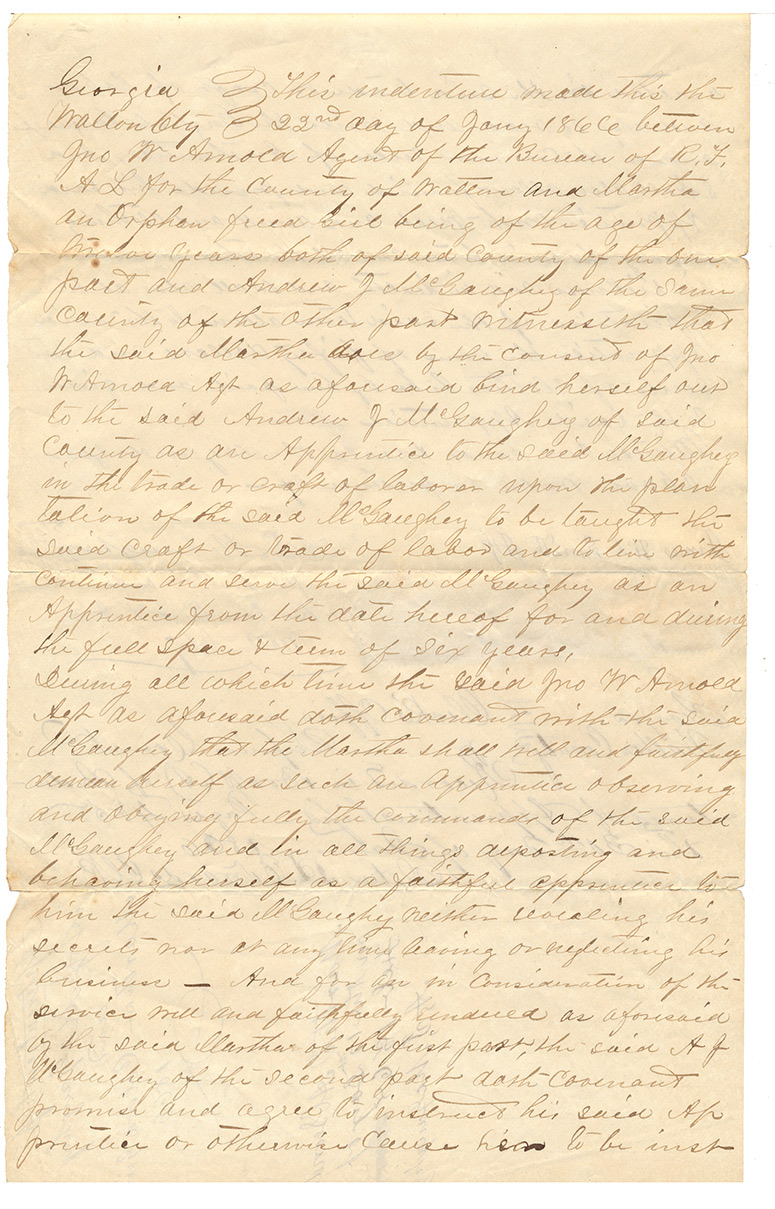
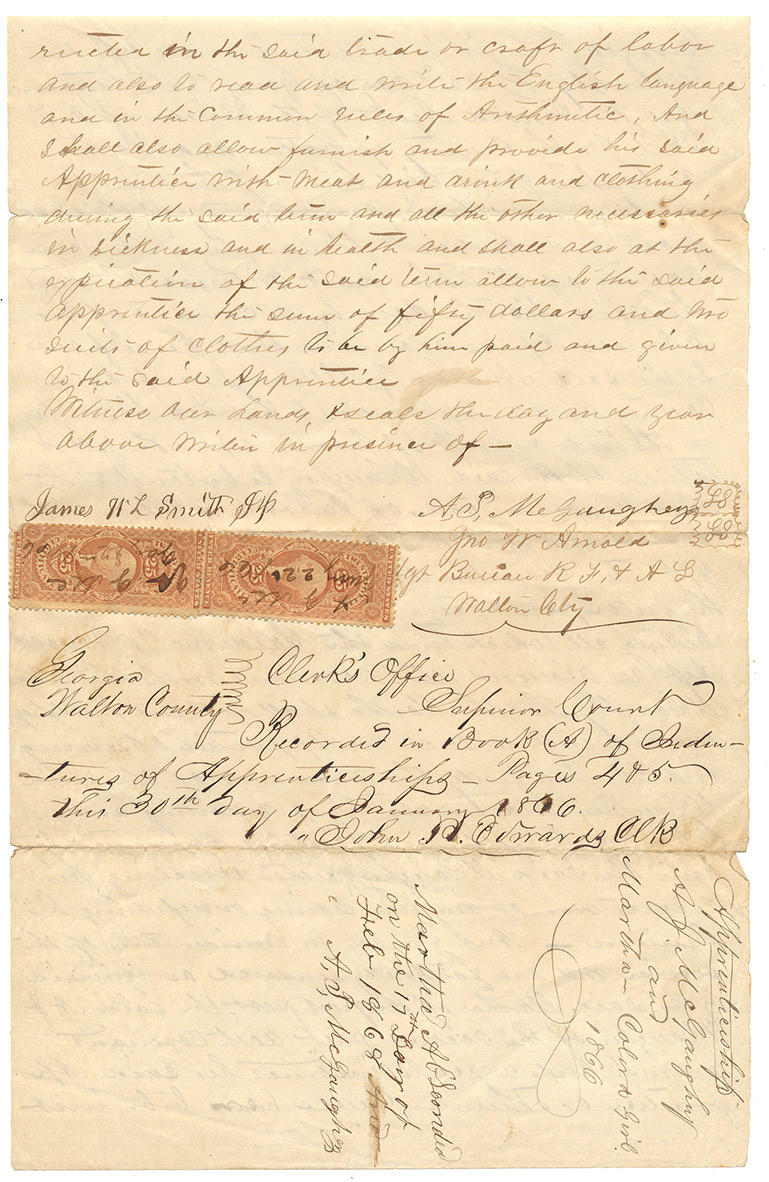
An important and sobering Reconstruction-era manuscript: an original apprenticeship indenture executed under the authority of the Bureau of Refugees, Freedmen, and Abandoned Lands — the Freedmen's Bureau — for Walton County, Georgia, dated the 22nd day of January 1866 and recorded eight days later. Ink on a folded folio sheet, written on the recto and continuing onto the verso, with the clerk's recording certificate, original docketing, and two affixed federal revenue stamps on the reverse.
The instrument binds "Martha, an orphan freed girl" — a formerly enslaved child, her age given in the text as twelve years — as an apprentice to planter Andrew J. McGaughey of the same county for a full term of six years. It is made "by the consent of" John W. Arnold, the Bureau's local agent for Walton County, and is witnessed by Justice of the Peace James W. L. Smith. Martha is bound "in the trade or craft of laborer upon the plantation of the said McGaughey." In return, McGaughey covenants to teach her "to read and write the English language and in the common rules of Arithmetic," to furnish meat, drink, clothing, and all necessaries "in sickness and in health," and at the expiration of the term to pay her the sum of fifty dollars and two suits of clothes. The document is signed by both A. J. McGaughey and, as Bureau Agent, Jno. W. Arnold.
The verso carries the formal recording certification of the Clerk's Office, Superior Court of Walton County — entered in "Book (A) of Indentures of Apprenticeships, Pages 4 & 5" by Clerk John H. Edwards on the 30th day of January 1866 — together with the original endorsement docketing the agreement and two manuscript-cancelled twenty-five-cent U.S. Internal Revenue documentary stamps.
HISTORICAL CONTEXT: Indentures of this kind were a central instrument of the postwar Black Codes. Across the former Confederacy, courts and planters used the machinery of "apprenticeship" to re-bind freedpeople — and especially orphaned freed children — to compulsory, unpaid labor, frequently in the households of their former enslavers and often over the objection of surviving family. Though couched in the paternalistic language of a trade apprenticeship and carrying nominal provisions for schooling and an end-of-term payout, in practice these arrangements perpetuated unfree labor under a new legal name. The Freedmen's Bureau's role was contradictory: agents both executed such bindings, as here, and increasingly moved to contest abusive or fraudulent ones through 1866–67. Surviving examples that name the bound child and retain full Bureau and county-court attestation, with the revenue stamps intact, are uncommon and carry strong research, teaching, and exhibition value as primary evidence of the transition from slavery to coerced free labor in Georgia.
CONDITION: Complete folded folio, approximately 8 x 12.5 inches unfolded. Old mailing/storage folds with light separation starting along intersections; toning and scattered foxing; legible throughout in a clean clerk's hand. Revenue stamps present with period manuscript cancellation. Generally very good for a working legal document of the period. [ss] [ph:L]
~~~~~~~~~~~~~~~~~~~~~~~~~~~~~~~~~~~
THIS ITEM, AS WITH ALL OTHER ITEMS AVAILABLE ON OUR WEB SITE,
MAY BE PURCHASED THROUGH OUR LAYAWAY PROGRAM.
CLICK HERE FOR OUR POLICIES AND TERMS.
THANK YOU!
Inquire About FREEDMEN'S BUREAU APPRENTICESHIP INDENTURE BINDING A FREED ORPHAN GIRL — WALTON COUNTY, GEORGIA, 1866
Most Popular
Historical Firearms Stolen From The National Civil War Museum In Harrisburg, Pa »
Theft From Gravesite Of Gen. John Reynolds »
Selection Of Unframed Prints By Don Troiani »
Fine Condition Brass Infantry Bugle Insignia »
featured item
CONFEDERATE CLIP POINT BOWIE WITH SALVAGED MUSICIAN SWORD BRASS HILT
This clip-point Bowie a great example of southern improvisation- a kind of weapons-making version of folk art – not sophisticated, but with an appeal of it own. Measuring 19.5 inches overall, the knife has a 13.25 inch blade that is 1.5 inches… (490-3265). Learn More »
site search