


site search
online catalog
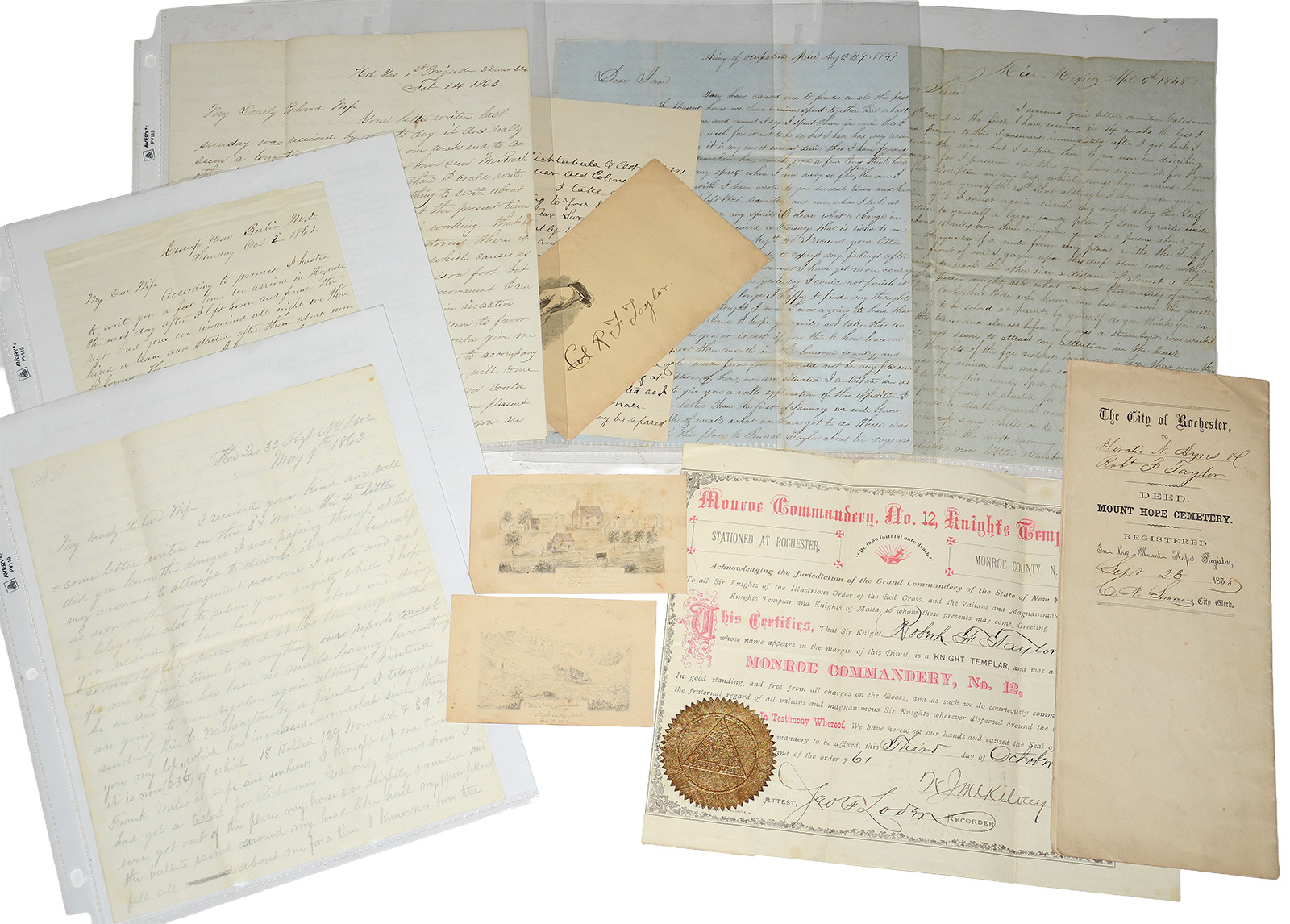
COL. ROBERT F. TAYLOR, 33RD NEW YORK VOLUNTEER INFANTRY — FAMILY GROUPING OF LETTERS, ORIGINAL CAMP SKETCHES AND DOCUMENTS, 1847–1900
Hover to zoom
$650.00 ON HOLD
Quantity Available: 1
Item Code: 557-286
A personal grouping descended with the family of Col. Robert F. Taylor (b. Erie, Pa., 1826) of Rochester, N.Y., the Mexican War regular who raised and commanded the 33rd New York Volunteer Infantry, the "Ontario Regiment," through its two years' service with the Sixth Corps, Army of the Potomac, and afterward raised the 1st New York Veteran Cavalry. The group follows him for more than half a century: two courtship letters written as a sergeant of the 10th U.S. Infantry at Mier, Mexico, to Miss Jane Alexander of Rochester, whom he married in October 1848; three wartime letters to her from the Antietam aftermath, the White Oak Church winter quarters and the Chancellorsville campaign; two small original pencil sketches from his brigade headquarters; an 1858 Mount Hope Cemetery deed; an 1879 Knights Templar dimit; an 1891 letter from a former soldier forwarding his regimental survivors' badge; and the newspaper notices of Jane's death in 1900.
THE MEXICAN WAR LETTERS
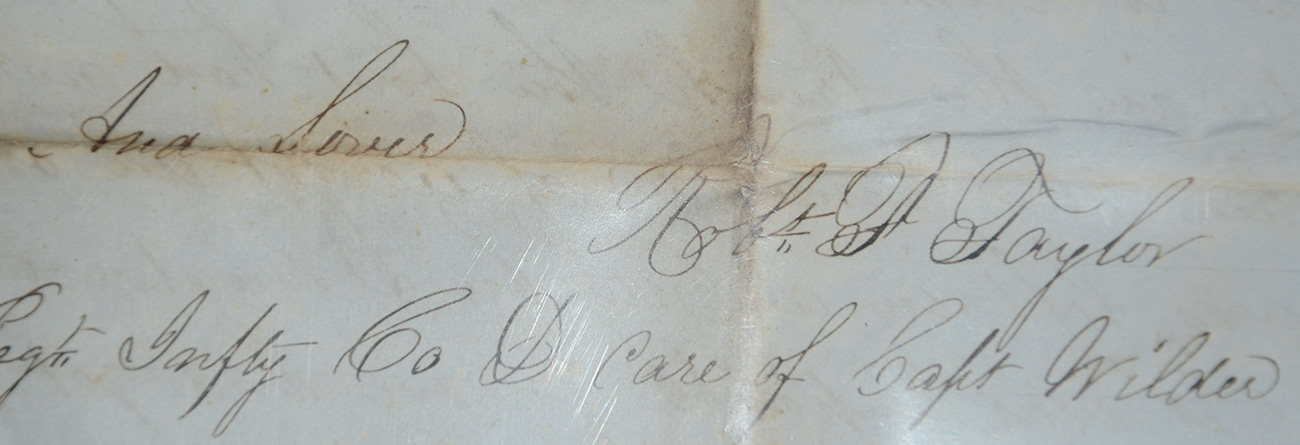
Army of Occupation, Mier [Mexico], Aug. 29, 1847. Four pages, ink on blue paper, to "Dear Jane," with "Write immediately" in the margin. Taylor enlisted April 14, 1847 in the 10th U.S. Infantry and served on the Rio Grande line until August 1848. He writes of nearly three months without a word from her; of dispatches gone through to "General Taylor" and talk that the army will either go home or march to join Scott; of not venturing more than a mile from camp without "pistoles and guns"; and of a brush in which "we took about fifteen guns of different kinds one saber one pistole one lance this was our 4th of July celebration." He describes the camp "between two mountains and on the banks of the Rio Grande," the thermometer at 116 in the shade while the Rochester papers complain of 74, his duty from daylight until ten with an hour of sword exercise, and the confusion when he was ordered to ready the men to march, sent the sick and his trunk down to Camargo by boat — with this very letter packed in the trunk — only for the rest to be ordered to remain at Mier and move from tents into houses. He promises that "if my life is spared I shall return to fulfill that sacred vow I made to you," recalls "the parting kiss," and closes "Your affectionate friend And Lover, Robt. F. Taylor," with instructions to direct her letters to "10th Regt. Infty. Co. D, care of Capt. Wilder."
Mier, Mexico, Apl. 6th, 1848. Four pages, ink on blue paper, to "Dear Jane," acknowledging her letter mailed from Caledonia, N.Y., Feb. 25, 1848, the first in six weeks. He describes a solitary walk along the Gulf shore near the mouth of the Rio Grande, gazing across the water toward home while "almost before my eyes a steamboat was wrecked," then the trip back upriver past "the spot where I first knew what a soldier's life was in Mexico" — shooting ducks, geese and turtle from the deck and visiting several fandangos. He teases her about the "pretty Mexican Señoritas": falling captive to one "would be something like a person wanting to live in a coal house," and "I have got the first pretty Mexican woman to see yet." All he waits for is word of "the only intruder Peace," when he will "go home in the quickest time," hoping it will not exceed six months. Signed "Your affectionate lover untill Death, Robt. F. Taylor," and addressed at foot to Miss Jane Alexander. They were married in Rochester on October 26, 1848, a little over six months later.
THE CIVIL WAR LETTERS
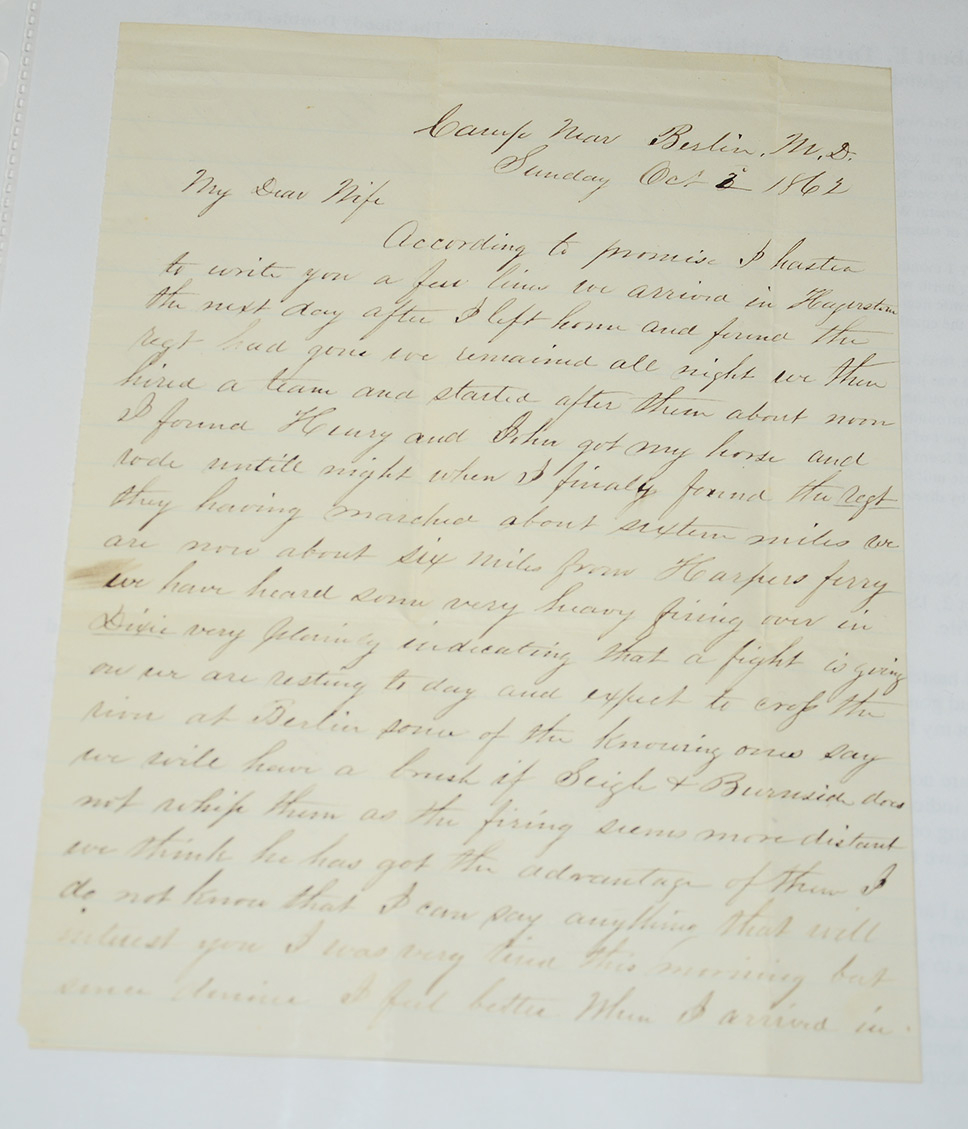
Camp near Berlin, Md., Sunday, Oct. [26?], 1862. Ink, to "My Dear Wife." Returning from home, he found the regiment gone from Hagerstown, rode until night to overtake it some six miles from Harpers Ferry, and reports heavy firing "over in Dixie," the knowing ones saying "we will have a brush." On his arrival in camp "the men gave three hearty cheers for the Col." He pities his men, who "looked so ragged and dirty," notes John's appointment as Quartermaster Sergeant at $21 a month, and laments that "many of my brave fellows have gone to their long homes" from sickness. Signed "R. F. Taylor, Col. 33 Regt N.Y.V."
Hd. Qrs. 1st Brigade, 2 Divn., 6 C[orps], Feb. 14, 1863. Ink, to "My Dearly Beloved Wife." With the army "remarkably quiet" — "a calm before a storm" — he weighs her proposed visit to camp and sets out his dilemma: in command of a brigade, a movement of the army might open the way to promotion, yet if superseded it will be too late to accomplish "my other object which is to prevent the consolidation of my regiment with any other so you see I am here between two fires." He understands the government intends to hold the men he enlisted the previous fall "and myself with them," and reports that the General "wants me to have a regiment at least and that I shall have one." Signed "R. F. Taylor, Col. Comdg. 1st Brigade."
Hd. Qrs. 33 Regt. N.Y. Vol., May 9, 1863. Pencil, to "My Dearly Beloved Wife." Written in the week after the storming of Marye's Heights and the fight at Salem Church: "little did you know the danger I was passing through at that very moment." He gives the regiment's loss as 236, "of which 18 killed 129 wounded & 89 missing," and writes: "I thought at one time I had got a ticket for Richmond God only knows how I ever got out of the place my horse was slightly wounded and the bullets rained around my head like hail my (poor fellows) fell all about me." He writes on his knee "while Mix is making out a report for me," and in a postscript recalls receiving her letter just before going into battle and reading it "while sitting on my horse." Signed "R. F. Taylor," postscript initialed.
THE SKETCHES
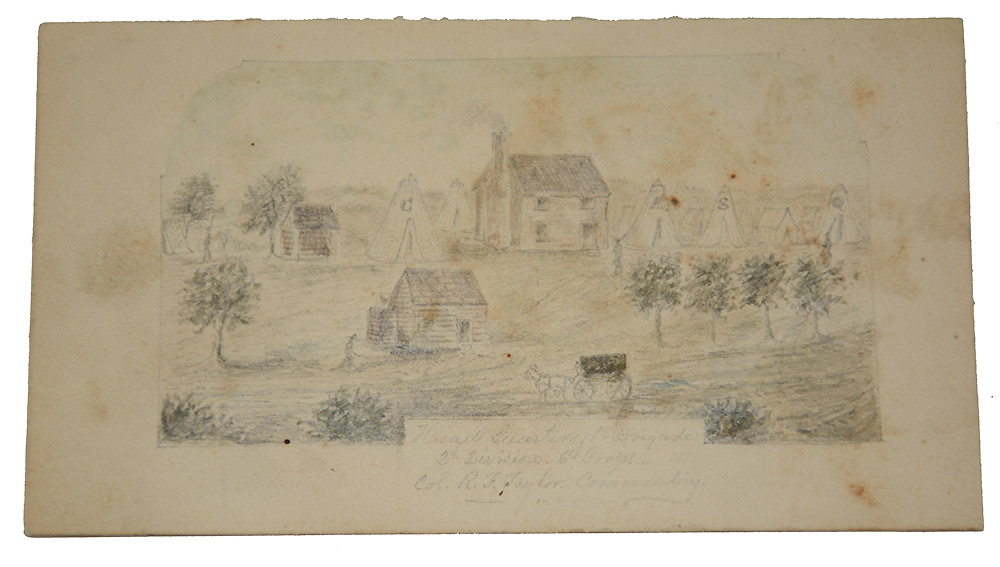
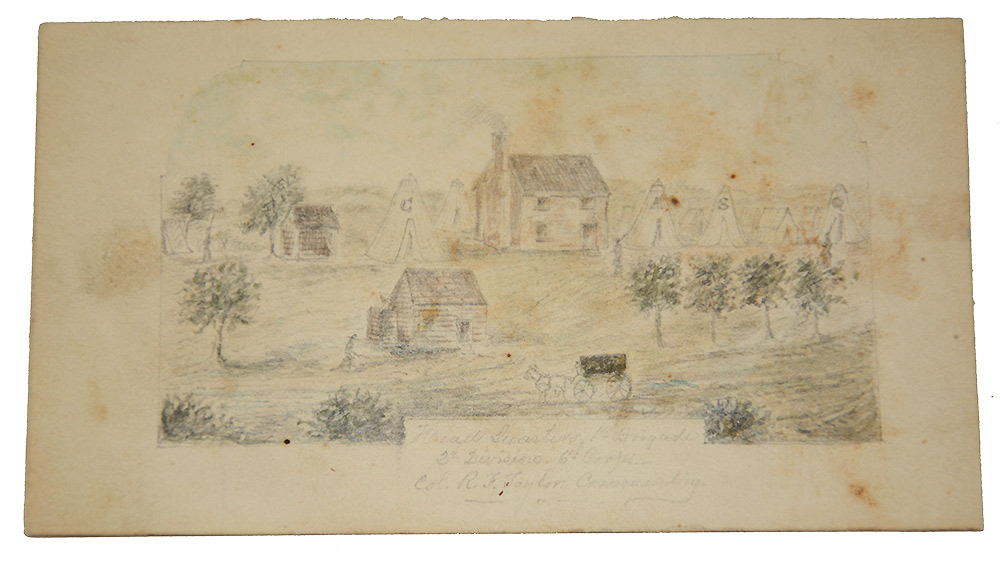
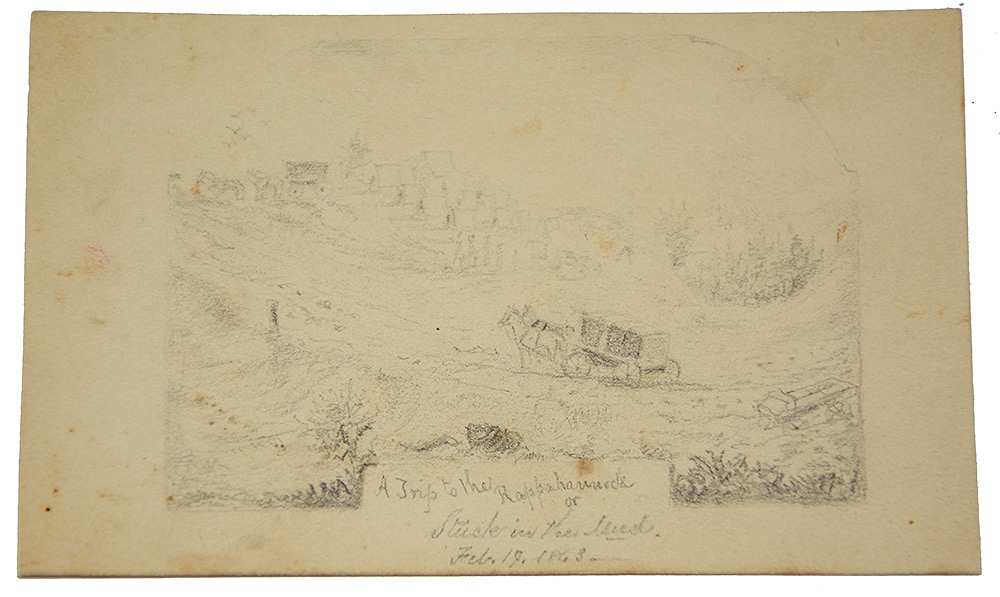
Two original pencil drawings on small card stock, each finished with a ruled border and a manuscript caption at the foot.
"Head Quarters, 1st Brigade, 2d Division, 6th Corps — Col. R. F. Taylor Commanding." A detailed view of a brigade headquarters encampment: a two-story frame house with smoking chimney at center, flanked by conical tents, several of them lettered; a log outbuilding in the foreground; a row of orchard trees at right; and a single-horse carriage on the road below, with faint touches of color in the sky and water. Inscribed in pencil on the verso "Compliments of Lieut. L. C. Mix." Approx. 4 1/4 x 2 1/2 in.
"A Trip to the Rappahannock or Stuck in the Mud. Feb. 19, 1863." A wry winter-quarters scene: a horse-drawn carriage laboring along a rutted road, a wagon mired and abandoned at lower right, and a wagon train and camp on the ridge beyond. Unsigned, in the same format and evidently the same hand. Approx. 4 x 2 1/2 in.
Lieutenant L. C. Mix of Rochester, an engraver by trade, served as an officer of the 33rd New York, and drawings by him illustrated David W. Judd's regimental history, The Story of the Thirty-Third N.Y.S. Vols. (Rochester, 1864). Taylor's May 9, 1863 letter places Mix at his side writing up the regiment's report. Original field sketches by a regiment's own illustrator, presented to his colonel, are seldom encountered.
POSTWAR
Ashtabula, O., Oct. 2[?], 1891. Four pages, ink, on paper blind-embossed with an infantry bugle, from Jas. K. Stebbins, signing as 1st Vice President of the Association, to "My dear old Colonel," forwarding "the official badge of our Survivors Association so beautifully wrought in gold" from "your 'old boys.'" Stebbins recalls recognizing Taylor's voice and face in a dimly lighted car at the Buffalo depot on the way to the Rochester reunion, encloses copies of his revision of Capt. Geo. M. Guion's poem on "Williamsburg," and takes up the old dispute over the May 5, 1862 charge there: the flag "unfortunately left in the little fort that Hancock ordered us out of," a 5th Wisconsin man's printed claim that there was no charge at all, and a man "from the old 13th" who saw McClellan rally the troops as he came onto the field. With the original corner-card envelope of Jas. K. Stebbins, Dealer in Watches, Clocks, Jewelry &c., 129 Main St., Ashtabula, O., addressed "Col. R. F. Taylor." The badge itself is not present.
THE DOCUMENTS
Mount Hope Cemetery, Rochester. Partly printed indenture, dated September 28[?], 1858, by which the City of Rochester, for twenty-five dollars, grants and conveys to Horatio N. Ayres and Robt. F. Taylor the west half of Lot 39, Section R, containing two hundred square feet, for the burial of the dead. Signed by C. H. Clark as Mayor and C. N. Simmons as Clerk, and countersigned by the Treasurer of the Board of Superintendents; gold foil city seal at lower left. Ayres was the husband of Jane Taylor's sister. Approx. 10 1/2 x 16 1/2 in.
Monroe Commandery, No. 12, Knights Templar, Stationed at Rochester. Printed dimit in red and black with engraved border, certifying that Sir Knight Robert F. Taylor is a Knight Templar and was a member of the Commandery in good standing and free from all charges, commending him to the fraternal regard of Sir Knights "wherever dispersed around the Globe." Dated the third day of October 1879, "and of the order 761." Signed by the Eminent Commander and attested by the Recorder; gold foil seal at lower left. Approx. 9 1/4 x 7 1/2 in.
Obituary notices. A sheet bearing three mounted newspaper clippings on the death of Mrs. Jane Alexander Taylor, widow of Colonel R. F. Taylor, at her home in Caledonia, N.Y., December 11, 1900, aged 73. The notices give her as a daughter of Judge Alexander of Rochester; record her marriage to Robert F. Taylor on October 26, 1848; summarize his military career and his postwar business in Fall River, Mass., Toronto and Chicago; name her surviving children, Henry A. of Toronto, Anson B. of Buffalo, Nelson R. of Chicago, Charles M. of New York and Harriet S.; and note her interment beside her husband in Rosehill Cemetery, Chicago. Their account of his Mexican War service differs in its particulars from the record of his own letters.
ALSO INCLUDED
Photocopied pages from the officers' biographies of the regimental history, including the sketch of Colonel Robert F. Taylor; and a typed modern research summary of Taylor's service in the 13th New York, 33rd New York and 1st New York Veteran Cavalry, including his dismissal of November 17, 1864 and its later revocation by Gen. George Crook with an honorable discharge to date from that day.
CONDITION
Letters with normal folds, light toning and scattered foxing; the Mexican War letters with small separations and spotting at fold intersections; the 1862 sheet with small chips at the left edge; all clearly legible. Sketches with light toning, foxing and a few small spots; images strong. Deed and dimit with fold lines and light toning, seals intact. Clippings browned. Envelope toned. [ss][ph:L]
~~~~~~~~~~~~~~~~~~~~~~~~~~~~~~~~~~~
THIS ITEM, AS WITH ALL OTHER ITEMS AVAILABLE ON OUR WEB SITE,
MAY BE PURCHASED THROUGH OUR LAYAWAY PROGRAM.
CLICK HERE FOR OUR POLICIES AND TERMS.
THANK YOU!
Inquire About COL. ROBERT F. TAYLOR, 33RD NEW YORK VOLUNTEER INFANTRY — FAMILY GROUPING OF LETTERS, ORIGINAL CAMP SKETCHES AND DOCUMENTS, 1847–1900
Most Popular
Historical Firearms Stolen From The National Civil War Museum In Harrisburg, Pa »
Theft From Gravesite Of Gen. John Reynolds »
Selection Of Unframed Prints By Don Troiani »
Fine Condition Brass Infantry Bugle Insignia »
Rare Identified 65Th Ny Sergeant’s Jacket, With Manscript Material: 1St U.s. Chasseurs »
featured item
VERY RARE 1834 ENGINEER AND MEDICAL STAFF SWORD BY HENRY BOKER, BELONGING TO BREVET BRIGADIER GENERAL JOHN HENDRICKSON, WHO LOST A LEG AT FREDERICKSBURG, 83rd NEW YORK VOLS (9th NYSM) AND 13th V.R.C.
New patterns of swords for the U.S. army were developed from 1832 to 1834. This elegant smallsword pattern (variously called by collectors the 1832 or 1834 pattern) was designated for officers of Engineers and Medical Staff (and Pay Department as… (870-325). Learn More »
site search