

site search
online catalog
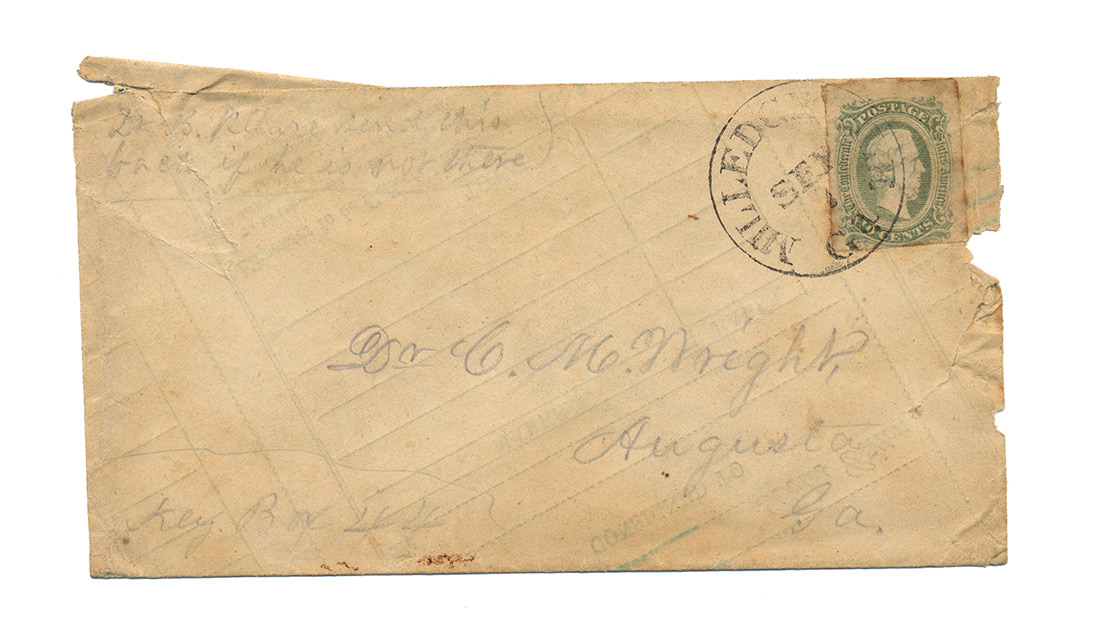
CONFEDERATE ADVERSITY COVER FASHIONED FROM A WESTERN & ATLANTIC RAIL-ROAD COTTON SHIPPING FORM — MILLEDGEVILLE, GEORGIA TO DR. C. M. WRIGHT, AUGUSTA
Hover to zoom
$175.00
Quantity Available: 1
Item Code: 2025-3470
Shipping: Determined by Method & Location of buyer
To Order:
Call 717-334-0347,
Fax 717-334-5016, or E-mail
Confederate States cover, measuring approximately 4 1/2 x 2 1/2 inches, cut, folded and gummed by hand from a printed antebellum railroad shipping form and carried in the Confederate mails. The face is addressed in a much-faded period hand to "Dr. C. M. Wright, Augusta, Ga.," with a further manuscript notation at the lower left, only partly legible, ending in what appears to read "...key, Box 1—" and evidently a box number or care-of direction. Across the upper portion of the face a second and smaller hand has added a forwarding instruction reading approximately "Dr. [S?] Please send this back if he is not there" — the sort of endorsement routinely added to wartime mail directed to surgeons and officers liable to reassignment.
The ten-cent Jefferson Davis adhesive at the upper right, in a distinctly green shade, is tied by a circular town datestamp reading MILLEDG[EVILLE] with the month slug SEP legible at center. The strike falls at the left of the stamp and onto the cover. Ten cents was the standard Confederate letter rate for distances under five hundred miles from July 1862 to the end of the war, and is the correct and expected franking for a letter carried from Milledgeville to Augusta.
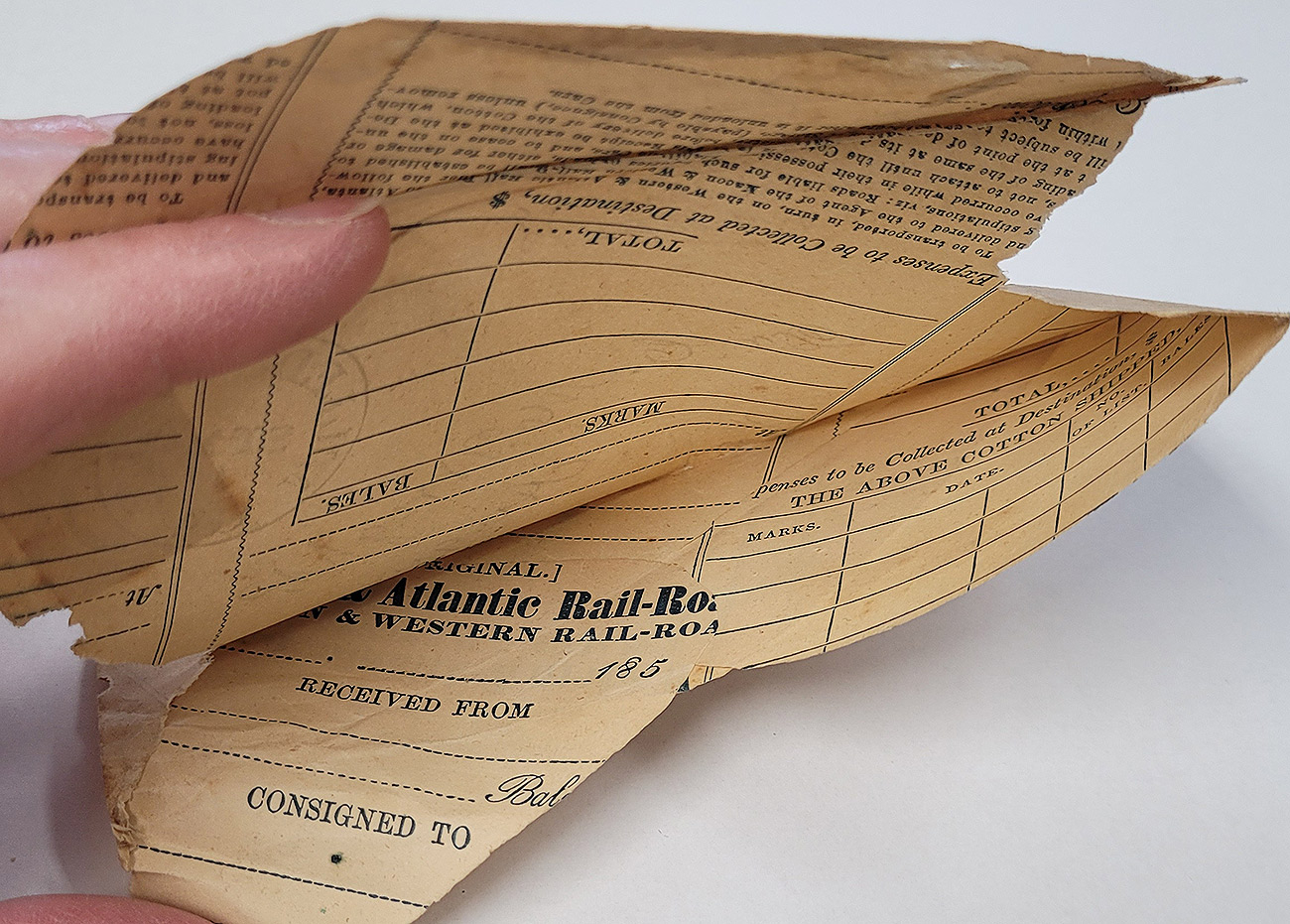
The interest of the piece lies in the paper from which it was made. Opened out, the envelope proves to have been folded from an unused printed form of the Western & Atlantic Rail-Road, headed in bold display type and carrying the sub-heading of transfer TO MACON & WESTERN RAIL-ROAD together with the bracketed designation [ORIGINAL.]. The printed dateline reads "No. ______, ______ 185_" and was never filled in.
The form is a cotton bill of lading and inter-road transfer receipt, with printed blanks for RECEIVED FROM, for a stated number of Bales Cotton, and for CONSIGNED TO, followed by a ruled table headed MARKS., BALES. and DATE., closing with TOTAL,.... and the line "Expenses to be Collected at Destination, $". Beneath runs the printed carriage agreement: the cotton to be transported in turn on the Western & Atlantic Rail-Road and delivered to the Agent of the Macon & Western Rail-Road at Atlanta, under stipulations holding each road liable only for such damage or loss as occurred while in its own possession, with charges not to attach until the cotton is unloaded at its destination and receipt taken by the consignee, and provision for storage should the cotton not be removed within a stated interval after unloading from the cars. Portions of the printed text run off the folded edges or are turned to the interior, and the printed rule and type of the form show plainly through the face of the finished envelope.
The Confederacy's paper famine set in early and never lifted. Envelope stock was among the first commodities to disappear from Southern stationers, and correspondents fell back on whatever printed or ruled paper lay at hand — wallpaper, ledger and account-book leaves, printed circulars, obsolete business forms, and previously received letters turned inside out. Covers of this kind are collected as "adversity covers," and their appeal rests almost entirely on the character of the salvaged paper. A pre-war railroad cotton form is among the more desirable underlying documents, joining Confederate postal history to the two industries — cotton and the railroads — on which the Southern war economy depended.
The Western & Atlantic Rail-Road was the property of the State of Georgia, running 138 miles from Atlanta to Chattanooga; the Macon & Western carried the traffic onward from Atlanta to Macon, where it met the Central of Georgia for Savannah. Together these roads formed the principal artery by which upcountry cotton reached market, and in wartime the same rails became the Confederacy's vital interior supply line — the object of Andrews's raiders in April 1862 and of Sherman's campaign in the summer of 1864. That this piece of the road's own printed stationery survives only because someone in Georgia needed an envelope is very much to the point.
Milledgeville, the town of origin, was the capital of Georgia throughout the war. The secession convention met there in January 1861, and Sherman's left wing occupied and looted the town in November 1864. Augusta, the destination, was the seat of the Confederate Powder Works and of a substantial complex of military hospitals, an entirely natural address for a physician in these years.
Dr. Charles M. Wright, born in 1837, died at the young age of 28 and is buried in Magnolia Cemetery in August, GA.
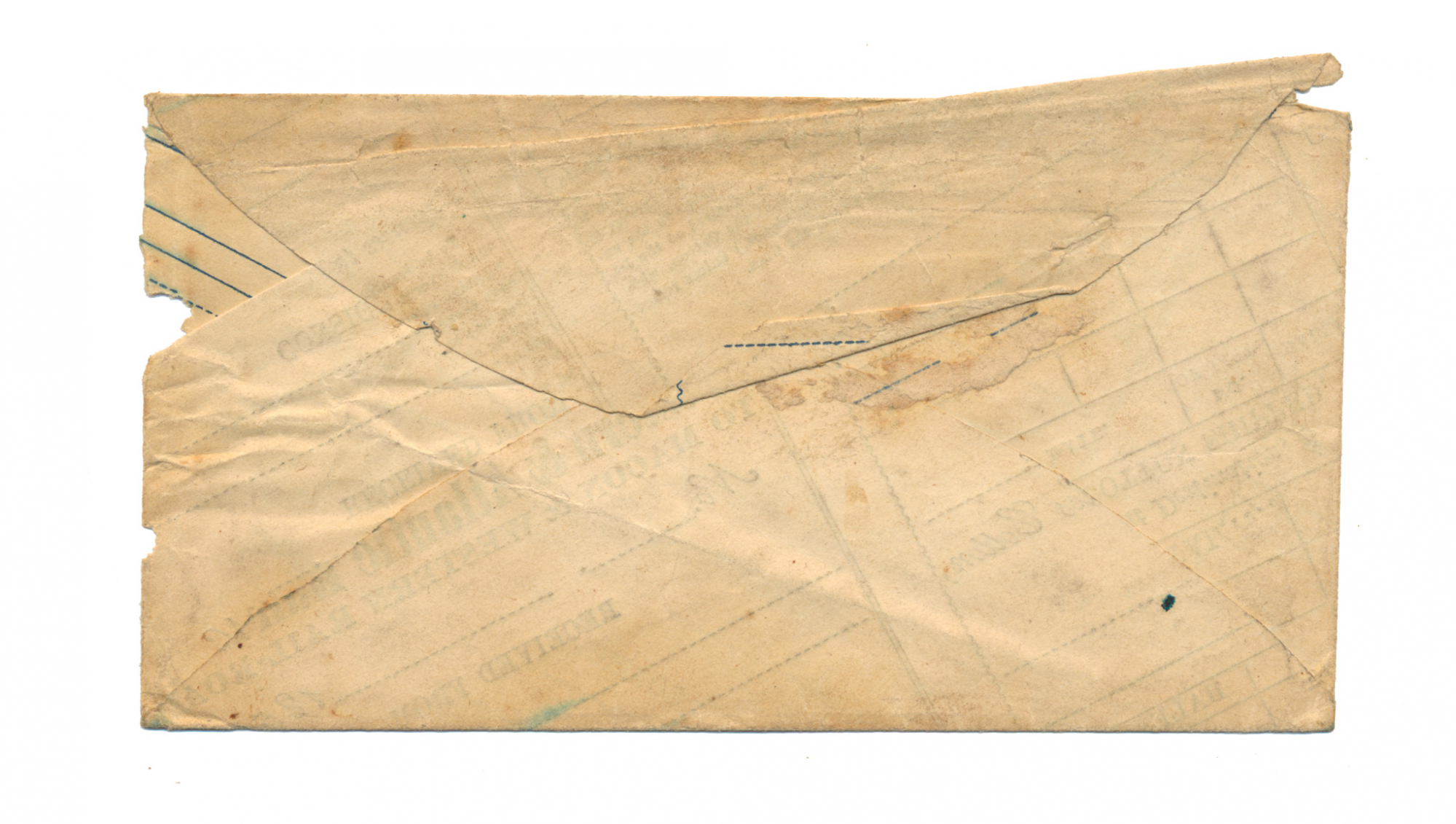
CONDITION: Toned overall with scattered soiling and light foxing consistent with the salvaged stock. Chipping and paper loss along the right edge, including a loss below the stamp and a torn area at the upper right corner adjacent to it; smaller nicks and short edge tears elsewhere. Heavy original folds and creasing throughout. The address is much faded but remains legible under good light. The adhesive is sound and firmly affixed. The reverse shows the plain converted flaps of the improvised envelope, without docketing, seal or backstamp. [ss][ph:L]
~~~~~~~~~~~~~~~~~~~~~~~~~~~~~~~~~~~
THIS ITEM, AS WITH ALL OTHER ITEMS AVAILABLE ON OUR WEB SITE,
MAY BE PURCHASED THROUGH OUR LAYAWAY PROGRAM.
CLICK HERE FOR OUR POLICIES AND TERMS.
THANK YOU!
Inquire About CONFEDERATE ADVERSITY COVER FASHIONED FROM A WESTERN & ATLANTIC RAIL-ROAD COTTON SHIPPING FORM — MILLEDGEVILLE, GEORGIA TO DR. C. M. WRIGHT, AUGUSTA
Most Popular
Historical Firearms Stolen From The National Civil War Museum In Harrisburg, Pa »
Theft From Gravesite Of Gen. John Reynolds »
Selection Of Unframed Prints By Don Troiani »
Fine Condition Brass Infantry Bugle Insignia »
Rare Identified 65Th Ny Sergeant’s Jacket, With Manscript Material: 1St U.s. Chasseurs »
featured item
A RARE US MARINE CORPS SERGEANT'S SABER
This scarce saber was manufactured by F.W. Widmann its designer. Andrew Mowbray, in his book THE AMERICAN EAGLE-POMMEL SWORD shows a specimen as figure 51A page 195. F.W. Widmann's company was acquired by Horstmann in 1848. This particular sword… (1179-250). Learn More »
site search