
site search
online catalog
WAR DATED DS – GEORGE E. PICKETT AS COLONEL, AND COL. D.H. MAURY, A.A.G
Hover to zoom
$1,950.00 SOLD
Quantity Available: None
Item Code: 2025-3324
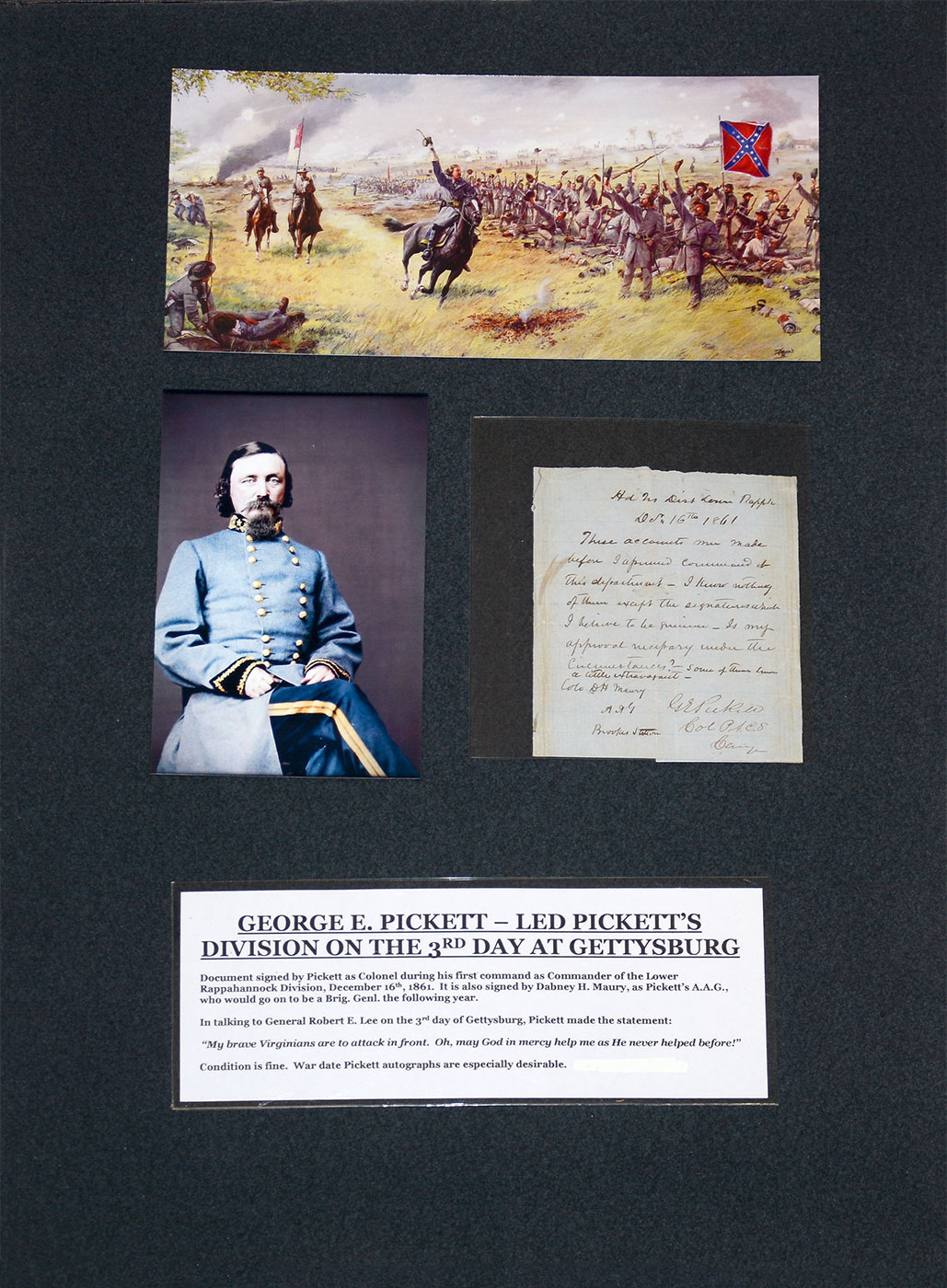
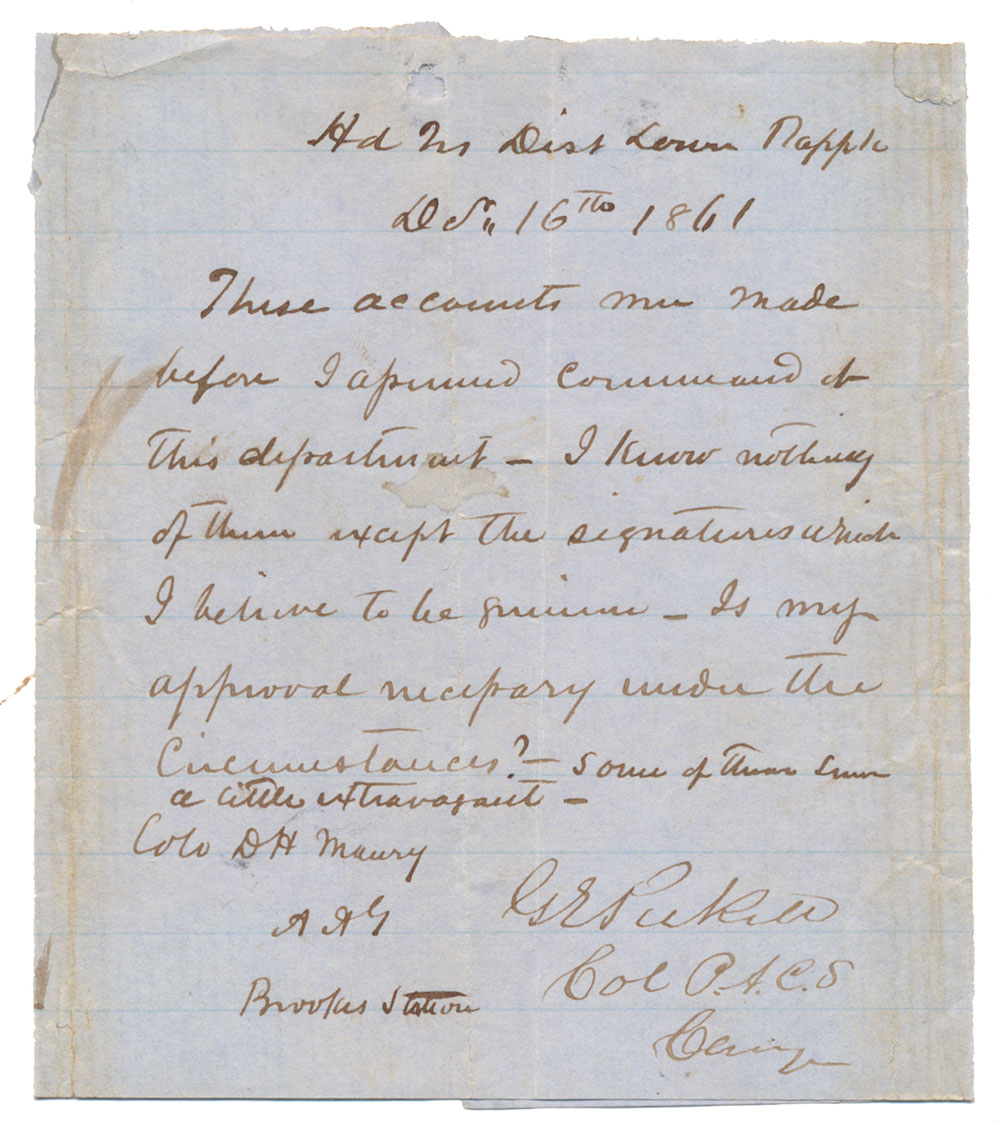
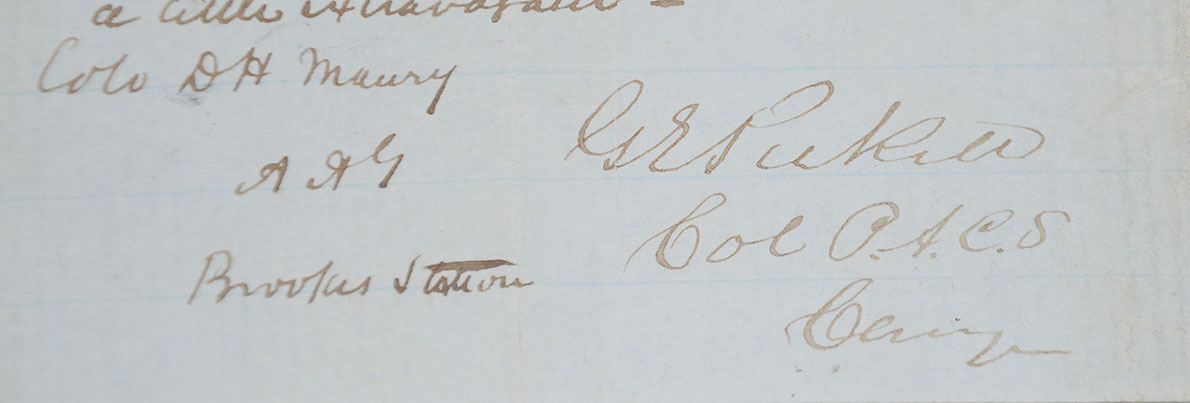
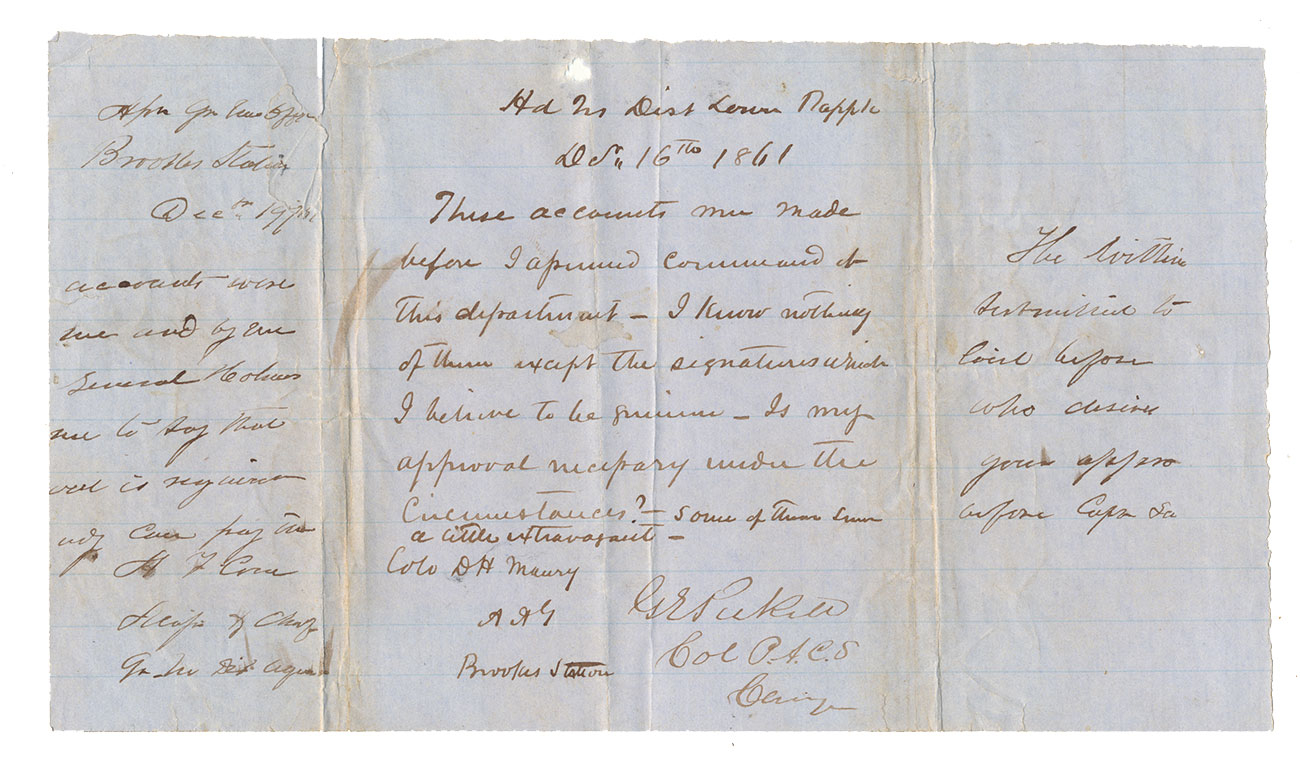
War dated document signed by Pickett. Ink on lined blue paper, overall measuring 7 ¾” x 4 ½”, folded so that note is on a 4” x 4 ½” section. Dated Headquarters District Lower Rappahannock [“Hd Qr Dist Lower Rappk”], Dec. 16th 1861. The body of the note reads,
“These accounts were made
before I ap_______ command of
this department ___ I know nothing
of them except the signatures which
I believe to be genuine__ Is my
approval necessary under the
circumstances? – some of them seem
a little extravagant.
Colo D H Maury
A A G G E Pickett
Brooks Station Col P.A.C.S
Comg”
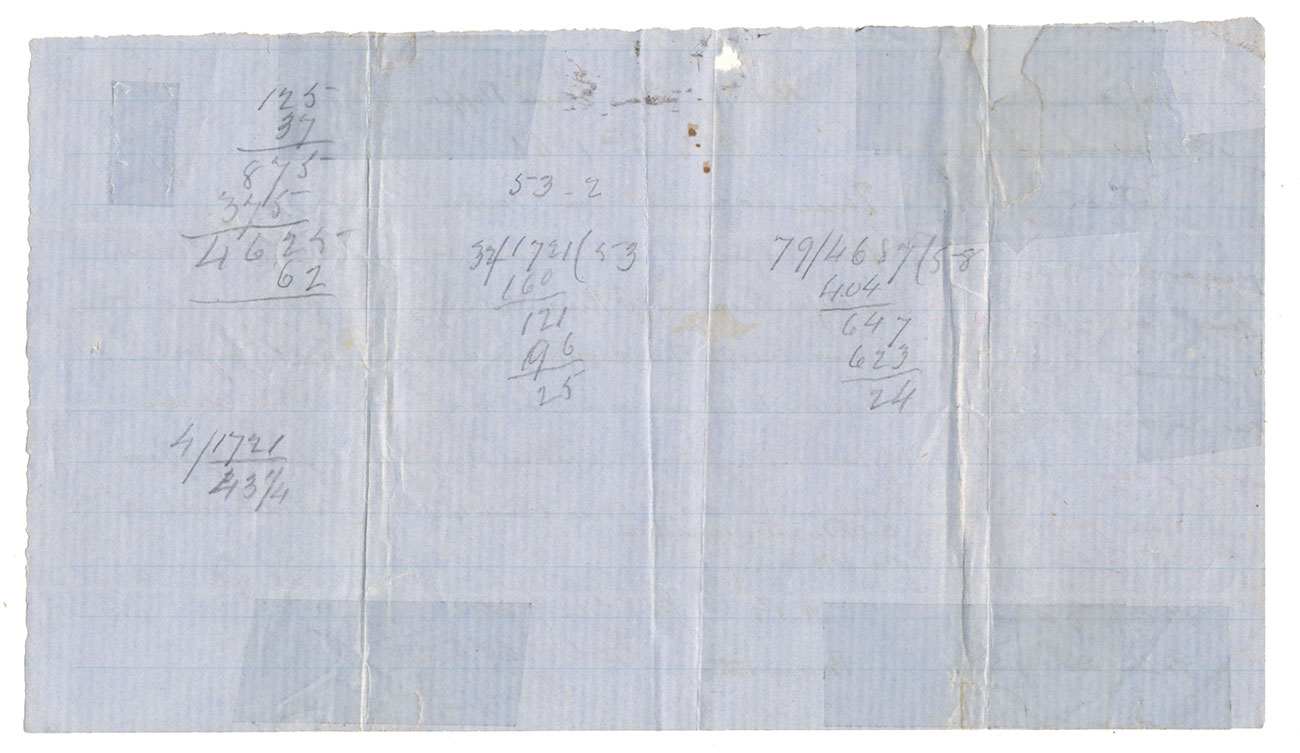
On the reverse of the paper are some mathematical calculations in pencil.
When the two sides are folded back, there is an additional note dated Dec. 19th, 1861 from Brooks Station: “The ______ accounts were submitted to me and by me _____ upon several others who desire me to say that your approx. ________ __________ __________. H. F. C_____ / __________ / ___________.
Pickett signed as Colonel during his first command as Commander of the Lower Rappahannock Division. It is also signed by Dabney H. Maury, as Pickett’s A.A.G. Dabney would go on to be a Brigadier General the following year. Condition is fine. Some age yellowing and light staining; small area of paper loss at upper edge at center. Housed in a 14" x 20 1/2" riker box along with color copies of a photo of Pickett and the print "Remember Old Virginia” by Dale Gallon, featuring Pickett at Gettysburg shouting inspiration to his men to remember that they were from “Old Virginia”.
George Edward Pickett was born at Richmond, Va., January 25, 1825. He was graduated at the United States military academy in the class of 1846.
Going into the war with Mexico he was promoted second lieutenant, 2nd Infantry; was transferred to the 7th and finally to the 8th Infantry, and participating in all the important engagements of Scott's army, was brevetted first lieutenant for gallantry at Contreras and Churubusco; earned the brevet of captain at Chapultepec, and finally took part in the capture of the Mexican capital.
He subsequently served with the 8th Infantry on frontier duty in Texas until 1855, when he was promoted captain 9th Infantry, and given a year's assignment to Fortress Monroe. He was afterward on duty in Washington territory, until the spring of 1861.
In 1856 he occupied San Juan island with sixty men, and forbade the landing of British troops, winning the thanks of the territorial legislature for his gallant and firm discharge of duty, and the commendation of General Harney for "cool judgment, ability and gallantry." His loyalty and firmness saved the rights of the United States until the title to the island was confirmed by international arbitration, and "Fort Pickett" guarded one end of the island until the British finally retired.
His first commission in the Confederate service was as major of artillery, regular army. On July 23, 1861, as colonel in the provisional army, he was assigned to temporary command on the lower Rappahannock, with headquarters at Fredericksburg, and on February 28, 1862, being promoted to brigadier-general, he was ordered to report to General Longstreet.
Commanding a brigade of Longstreet's corps, he won commendation for "using his forces with great effect, ability and his usual gallantry, " at Williamsburg. On the second day of the battle of Seven Pines he was particularly distinguished for his good generalship during an attack by Hooker's command.
An order to withdraw was received, which was obeyed by the other brigade commanders after the repulse of the first attack; but "Pickett, the true soldier," as Longstreet writes, "knowing that the order was not intended for such an emergency, stood and resisted the attack," holding his ground against odds of ten to one for several hours longer.
At Gaines' Mill, fighting on the right with Longstreet, his brigade broke Porter's line just west of the Watts house, attacking with such vigor as almost to gain possession of the Federal reserve artillery. In this assault Pickett fell severely wounded.
In October, 1862, Pickett was promoted to major-general and assigned to a division of Longstreet's corps, composed of his old brigade under Garnett, and the brigades of Armistead, Kemper and Corse, all Virginians, and Micah Jenkins' South Carolina brigade.
He held the center of the line at Fredericksburg, and after that battle was sent with his division to Richmond, which was supposed to be threatened by the Federal movements. He was reinforced by Hood's division, and General Longstreet, in command, operated against Suffolk.
Pickett went into the Gettysburg campaign with three brigades, Garnett's, Kemper's and Armistead's, and Dearing's artillery. He reached the battlefield with his men on the forenoon of the third day of battle, and was selected to make the attack upon the Federal center on Cemetery Hill, Heth's division under Pettigrew to form the left of the line, which should be supported by Pender's division under Trimble.
The story of the charge has been often eloquently related and need not be repeated here except to say the attack failed with heavy losses to Pickett’s Division. Pickett himself was unhurt.
In September, 1863, Pickett was assigned to command of the department of North Carolina, embracing Petersburg and Southern Virginia. He made a demonstration against New Bern in the latter part of January, 1864. In May he joined Lee on the North Anna, and from that time commanded his old division, Armistead's, Pickett's, Corse's and Kemper's brigades, now under Barton, Hunton, Corse and Terry, until the close of hostilities.
On June 16th, Lee arrived at Drewry's Bluff with Pickett's division, and witnessed the recapture of the Confederate lines from Butler.
Pickett remained before Bermuda Hundred until March, 1865, when he was sent to Lynchburg to oppose Sheridan's raid, and then marched with Longstreet north of Richmond in an attempt to intercept the Federal cavalryman, whom he finally met on March 31st and April 1st at Dinwiddie Court House and Five Forks.
General Pickett had received orders from Robert E. Lee to, with the Cavalry divisions of Major Generals William Henry Fitzhugh Lee and Thomas L. Rosser, hold the vital railroad crossing at Five Forks at all costs. On April 1, 1865 their troops were attacked by a combined force under Major General Philip Henry Sheridan, which consisted of the 5th Corps of the Army of the Potomac, commanded by Major General Gouverneur K. Warren, and the Cavalry Corps of the Army, commanded by Brigadier General Wesley Merritt. Pickett, W.H.L. Lee, and Rosser were located behind the lines of their troops at the time of the attack, enjoying a shad bake while failing to inform their subordinate officers of their location. Meanwhile, Warren's troops overwhelmed Pickett's left flank, and the Cavalry troops pinned the Confederates down elsewhere. By the time the Confederate commanders realized the catastrophe, it was too late to prevent the defeat. The result of the battle, as well as that of the Third Battle of Petersburg the following day, forced Lee to abandon his entrenchments at Petersburg, leading to the capture of Richmond and surrender of his army on April 9
Pickett marched with his division from Petersburg, escaped from the disaster at Rice's Station with 600 men of his splendid division, and finally was surrendered April 9, 1865, with the last of the army of Northern Virginia.
Subsequently he engaged in business at Richmond, but did not survive the first decade following the war, dying at Norfolk, July 30, 1875. He is buried in Richmond’s Hollywood Cemetery.
Dabney Herndon Maury was born at Fredericksburg, Virginia, May 20, 1822, the son of Capt. John Minor Maury, United States Navy, whose wife was the daughter of Fontaine Maury.
He was educated at the classical school of Thomas Harrison, Fredericksburg, studied law at the University of Virginia, and was graduated at West Point in 1846, with the rank of brevet second lieutenant in the Mounted Rifles.
A theater for active service in his profession was awaiting him in Mexico, where he was at once ordered. He conducted himself with soldierly valor in this war, particularly at the siege of Vera Cruz and the battle of Cerro Gordo, where he was severely wounded, and received the brevet of first lieutenant for gallantry.
In further recognition of his services, he was presented with a sword by the citizens of Fredericksburg and the legislature of Virginia. For several years subsequent to the Mexican War he was detailed for service at the United States Military Academy, first as assistant professor of geography, history and ethics, and afterward as assistant professor of infantry tactics.
In 1852 he was transferred to frontier duty in Texas, in which he continued, with promotion to first lieutenant, until 1858, when he was appointed superintendent of the cavalry school at Carlisle, Pa. From April 15, 1860, until the outbreak of the Civil War he was assistant adjutant-general, with the rank of brevet captain, in New Mexico.
He promptly acted with his State in 1861, and was commissioned captain, corps of cavalry, C. S. A., to date from March 16th. Subsequently he was promoted colonel, was appointed adjutant-general of the army at Manassas, and when Gen. Earl Van Dorn was assigned to command the Trans-Mississippi department, early in 1862, he became his chief of staff and adjutant-general.
In his report of the battle of Elkhorn Tavern, General Van Dorn wrote: "Colonel Maury was of invaluable service to me both in preparing for and during the battle. Here, as on other battlefields where I have served with him, he proved to be a zealous patriot and true soldier; cool and calm under all circumstances, he was always ready, either with his sword or pen. "
Maury was promptly promoted brigadier-general. He accompanied Van Dorn to the consultation with A. S. Johnston and Beauregard at Corinth previous to the battle of Shiloh, and subsequently was transferred with the main Confederate force east of the Mississippi, where his service was afterward given.
When Price took command of the Army of the West at Tupelo, he commanded one of its two divisions, including the brigades of John C. Moore, W. L. Cabell and C. W. Phifer, and the cavalry of F. C. Armstrong. Little of Maryland, commanding the other division, fell at Iuka, where Maury was held in reserve, and afterward served as rear guard, repelling pursuit.
About a fortnight later he commanded the center in the battle of Corinth, against Rosecrans, and gallantly engaged the enemy, who was driven from his intrenchments and through the town. During the subsequent retirement he defended the rear, fighting spiritedly at Hatchie's Bridge.
He was promoted major-general in November, 1862, and on December 30th, arrived before Vicksburg from Grenada, to support S. D. Lee, who had repulsed Sherman's attack at Chickasaw Bayou, and was assigned to command of the right wing. He continued in service here, his troops being engaged at Steele's Bayou and in the defeat of the Yazoo Pass Expedition, until he was ordered to Knoxville, April 15th, to take command of the Department of East Tennessee.
A month later he was transferred to the command of the District of the Gulf. In this region, with headquarters at Mobile, he continued to serve until the end of the war. During the siege of Atlanta, in command of reserve troops, he operated in defense of the Macon Road.
In August, 1864, in spite of a gallant struggle, the defenses of Mobile Bay were taken, and in March and April, 1865, Maury, with a garrison about 9,000 strong, defended the city against the assaults of Canby's army of 45,000 until, after heavy loss, he retired without molestation to Meridian.
But the war was now practically over, and on May 4th, his forces were included in the general capitulation of General Taylor.
Subsequently he made his home at Richmond, Va. He has given many valuable contributions to the history of the war period, and in 1868 organized the Southern Historical Society, the collections of which he opened to the government War Records Office, securing in return free access to that department by ex-Confederates.
In 1878 he was a leader in the movement for the reorganization of the volunteer troops of the nation, and until 1890 served as a member of the executive committee of the National Guard Association of the United States.
In 1886 he was appointed United States minister to Columbia, a position he held until June 22, 1889. Maury died in Peoria, Illinois on January 11, 1900 and is buried in Confederate Cemetery, Fredericksburg, Virginia. [ld/ad][ph:L]
[PH:L]
~~~~~~~~~~~~~~~~~~~~~~~~~~~~~~~~~~~
THIS ITEM, AS WITH ALL OTHER ITEMS AVAILABLE ON OUR WEB SITE,
MAY BE PURCHASED THROUGH OUR LAYAWAY PROGRAM.
CLICK HERE FOR OUR POLICIES AND TERMS.
THANK YOU!
Inquire About WAR DATED DS – GEORGE E. PICKETT AS COLONEL, AND COL. D.H. MAURY, A.A.G
Most Popular
Historical Firearms Stolen From The National Civil War Museum In Harrisburg, Pa »
Theft From Gravesite Of Gen. John Reynolds »
Selection Of Unframed Prints By Don Troiani »
Fine Condition Brass Infantry Bugle Insignia »
featured item
RARE USN GOSPORT NAVY YARD PRIMING FLASK
Gosport Shipyard was the original name of the facility in Portsmouth, Virginia, that was founded in 1767, passed into the hands of Virginia in the Revolution, was leased from that state by the U.S. government in 1794, purchased by them in 1801 and… (490-6824). Learn More »
site search