

site search
online catalog
1857 LETTER FROM JOHN B. FLOYD (SECRETARY OF WAR UNDER PRESIDENT BUCHANAN, LATER CS BRIGADIER GENERAL) TO CAPT. MONTGOMERY MEIGS, SUPERINTENDENT OF WASHINGTON AQUADUCT
Hover to zoom
$150.00 ON HOLD
Quantity Available: 1
Item Code: 2026-1753
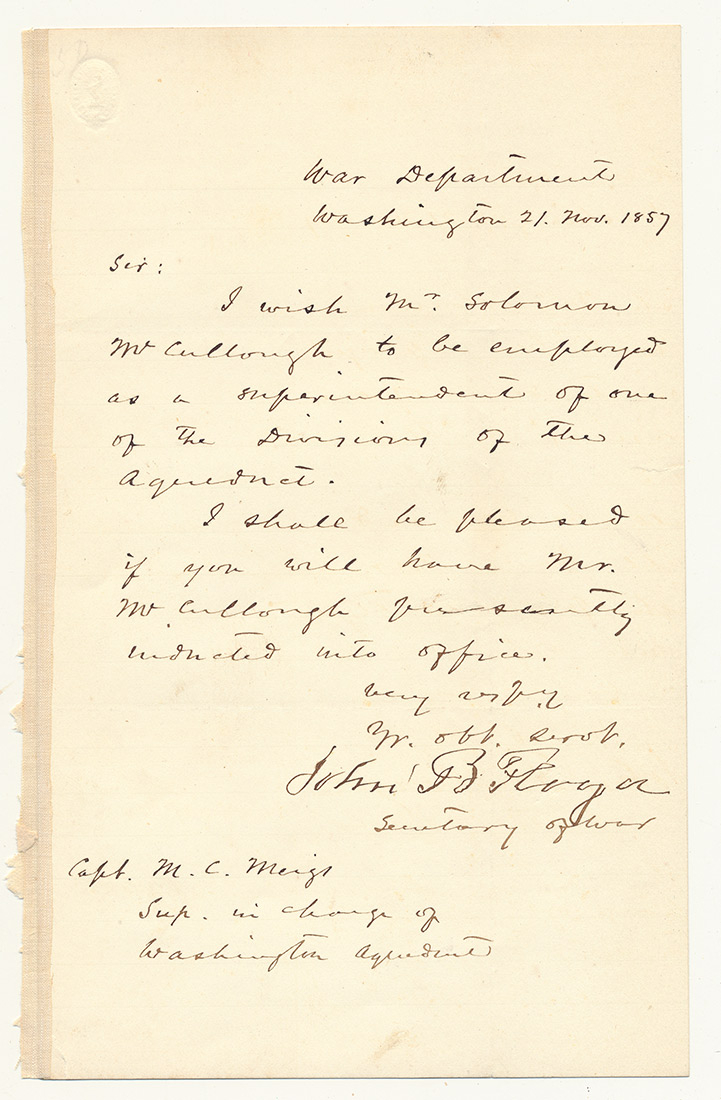
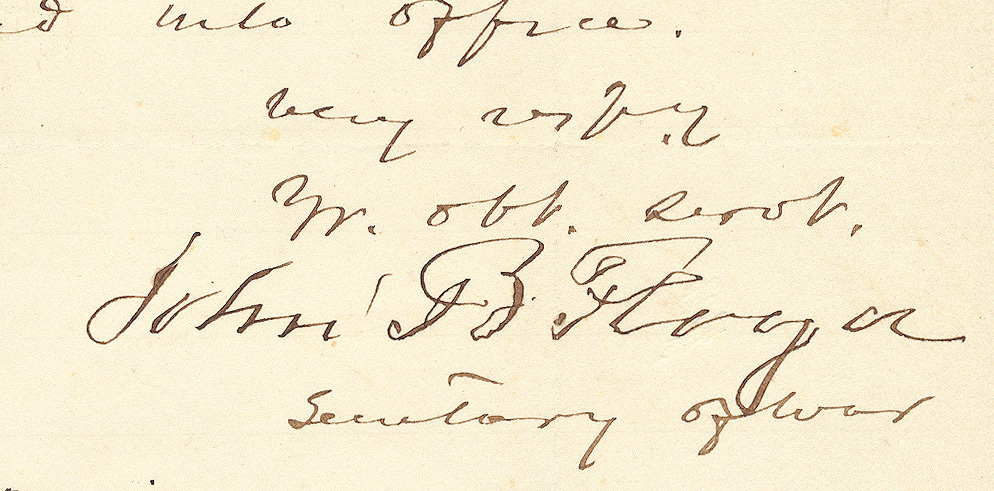
FLOYD, JOHN B. (1806–1863). U.S. Secretary of War under President James Buchanan; later Confederate brigadier general, infamous for abandoning his command at Fort Donelson. Letter Signed ("John B. Floyd, Secretary of War"), one page on a folded letter sheet (approx. 8 x 10 in.), "War Department, Washington," November 21, 1857, addressed to Capt. M. C. Meigs, Superintendent in charge of the Washington Aqueduct.
A choice piece of documentary content linking two men who would soon become bitter antagonists — and who would end the next decade on opposite sides of the Civil War. In full: "Sir: I wish Mr. Solomon McCullough to be employed as a superintendent of one of the Divisions of the Aqueduct. I shall be pleased if you will have Mr. McCullough presently inducted into office. Very re[spectfully], Yr. obt. servt., John B. Floyd, Secretary of War. — Capt. M. C. Meigs, Sup. in charge of Washington Aqueduct."
Here Floyd orders Captain (and future Union Quartermaster General) Montgomery C. Meigs to install a named appointee as a division superintendent on the Washington Aqueduct — precisely the kind of patronage interference in Meigs's contracts and personnel that ignited one of the most celebrated feuds in the antebellum War Department. Meigs, who supervised the Aqueduct from 1852–1860 along with the U.S. Capitol extension and dome, resisted Floyd's efforts to steer government work to political favorites; the quarrel reached President Buchanan and, in 1860, Floyd effectively banished Meigs to Fort Jefferson in Florida's Dry Tortugas. The exile proved providential: when Floyd resigned in December 1860 to join the Confederacy, Meigs was recalled, promoted colonel in May 1861, and appointed Quartermaster General of the Union Army — a role in which many historians credit him as an architect of Union victory and as the founder of Arlington National Cemetery. Floyd, by contrast, fled his command at Fort Donelson ahead of its surrender to U. S. Grant in February 1862, his name permanently stained.
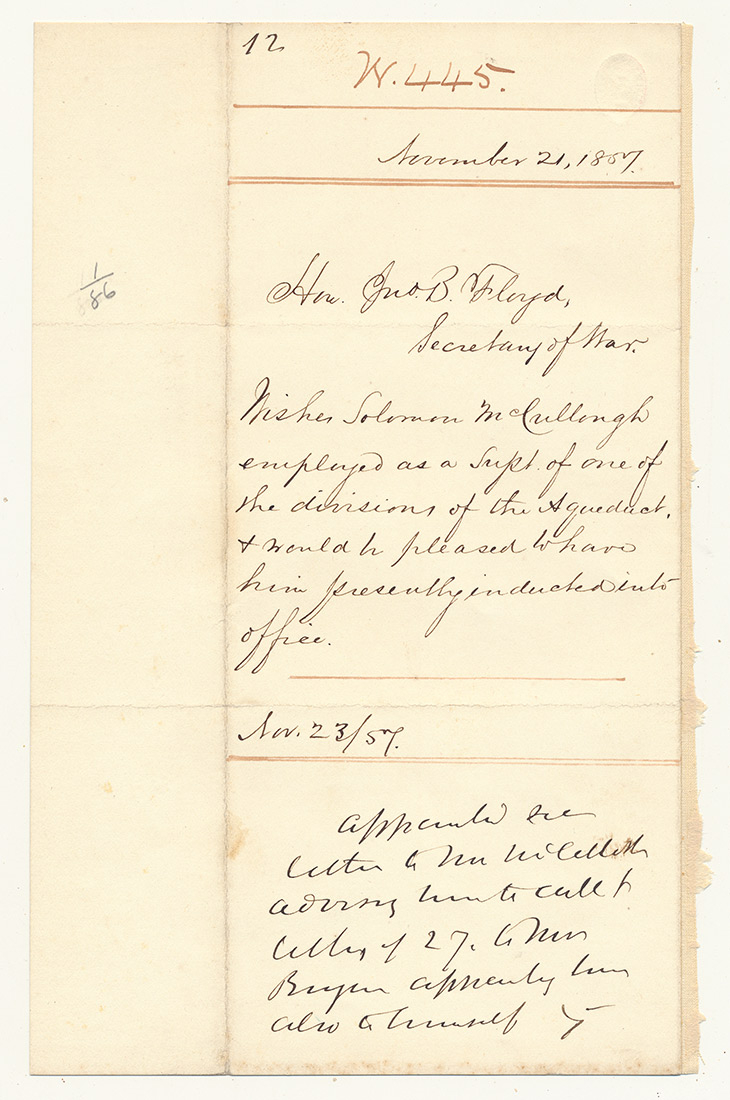
The integral docket leaf carries the Aqueduct office's period filing endorsement in ink — register "W. 445," summarizing the request that Solomon McCullough be employed as a superintendent and "presently inducted into office," with a follow-up notation dated "Nov. 23/57." — establishing the letter as a documented piece from the Washington Aqueduct's official correspondence files.
Note: The letter is signed by Floyd as Secretary of War and reads as in his hand; as with much cabinet-level directive correspondence, the body may have been penned by a War Department clerk, which would make it technically a Letter Signed rather than a full Autograph Letter Signed. In-hand examination is recommended if a precise ALS/LS designation is material to the buyer.
Condition: Usual mailing folds; light overall toning with a few scattered foxing spots; minor edge wear and a short closed separation at the central fold; a blind-embossed oval at the head of the sheet. Ink strong and fully legible throughout. Very good.
A teachable artifact of the Floyd–Meigs rivalry — Confederate disgrace and Union hero joined on a single sheet. [ss][ph:L]
~~~~~~~~~~~~~~~~~~~~~~~~~~~~~~~~~~~
THIS ITEM, AS WITH ALL OTHER ITEMS AVAILABLE ON OUR WEB SITE,
MAY BE PURCHASED THROUGH OUR LAYAWAY PROGRAM.
CLICK HERE FOR OUR POLICIES AND TERMS.
THANK YOU!
Inquire About 1857 LETTER FROM JOHN B. FLOYD (SECRETARY OF WAR UNDER PRESIDENT BUCHANAN, LATER CS BRIGADIER GENERAL) TO CAPT. MONTGOMERY MEIGS, SUPERINTENDENT OF WASHINGTON AQUADUCT
Most Popular
Historical Firearms Stolen From The National Civil War Museum In Harrisburg, Pa »
Theft From Gravesite Of Gen. John Reynolds »
Selection Of Unframed Prints By Don Troiani »
Fine Condition Brass Infantry Bugle Insignia »
Rare Identified 65Th Ny Sergeant’s Jacket, With Manscript Material: 1St U.s. Chasseurs »
featured item
EYE-CATCHING 1859-1861 VIRGINIA MILITIA GROUPING OF CAPT. J.Q.A. NADENBOUSCH, BERKELEY BORDER GUARDS, LATER COLONEL 2nd VA INFANTRY OM RECOMMENDATION OF LEE AND STONEWALL JACKSON
An historic and eye-catching Virginia officer’s group belonging to John Quincy Adams Nadenbousch while Captain of the “Berkeley Border Guards,” a militia company raised in response to the John Brown raid, present at the execution of Brown’s… (2025-3677). Learn More »
site search