

site search
online catalog
1864 ALS COMMODORE J.B. MONTGOMERY TO NAVY SECRETARY GIDEON WELLES
Hover to zoom
$25.00 ON HOLD
Quantity Available: 1
Item Code: 1268-1070
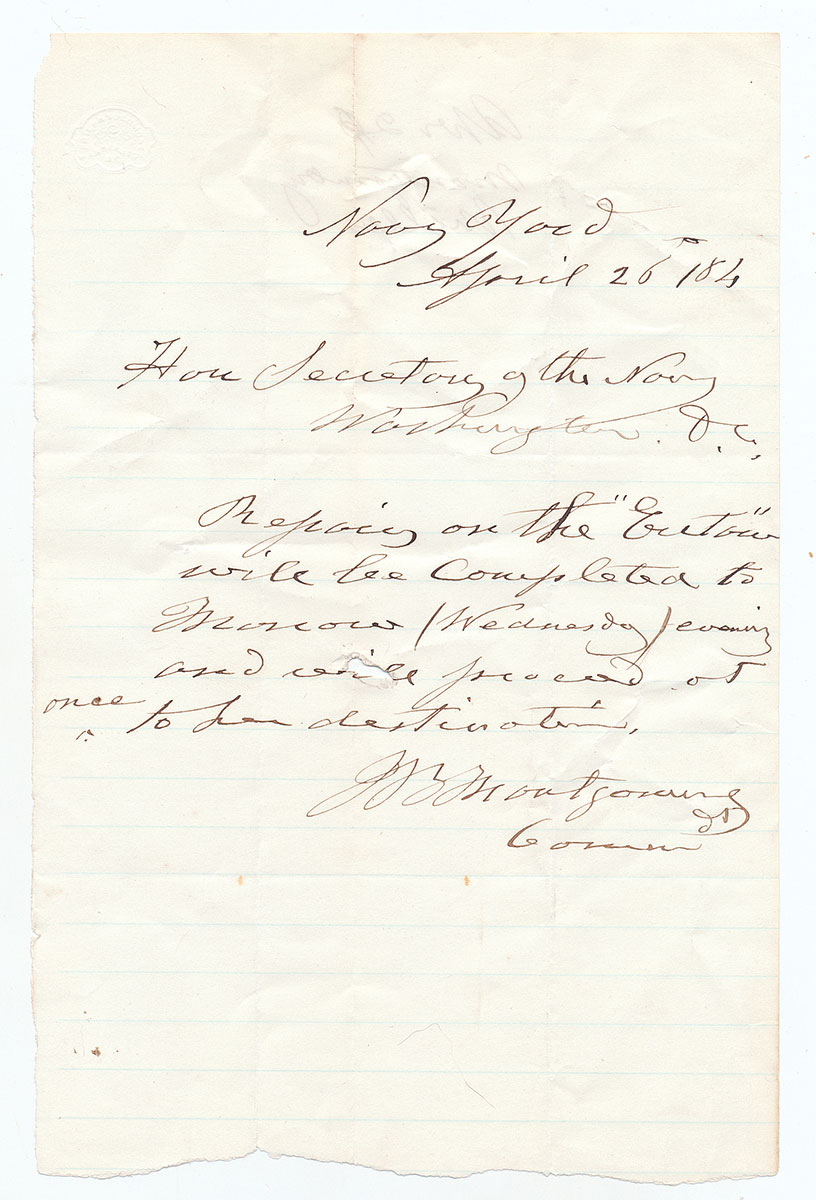
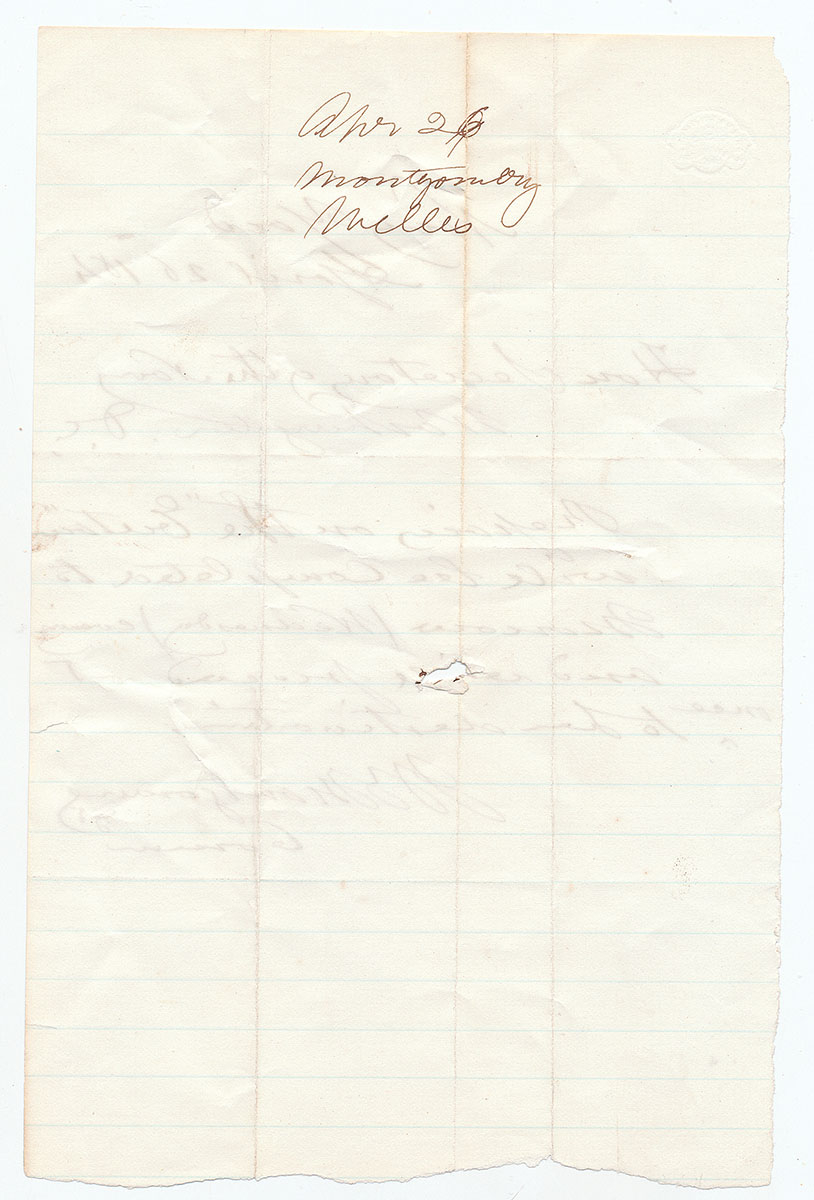
This letter is a single sheet of light cream, blue-ruled paper, roughly the size of a small notepad leaf. It has been folded in thirds for mailing or filing, and the fold lines are visible on both sides. The bottom edge is deckled or torn. There is a small hole in the middle of the sheet, with some light creasing and minor toning. An embossed stationer's blind stamp appears in the upper corner, visible on the front at upper left and on the back at upper right. The ink is brown, typical of iron gall ink of the period, and the hand is a fluent, ornate nineteenth-century cursive.
Text (front):
Navy Yard
April 26, 18[6]4
Hon. Secretary of the Navy
Washington, D.C.
Repairs on the "Eutaw" will be completed tomorrow (Wednesday) evening and will proceed at once to her destination.
J. B. Montgomery [?]
Comm[andan]t
In a different hand, at the top of the reverse, is the filing note "Apr 26 / Montgomery / Welles". Faint show-through of the letter's text is visible from the front. Good overall condition. The writing is clear and fully legible. Flaws are limited to the fold lines, the small central hole, the rough bottom edge, and light soiling.
This is a short official communication from the commandant of a navy yard to the Secretary of the Navy in Washington. It reports that repairs to a vessel will be finished the following evening, after which the ship will depart for her destination.
The USS Eutaw, a 1173-ton Sassacus class "double-ender" steam gunboat built at Baltimore, Maryland, was commissioned in July 1863. Assigned to the North Atlantic Blockading Squadron, she spent most of the Civil War operating on the Potomac and James Rivers and along the Atlantic coast. In May 1864, Eutaw covered the army as it landed below City Point, Virginia, and, in July of that year, she bombarded the Confederates at Malvern Hill. Later in July 1864, she towed the ill-fated monitor Tecumseh to the Gulf of Mexico, returning to the James River in August. In April 1865, with the War nearly at an end, Eutaw went to New York, where she decommissioned in early May. She was sold in October 1867.
A native of New Jersey, Montgomery he joined the United States Navy in June 1812, several days before the outbreak of the War of 1812. Assigned at the rank of Midshipman, he served with distinction throughout the war, including service aboard the "USS Niagara" during the September 10, 1813 Battle of Lake Erie. Commissioned to the rank of Lieutenant in 1818, he continued to rise through the ranks until 1845, when he was given command of the "USS Portsmouth" in the Navy's Pacific Fleet. With the outbreak of the Mexican War, the Portsmouth was ordered to Northern California where she anchored in the San Francisco Bay. On July 9, 1846, Commander Montgomery led a small force of men from his ship into the coastal town of Yerba Buena and raised the American flag in the town plaza to capture it without firing a shot. In 1847, the town he captured would be officially re-named San Francisco. Promoted to Captain in 1853, he remained in active service and by the outbreak of the Civil War, was in command of the Pacific Fleet. In 1862, he was promoted to Commodore and assigned as commander of the Boston Navy Yard until 1863 when he took command of the Washington Navy Yard. At war's end, he was promoted to Rear Admiral and given command of the Naval Station at Sacket's Harbor, New York, a post he held until his retirement in 1869. [ss][ph:L]
~~~~~~~~~~~~~~~~~~~~~~~~~~~~~~~~~~~
THIS ITEM, AS WITH ALL OTHER ITEMS AVAILABLE ON OUR WEB SITE,
MAY BE PURCHASED THROUGH OUR LAYAWAY PROGRAM.
CLICK HERE FOR OUR POLICIES AND TERMS.
THANK YOU!
Inquire About 1864 ALS COMMODORE J.B. MONTGOMERY TO NAVY SECRETARY GIDEON WELLES
Most Popular
Historical Firearms Stolen From The National Civil War Museum In Harrisburg, Pa »
Theft From Gravesite Of Gen. John Reynolds »
Selection Of Unframed Prints By Don Troiani »
Fine Condition Brass Infantry Bugle Insignia »
Rare Identified 65Th Ny Sergeant’s Jacket, With Manscript Material: 1St U.s. Chasseurs »
featured item
IDENTIFIED ISSUE RED BLANKET OF THEODORE P. BOWKER 13th MASSACHUSETTS - DIED OF WOUNDS AT ANTIETAM!
This is a rare, early-war, identified Massachusetts issue red blanket carried by a soldier in the 13th Massachusetts who was wounded at Antietam on Sept. 17, 1862, and died of those wounds at a U.S. hospital at Rappahannock Station on November 12.… (490-7138). Learn More »
site search