


site search
online catalog
CONFEDERATE “CS & STAR” SHORT SWORD

Hover to zoom

$3,950.00 ON HOLD
Quantity Available: 1
Item Code: 2026-1237
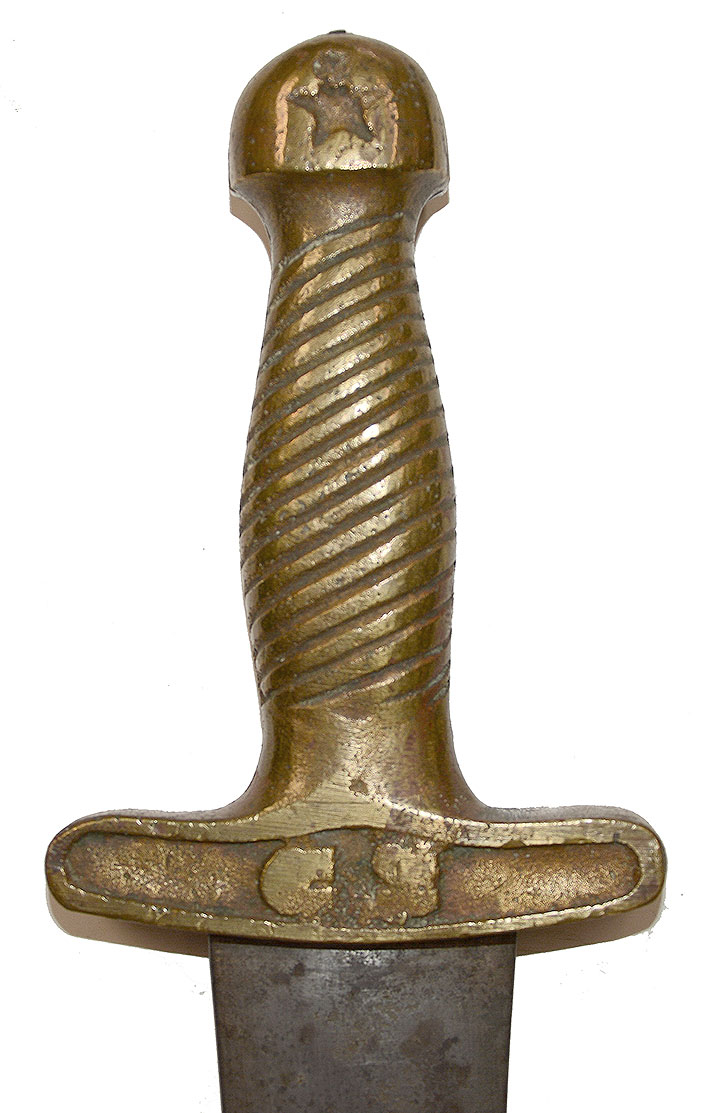
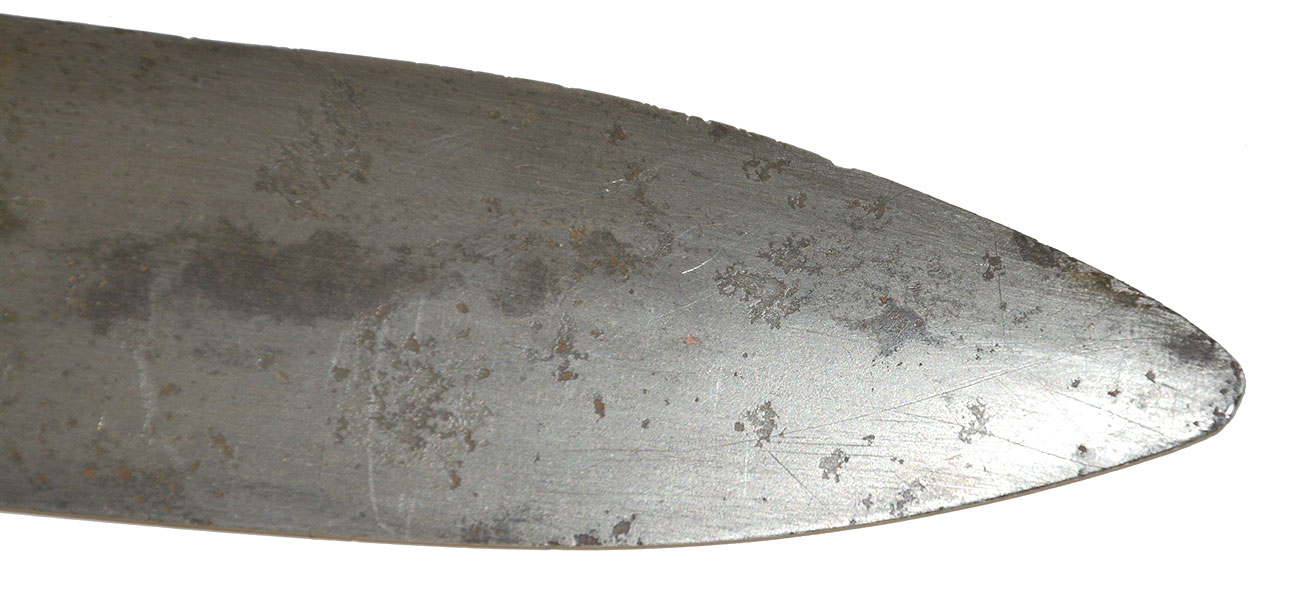
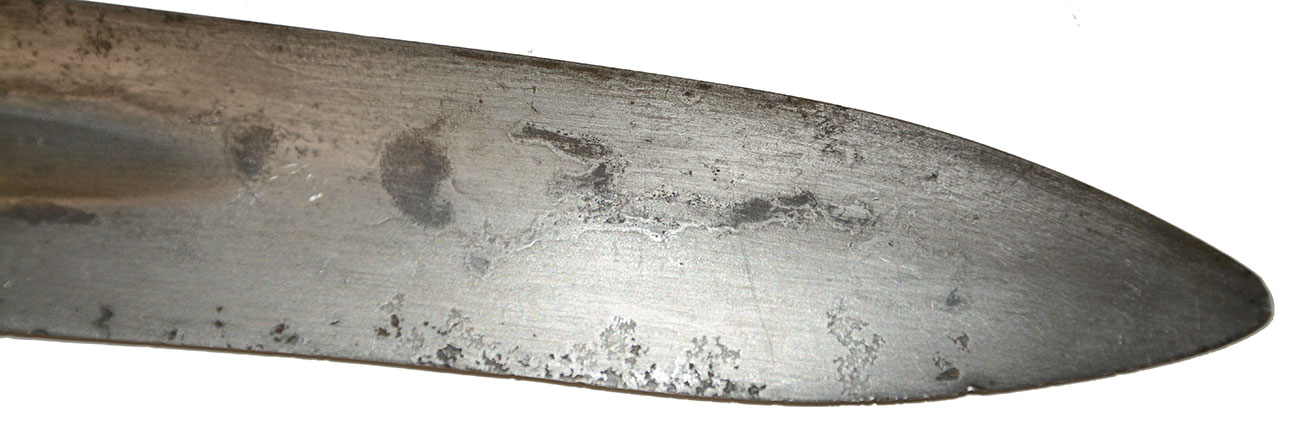
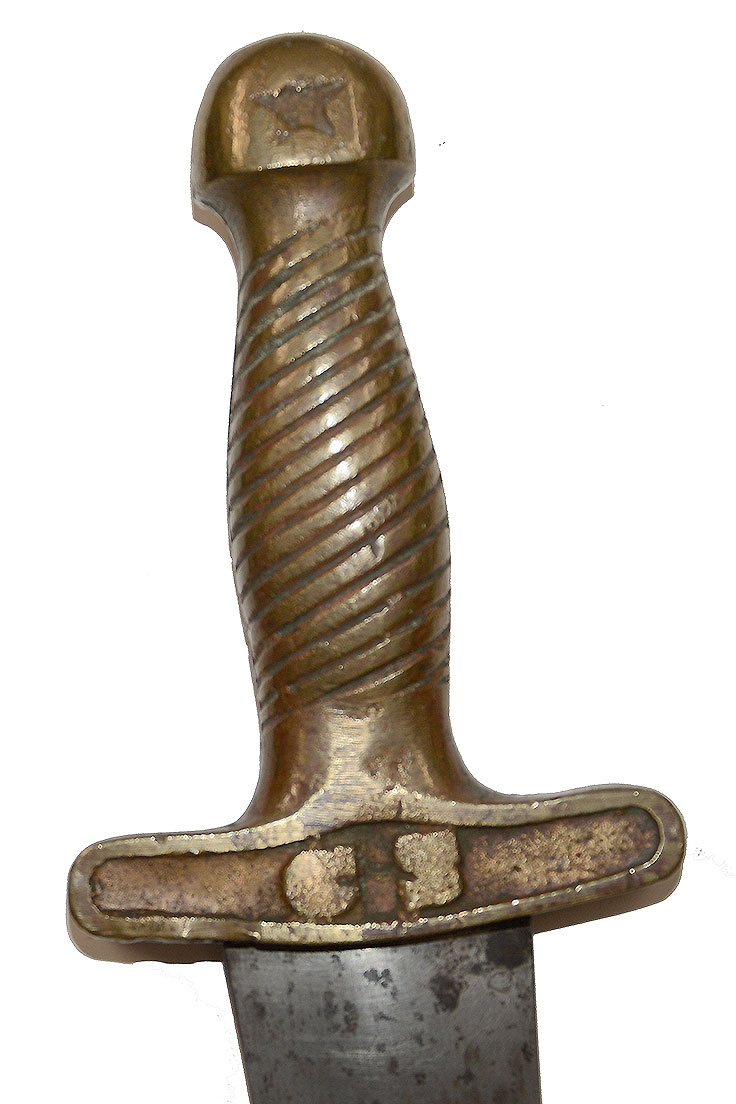
A classic Confederate sword patterned after the US M1833 short sword, using a brass hilt with a prominent star in place of the eagle on the pommel face and a prominent “CS” in the crossguard. This measures 24-1/2” overall and has a blade 18-3/4” long that is 1-3/4” wide at the guard, briefly narrows by 1/8” and then widens again for most of its length and ends with a spearpoint. The condition is far better than most. The blade is full length, with good edge, no nicks or chips, and good point, and shows smooth metal overall, a muted gray in color with darker gray stains, but no significant pitting, scaling or blade flaws. It shows a pleasingly, slightly uneven central, unstopped fuller, testimony to the maker’s aspirations and perhaps lack of machine tools, if not skill. The hilts on these were hollow-cast (as distinct from modern copies) and as is often the case the blade tang has loosened slightly, allowing about 1/8” movement.
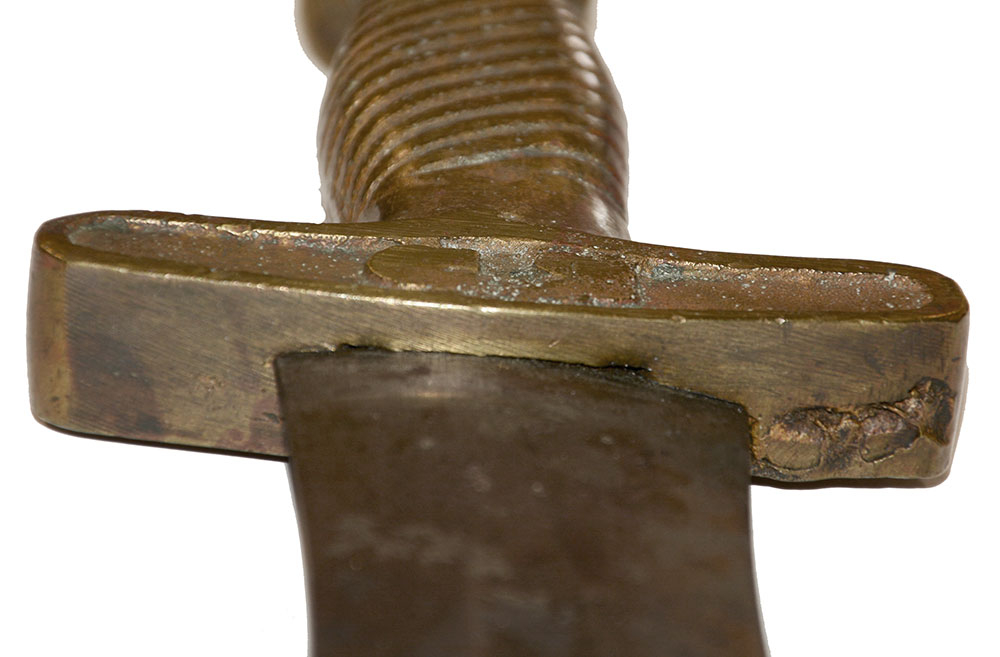
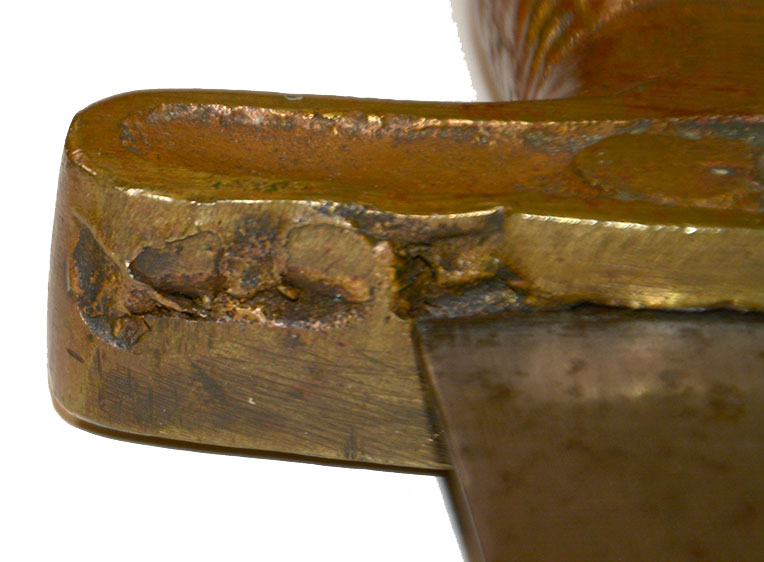
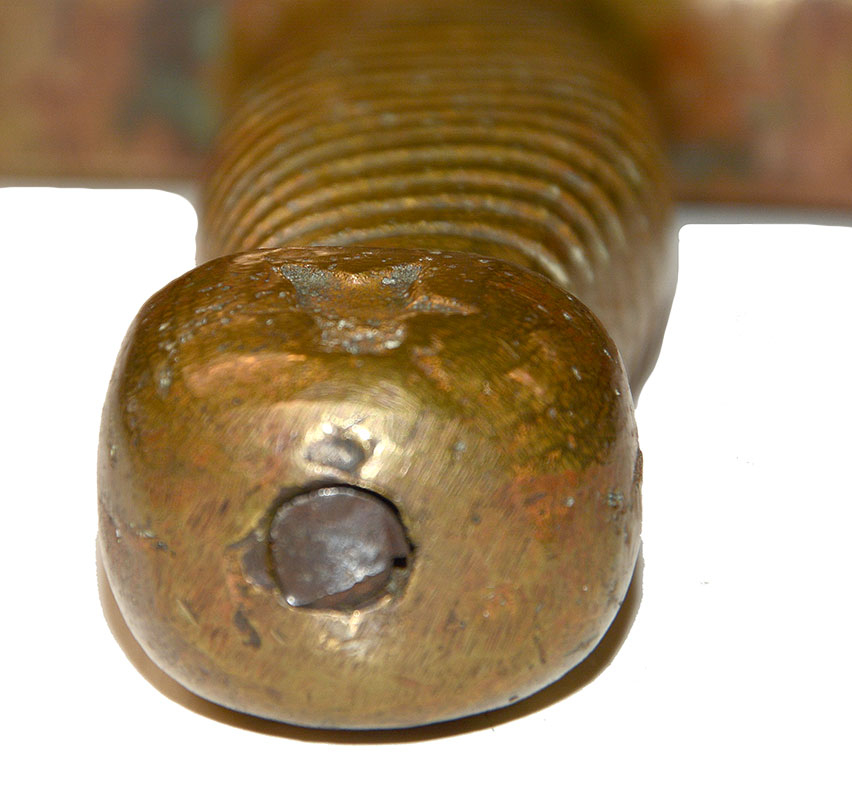
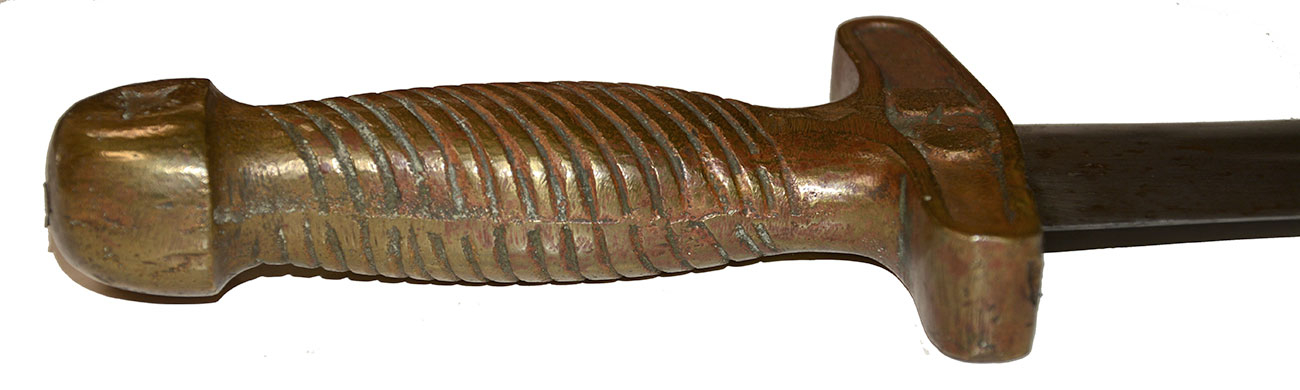
The brass hilt has a good undisturbed, aged patina. Clearly following the general form of the US pattern, the maker simplified the pommel contour to a rather crude plug shape, and replaced its original decoration, a U.S. eagle, with an impressed five-pointed star, leading early collectors to assume a Texas or Louisiana connection, though the actual place of manufacture has still not been pinpointed. Selma and Macon have been proposed, the latter from the appearance of some of these with scabbards like those used on W.J. McElroy short swords made in that city. In any case, some think there were several makers, so “Unknown” may be the most accurate current attribution. The maker also simplified the grip pattern, using simple flat lands and grooves in a spiral in place of the U.S. version with scales or feathers, with a plain section at bottom imitating a ferrule, and gave the crossguard simple rounded ends, but dressed it up with a shallow upward curve at either end and incorporated a raised “CS” in the center of the recessed panel, curving the upper border of the crossguard over it.
The maker’s sense of design clearly outran his abilities in casting, chasing, and finishing, though that is part of the charm of these swords and clearly shows a determination to pursue function over decoration. The border of the crossguard is uneven in thickness and its curves are uneven as well, and the CS letters themselves are poorly delineated, looking almost blotted, on this example as on most of this pattern. The lower, “ferrule” portion of the grip clearly bled into the raised upper border of the crossguard and shows crude file marks on the “ferrule” portion, and the maker tried unsuccessfully to delineate them by filing, with rather unfinished results- more obvious on one side than the other. The pommel was somewhat better finished, though there is one dimple in the brass on the top and the seat of the blade tang is uneven.
These are usually categorized as artillery short swords, and often heavy artillery in particular, to which service US practice relegated them by the time of the Civil War. Some, however, have appeared in field artillery contexts, suggesting they were useful in clearing underbrush from gun positions, etc. Indeed, when first issued by the U.S. Army in 1833 they were intended for use as NCO and musician swords and in militia hands were popular and more widely used, some which may have carried over in Confederate use. Even in US hands some of the M1833 short swords were drafted into other service, being found on naval vessels, where they clearly served as cutlasses. See Pritchard, Collecting the Confederacy, Chapter 3, for this “CS & Star” pattern as well as other types. This is a very good, honest example of a no-doubt-about-it CS sword. [sr] [ph:L]
~~~~~~~~~~~~~~~~~~~~~~~~~~~~~~~~~~~
THIS ITEM, AS WITH ALL OTHER ITEMS AVAILABLE ON OUR WEB SITE,
MAY BE PURCHASED THROUGH OUR LAYAWAY PROGRAM.
CLICK HERE FOR OUR POLICIES AND TERMS.
THANK YOU!
Inquire About CONFEDERATE “CS & STAR” SHORT SWORD
Most Popular
Historical Firearms Stolen From The National Civil War Museum In Harrisburg, Pa »
Theft From Gravesite Of Gen. John Reynolds »
Selection Of Unframed Prints By Don Troiani »
Fine Condition Brass Infantry Bugle Insignia »
Rare Identified 65Th Ny Sergeant’s Jacket, With Manscript Material: 1St U.s. Chasseurs »
featured item
SCARCE VIEW OF CONFEDERATE GENERAL THOMAS ROSSER FROM THE ALBUM OF R. CHANNING PRICE PRESENTED TO HIM BY JEB STUART
CDV is a full standing view of Thomas L. Rosser wearing a dark civilian frock coat with a white vest and dark cravat with matching white trousers. He holds his dark hat in his hand, just behind his waist. Rosser is posed in front of a painted… (846-497). Learn More »
site search