


site search
online catalog
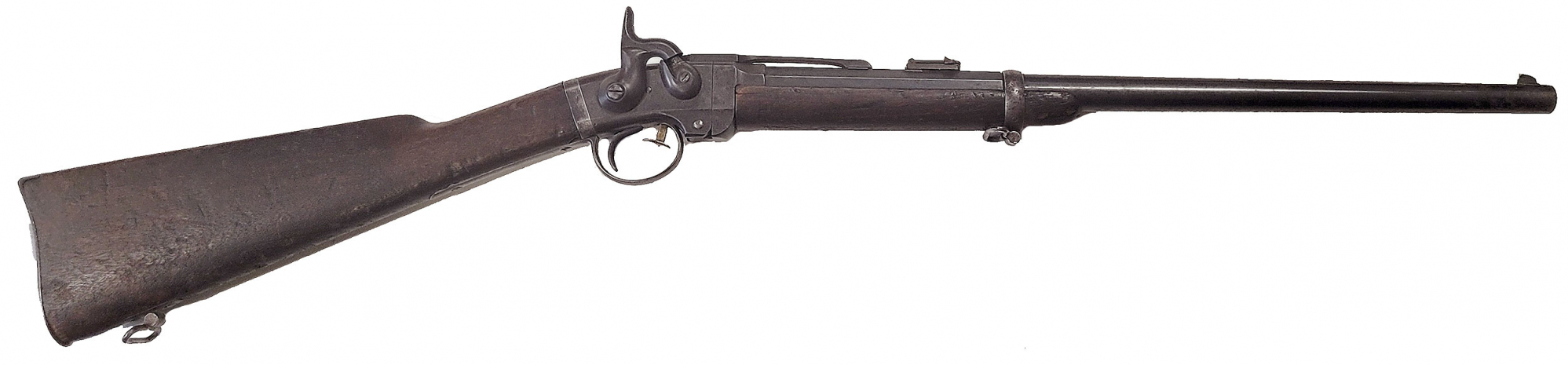
MODEL 1861 OR “FIRST MODEL” SMITH CARBINE, SERIAL #2755, CA. JUNE 1862, WITH NAME
Hover to zoom



$2,950.00
Quantity Available: 1
Item Code: 1311-04
Shipping: Determined by Method & Location of buyer
To Order:
Call 717-334-0347,
Fax 717-334-5016, or E-mail
This pattern of Smith carbine has gone through several collector designations: the “Artillery Model,” the “First Model,” and more recently out of deference to some military carbines produced starting in 1859 and a few sporting models, the “Model 1861.” See Spears’s excellent two-part ASAC article on the carbine’s development and production and different patterns. This one was among some 11,000 Smith carbines made by the Mass. Arms Company and fitted with sling swivels at the barrel band and toe of the buttstock for a musket/rifle sling rather than the side-bar with sling ring for a carbine sling.
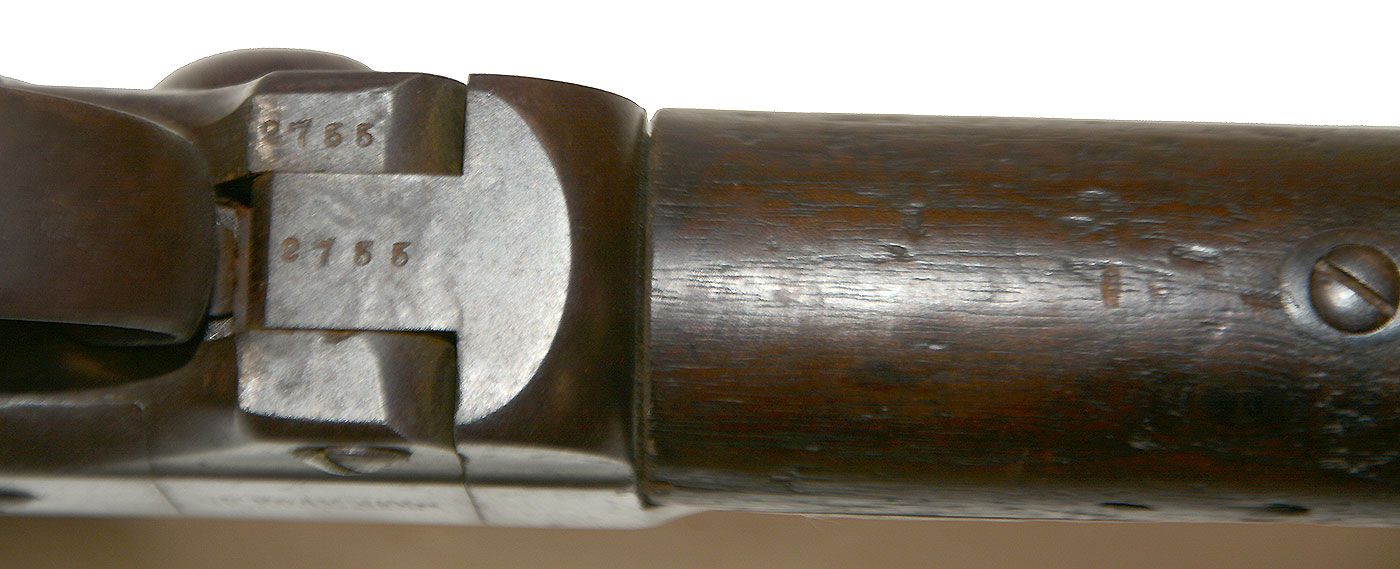
This is a good to very good condition example of that pattern, manufactured and delivered through July 1863, with serial #2755, placing it likely among 1,500 Smiths listed as purchased (which assumes delivery,) on June 9, 1862, according to McAulay. These first models were continued in use even after the newer model with the sling ring was introduced in August 1863, the two seeing side-by-side use in some units at least for a time.
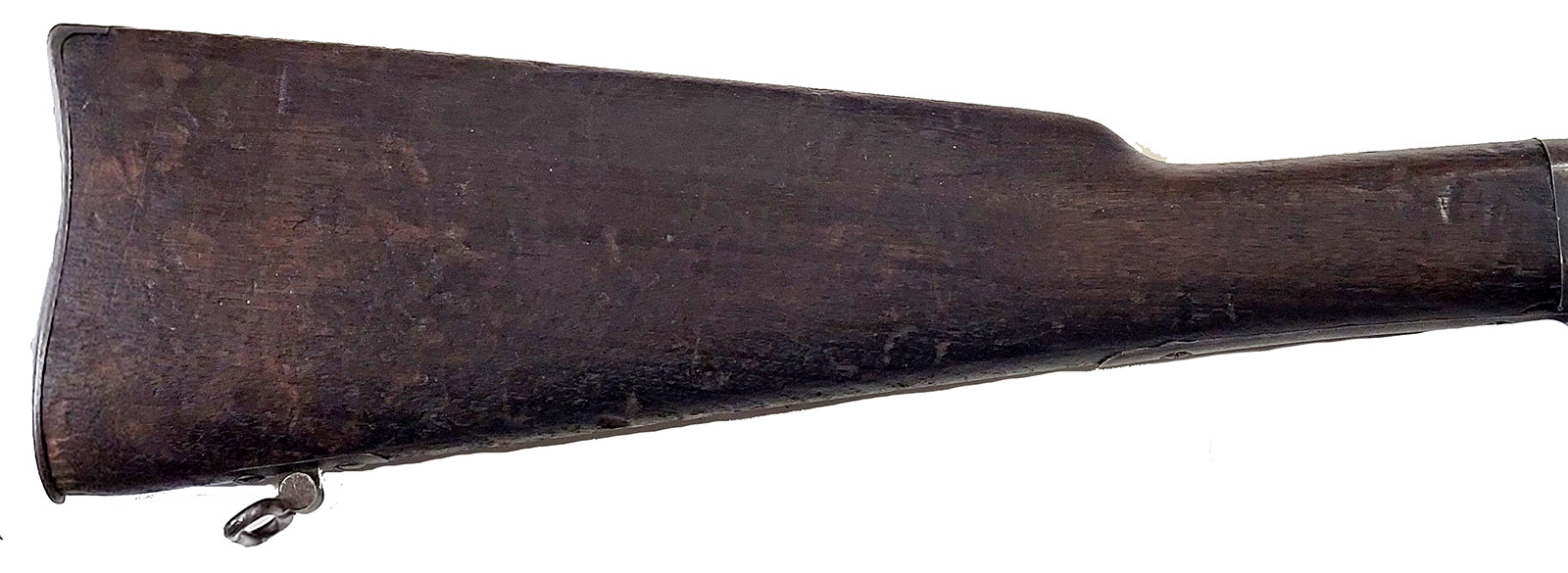
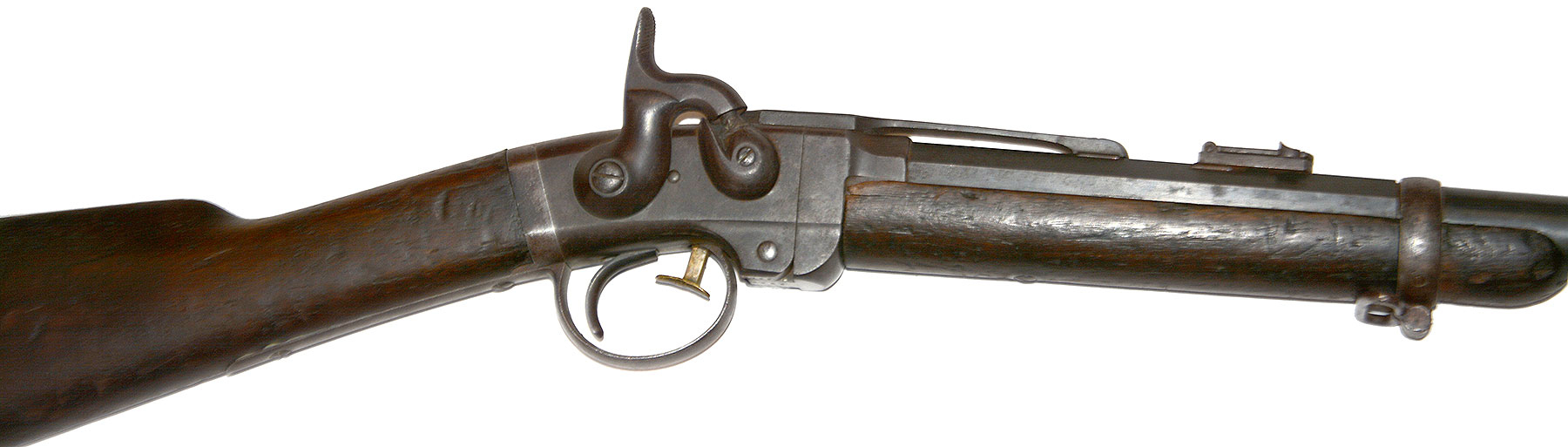
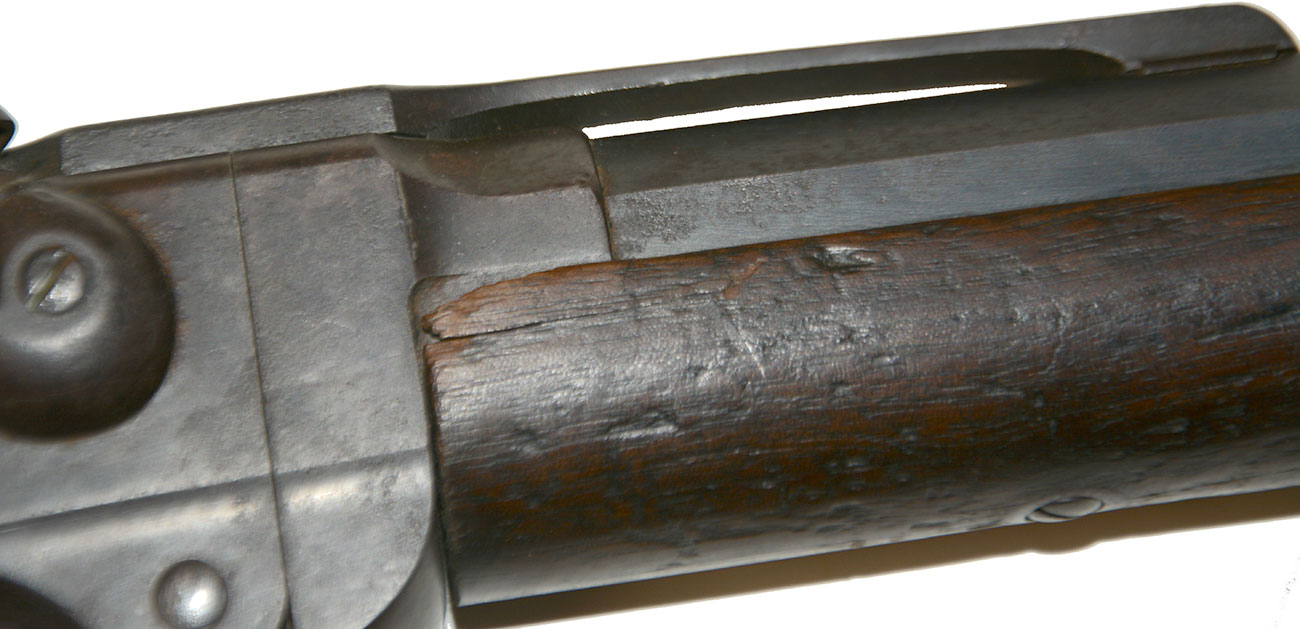
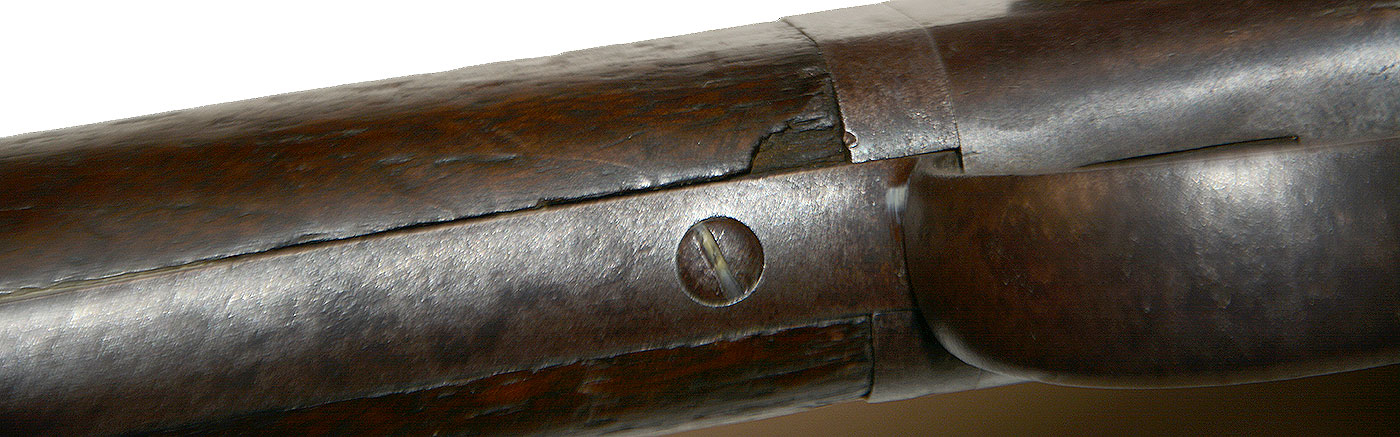
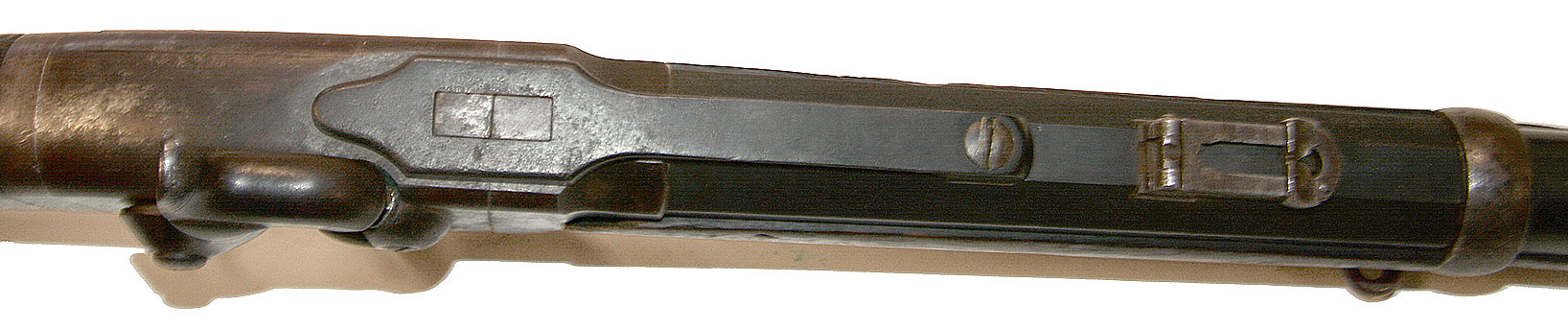
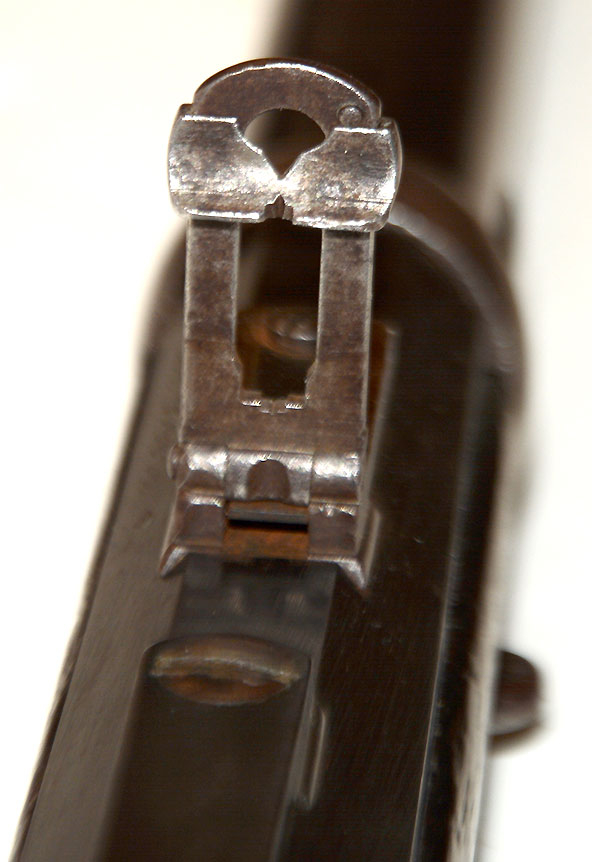
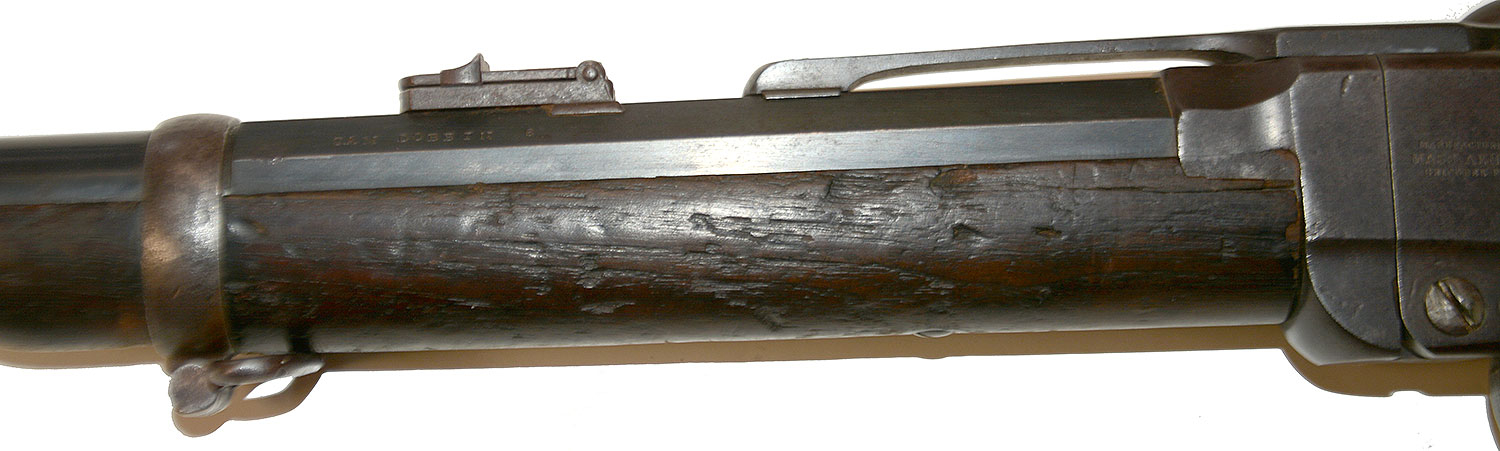
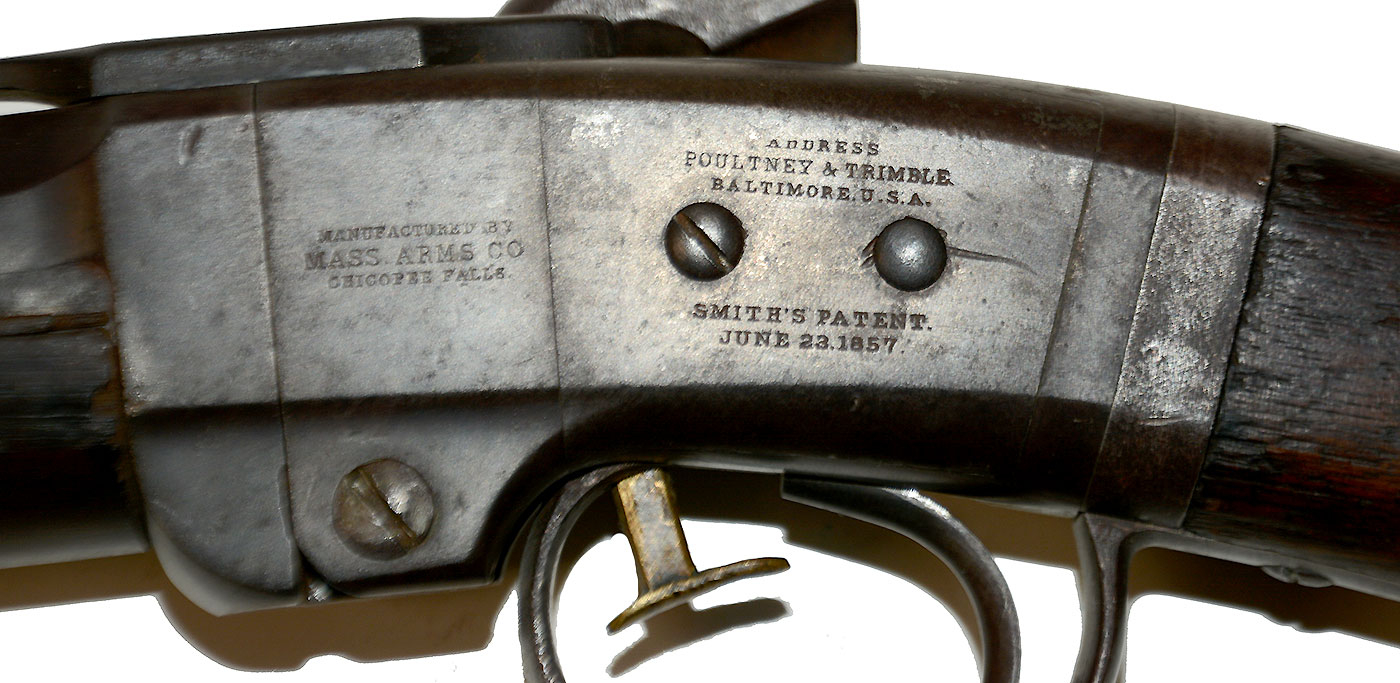
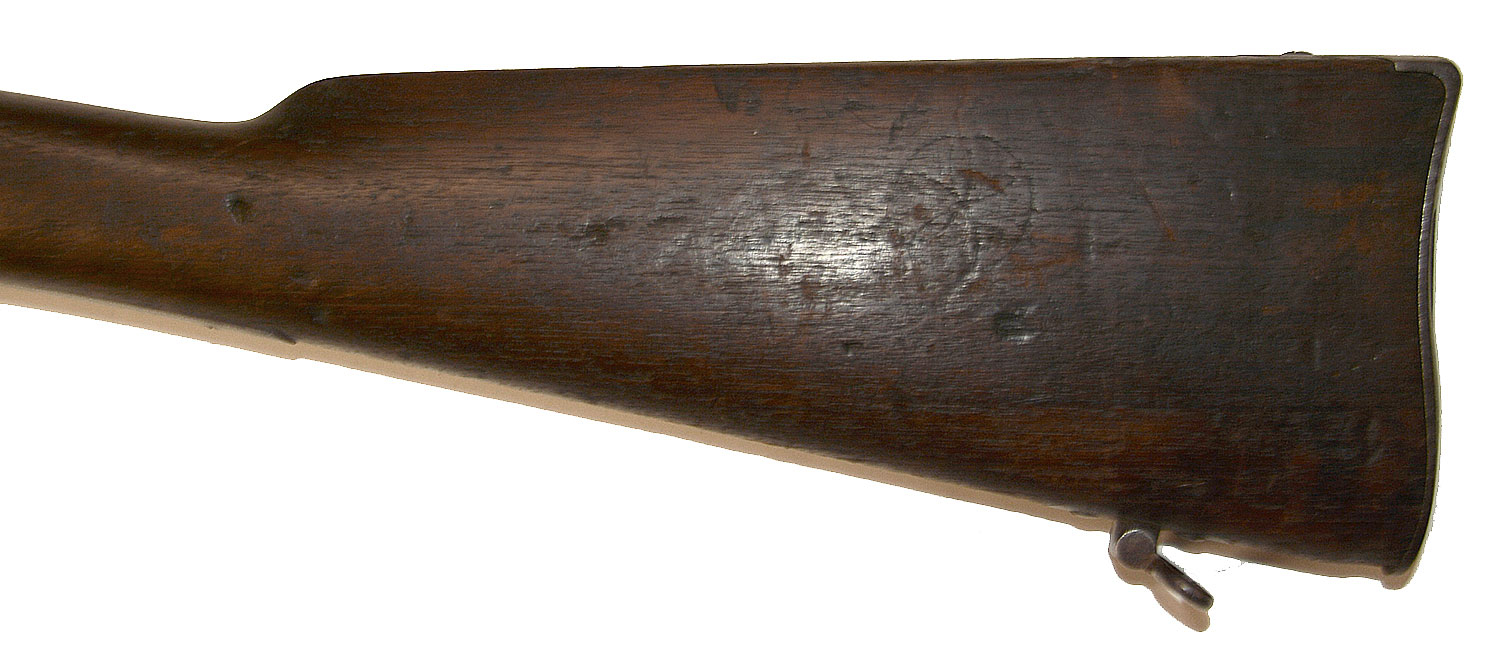
This carbine shows handling and use, but has some significant blue on the barrel, both sights in place, and very good markings on the frame. All parts appear original, though the sling swivels appear a tad brighter and might have been replaced by a collector to return it to its proper configuration. The metal is generally smooth, but with a patch of shallow pitting on the top of the barrel about halfway between the barrel band and muzzle. The barrel otherwise has significant blue remaining. The receiver is a bluish gray, but showing some faint mottled color from case hardening, mostly on the right. The band at the wrist shows as gray with some dark spotting from handling, as do the barrel band, triggerguard and tang, as would be expected. The locking spring is mostly gray with darker gray spotting as well, but with some very faint blue near the front. The left receiver shows more gray with some faint bluish-gray color at the front, but sharp markings: “ADDRESS / POULTNEY & TRIMBLE / BALTIMORE U.S.A.” opposite the hammer, over “SMITH’S PATENT / JUNE 23, 1857” and at the front of the receiver, “MANUFACTURED BY / MASS. ARMS CO / CHICOPEE FALLS” with all markings horizontal, i.e., in line with the barrel. We see no barrel proof marks, but Spears does not record any until the #3300-4600 range. The wood has good color and a good fit, though showing numerous small handling marks, wear spots and some shallow divots, with small chipping at the wrist band, a narrow rectangular chip out at the rear of the forestock where it meets the frame on the left and the beginning of one on the right. We see no inspection cartouche, and it could have been lightly applied or obscured by some slight rubs in about the spot it would be (left wrist, about where the comb begins,) but Spears indicates that, like a barrel proof, they do not show up on carbines in #1-2000 range, and while he does indicate the “JH” cartouche of John Hannis shows up in the 2400-3300 range, it is unclear if it shows up on all carbines in that range, since it seems rather newly introduced. The bore and mechanics are good. As is common with Smiths seeing some use, the hinge is a bit wobbly.
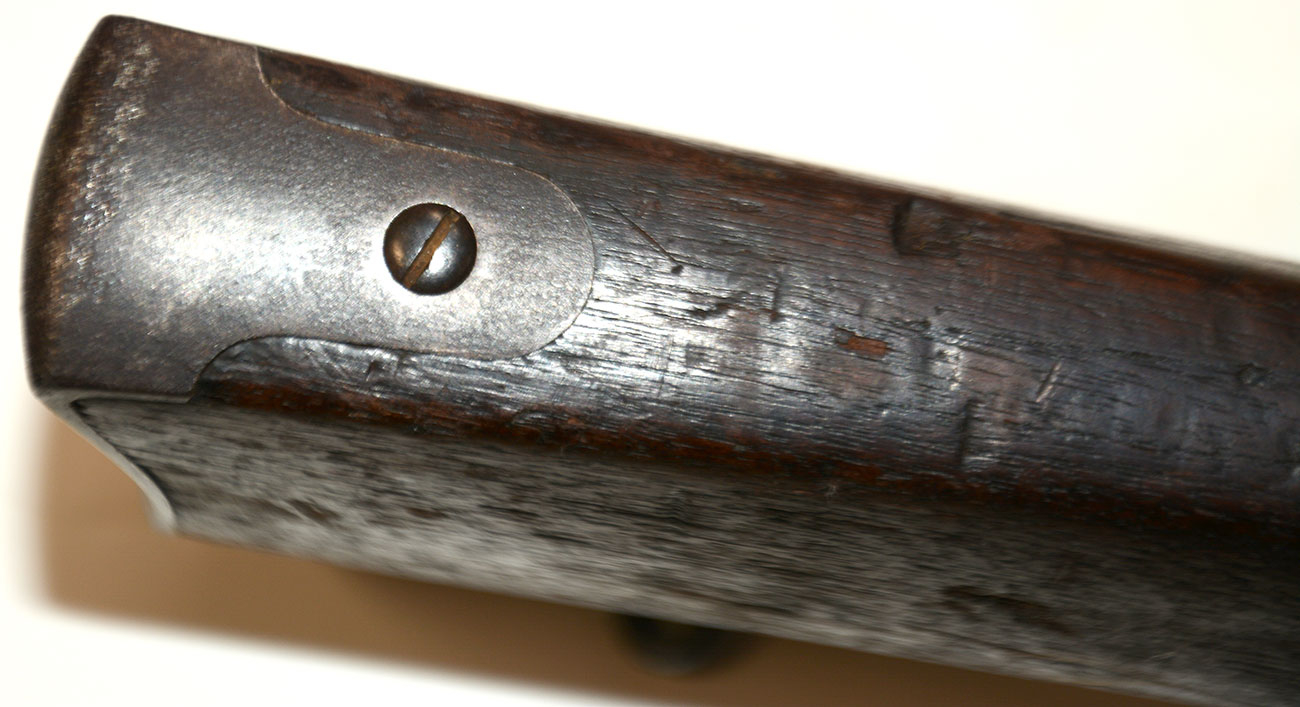
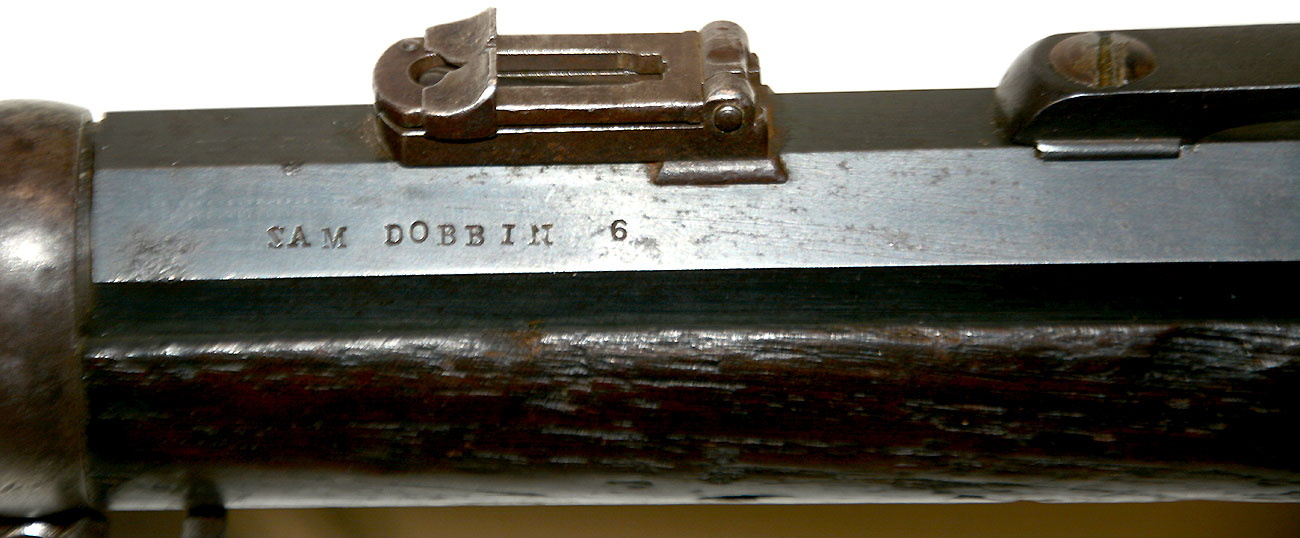
The left buttstock shows a faint incised circle with a six-petal flower inside. Likely from postwar use around the farm, if not a bored trooper in winter quarters. The left upper barrel flat has a name and number stamped in individual characters, “SAM DOBBIN 6.” A previous owner postulated this was Sam Dobbin of the 22nd NY Cavalry, who enlisted at age 24 at Riga, NY, 1/4/64 and mustered into Co. C as a private on 1/5/64, surviving to muster out as a sergeant 8/1/65 at Winchester, VA., and that “6” might have been his rack number. His service records might reveal if he was charged for taking a gun home when discharged. We note in passing, however, that Sam Dobbin was also a skilled machinist and member of the North-South Skirmish Association, dedicated to competitive target shooting with Civil War arms. In any case, this a good, hard-to-find, early war cavalry carbine, and Smiths in general were widely used, ranked fourth in government procurement (behind Sharps, Burnsides, and Spencers) and carried by units such as the 1st Connecticut, 10th New York, 6th Ohio, 7th and 17th PA, 1st Mass, 1st Maine, 1st West Virginia, 10th Michigan and many others including some of the regulars. It also helps that this is a no-doubt-about-it pre-Gettysburg Union cavalry carbine, making it a good addition to a carbine or cavalry display. [sr][ph:L]
DISCLAIMER: All firearms are sold as collector's items only - we do not accept responsibility as to the shooting safety or reliability of any antique firearm. All firearms are described as accurately as possible, given the restraints of a catalog listing length. We want satisfied customers & often "under" describe the weapons. Any city or state regulations regarding owning antique firearms are the responsibility of the purchaser. All firearms are "mechanically perfect" unless noted, but again, are NOT warranted as safe to fire.
~~~~~~~~~~~~~~~~~~~~~~~~~~~~~~~~~~~
THIS ITEM, AS WITH ALL OTHER ITEMS AVAILABLE ON OUR WEB SITE,
MAY BE PURCHASED THROUGH OUR LAYAWAY PROGRAM.
CLICK HERE FOR OUR POLICIES AND TERMS.
THANK YOU!
Inquire About MODEL 1861 OR “FIRST MODEL” SMITH CARBINE, SERIAL #2755, CA. JUNE 1862, WITH NAME
Most Popular
Historical Firearms Stolen From The National Civil War Museum In Harrisburg, Pa »
Theft From Gravesite Of Gen. John Reynolds »
Selection Of Unframed Prints By Don Troiani »
Fine Condition Brass Infantry Bugle Insignia »
Rare Identified 65Th Ny Sergeant’s Jacket, With Manscript Material: 1St U.s. Chasseurs »
featured item
VERY RARE 1834 ENGINEER AND MEDICAL STAFF SWORD BY HENRY BOKER, BELONGING TO BREVET BRIGADIER GENERAL JOHN HENDRICKSON, WHO LOST A LEG AT FREDERICKSBURG, 83rd NEW YORK VOLS (9th NYSM) AND 13th V.R.C.
New patterns of swords for the U.S. army were developed from 1832 to 1834. This elegant smallsword pattern (variously called by collectors the 1832 or 1834 pattern) was designated for officers of Engineers and Medical Staff (and Pay Department as… (870-325). Learn More »
site search