

site search
online catalog
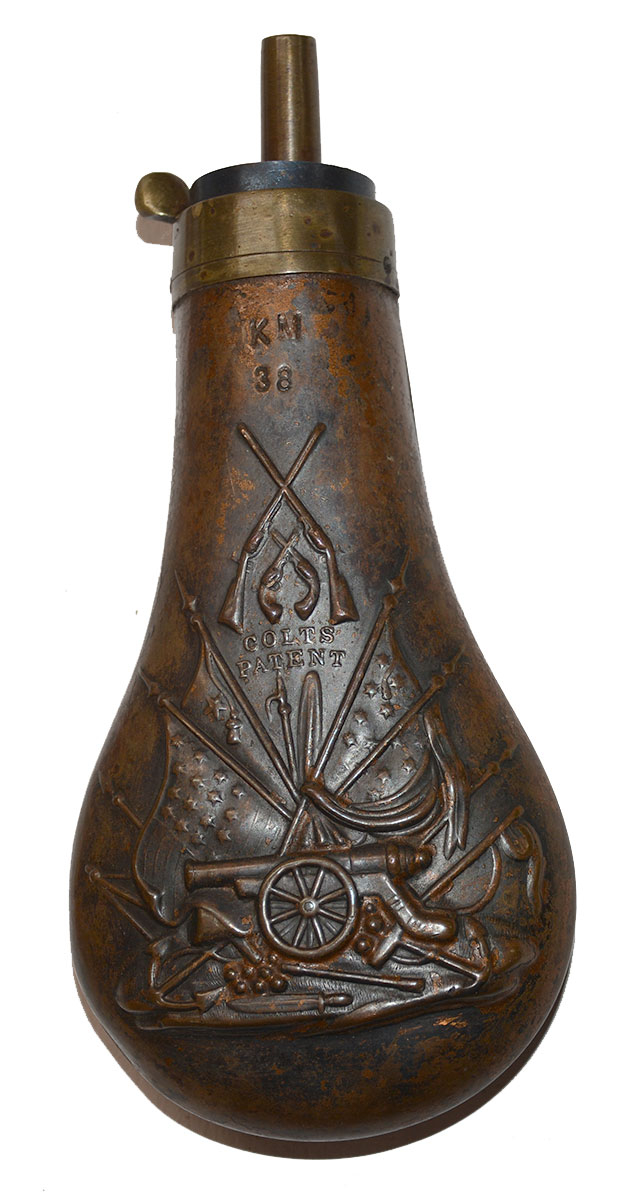
SCARCE COLT NAVY PRUSSIAN “KRIEGSMARINE” MARKED POWDER FLASK
Hover to zoom
$895.00 SOLD
Quantity Available: None
Item Code: 2025-3322
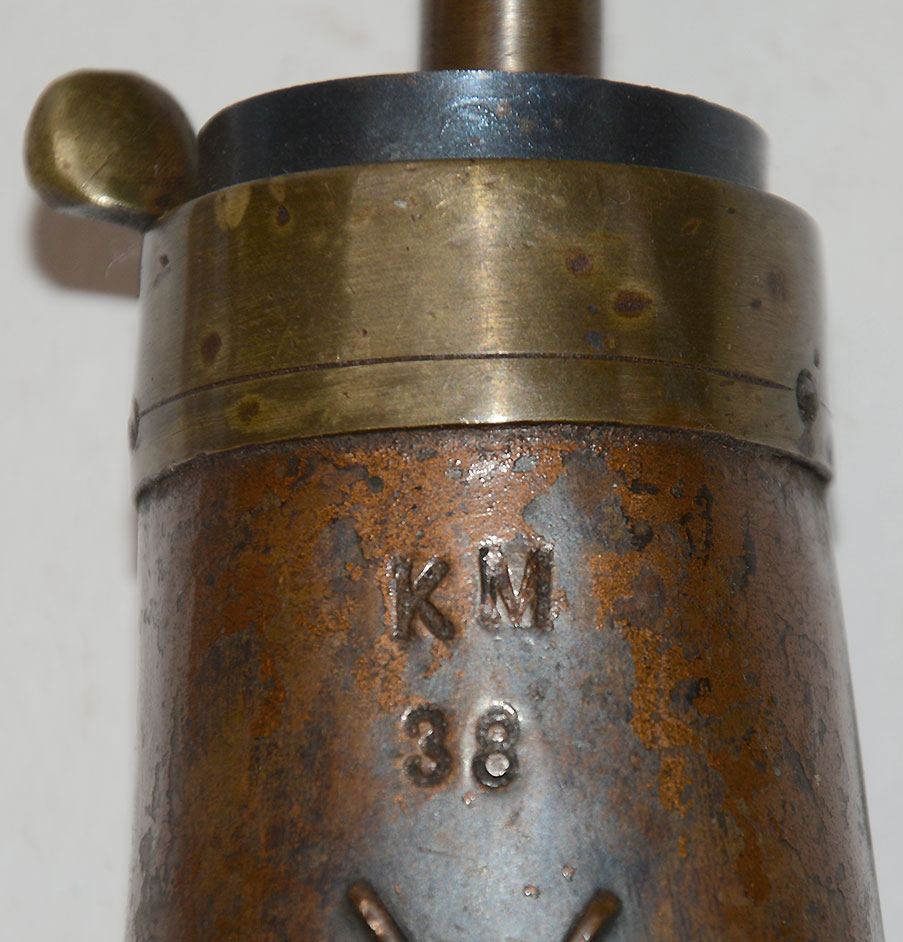
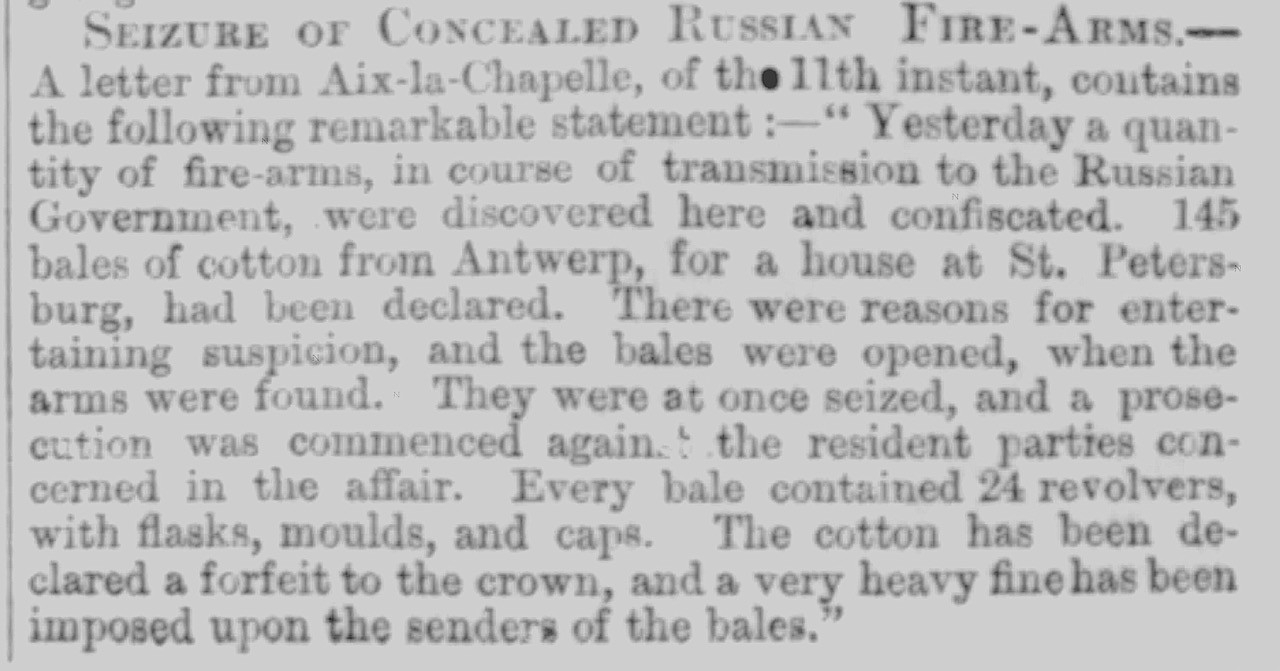
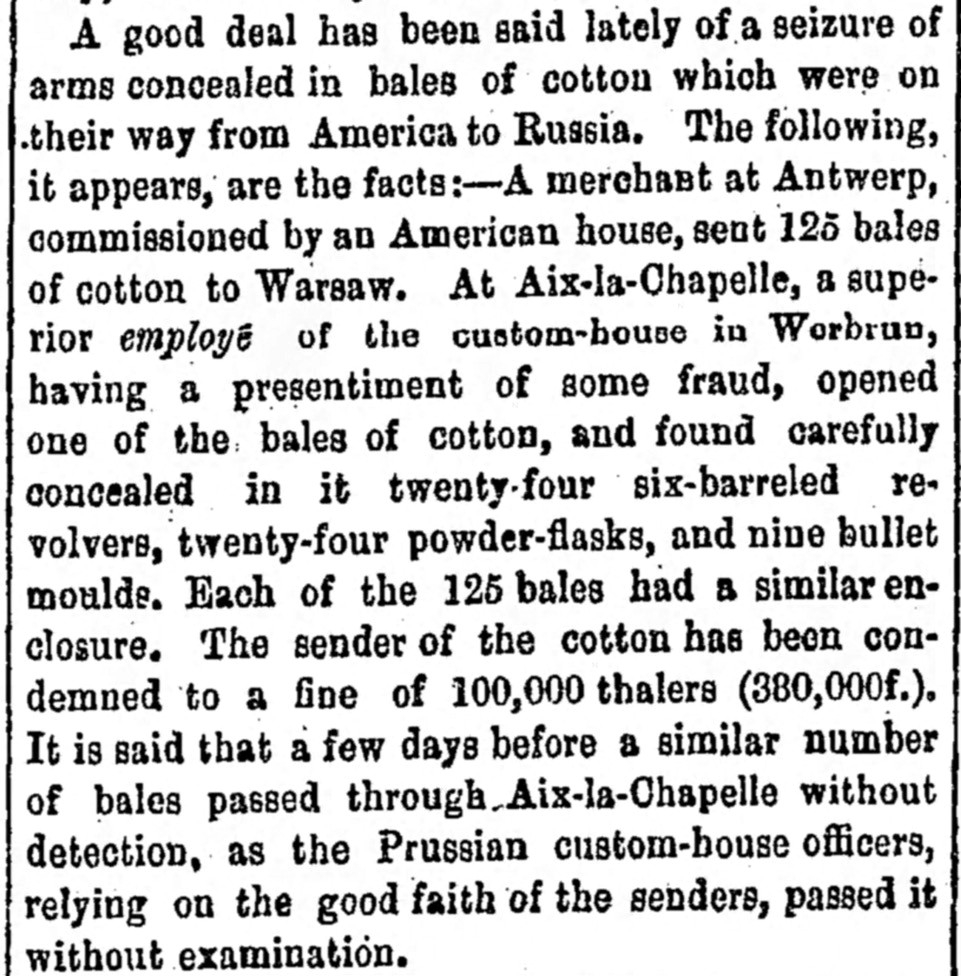
Colt came in for considerable criticism for selling arms to the South right up to the opening shots of the Civil War. He showed a similar broad-mindedness in dealing with both Britain and Russia in the Crimean War. This Colt Navy flask was among a number of Colt M1851 Navy revolvers and flasks intercepted by Prussian authorities as they were being smuggled into Russia while the war was still going on. (See, among others, Jordan and Geri (2016) and Rapley’s 1994 book on Colt percussion accoutrements.) Some details are still debated. J&G say, for instance, there were actually two seizures by Prussian authorities, one in 1855 and another in 1856. The first is better known from newspaper accounts and involved some 3,480 revolvers and flasks concealed in bales of cotton. The second accounted for another 3,000 or so pistols. Colt, or his agents, tried to get the guns back, but they were auctioned off, with the Prussian navy apparently purchasing about 1,000 pistols and flasks that were then stamped “KM” (for “Kriegsmarine” or “Koenigliche Marine”) and numbered, like this one, which is boldly and clearly stamped “KM” over “38” on the face, between the collar and the embossed motifs. The pistols seem all to have been Middle 3rd Model Navies, which were then designated as the M1857 by the Prussian navy and used until phased out in favor to the British double-action Beaumont-Adams, designated the M1869.
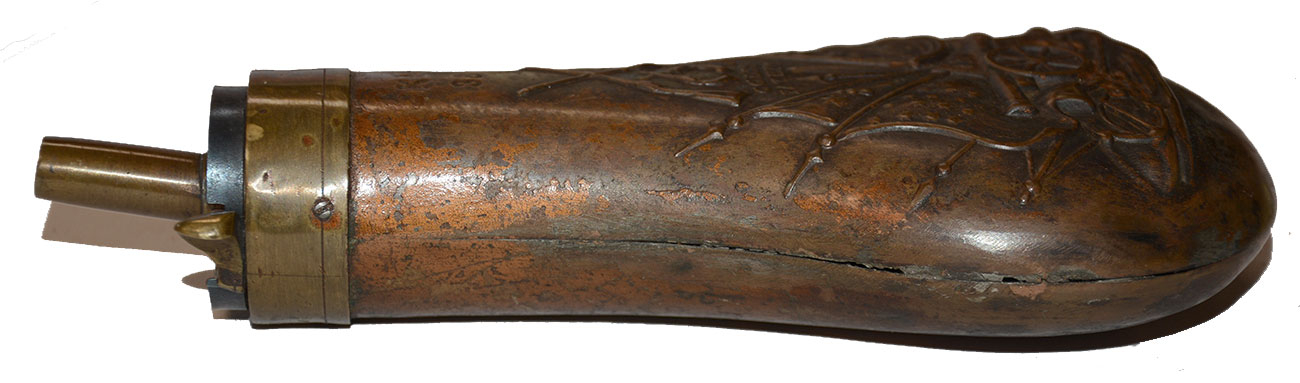
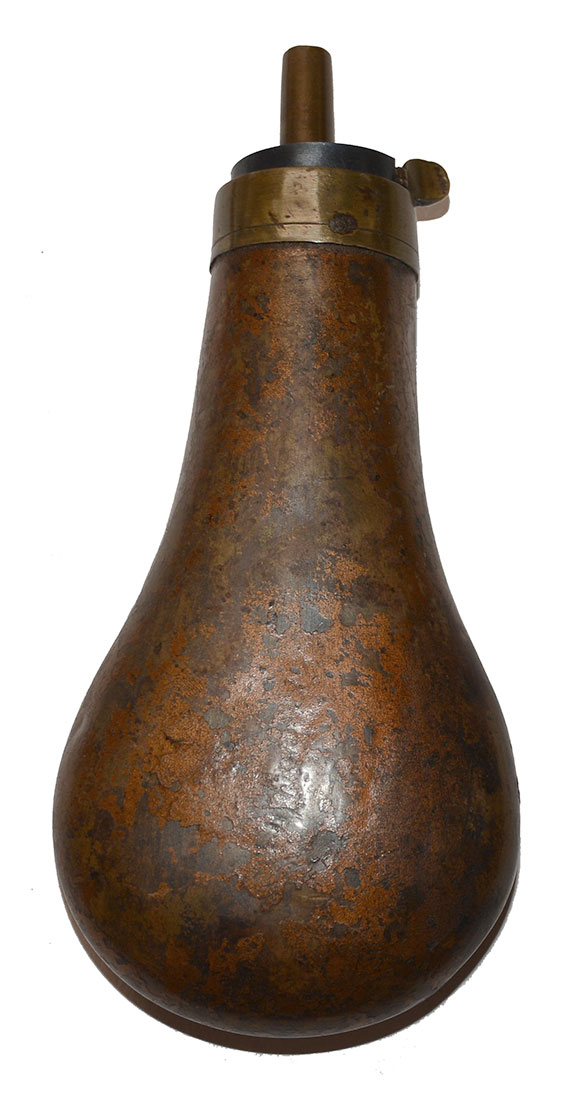
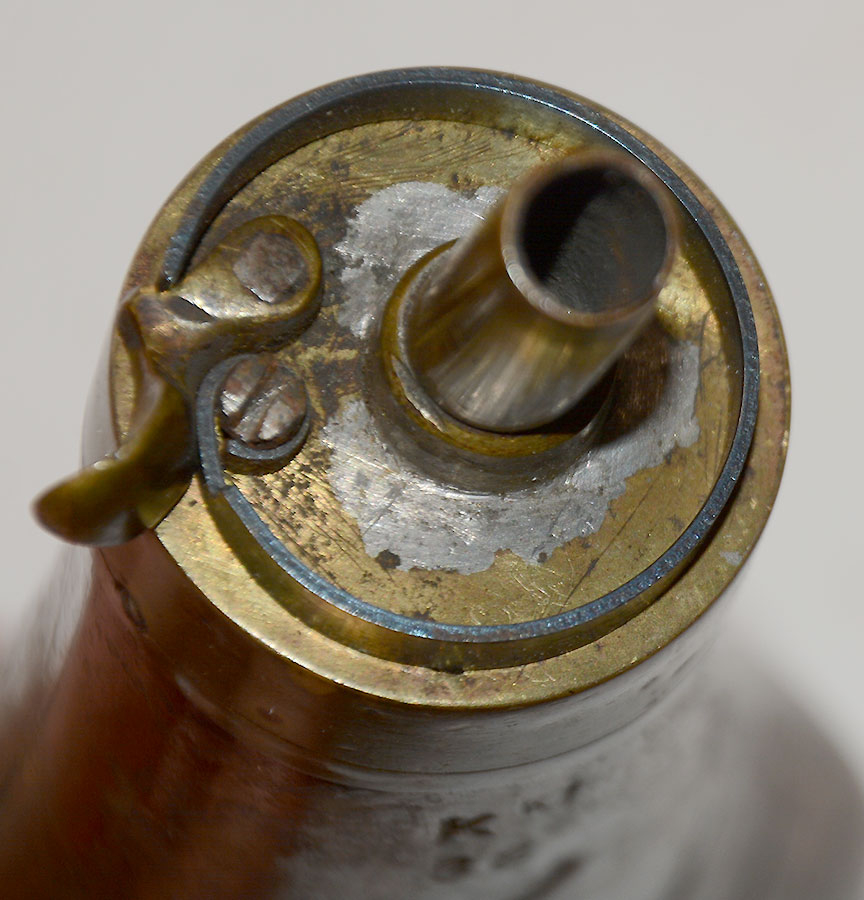
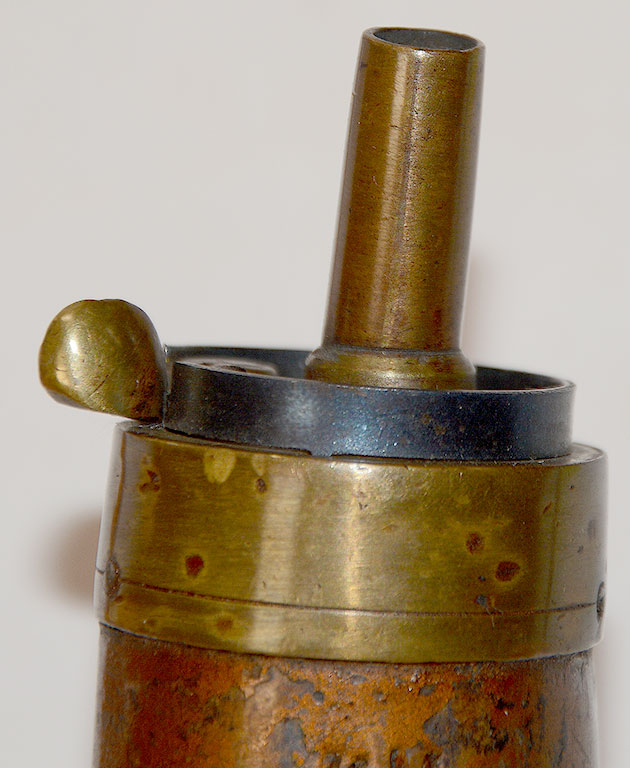
In form, the flask is Rapley’s F#14 with the “KM” and number simply added, but designated by him separately as F#15. This measures about 5-1/2 inches tall by 3 inches across. The embossed motifs include a pair of crossed Colt revolving longarms at top, with a pair of crossed revolvers in their lower angle, and “COLTS / PATENT” in raised letters below them and in the upper angle of a panoply of draping flags with stars on pikes, a cannon on field carriage, cannonballs, two anchors, what is likely a drum partially hidden by a draped flag, a short sword at bottom center, and other martial elements. The brass top has a fixed spout, with thumbpiece and spring in place. The raised details are sharp and there are only a few shallow dings on the back. The seam on the left is open starting about an inch below the collar, but stable and the gap narrow. The brass top and spout have a mellow, aged brass patina. The spring shows a good deal of blue. The body shows what appears to be a thicker light brown finish showing some flaking and losses that had been applied over the brown lacquer, and shows some of the darker metal beneath. The spouts of these flasks were shortened by the Prussian government, in some opinions to prevent over-charging the cylinder, but in others simply to reduce the usage of powder and save money. The top of the collar shows silver-gray solder around the base of the spout, perhaps from this alteration.
This is a scarce flask. Jordan and Geri list just 38 verified KM Colt Navies, in the 31000-37500 serial number range, in their database for the pattern. There could not be many more of the flasks out there. Please see our photographs to get an idea of the condition. We also show two contemporary London newspaper reports on the detection and confiscation of the 1855 arms shipment. [sr] [ph:L]
~~~~~~~~~~~~~~~~~~~~~~~~~~~~~~~~~~~
THIS ITEM, AS WITH ALL OTHER ITEMS AVAILABLE ON OUR WEB SITE,
MAY BE PURCHASED THROUGH OUR LAYAWAY PROGRAM.
CLICK HERE FOR OUR POLICIES AND TERMS.
THANK YOU!
Inquire About SCARCE COLT NAVY PRUSSIAN “KRIEGSMARINE” MARKED POWDER FLASK
Most Popular
Historical Firearms Stolen From The National Civil War Museum In Harrisburg, Pa »
Theft From Gravesite Of Gen. John Reynolds »
Selection Of Unframed Prints By Don Troiani »
Fine Condition Brass Infantry Bugle Insignia »
featured item
EXTRAORDINARILY RARE AND IMPORTANT CONFEDERATE RAINS BARREL TORPEDO - 1 OF 2 KNOWN - FROM THE TEXAS MUSEUM
This is a Rains barrel torpedo that was recovered during the Civil War in Mobile Bay, AL. It was developed by Gabriel James Rains, Chief of the Confederate Torpedo Service. Gabriel Rains was born in Craven County, NC and entered West Point,… (1268-690). Learn More »
site search