


site search
online catalog
WHITNEY “L” SHAPED COMBINATION TOOL-NAVY PERCUSSION REVOLVERS
Hover to zoom
$195.00 SOLD
Quantity Available: None
Item Code: 2026-1202
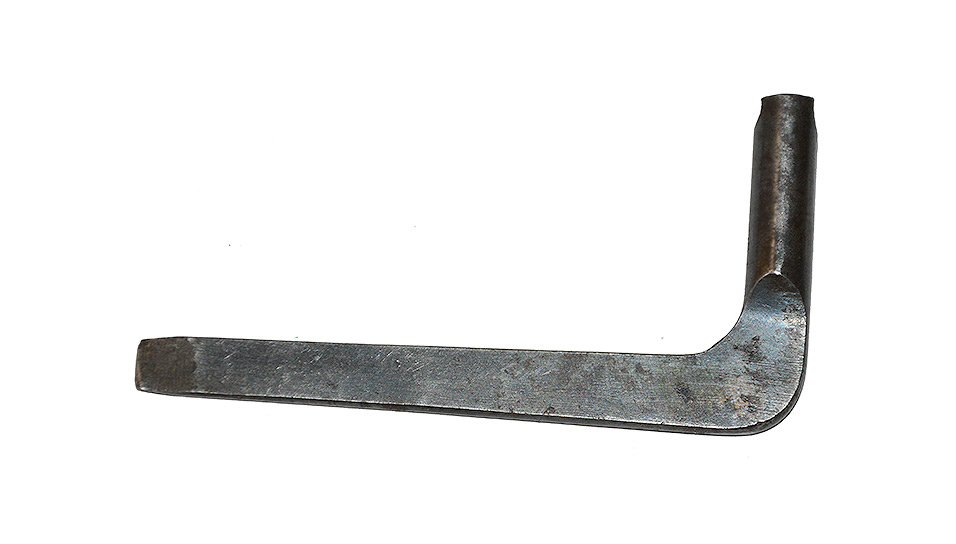
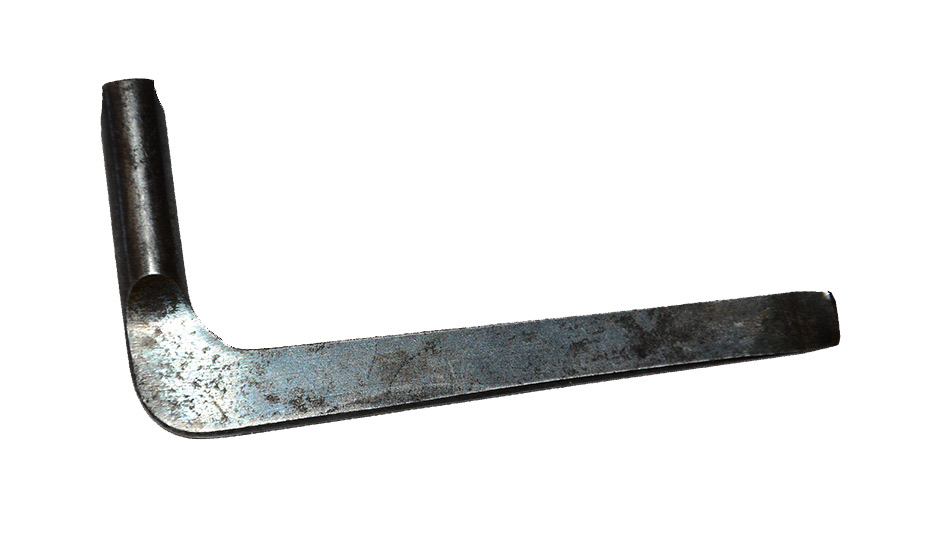
This is a very fine condition example of an original L-shaped combination tool for the Whitney “Navy” percussion revolvers. The tool is well machined steel with a blued finish and measures 2 7/8” in overall length and is 1 1/2” wide at the top. The tool combines an open-end cone wrench with recess for the tip of the percussion cone at the shorter portion of the “L” and a screwdriver arm. The tool also has the slightly beveled edge along the spine that is found only on the original tools and not on modern reproductions.
The tool retains some strong traces and scattered flashes of the original bright blued surface finish, possibly as much as 25%. The balance of the tool shows much of the original underlying dull blue still intact. There are signs of wear and loss to the finish from handling and use. The largest areas of loss are along the sides of the round cone wrench body and along the sharp and high edges and places where the tool was regularly handled. The cone wrench itself remains fairly crisp, with some minor wear to the face of the wrench from use. The metal is smooth and free of pitting but does show some scattered freckles of surface oxidation and a few tiny areas of minor pinpricking.
Overall, this is a very nice, complete and crisp tool that will be a good addition to the display of your Whitney revolver or to add to a cased set that is missing its original tool. [stp][ph:L]
~~~~~~~~~~~~~~~~~~~~~~~~~~~~~~~~~~~
THIS ITEM, AS WITH ALL OTHER ITEMS AVAILABLE ON OUR WEB SITE,
MAY BE PURCHASED THROUGH OUR LAYAWAY PROGRAM.
CLICK HERE FOR OUR POLICIES AND TERMS.
THANK YOU!
Inquire About WHITNEY “L” SHAPED COMBINATION TOOL-NAVY PERCUSSION REVOLVERS
Most Popular
Historical Firearms Stolen From The National Civil War Museum In Harrisburg, Pa »
Theft From Gravesite Of Gen. John Reynolds »
Selection Of Unframed Prints By Don Troiani »
Fine Condition Brass Infantry Bugle Insignia »
Rare Identified 65Th Ny Sergeant’s Jacket, With Manscript Material: 1St U.s. Chasseurs »
featured item
EXCELLENT U.S. MODEL 1840 LIGHT ARTILLERY OFFICER’S SABER WITH MINTY ETCHED BLADE
This pattern was introduced in 1840 for all mounted officers other than cavalry, but with the introduction of the 1850 patterns it was limited to officers of light artillery, making it very scarce. On top being a very hard to find pattern, this one… (870-635). Learn More »
site search