


site search
online catalog
STRONG CONDITION CASED M1854 BEAUMONT-ADAMS REVOLVER
Hover to zoom
$3,500.00
Quantity Available: 1
Item Code: 2023-253
Shipping: Determined by Method & Location of buyer
To Order:
Call 717-334-0347,
Fax 717-334-5016, or E-mail
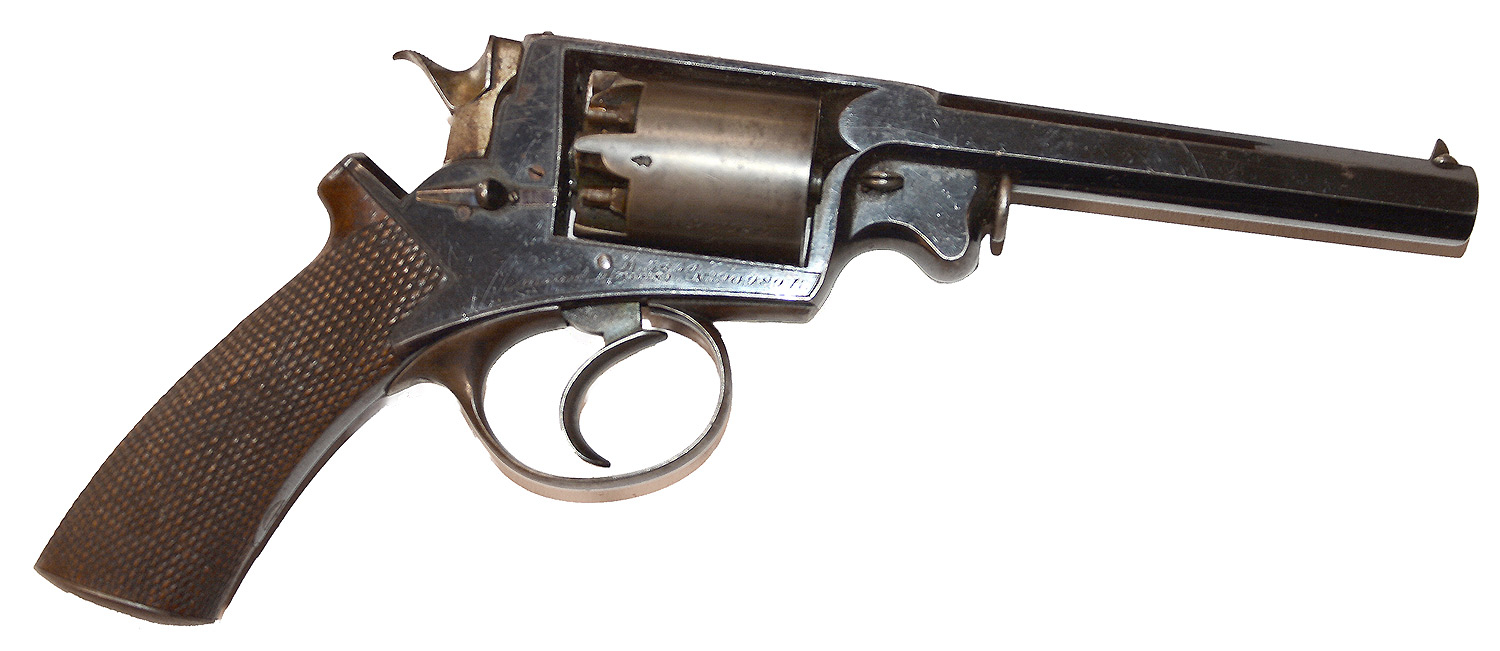
Adams revolvers had a good deal to do with dimming Sam Colt’s hopes for the British market and were a challenge not to be ignored even in America. Adams first patented his revolver in 1851, utilizing a robust frame and barrel forged in one piece and a “self-cocking” action (i.e. double action,) in powerful 54-bore (roughly .44 caliber,) and took on partners for production as Deane, Adams & Deane in 1853. He improved his design in several ways during production in 1854 and included an improved rammer patented by Kerr in 1855 and Beaumont’s February 1855 patented linkage connecting the trigger and hammer to give it a single-action function as well. The improved pistols are referred to both as Model 1854s (despite 1855 production) and as Beaumont-Adams.
These were popular prewar imports to the U.S. for private sale, particularly in the south where their English origins added a certain elegance and class appeal, and their popularity lasted throughout the war with pistols coming in by blockade runner and with engraved, presentation and Confederate identified examples well documented. They were available in the north as well, the 1864 Schuyler, Hartley and Graham catalog offering, “Adams’ English Patent Pistol – Selfcocking” in both 120 and 54 bore. But, they are most closely associated with southern usage. See “The English Connection” for details on the pistols, examples of identified and southern-agent marked examples and a wonderful photo of a 43rd Battalion Va. Partisan Ranger with a pair of Beaumont-Adams revolvers tucked in his belt.
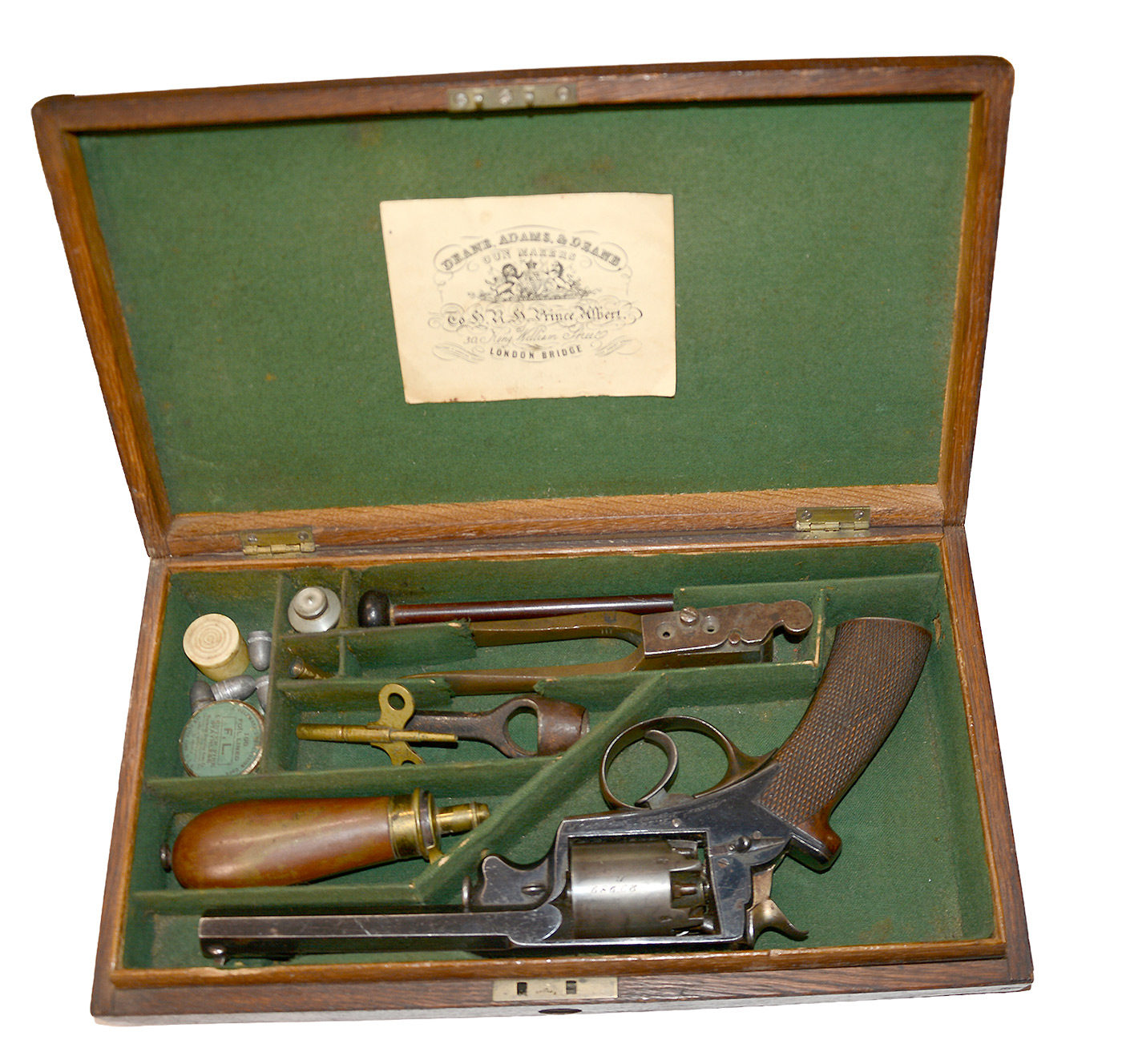
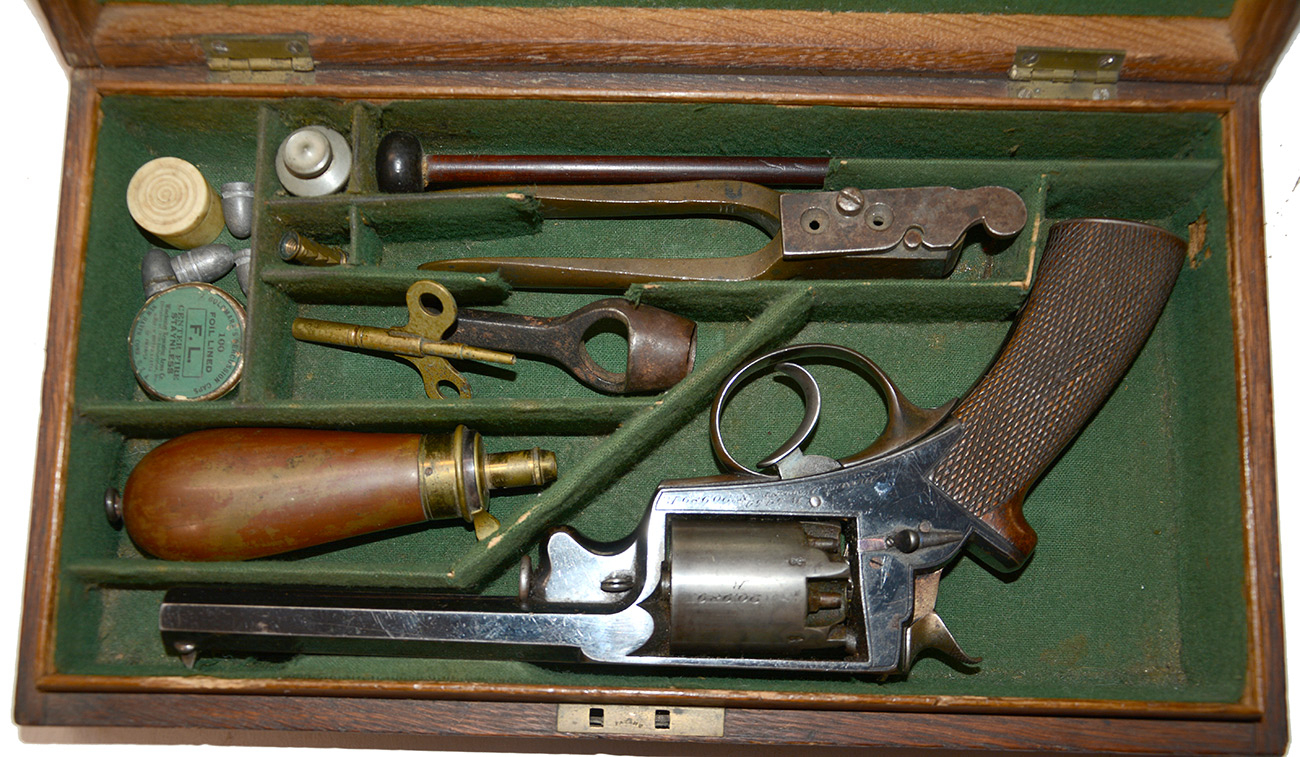
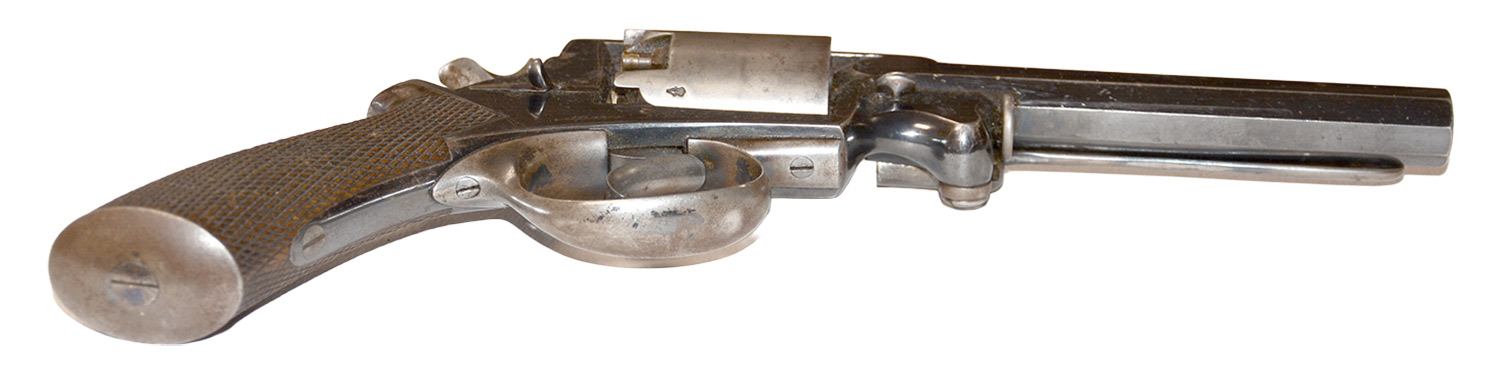
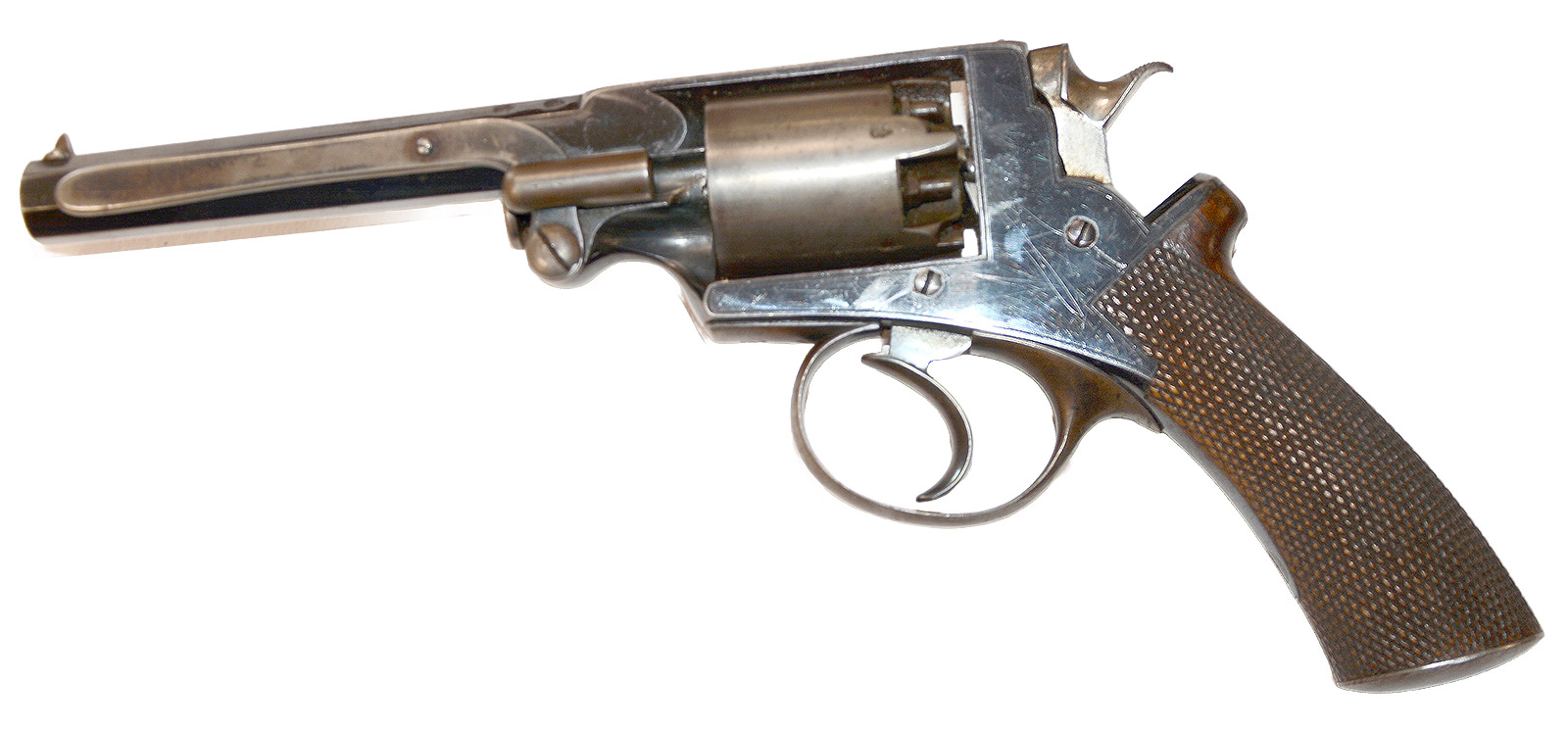
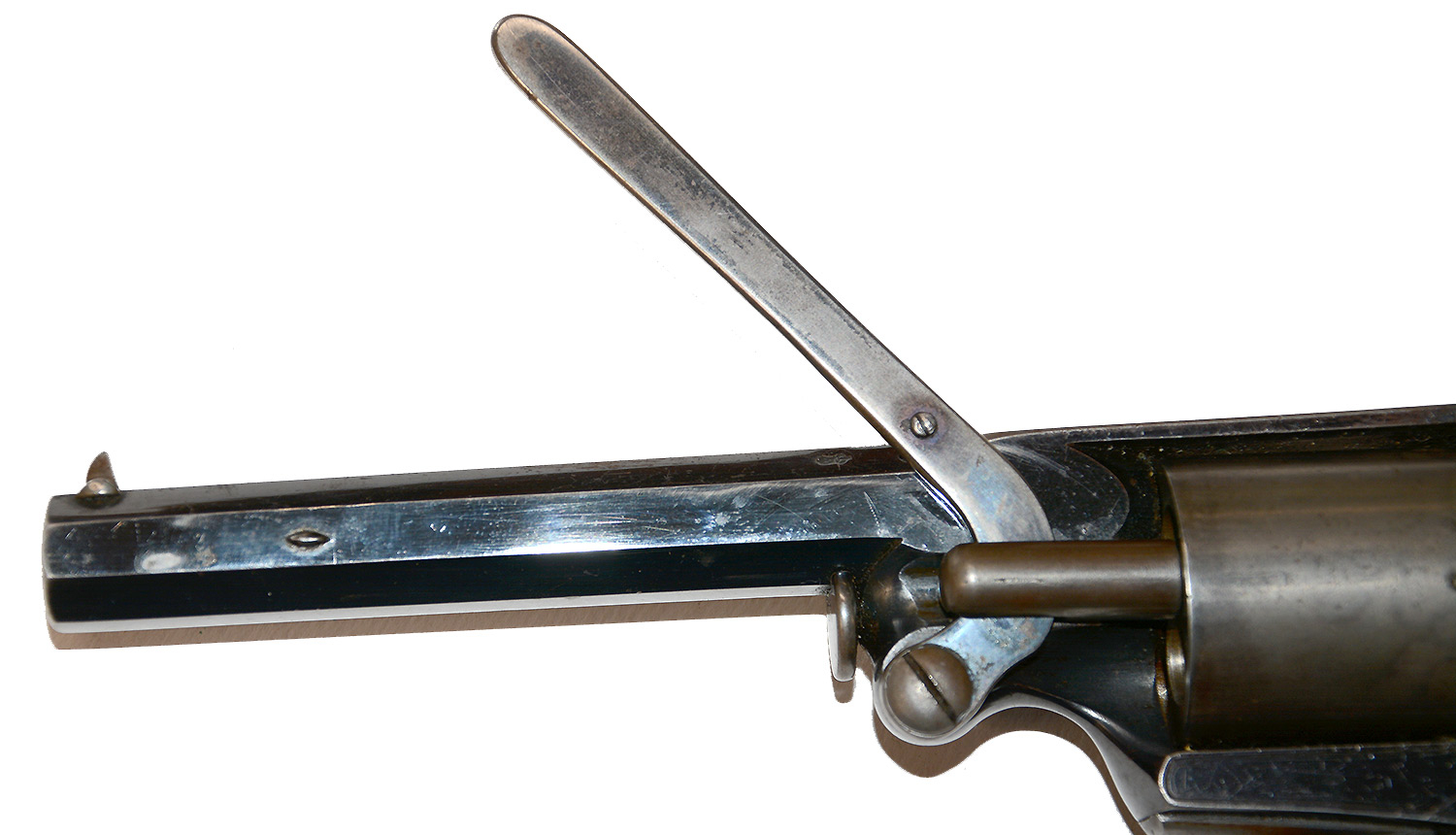
This one rates near excellent for condition and is in a period case with some tools. All the metal is smooth, the tight checkering on the walnut grips is sharp, the wood to metal fit is tight, and markings are crisp. The pistol retains an attractive, full, deep blue on the barrel and frame. The cylinder is a muted silver gray, natural from handling and the pistol naturally resting on its high points. The trigger shows blue. The triggerguard is a thin plum brown. The hammer is a silver gray matching the cylinder. The safety is present on the right of the frame and a Kerr patent loading lever is fitted on the left, showing some silver gray on the plunger and rubbing but also some thinning blue on the lever. The buttcap is a thin brown mixed with dull gray and some age spotting. The mechanics are very good and the revolver indexes and locks up well in both single and double action.
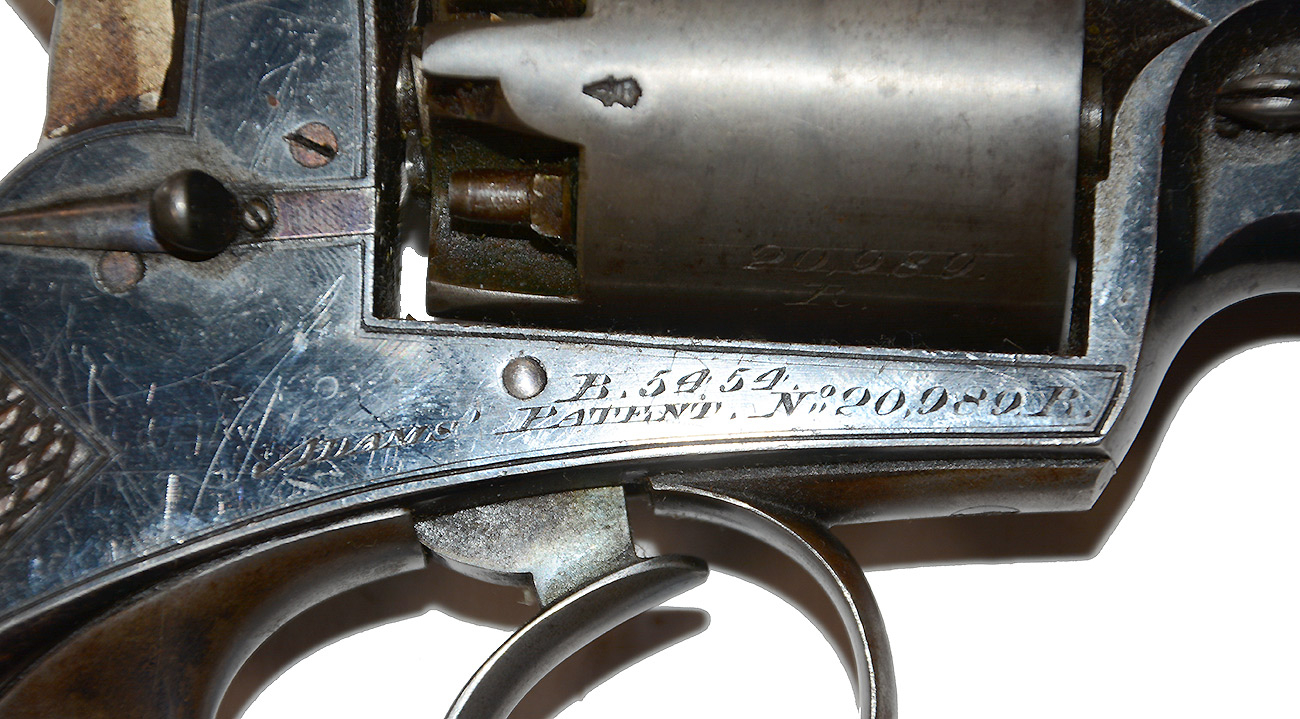
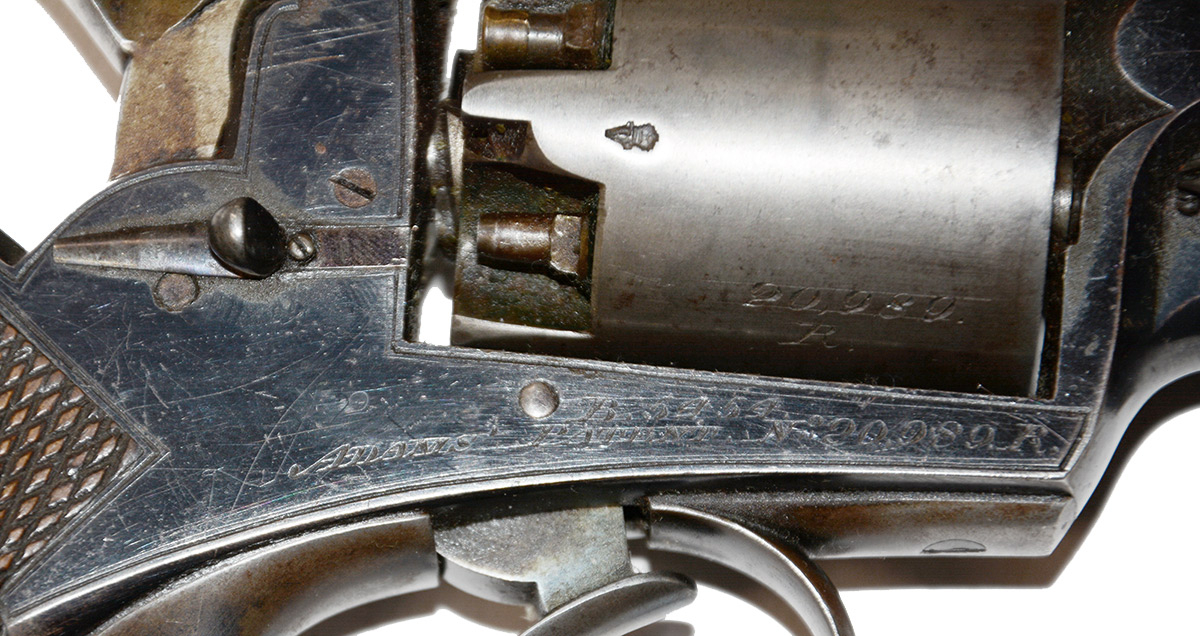
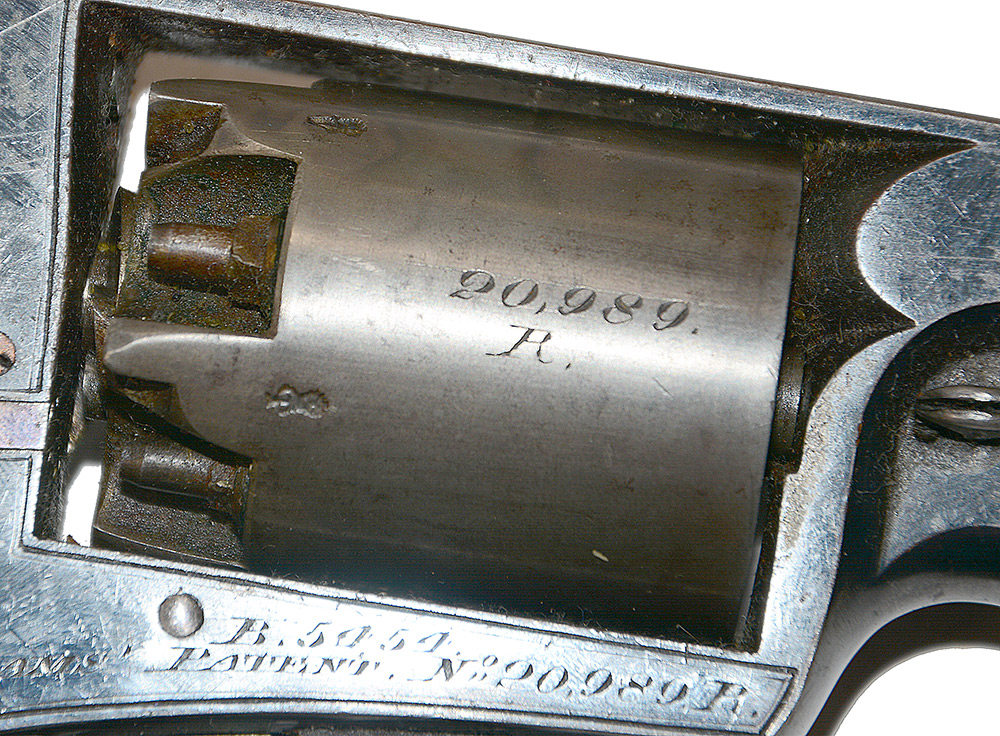
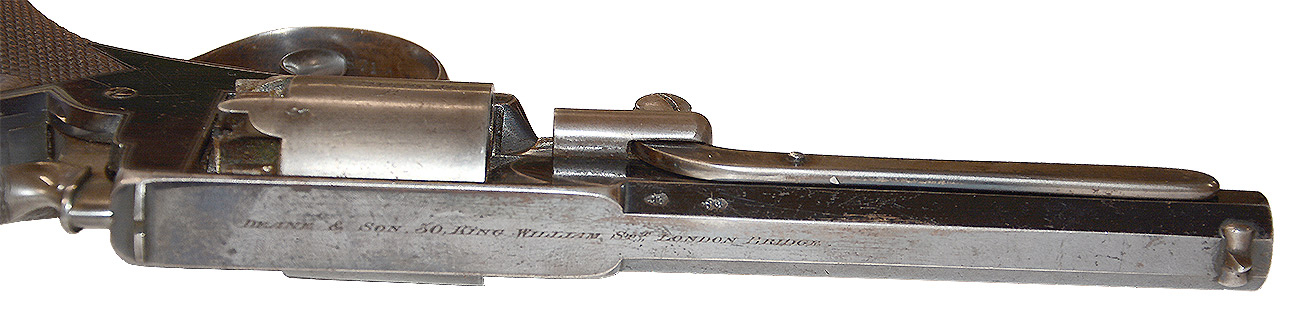
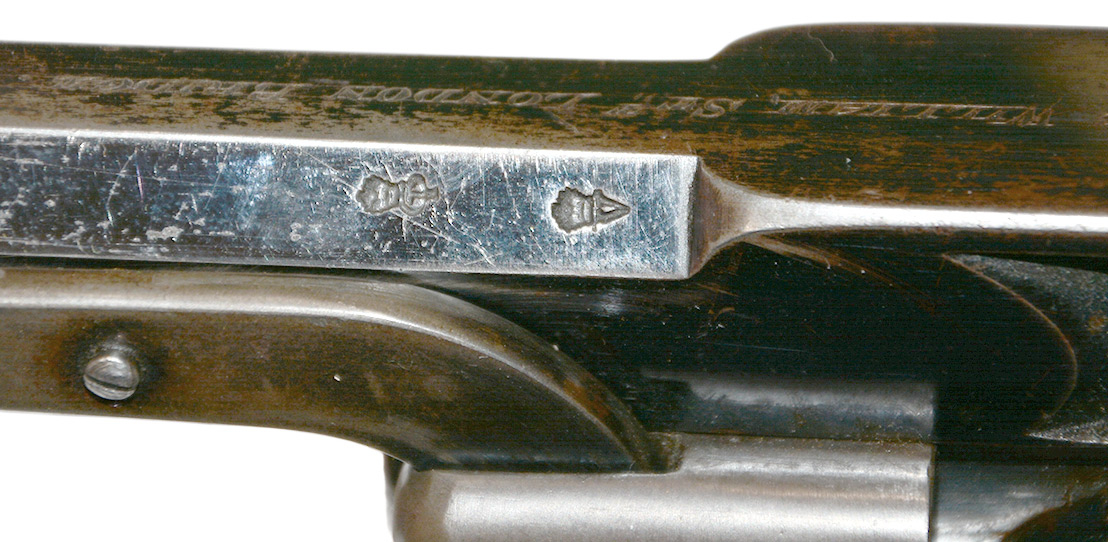
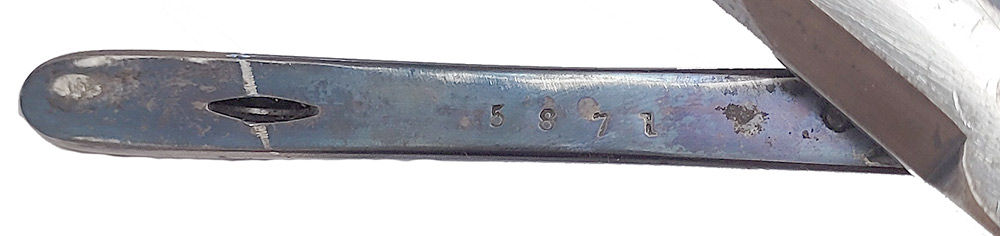
The markings are crisp. The top of the frame is marked, “DEANE & SON 50 KING WILLIAM STt. LONDON BRIDGE.” The Lower right frame is marked B.5454 / ADAMS’ PATENT No. 20,989 R.” The cylinder shows sharp proofs at rear between chambers and the same Adams patent number. Both numbers serve to indicate the sequential use of a patent: the B prefix numbers for the use of Beaumont’s patent, and the R suffix for the use of Adams’ patent, with the letter indicating the usage was by Adams himself, with other letters used to indicate licensed manufacturers.
In this case the matter is even a little more complicated. Adams had initially been partners in the firm of Deane, Adams and Deane in the production of the pistols. This partnership ended when Adams joined the London Armoury Company in late 1856 or early 1857, where he continued to work through 1858, but he apparently continued to license manufacture to his old partners, who also received some shares in the London Armoury Company. In any case they changed the name of their company to Deane & Son and continued in business. Adams’s London Armoury Company pistols seem to start about #17,000, but it is unclear how the numbering was worked out among the different manufacturers. In any case, in our estimate a date of 1856-57 cannot be far off for this pistol.
Thus, by its likely date of manufacture, this pistol may well have made it way to America in time for use in the Civil War. The English Connection notes that wartime Confederate imports seem to fall in #33,000-42,000 range for 54-bore Beaumont-Adams revolvers and in the #20,000 for the scarcer, larger 38-bore. At the same time, however, arms speculators were likely clearing British shelves of old inventory for private shipments and sales in America.
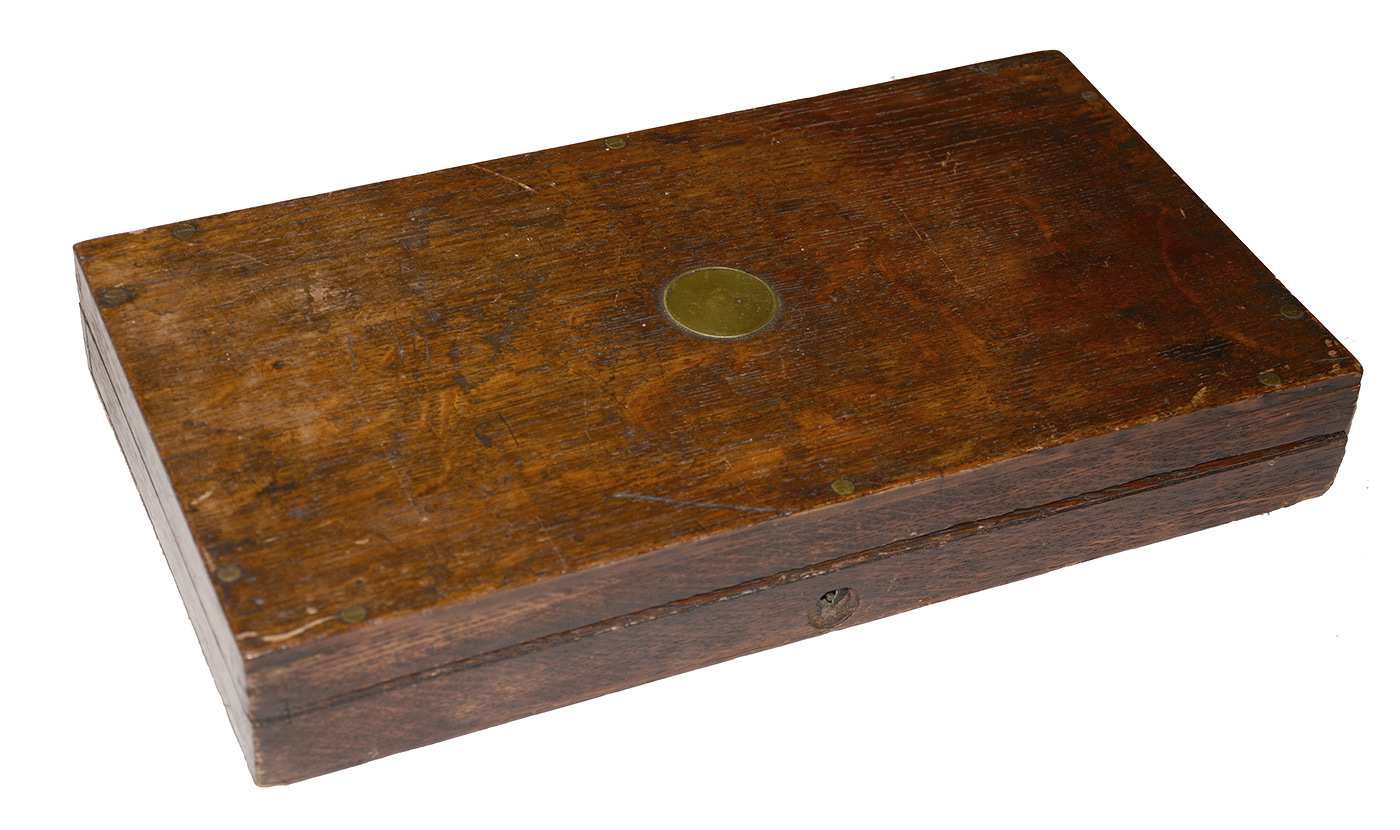
The pistol is cased in a British oak case that is old, appears original to the pistol. The exterior shows some stains, handling marks and scratches, but is solid and looks good. A circular brass escutcheon plate is in place in the center of the lid and has the initials “SHG” deeply scratched into it. The screws and hinges are brass as well. The keyhole escutcheon is missing. A period brass key is with it that looks good, but does not fit the lock. The interior dividers are in place and the case is lined in green. We see some very minor repairs to the dividers. The lining is complete, but shows wear in the pistol compartment from the cylinder and movement of the butt at the edge, and wear to the top edges and corners of compartment dividers, exposing some of the wood, but nothing too egregious.
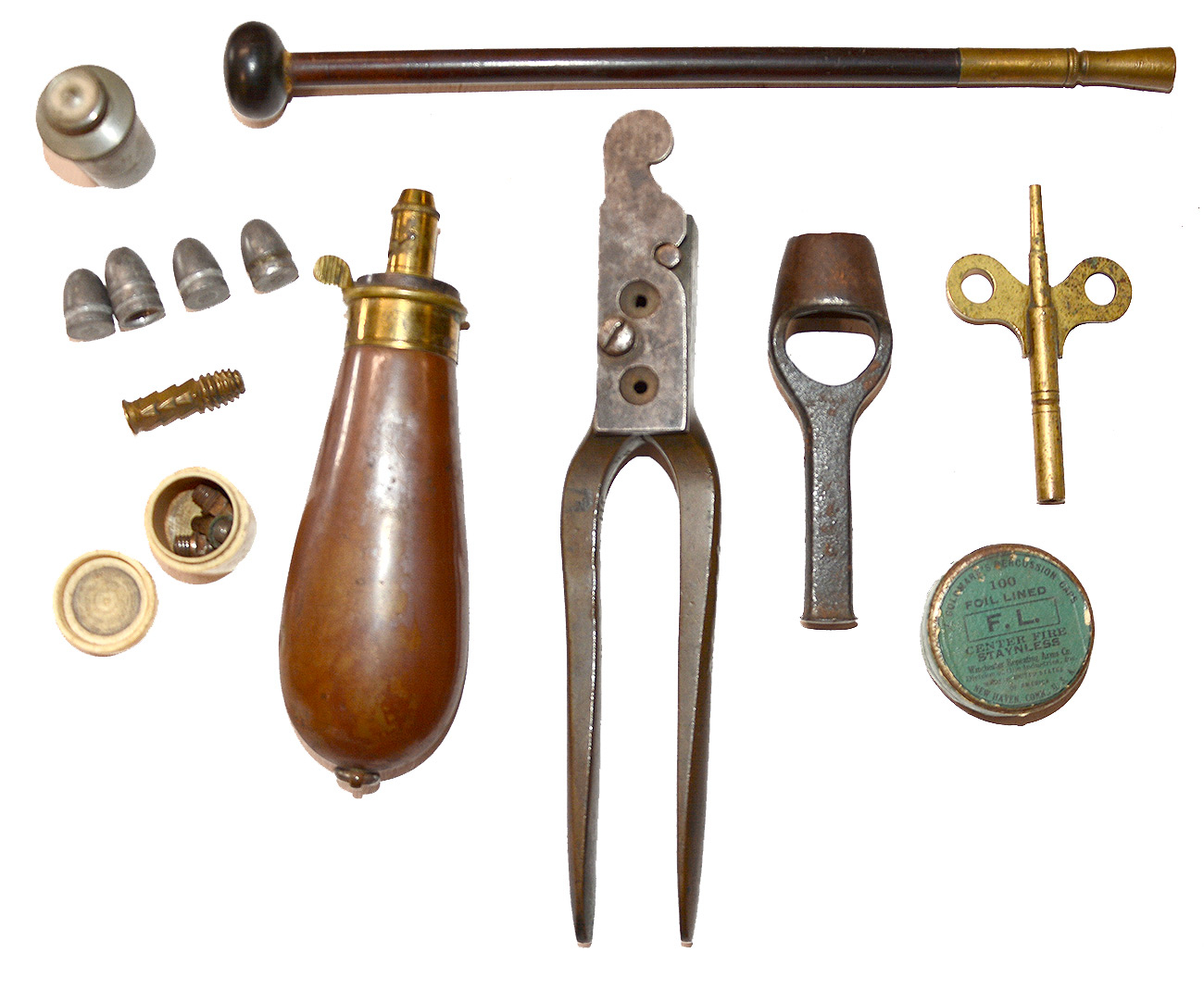
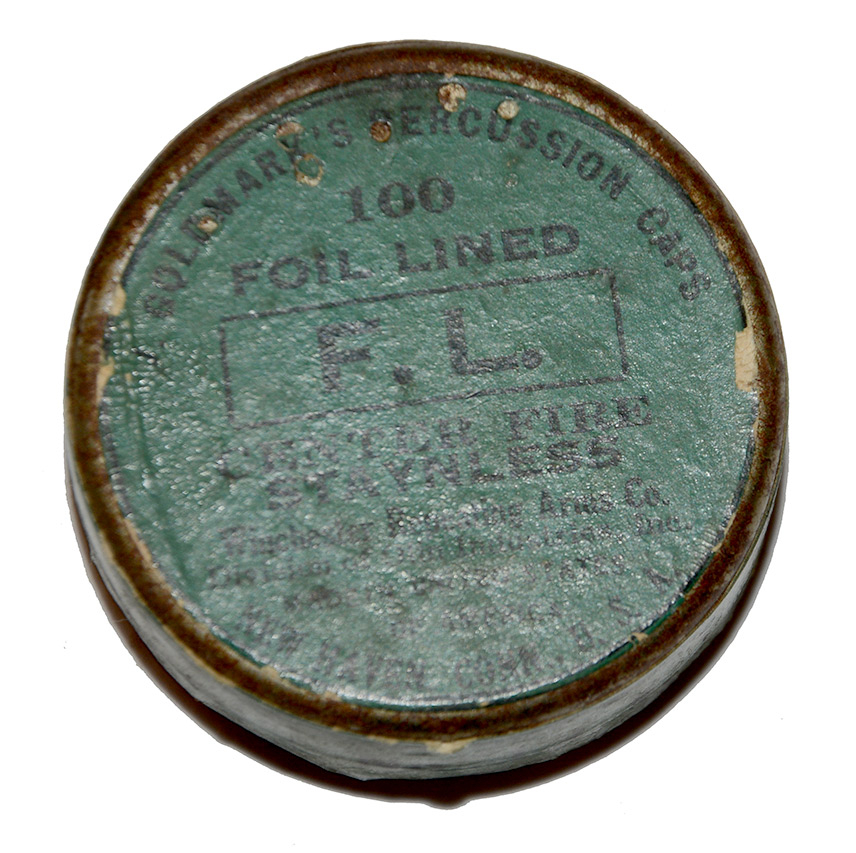
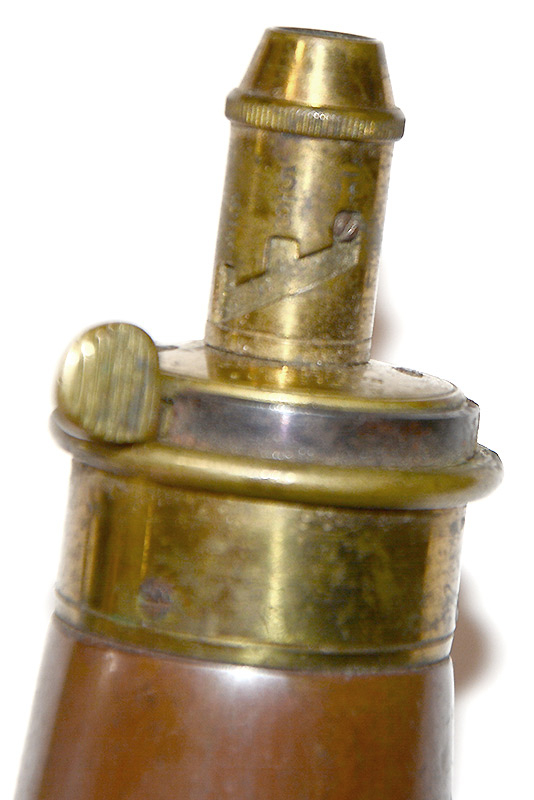
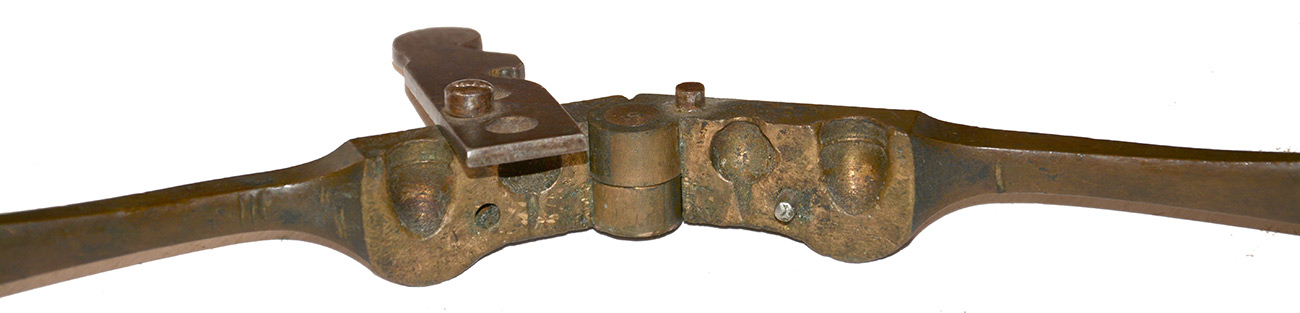
The case contains a plain, small copper powder flask, three nipples in a small ivory container, four conical bullets (one two-ring and three one-ring, an oiler,) a cleaning rod, a double-cavity bullet mold for a round and a conical bullet, with an “Registered R. Adams 1851” marking and “54” bore designation. There is also a shotgun wad cutter that made its way in there at some point over the years.
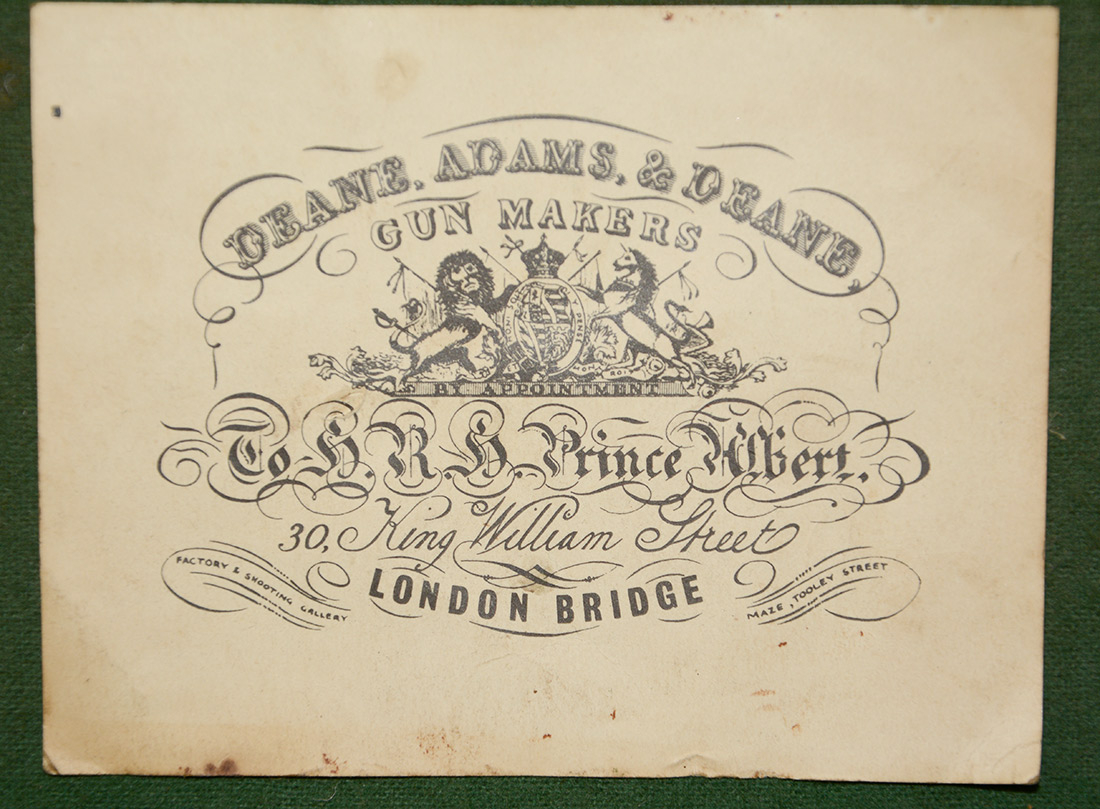
The underside of the lid, also lined in green, has a paper label glued in place, that shows some age and stains and reads, “Deane, Adams & Deane, Gun Makers / [crest with lions and arms] By Appointment / To H.R.H. Prince Albert / 30 King William Street / London Bridge.” The label appears to have some age, but being from Adams’ earlier company, would predate the revolver and seem an unlikely choice for its casing after the formation of Deane & Son, who would want to advertise their own operation, so the label may be a later addition to dress up the case to match the condition of the revolver, which it does very well. The revolver is a very desirable Beaumont-Adams in very strong condition, a significant pistol in nineteenth century arms development and the arms industry, and one seeing service on both sides during the American Civil War. This would be a key piece in any Civil War revolver collection and a strong addition to their display. [sr][ph:L]
DISCLAIMER: All firearms are sold as collector's items only - we do not accept responsibility as to the shooting safety or reliability of any antique firearm. All firearms are described as accurately as possible, given the restraints of a catalog listing length. We want satisfied customers & often "under" describe the weapons. Any city or state regulations regarding owning antique firearms are the responsibility of the purchaser. All firearms are "mechanically perfect" unless noted, but again, are NOT warranted as safe to fire!
~~~~~~~~~~~~~~~~~~~~~~~~~~~~~~~~~~~
THIS ITEM, AS WITH ALL OTHER ITEMS AVAILABLE ON OUR WEB SITE,
MAY BE PURCHASED THROUGH OUR LAYAWAY PROGRAM.
CLICK HERE FOR OUR POLICIES AND TERMS.
THANK YOU!
Inquire About STRONG CONDITION CASED M1854 BEAUMONT-ADAMS REVOLVER
Most Popular
Historical Firearms Stolen From The National Civil War Museum In Harrisburg, Pa »
Theft From Gravesite Of Gen. John Reynolds »
Selection Of Unframed Prints By Don Troiani »
Fine Condition Brass Infantry Bugle Insignia »
Rare Identified 65Th Ny Sergeant’s Jacket, With Manscript Material: 1St U.s. Chasseurs »
featured item
REGULATION CIVIL WAR US ARMY ISSUE BLANKET IN AMAZING CONDITION
These wool blankets were an essential piece of a Union soldier's gear. This one is full length and unaltered. It measures 66 inches wide by 80 inches in length. The ends are finished on the sides, and they are basted over 1/2 inch on the long ends to… (2025-1850). Learn More »
site search