

site search
online catalog
A MUCH SOUGHT AFTER "BROWN BESS" OF THE 1756 LONG LAND PATTERN WITH BAYONET

Hover to zoom









$15,000.00 SOLD
Quantity Available: None
Item Code: 1273-29
It is believed, but not affirmed, that the "Brown Bess" was named after Elizabeth I of England (However she was dead over a century before the first of these was made therefore begging the question). Uses of the term first appear in the later 18th century. The Connecticut Courant in April 1771, said "...but if you are afraid of the sea, take Brown Bess on your shoulder and march." The 1785 Dictionary of Vulgar Tongue, a contemporary work which defined vernacular and slang terms, contained this entry: "Brown Bess: A soldier's firelock. To hug Brown Bess; to carry a firelock or serve as a private soldier." Other popular explanations of the use of the word "Brown" include that it was a reference to either the color of the walnut stocks or to the characteristic brown color that was produced by russeting, an early form of metal treatment. However, the Oxford English Dictionary notes that "browning" was only introduced in the early 19th century, well after the term had come into general use. The word "Bess" is commonly held to either derive from the word arquebus. More plausible is that the name could have been derived from the German words "brawn buss" or "braun buss", meaning "strong gun" or "brown gun"; King George I who sanctioned its use as early as the first quarter of the 18th century was from Germany.
Originally officially designated the Land Service Musket of the King’s Pattern. These weapons began official production around 1730 and are today referred to as the Long Land or the 1st Model Brown Bess. These were the standard arm of the British infantry forces fighting in Europe, India and the Americas during the time of French & Indian War, the American Revolution and beyond.
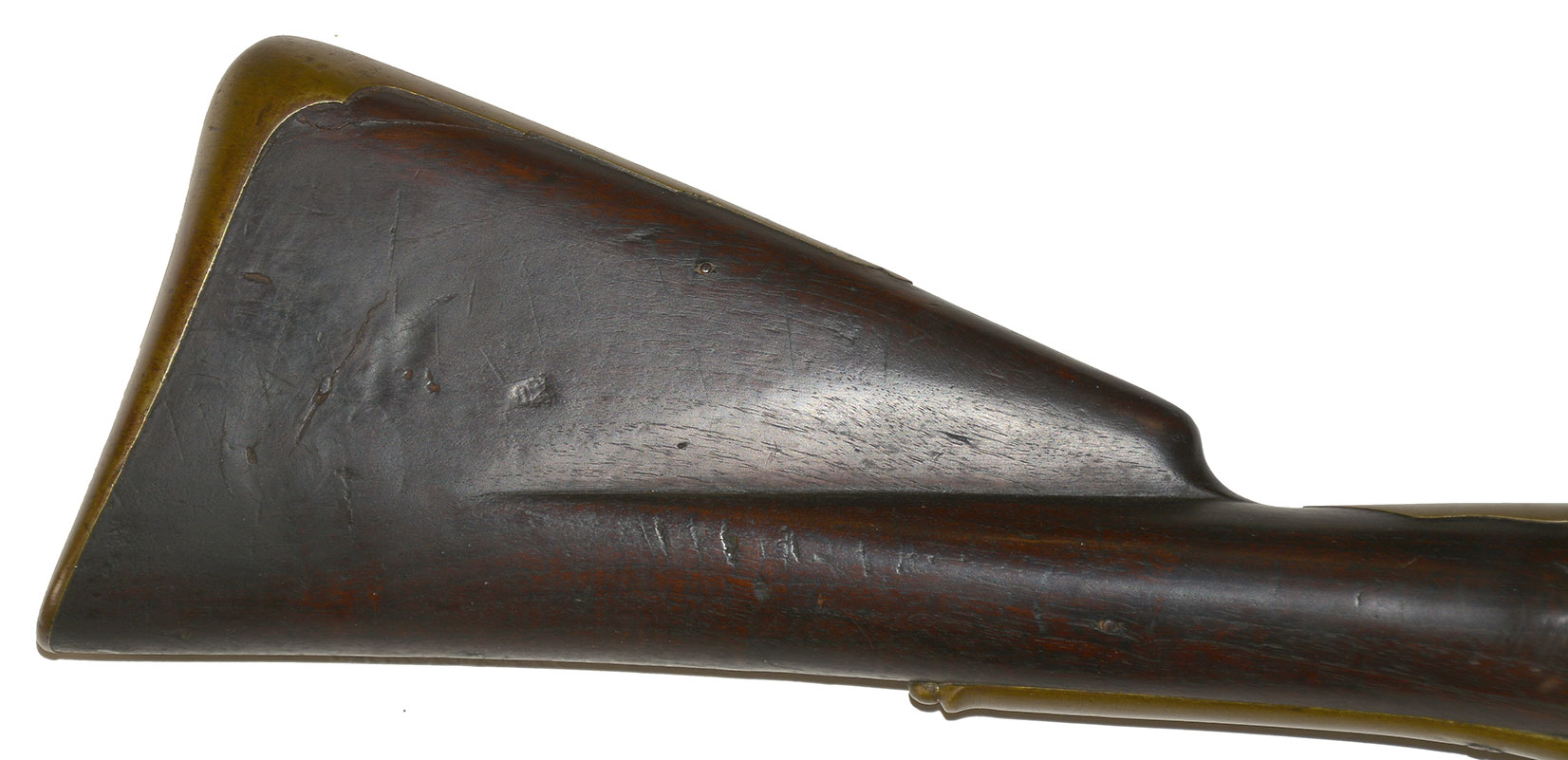
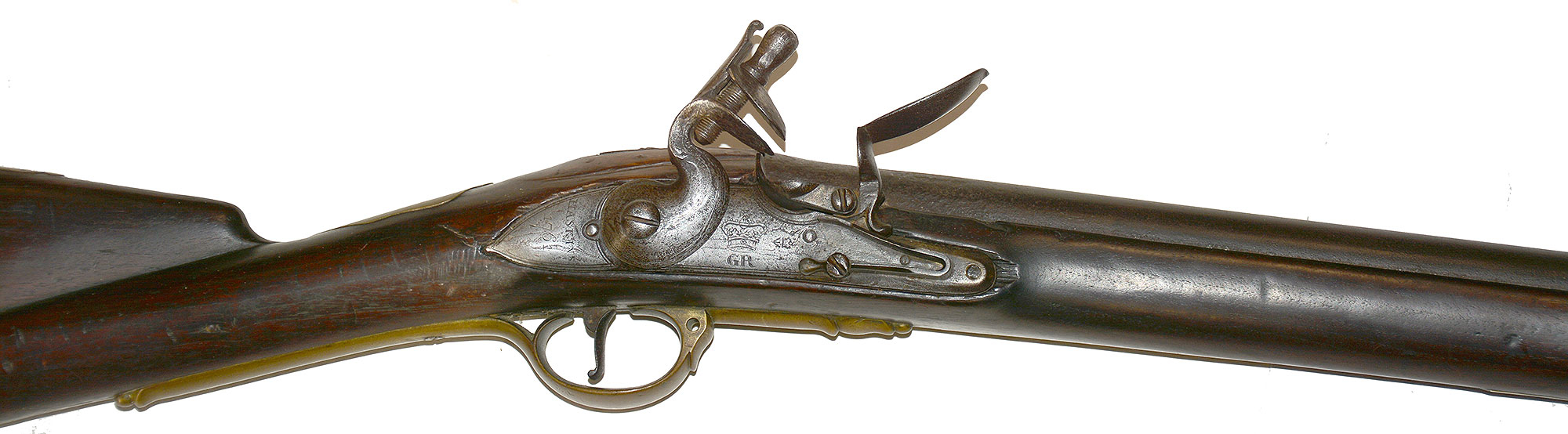
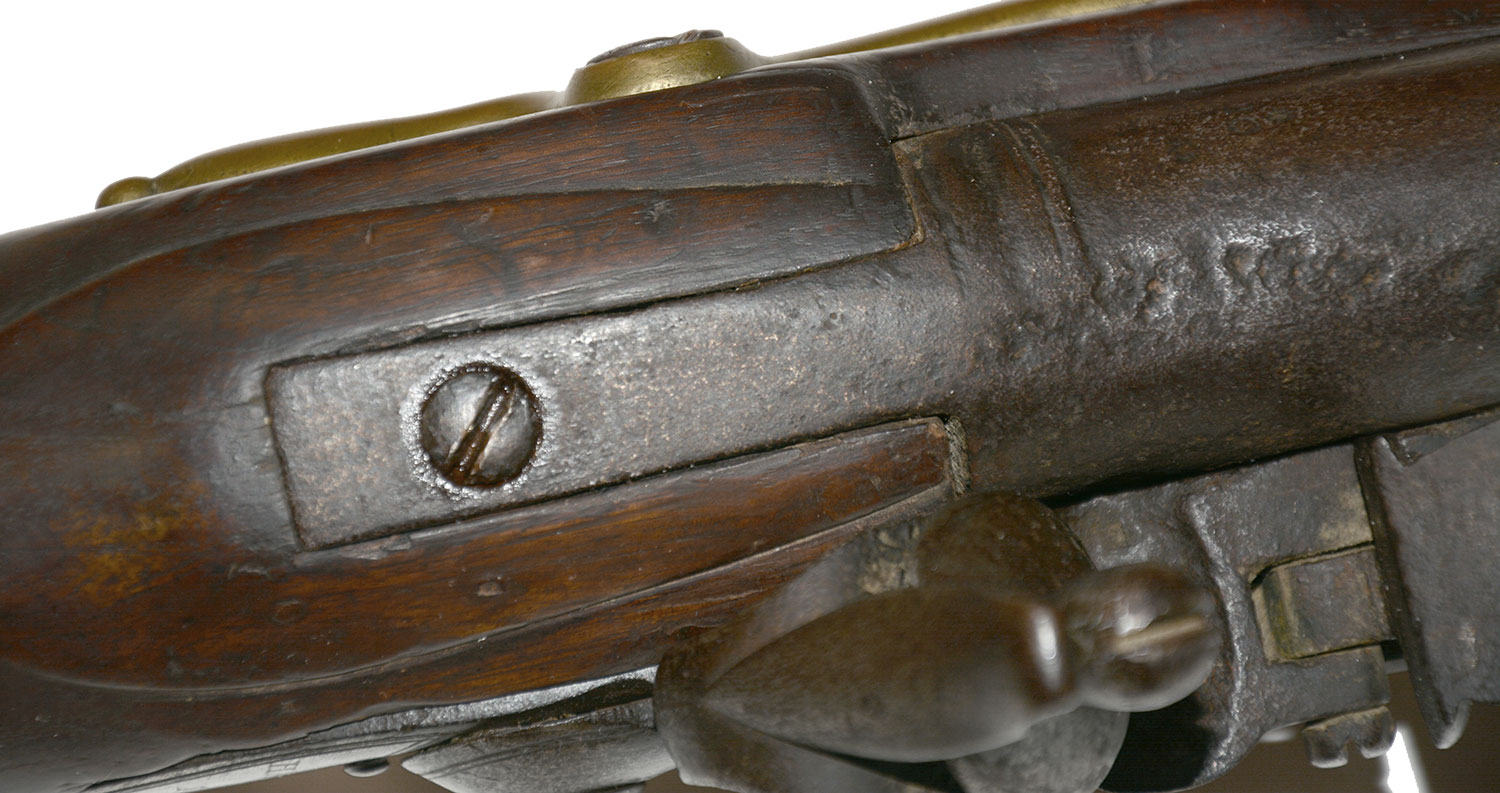
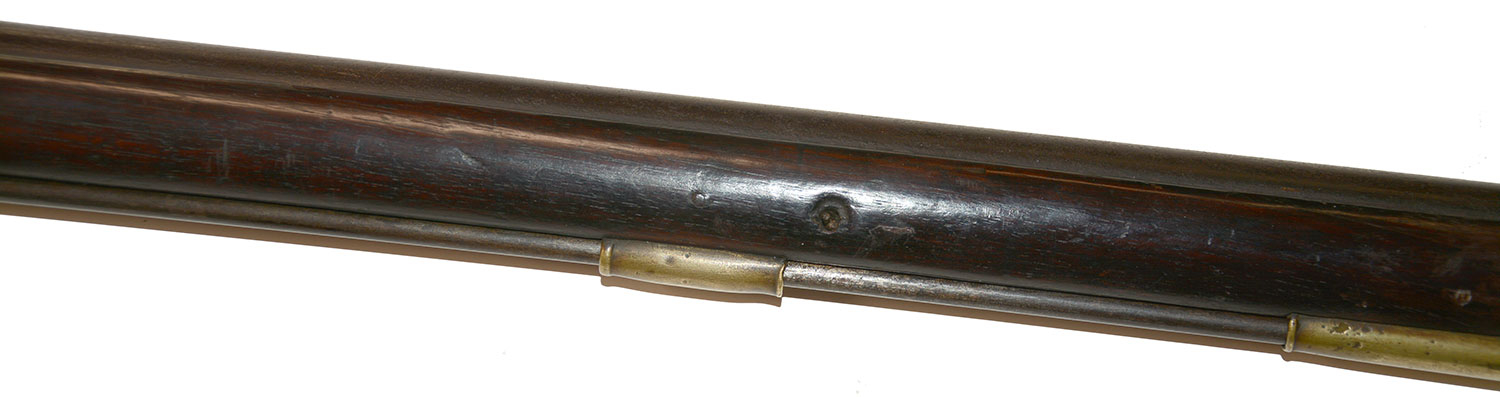
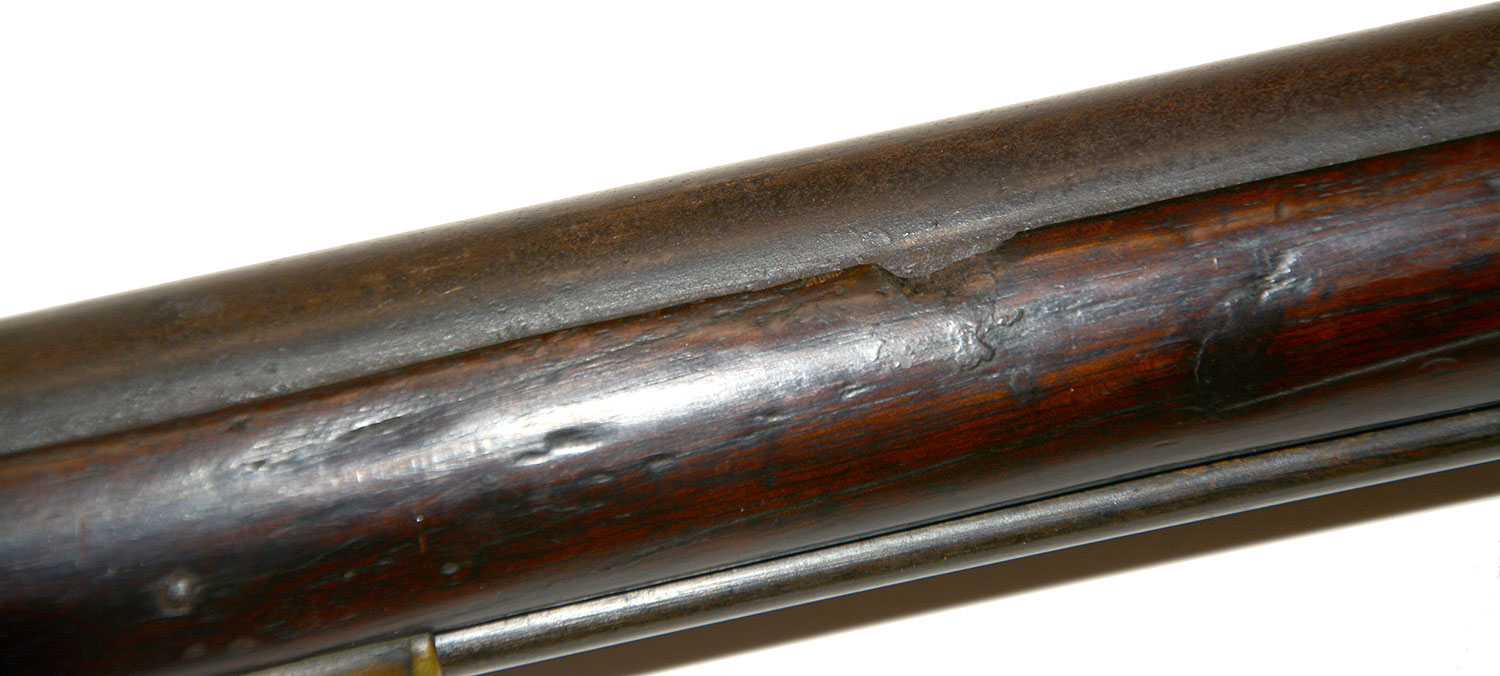
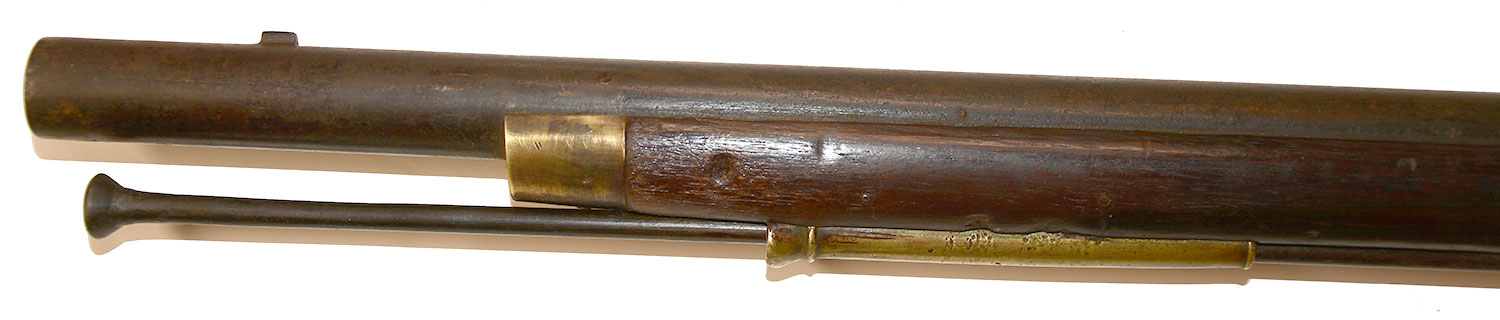
The here offered unaltered flintlock longarm is a British "Sealed Pattern of 1756". It is a single shot, smoothbore muzzleloader. This example measures a total of almost 62” long with a 46” long barrel which is secured to the stock with pins. The top of barrel breech has two stampings that show the proof mark of a crown over crossed scepters and a government viewer’s acceptance mark of a crown over "GR" and broad arrow. The left side of barrel breech also shows an asterisk over “10”. The barrel breech tang has a barely visible crown. The bayonet lug on barrel is 2” back from the muzzle. The bore is dark and has moderate rust pitting. The barrel surface is smooth with little pitting except around the breech and the well-used touch hole. Barrel has a beautiful, uniform deep brown color. The musket has what could be its original iron hand forged ramrod with the button tip, but it has lost 2 inches at the formerly threaded end.
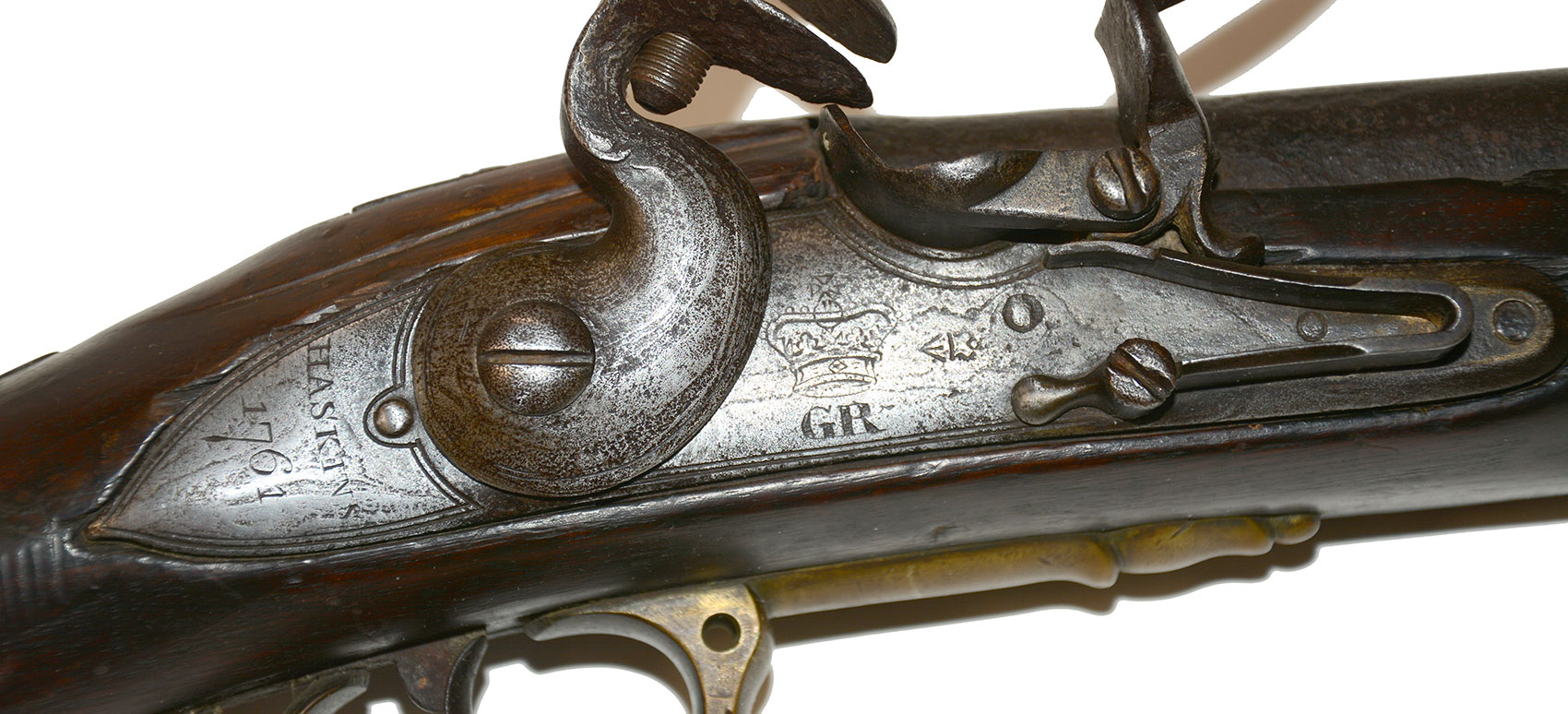
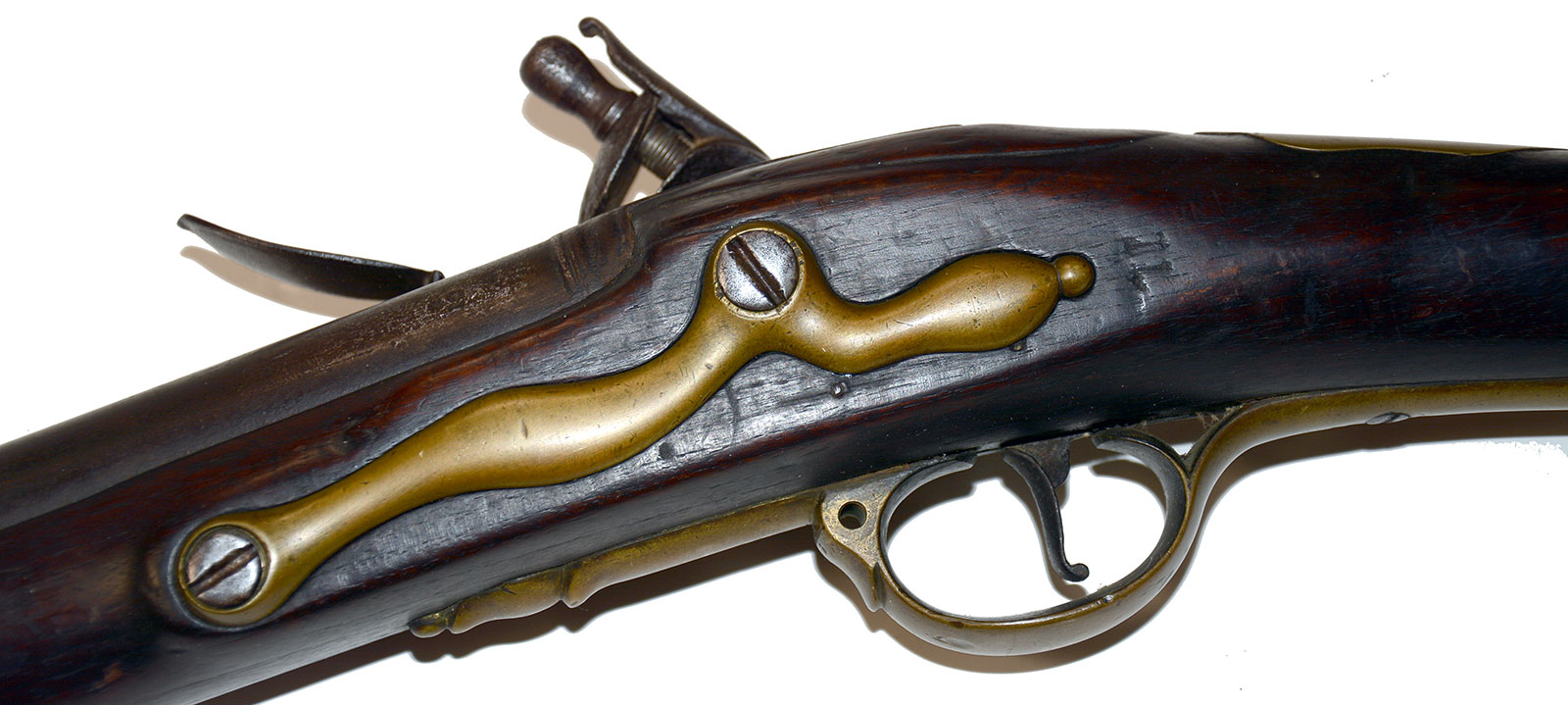
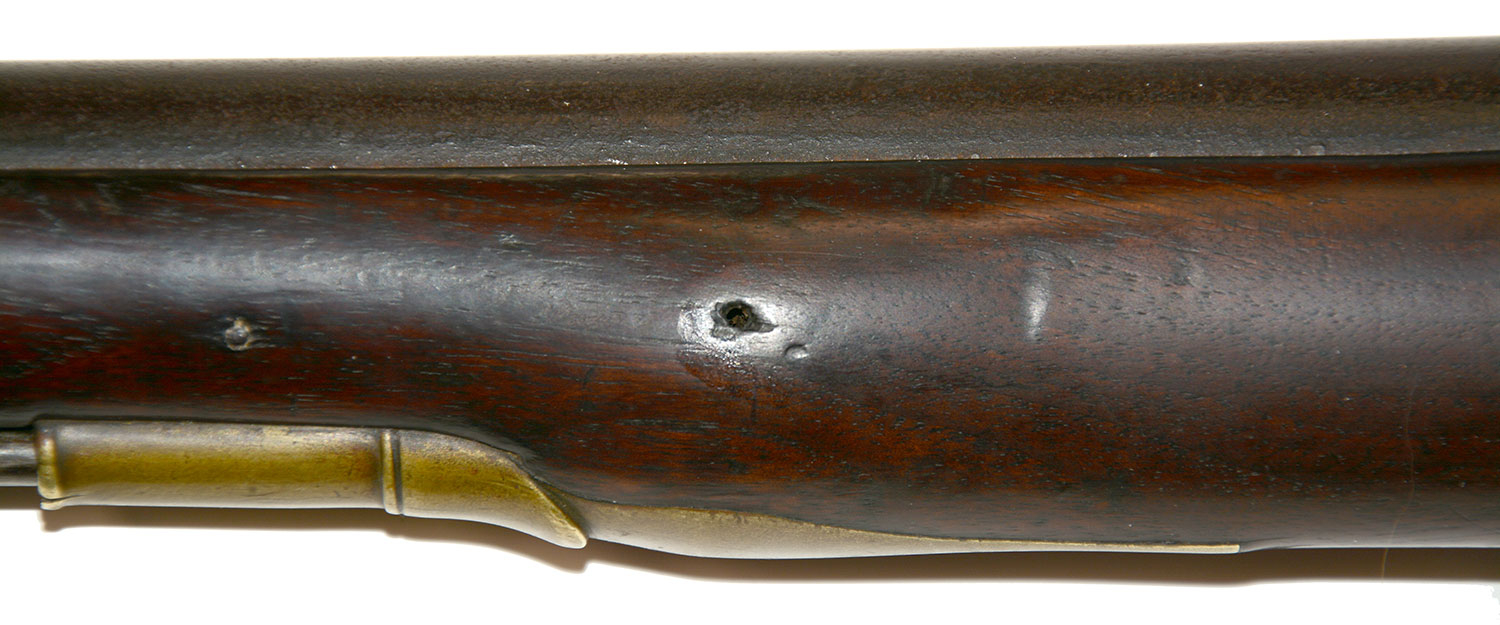
The lock plate is engraved at the rear with the lock maker's/ furbisher's name 'HASKINS" and dated "1761". It has a slightly curved "banana" contour and measures 7 inches long. Haskins was active 1755 to 1762 providing components for the Long Land muskets that were then assembled at The Tower, the time-honored production method. The lock features the single (visible) sear screw behind the cock. Cock, cock screw and top jaw are all original but the frizzen spring was replaced during the period of use perhaps as early as 1780. The hammer features fine two-line engraving. The same two-line engraving is found around the edge of the lock plate itself and the top jaw. Between the cock and the frizzen pan are found the King’s crown above the monarch’s initials “GR” and the British broad arrow is found below the flash pan and the spring finial. The mechanics are excellent. Opposite side from lock has the curvy brass side plate with its two large stock screws or "nails". Other brass components are the nose cap, four ramrod tubes, trigger guard, escutcheon plate, and butt plate. The butt plate tang for this pattern is nearly 6” long and features three sets of “shoulders” that tapper in and eventually terminate at a small round button. Most of the brass parts have mellow patina. Neither of the iron sling swivels remain. The stock measures 57” long and is of dark walnut and is in very solid condition. It appears to be in original color and finish. Stock exhibits a minor stress crack behind the lock and small chips around the breech tang and lock plate. The bayonet is in excellent condition with a slightly lighter patina then the musket. It is British militarily proof and fits compatibly. There is minor wood stabilization on the left fore end portion of the stock, but the weapon is remarkably sound with a great overall surface. The socket bayonet is in excellent condition. It is British militarily proofed and fits compatibly.
This is one of the best Pattern 1756 Long Land muskets seen by this compiler in decades! [pe][ph:L]
DISCLAIMER: All firearms are sold as collector's items only - we do not accept responsibility as to the shooting safety or reliability of any antique firearm. All firearms are described as accurately as possible, given the restraints of a catalog listing length. We want satisfied customers & often "under" describe the weapons. Any city or state regulations regarding owning antique firearms are the responsibility of the purchaser. All firearms are "mechanically perfect" unless noted, but again, are NOT warranted as safe to fire!
~~~~~~~~~~~~~~~~~~~~~~~~~~~~~~~~~~~
THIS ITEM, AS WITH ALL OTHER ITEMS AVAILABLE ON OUR WEB SITE,
MAY BE PURCHASED THROUGH OUR LAYAWAY PROGRAM.
CLICK HERE FOR OUR POLICIES AND TERMS.
THANK YOU!
Inquire About A MUCH SOUGHT AFTER "BROWN BESS" OF THE 1756 LONG LAND PATTERN WITH BAYONET
Most Popular
Historical Firearms Stolen From The National Civil War Museum In Harrisburg, Pa »
Theft From Gravesite Of Gen. John Reynolds »
Selection Of Unframed Prints By Don Troiani »
Fine Condition Brass Infantry Bugle Insignia »
featured item
RARE INSPECTOR MARKED REGULATION MODEL 1850 FOOT OFFICER’S SWORD BY AMES, ID’D TO 11TH US INFANTRY CAPTAIN & LATER BRIGADIER GENERAL JOHN W. AMES
This inspected regulation Model 1850 foot officer’s sword made by Ames. Overall the drawn sword meas. approx. 36.25” long from point to pommel. The blade itself measures 30.00” long with a 20.50” long stopped central fuller and a 15.50”… (2025-3342). Learn More »
site search
Upcoming Events
May 13 - 17: N-SSA Spring Nationals, Fort Shenandoah, Winchester, VA Learn More »