


site search
online catalog
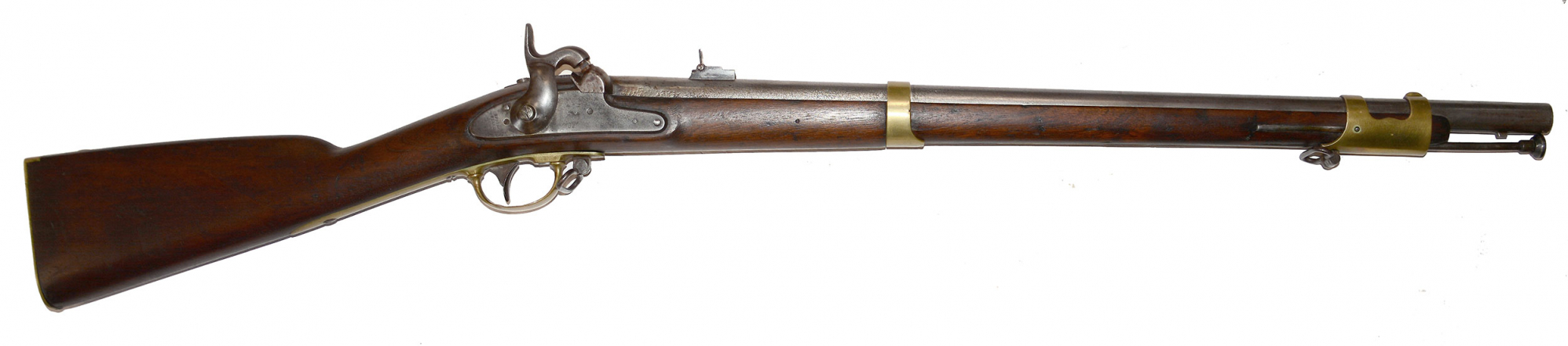
SCARCE SPRINGFIELD M1847 CAVALRY MUSKETOON ALTERED TO ARTILLERY CONFIGURATION, WITH 1858 REAR SIGHT, BUT SMOOTHBORE
Hover to zoom



$2,950.00 SOLD
Quantity Available: None
Item Code: 2026-858
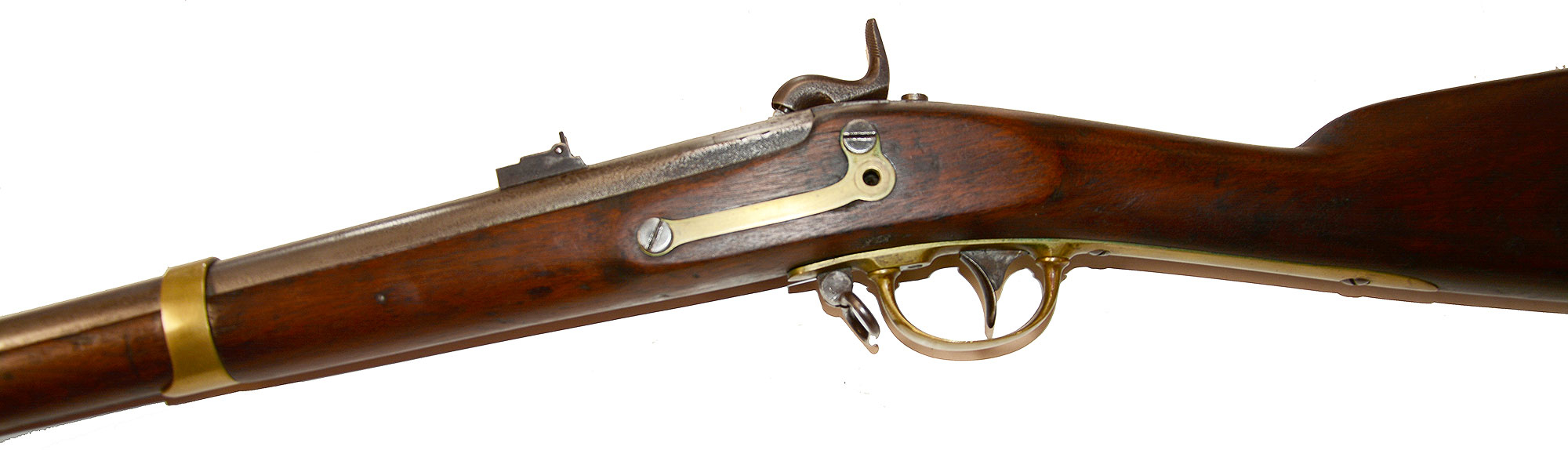
US Model 1847 Musketoons are a collecting field of their own. Manufactured at Springfield in three configurations -cavalry (dragoons,) foot artillery, and engineers (sappers and miners,) with respective totals of 3,201, 5,802, and 1,030- they were subject to enough modifications and alterations as to produce at least ten variations in Moller’s estimate. This is a cavalry version altered to artillery configuration, which made it suitable for foot troops by substituting a bayonet stud for a socket bayonet on the underside of the muzzle in place of the swivel and captive ramrod (and substituting a conventional ramrod,) and also removing the sidebar and ring for suspension on a carbine sling and installing two conventional sling swivels. It is worth noting that the installation of conventional sling swivels may also have made it a better arm for cavalry since one of the major complaints it received was that when carried muzzle-down on a carbine sling by a mounted trooper loaded rounds were jogged loose by movement of the horse. For federal authorities the motive in the alteration seems largely to make them acceptable for issue to states under the militia act for use as cadet muskets, the supply of which had been depleted. Musketoons of unspecified configuration, however, were mentioned in the hands of some cavalry in the Civil War, both Union and Confederate, with the 1862 Confederate ordnance manual including them and requests made as late as August 1863 in Bragg’s Army of the Tennessee for ammunition for musketoons in the hands of Wheeler’s and Forrest’s cavalry.
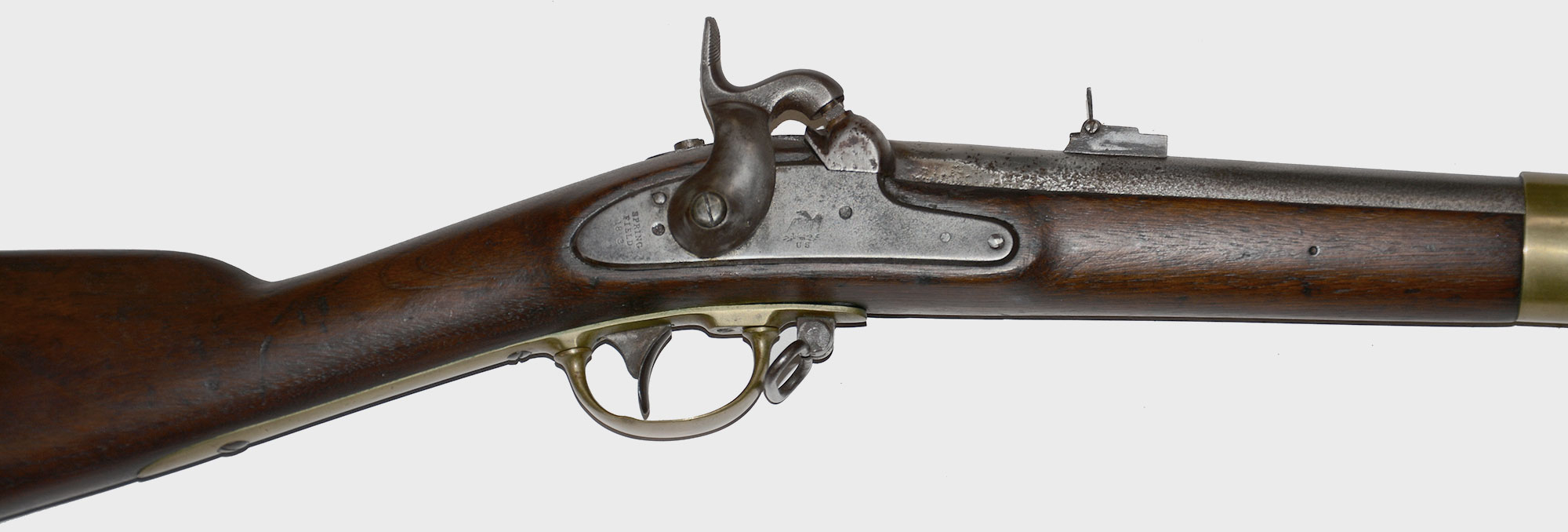
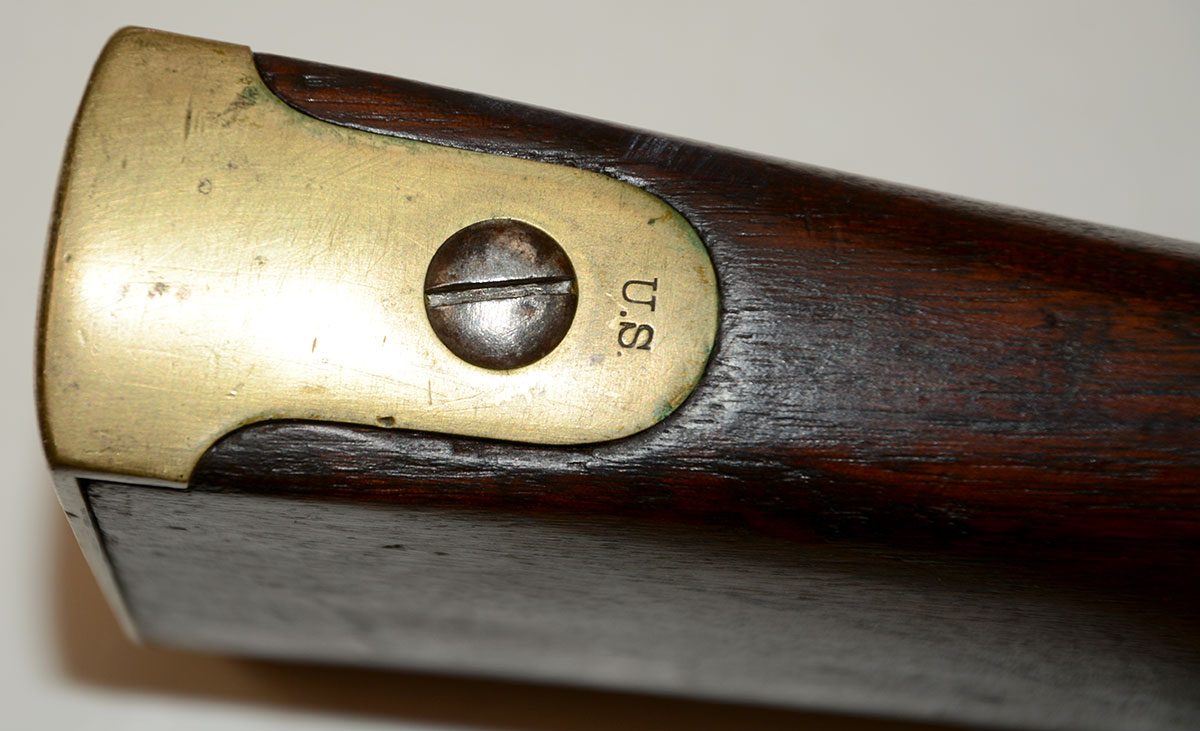
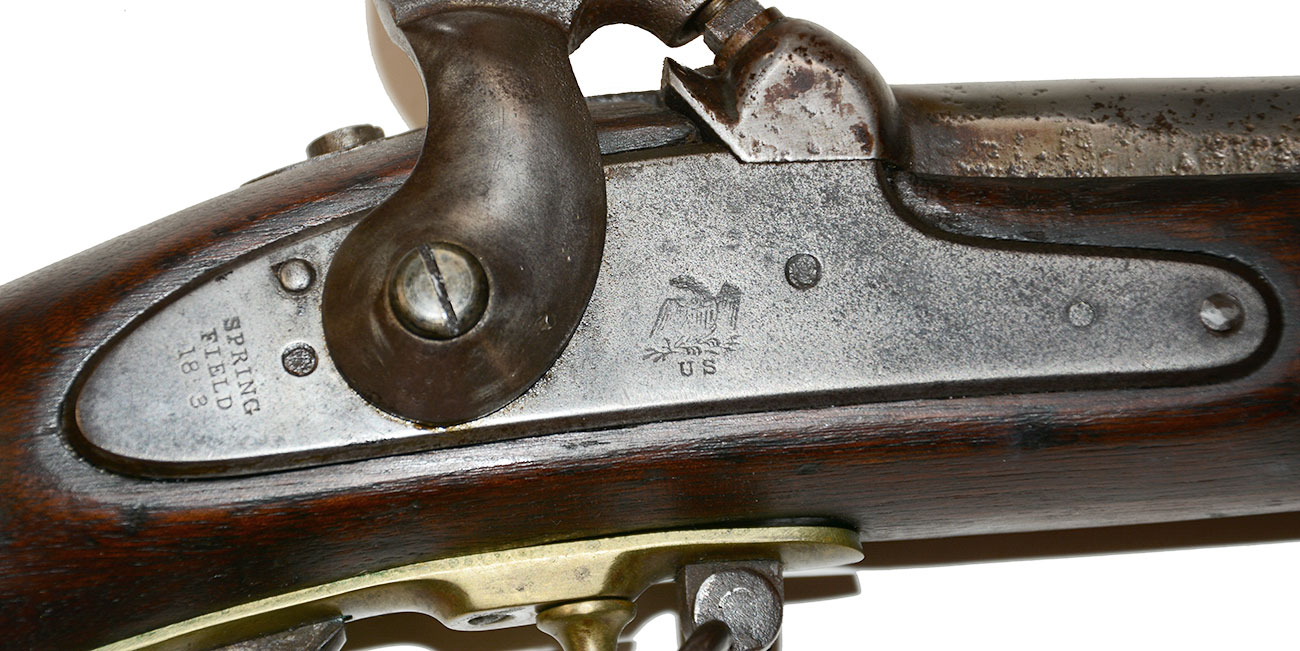
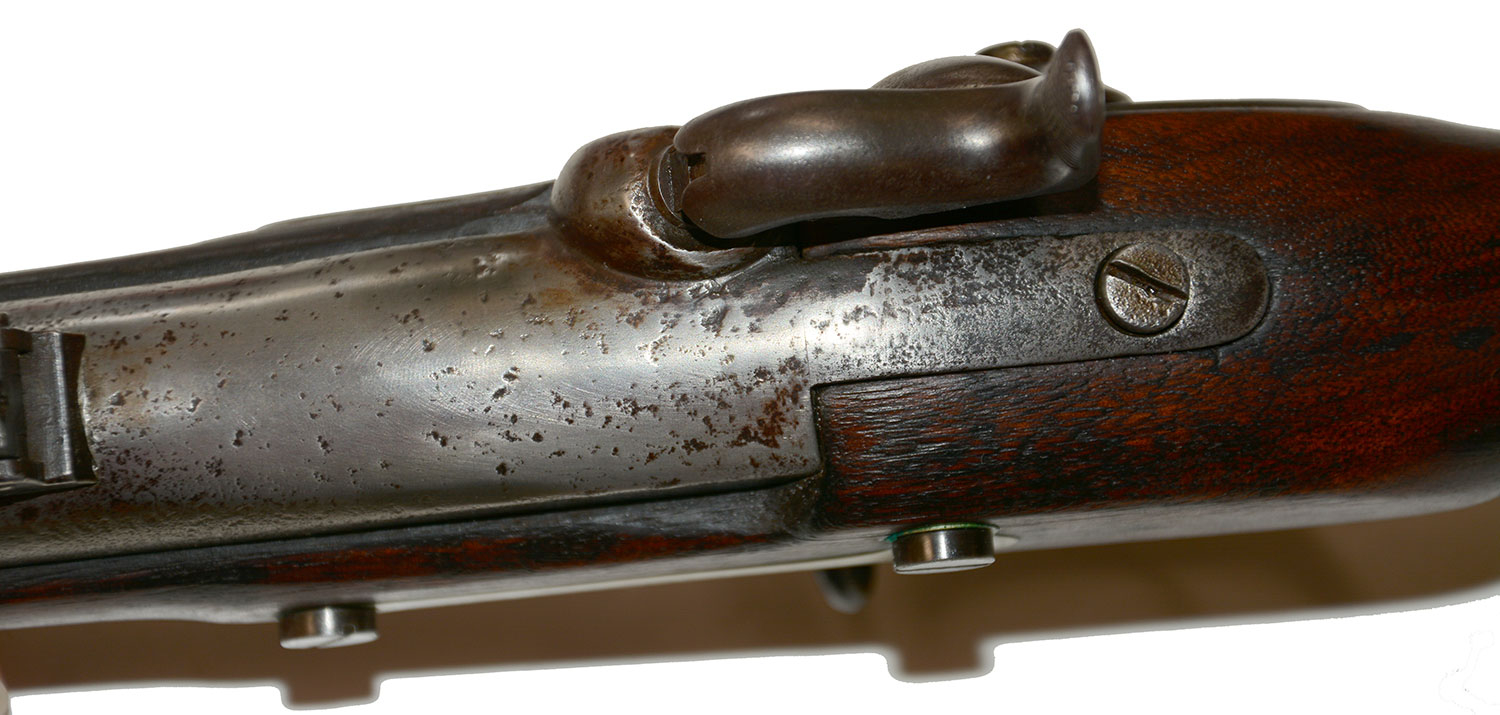
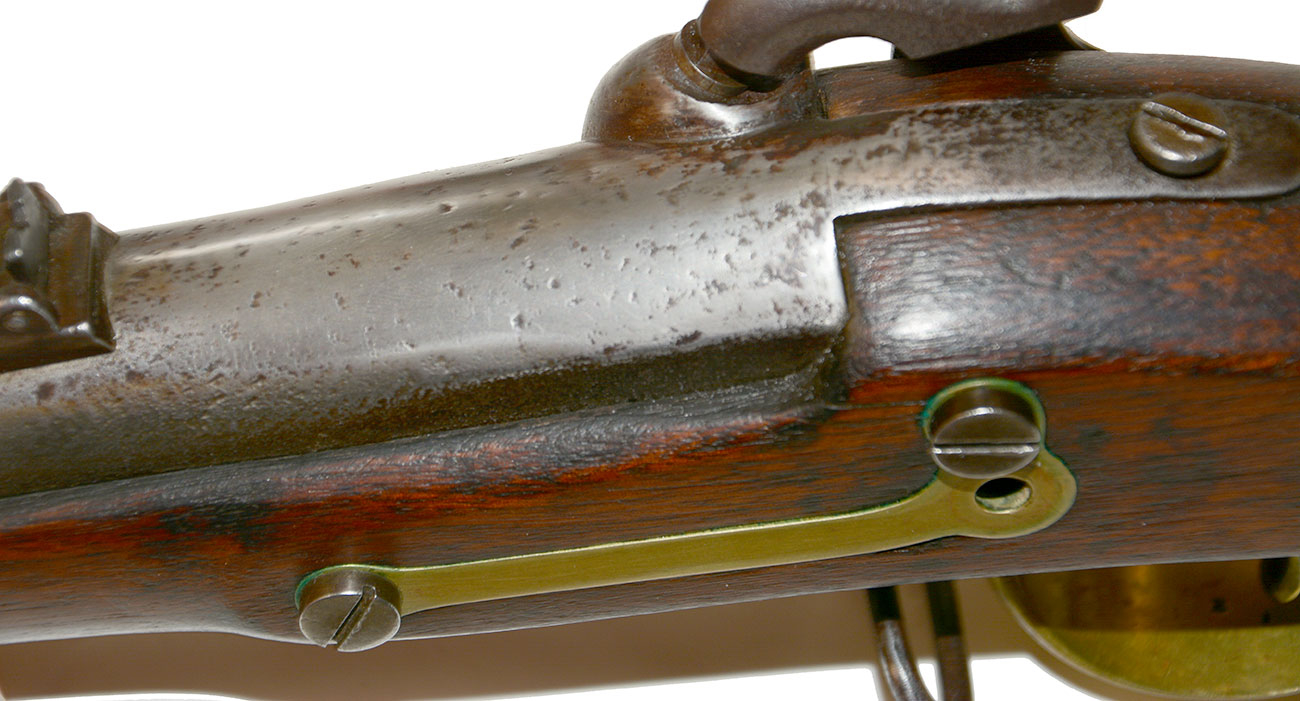
This is clearly marked at rear of the lockplate “SPRING/FIELD/1853” and forward of the hammer with a Springfield style eagle over “U.S.,” with just a little rubbing across the eagle. Five hundred cavalry musketoons were fabricated at Springfield that year, all in the last quarter, with some bearing that date perhaps spilling over into the 1,498 counted as 1854 production, all during the first six months of the year, which was the end of the production run. These guns were .69 caliber smoothbore, mounted with brass buttplate, sideplate, trigger plate, trigger guard and two barrel bands- the top band double-strapped and carrying a front sight. They were fitted with swivel ramrods and with an iron sidebar with floating ring for use with attachment by a sling swivel with snap hook to a cross-shoulder carbine sling, the bar anchored by a nut in the L-shaped brass sideplate and by a screw through a split lug left of the lower barrel band.
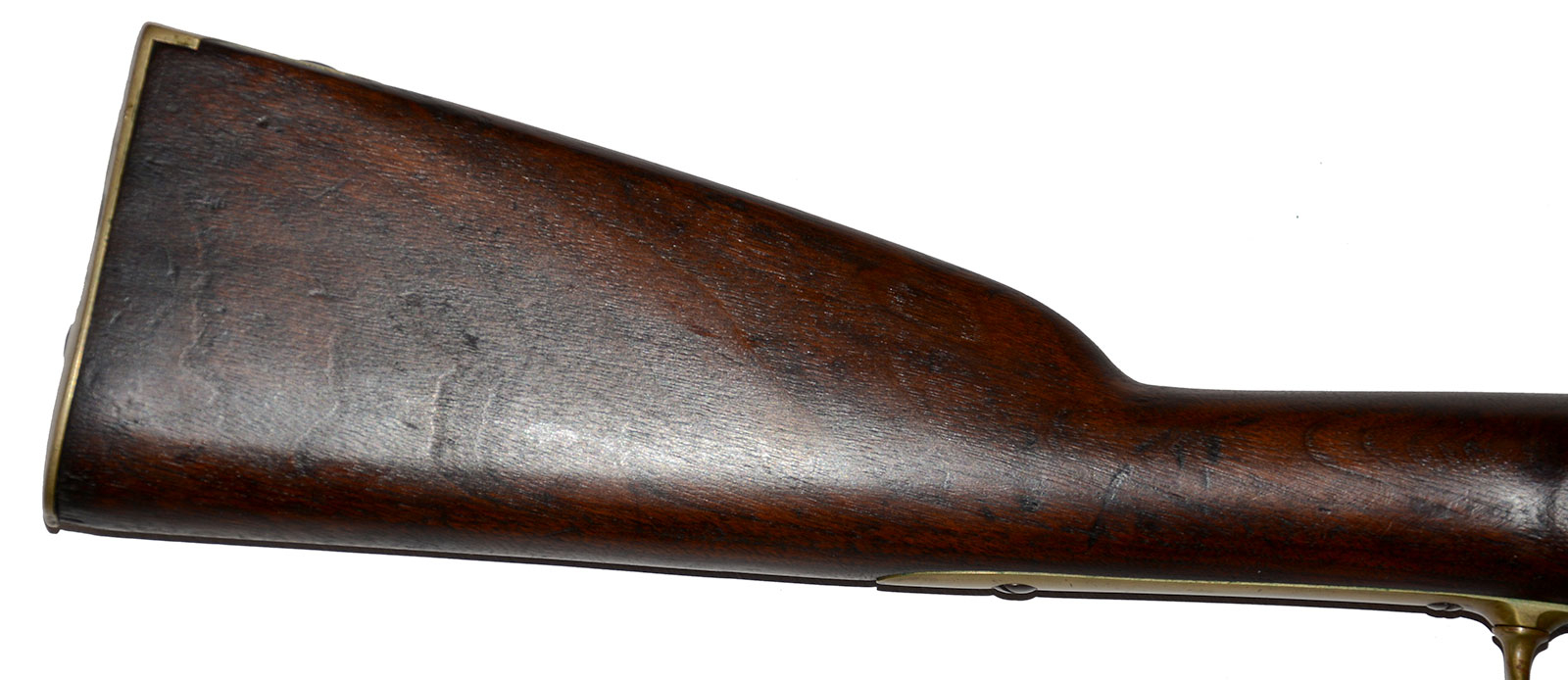
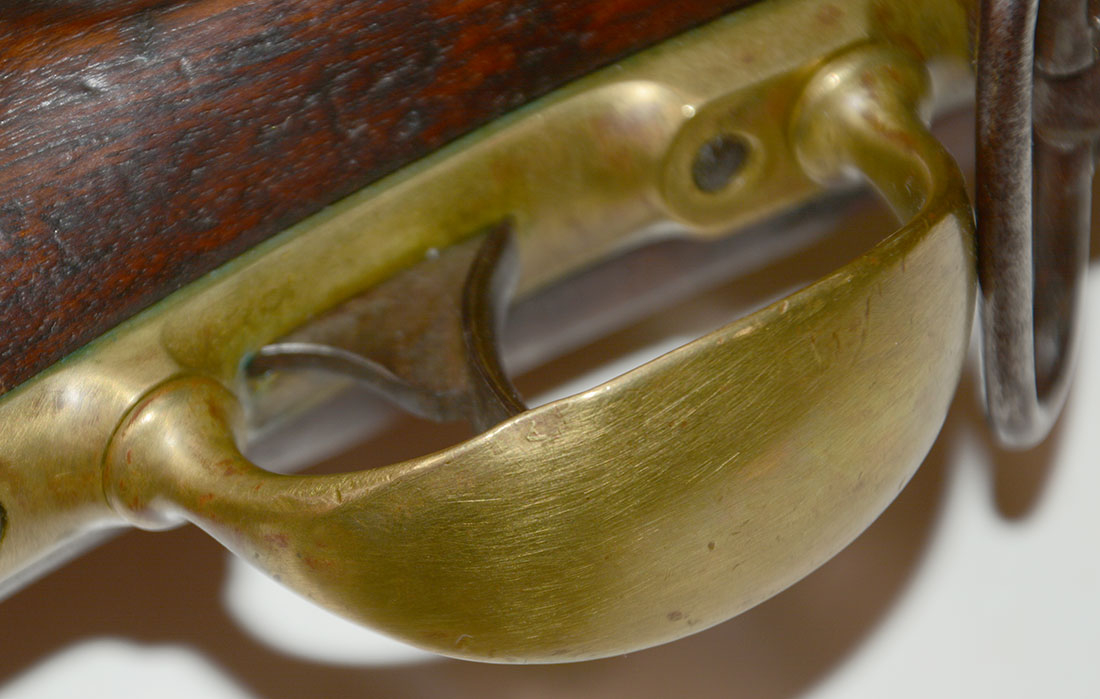
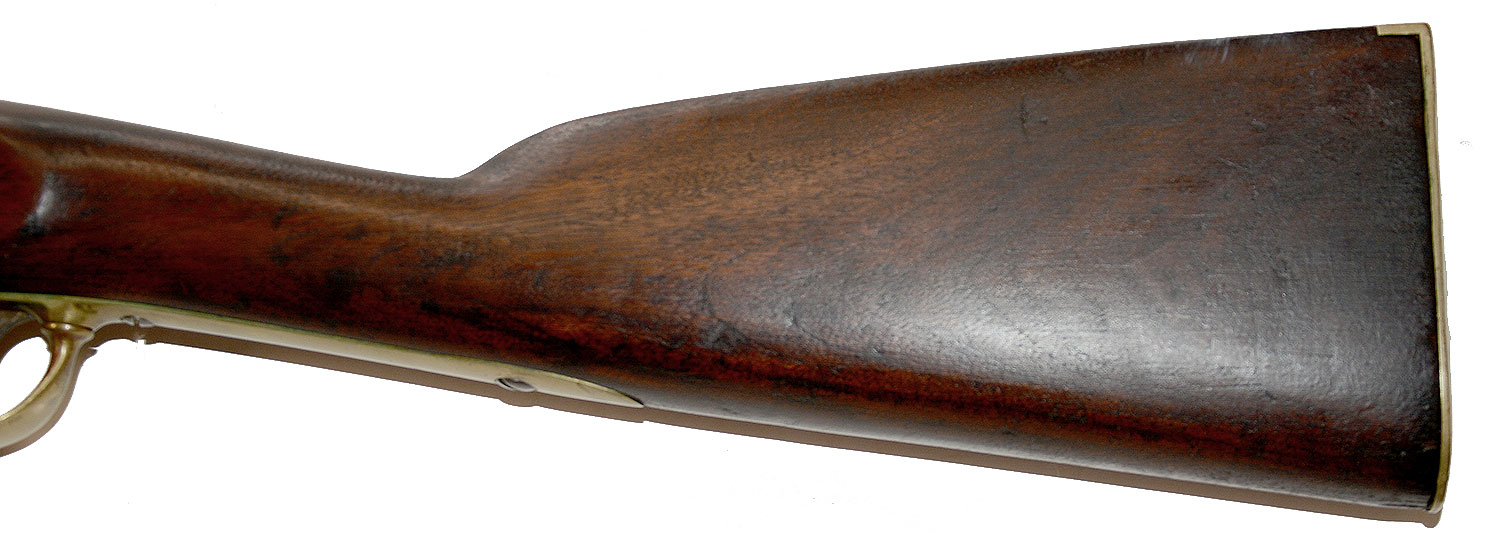
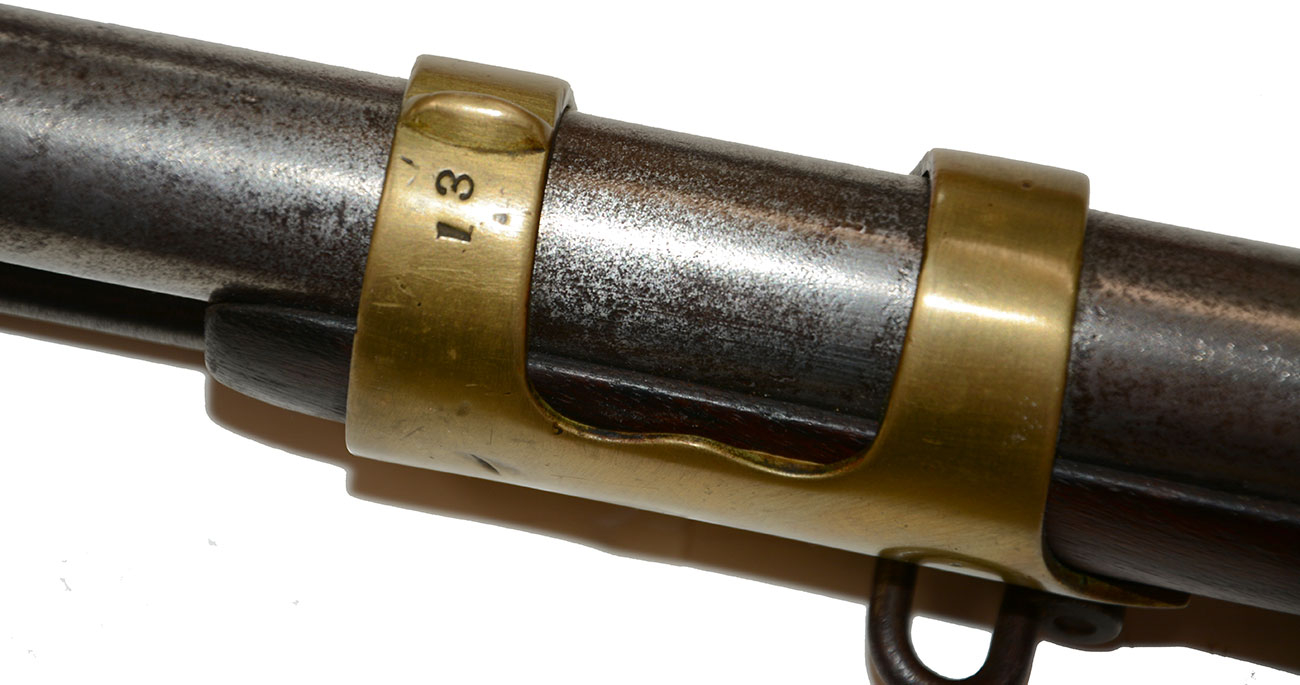
The wood on this is very good, showing a deep brown tone, with good surface. The fit to the metal is generally good, with a very small chip at the bottom rear of the sideplate, some slight rounding to edges from handling, and some wear the ramrod channel with a little chipping at top just below the upper band. The brass mounts are good, with a medium bright tone. The lugs on the left of the lower band were cleanly removed without a trace when the sidebar was taken off. The hole in the sideplate for the base of the sidebar, just below the rear lock screw is open, though these were apparently closed by simply using another screw. The bayonet stud is in place, as are the conventional sling swivels added to the forward triggerguard tang and rear underside of the upper band. The barrel shows as smooth metal and silver gray from the muzzle to about half way between the lower band and breech, where scattered dark shallow pitting becomes more concentrated next to the nipple and along the breechplug tang, eliminating any barrel proofs and date.
Records indicate that 630 cavalry musketoons, along with 228 sappers and miners musketoons, were altered to the artillery configuration by the government from January 1858 to March 1859. This was done largely because of complaints about the cavalry pattern from mounted troops and the potential for supplying the artillery version to states under the militia act for use as cadet muskets since stocks of the M1841 and M1851 cadet muskets had been depleted. By June 30, 1860, the states had received 181 Cavalry musketoons, 485 Sappers and Miners, and 2,183 Artillery musketoons, which seem to have included those altered musketoons.
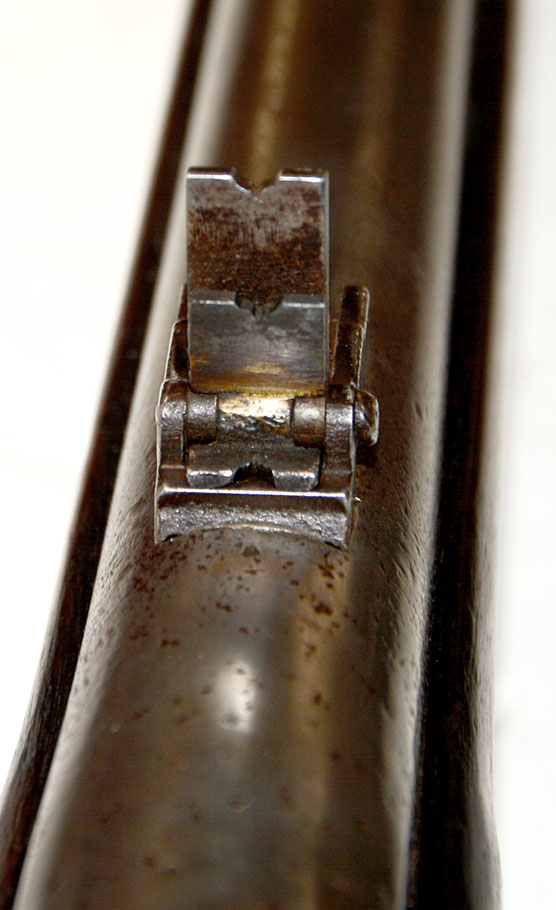
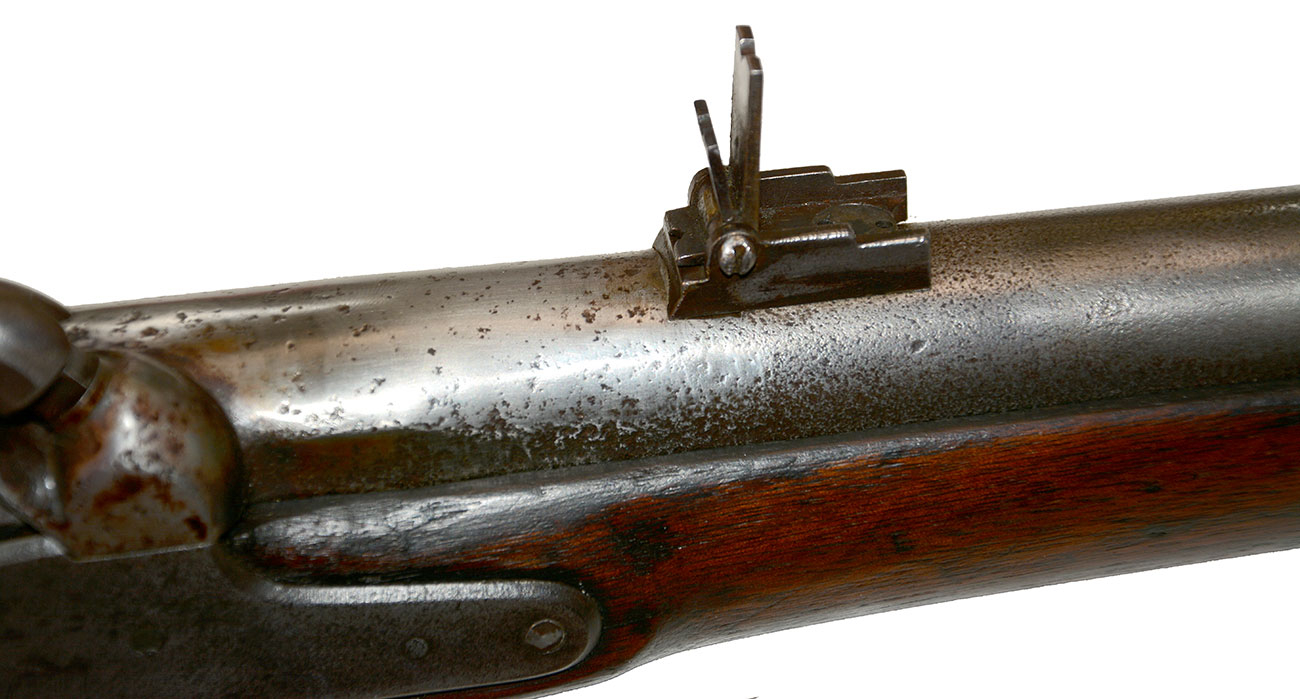
In addition to the conversion to the artillery configuration, this musketoon had an 1858 pattern rear sight installed. It is thus tempting to see this as one of just 340 musketoons, apparently all cavalry, that were rifled and sighted at Springfield in 1859. Remarkably, however, the bore shows no indication of rifling. Flayderman clearly recognizes this variation, noting in his summary of cavalry musketoons that, “Some specimens will be found rifled, and/or with two leaf rear sight of musket type.” [Our emphasis.]
It seems unlikely that Springfield would have only installed the sight. In elaborating on his two broad variations of the altered cavalry musketoon, smoothbore and rifled and sighted, Moller allows that, “Other variations of the cavalry musketoon altered to the artillery configuration exist. It is not known whether the features they contain that vary are armory products, or whether these features were the result of alterations to the musketoon subsequent to issue, perhaps by state authority.” (Moller, 2.229) There are also other possibilities. In addition to some small scale, local alteration by a militia unit, adding a rear sight but foregoing the additional expense of actually rifling the barrel, could well have a cost-saving, if not deceitful motive in the commercial market, and we know some of these guns were sold off in 1860 by St. Louis Arsenal, for instance, with numbers going to dealer A. Hitchcock of New York at the same time Delaware Kemper of Virginia purchased 30, likely for cadets, but which may have ended up with his Alexandria Light Artillery when the war started.
In any case, while U.S. cavalry had moved on to different arms by the beginning of the Civil War, many musketoons were still in state arsenals when the war started and were issued to various state troops. Michigan issued musketoons to one of its infantry companies and four of its artillery companies. In other Union hands the guns saw service in the west and southwest. McAulay notes that as of December 1862 nearly one thousand of the smoothbore M1847 cavalry musketoons were in field service with Union cavalry- carried. by several Missouri State Militia units, the 5th Kansas, 1st Texas (US,) and 1st New Mexico. Among Confederate states, Virginia had issued 625 to various militia units in 1860, and had still had 201 of various configurations in arsenal racks.
Further examination may shed light on its history and that of this pattern- we note for instance that the tumbler seems only to have full and half-cock notches, despite the fact that a safety position close to nipple to prevent the percussion cap coming off, had been used on some musketoons at Springfield as early as mid-1851. The barrel also seems to be dead-on 26-inches rather than the 26-1/16 inches specified for the cavalry configuration. It has also been suggested that the corrosion next to the nipple might be due to the high-pressure British percussion caps imported by the Confederacy. We have mentioned requests for musketoon ammunition for Wheeler’s and Forrest’s cavalry above, and the notion that although carried by cavalry, the musketoons themselves were likely, but not necessarily of cavalry configuration. We conclude with the 1862 Confederate entry for musketoons in the manual intended for officers on ordnance duty, which does not specify the configuration: “Musketoon - The musketoon is a short musket, having barrel 26 inches in length and calibre .69 inches. This is an old model, and was formerly issued to the cavalry and artillery in the U.S. service. Some are now used by the C.S. cavalry.” Whatever its specific history, this is an interesting gun. See Moller Vol. 2, Flayderman’s comments, and McAulay (CW Carbines Volume II, and Carbines of the U.S. Cavalry) for details. [SR] [ph:L]
DISCLAIMER: All firearms are sold as collector's items only - we do not accept responsibility as to the shooting safety or reliability of any antique firearm. All firearms are described as accurately as possible, given the restraints of a catalog listing length. We want satisfied customers & often "under" describe the weapons. Any city or state regulations regarding owning antique firearms are the responsibility of the purchaser. All firearms are "mechanically perfect" unless noted, but again, are NOT warranted as safe to fire!
~~~~~~~~~~~~~~~~~~~~~~~~~~~~~~~~~~~
THIS ITEM, AS WITH ALL OTHER ITEMS AVAILABLE ON OUR WEB SITE,
MAY BE PURCHASED THROUGH OUR LAYAWAY PROGRAM.
CLICK HERE FOR OUR POLICIES AND TERMS.
THANK YOU!
Inquire About SCARCE SPRINGFIELD M1847 CAVALRY MUSKETOON ALTERED TO ARTILLERY CONFIGURATION, WITH 1858 REAR SIGHT, BUT SMOOTHBORE
Most Popular
Historical Firearms Stolen From The National Civil War Museum In Harrisburg, Pa »
Theft From Gravesite Of Gen. John Reynolds »
Selection Of Unframed Prints By Don Troiani »
Fine Condition Brass Infantry Bugle Insignia »
featured item
SILVERED PRESENTATION FIFE TO MARTIN MURPHY, 4th NEW YORK VOLUNTEERS, 17th NY VETERAN ZOUAVES, AND REGULAR ARMY
This elegant silvered fife, 15-1/4” long, bears a great presentation and was carried by a company musician with Civil War service in two New York regiments, one of them a zouave regiment, and substantial service in the regular army. He seems to… (1268-167). Learn More »
site search