

site search
online catalog
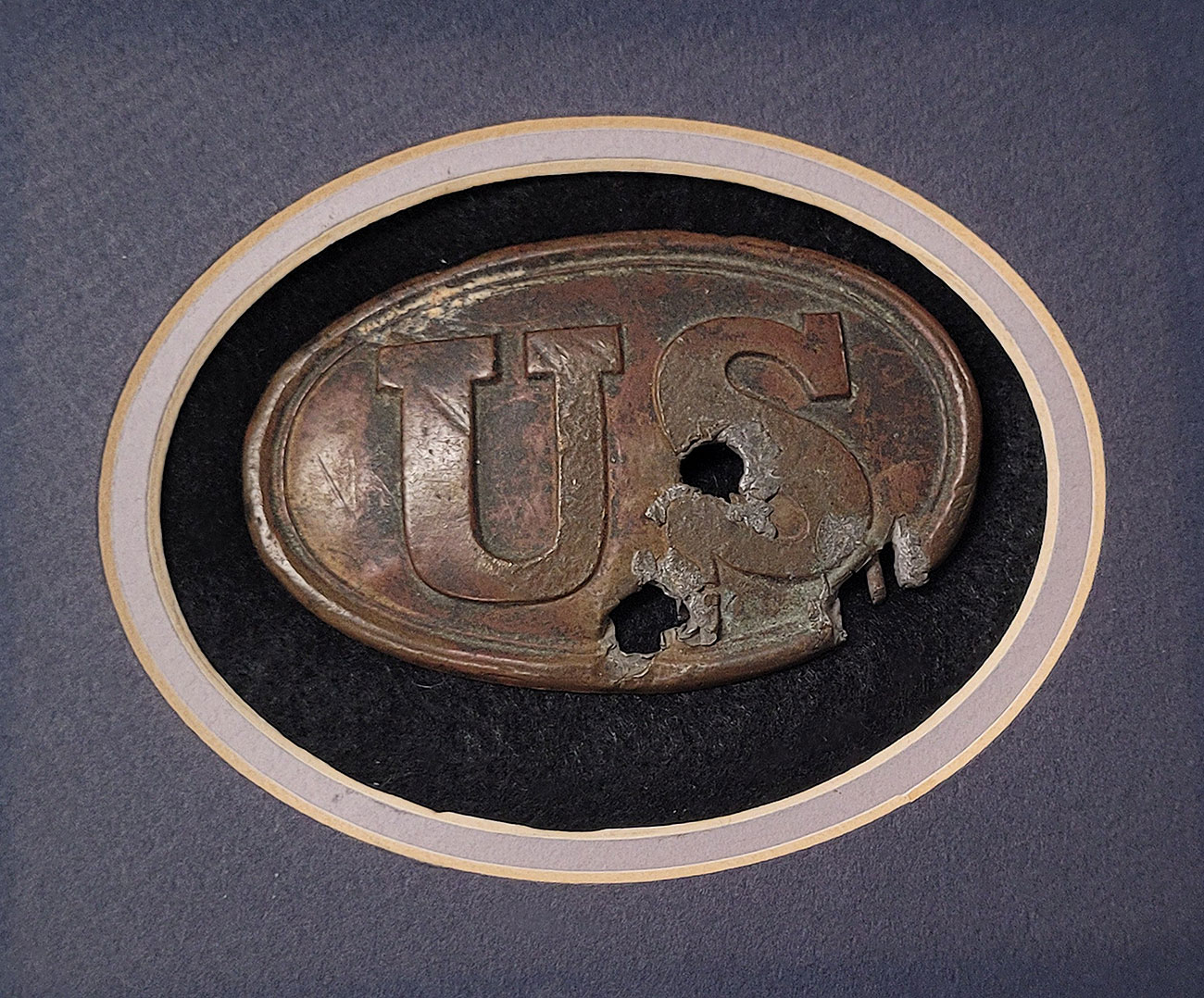
GETTYSBURG RECOVERED BULLET-STRUCK CARTRIDGE BOX PLATE
Hover to zoom
$2,950.00 SOLD
Quantity Available: None
Item Code: 1125-03
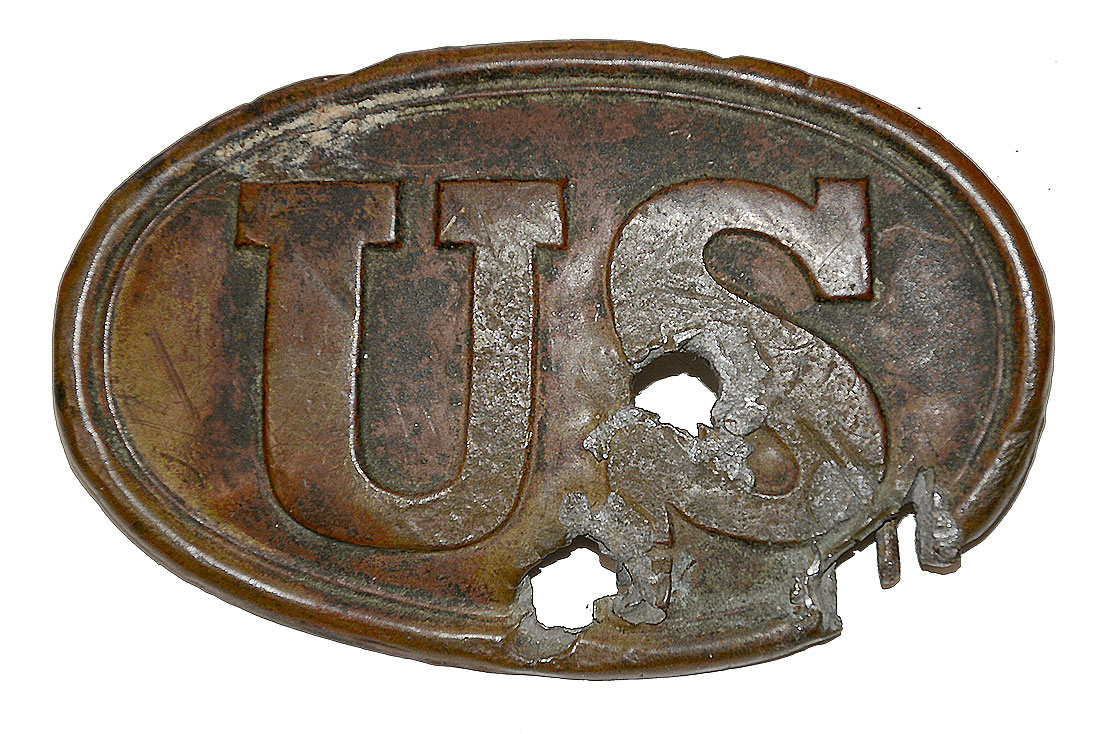
This U.S. cartridge box plate was recovered at Gettysburg and shows two holes piercing it at center right and lower center, just above the rim, along with a chip missing from the rim at lower right likely knocked off by a third ball. The holes are the size of the buckshot used in the .69 caliber “buck-and-ball” cartridges which had a .69 caliber round ball with buckshot held in place on top of it by the cartridge paper and string tie, and indicates some close fighting.
These rounds were used in the .69 caliber smooth-bore percussion muskets, which had shorter range than their rifled brethren, but could be devastating at close range with the chances of hitting something, and disabling if not killing it, increased by the inclusion of the buckshot. Few Union troops were carrying those weapons at Gettysburg and the fact that this round was obviously aimed at U.S. target clearly points to Confederate use. See Dean Thomas’s “Ready.. Aim… Fire! Small Arms Ammunition in the Battle of Gettysburg” for several examples of these rounds recovered at spots on the battlefield associated with specific Confederate units. In particular see page 44, where he illustrates an excavated .69 ball, a complete set of .69 buck and ball, a non-excavated Richmond Laboratory .69 buck and ball cartridge, and the wrapper for a pack of ten of those cartridges from the Richmond Arsenal. These are illustrated in connection with Heth’s Division, of Hill’s Corps, which opened the fighting on July 1, and also took part in Pickett’s Charge.
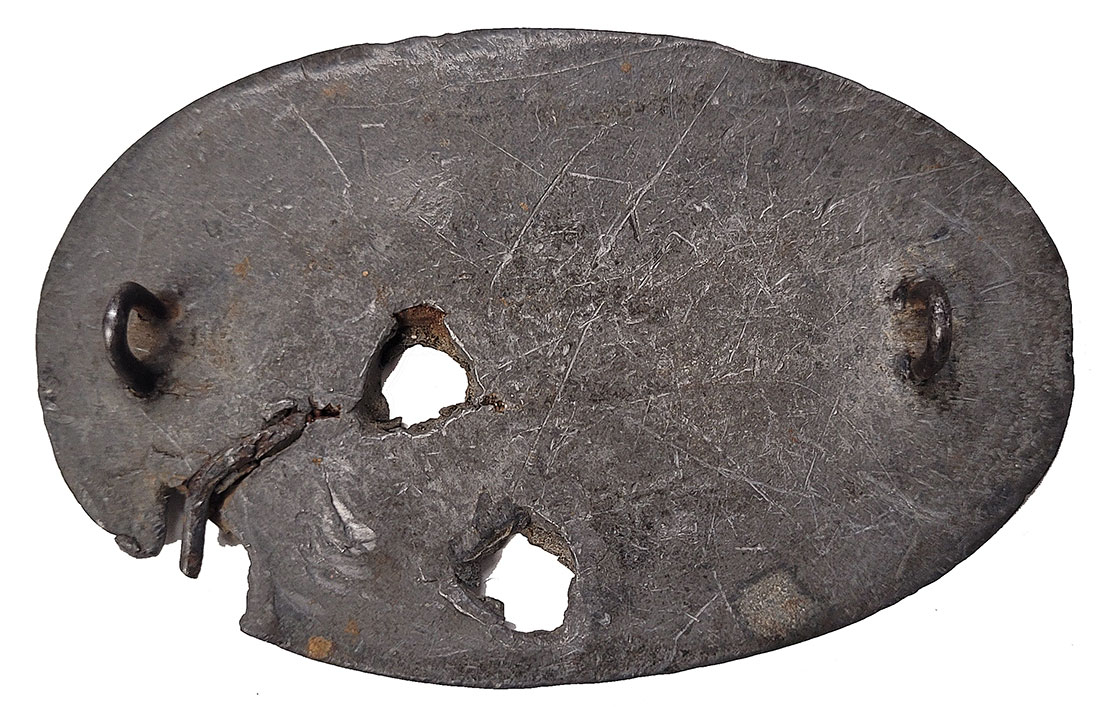
The M1839 cartridge box plate was used by Union infantry throughout the war both as an ornamental badge on the cartridge box flap and a practical way to it hold down if left unlatched in the heat of combat. The die-struck, rolled brass face of the plate has a pleasing patina showing some muted bronze tones mixed with some darker areas and a little white corrosion at upper left, indicating it may be an early battlefield pick-up, as do the fairly well preserved loops on the back. The reverse preserves a level surface to the lead solder fill, which shows gray with some lighter colored scratches except, of course, where the buckshot punched through, again indicating some close fighting, and both iron wire loops, used to hold it on the cartridge box flap by a leather thong, are still in place.
This is a great example of a struck plate actually worn and damaged by enemy shot in the most famous battle of the war, the holes indicating the severity of the fire and the real danger in which in the combatants found themselves. Battlefield relics don’t get much better or more telling than this. [sr][ph:L]
~~~~~~~~~~~~~~~~~~~~~~~~~~~~~~~~~~~
THIS ITEM, AS WITH ALL OTHER ITEMS AVAILABLE ON OUR WEB SITE,
MAY BE PURCHASED THROUGH OUR LAYAWAY PROGRAM.
CLICK HERE FOR OUR POLICIES AND TERMS.
THANK YOU!
Inquire About GETTYSBURG RECOVERED BULLET-STRUCK CARTRIDGE BOX PLATE
Most Popular
Historical Firearms Stolen From The National Civil War Museum In Harrisburg, Pa »
Theft From Gravesite Of Gen. John Reynolds »
Selection Of Unframed Prints By Don Troiani »
Fine Condition Brass Infantry Bugle Insignia »
featured item
NON-REGULATION SILVER GRIPPED PRESENTATION SWORD BY SCHUYLER, HARTLEY & GRAHAM - LT. JAMES MOFFAT, 16TH NEW YORK CAVALRY
This presentation sword has very impressive deeply cast and chased mounts and silver gripped hilt. Schuyler, Hartley and Graham assembled and sold a wide variety of swords that were often highly embellished and upgraded from regulation patterns, to… (870-653). Learn More »
site search