


site search
online catalog
TIPTON STEREO VIEW OF EAST CEMETERY HILL AT GETTYSBURG
Hover to zoom
$65.00
Quantity Available: 1
Item Code: 2026-1907
Shipping: Determined by Method & Location of buyer
To Order:
Call 717-334-0347,
Fax 717-334-5016, or E-mail
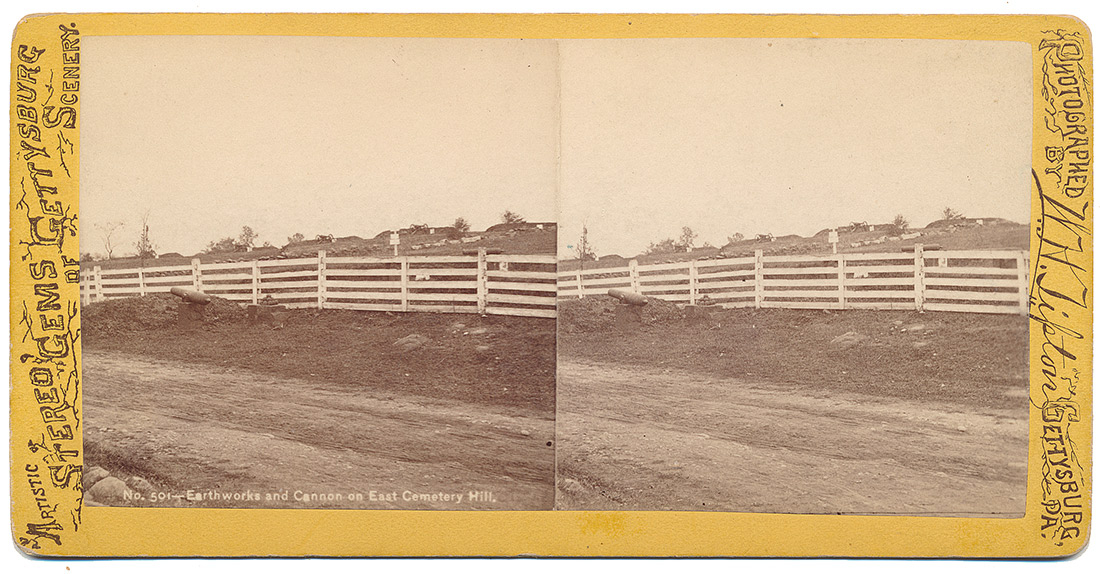
This is a stereo view (stereograph) made from two nearly identical photographs taken from slightly different angles and mounted side by side. Seen through a stereoscope, they merge into one three-dimensional image. This card is in good condition overall, with good yellow color on the mount.
The mount is mustard-yellow, printed in brown with the rustic “twig” or branch-style lettering popular in the late Victorian era. The left side reads “Artistic Stereo Gems of Gettysburg Scenery.” The right edge reads “Photographed by W. H. Tipton, Gettysburg, PA.” The caption printed at the bottom of the left image reads “No. 501 — Earthworks and Cannon on East Cemetery Hill.”
The photograph shows Baltimore Pike in the foreground, with a bare, sloping earthen bank rising behind it. A cannon tube mounted on cut stone and a stack of cannon balls is seen on the ground at the left, near the crest of the bank. Behind it runs a long white board fence. Beyond the fence, the ground rises to a low crest where the mounded artillery lunettes (crescent-shaped earthen gun emplacements) are visible. More cannon sit within them, along with a small white marker sign, a scatter of rocks, and a few sparse young trees against the sky.
The photographer was William H. Tipton (1850–1929) one of the most prolific of Gettysburg’s commercial photographers. As a teenager he apprenticed with the Tyson Brothers, whose studio photographed the battlefield in the weeks after the fighting in July 1863. He later took over the business, first as part of Tipton & Myers and then under his own name. For decades he documented the battlefield, its monuments, veterans’ reunions, and the growing tourist trade, producing thousands of numbered views like this one. His images are now among the most important visual records of how the field looked as it was being turned into a memorial park. Tipton was also a local businessman and booster, he ran “Tipton Park,” a pavilion and photo stand near Devil’s Den served by a trolley line.
East Cemetery Hill was one of the key positions of the Union line at Gettysburg. After the Union retreat through town on July 1, 1863, artillery batteries dug in on the hill. On the evening of July 2, Confederate General Jubal Early sent Hays’ Louisiana brigade (the “Louisiana Tigers”) and Avery’s North Carolina brigade up the slope in the twilight. They broke through the Union infantry at the base of the hill and reached the guns. Fierce hand-to-hand fighting followed among the cannon, with artillerists swinging rammers and handspikes. The attackers were eventually driven back. The lunettes on East Cemetery Hill survive today within Gettysburg National Military Park. [jet][ph:L]
~~~~~~~~~~~~~~~~~~~~~~~~~~~~~~~~~~~
THIS ITEM, AS WITH ALL OTHER ITEMS AVAILABLE ON OUR WEB SITE,
MAY BE PURCHASED THROUGH OUR LAYAWAY PROGRAM.
CLICK HERE FOR OUR POLICIES AND TERMS.
THANK YOU!
Inquire About TIPTON STEREO VIEW OF EAST CEMETERY HILL AT GETTYSBURG
Most Popular
Historical Firearms Stolen From The National Civil War Museum In Harrisburg, Pa »
Theft From Gravesite Of Gen. John Reynolds »
Selection Of Unframed Prints By Don Troiani »
Fine Condition Brass Infantry Bugle Insignia »
Rare Identified 65Th Ny Sergeant’s Jacket, With Manscript Material: 1St U.s. Chasseurs »
featured item
CONFEDERATE GENERAL LUNSFORD LINDSAY LOMAX AS A U.S. CAVALRY SECOND LIEUTENANT
Formerly in the collection of Virginia collector and dealer Bill Turner this sixth plate ambrotype shows Confederate General Lunsford Lindsay Lomax as a Second Lieutenant in the U.S. Army, sometime between 1856 and 1861. Lomax was born in Rhode… (1138-1830). Learn More »
site search