
site search
online catalog
WONDERFUL ID’D TYLER TEXAS P.O.W. CARVED POWDER HORN: LADY LIBERTY, COLUMBIA, US EAGLE, AND THE ESCAPING OWNER AND COMRADE CHASED BY HOUNDS!
Hover to zoom
$5,500.00 ON HOLD
Quantity Available: 1
Item Code: 2026-473
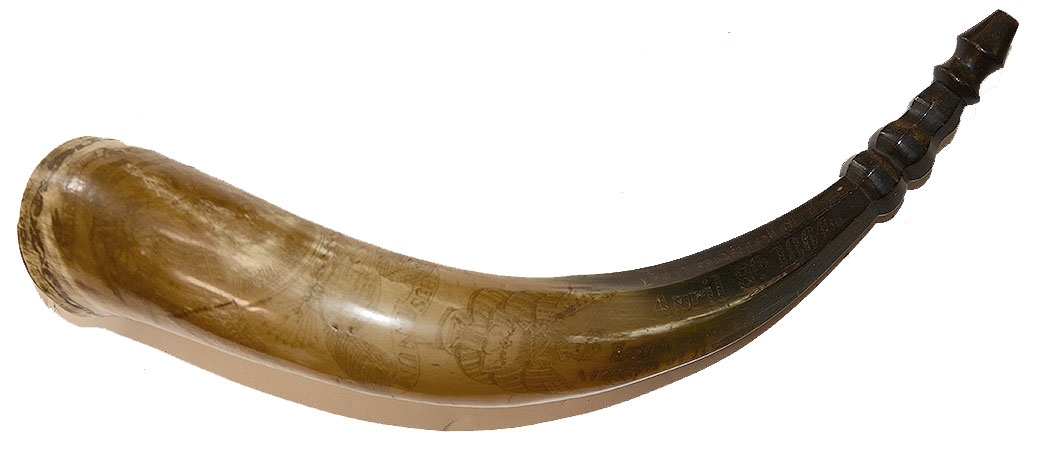
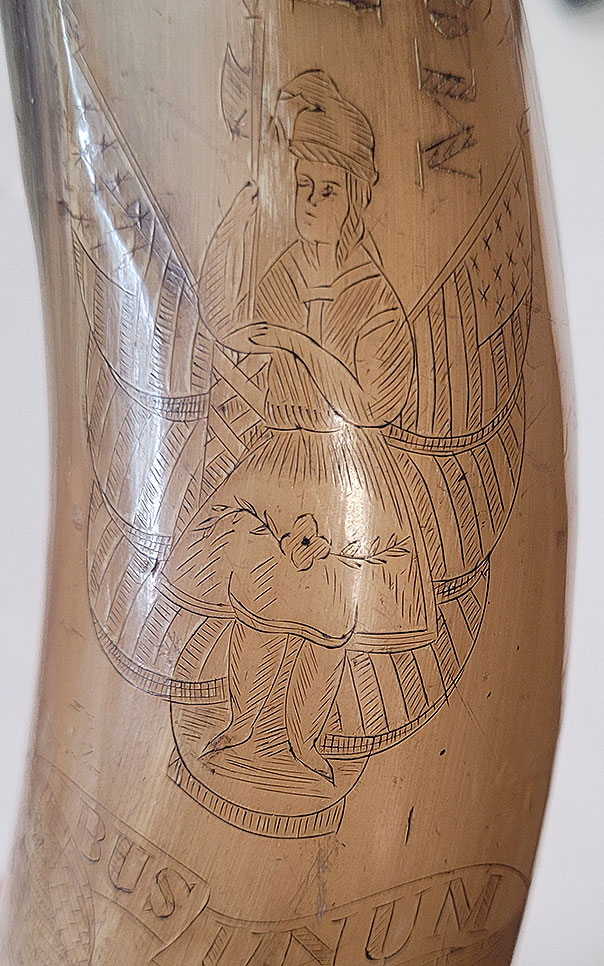
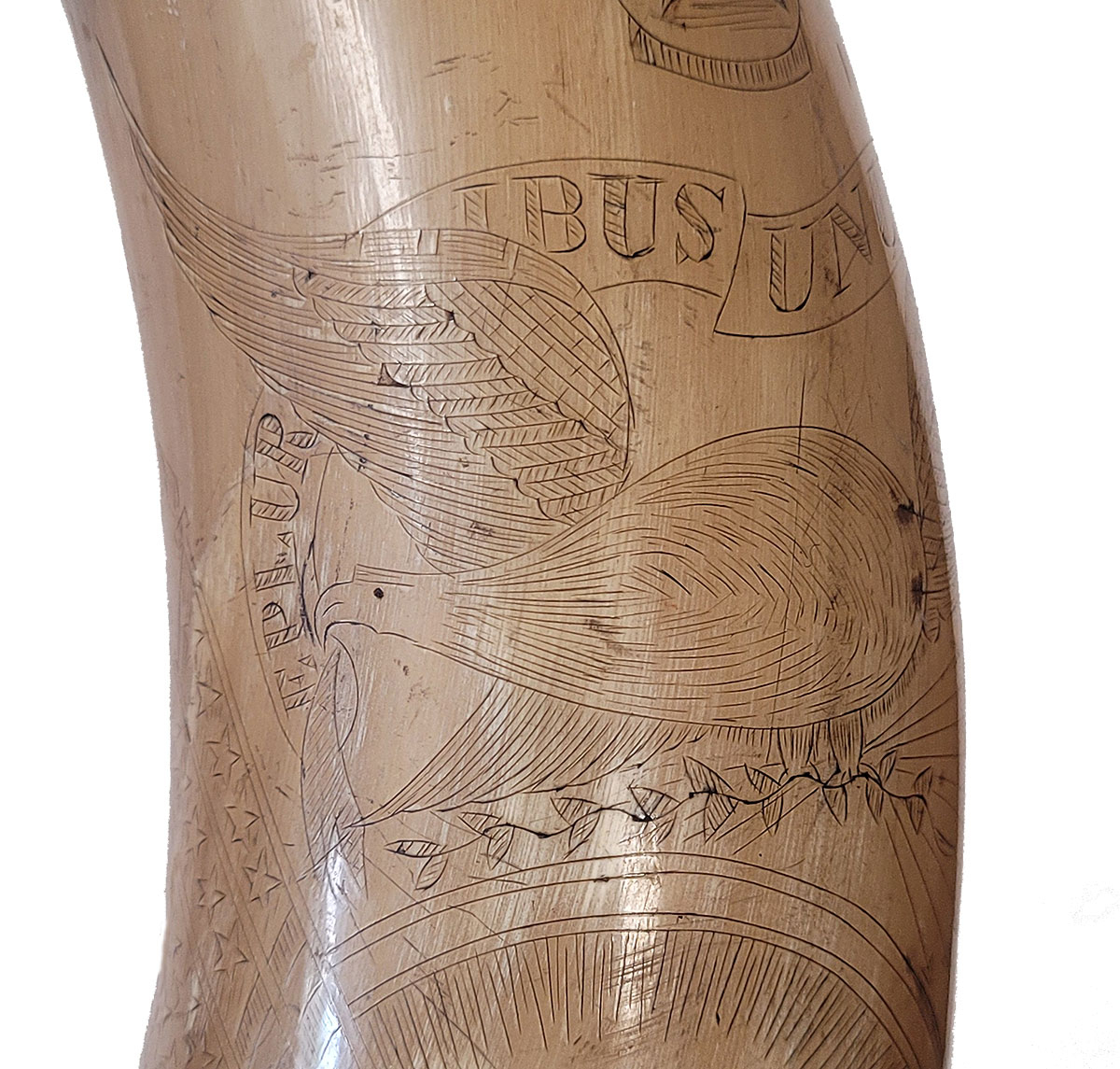
This is an eye-catching, very well crafted powderhorn made for a member of the Chicago Mercantile Battery while incarcerated at Camp Ford, the Confederate prison camp at Tyler, Texas, inscribed and decorated with a very folky Lady Liberty, Columbia, an eagle representing the Arms of the U.S., and a very unusual portrayal of the ultimately unsuccessful escape of the horn’s owner and a comrade, who are shown trying to out run pursuing hounds and a pistol-wielding Confederate on horseback.
Union prisoners of war confined at Camp Ford, like all such inmates, had a lot of time on their hands. They were an ingenious lot and in addition to occasional escape attempts, in the recollection of an officer confined there, “an amazing number of industrial activities were undertaken by the inmates. From implements consisting of a few axes, a saw, and some jackknives, the prisoners turned out not only manufactured goods but even crude machinery. A wood-turning lathe that used forged knife blades for chisels and a center bit was contrived. Footboards and hand wheels were added and the machine turned out satisfactory furniture legs, chess men, and goblets.” It was certainly that lathe that turned the wood base plug and spout of this powderhorn, created by a talented but as yet unidentified craftsman and carver, using a horn taken from cattle slaughtered for beef for the prison population. A few other horns by his hand are known. We handled one made for an officer of the 77th Ohio not long ago. But, we are not aware of any study made of the group.
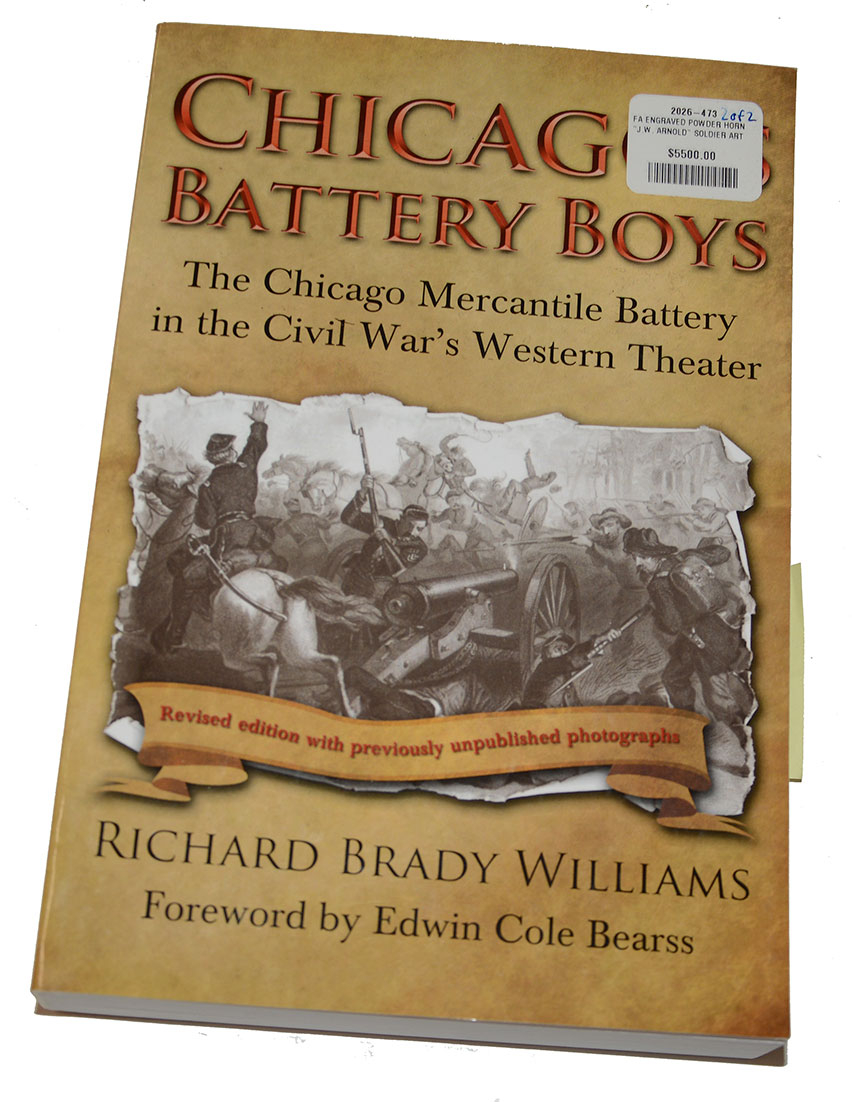
Other objects made by the prisoners were likely traded to guards or local civilians for food and supplies. Something adorned with glaringly patriotic and obvious Union sentiments, was certainly destined for another prisoner. A powderhorn might seem an unlikely product for prisoner of war. Indeed, the author of a recent history of the Chicago Mercantile Battery, in which this horn is illustrated, thinks it was used to carry smoking tobacco. But, powderhorns as souvenirs of military service likely had a strong appeal to soldiers who might remember horns hanging on the wall at home carried by ancestors in the Revolution and French and Indian War.
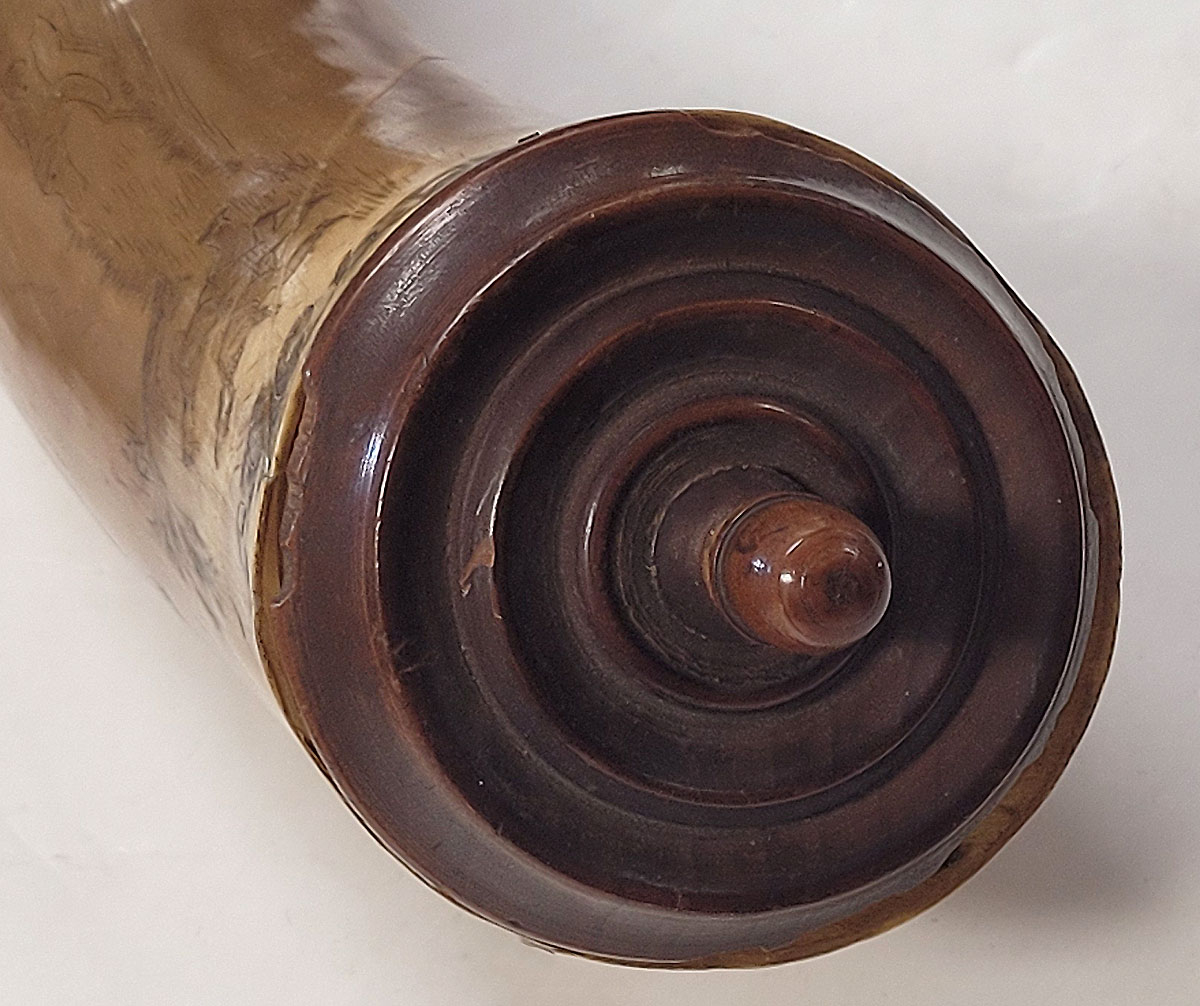
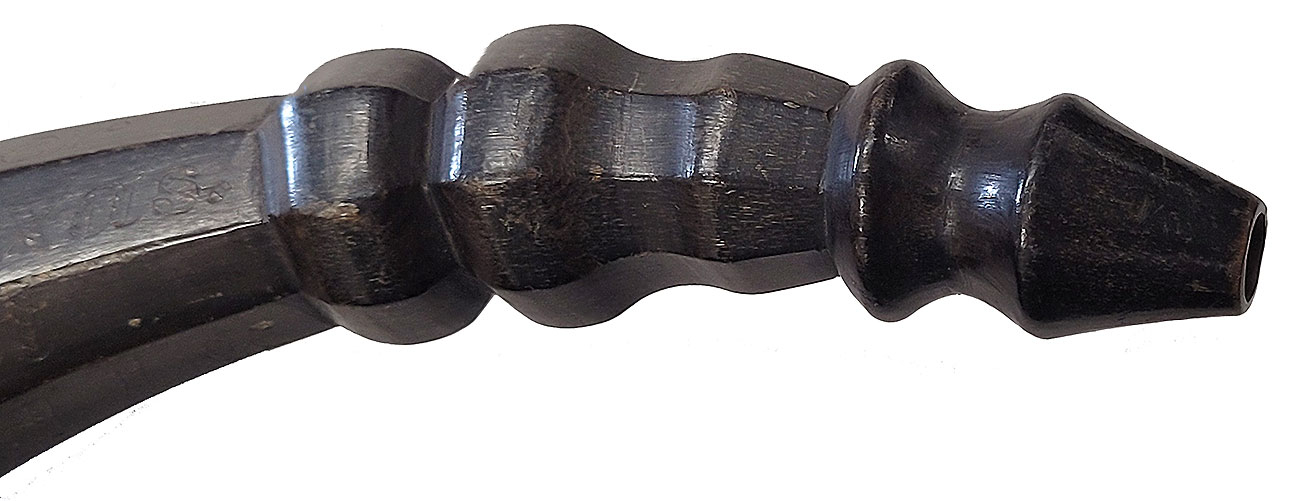
The measures 15-inches overall. It fitted at the bottom with a convex wood base plug with deeply turned grooves and raised ridges with a central, narrow raised knob for attachment of a cord. The horn is cream colored, but shading toward and olive brown toward the tip, last few inches of which are flattened into eight facets, ending with a wood tip turned with faceted rings and grooves and a narrow spout. The base plug shows as a medium brown. The tip is closer to a black. There are some minor chips to the base plug, a missing pin or two and a couple of hairlines to the horn, but no missing pieces or wide cracks, and the horn is stable. Please see our photos.
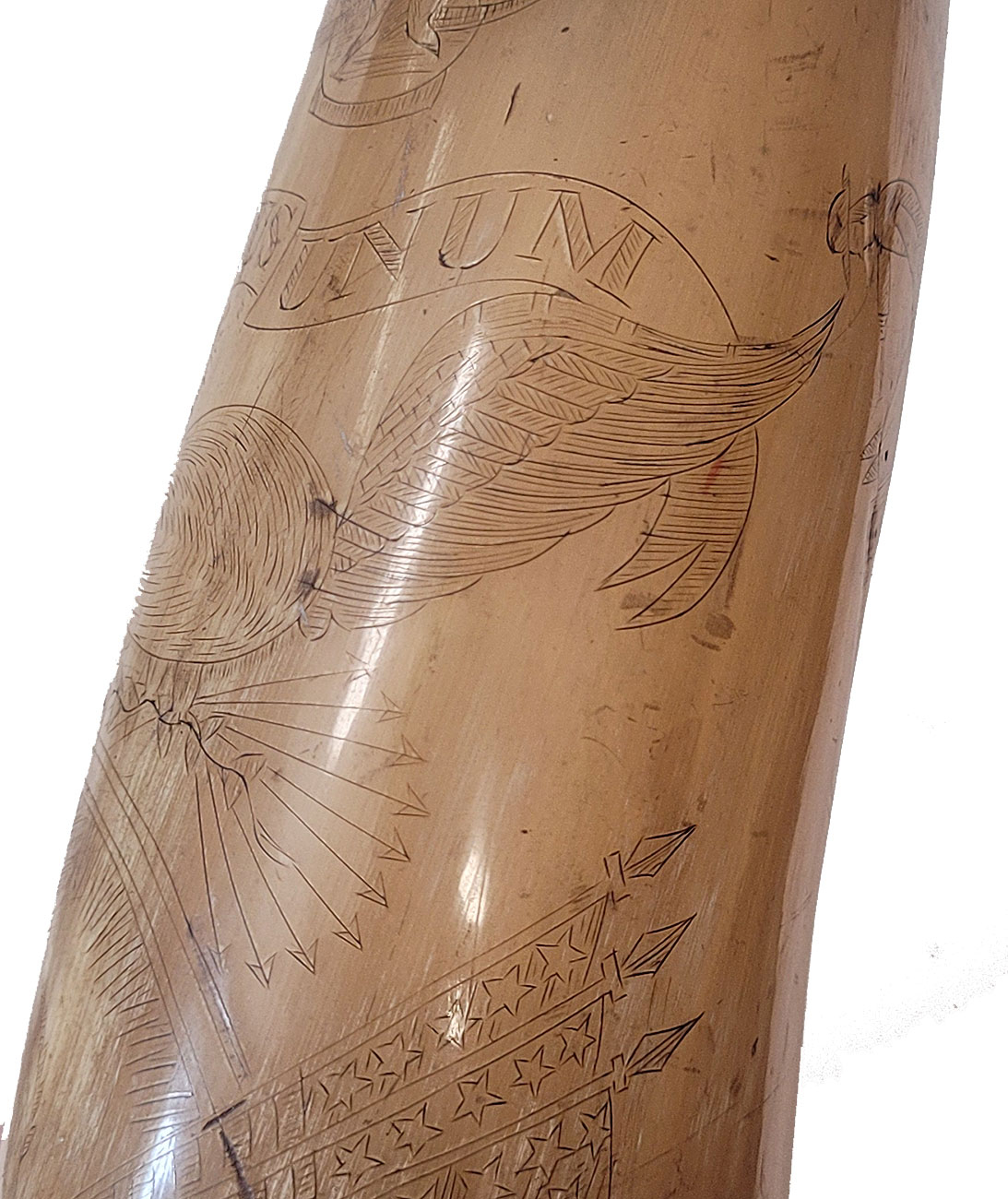
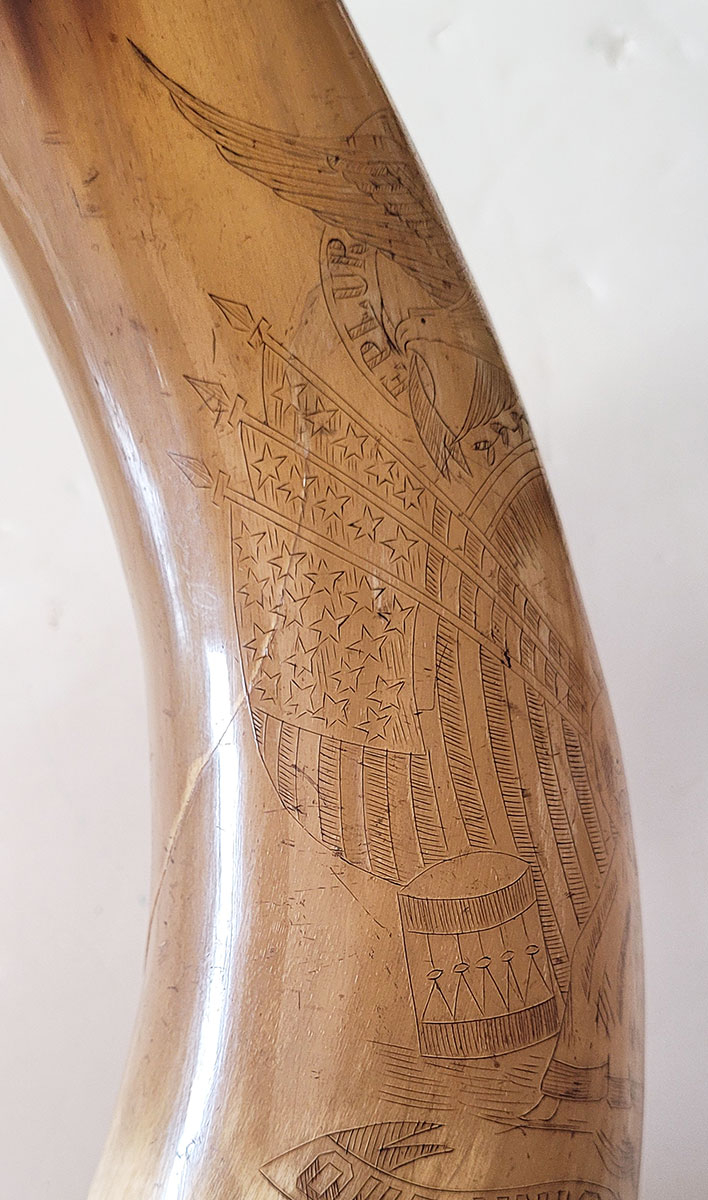
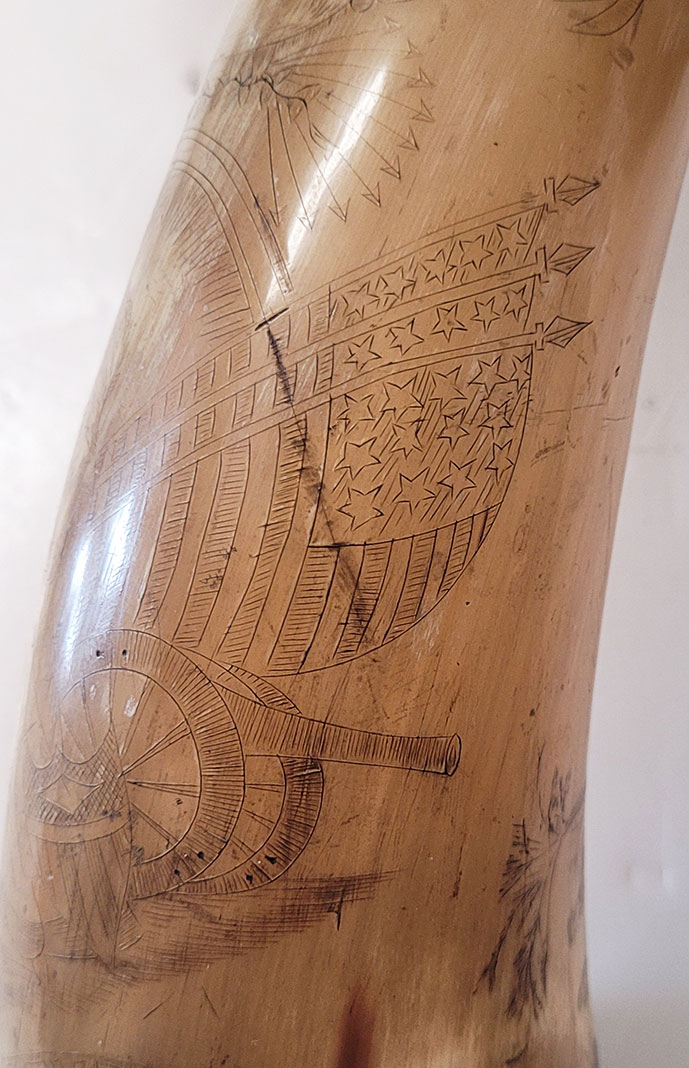
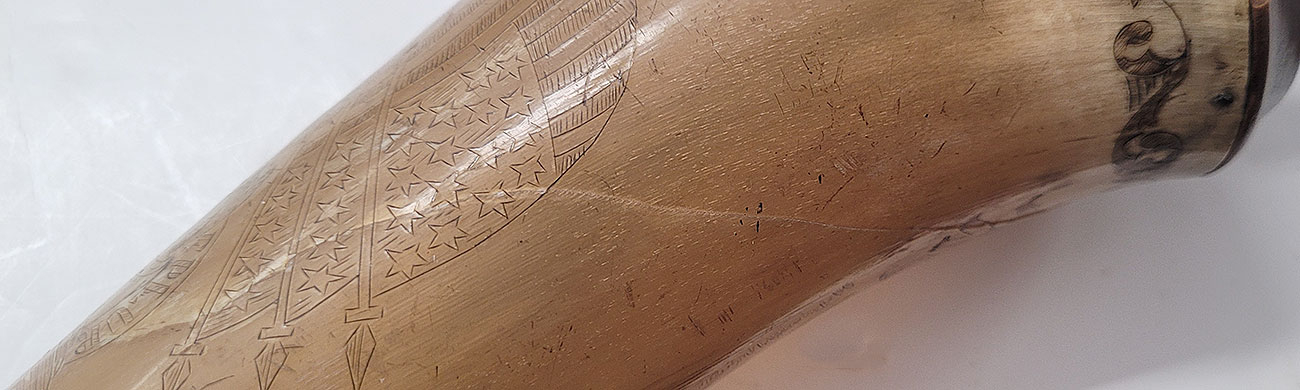
We don’t have much to compare it with, but it looks very much like the carver made this at the height of his powers. He decorated the external curve of the horn with three elaborate figures. When held upright, the top figure is a suitably modern Lady Liberty, clothed in bloomers, her short skirt decorated with a rosette and leafy vine in front, but wearing a traditional Liberty Cap with tassel and holding a halberd in her right hand. She is turned slightly to the viewer’s left, and has two crossed stars-and-stripes United States flags behind her, with their billowing folds extending down on either side. Below her the artist place a dynamic, if folky, version of the Arms of the U.S. with the eagle flying across the horn to the left, stretching its wings out ahead of it, and the artist showing some difficulty with perspective, creating a slightly pot-bellied bird, but with an E PLURIBUS UNUM scroll held in its beak, flowing upward and then trailing above and behind it, effectively a base for Lady Liberty, with the eagle clutching a long leafy (olive) branch in one claw, and a cluster of ten arrows in the other.
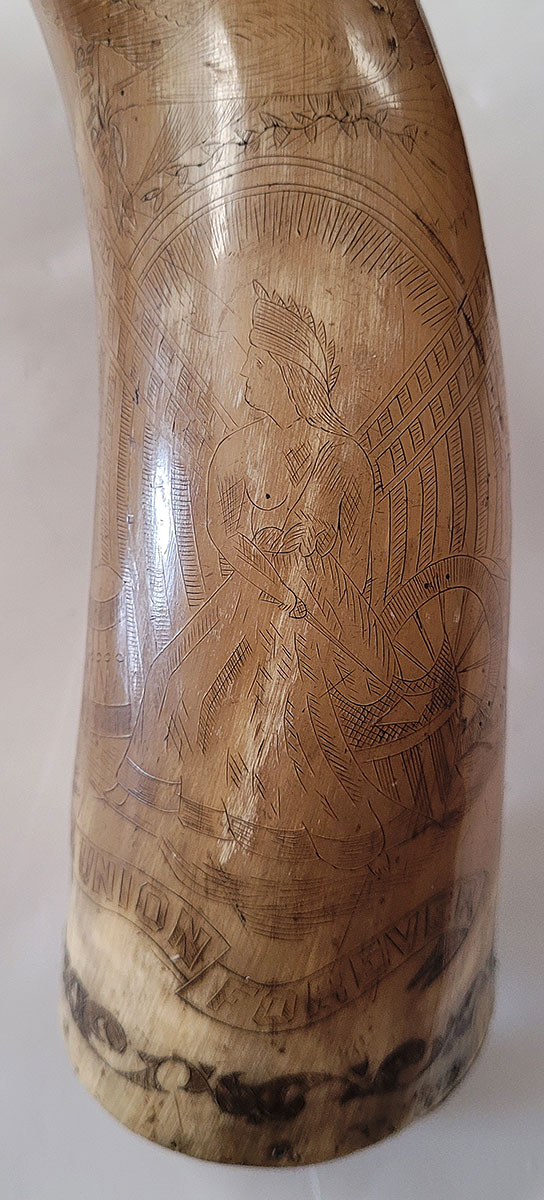
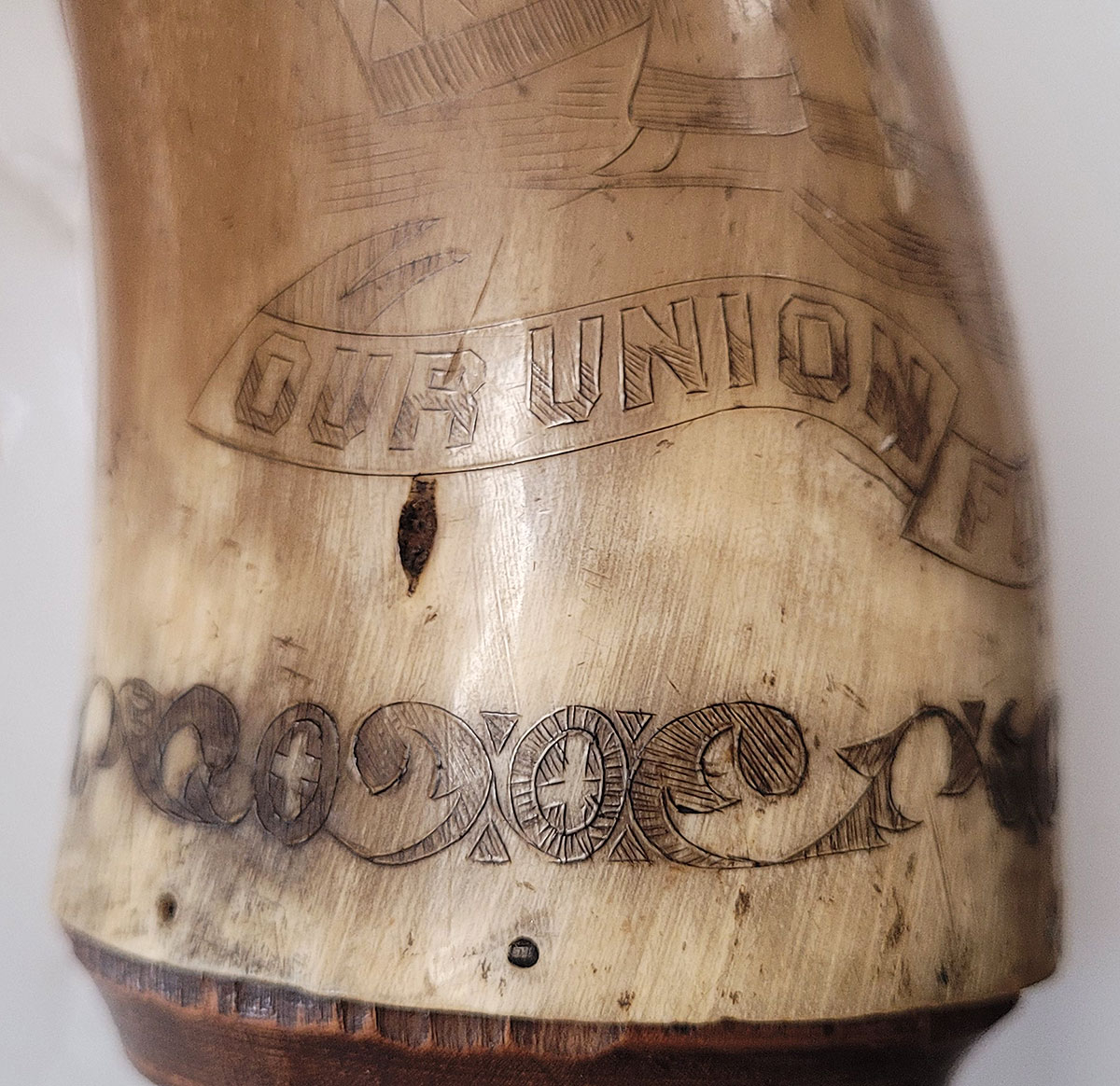
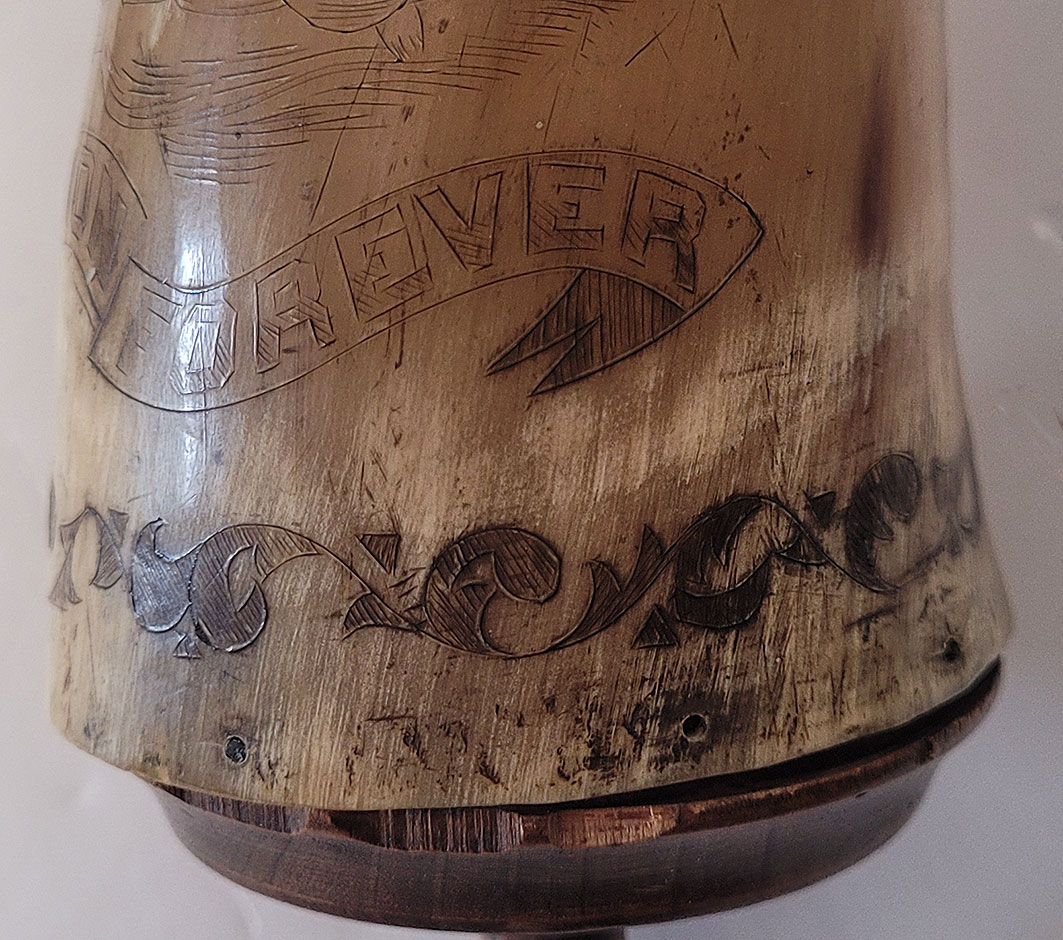
Underneath those two figures the artist placed a rather martial Columbia. She appears under an arc with lines likely indicating sun rays beaming down, and is flanked on either side by three slanting US flags. Beneath their folds a drum is positioned on the lower left and a cannon on the lower right. She wears a headdress that appear to show feathers along its top, which we take to be a Native American allusion making clear her identity, her gown exposing one breast as she turns to the viewer’s left, drawing a sword with her right hand to face a challenge, a US shield resting upright at her left. Below her a scroll reads in bold block letters, “OUR UNION FOREVER.”
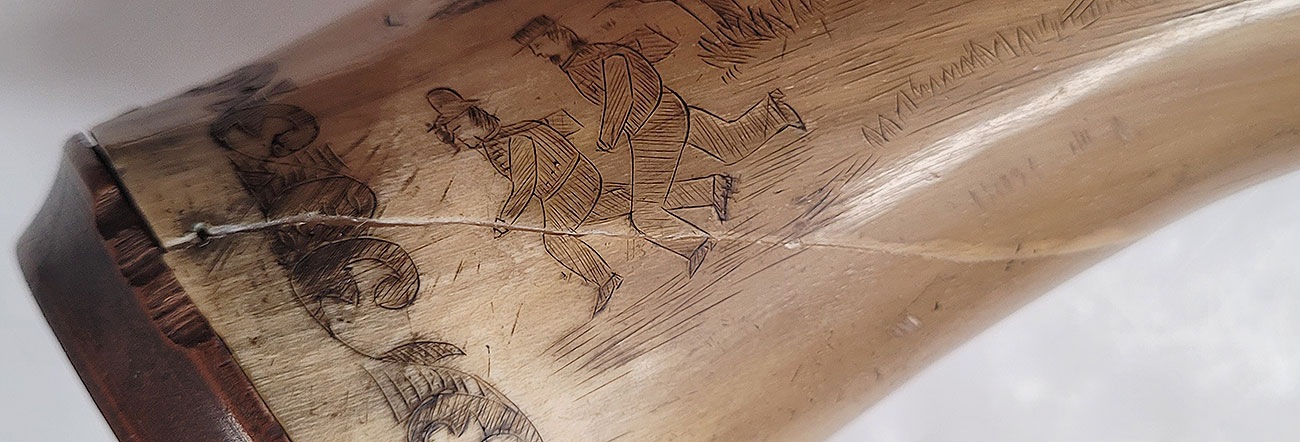
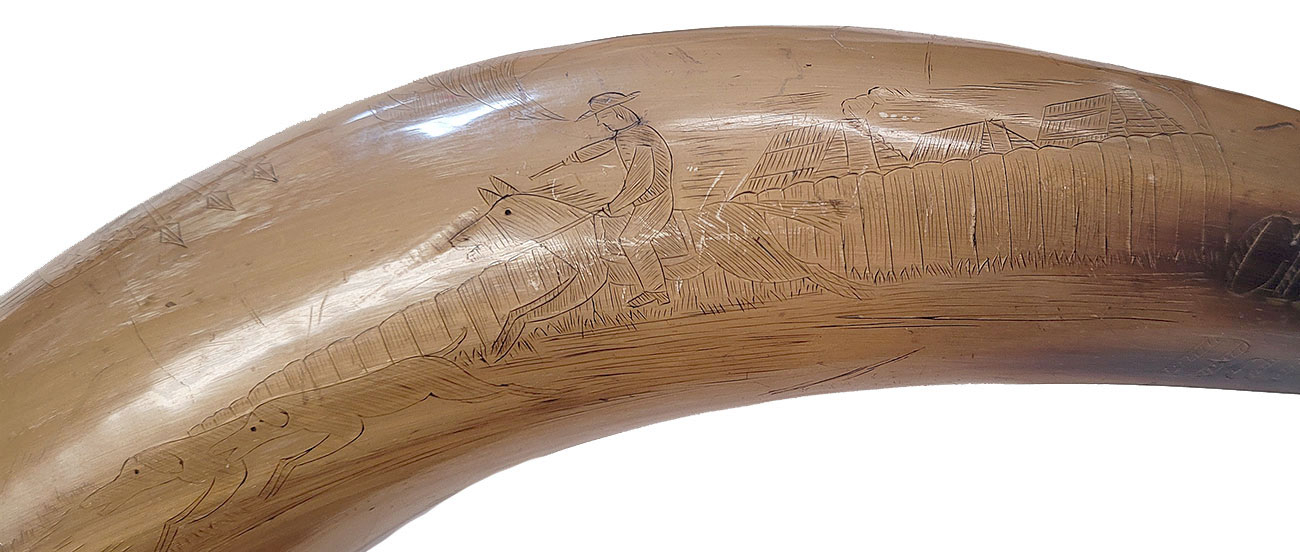
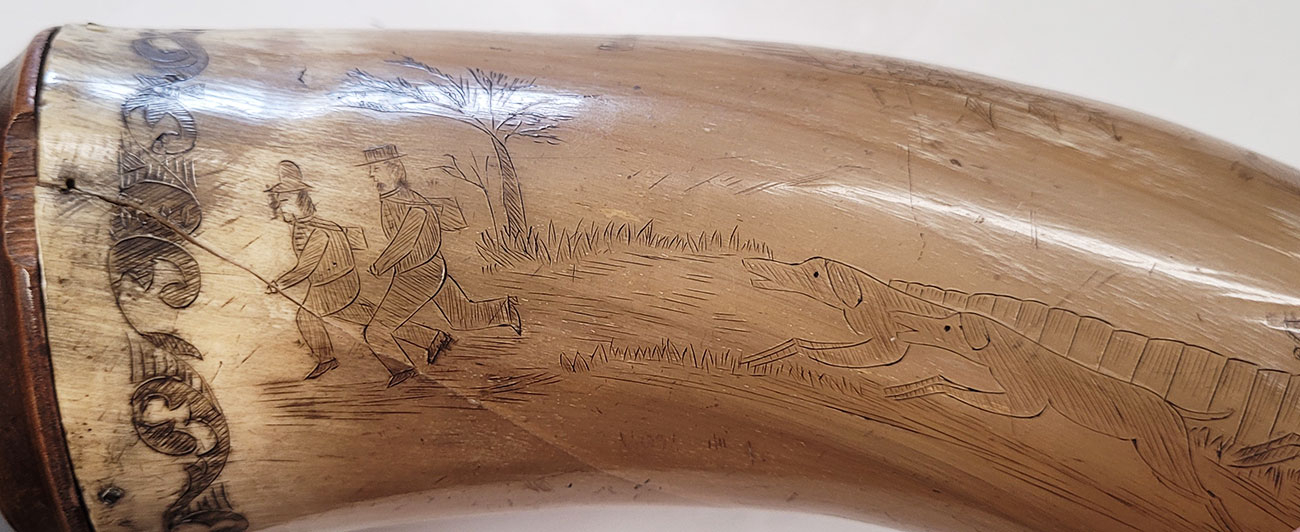
To top off the rather virtuoso carving, which has a crosshatched, abstract foliate band around the bottom of the horn, the horn’s maker added on the reverse a portrayal of a prison camp escape that is a direct personal reference to the owner. Read horizontally, two Union soldiers, one wearing a cap and the other, a hat, run across a somewhat barren landscape showing some tall grass and a scrawny tree, pursued by two dogs with outstretched legs, and a mounted figure in brimmed hat on horseback racing along behind them with outstretched right arm pointing what it clearly meant to be a pistol, his hat and clothing more sparingly crosshatched to indicate a gray uniform in contrast to the darker (blue) uniforms of his quarry. In the background is the long palisade of the prison camp wall, with the roofs of three huts visible over the top edge of the wall.
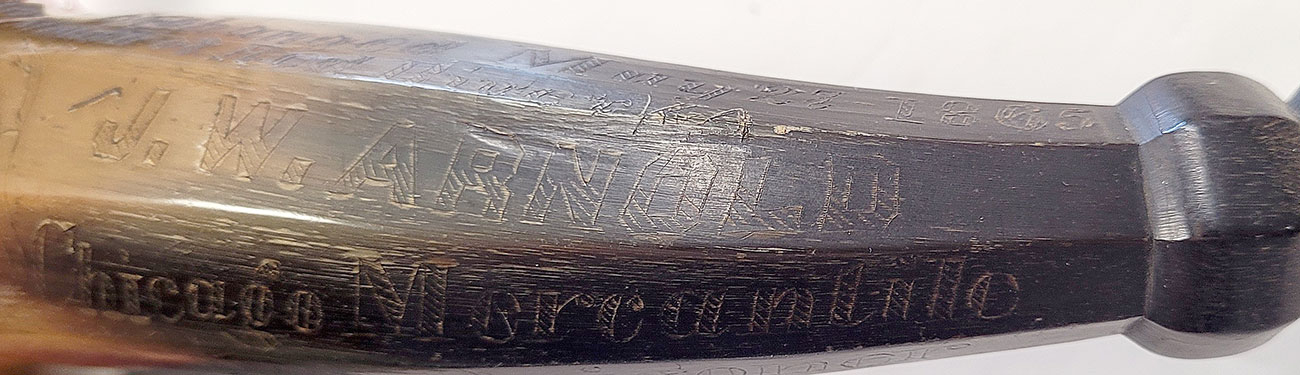
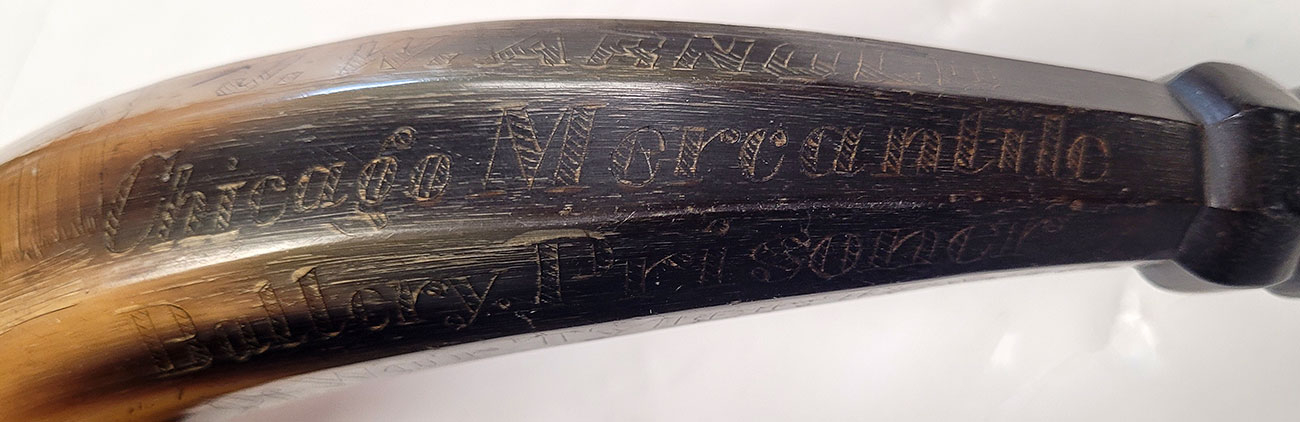
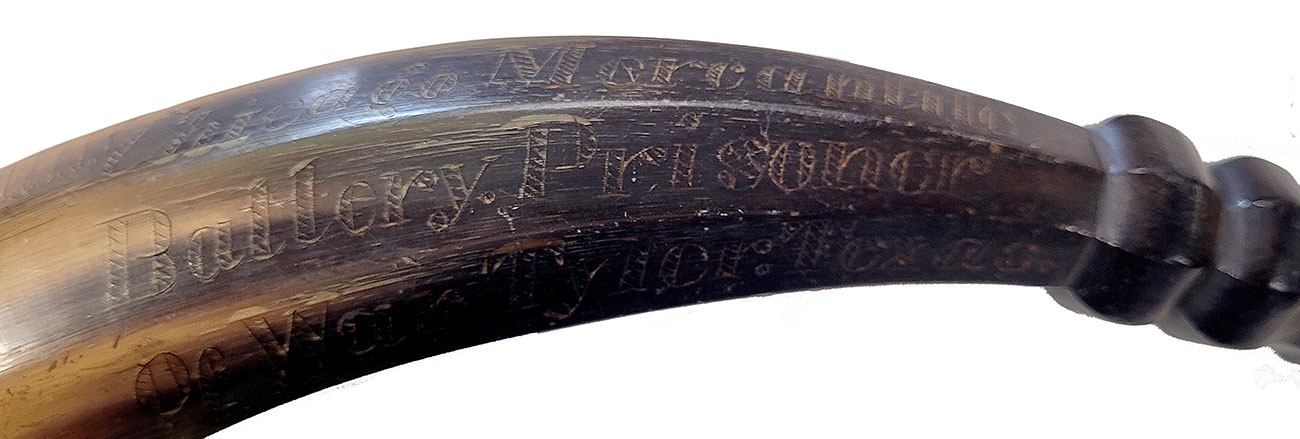
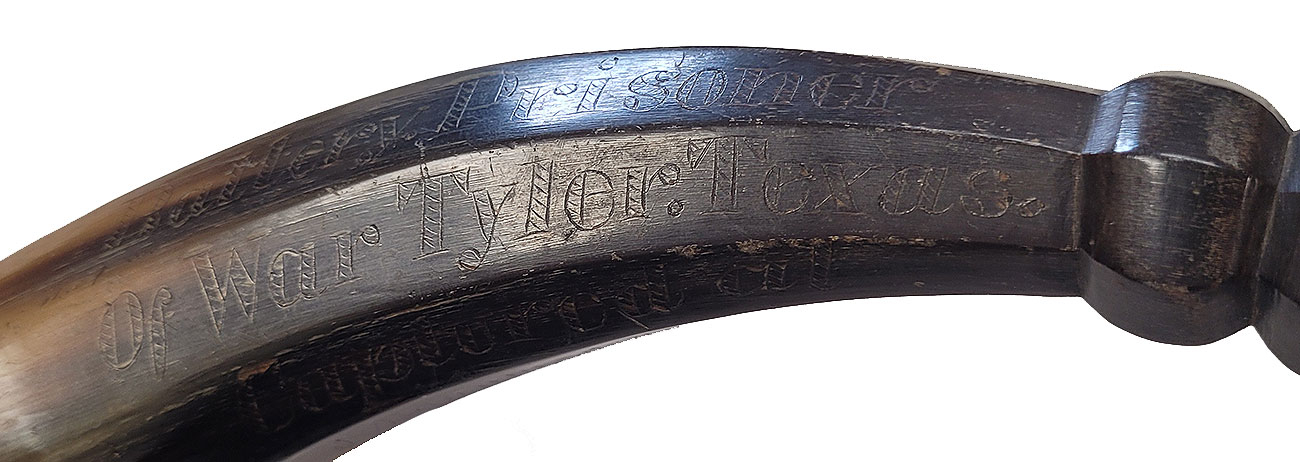
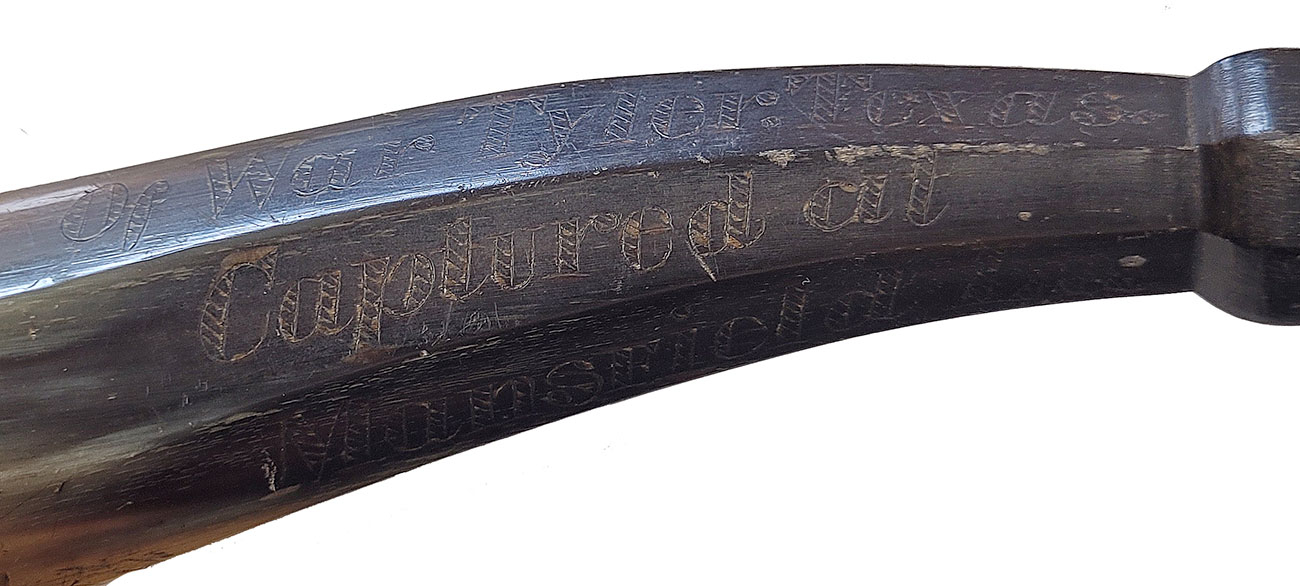
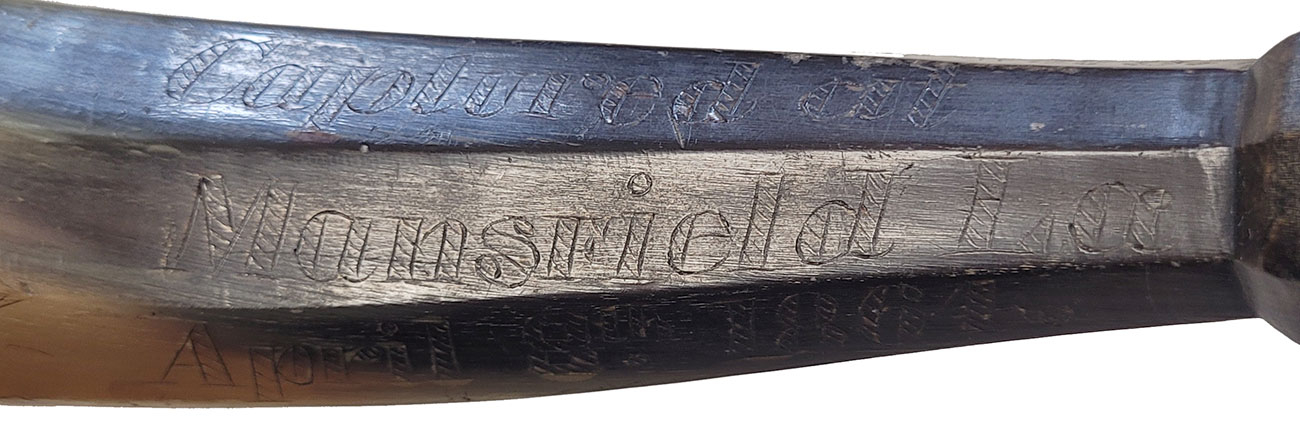
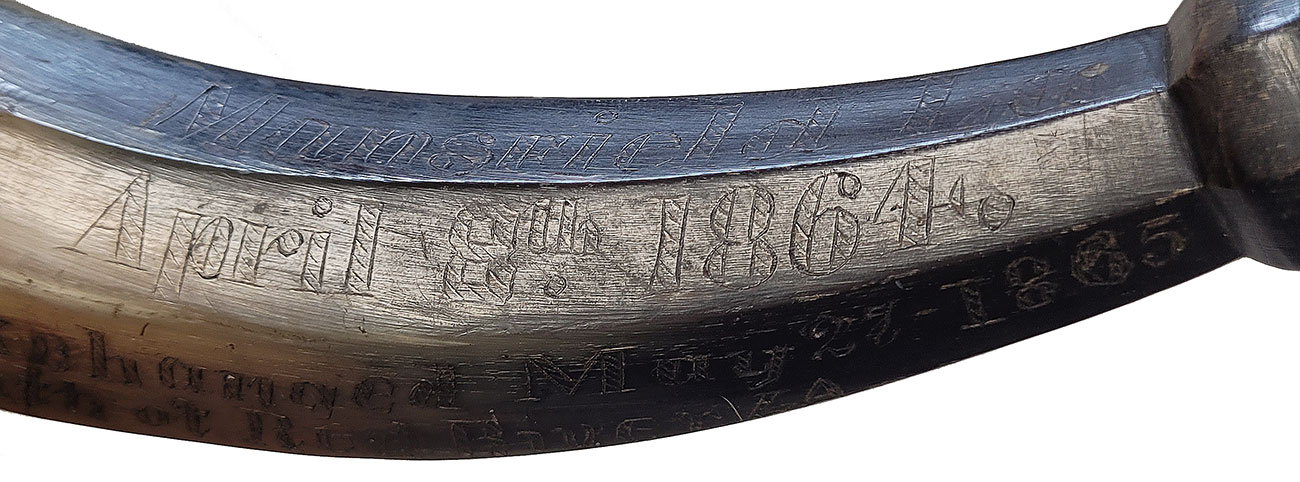
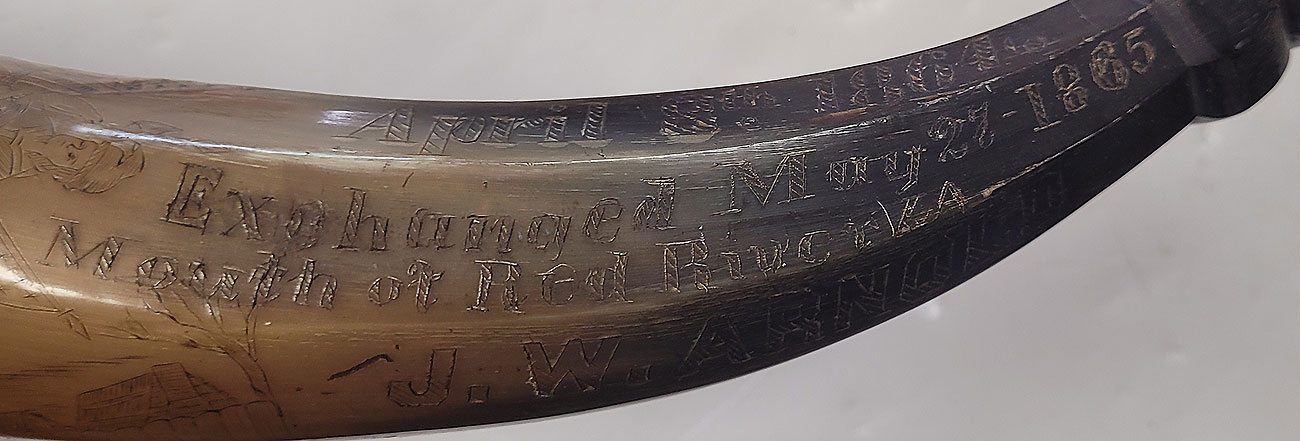
The faceted upper end of the horn enables us to fill in the story. Seven panels are inscribed in crosshatched block letters: “J.W. ARNOLD / Chicago Mercantile / Battery. Prisoner / of War. Tyler. Texas. / Captured at / Mansfield La. / April 8th 1864.” The eighth facet is inscribed in two lines in similar but smaller letters: “Exchanged May 27 – 1865 / Mouth of Red River LA.”
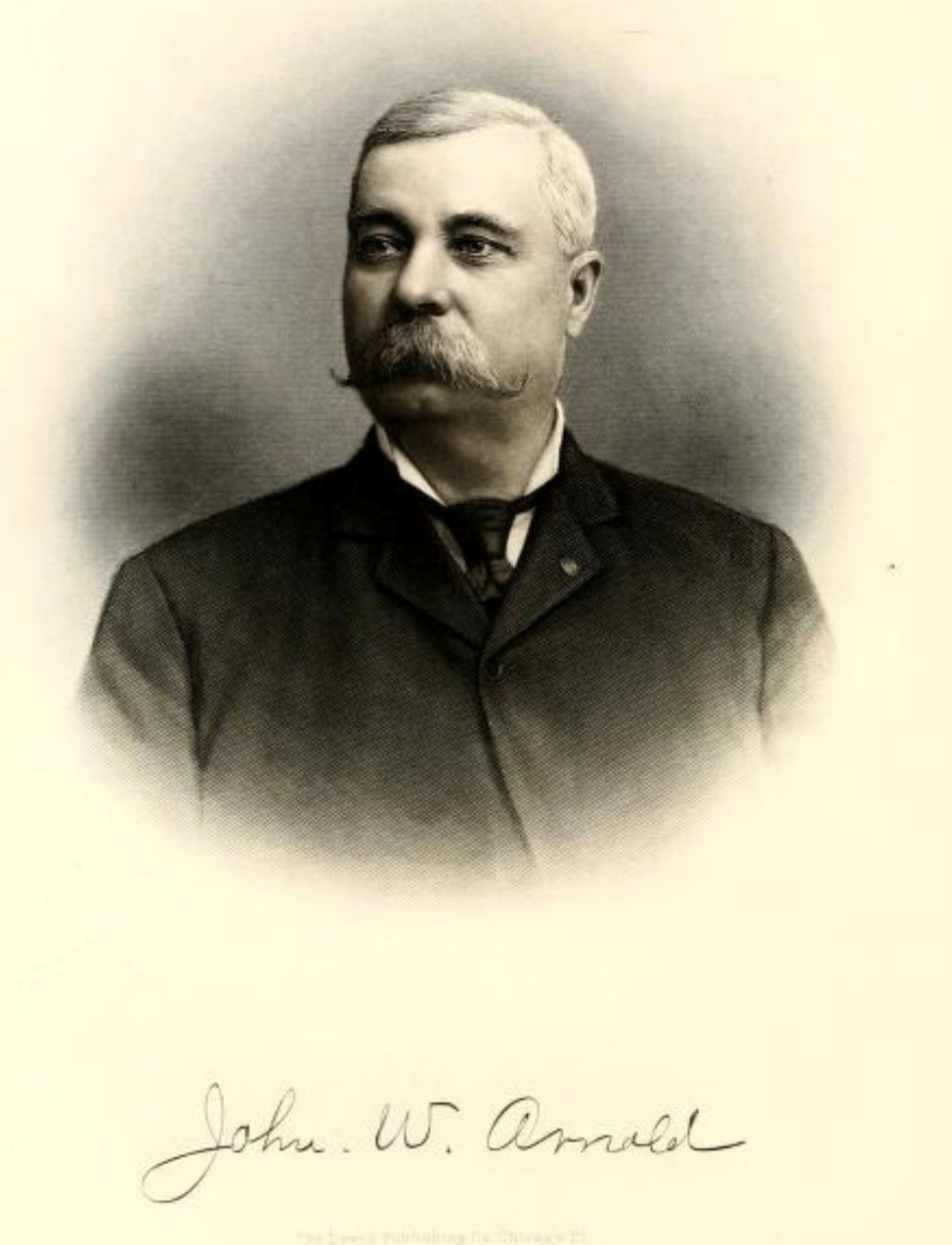
Born in New York February 14, 1842, John W. Arnold moved with his family to Lockport, IL, about 1855, where his father was a merchant. He enlisted at Lockport at age 20 on Sept. 7, 1861, and mustered in as a private in Co. D of the 4th IL Cavalry on Sept. 26. During his time with it the regiment they were posted at Cairo, Il, and then took part in the advance on the march to Columbus, KY, in December, in February 1862 had a share in Grant’s victories at Forts Henry and Donelson, and then took part in the movement on Corinth. They were apparently on guard duty at various points immediately afterward and at some point Arnold reportedly contracted Typhoid, resulting in his discharge for disability on August 1, 1862. He recovered sufficiently, however, to reenlist less than a month later, signing up at Chicago on August 24, and mustering into the “Chicago Mercantile Battery” as a private on August 29. He was described as 5’9” with dark complexion, blue eyes and dark hair. Army life apparently agreed with him- he listed his occupation as “soldier.”
The battery’s history is recounted in “Chicago’s Battery Boys,” a copy of which accompanies the horn. We do not have Arnold’s service or pension records from the National Archives, but the 1896 “Biographical Dictionary and Portrait Gallery of the Representative Men of the United States, Illinois Volume,” adds some details of his service, likely furnished by him, stating that he participated with them “in the battles of Oxford, Mississippi, Haines Bluff, the battle of Arkansas Post, and was with the forces of General Grant at Magnolia Hills, Champion Hills, Black River Bridge and the siege of Vicksburg, which began on the 22d of May, 1863, and continued until the 4th of July, following. With others he volunteered and took two guns up to the rebel breastworks. This hazardous position they held for two hours when, by the overwhelming numbers on the other side, they were repulsed. He then helped to drive Joe Johnston out of Jackson, Mississippi, and participated in the battle of Sabine Cross Roads, Louisiana, April 8, 1864, where the battery was captured and thirty-five of the men were killed and wounded.”
This latter engagement, also known as the Battle of Mansfield, as he has it on the horn, was part of Nathaniel Banks’s ill-fated and poorly conducted Red River Campaign. His Biographical Dictionary entry then goes on to state that he was one of 22 members of the battery captured and sent to Camp Ford, where he was confined for 14 months. The battery history gives some details of his escape, which took place August 16, 1864, in company with three others, though he seems to have been captured with just one companion some three weeks later, rain apparently preventing the pursuing hounds from picking up their scent in the initial escape. When retaken and returned to Camp Ford, a comrade recalled Arnold was brought back “in bad condition” from exposure and hunger. His sickness, however, may have prevented punishment further than being confined for a time to the prison’s jail, though it could hardly have been pleasant, apparently earning the name “the wolf pen,” according to the battery history.
Camp Ford had been a training camp. A prisoner of war camp was added to its facilities in 1863, eventually expanding to three or four acres with a stockade and holding some 4,700 prisoners. The total number incarcerated in the camp during its operation is estimated at 6,000 by some sources, with 286 deaths. Prisoner exchanges eased some of the overcrowding caused by an 1864 influx. There were about 1,200 remaining there when they were released in May 1865 and conveyed to Shreveport. It looks like Arnold was among the last out, officially exchanged May 27, 1865, and officially mustered out June 16.
He returned home to Lockport, where, like his father, he was a merchant, but also held some minor civic offices. He was appointed postmaster in 1888. In 1890 he was elected to the state senate on the Democratic ticket in a largely Republican district, and in 1894 was appointed a US Marshal. He was active in veterans’ affairs as a member of E.I. Good Post No. 401, GAR, of which he served for time as Post Commander. He passed away in Chicago on March 26, 1926, and was interred back in Lockport.
This is a wonderful piece that would be a great addition to any display of Civil War camp art, POW art in particular, a collection of Chicago Mercantile Battery material, or even a broad collection of American folk art. It would also supply a lot of material for a potential study of the Camp Ford Carver, whoever he was. [sr] [ph:L]
~~~~~~~~~~~~~~~~~~~~~~~~~~~~~~~~~~~
THIS ITEM, AS WITH ALL OTHER ITEMS AVAILABLE ON OUR WEB SITE,
MAY BE PURCHASED THROUGH OUR LAYAWAY PROGRAM.
CLICK HERE FOR OUR POLICIES AND TERMS.
THANK YOU!
Inquire About WONDERFUL ID’D TYLER TEXAS P.O.W. CARVED POWDER HORN: LADY LIBERTY, COLUMBIA, US EAGLE, AND THE ESCAPING OWNER AND COMRADE CHASED BY HOUNDS!
Most Popular
Historical Firearms Stolen From The National Civil War Museum In Harrisburg, Pa »
Theft From Gravesite Of Gen. John Reynolds »
Selection Of Unframed Prints By Don Troiani »
Fine Condition Brass Infantry Bugle Insignia »
Rare Identified 65Th Ny Sergeant’s Jacket, With Manscript Material: 1St U.s. Chasseurs »
featured item
APPOMATTOX PAROLE OF LT. DAVID BEAM HARRILL COMPANY B 34th NORTH CAROLINA: PICTURED IN UNIFORM IN MAST VOLUME 1: NC STATE TROOPS AND VOLUNTEERS
This comes from the collection of Greg Coco, scholar and author of an article on Appomattox paroles in the March-April 2006 issue of Civil War Times that deals with the circumstances of the printing of these paroles, their importance to paroled… (1300-64). Learn More »
site search