


site search
online catalog
IDENTIFIED US M1855 TYPE-1 SPRINGFIELD MUSKET: ALBERT WADHAMS CO. I, 11th CONNECTICUT: WOUNDED IN ACTION AT COLD HARBOR

Hover to zoom



$7,950.00
Quantity Available: 1
Item Code: 2026-2163
Shipping: Determined by Method & Location of buyer
To Order:
Call 717-334-0347,
Fax 717-334-5016, or E-mail
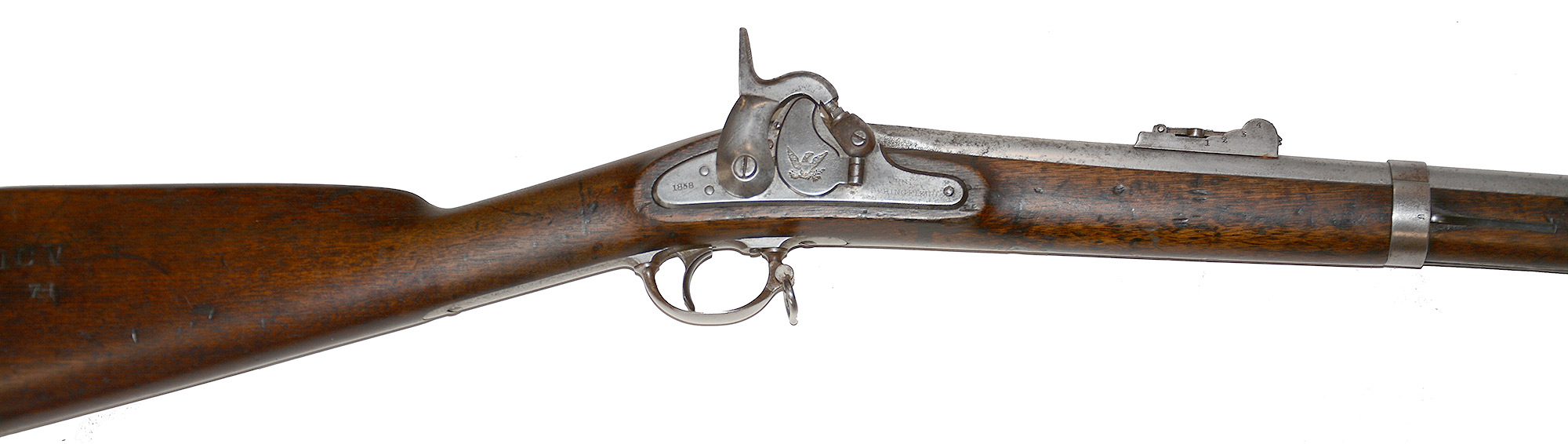
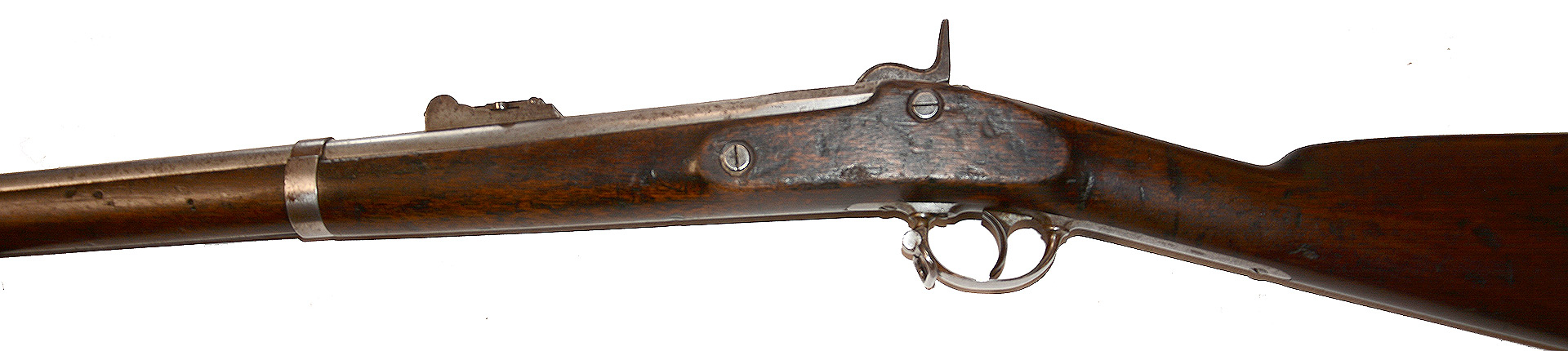
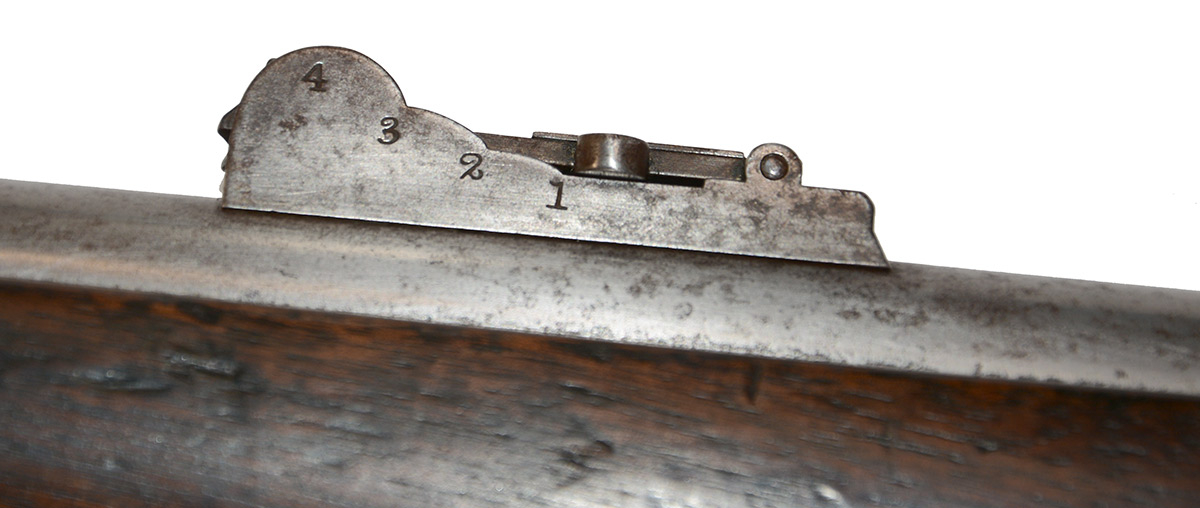
A scarce 1858-dated, regimentally marked and soldier-identified Type-1, Version-1, M1855 Springfield Rifle Musket. For the history and details of this pattern see Moller and, especially, Willyard, “US Model 1855 Series Small Arms.” The M1855 was the first US longarm firing the .58 Cal. Minie Ball and was the precursor of the widely used M1861, M1863 and M1864 rifle muskets. It first saw service in the regular army in the Northwest in 1858 and was in use throughout the Civil War. Production took place at Harpers Ferry and from 1857 to 1861 at Springfield.
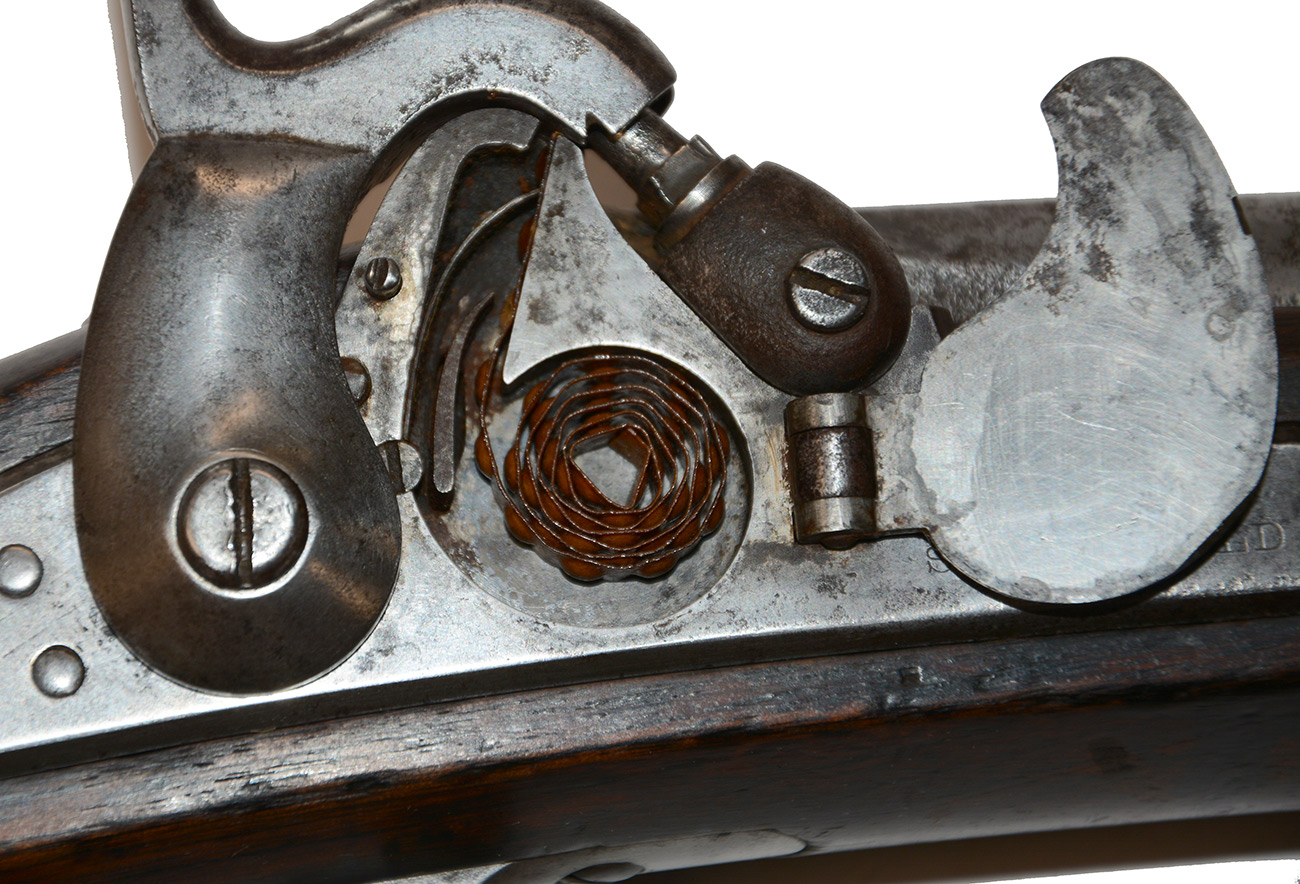
The Type 1 - Version 1 uses a brass stock tip, Maynard tape primer, a ladder-style “long range” or “slide” rear sight, and omits a patchbox in the buttstock,. A total of 6,689 were made at Springfield through January 1858, when it was decided to omit a rear sight entirely until a new pattern sight could be placed into production. Willyard fixes January 1858 production of these guns with the long range rear sight at just 975. Production of the guns without any rear sight continued, however, creating the “Type 1- Version 2,” which placed in storage for the time being.
Production and installation of the new M1858 three-leaf rear sight did not begin until August and demand from various states for the new rifle-muskets in the meantime led to a May 1858 directive to recommence installation of the earlier slide pattern. Some 6,000 of the guns without rear sights were in storage by that time, but how many were now fitted with the slide sight is unclear. Willyard allows that likely some had barrels slotted for the old pattern sight, and some old pattern sights and components on hand, but thinks there were not many, given how many of the Version 2 remained without any rear sight at all.
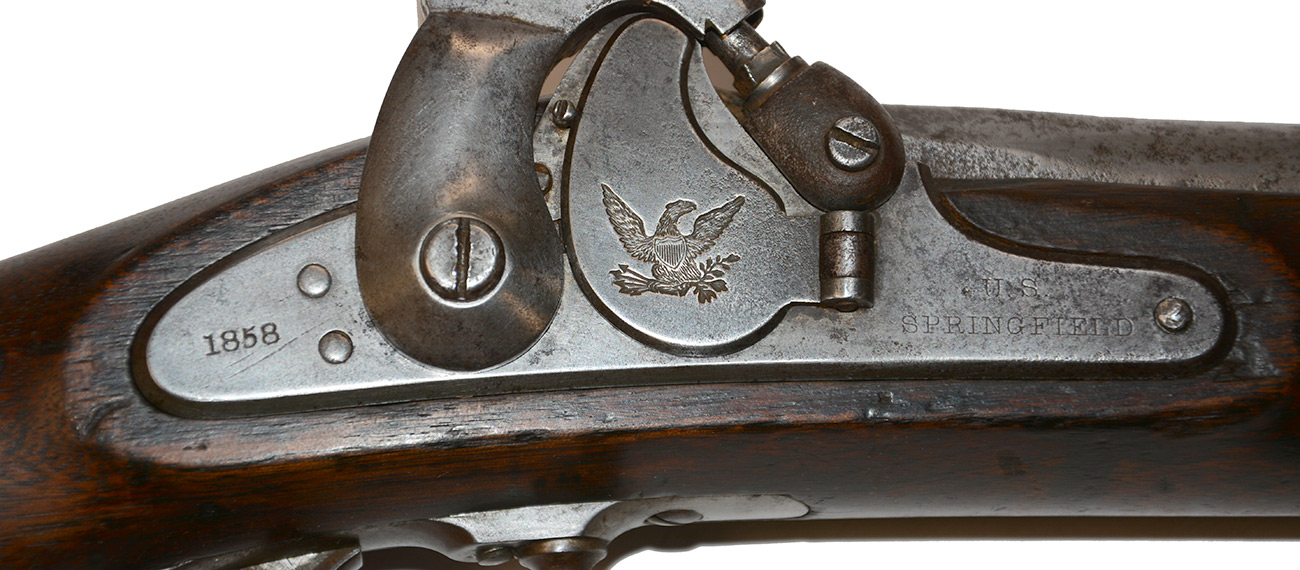
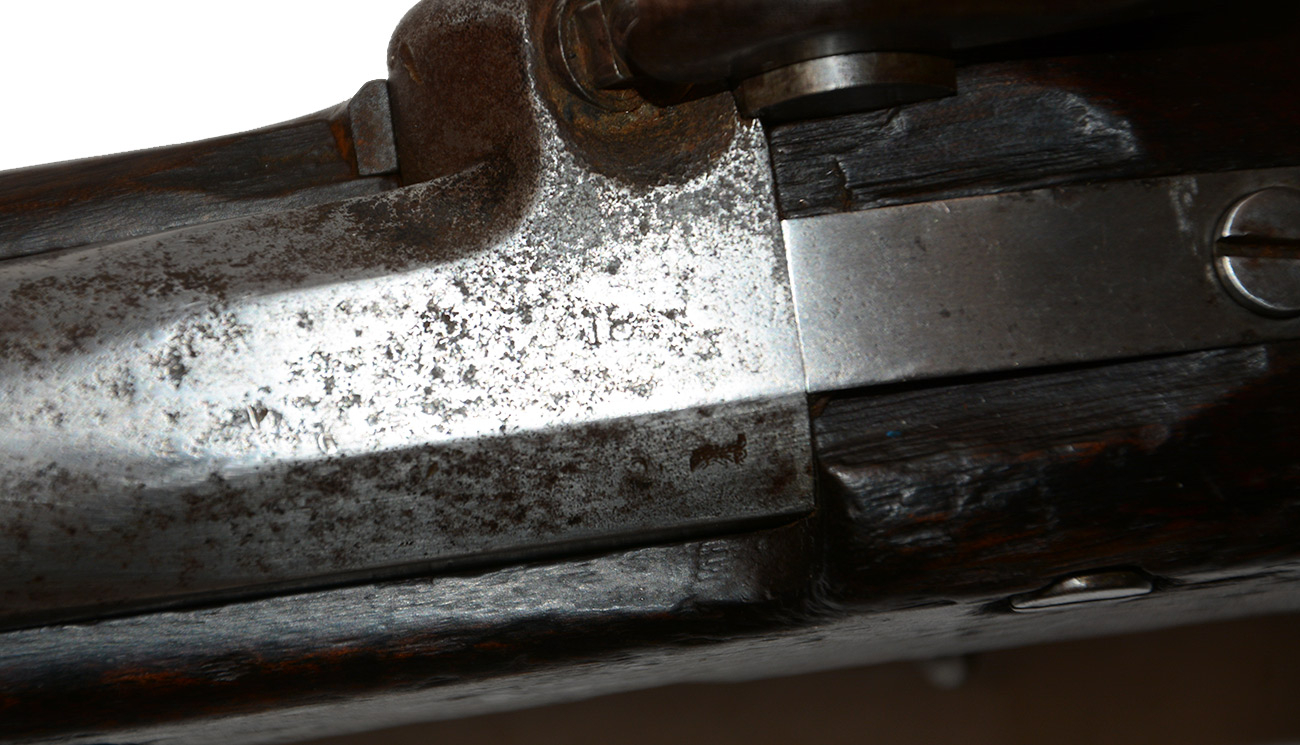
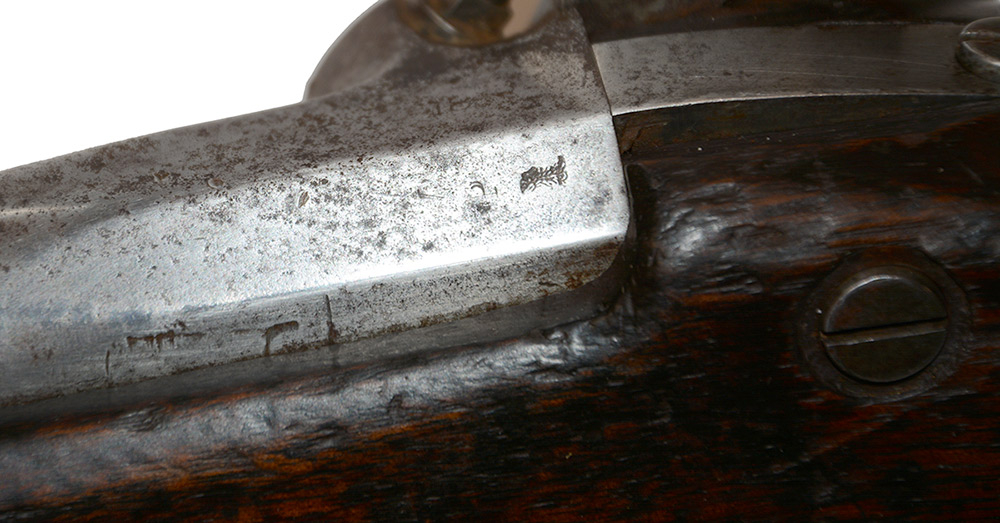
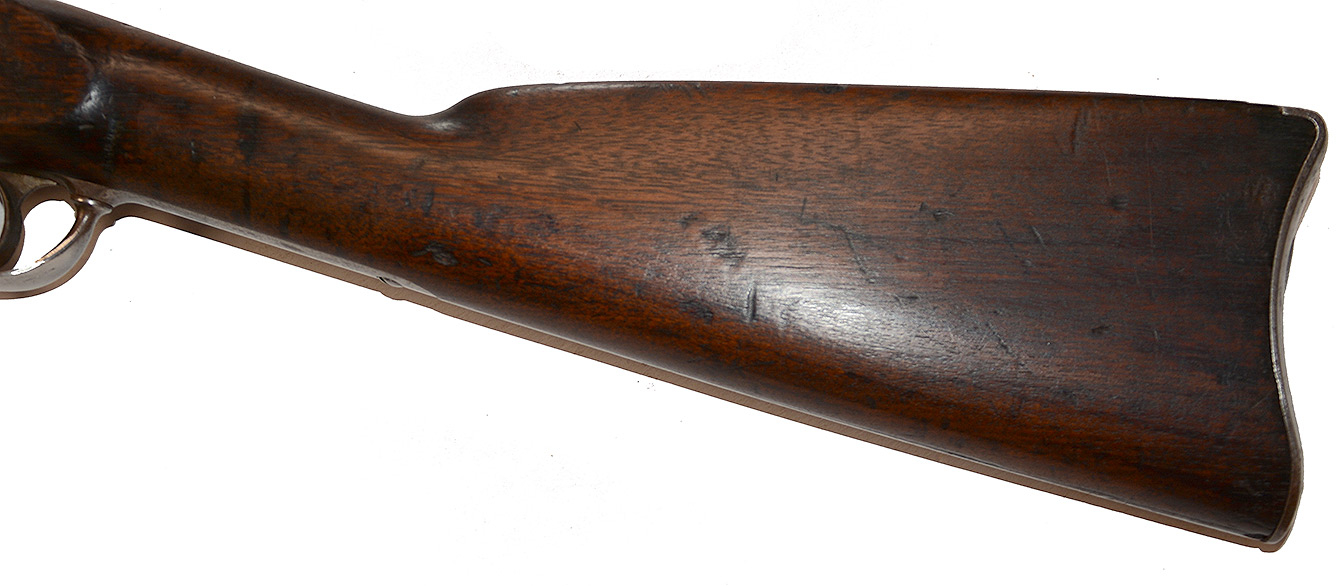
This is a very good example with a sharp 1858 lock date. The barrel date shows some corrosion from firing on the last digit, but Willyard is clear that all of the pattern with 1858 lock dates had matching 1858 barrel dates. The weapon is all original, full length and complete with all sights, barrel bands, springs, and the Maynard tape priming system in place, along with the brass stock tip, the ramrod, etc. The mechanics are good. The bore shows some rust and oxidation, but has visible rifling. The metal is generally smooth, with the barrel and bands silver-gray or “semi-bright,” with some scattered small, thin gray stains and some very shallow corrosion at the breech from the fulminate of mercury priming of the tape primer and percussion caps. This has obscured the last digit of the barrel date on the top of the barrel and the “V” and part of the “P” of the barrel proofs, but left the eagle’s head sharp.
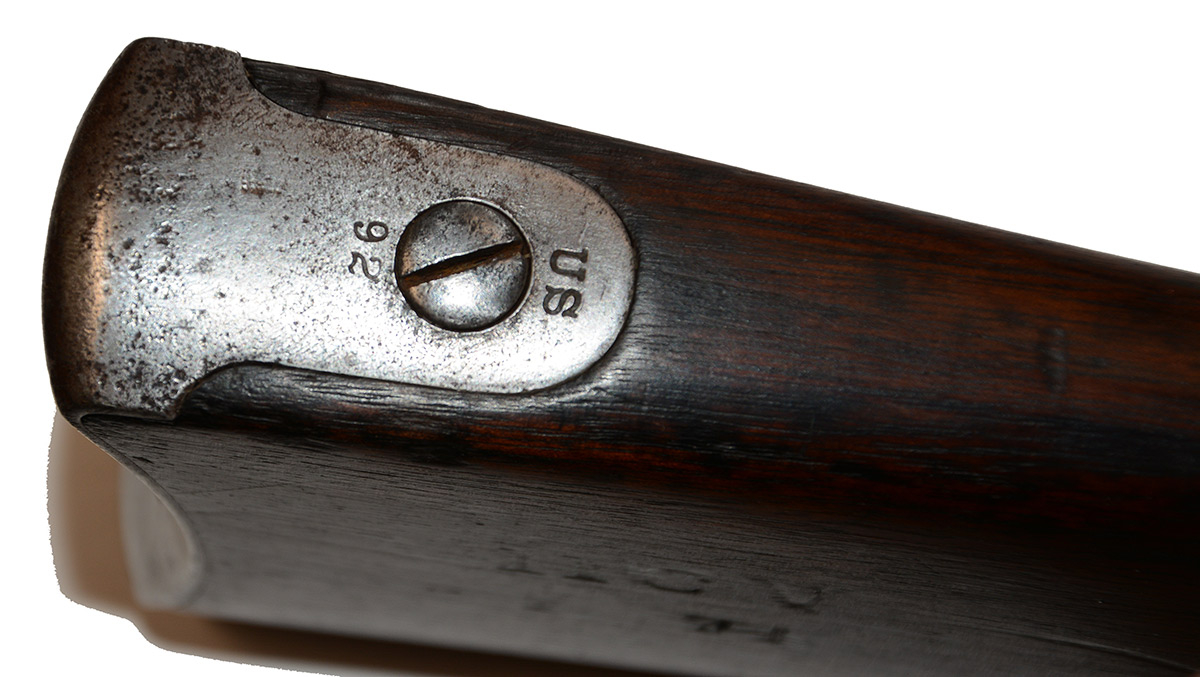
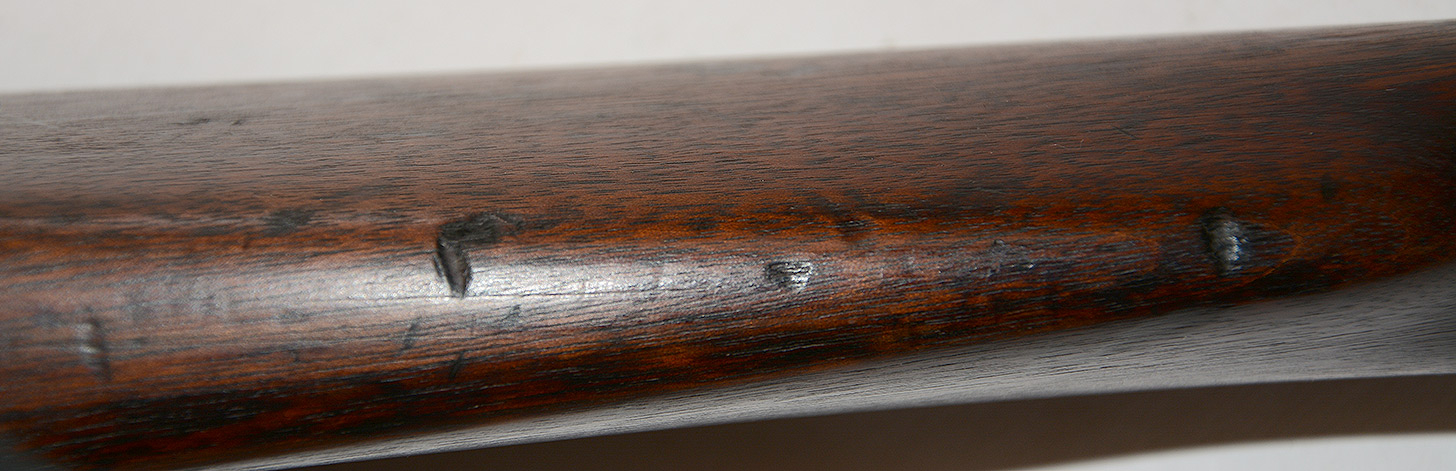
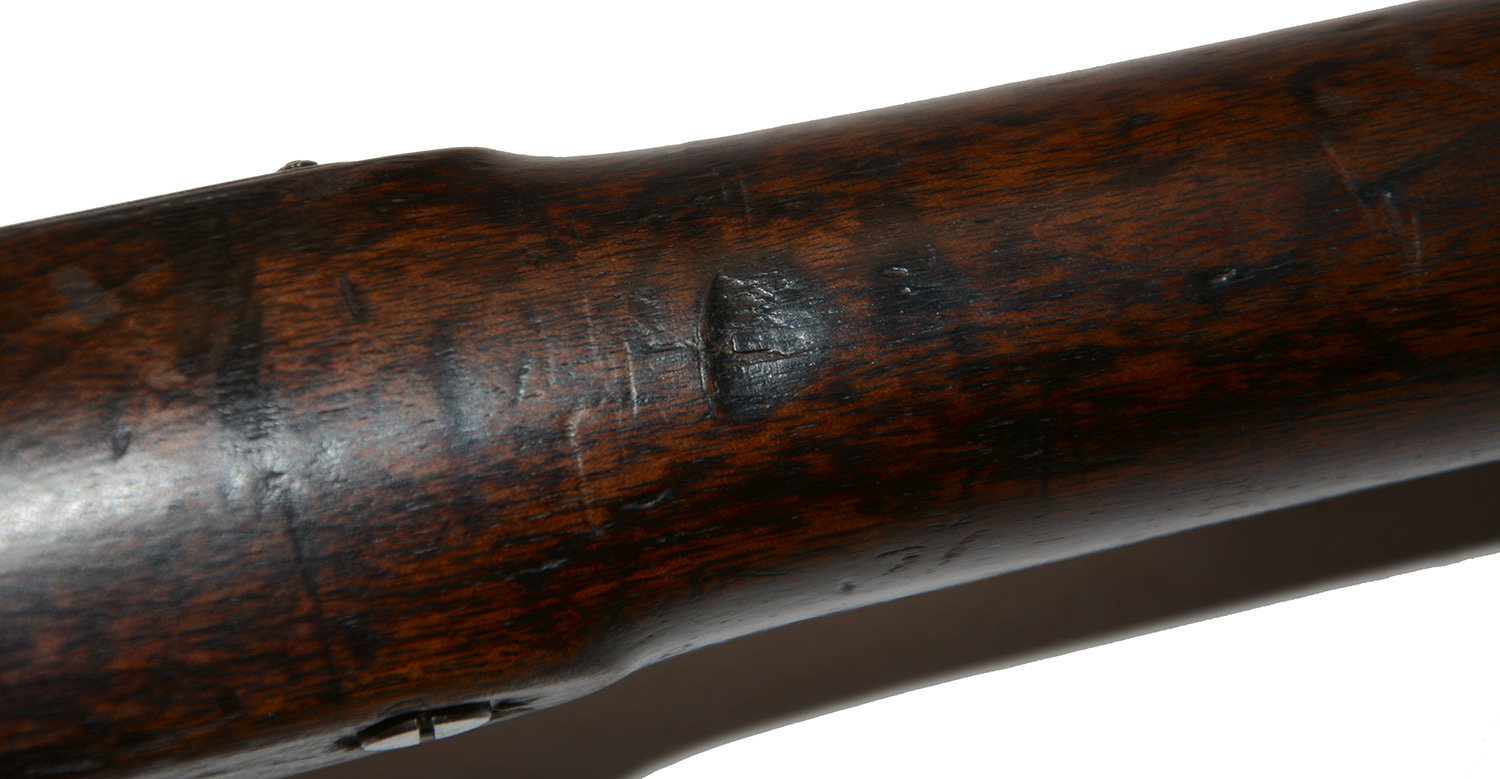
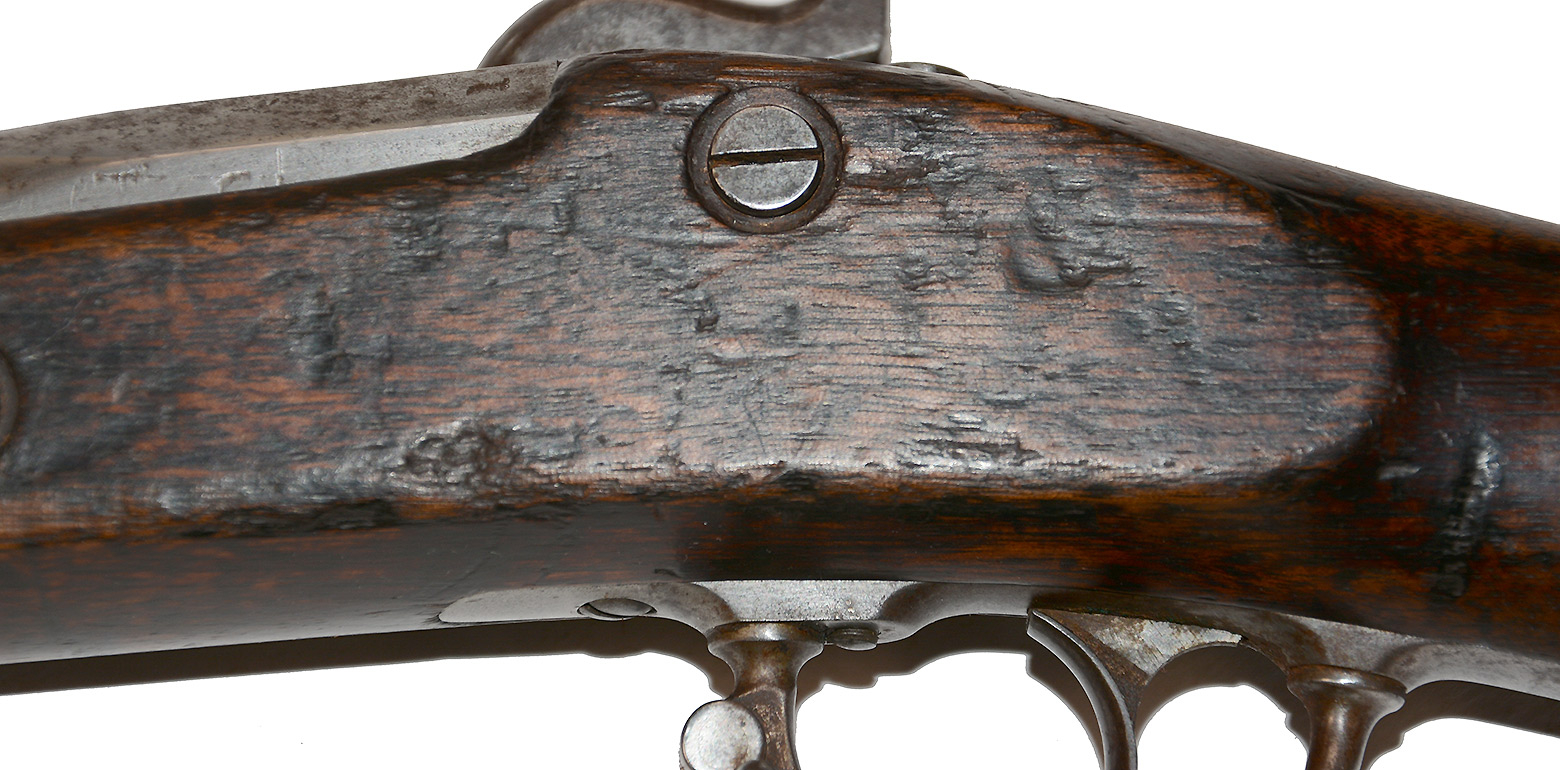
The lock is very good, showing a sharp 1858 date, crisp eagle on the door of Maynard tape priming system, which has a partial roll of tape primers in it, and a clear “US / SPRINGFIELD” stamping forward. The lock has some minor dark gray staining, mainly forward, with some shallow freckling on the right of the primer door, with more pronounced shallow pitting and brown color on the bolster of nipple, all as should be expected from corrosive primers on a rifle musket that saw service. The buttplate shows some shallow pitting, but clear US and inventory number 92 at the buttplate tang screw. The wood has a good fit to the metal good color and surface. The edges show minor wear, more evident on the counterpane than elsewhere, but with small dings, divots and handling marks on the sideflats of the buttstock and its belly, minor handling marks on the forestock, and on the counterpane more pronounced divots, dings, and some small chips, the sideflat usually being subject to jostling from the locks of guns next to it when stacked or in racks as well as rough usage in the field.
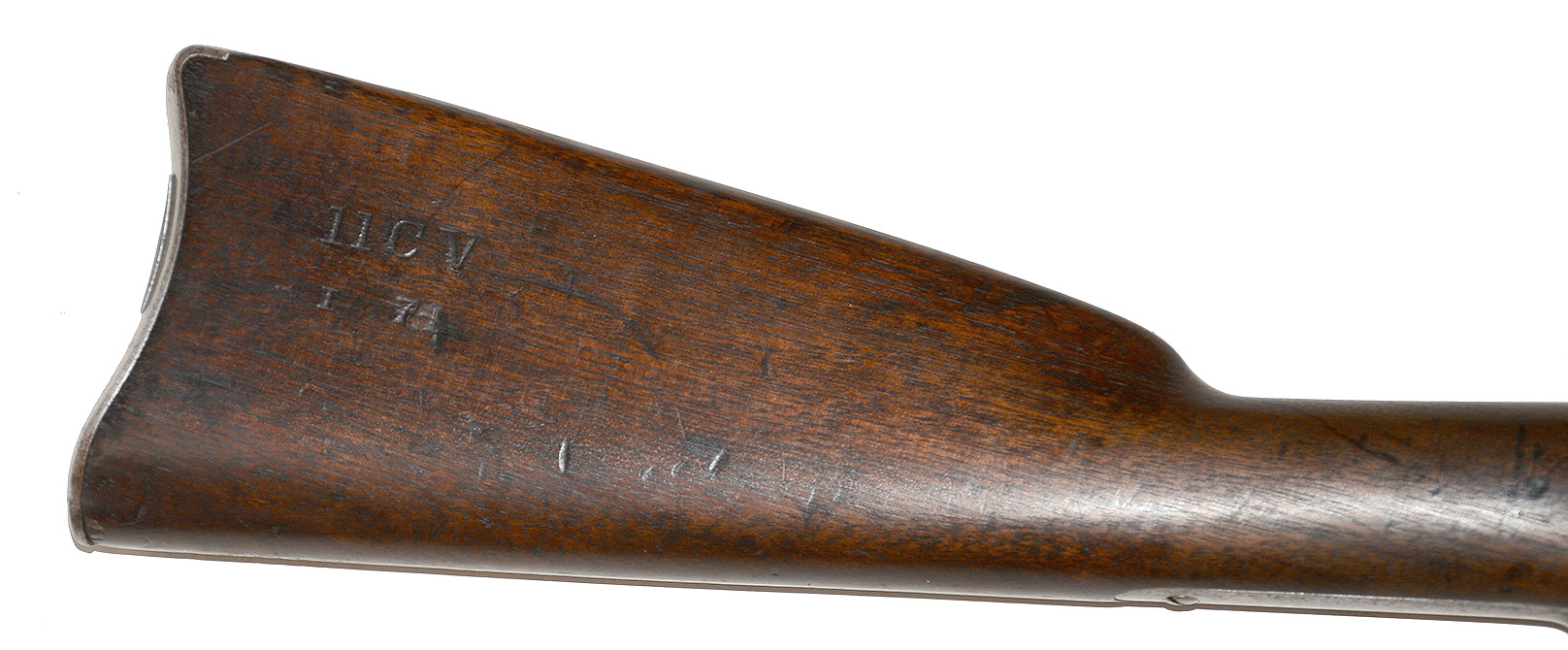
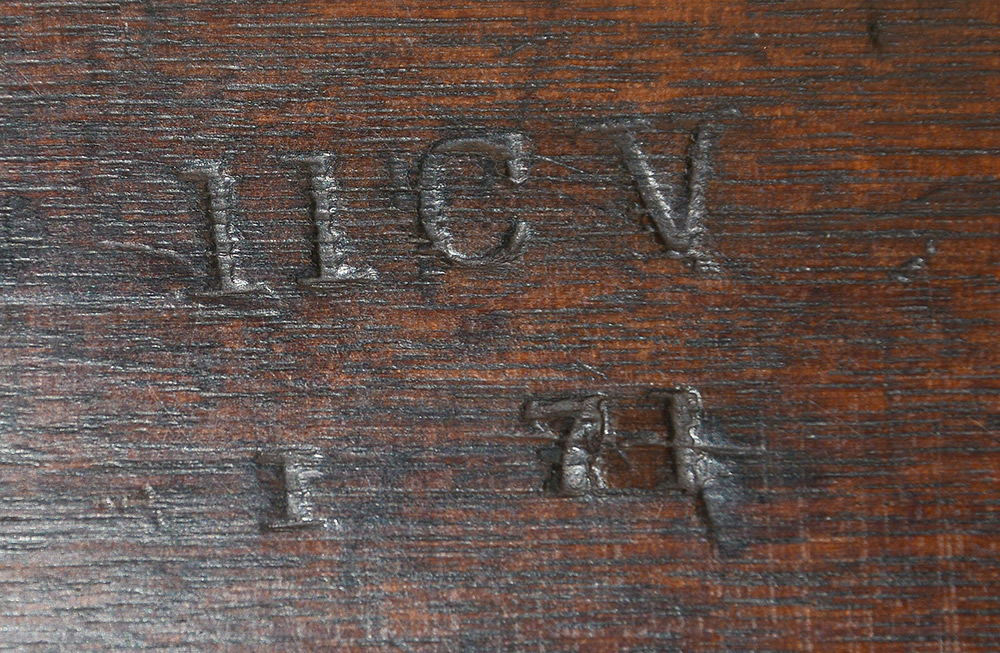
Most significantly, ours stamped on the right butt flat: “11 CV” over “I 71,” indicating issue to a member of Company I of the 11th Connecticut Volunteers with the individual or “rack” number for his gear of “71.” Research in the Company I “Descriptive Book” at the National Archives revealed Private Albert Wadhams as number 71, and a copy of that entry is included in the file. Wadhams is listed as age 42, enlisted at Goshen, CT, on Oct. 3, 1861, for three years and mustered out effective November 1864 at the expiration of his term of service. He is described as a farmer by occupation, standing 5’9-1/2” tall with dark complexion, black eyes and hair. As a side note: we know of at least one other Type-1 Version 1 M1855 Springfield identically marked (though with different company letter and rack number,) indicating this was a regimental practice.
The 11th Connecticut was organized at Hartford, officially mustering into US service on Nov. 14, 1861. They were in Burnside’s expedition to North Carolina and saw action at Roanoke and New Bern. They joined the 9th Corps in mid-1862, seeing more action at South Mountain, Antietam, and Fredericksburg. In early 1863 they were assigned to the Department of Virginia and North Carolina for the Suffolk Campaign, in which they again saw fighting in the Siege of Suffolk, at Edenton Road, Providence Church Road, and the Nansemond River. In late June and early July they took part in Dix’s Peninsula Campaign and in April 1864 joined the 18th Corps and the Army of the James for Butler's operations on south side of the James River and against Petersburg and Richmond May 4–28.
During this period they took part in the occupation of Bermuda Hundred, Va., May 5; fighting at Port Walthal Junction and Chester Station, May 7; Swift Creek or Arrowfield Church May 9–10; and operations against Fort Darling May 12–16. They were in the Battle of Drewry's Bluff May 12–16. They were on the Bermuda Hundred front May 17–27, then moved to White House and on to Cold Harbor May 27–31, where they were in the June 3 assault as part of Stedman’s Brigade, Martindale’s Division, in Smith’s 18th Corps, which was on the right of the Union center in the attack and hard hit, as their attack was channeled into two ravines and then devasted by rifle and artillery fire, much of the latter delivered from their right flank as the 5th Corps hesitated to advance. Wadhams suffered an ankle wound in that fighting that he attributed to a “grape shot,” by which he might well have meant a canister round, though medical records attribute it also to a shell fragment or Minie ball.
Wadham’s record essentially follows that of his regiment up to that point. After enlisting, he was officially mustered in Dec. 14, to date Nov. 27. He took part in Burnside’s North Carolina expedition, and was noted as being fined two month’s pay by a regimental court martial at Roanoke on March 4, 1862, for an unspecified infraction. Company muster rolls show him present until September 6, 1862, when he is sick in hospital at Washington, returning to his company by January 1863. He was then marked present again for six months, until taken prisoner during Dix’s Peninsula Campaign, reportedly being captured at Hanover Court House on July 6. He was confined at Richmond July 9, paroled July 14 at City Point and in Camp Parole by July 14, but does not seem to have been exchanged and returned to duty until December 1863, when he is back in the ranks and present on the rolls for November-December 1863. He was detached for duty with the 148th New York at Yorktown in January-February 1864, but present again with his company for the March-April roll and the May-June roll, putting him in the fighting at Bermuda Hundred, Drewry’s Bluff, etc., until his wounding on June 3.
Wadhams was hit in the right ankle, with the wound variously reported as “severe” and as “slight.” He may also have suffered a hand injury. One medical record indicates loss of his “3rd finger,” which another refers to loss of “3 fingers.” For some reason, he himself does not refer to that, but he does later claim he suffered deafness on May 8, 1863, something record clerks could not find recorded. In any case, he was treated at Finley Hospital in Washington, Knight Hospital in New Haven, and was in the Convalescent Barracks at Fort Wood on Bedloe’s Island in NY Harbor, when he was returned to duty Sept. 6, being present on his company’s Sept.-Oct. roll and listed on the Nov-Dec roll as mustered out at expiration of his term of service to date Nov. 26, 1864.
Wadhams’ personal life presents some challenges. Born in Goshen, CT, June 7, 1819, he was an 1844 graduate of Norwalk University in Vermont. He seems to have spent most of his life as a farmer, in Goshen, in Massachusetts and in Iowa, but a family genealogy says he was admitted to the bar in New York state and we find him practicing law back in Goshen after the war, as well as a newspaper notice that he had been elected a justice. He seems to have married twice, first in 1844, and may not have bothered with the formalities of divorce before marrying again in 1866. Newspapers record some legal disputes, and apparently some excentric behavior and letters to the editor. He was judged insane in May 1883 and committed to the “Retreat for the Insane” at Hartford, where he died a little over a year later.
He did, however, leave behind an interesting, scarce pattern, regimentally marked Springfield rifle musket that would be a great addition to a Civil War long arm display, a specialized collection of the 1855 pattern arms, and especially one concentrating on Connecticut troops in the war. [sr][ph:L]
DISCLAIMER: All firearms are sold as collector's items only - we do not accept responsibility as to the shooting safety or reliability of any antique firearm. All firearms are described as accurately as possible, given the restraints of a catalog listing length. We want satisfied customers & often "under" describe the weapons. Any city or state regulations regarding owning antique firearms are the responsibility of the purchaser. All firearms are "mechanically perfect" unless noted, but again, are NOT warranted as safe to fire!
~~~~~~~~~~~~~~~~~~~~~~~~~~~~~~~~~~~
THIS ITEM, AS WITH ALL OTHER ITEMS AVAILABLE ON OUR WEB SITE,
MAY BE PURCHASED THROUGH OUR LAYAWAY PROGRAM.
CLICK HERE FOR OUR POLICIES AND TERMS.
THANK YOU!
Inquire About IDENTIFIED US M1855 TYPE-1 SPRINGFIELD MUSKET: ALBERT WADHAMS CO. I, 11th CONNECTICUT: WOUNDED IN ACTION AT COLD HARBOR
Most Popular
Historical Firearms Stolen From The National Civil War Museum In Harrisburg, Pa »
Theft From Gravesite Of Gen. John Reynolds »
Selection Of Unframed Prints By Don Troiani »
Fine Condition Brass Infantry Bugle Insignia »
Rare Identified 65Th Ny Sergeant’s Jacket, With Manscript Material: 1St U.s. Chasseurs »
featured item
AN OUTSTANDING CIVIL WAR PRODUCTION COLT MODEL 1860 ARMY REVOLVER
This Colt martial revolver with serial number 60,160 was made in 1862. It is complete and rates as excellent in condition. It is a three-screw model and has an 8-inch barrel. The barrel has 85% factory blue coverage and with 15% scattered light age… (1304-73). Learn More »
site search