


site search
online catalog
CONFEDERATE P.O.W. FOLK-ART GROUP: THOMAS A. WALKER 11th MISSISSIPPI, CAPTURED AT GETTYSBURG - PICKETT’S CHARGE!
Hover to zoom
$3,250.00
Quantity Available: 1
Item Code: 490-7649
Shipping: Determined by Method & Location of buyer
To Order:
Call 717-334-0347,
Fax 717-334-5016, or E-mail
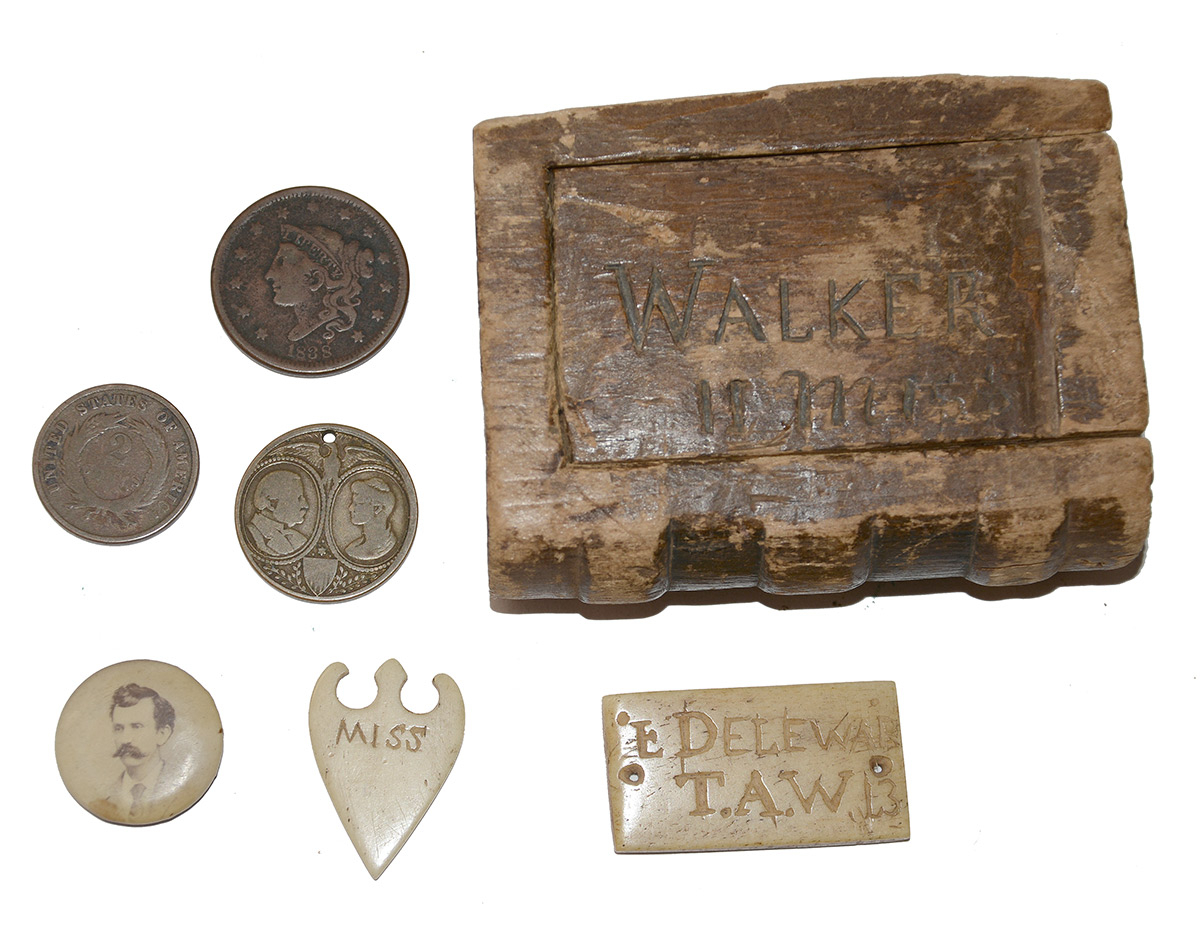
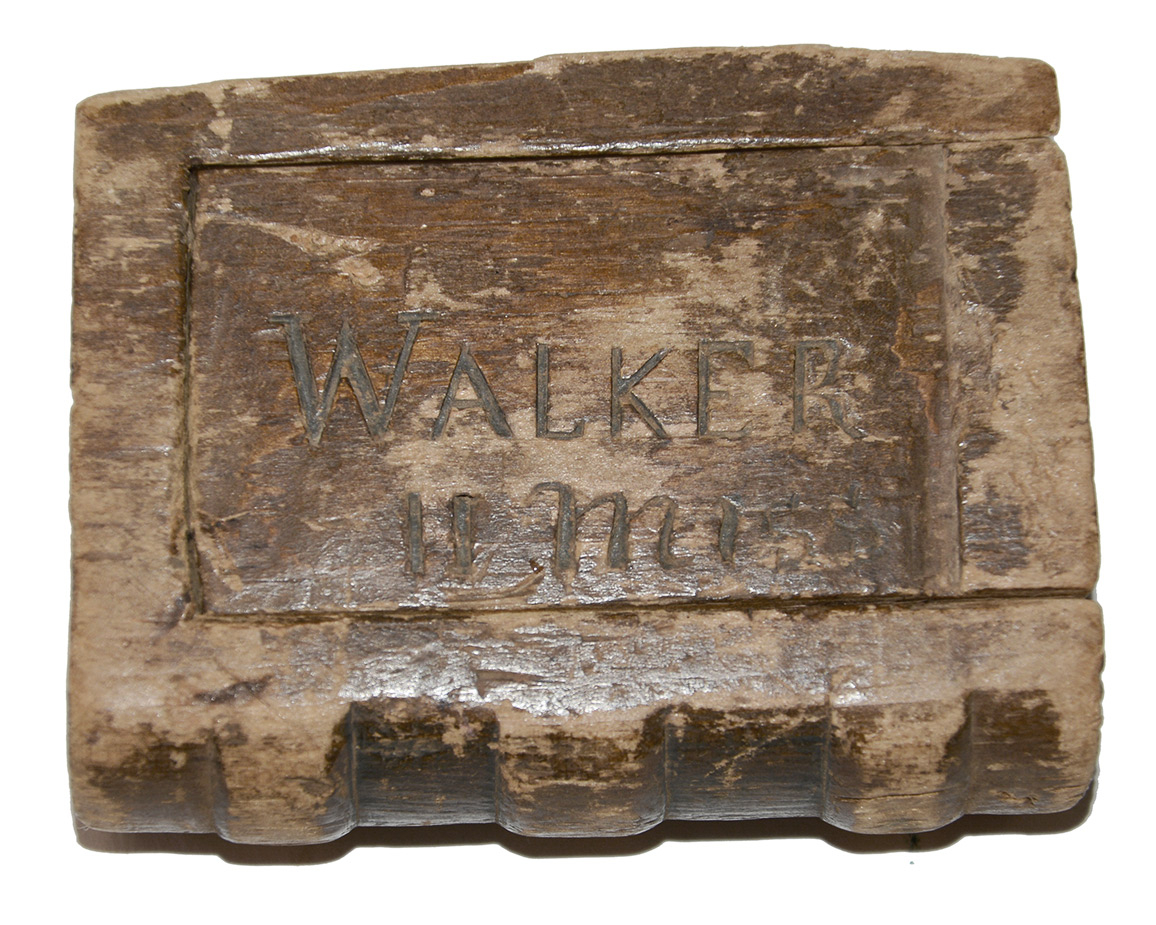
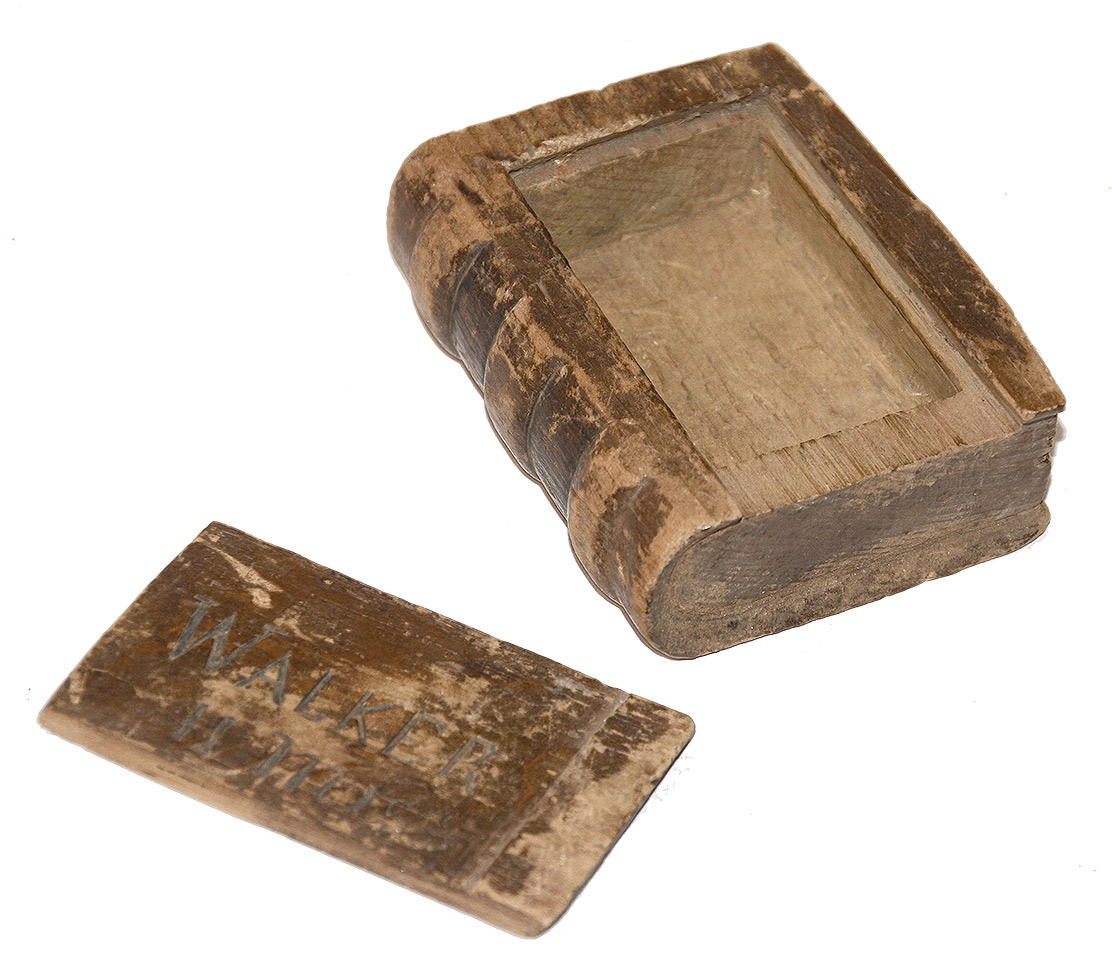
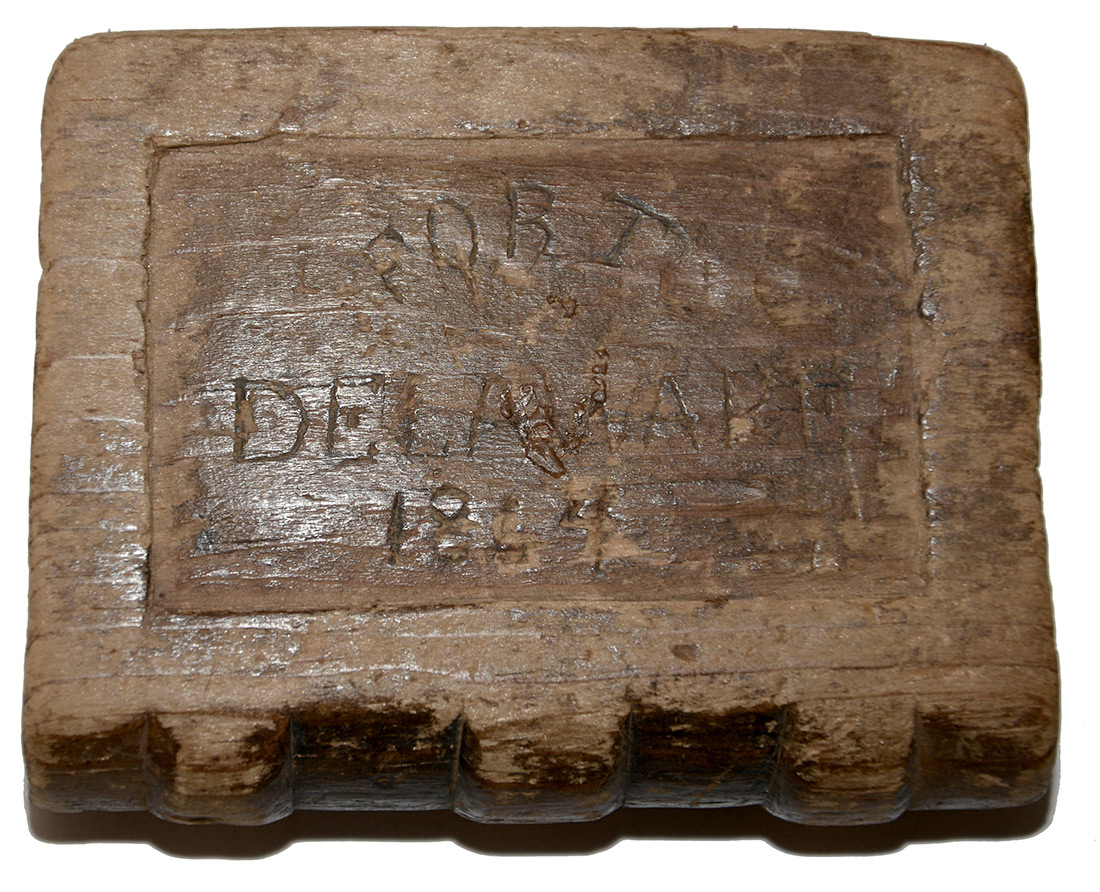
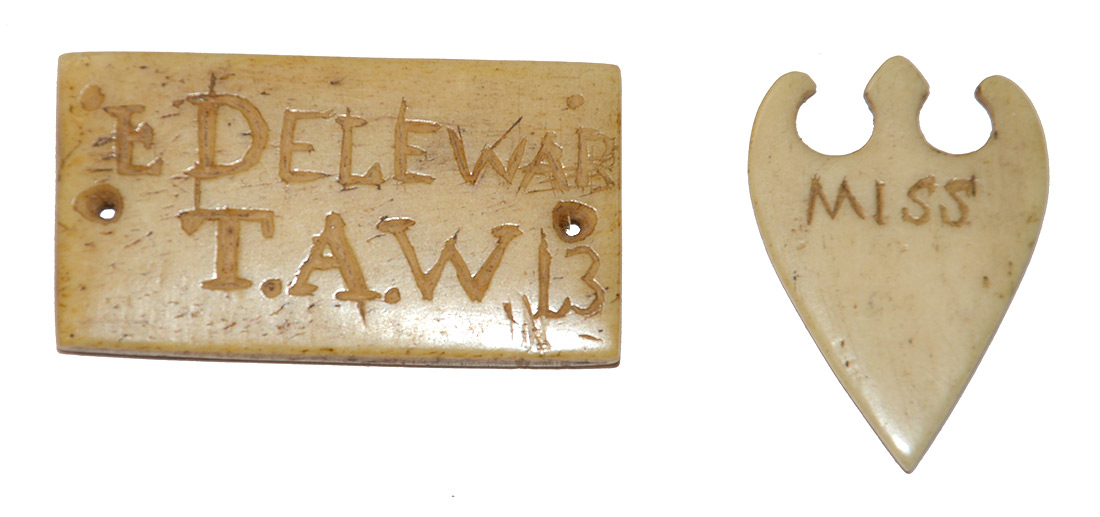
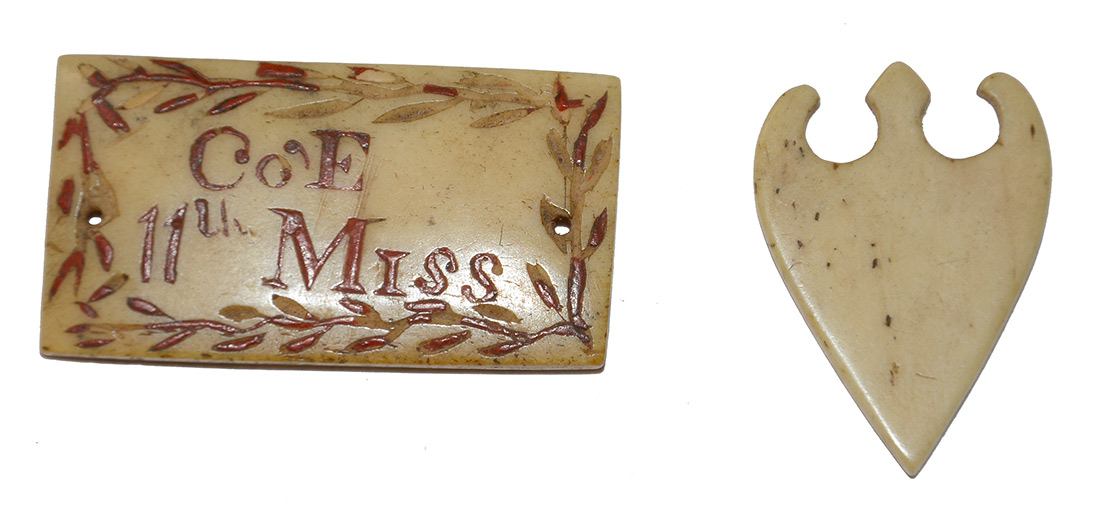
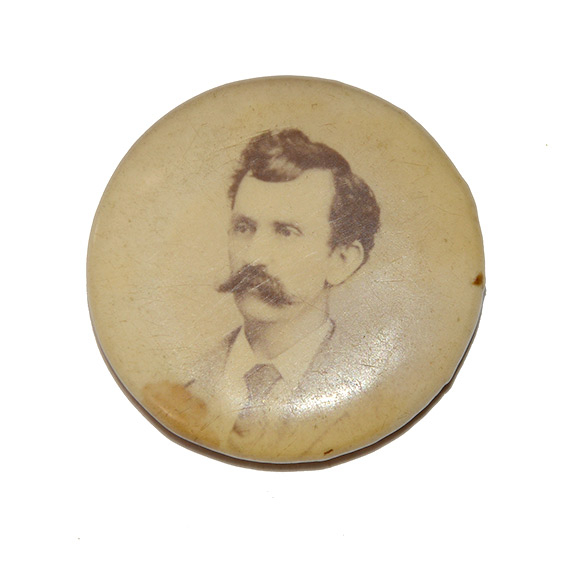
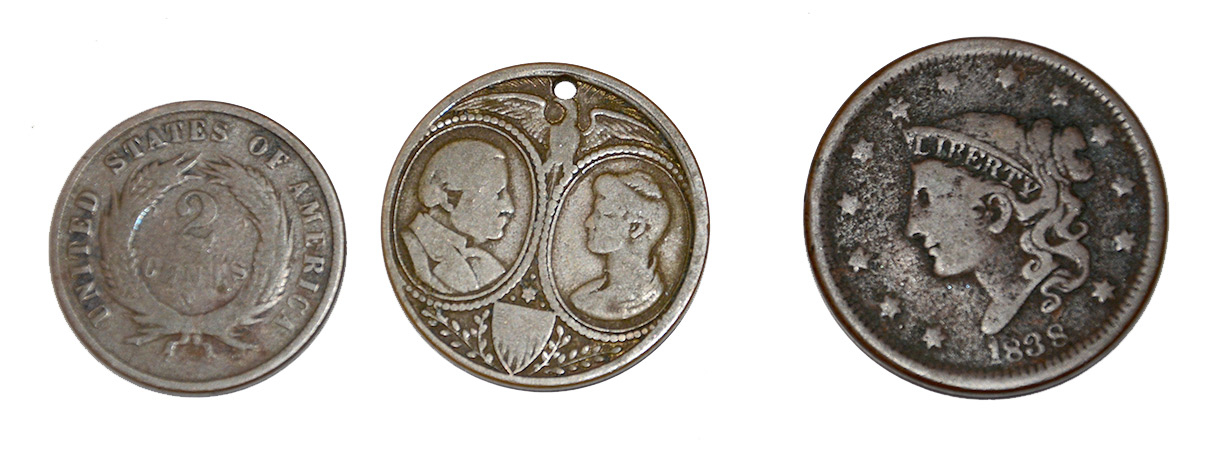
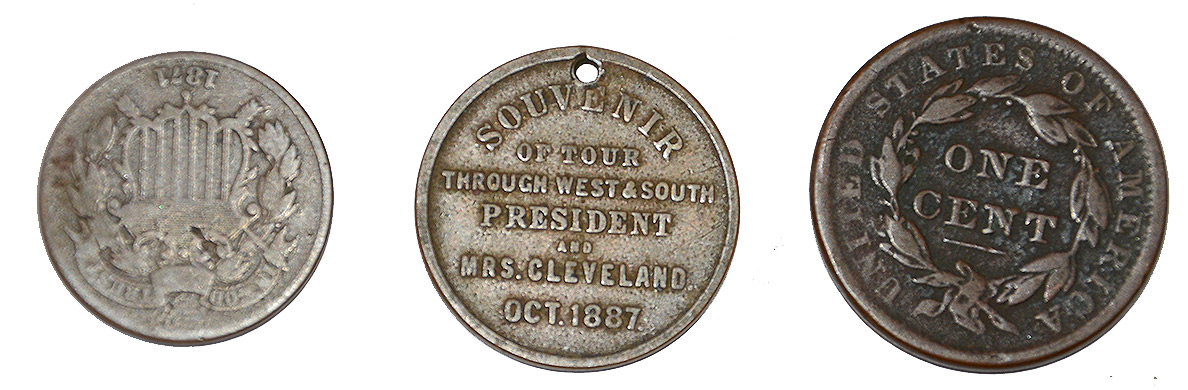
Soldiers of both sides had downtime in camp during which they engaged in various pastimes, carving and whittling among them, creating a whole sub-category of folk art. This was particularly true of prisoners of war, who usually had a lot more time on their hands and thoughts of home. This is a collection of items descended from private Thomas Alexander Walker, who was captured on July 3 at Gettysburg and spent almost two years in the Union prisoner of war camp at Fort Delaware. The group consists of a small wooden box carved to look like a small book, but fitted with a sliding cover with “WALKER / 11 MISS” caved into it in large letters, together with its contents: two coins, a souvenir token, a late photo celluloid button, and two period bone carvings.
The box itself measures 3 ½” x 2 ½” x 1 1/8” and judging from the contents Walker took it home with him. The coins are an 1838 penny and an 1871 2-cent piece. The token is a souvenir of President and Mrs. Cleveland’s 1887 tour of the west and south. The celluloid is unidentified and undated, but of that period. The bone carvings, however, are certainly wartime, contemporaneous with the box, and likely intended to be mounted on it. One is a flat bone carving in the form of a heart-shaped urn or vase, with “MISS” lightly carved across the top. The other is a thicker, cream colored bone rectangle, bearing two small holes on either side to attach it. The back is lightly carved with some stray letters that look like Walker was practicing, but include his initials “T.A.W.” The face is slightly rounded and attractively carved “Co E / 11th MISS” in the center, with a leafy branch border around it, the lettering and the foliate border both colored a muted red.
Thomas Alexander Walker first enlisted at age 24 at Crawfordsville, MS, as a private in the “Prairie Guards,” Capt. J.T.W. Hairston’s company of the 5th Regiment, 1st Brigade Mississippi Volunteers, which was called into state service on Feb. 15, 1861. The company was then later mustered into state service for one year as Company E of the 11th Mississippi Vols. on April 26, 1861, at Corinth, and then into Confederate service at Lynchburg, VA. Extant company muster rolls carry him as “present” throughout 1861 and as having extended his enlistment for another two years on the Jan-Feb 1862 muster roll, and being due a bounty. The regiment as a whole seems then to have reenlisted “for the war” in April 1862.
Part of the regiment saw action at First Manassas with Bee’s brigade. The majority saw their first serious action, however, on the Peninsula at Seven Pines and in the Seven Days Battles at Gaines Mill, where they lost 18 killed, 142 wounded and 3 missing out of some 400 engaged, with some additional casualties at Malvern Hill. At Second Manassas they lost another 4 killed and 55 wounded. In the Antietam Campaign they fought at South Mountain and on September 17 they fought on the Confederate left under Hood, as part of Law’s brigade, losing all three field officers killed or mortally wounded and over 100 of some 200 men on the field. Late in the year they joined Davis’s brigade and were in the Suffolk Campaign under Longstreet.
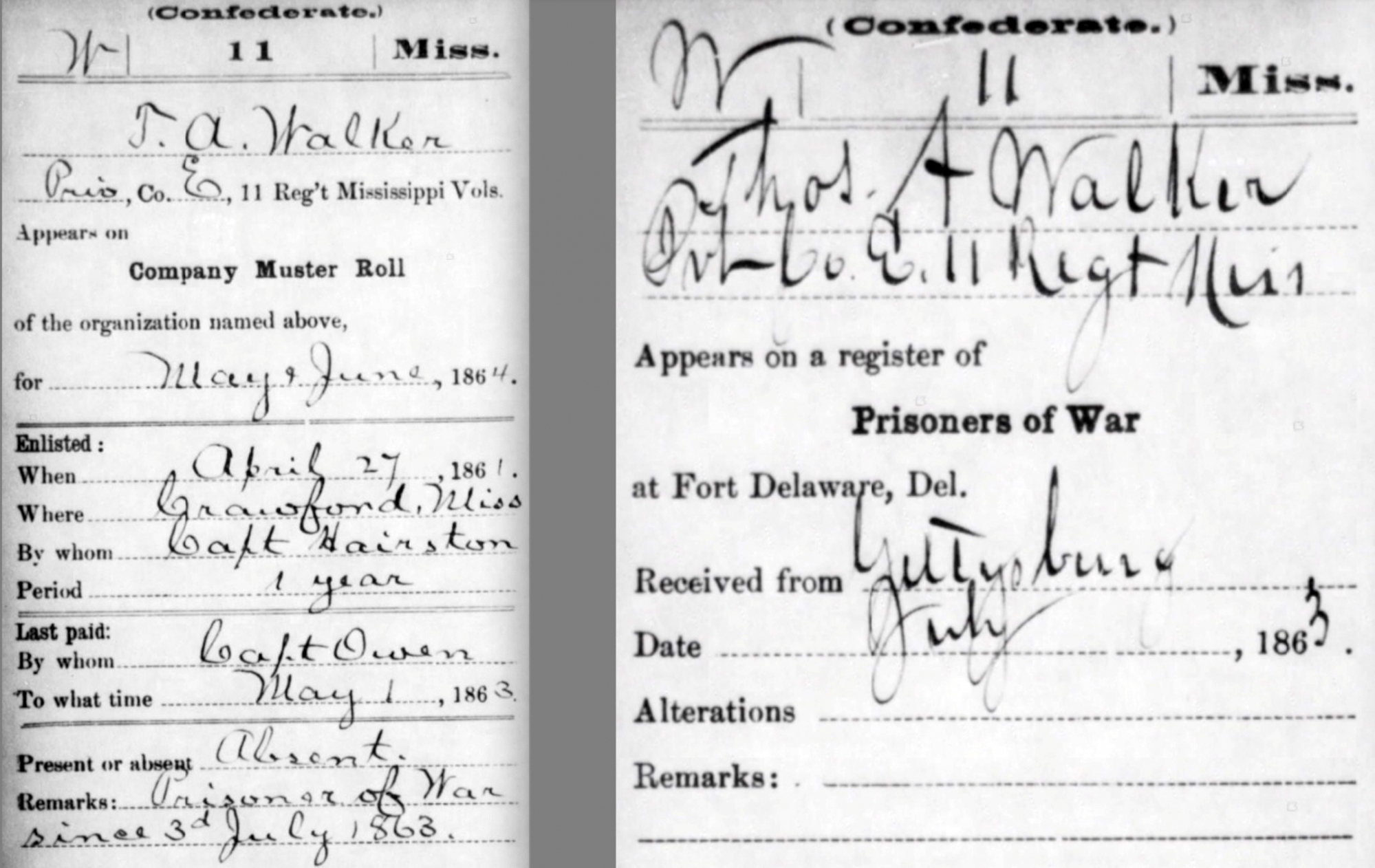
Walker seems to have been wounded in Fall 1862: he appears on a Sept.-Oct. 1862 muster roll for the General Hospital at Liberty, VA, on a regimental return for November 1862 is listed as “absent wounded,” and is listed as admitted to the Henningsen Hospital at Richmond, a private hospital, on Dec. 29, 1862. In any case, he returned to the regiment in time for the Spring 1863 campaign, where his history is more certain. The regiment did not return to the main army in time for Chancellorsville, and escaped the July 1 fighting at Gettysburg by serving as wagon guards, but made up for it on July 3, when they were the left flank regiment in Davis’s brigade, on the left in Pickett’s Charge, bringing 592 men to the battlefield (Busey and Martin) and losing more than half, 312, including their Colonel and Major, a total of 102 killed, 168 wounded and 42 missing or captured, which would include Walker. Their monument at Gettysburg gives a more precise count with an even heavier percentage of loss: “393 combatants; 110 killed or mortally wounded; wounded or wounded and captured 193; captured unwounded 37; non-casualty 53.”
The muster rolls in Walker’s Compiled Military Service Record are clear that he was captured on July 3. A US register of POWs at Fort Delaware listing him as captured July “5,” is likely a transcription error for “3” or simply the date the initial list of Confederate prisoners with names and units was compiled. He remained a prisoner of war for the remainder of the conflict, giving him plenty of reason to kill time with projects like carving this small book. He finally took the Oath of Allegiance at Fort Delaware on June 11, 1865, giving his place of residence as Lowndes County, Miss., and was described as having a dark complexion and hair, blue eyes, and standing 5ft. 8in. tall. Records of his subsequent life are even skimpier, but he might be the Thomas Walker who appears in the 1900 census as a farmer, born in Mississippi in 1837, married and with a daughter born in 1876, the family then living in Pontotoc County, Mississippi.
We have not consulted, Duty, Honor, Valor: The Story of the Eleventh Mississippi Infantry Regiment, by Steven H. Stubbs, (Dancing Rabbit Press, 2000,) but expect there would be additional details or clarification of his record there, so there is lots of room for further research. An Ancestry listing has him wounded July 21, 1861, at First Manassas, citing his service file and the Confederate Veteran. We do not find such a supporting reference in the Confederate Veteran, his service file contains no such reference, and secondary sources indicate only Companies A and E took part in the battle. We suspect this is confusion from his likely wounding in the period of the Second Manassas Campaign as mentioned above.
This is splendid grouping from a soldier in one of the better known Confederate units regiments, one with hard service and one with its own monument at Gettysburg, featuring a statue of their first color-bearer in the action, one of eight to fall in Pickett’s Charge. A plaque on the monument, situated on West Confederate Avenue, reads: “The 11th Mississippi Infantry Regiment, under the command of Col. Francis M. Green and Maj. Reuben O. Reynolds, formed west of the tree line on Seminary Ridge behind Maj. William Pegram’s Battalion of Artillery and immediately south of McMillan’s Woods on July 3, 1863. Shortly after 3:00 p.m., Color Sgt. William O’Brien of Company C, memorialized on this monument, raised the colors and the regiment stepped forward. Although clusters of men reached the stone wall near Brian’s Barn, the attack was driven back with heavy loss . . . “ [sr] [ph:L]
~~~~~~~~~~~~~~~~~~~~~~~~~~~~~~~~~~~
THIS ITEM, AS WITH ALL OTHER ITEMS AVAILABLE ON OUR WEB SITE,
MAY BE PURCHASED THROUGH OUR LAYAWAY PROGRAM.
CLICK HERE FOR OUR POLICIES AND TERMS.
THANK YOU!
Inquire About CONFEDERATE P.O.W. FOLK-ART GROUP: THOMAS A. WALKER 11th MISSISSIPPI, CAPTURED AT GETTYSBURG - PICKETT’S CHARGE!
Most Popular
Historical Firearms Stolen From The National Civil War Museum In Harrisburg, Pa »
Theft From Gravesite Of Gen. John Reynolds »
Selection Of Unframed Prints By Don Troiani »
Fine Condition Brass Infantry Bugle Insignia »
Rare Identified 65Th Ny Sergeant’s Jacket, With Manscript Material: 1St U.s. Chasseurs »
featured item
INSCRIBED CIVIL WAR BOWIE OF ANDREW E. BENSON CO. D, 123rd NYV, TWO BUTTONS, G.A.R. VETERAN’S ID BADGE, CELLULOID PIN AND BOOK BY FELLOW VETERAN R.C. BULL
A nice grouping from a veteran of the 123rd New York, which served from September 1862 to June 1865, seeing action in the eastern and western theatres of war in the 12th/20th Army Corps. The group consists of his bowie knife, typical of those… (534-40). Learn More »
site search