

site search
online catalog
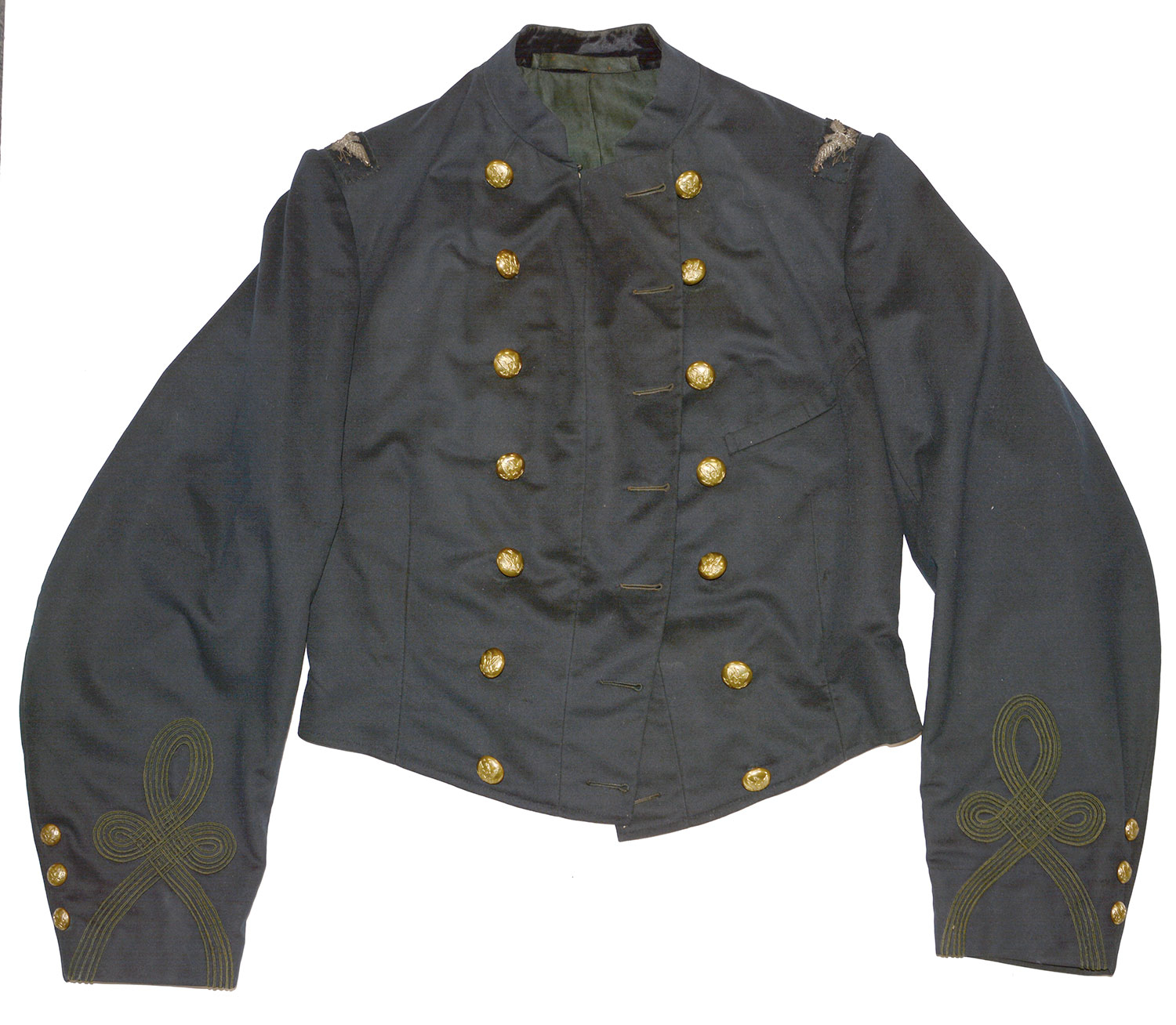
BEAUTIFUL OFFICER’S SHELL JACKET OF COLONEL, LATER BREVET BRIG. GEN. WINSOR B. FRENCH 77th NEW YORK
Hover to zoom
$15,500.00
Quantity Available: 1
Item Code: 1314-06
Shipping: Determined by Method & Location of buyer
To Order:
Call 717-334-0347,
Fax 717-334-5016, or E-mail
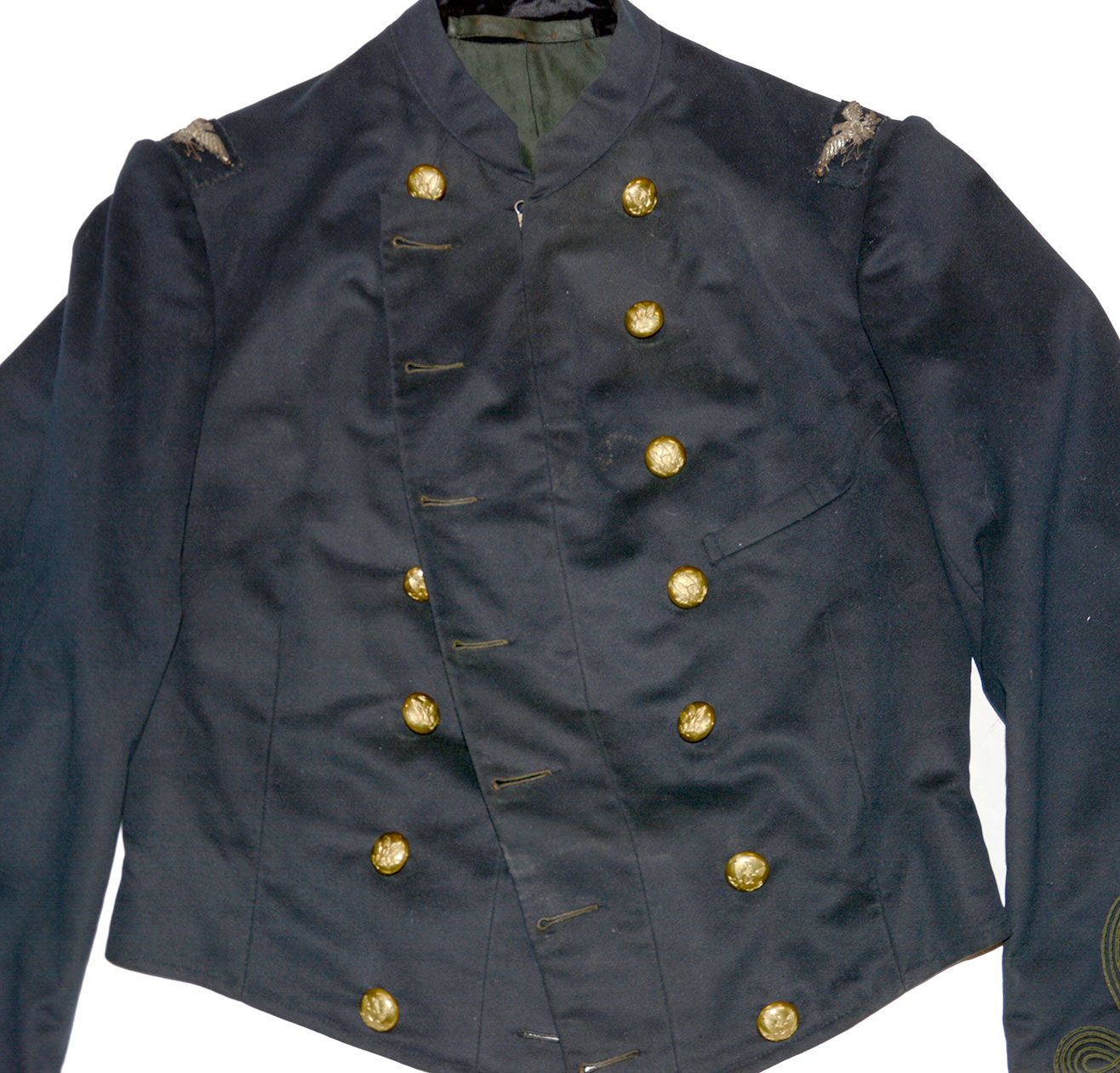
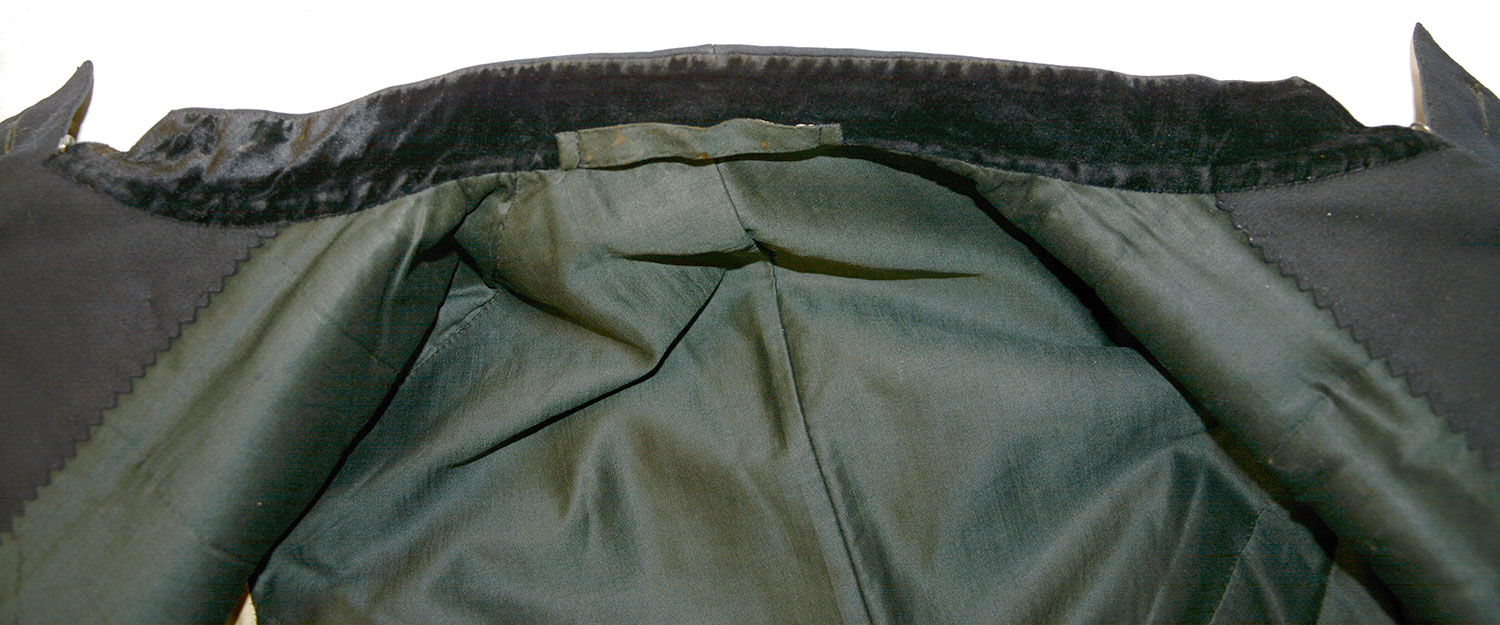
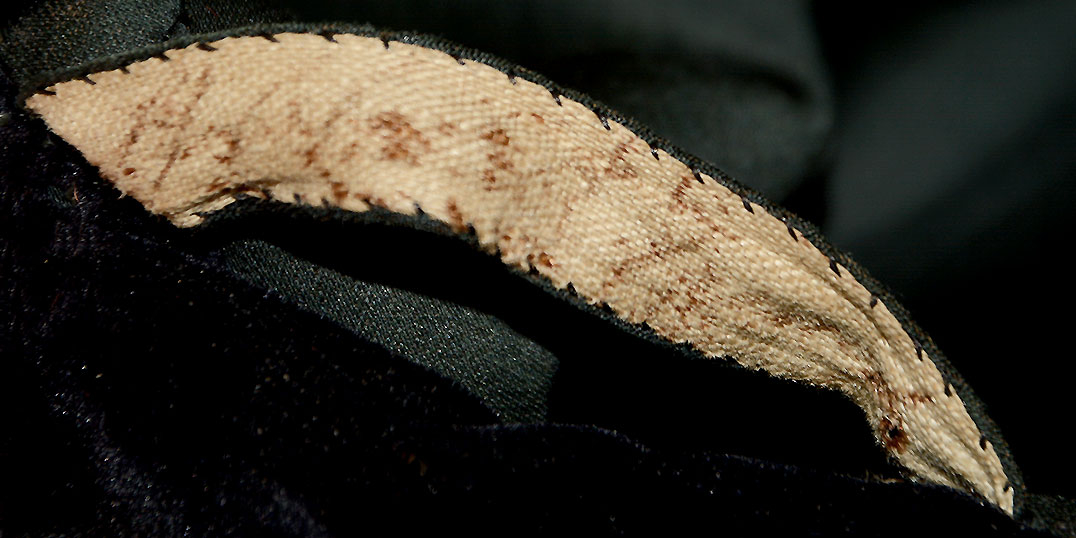
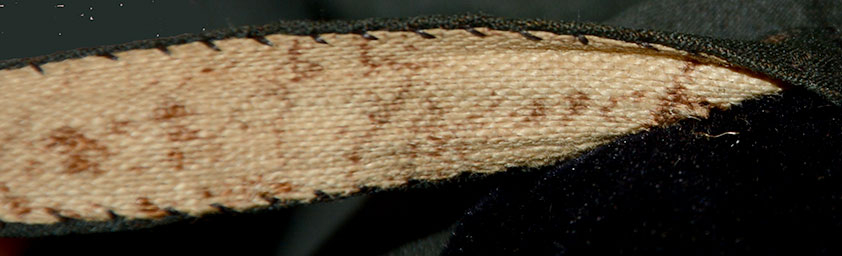
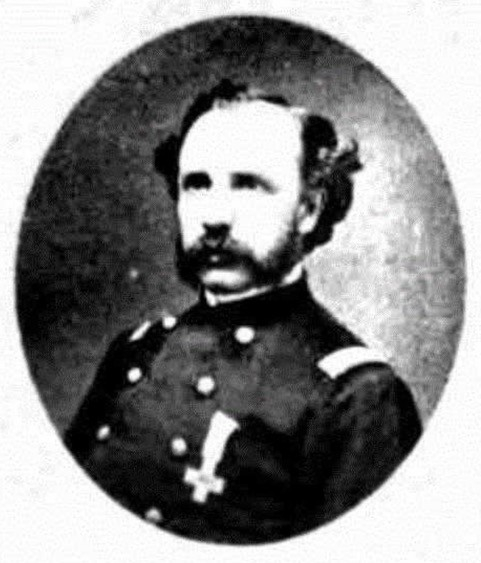
This officer’s shell jacket was worn by Winsor B. French while Colonel of the 77th New York and carries his name in old brown ink on interior of the hanging loop inside the collar. Short jackets like this were non-regulation, but popular with both line and field officers for comfort, though the style is sometimes associated most with mounted officers who wanted to dispense with the long skirts of the regulation frock coat and cut a more dashing figure. Custer was perhaps its foremost exponent. Time-Life “Arms and Equipment of the Union” illustrates a couple of cavalry line officer jackets as well. We show a period photo of an infantry line officer as an example of this style worn in the field.
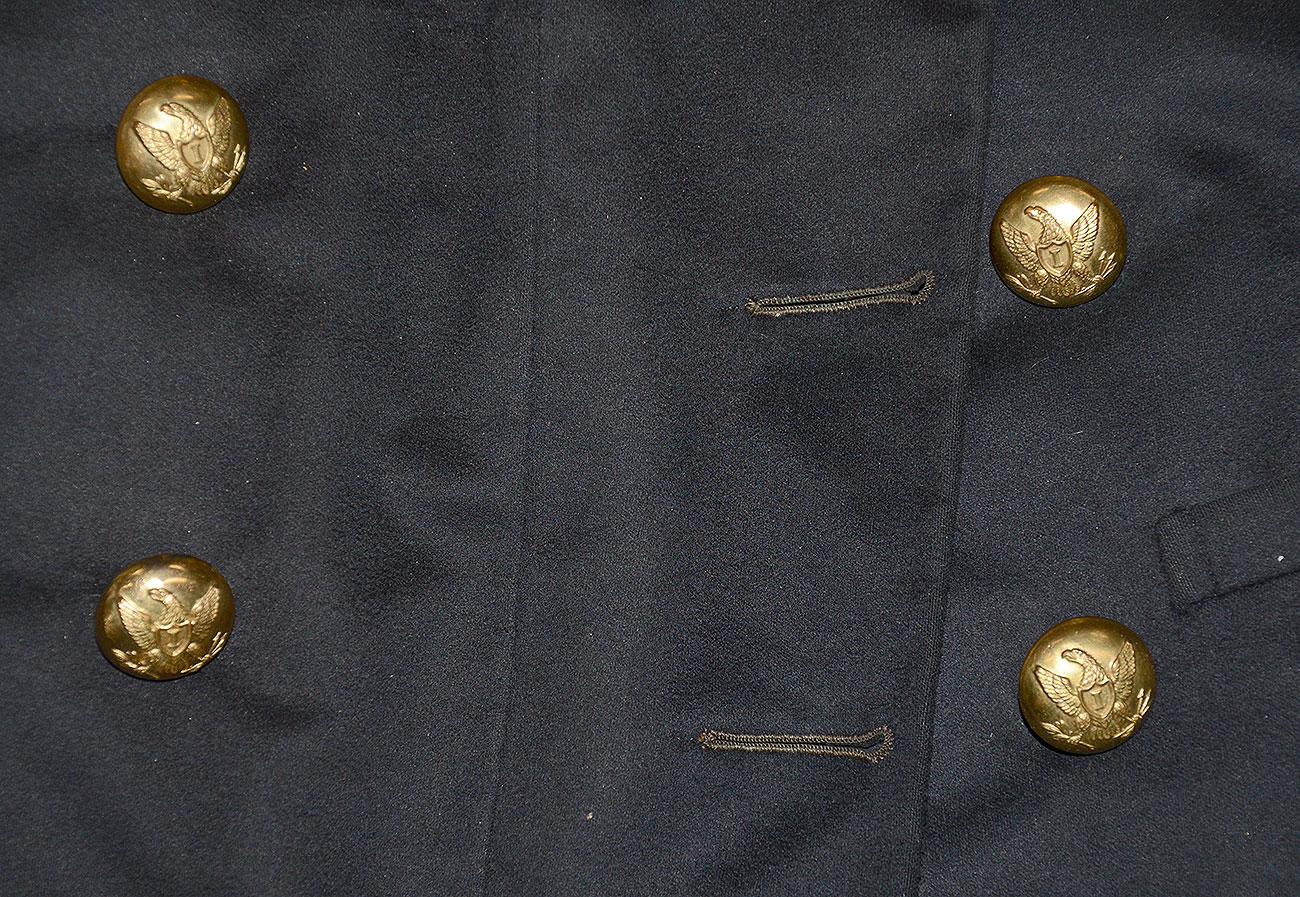
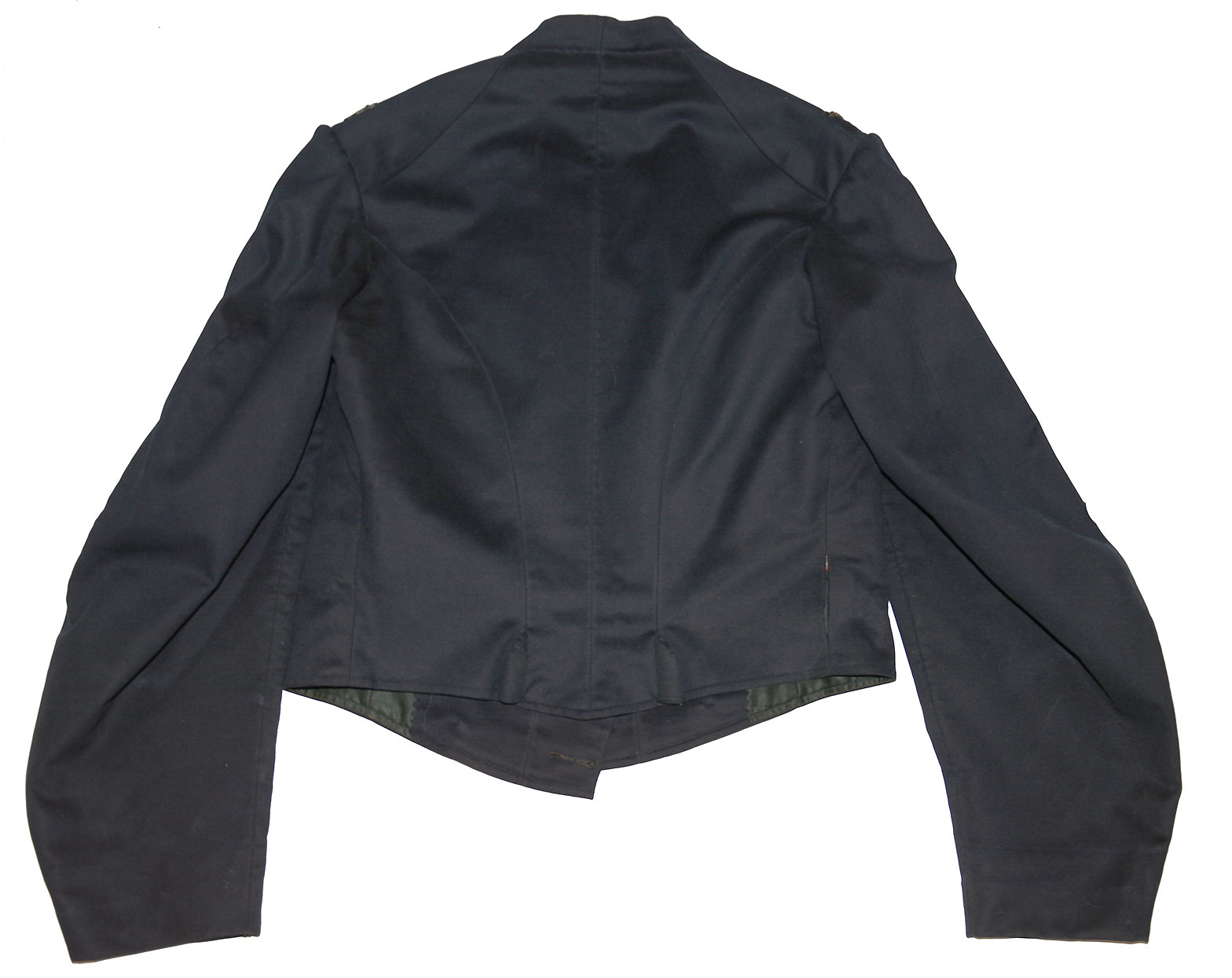
This is in excellent condition, with strong color to the fabric and all buttons are present, showing bright, along with rank insignia, sleeve knots, and even the short cloth bolsters on the rear waist intended to support his waist belt. The jacket is double-breasted, indicating a field-grade officer, made with a six-piece body, and fastened by two rows of large, infantry officer’s “Eagle-I” buttons with Scovill backmarks. The collar stands 1-1/2” tall, is lined with black velvet, and closes at the bottom with a single hook and eye. The hanging loop inside the collar has a black surface like the body lining, but an exposed lighter color fabric on its back showing French’s name in old, brown ink thin letters, with the left portion of the name rubbed, but very clearly “French” on the right, looking down at it from above.
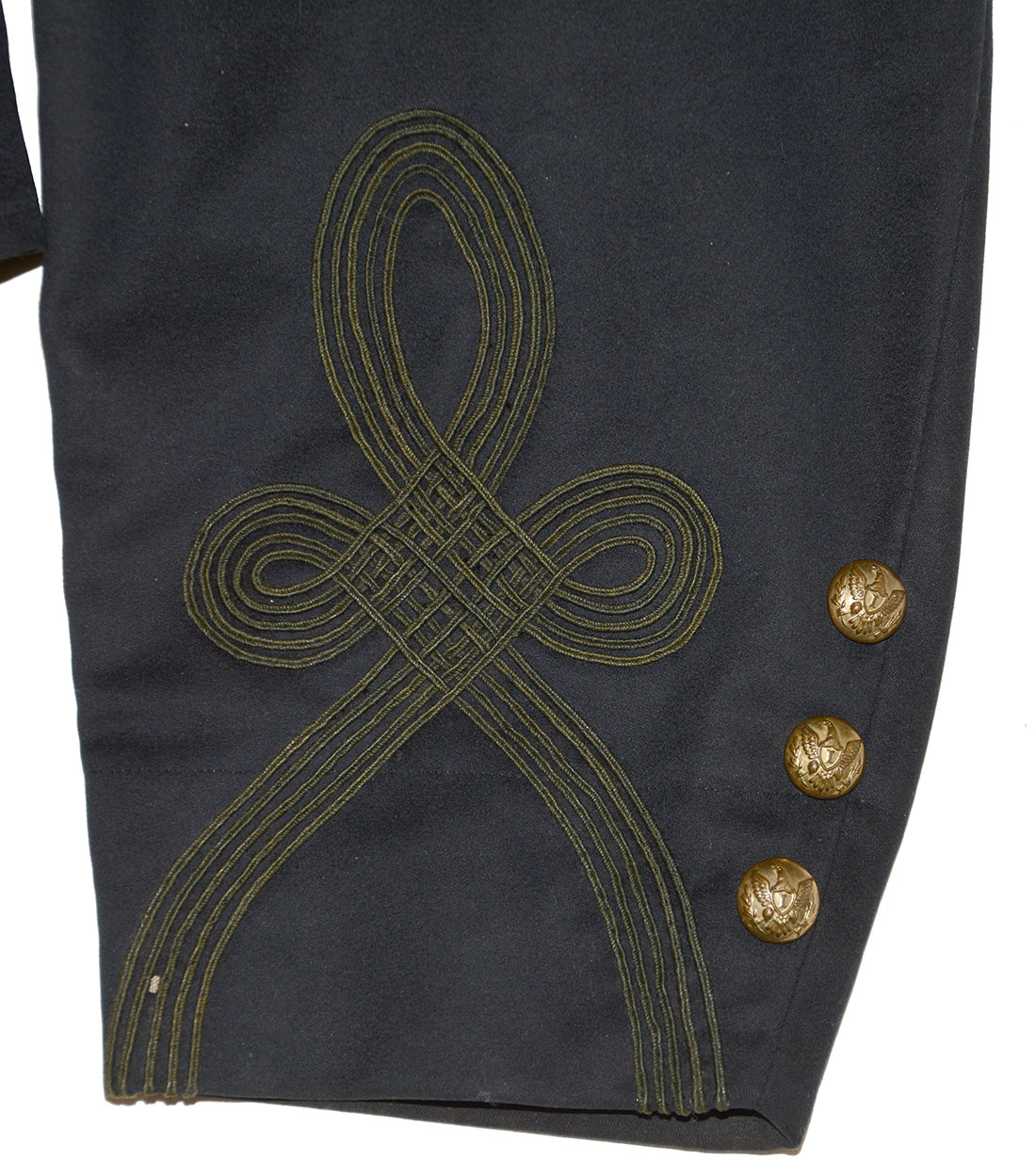
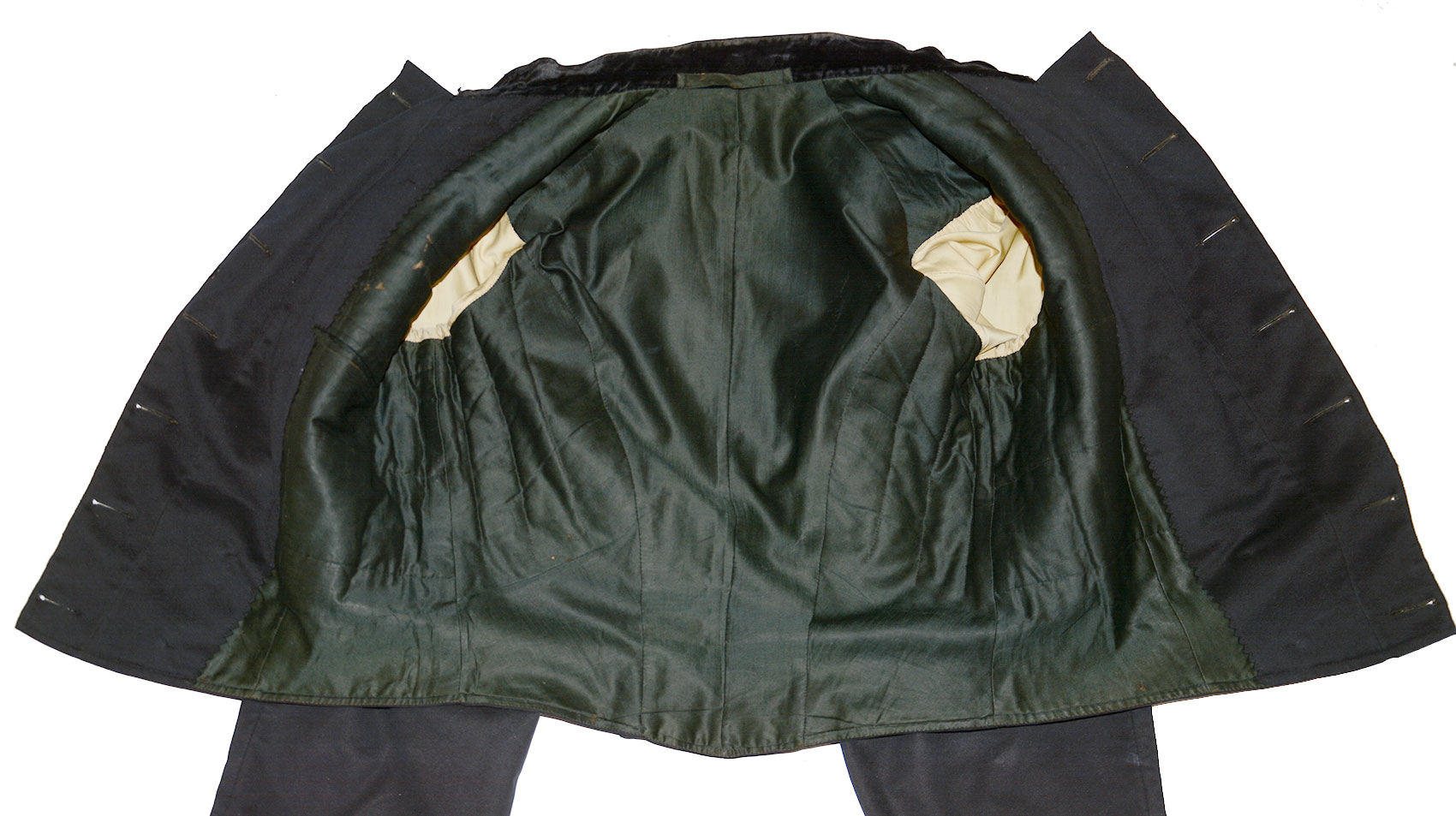
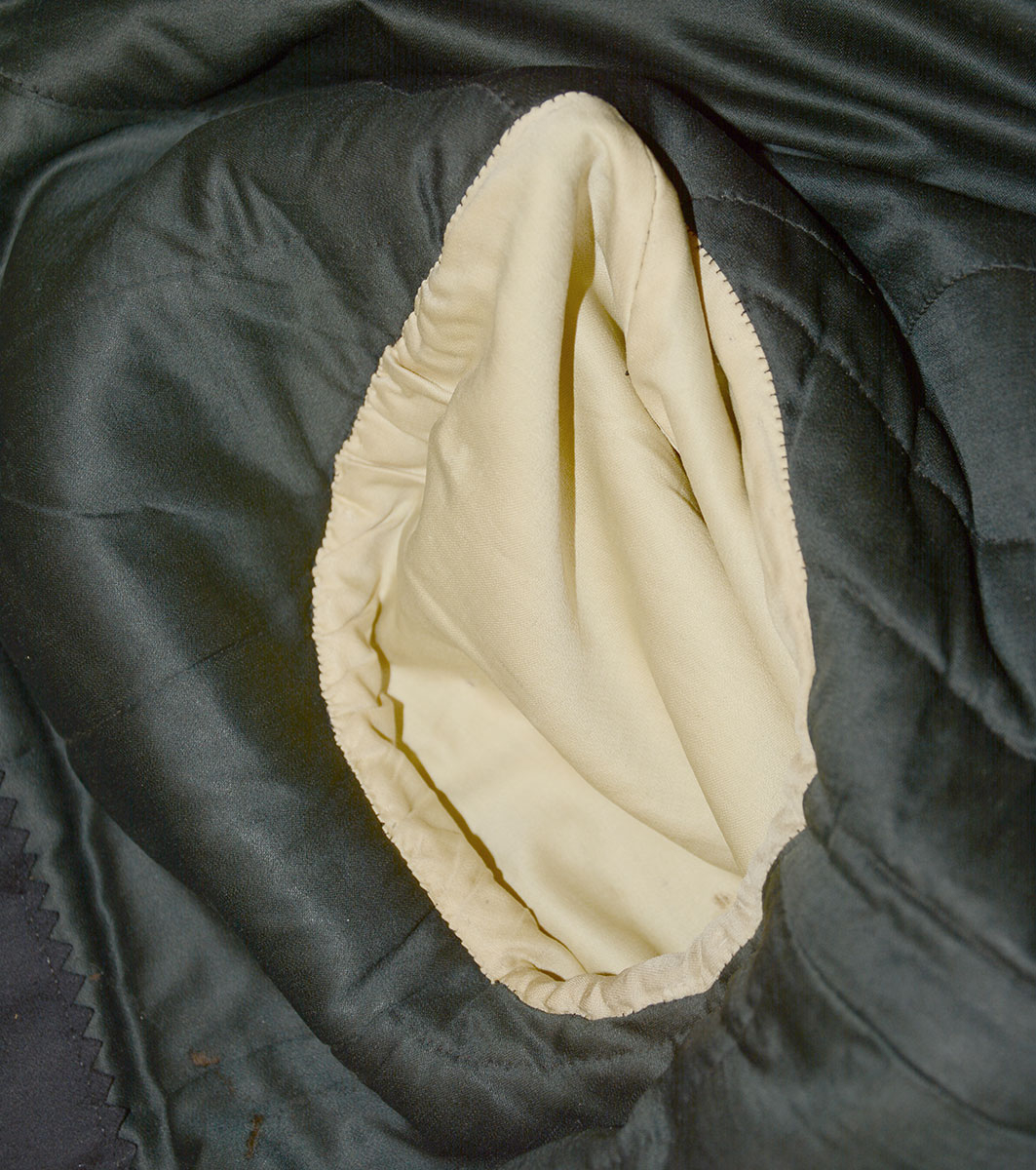
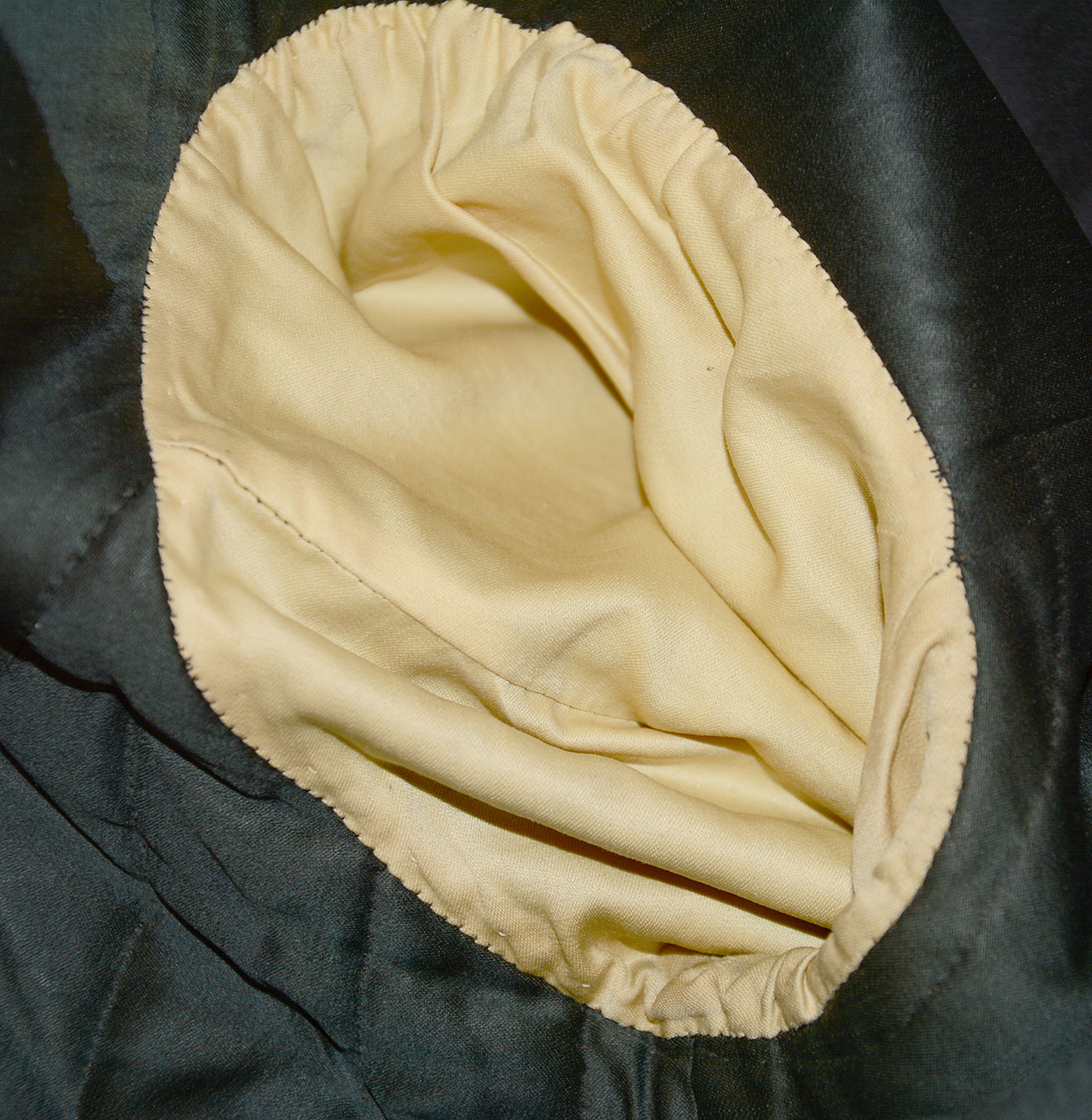
The sleeves are two-piece, with nice 9-1/2” wide elbows and 5” non-functional cuffs, each carrying three small infantry officer Eagle-I buttons. The left breast has an exterior pocket 5” wide, the opening just above the middle button and to its side so as to be accessible when the coat was buttoned, left lapel over right, though both lapels are provided with buttonholes as well as buttons. The interior is fully lined, the back in black and the sides and upper shoulders quilted in green. The inside of the lapels is lined in a blue wool matching the exterior with a pinked edge where it meets the lining of the sides. There is a single interior pocket in the wearer’s right breast. The sleeves are lined in white.
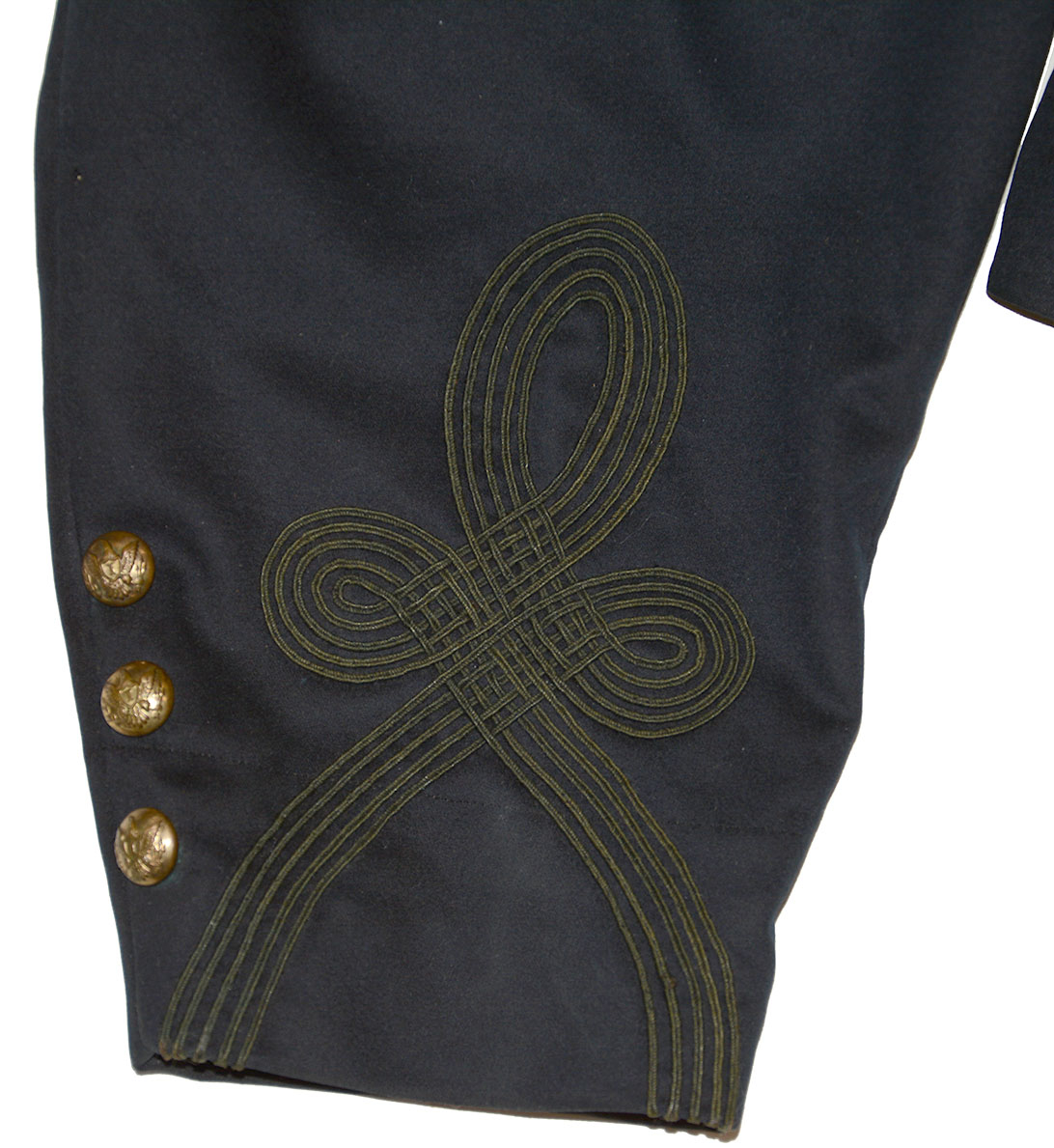
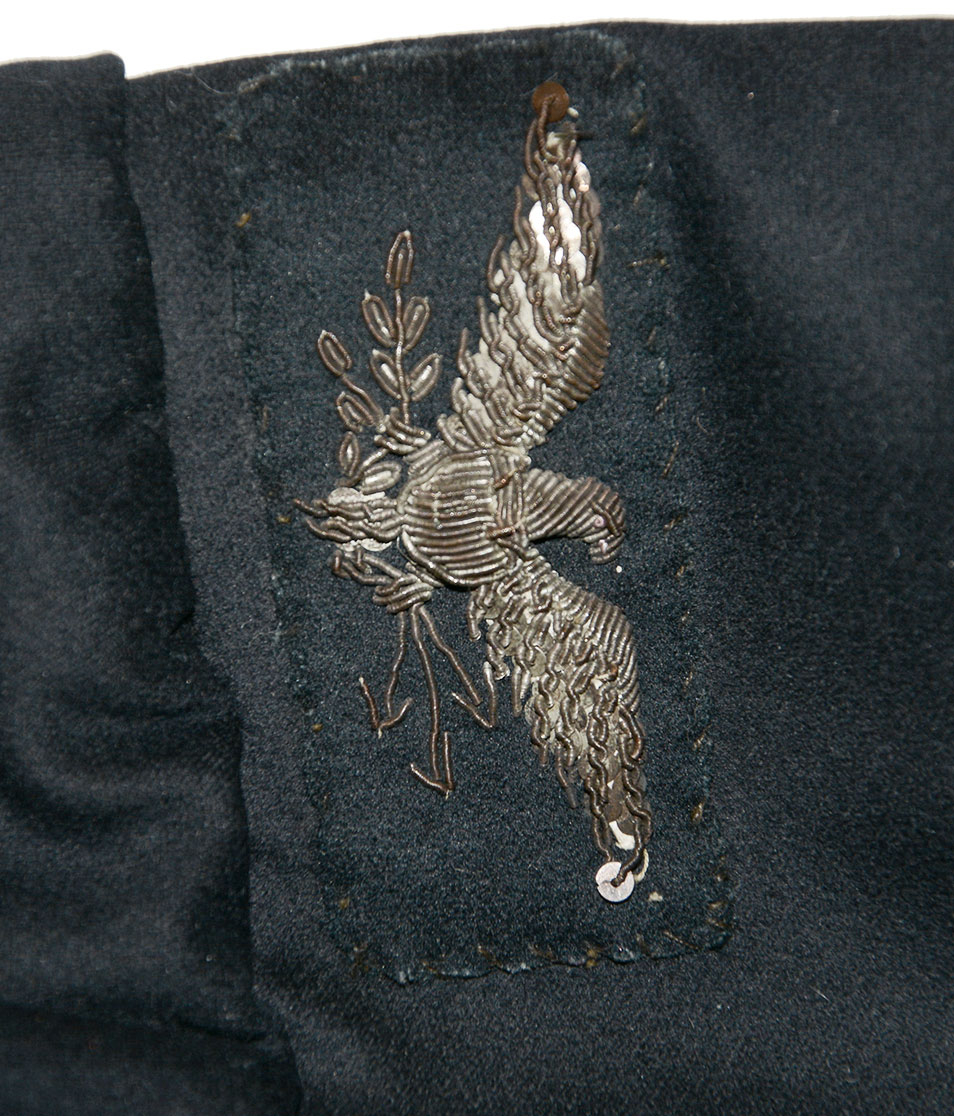
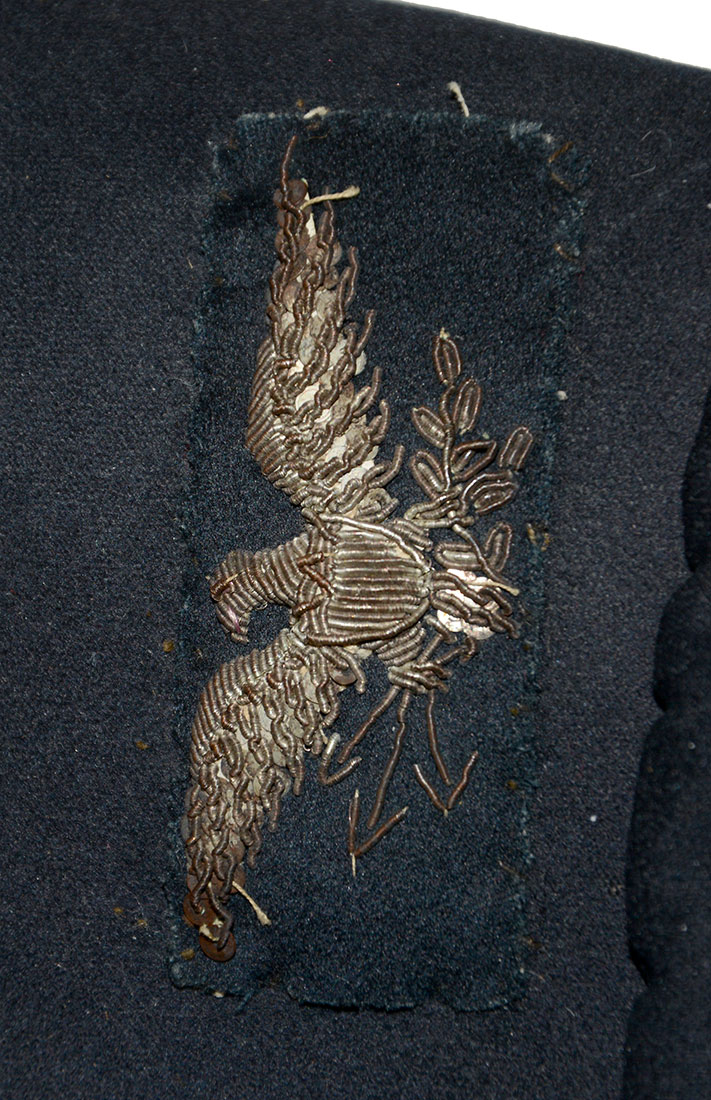
The button arrangement marked French as a field-grade officer. His specific rank is indicated in two ways. First: the lower sleeves are decorated in the manner of an officer’s overcoat with five rows of black mohair braid, 1/16” wide, arranged in a trefoil knot, the number of rows indicating a Colonel. This knot extends from the edge of the cuff on each arm, 7-1/2” up the sleeve and is 4-1/8” at its widest point. (The rows of braid extend up the inside of the cuff, with the blue sleeve fabric turned under for 1” and sewn down where it meets the white sleeve lining.) Second: his rank is also indicated by 2-1/2” wide silver bullion embroidered Colonel’s eagles, having spread wings, US shield on their chests and carrying arrows and olive branch, each embroidered on a dark blue wool patch, matching the jacker, about 1-1/8” by 2-3/4” and sewn on each shoulder near the sleeve. These are essentially shoulder straps without raised bullion-embroidered borders.
This use of subdued rank insignia was officially sanctioned by the War Department in Washington only in General Order #286 of November 22, 1864, stating that officers might dispense with shoulder straps and, “The marks of rank prescribed to be worn on the shoulder-straps will be worn on the shoulder in place of the strap.” This, however, merely recognized established practice that got its start much earlier, perhaps in the western theatre, as documented by General Order No 174 of the Department of the Cumberland, issued on July 25, 1863, even before Brown’s promotion, the relevant portion reading: "...The rectangle of the shoulder-strap being too conspicuous on the field of battle, need not be worn.”
It was a lesson that took some time to sink in and was learned at some cost: French reported he had lost four lieutenants to sharpshooters at Opequon, Third Winchester, in September 1864. In French’s case the subdued rank insignia and black sleeve knots might have helped, though the double row of bright, gilt brass buttons would have marked him out as a field officer to the least observant.
The blue wool exterior has great color and tight seams with the exception of one 2” section of the seam on the lower right back near the waist. We see just one small, pencil eraser size moth nip inside the wearer’s right lapel, near the edge just above the middle buttonhole. We note in passing that in assembling the coat, the cylindrical cloth belt bolsters, 2” long and ¾” in diameter, seem to have been sewn on the rear waist upside down, with tapered ends at the top and flat ends on the bottom, which would seem to have served better as support for a sword belt, though the bolsters in any case would have hindered the jacket from riding up over the belt.
The 77th New York was organized in the Saratoga area, nicknamed the “Saratoga” or “Bemis Heights Regiment,” mustered into US service for 3 years on Nov. 23, 1861, and was mustered out under the command of Winsor French on Dec. 13, 1864, with reenlisted veterans and men with unexpired enlistments consolidated into a battalion that served to June 1865. After the usual breaking-in period around Washington, the regiment served briefly in the 4th Army Corps until May 1862, when it joined the 6th Corps, in which it served until muster out.
Born in Windsor County, Vermont, in 1832, French was living with his family in Wilton, Saratoga County, NY, by 1855. Graduating Tufts College in 1859, he took up law as profession, and on September 24, 1861, at age 29, enrolled with the regiment, serving initially as 1st Lieutenant of Co. D until November 23, the muster-in date of the regiment, when he was promoted to Regimental Adjutant (also a First Lieutenant rank,) perhaps helped by the fact he had worked in the law office of Col. McKean. He was commissioned Major on July 25, 1862, giving him rank from June 1, then to Lieutenant Colonel with a commission dated September 23, 1862, with rank from July 18. He was commissioned Colonel by the Governor on Sept. 5, 1863, with rank from July 27, 1863, the date of McKean’s discharge for disability. Due to an oversight in army paperwork or unavailability of a mustering officer, he was not officially mustered in at that rank before he was discharged. This is something that might have been taken care of postwar records since it affected his pay, but he clearly served at that rank, and was referred to by himself and others both as “Lieutenant Colonel” and “Colonel.” He clearly wore Colonel’s insignia and the jacket shows no indication of another rank – even if the shoulder rank insignia had been different, the five rows of sleeve braid would mark it. A 1999 letter of authenticity accompanying the jacket by uniform authority Jensen says that he read the ink inscription in the hanging tab as “Lt. Col. W.B. French.” Only the last name seems clear to us, but even Jensen’s reading would only indicate French was waiting for his muster-in after being commissioned. An additional indicator that his rank as Colonel was recognized in the field is that his brevet, effective March 13, 1865, “for gallant and meritorious services in the field during the war” was to Brigadier General, the appropriate next grade in rank above Colonel.
The regiment saw action in the Peninsula Campaign starting with Lee’s Mills and the siege of Yorktown. According to a short biography with the jacket, French was in command during its fighting in the Seven Days Battles, which included Garnett’s and Golding’s Farm, Savage Station, White Oak Swamp and Malvern Hill. He was detached on recruiting service during the Antietam Campaign, where the regiment lost 32 in the battle. The regiment was lightly engaged at Fredericksurg, but in May 1863 fought over the ground as Sedgwick tried to link up with Hooker and Chancellorsville, with French playing a prominent part in storming the heights, leading the 77th in taking two artillery pieces and the colors of the 18th Mississippi at the cost of 83 casualties, according to his official report, a copy of which is in the file with the coat. At Gettysburg the regiment was lightly engaged, like most of the 6th Corps, but they were active in the Fall campaigns, by which time he would have received his commission as Colonel.
In Spring 1864 French was reportedly ill from March to mid-May, but back with regiment shortly after Spottsylvania, leading it in the advance on Petersburg beginning in mid-June and then as part of the 6th Corps moving to defend Washington from Jubal Early, during which French was wounded slightly at Fort Stevens, where Lincoln himself was briefly under fire in the Washington defenses. He continued to lead the regiment as it joined the Army of the Shenandoah to deal with Early in the Valley, fighting at Charlestown, Opequon (Third Winchester,) where the 77th suffered 42 casualties and French was wounded a second time- a slight wound to the chin,) followed by Fisher’s Hill, where they lost 5 men, and lastly at Cedar Creek, where they lost another 36 in the fight to turn back the Confederate attack and French found himself in command of the 3rd Brigade, 2nd Division of the 6th Corps after the death of Gen. Bidwell. The file with the jacket includes French’s Official Report of the fighting at Winchester and a Sept. 28, 1864, letter to a Saratoga newspaper describing both Winchester and Fisher’s Hill. French then commanded the regiment in its journey back to the Petersburg front, where he mustered out with it on Dec. 13, 1864.
French returned to the practice of law on his return home, being listed as District Attorney in Saratoga in 1870 and simply as a lawyer in 1880. He seems to have married twice and had at least four children. He passed away in Saratoga Springs in 1910, reportedly as the highest-ranking Civil War veteran in northern New York.
The detailed service record for the regiment in Dyer’s Compendium while French was with it is as follows: Left New York for Washington, D.C., November 28, 1861. Duty in the defenses of Washington, D.C., until March 1862. Advance on Manassas, Va., March 10. Ordered to the Virginia Peninsula March 22. Near Lee's Mills April 5. Siege of Yorktown April 5-May 4. Lee's Mills April 16. Battle of Williamsburg May 5. Mechanicsville May 23–24 and June 24. Seven Days Battles before Richmond June 25-July 1. Garnett's Farm June 27. Garnett's and Golding's Farms June 28. Savage's Station June 29. White Oak Swamp and Glendale June 30. Malvern Hill July 1. At Harrison's Landing until August 16. Movement to Fort Monroe, then to Centreville, August 16–28. In works at Centreville August 28–31. Assist in checking Pope's rout at Bull Run August 30, and cover retreat to Fairfax Court House September 1. Maryland Campaign September 6–22. Crampton's Pass, South Mountain, September 14. Battle of Antietam September 16–17. Duty in Maryland until October 29. Movement to Falmouth, Va., October 29-November 19. Union November 2–3. Battle of Fredericksburg December 12–15. At Falmouth until April 27, 1863. "Mud March" January 20–24. Chancellorsville Campaign April 27-May 6. Operations about Franklin's Crossing April 29-May 2. Battle of Maryes Heights, Fredericksburg, May 3. Salem Heights May 3–4. Banks' Ford May 4. Deep Run Ravine June 5–13. Battle of Gettysburg July 2–4. Pursuit of Lee July 5–24. Duty on line of the Rappahannock until October. Bristoe Campaign October 9–22. Advance to line of the Rappahannock November 7–8. Rappahannock Station November 7. Mine Run Campaign November 26-December 2. Duty near Brandy Station until May 1864. Demonstration on the Rapidan February 6–7. Campaign from the Rapidan to the James River May 3-June 15. Battle of the Wilderness May 5–7. Spotsylvania May 8–12. Spotsylvania Court House May 12–21. Assault on the Salient or "Bloody Angle" May 12. North Anna River May 23–26. On line of the Pamunkey May 26–28. Totopotomoy May 28–31. Cold Harbor June 1–12. Before Petersburg June 17–18. Siege of Petersburg June 17 to July 9. Jerusalem Plank Road, Weldon Railroad, June 22–23. Moved to Washington, D.C., July 9–11. Repulse of Early's attack on Fort Stevens and the northern defenses of Washington July 11–12. Sheridan's Shenandoah Valley Campaign August 7-November 28. Gilbert's Ford, Opequon Creek, September 13. Battle of Winchester September 19. Fisher's Hill September 22. Battle of Cedar Creek October 19. Duty in the Shenandoah Valley until December. Moved to Washington, D.C., then to Petersburg, Va., December 13–16.
Phisterer reports their battle losses up to that point as 6 officers and 56 men killed, 3 officers and 40 men mortally wounded, and 21 officers and 252 men wounded, in addition to 4 officers and 73 men listed as missing.
The file accompanying the jacket includes: Les Jensen’s 1999 letter of analysis and authenticity mentioned above; a modern 6-page biography focusing on his military record; a 4-page history of the 77th NY published in America’s Civil War; Phisterer’s history of the unit; Roger Hunt’s entry for French in Brevet Brigadier Generals; Dyer’s Compendium entry for the 77th NY; French’s CW Data entry; a dealer’s catalog entry for the jacket; OR reports by French; text for a display panel for the jacket; and copies of Heitman’s and Phisterer’s entries for French.
This is a great Civil War uniform with lots of history and tremendous eye-appeal. [sr][ph:L]
~~~~~~~~~~~~~~~~~~~~~~~~~~~~~~~~~~~
THIS ITEM, AS WITH ALL OTHER ITEMS AVAILABLE ON OUR WEB SITE,
MAY BE PURCHASED THROUGH OUR LAYAWAY PROGRAM.
CLICK HERE FOR OUR POLICIES AND TERMS.
THANK YOU!
Inquire About BEAUTIFUL OFFICER’S SHELL JACKET OF COLONEL, LATER BREVET BRIG. GEN. WINSOR B. FRENCH 77th NEW YORK
Most Popular
Historical Firearms Stolen From The National Civil War Museum In Harrisburg, Pa »
Theft From Gravesite Of Gen. John Reynolds »
Selection Of Unframed Prints By Don Troiani »
Fine Condition Brass Infantry Bugle Insignia »
Rare Identified 65Th Ny Sergeant’s Jacket, With Manscript Material: 1St U.s. Chasseurs »
featured item
THE FROCK COAT AND SASH OF COLONEL WILLIAM McCOMB, 14TH TENNESSEE INFANTRY – WIA SHARPSBURG & CHANCELLORSVILLE
William McComb was a Pennsylvanian by birth. At the age of 26 he moved to Tennessee here he engaged in business. When the Civil War began he enlisted in the 14th Tennessee Infantry soon rising to a 2nd Lieutenant. He fought at Cheat Mountain in 1861… (1268-047). Learn More »
site search