


site search
online catalog
ELEGANT 1870’S GREEN SILK DRESS
Hover to zoom
$1,500.00
Quantity Available: 1
Item Code: 1307-36
Shipping: Determined by Method & Location of buyer
To Order:
Call 717-334-0347,
Fax 717-334-5016, or E-mail
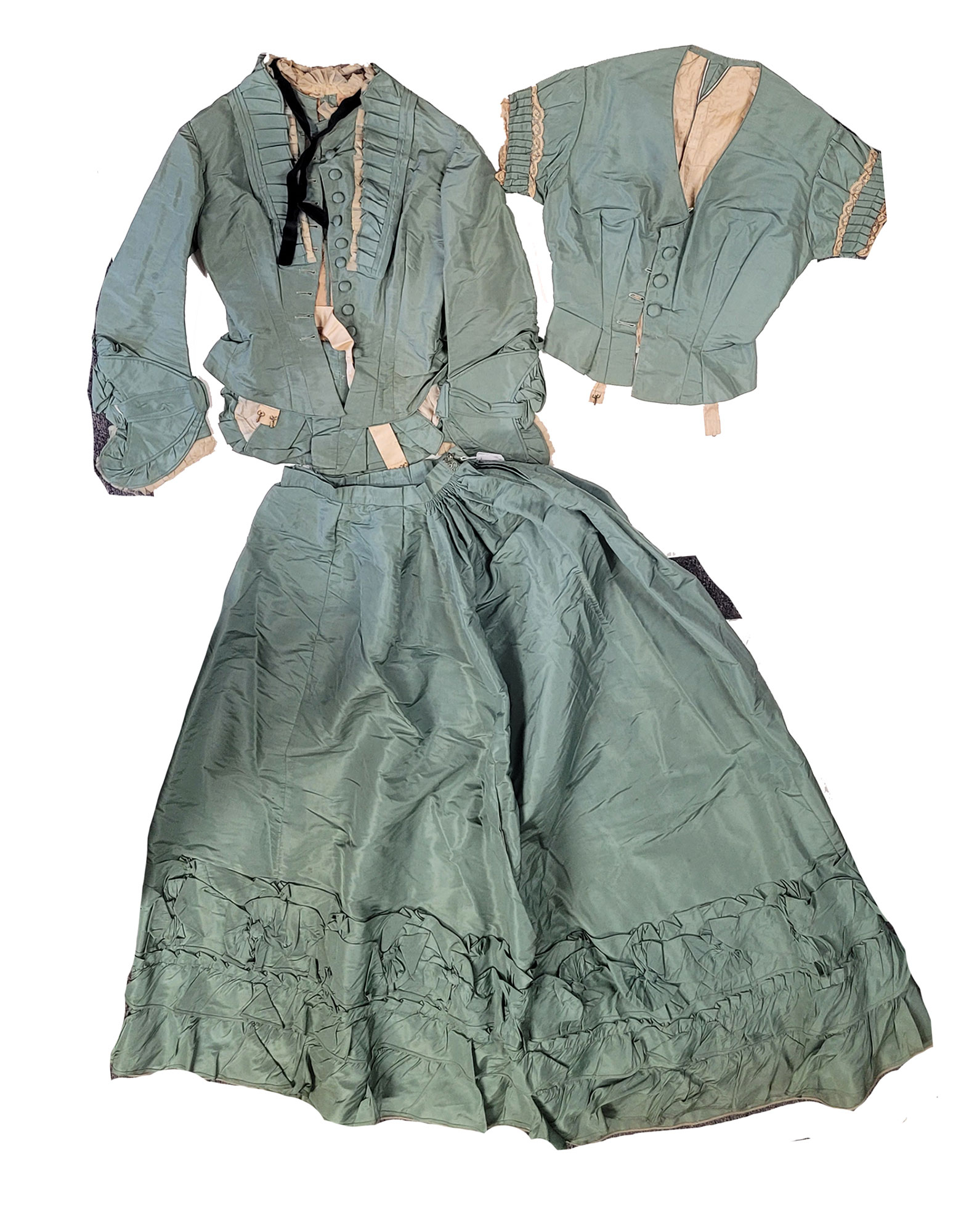
An elegant 1870s green silk dress, with two bodices, overskirt, and skirt, from the Texas Civil War Museum. The dress is monochromatic, with the emphasis on the excellent draping and embellishments. Either of the bodices can be worn with the skirt, with or without the overskirt, creating several different looks from the four pieces.
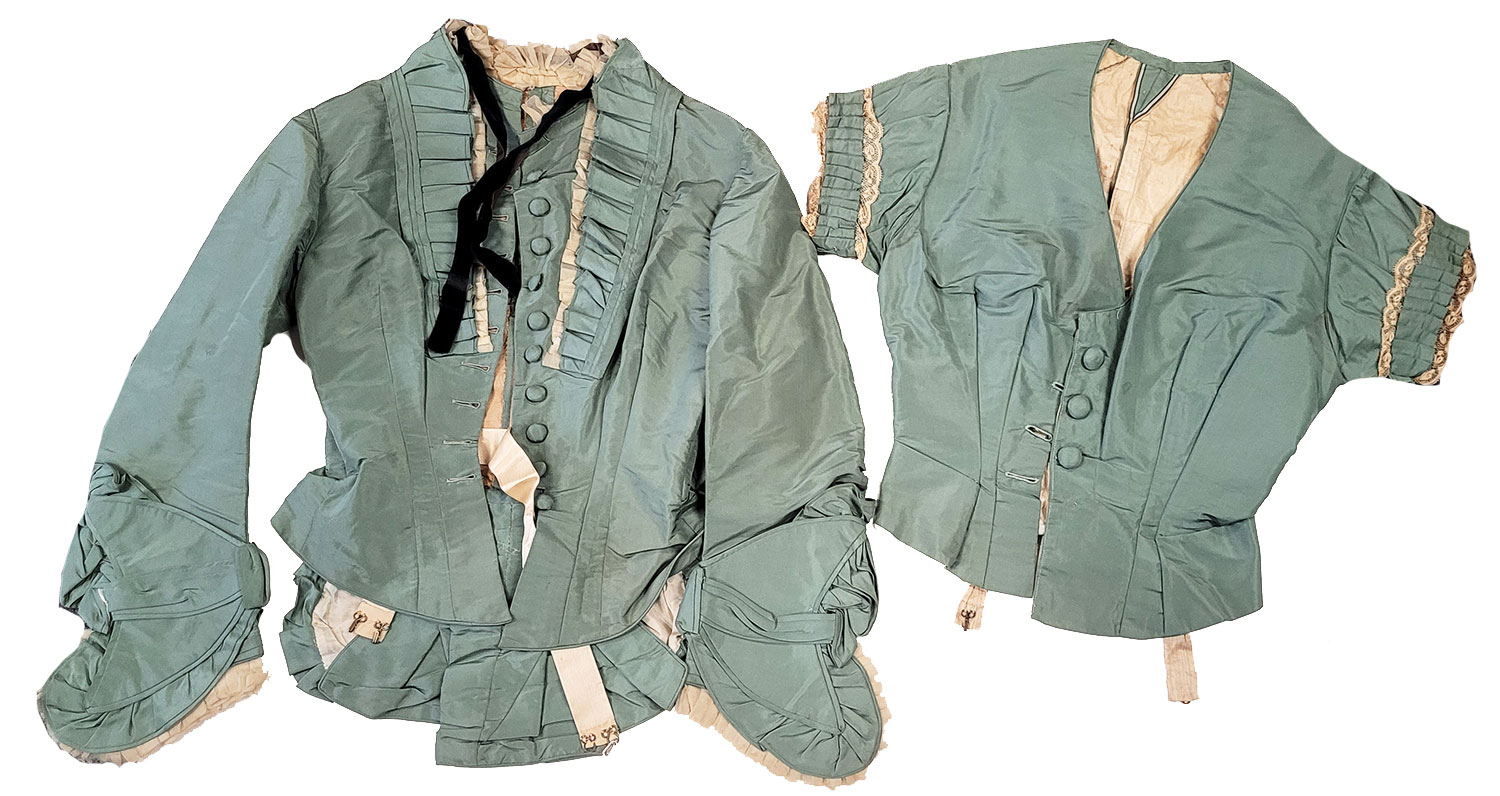
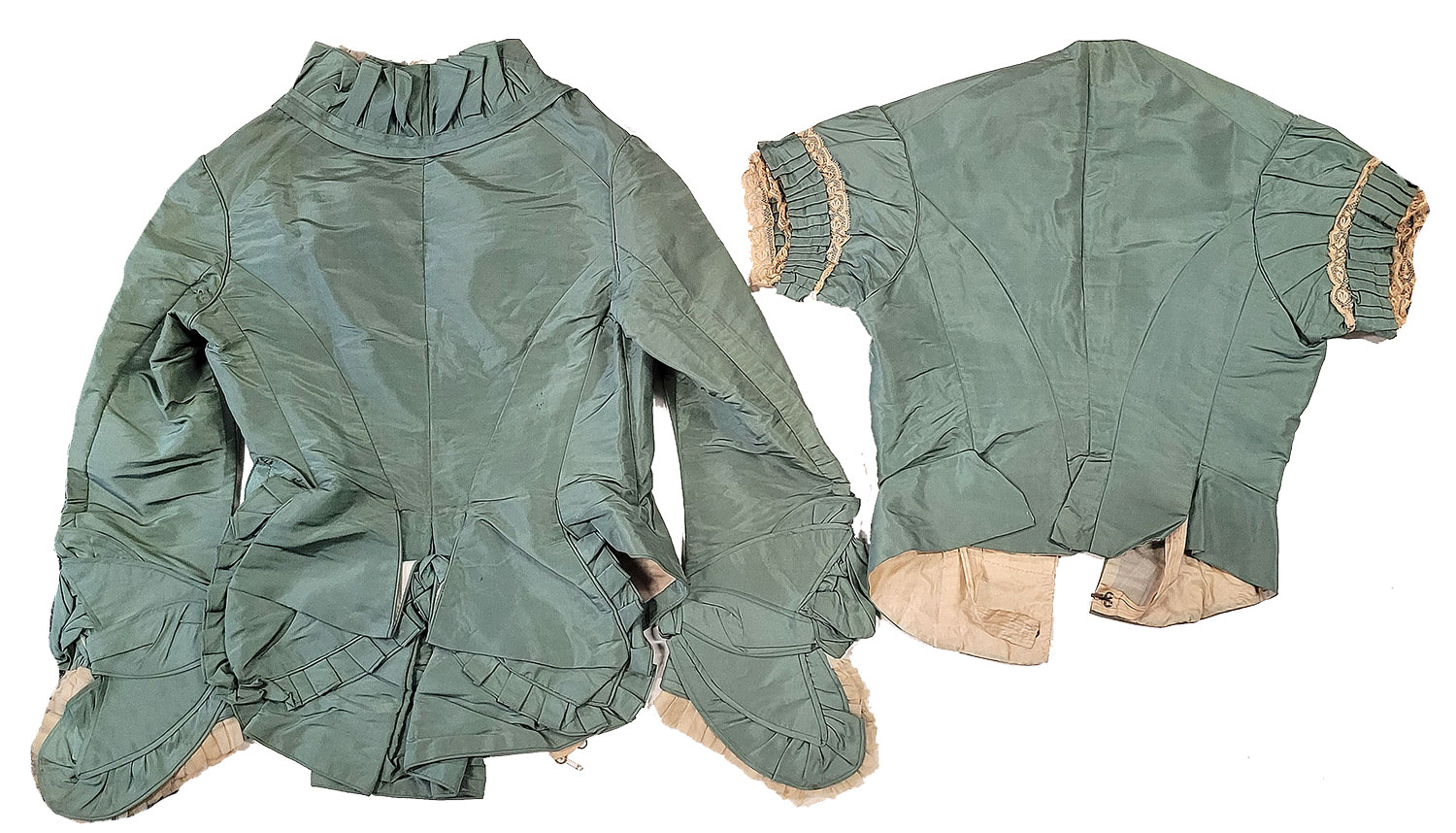
The day bodice is cut with a basque in the front and a peplum in the back. It has a round neckline with a small standing collar; the center front closes with ten self-fabric covered buttons. Silk ruching of spaced box pleats set in a V frame the neckline and the top of the bodice. A box-pleated ivory silk ruche peaks out from underneath the silk ruching. A black silk velvet ribbon is sewn to the back of the neckline, with long ends that can tie in the front in a bow. The edges of the peplum in the back are accented with bias binding, two large fabric loops, and a box pleated edging. The long 2-piece sleeves are shaped at the elbow and flared at the wrist. The bottom of each sleeve ends in a gauntlet cuff accented with ruffles on the edges and a fabric bow. Ivory silk box pleated organza ruffles peek out from the bottom of the sleeves. The bodice is lined, boned, and has a ribbon waist stay.
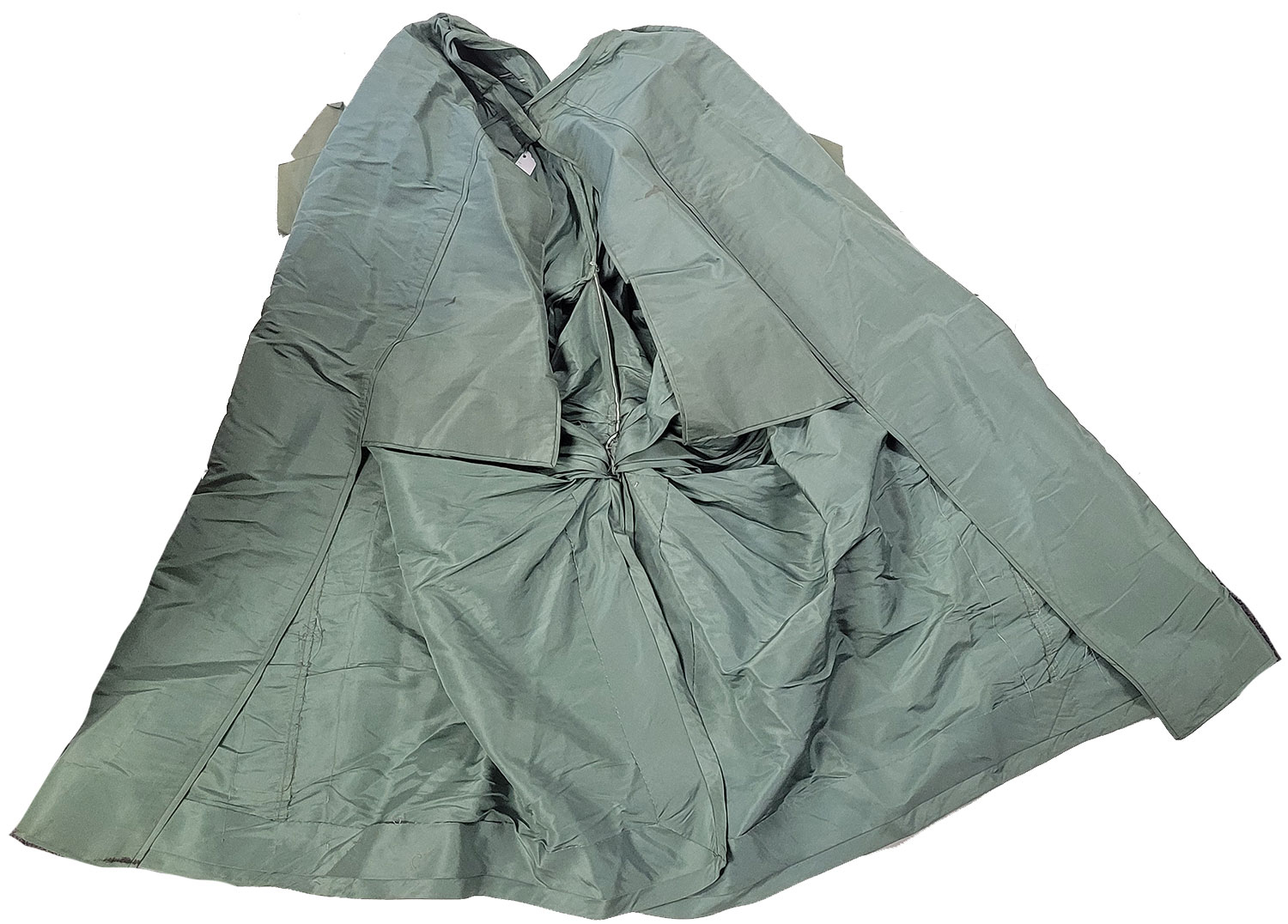
The evening basque bodice has a deep V-neckline and a front opening that closes with fabric-covered buttons. The short, gathered sleeves are finished with a pleated ruche and ivory lace. The bodice is lined, boned, and has a linen waist stay.
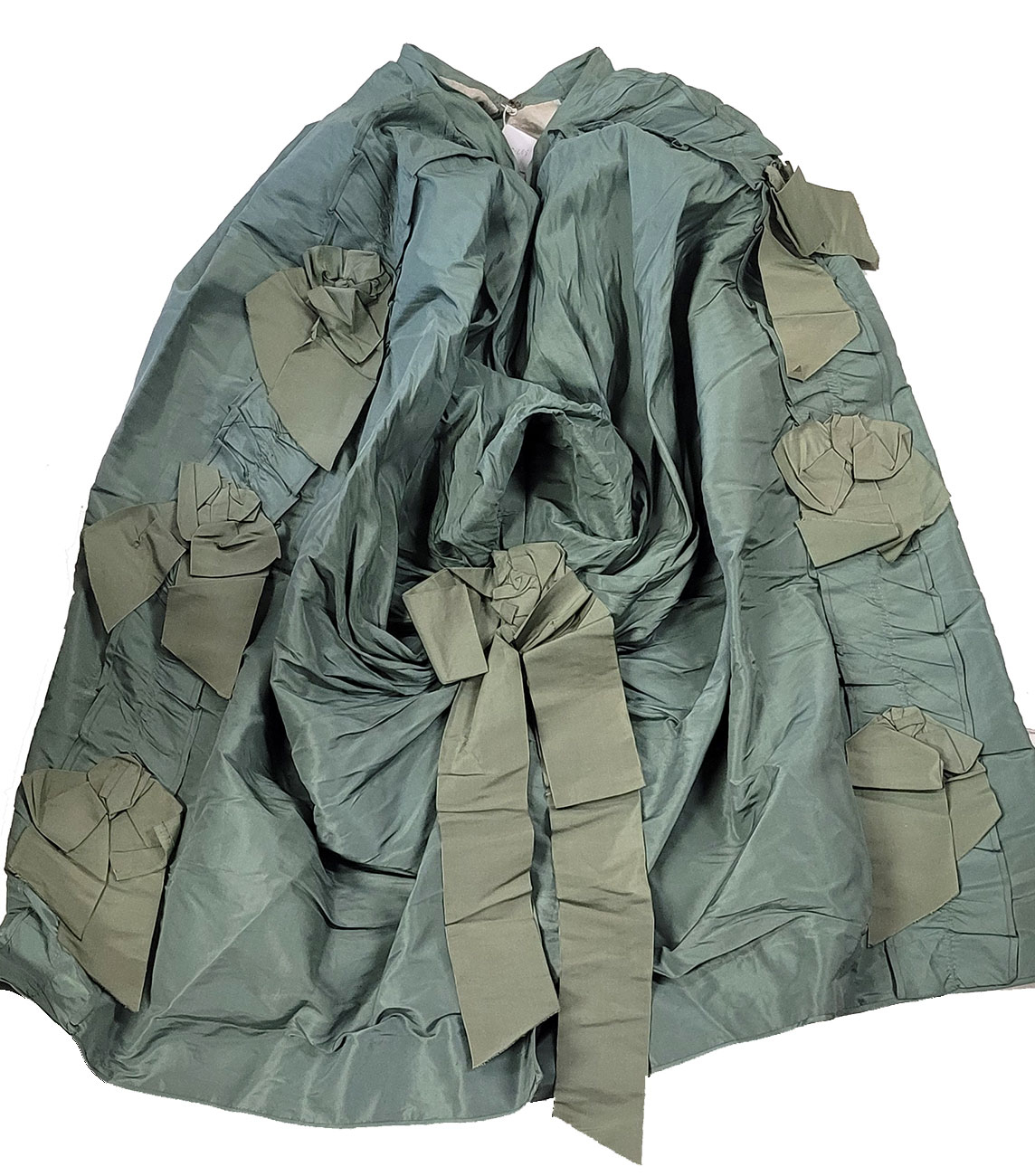
The front opening over-skirt is accented on either side of the body with a wide vertical strip of lightly-gathered ruching with bias-binding on the edges. Three large bows made from wide green ribbon accent each strip. The back of the overskirt is bustled into a large poof. A large green bow sits below the poof and tops a slit opening.
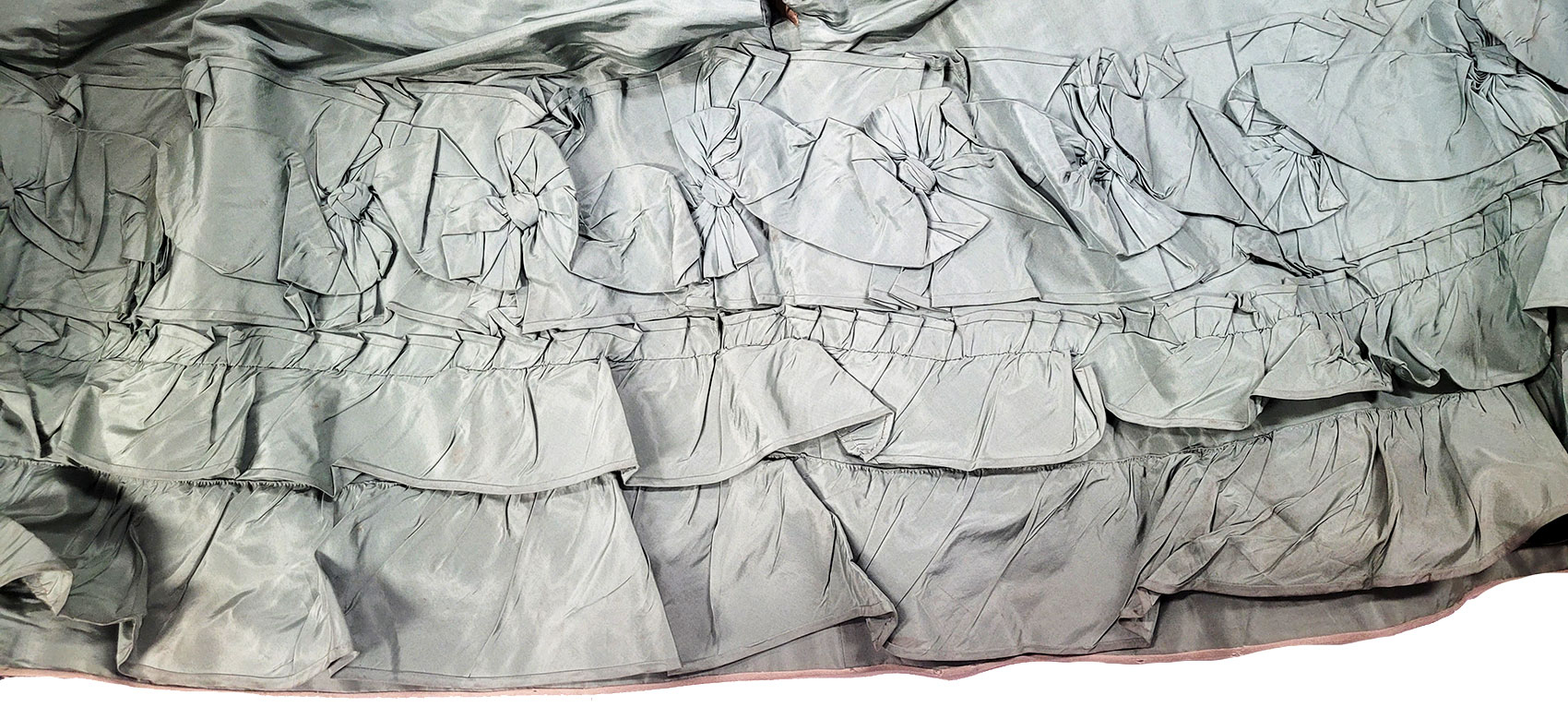
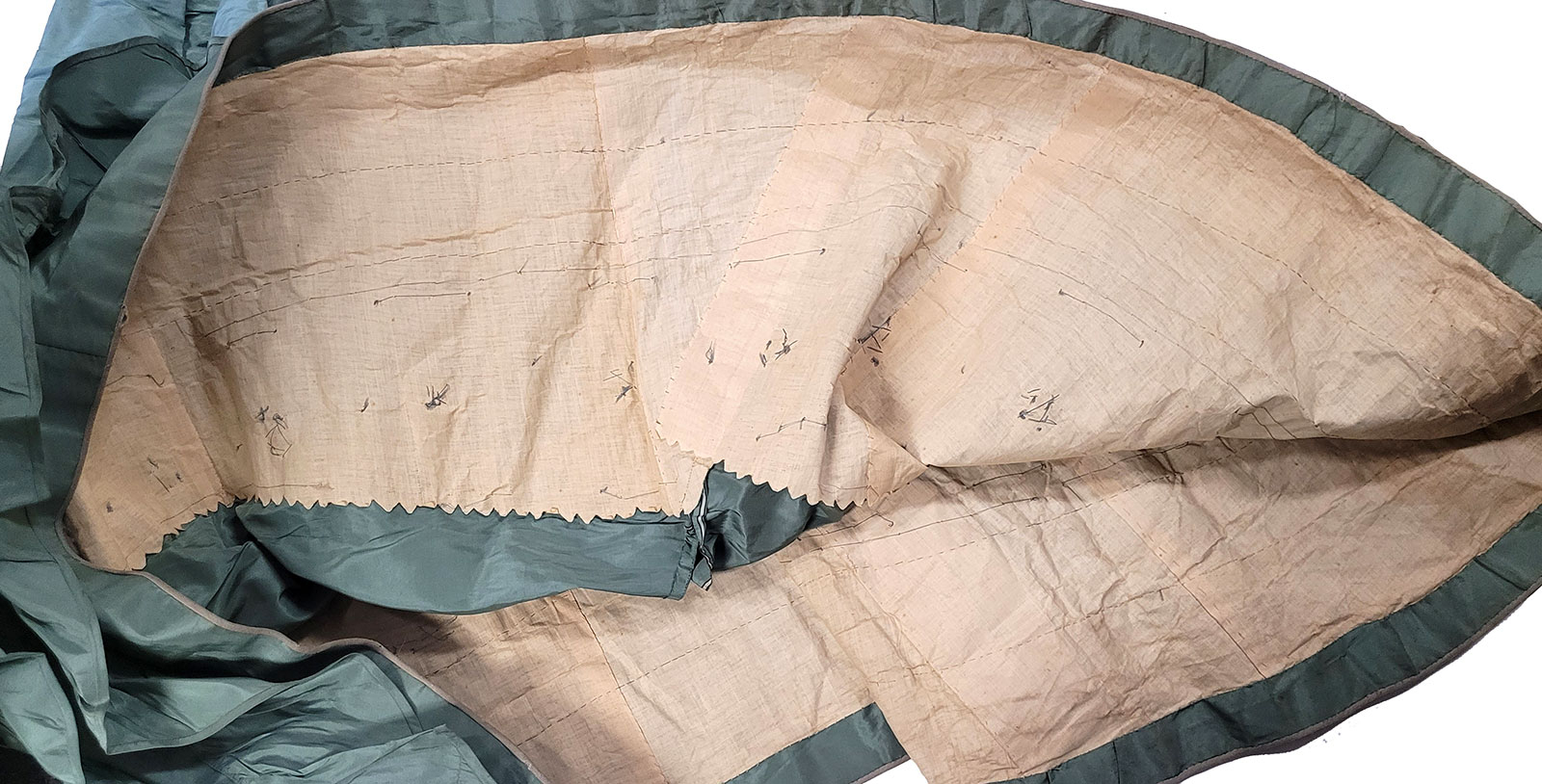
The gored skirt is styled with a flat front, a full back created by gauging on either side of the center back opening, and a pocket in the right front seam. The bottom of the skirt is accented with three rows of self-fabric embellishments. The top row is a wide strip of the silk, bound on the top and bottom edges with bias strips of self-fabric. The strip is arranged with flat sections divided with three directional pleats. A narrower continuous bias strip of silk is sewn to the base strip, with a tied bow placed on every flat section. The middle row of the trimming is a narrower bias ruffle, with a heading made by gathering the strip over a tiny cord, and the top and bottom edges bound with bias strips of self-fabric. The bottom row of trimming is wider bias ruffle, gathered over a cord, the bottom edge also bound with self-fabric bias binding. The lower half of the skirt has a lining of very stiff cotton with a 2" folded hem. The bottom edge of the skirt is finished with wool hem braid. There are tape ties to arrange how the skirt drapes over a bustle.
The vertical seams on the two bodices are machines sewn. All of the other seams in the bodices, the overskirt, the skirt, and the embellishments are hand-sewn.
Measurements: Both bodices: Bust = 36", waist 24. Overskirt: Waist = 24", front length 18", side length = 43", back length = 38" after bustling. Skirt: Waist = 24", front length = 43", back length = 48".
Condition: Very good. The bottom button on the evening bodice is missing. A short stretch of stitching on the side seam of the skirt has come loose. [cs][ph:L]
~~~~~~~~~~~~~~~~~~~~~~~~~~~~~~~~~~~
THIS ITEM, AS WITH ALL OTHER ITEMS AVAILABLE ON OUR WEB SITE,
MAY BE PURCHASED THROUGH OUR LAYAWAY PROGRAM.
CLICK HERE FOR OUR POLICIES AND TERMS.
THANK YOU!
Inquire About ELEGANT 1870’S GREEN SILK DRESS
Most Popular
Historical Firearms Stolen From The National Civil War Museum In Harrisburg, Pa »
Theft From Gravesite Of Gen. John Reynolds »
Selection Of Unframed Prints By Don Troiani »
Fine Condition Brass Infantry Bugle Insignia »
Rare Identified 65Th Ny Sergeant’s Jacket, With Manscript Material: 1St U.s. Chasseurs »
featured item
ORIGINAL WATERCOLOR AND GOUACHE PAINTING BY DON TROIANI – CONFEDERATE INFANTRY SERGEANT
Watercolor and gouache on paper. Signed and dated lower right, “© D. Troiani 78.” Depicting a Civil War–era Confederate infantry sergeant standing at ease in a butternut-gray shell jacket bearing the chevrons of his rank, a slouch hat with… (1100-434). Learn More »
site search