

site search
online catalog
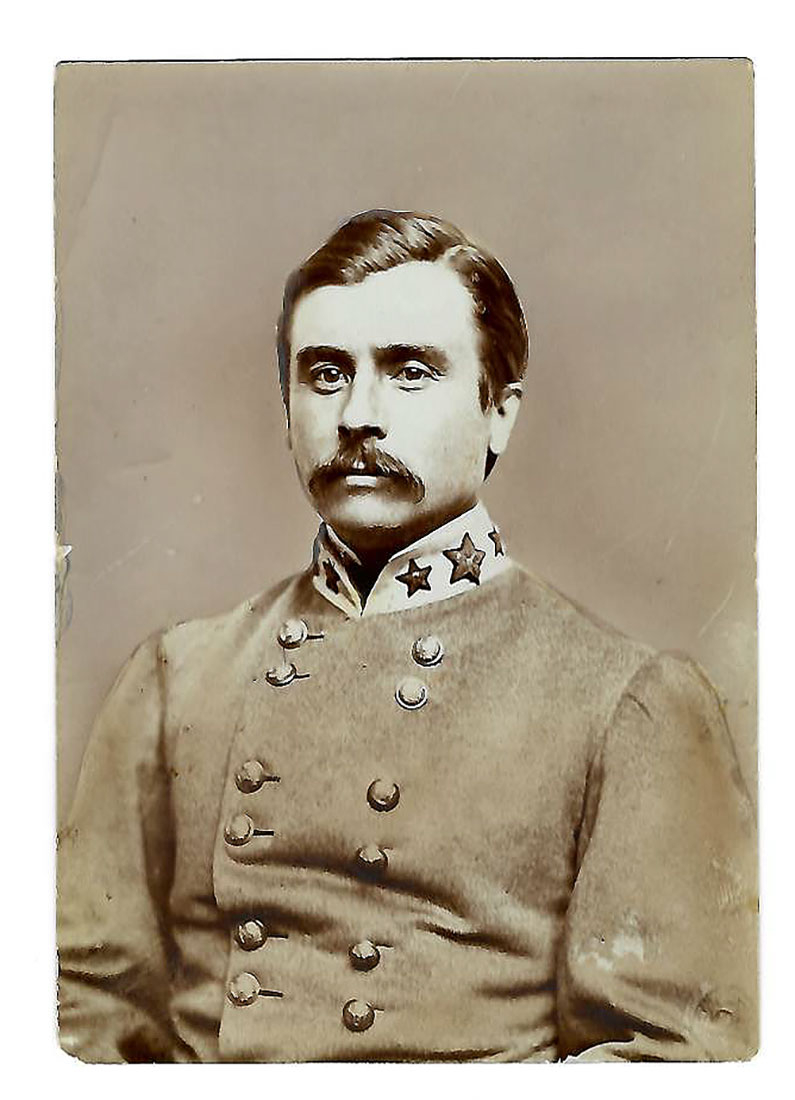
GELATIN PHOTOGRAPH OF CONFEDERATE GENERAL GEORGE H. “MARYLAND” STEUART BY RICHMOND PHOTOGRAPHER, GEORGE COOK & SONS
Hover to zoom
$125.00 SOLD
Quantity Available: None
Item Code: 1189-183
This image features a waist-up view of General George Steuart. The photograph measures approximately 5 ½ inches by 4 inches.
Overall, the condition of this photograph is very good. The image is unmounted and remains strong. There is a small fold to the upper left-hand corner but it is stable. There is one minor chip at the center of the left border. Each corner shows wear.
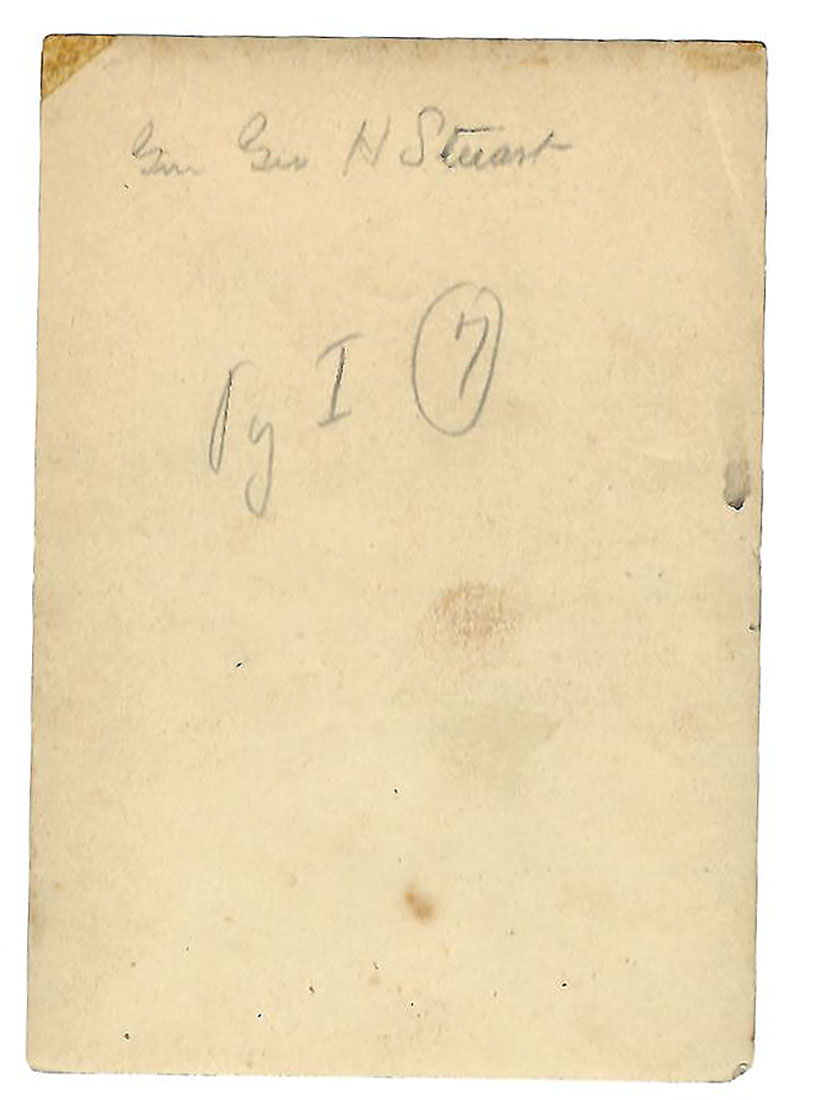
The reverse of the image shows dirt throughout with minor staining. There is a pencil identification: “Gen Geo H. Steuart,” as well as another notation.
George Hume "Maryland" Steuart, born August 24, 1828 in Baltimore, was one of the few Confederate generals from Maryland. Raised at his family’s plantation, Maryland Square, he came from a military background—his father was a Major General in the War of 1812 and his grandfather served as a physician during the American Revolution.
Steuart continued his family’s military tradition by attending West Point, graduating second to last in the class of 1848.. After graduating, Steuart was assigned to frontier duty as a second lieutenant in the 2nd United States Dragoons. While on assignment in Kansas, he met his future wife Maria Kinzie, whom he married in 1858. Their marriage was a troubled one, strained by Steuart’s long absences and Kinzie’s loyalty to the Union.
After the outbreak of the Civil War in April 1861, Steuart resigned from the US Army and was named a cavalry captain in the Confederate Army. He then tried convincing Maryland officials to secede from the Union, which ultimately proved futile.
Shortly thereafter, Steuart was made lieutenant colonel of the 1st Maryland Infantry, a regiment compromised entirely of Marylanders who snuck across the Potomac River to serve the Confederacy.
After the 1st Maryland took part in the charge that led to the rout of the Union Army at First Bull Run, Steuart was promoted to colonel of the regiment.
Steuart was then promoted to Brigadier General on March 6, 1862, now commanding a brigade under General Richard S. Ewell that contained the 1st Maryland. His brigade took part in Jackson’s Shenandoah Valley Campaign, with engagements at Front Royal and Winchester. Steuart, despite repulsing Union attacks, was severely wounded in the shoulder at Cross Keys. He spent several months recuperating from his wound.
His next action would be Gettysburg. Still in Ewell’s Corps but now in Johnson’s Division, Steuart took part in the brutal attempt to take Culp’s Hill from Brigadier General George Sears Greene’s New York brigade on the night of July 2nd. However, several factors such as entrenchments, rocky terrain, and lack of ammunition kept the Rebels from gaining much ground. On the morning of July 3rd, Culp’s Hill was reinforced by remnants of the Sixth Corps along with some artillery, and the Confederates were officially repulsed. About 35% of the casualties of Johnson’s division were from Steuart’s brigade.
Steuart successfully led his infantry at the Battles of Mine Run and the Wilderness, but Spotsylvania was another story. Steuart’s brigade was involved in the attack on the Mule Shoe where they experienced close hand-to-hand combat. His brigade suffered immense casualties, and Steuart was captured in the melee.
Steuart was imprisoned at Hilton Head and was exchanged in the summer of 1864. When he returned to command, he was assigned to a brigade under Pickett where he saw action at Petersburg, Five Forks, and Sayler’s Creek, before surrendering with Lee at Appomattox.
When the war ended, Steuart swore an oath of allegiance to the Union and returned to his home at Mount Steuart with his wife and daughters. He died on November 22, 1903, of an ulcer. He is buried in Green Mount Cemetery in Baltimore.
The Cook studio was owned by George S. Cook whose two sons, George LaGrange Cook and Heustis Cook, also worked as photographers. The father, George S. Cook, is famously known for taking the first combat images of ironclads firing on Ft. Moultrie in 1863. George S. was born in 1819 in Connecticut and moved south to Louisiana in 1839. From there, he moved several times (always remaining in the South), making money as a merchant and studying photography until he eventually wound up in Richmond in 1880, where he bought Anderson’s photography studio. This is where many of the original glass plate negatives came from to reproduce his photographs. The Cook studio also purchased other collections of negatives as well. [cla][ph:cla]
~~~~~~~~~~~~~~~~~~~~~~~~~~~~~~~~~~~
THIS ITEM, AS WITH ALL OTHER ITEMS AVAILABLE ON OUR WEB SITE,
MAY BE PURCHASED THROUGH OUR LAYAWAY PROGRAM.
CLICK HERE FOR OUR POLICIES AND TERMS.
THANK YOU!
Inquire About GELATIN PHOTOGRAPH OF CONFEDERATE GENERAL GEORGE H. “MARYLAND” STEUART BY RICHMOND PHOTOGRAPHER, GEORGE COOK & SONS
Most Popular
Historical Firearms Stolen From The National Civil War Museum In Harrisburg, Pa »
Theft From Gravesite Of Gen. John Reynolds »
Selection Of Unframed Prints By Don Troiani »
Fine Condition Brass Infantry Bugle Insignia »
Rare Identified 65Th Ny Sergeant’s Jacket, With Manscript Material: 1St U.s. Chasseurs »
featured item
US MODEL 1842 HARPER’S FERRY MUSKET FROM GEORGE ROSENSTEEL’S CIVIL WAR NATIONAL MUSEUM IN GETTYSBURG
This US Model 1842 Harper’s Ferry Musket dated 1850 was once part of George Rosensteel’s Civil War National Museum located in Gettysburg, PA on the Taneytown Road. Later the museum incorporated the famous “Electric Map” invented by his son… (2025-3337). Learn More »
site search