

site search
online catalog
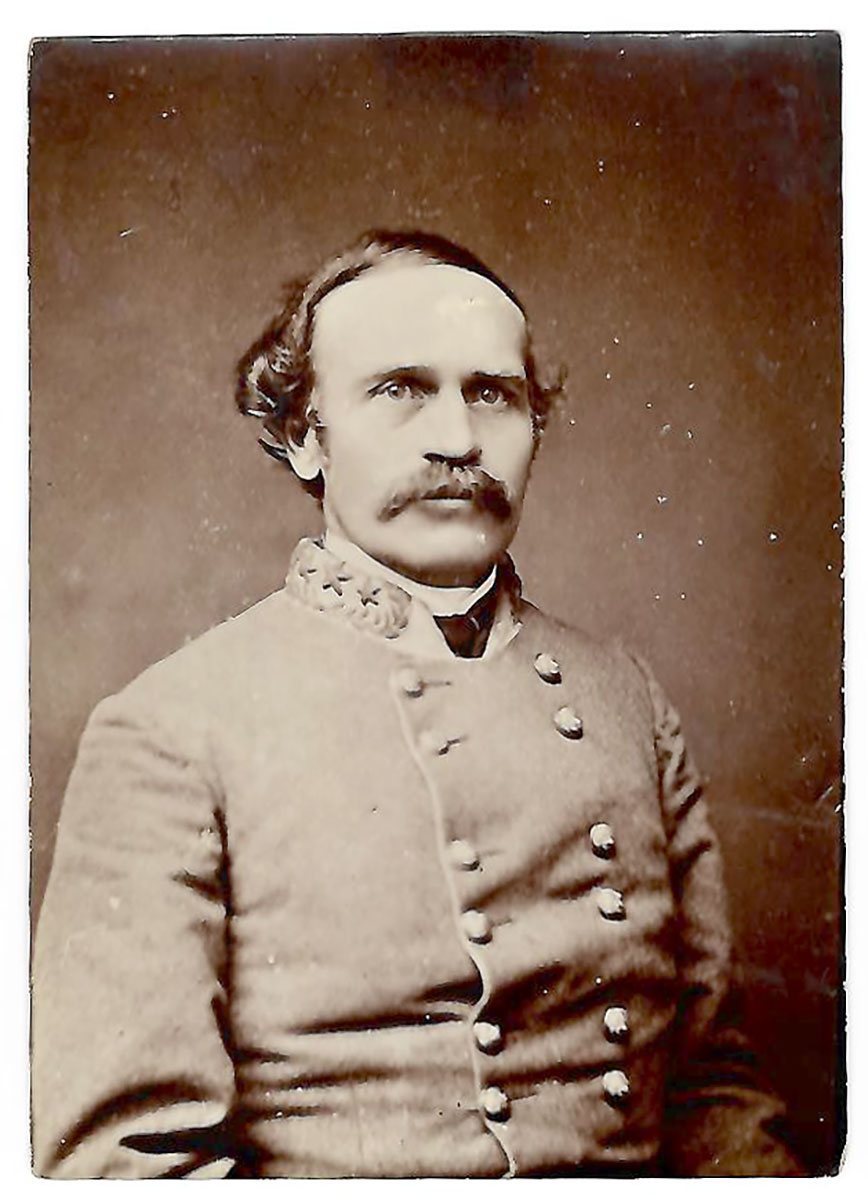
POST-WAR UNMOUNTED GELATIN PRINT OF GENERAL BUSHROD JOHNSON, FROM A RICHMOND PHOTOGRAPHER, GEORGE S. COOK & SONS
Hover to zoom
$150.00
Quantity Available: 1
Item Code: 1189-165
Shipping: Determined by Method & Location of buyer
To Order:
Call 717-334-0347,
Fax 717-334-5016, or E-mail
Measures approximately 5.5 inches by just under 3.75 inches wide. Photograph features a waist-up view of Confederate General Bushrod Johnson.
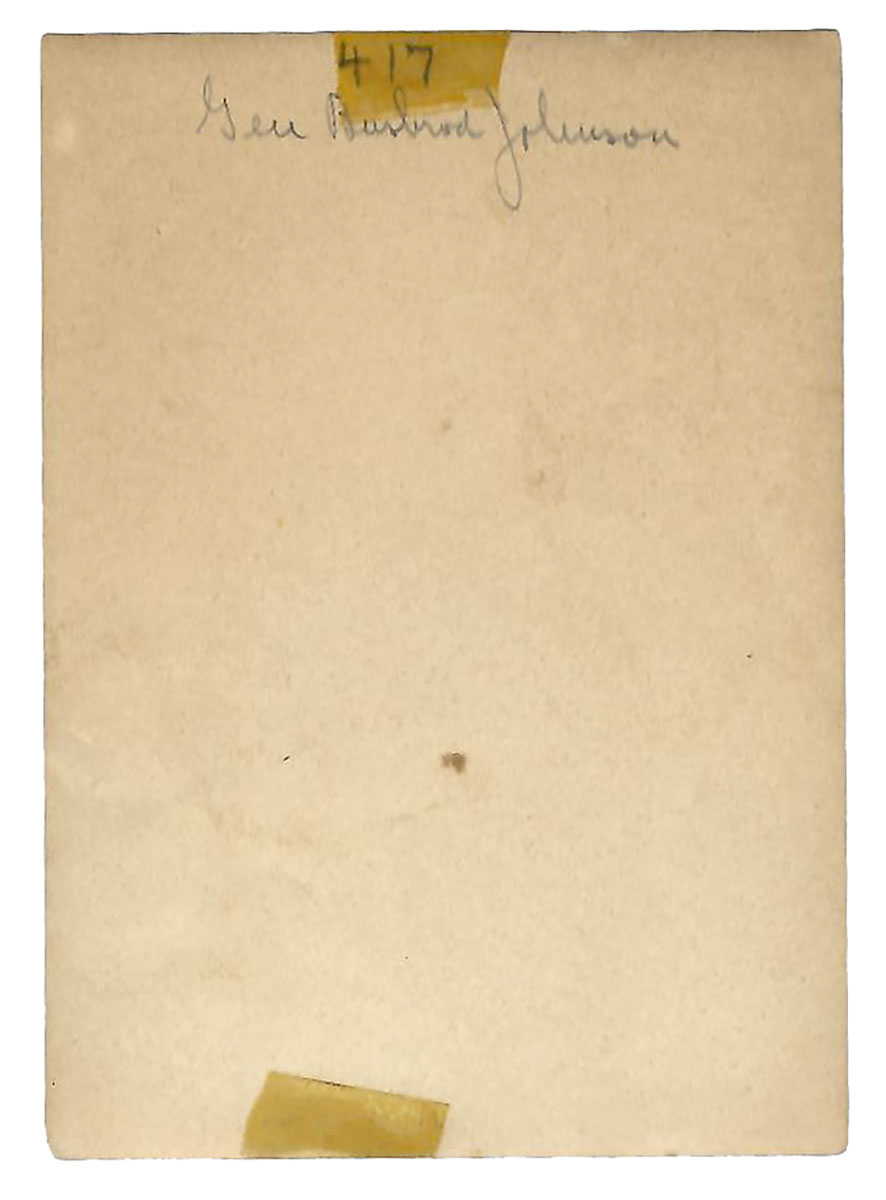
The reverse of the image shows a pencil notation: “Gen Bushrod Johnson” as well as “417.” There is adhesive tape stuck to the top and bottom of the back of the photograph.
Overall, this image is in good condition. There are minor pushes to the corners. The back shows surface dirt throughout.
Bushrod Rust Johnson was born in Ohio in 1817 and graduated from West Point in 1840. After serving in the Seminole War and on the western frontier, he was promoted to first lieutenant in 1844.
He took part in the occupation of Texas in 1845, and in the war with Mexico served gallantly in the battles of Palo Alto, Resaca de la Palma, Monterey, and the siege of Vera Cruz. Resigning in October, 1857, he became a professor in the Western Military Institute of Kentucky in 1848, was its superintendent, 1851-55, and afterward was superintendent of the military college of the University of Nashville until the outbreak of war, in 1861, also holding the rank of colonel of militia.
He was appointed colonel of engineers in the provisional army of Tennessee, June 28, 1861, and when the Tennessee troops were turned over to the Confederate States, he was assigned to the army acting in Tennessee and Kentucky under the command of Gen. Albert Sidney Johnston. He commanded with great ability a brigade at Fort Donelson, having been commissioned brigadier-general January 24, 1862.
Though captured on the fall of that important post, he was exchanged in time to bear a conspicuous part in the battle of Shiloh, where he was severely wounded April 6, 1862. On his recovery he went into the Kentucky campaign, and at the battle of Perryville, his and Cleburne's brigades, charging together, captured three batteries and many prisoners.
General Johnson also led his brigade in Hardee's brilliant and successful charge in the battle of Murfreesboro. At Chickamauga, in the second day's battle, he was the first to detect and enter the gap in the Federal lines. Of this, Gen. D. H. Hill says: "With the coolness and judgment for which he was always distinguished, he took in the situation at a glance, and began a flank movement to the right. Longstreet adopted the plan of his lieutenant and made his other troops conform to Johnson's movement, thus sweeping away one wing of the Federal army and with it the commanding general himself.”
General Johnson also served under Longstreet in the unfortunate campaign into east Tennessee, commanding Buckner's division, brigades of Gracie, Johnson and Reynolds; shared in the disastrous assault on Fort Sanders (Knoxville), and fought the battle of Bean's Station.
When the campaign of 1864 opened in Virginia, General Johnson, with his division, was near Petersburg, where he assisted in the defense against Butler's attack upon the Richmond & Petersburg railroad. His services were also eminent in the battle of Drewry's Bluff, where Beauregard "bottled up" Butler. A few days after this battle Johnson was commissioned major-general (May 21, 1864).
At the battle of the Crater, before Petersburg, he commanded the troops who repulsed the Federal assault. He continued to serve with distinguished ability until the end came and the banners of the Confederacy were furled forever.
At the evacuation of Richmond, he commanded the division of Anderson's corps, comprising the brigades of Wallace, Moody, Ransom and Wise, South Carolina, Alabama, North Carolina and Virginia troops; was engaged in severe fighting preceding and during the retreat, and after the battle of Sailor's Creek was ordered by General Lee to collect all the scattered forces of Anderson's and Ewell's commands.
In 1866 he resumed his favorite occupation, that of a teacher, and served as professor of engineering, mechanics and natural philosophy in the Western Military Institute at Georgetown, Ky., until 1880. On December 7th of that year, he died at Brighton, Ill., at the age of sixty-three years. He is buried in The Old City Cemetery in Nashville, Tennessee.
This image was produced from the original negative by the Cook Studio in Richmond sometime after 1880.
The Cook studio was owned by George S. Cook whose two sons, George LaGrange Cook and Heustis Cook, also worked as photographers. The father, George S. Cook, is famously known for taking the first combat images of ironclads firing on Ft. Moultrie in 1863. George S. was born in 1819 in Connecticut and moved south to Louisiana in 1839. From there, he moved several times (always remaining in the South), making money as a merchant and studying photography until he eventually wound up in Richmond in 1880, where he bought Anderson’s photography studio. This is where many of the original glass plate negatives came from to reproduce his photographs. The Cook studio also purchased other collections of negatives as well. [cla][ph:cla]
~~~~~~~~~~~~~~~~~~~~~~~~~~~~~~~~~~~
THIS ITEM, AS WITH ALL OTHER ITEMS AVAILABLE ON OUR WEB SITE,
MAY BE PURCHASED THROUGH OUR LAYAWAY PROGRAM.
CLICK HERE FOR OUR POLICIES AND TERMS.
THANK YOU!
Inquire About POST-WAR UNMOUNTED GELATIN PRINT OF GENERAL BUSHROD JOHNSON, FROM A RICHMOND PHOTOGRAPHER, GEORGE S. COOK & SONS
Most Popular
Historical Firearms Stolen From The National Civil War Museum In Harrisburg, Pa »
Theft From Gravesite Of Gen. John Reynolds »
Selection Of Unframed Prints By Don Troiani »
Fine Condition Brass Infantry Bugle Insignia »
Rare Identified 65Th Ny Sergeant’s Jacket, With Manscript Material: 1St U.s. Chasseurs »
featured item
SINGLE SHOT PERCUSSION PISTOL BY HOLLIS OF LONDON PRESENTED TO BEVERLY KENNON, CSN
Offered here is a single shot .54 caliber percussion pistol is a product of gunmaker Richard Hollis of London, England, and identified to a navy officer who served in the U.S. and C.S. navies. The pistol measures approximately 10” long. The… (1268-689). Learn More »
site search