

site search
online catalog
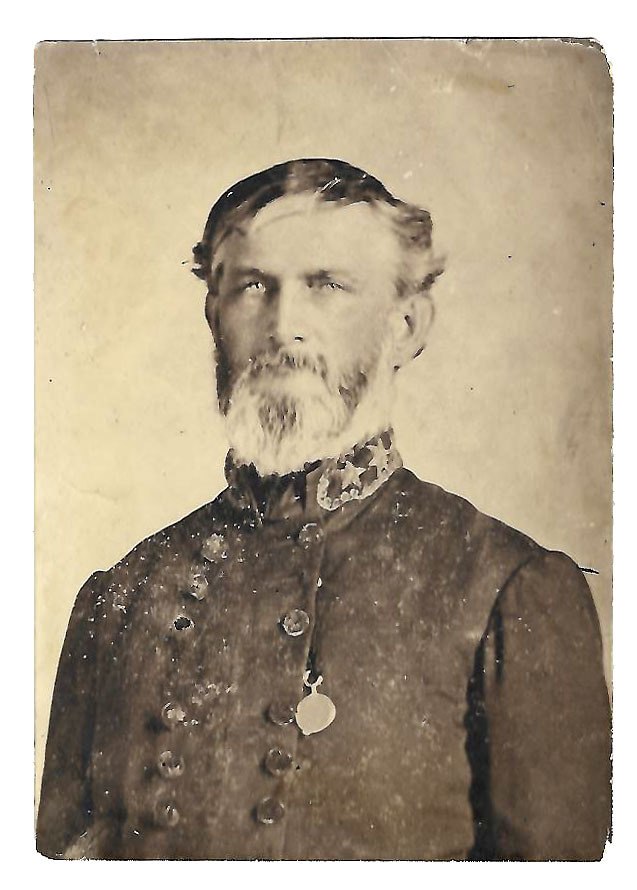
SILVER PRINT OF CONFEDERATE GENERAL LEONIDAS POLK BY RICHMOND PHOTOGRAPHER, GEORGE COOK & SONS
Hover to zoom
$125.00 ON HOLD
Quantity Available: 1
Item Code: 1189-177
This image features a bust view of Leonidas Polk wearing his general’s frock coat. The photograph measures approximately 3 ¾ by 5 ¼ inches.
Overall, the condition of this photograph is very good. There are no chips, tears, or breaks to the image itself but the corners show some wear.
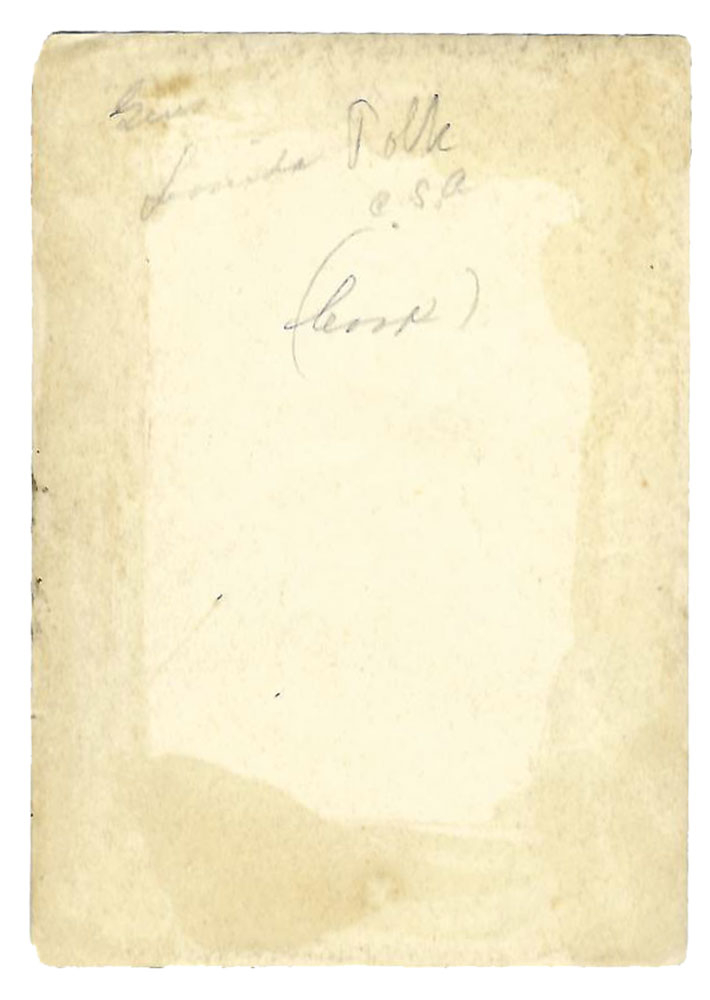
The reverse of the image shows some dirt and some discoloration (possibly from adhesive). There is a pencil identification: “Gen / Leonidas Polk / CSA / (Cook).”
Leonidas Polk was born April 10, 1806, near Raleigh, North Carolina, and was raised by extremely wealthy parents. The family owned more than 100,000 acres of land. He excelled at the University of North Carolina and went on to West Point. Shortly after graduation he resigned his military commission to focus on religious life.
By 1838, Polk was a prominent Episcopal Bishop living in Maury County, Tennessee. In 1860, he began construction of the University of the South in the mountains of Sewanee, Tennessee. When the Civil War came, his friendship with West Point classmate Jefferson Davis won him a commission as a major general in the Confederate States Army. He had no military experience beyond his time at West Point, where he ranked 8th in a class of 38.
Much authority was granted to Major General “Fighting Bishop” Polk, but his military qualities were lacking. Upon taking command, he ordered an expedition into Columbus, Kentucky. Since Kentucky was officially neutral, Polk’s 1861 incursion prompted the state to call for Northern aid. A potentially invaluable strategic asset was largely lost to the Confederacy.
In 1862, Polk commanded troops at the Battles of Shiloh, Perryville, and Stones River. Bad blood developed between Polk and his superior officer, Braxton Bragg, due to Polk’s refusal to follow orders during the Perryville Campaign. A close friendship with Jefferson Davis sustained Polk’s military status throughout the war. He was also loved by his men, due in large part to his geniality, commanding presence, and lax attitude towards discipline.
The 1863 Battle of Chickamauga ended in Confederate victory, but Braxton Bragg again accused Polk of disregarding and critically delaying orders while in command of roughly half of the army. In response, Jefferson Davis transferred Polk to take charge of a military department encompassing most of Mississippi from December 1863-May 1864.
Polk came back to the Army of Tennessee just before Union General William Sherman launched his campaign towards Atlanta on May 4. This move prompted the fierce “Hundred Days Battles” between Chattanooga and Atlanta.
On June 14, 1864, in the midst of the titanic conflict, Polk and a group of fellow officers rode to the top of Pine Mountain in order to better examine the Union positions in the valley below. Riding along the blue lines, General Sherman spotted the officers through a spyglass. He ordered cannons to fire on the group. The first shot scattered the Confederates and the second tore through Polk’s body. He was killed and brought back through the army lines on a litter. He was buried in Christ Church Cathedral, New Orleans, Louisiana.
This photograph is a lesser-known photograph type called a silver print, where silver halide is suspended in a gelatin emulsion. This emulsion coats the base and then a chemical wash is poured over the paper exposing the image. This image was produced from the original negative by the Cook Studio in Richmond sometime after 1880.
The Cook studio was owned by George S. Cook whose two sons, George LaGrange Cook and Heustis Cook, also worked as photographers. The father, George S. Cook, is famously known for taking the first combat images of ironclads firing on Ft. Moultrie in 1863. George S. was born in 1819 in Connecticut and moved south to Louisiana in 1839. From there, he moved several times (always remaining in the South), making money as a merchant and studying photography until he eventually wound up in Richmond in 1880, where he bought Anderson’s photography studio. This is where many of the original glass plate negatives came from to reproduce his photographs. The Cook studio also purchased other collections of negatives as well. [cla][ph:cla]
~~~~~~~~~~~~~~~~~~~~~~~~~~~~~~~~~~~
THIS ITEM, AS WITH ALL OTHER ITEMS AVAILABLE ON OUR WEB SITE,
MAY BE PURCHASED THROUGH OUR LAYAWAY PROGRAM.
CLICK HERE FOR OUR POLICIES AND TERMS.
THANK YOU!
Inquire About SILVER PRINT OF CONFEDERATE GENERAL LEONIDAS POLK BY RICHMOND PHOTOGRAPHER, GEORGE COOK & SONS
Most Popular
Historical Firearms Stolen From The National Civil War Museum In Harrisburg, Pa »
Theft From Gravesite Of Gen. John Reynolds »
Selection Of Unframed Prints By Don Troiani »
Fine Condition Brass Infantry Bugle Insignia »
Rare Identified 65Th Ny Sergeant’s Jacket, With Manscript Material: 1St U.s. Chasseurs »
featured item
CONFEDERATE SOLDIER LETTER—MAJOR SAMUEL S.J. MOORE, STONEWALL BRIGADE / WIA AT KERNSTOWN--SECOND MANASSAS--THE WILDERNESS
Dated “Camp near Centerville November 1 1861.” Addressed to wife Ellen Scollay Moore. 3 pp. In ink on unlined paper, 12.75 x 7.75.” Exhibits fold marks & slight smudging while remaining entirely legible. In protective sleeve. Born June… (846-566). Learn More »
site search