

site search
online catalog
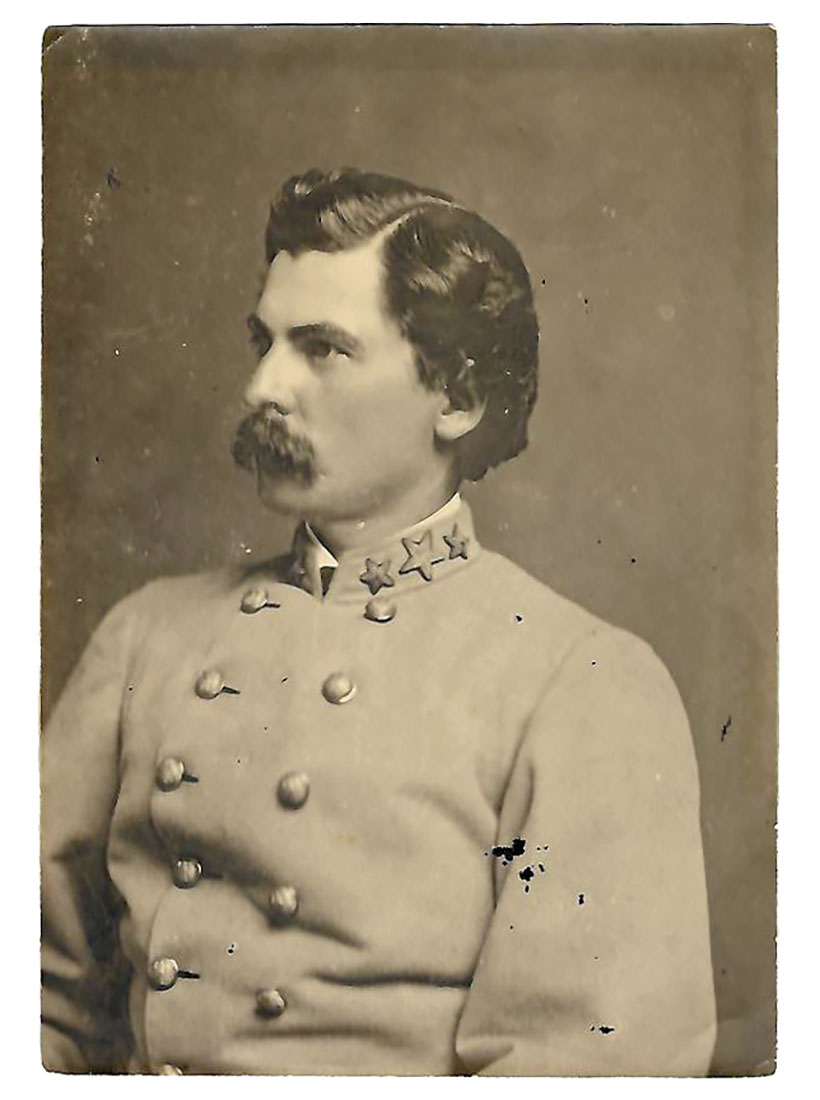
SILVER PRINT OF CONFEDERATE GENERAL HENRY HARRISON WALKER BY RICHMOND PHOTOGRAPHER, GEORGE COOK & SONS
Hover to zoom
$150.00
Quantity Available: 1
Item Code: 1189-187
Shipping: Determined by Method & Location of buyer
To Order:
Call 717-334-0347,
Fax 717-334-5016, or E-mail
This image features a profile bust view of Genera Henry H. Walker. The photograph measures approximately 4 by 5 ½ inches.
Overall, the condition of this photograph is very good. There are no chips, tears, or breaks to the image itself but the corners show some wear.
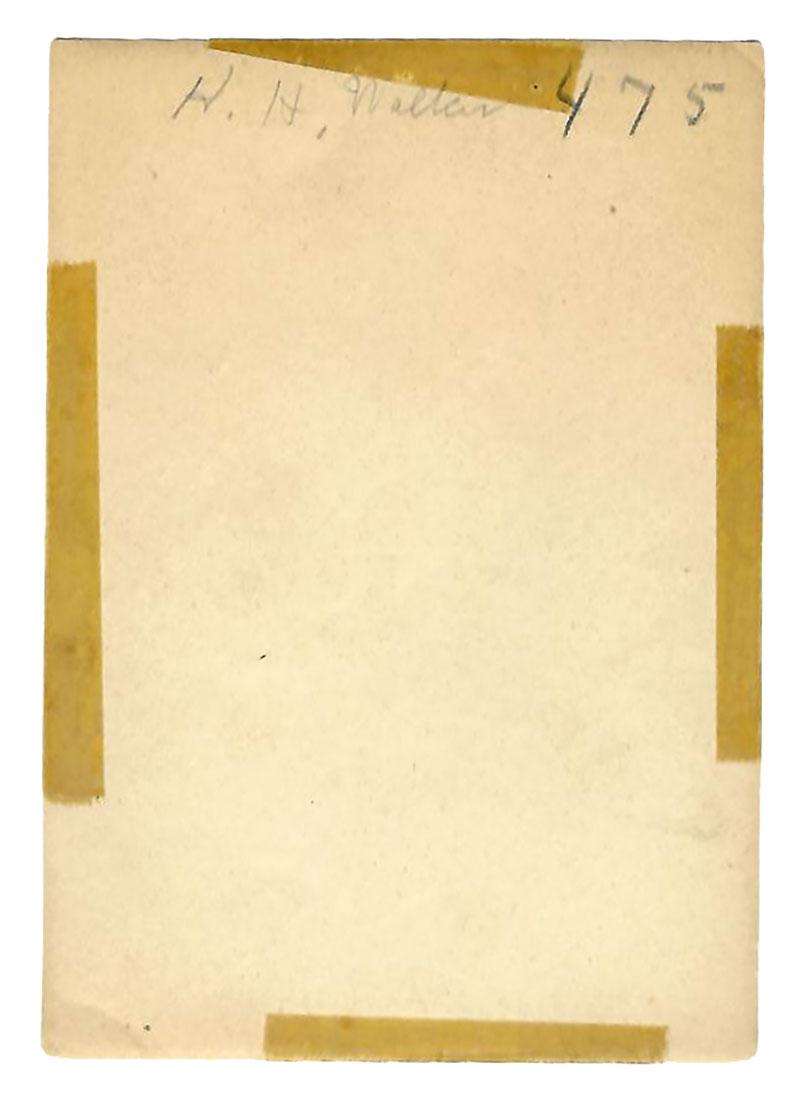
The reverse of the image shows some dirt throughout. Mid-20th century tape is affixed on all sides of the reverse. There is a pencil identification: “H.H. Walker” and the number “475.”
Henry Harrison Walker was born October 15, 1832 at “Elmwood” in Sussex County, Virginia. He was appointed to the United States military academy in 1849 and was graduated in 1853 with the brevet of second lieutenant of infantry.
His service with the United States army was rendered at Newport, Ky., and then until 1855 in New Mexico. He became second lieutenant, 6th U. S. Infantry, in 1855, and first lieutenant in 1857, and in the latter year was appointed aide-de-camp to Governor Walker of Kansas.
After assisting in quelling the disturbances in Kansas, he served upon the staff of General Clarke, at San Francisco, three years.
The secession of Virginia called him from frontier duty at Fort Churchill, Nev., to offer his services to his native State. He received a commission as captain of infantry in the regular army of the Confederate States.
Subsequently he was promoted lieutenant-colonel of the 40th Virginia infantry, Field's brigade. At Gaines' Mill he was twice wounded and was mentioned by General Field as "a gallant and meritorious officer, " and by Gen. A. P. Hill as one of those deserving especial mention for conspicuous gallantry.
In July, 1863, after having overseen a convalescent camp, he was promoted brigadier-general and assigned to the command of his old brigade, which had meanwhile been under the leadership for some time of Gen. Henry Heth and Colonel Brockenbrough.
Walker served creditably as a brigade commander in the battles of Bristoe Station and Mine Run, in the latter affair his brigade being the first infantry to meet the enemy and check his advance. In December he was ordered to the Shenandoah valley to reinforce Early, and was recalled from that region in March 1864, to the main army.
He did good and brave service through the bloody battles of the Wilderness and Spotsylvania Court House, until severely wounded on May 10, 1864. On November 10th he was assigned to duty as a member of the general court-martial of the department of Richmond, and his brigade, much reduced, was consolidated with Archer's.
After the Civil War, Walker moved to New Jersey and became a stockbroker. Henry Harrison Walker died at Morristown, New Jersey on March 22, 1912. He is buried in Evergreen Cemetery at Morristown.
This photograph is a lesser-known photograph type called a silver print, where silver halide is suspended in a gelatin emulsion. This emulsion coats the base and then a chemical wash is poured over the paper exposing the image. This image was produced from the original negative by the Cook Studio in Richmond sometime after 1880.
The Cook studio was owned by George S. Cook whose two sons, George LaGrange Cook and Heustis Cook, also worked as photographers. The father, George S. Cook, is famously known for taking the first combat images of ironclads firing on Ft. Moultrie in 1863. George S. was born in 1819 in Connecticut and moved south to Louisiana in 1839. From there, he moved several times (always remaining in the South), making money as a merchant and studying photography until he eventually wound up in Richmond in 1880, where he bought Anderson’s photography studio. This is where many of the original glass plate negatives came from to reproduce his photographs. The Cook studio also purchased other collections of negatives as well. [cla][ph:cla]
~~~~~~~~~~~~~~~~~~~~~~~~~~~~~~~~~~~
THIS ITEM, AS WITH ALL OTHER ITEMS AVAILABLE ON OUR WEB SITE,
MAY BE PURCHASED THROUGH OUR LAYAWAY PROGRAM.
CLICK HERE FOR OUR POLICIES AND TERMS.
THANK YOU!
Inquire About SILVER PRINT OF CONFEDERATE GENERAL HENRY HARRISON WALKER BY RICHMOND PHOTOGRAPHER, GEORGE COOK & SONS
Most Popular
Historical Firearms Stolen From The National Civil War Museum In Harrisburg, Pa »
Theft From Gravesite Of Gen. John Reynolds »
Selection Of Unframed Prints By Don Troiani »
Fine Condition Brass Infantry Bugle Insignia »
Rare Identified 65Th Ny Sergeant’s Jacket, With Manscript Material: 1St U.s. Chasseurs »
featured item
CIVIL WAR MUSICIAN’S GROUPING INCLUDING WARTIME IDENTIFICATION DISK, IDENTIFICATION SHIELD, AND FREEMANTLE ROTARY VALVE CORNET/VALVED BUGLE: JOHN J. WEAVER- 10th and 56th PA- AND CUTLER’S BRIGADE BAND 1861-1865
This wonderful grouping includes two wartime identification badges, a rotary valve cornet dating about 1864, along with his GAR membership badge and veteran’s id badge. To top it off, in addition to prior service in the 10th PA from April 26 to… (1179-420). Learn More »
site search