

site search
online catalog
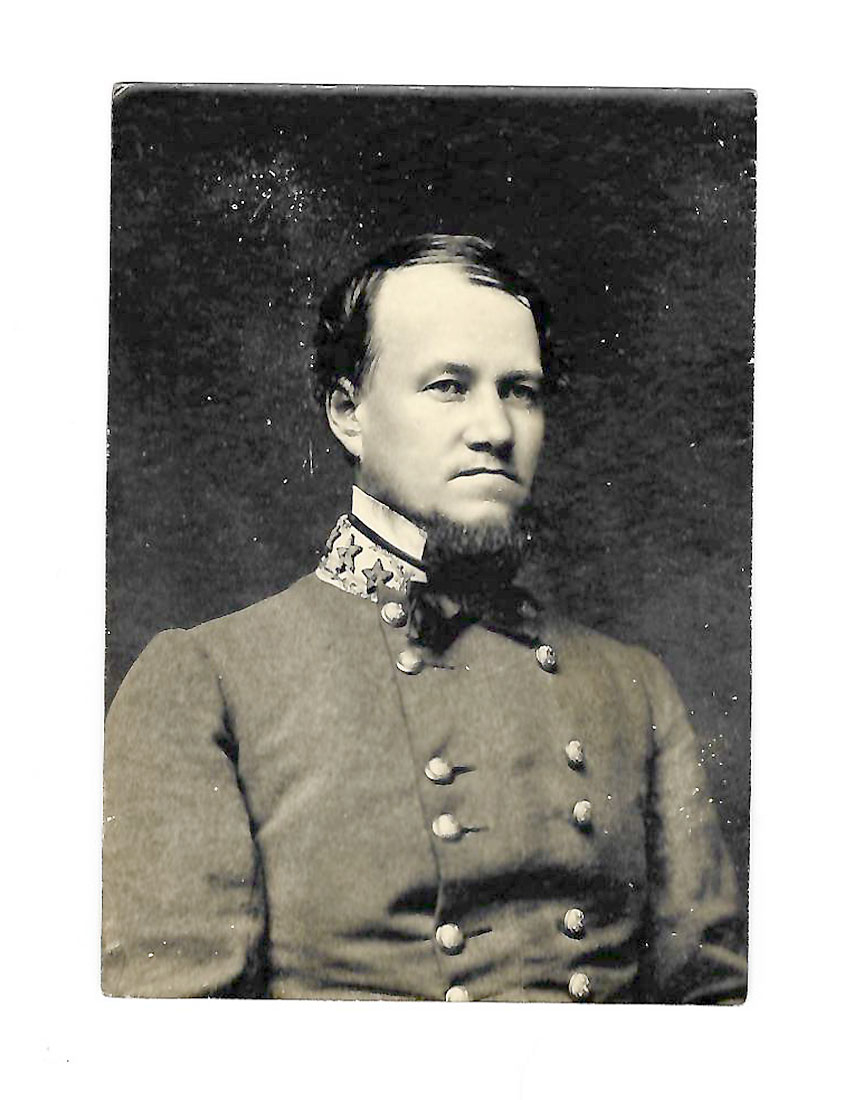
POST-WAR UNMOUNTED SILVER PRINT OF GENERAL GUSTAVUS WOODSON SMITH, FROM A RICHMOND PHOTOGRAPHER, GEORGE S. COOK & SONS
Hover to zoom
$150.00
Quantity Available: 1
Item Code: 1189-180
Shipping: Determined by Method & Location of buyer
To Order:
Call 717-334-0347,
Fax 717-334-5016, or E-mail
Measures approximately 5.5 inches by just under 3.75 inches wide. Photograph features a bust view of Confederate General Gustavus Smith.
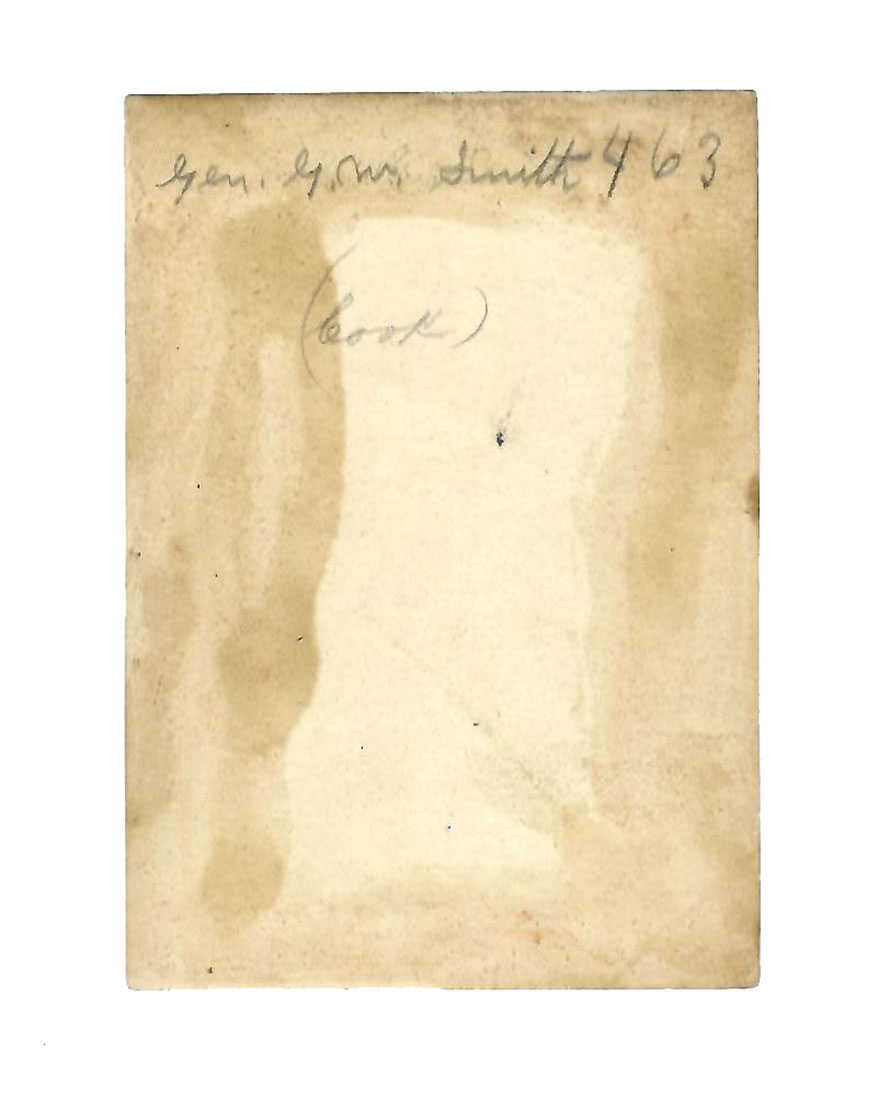
The reverse of the image shows a pencil notation: “Gen. G.W. Smith” as well as “463” and “(Cook)” denoting the photographer.
Overall, this image is in good condition. There are minor pushes to the corners. No other issues to note.
Gustavus W. Smith was born in Georgetown, Kentucky on November 30, 1821. He graduated from the United States Military Academy at West Point as a brevet 2nd Lieutenant in 1842 finishing 8th out of 56 cadets. He entered the Army Corps of Engineers and was promoted to 2nd Lieutenant on January 1, 1845.
Smith fought in the Mexican War, winning two brevet promotions for his actions. He was appointed brevet 1st Lieutenant on April 18, 1847 for the Battle of Cerro Gordo, and to brevet Captain on August 20, 1847 for the Battle of Contreras.
When the Mexican War ended he reverted back to his pre-war rank of 2nd Lieutenant but was promoted to 1st Lieutenant on March 3, 1853. Smith resigned his commission on December 18, 1854 to become a civilian engineer in New York City, and was Streets Commissioner there from 1858 to 1861.
Smith's home state of Kentucky became a border state when the Civil War broke out in 1861. Some months afterward, he presented himself at Richmond to serve the Confederate States of America. Commissioned as a Major General on September 19, 1861 he served in Northern Virginia as a divisional and "wing" commander, and fought in the Battle of Seven Pines near Richmond during the Peninsula Campaign.
On May 31, 1862, Smith briefly took command of what would become the Army of Northern Virginia after Gen. Joseph E. Johnston was wounded, due to his being the senior Major General in Johnston's army. However, Jefferson Davis replaced him with Robert E. Lee the following day. On June 2, Smith became ill and took a leave of absence to recuperate.
In late August, Smith returned and took command of the defenses around Richmond, which was expanded to become the Department of North Carolina & Southern Virginia in September. In addition, he acted as interim Confederate States Secretary of War from November 17 through November 21, 1862.
He resigned his commission as a Major General on February 17, 1863, and became a volunteer aide to General P.G.T. Beauregard for the rest of that year. Smith was also the superintendent of the Etowah Iron Works in 1863 until June 1, 1864, when he was commissioned a Major General in the Georgia state militia and commanded its first division until the end of the war.
Smith was paroled in Macon, Georgia, on April 20, 1865, and moved to Tennessee to become an iron manufacturer from 1866 to 1870. He moved back to his native Kentucky where he became Insurance Commissioner until 1876, and then moved to New York City and began writing. Smith authored “Noted on Insurance” in 1870, “Confederate War Papers” in 1884, “The Battle of Seven Pines” in 1891, and “Generals J. E. Johnston and G. T. Beauregard at the Battle of Manassas, July 1861” in 1892. His final work, “Company "A," Corps of Engineers, U.S.A., 1846–48, in the Mexican War”, was published in 1896 after his death.
In December 1894 he was one of nineteen founders of the Military Order of Foreign Wars - a military society for officers who were veterans of wars with foreign nations and their descendants.
Smith died in New York City in 1896 and is buried in the Cedar Grove Cemetery in New London, Connecticut.
This photograph is a lesser-known photograph type called a silver print, where silver halide is suspended in a gelatin emulsion. This emulsion coats the base and then a chemical wash is poured over the paper exposing the image. This image was produced from the original negative by the Cook Studio in Richmond sometime after 1880.
The Cook studio was owned by George S. Cook whose two sons, George LaGrange Cook and Heustis Cook, also worked as photographers. The father, George S. Cook, is famously known for taking the first combat images of ironclads firing on Ft. Moultrie in 1863. George S. was born in 1819 in Connecticut and moved south to Louisiana in 1839. From there, he moved several times (always remaining in the South), making money as a merchant and studying photography until he eventually wound up in Richmond in 1880, where he bought Anderson’s photography studio. This is where many of the original glass plate negatives came from to reproduce his photographs. The Cook studio also purchased other collections of negatives as well. [cla][ph:cla]
~~~~~~~~~~~~~~~~~~~~~~~~~~~~~~~~~~~
THIS ITEM, AS WITH ALL OTHER ITEMS AVAILABLE ON OUR WEB SITE,
MAY BE PURCHASED THROUGH OUR LAYAWAY PROGRAM.
CLICK HERE FOR OUR POLICIES AND TERMS.
THANK YOU!
Inquire About POST-WAR UNMOUNTED SILVER PRINT OF GENERAL GUSTAVUS WOODSON SMITH, FROM A RICHMOND PHOTOGRAPHER, GEORGE S. COOK & SONS
Most Popular
Historical Firearms Stolen From The National Civil War Museum In Harrisburg, Pa »
Theft From Gravesite Of Gen. John Reynolds »
Selection Of Unframed Prints By Don Troiani »
Fine Condition Brass Infantry Bugle Insignia »
Rare Identified 65Th Ny Sergeant’s Jacket, With Manscript Material: 1St U.s. Chasseurs »
featured item
FINE ITALIAN SNAPHAUNCE BELT PISTOL CA. 1675
The snaphaunce is one of the earlier forms of flint and steel ignition and was introduced in the mid-16th century. It remained in use in Northern Italy into the mid-18th century giving it a particularly long period of use. Ornate pistols such as… (2026-657). Learn More »
site search