
site search
online catalog
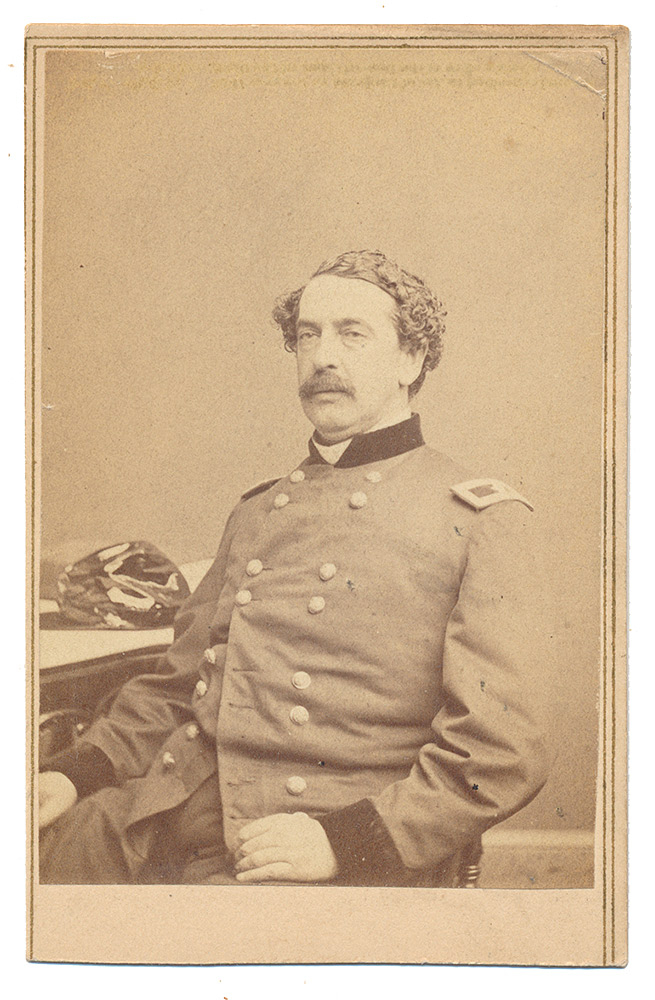
CDV PHOTO OF GENERAL ABNER DOUBLEDAY
Hover to zoom
$200.00 SOLD
Quantity Available: None
Item Code: 1323-12
This is a carte de viste (CDV) photograph of Doubleday in uniform. This is a seated, studio view on him in double-breasted frock with shoulder straps and a with his kepi on the table next to him. Image is on a typical ruled mount that has been trimmed close around the edges.
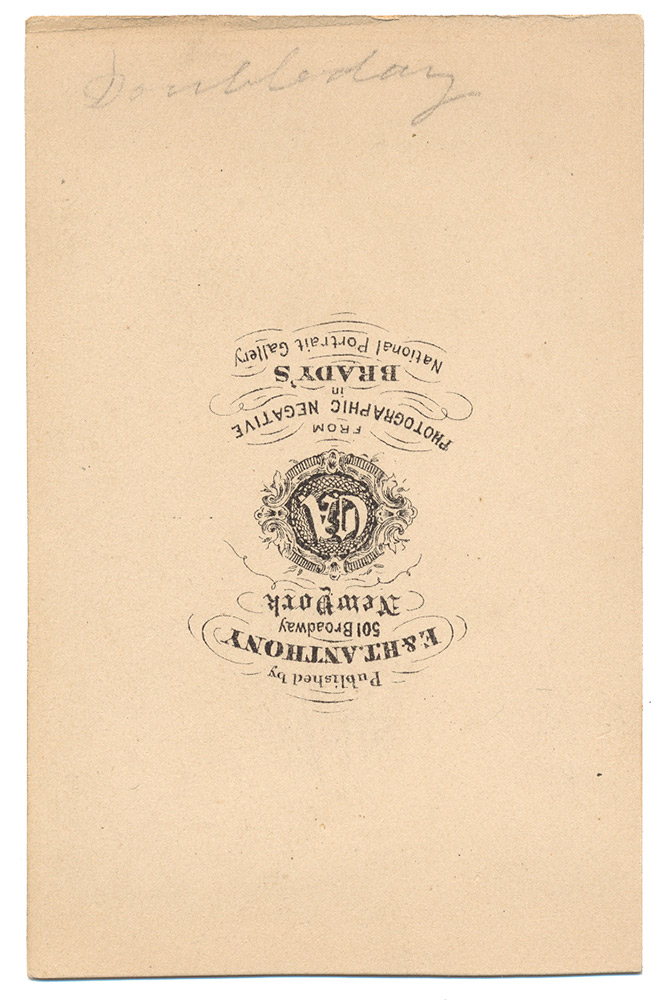
Photographer’s backmark is from E. &H.T. Anthony, New York. From a Brady negative.
Abner Doubleday (June 26, 1819 – January 26, 1893) was a career United States Army officer and Union major general in the Civil War. He fired the first shot in defense of Fort Sumter, the opening battle of the war, and had a pivotal role in the early fighting at the Battle of Gettysburg. Gettysburg was his finest hour, but his relief by Maj. Gen. George G. Meade caused lasting enmity between the two men. In San Francisco, after the war, he obtained a patent on the cable car railway that still runs there. In his final years in New Jersey, he was a prominent member and later president of the Theosophical Society. Doubleday died of heart disease in Mendham Township on January 26, 1893. Doubleday's body was laid in state in New York's City Hall and then was taken to Washington by train, and was buried in Arlington National Cemetery. [jet] [PH:L]
~~~~~~~~~~~~~~~~~~~~~~~~~~~~~~~~~~~
THIS ITEM, AS WITH ALL OTHER ITEMS AVAILABLE ON OUR WEB SITE,
MAY BE PURCHASED THROUGH OUR LAYAWAY PROGRAM.
CLICK HERE FOR OUR POLICIES AND TERMS.
THANK YOU!
Inquire About CDV PHOTO OF GENERAL ABNER DOUBLEDAY
Most Popular
Historical Firearms Stolen From The National Civil War Museum In Harrisburg, Pa »
Theft From Gravesite Of Gen. John Reynolds »
Selection Of Unframed Prints By Don Troiani »
Fine Condition Brass Infantry Bugle Insignia »
Rare Identified 65Th Ny Sergeant’s Jacket, With Manscript Material: 1St U.s. Chasseurs »
featured item
OUTSTANDING ISSUE BLANKET WITH SOLDIER ART ID'D TO 1ST MASSACHUSETTS INFANTRYMAN
This is a standard Federal issue blanket that has been cut down by the soldier and decorated with corps badges, his name and where he was at the time he applied the decoration. There is a lot to cover on this item so lets start with the basics. The… (1179-468). Learn More »
site search