

site search
online catalog
RELIC GROUPING – CONFEDERATE SURRENDER AT APPOMATTOX
Hover to zoom
$95.00 SOLD
Quantity Available: None
Item Code: 173-4310
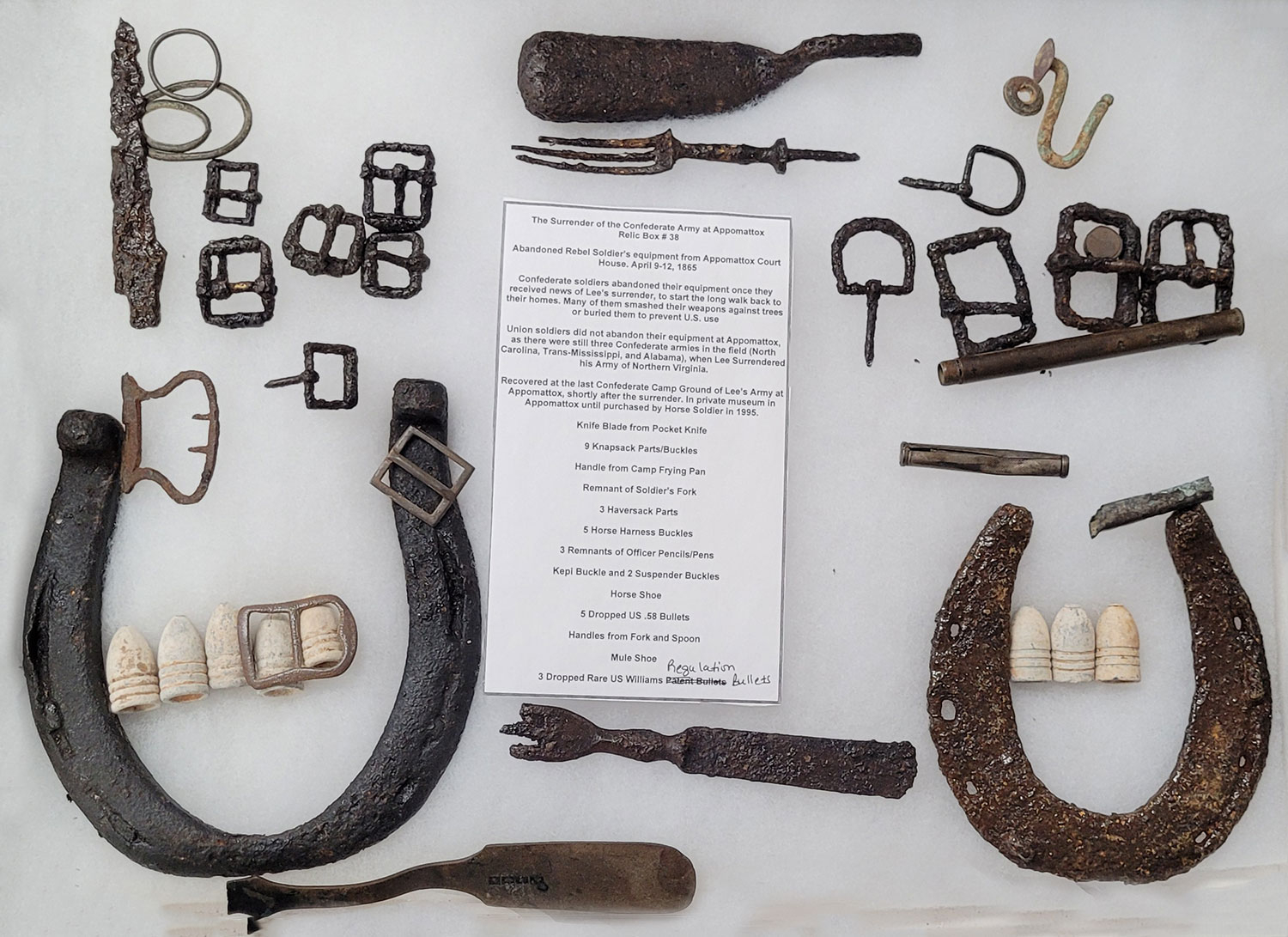
At Appomattox, once news of the surrender circulated, Confederates dismantled and destroyed as much equipment as possible to prevent confiscation by US Forces.
Dug from the last documented camp site of the Army of Northern Virginia, this grouping was acquired by The Horse Soldier in 1995 from a private museum at Appomattox as part of a large collection of artifacts from Lee’s surrender and the Battle of Appomattox Station. This portion includes:
a pocket knife blade, 9 pieces of knapsack accessories, a camp style frying pan handle, part of a period fork, 3 haversack parts, 5 horse harness buckles, 3 partial pens/pencils, a Kepi buckle, 2 suspender buckles, a horse shoe, 5 dropped .58 caliber bullets, period fork and spoon handles, a mule shoe, and 3 dropped Williams regulation bullets. These items are housed in a glass fronted Riker display case.
While most relics are remnants of a great fight, these stand in stark contrast as artifacts of the end of hostilities in Virginia. After years of terrible conflict, these items are a veritable snapshot of the moments when relative peace was becoming a new and accepted reality.
Any collection would benefit from the addition of these Appomattox surrender relics as a feature or a bookend to a collection spanning the Civil War. [cm] [ph:L]
~~~~~~~~~~~~~~~~~~~~~~~~~~~~~~~~~~~
THIS ITEM, AS WITH ALL OTHER ITEMS AVAILABLE ON OUR WEB SITE,
MAY BE PURCHASED THROUGH OUR LAYAWAY PROGRAM.
CLICK HERE FOR OUR POLICIES AND TERMS.
THANK YOU!
Inquire About RELIC GROUPING – CONFEDERATE SURRENDER AT APPOMATTOX
Most Popular
Historical Firearms Stolen From The National Civil War Museum In Harrisburg, Pa »
Theft From Gravesite Of Gen. John Reynolds »
Selection Of Unframed Prints By Don Troiani »
Fine Condition Brass Infantry Bugle Insignia »
Large English Bowie Knife With Sheath 1870’S – 1880’S »
Imported (Clauberg) Us Model 1860 Light Cavalry Officer's Saber »
featured item
MAMALUKE SABER MANUFACTURED IN ENGLAND
Manufactured: England Maker: William Harvey Year: 1840 - 1850 Model: Mameluke Size: 30.25 Condition: VG Wonderful Mamaluke Saber manufactured in England. Most likely for a British officer but possible it was imported to the US market. … (870-74). Learn More »
site search