


site search
online catalog
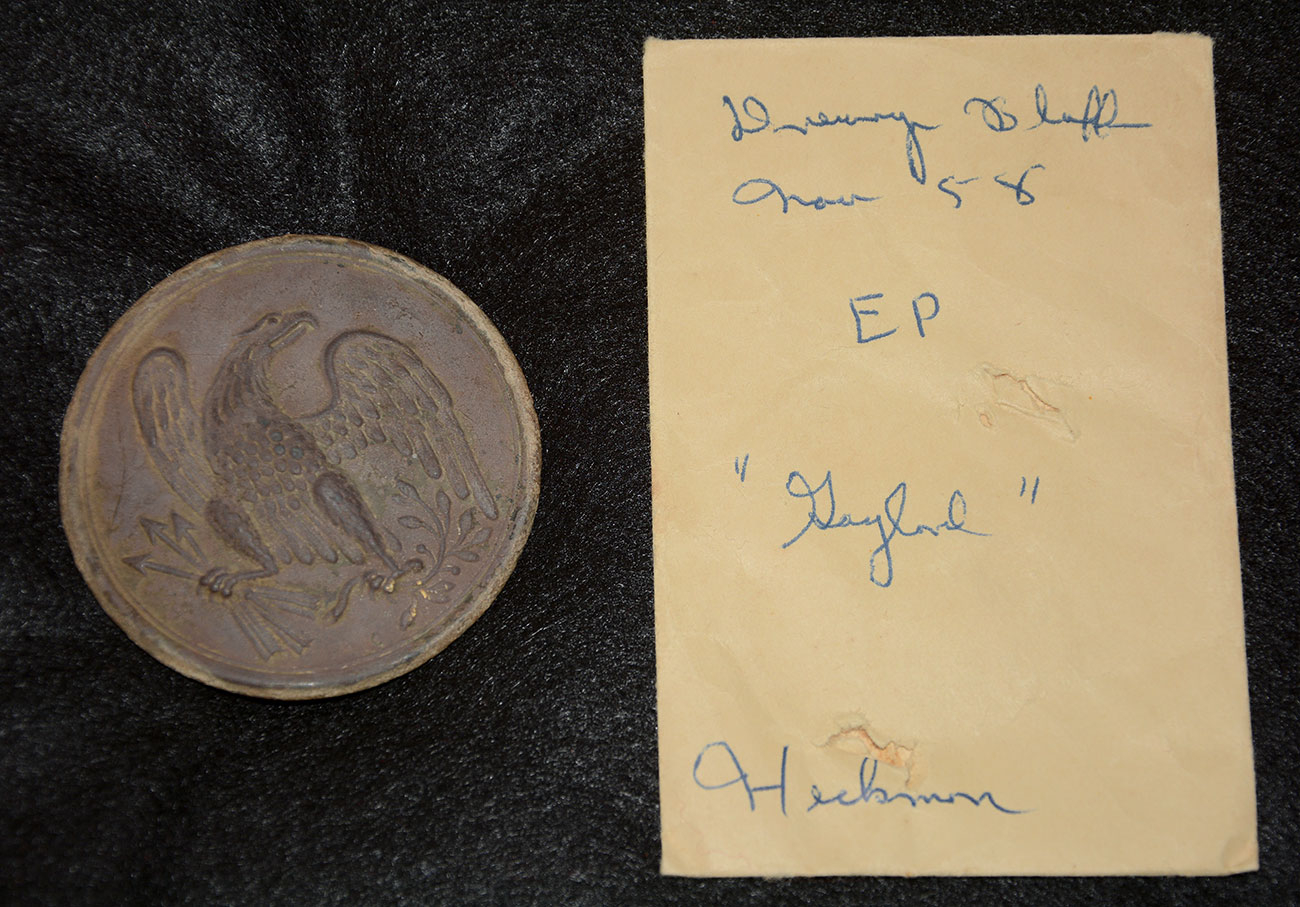
GAYLORD MARKED EAGLE CARTRIDGE BOX BELT PLATE FOUND NOVEMBER 1958 BY SID KERKSIS AT DREWRY’S BLUFF IN HECKMAN’S LINES
Hover to zoom
$550.00 SOLD
Quantity Available: None
Item Code: 2026-1552
This regulation US belt plate for the infantry cartridge box sling was in the collection of Syd Kerksis, well-known and respected early collector and author and comes with his annotated envelope indicating he found it in November 1958 at Drewry’s Bluff, with the additional note “Heckman,” indicating he recovered it in the area vainly defended by Heckman’s brigade in the Second Battle of Drewry’s Bluff on May 16, 1864, the largest battle of the Bermuda Hundred Campaign. Ben Butler had landed at Bermuda Hundred on May 5, and captured Confederate outer defenses at Drewry’s Bluff a few days later, but slowed his offensive, giving Beauregard a chance to counterattack on May 16, shattering Heckman’s brigade of Union troops and capturing Heckman himself in the initial assault.
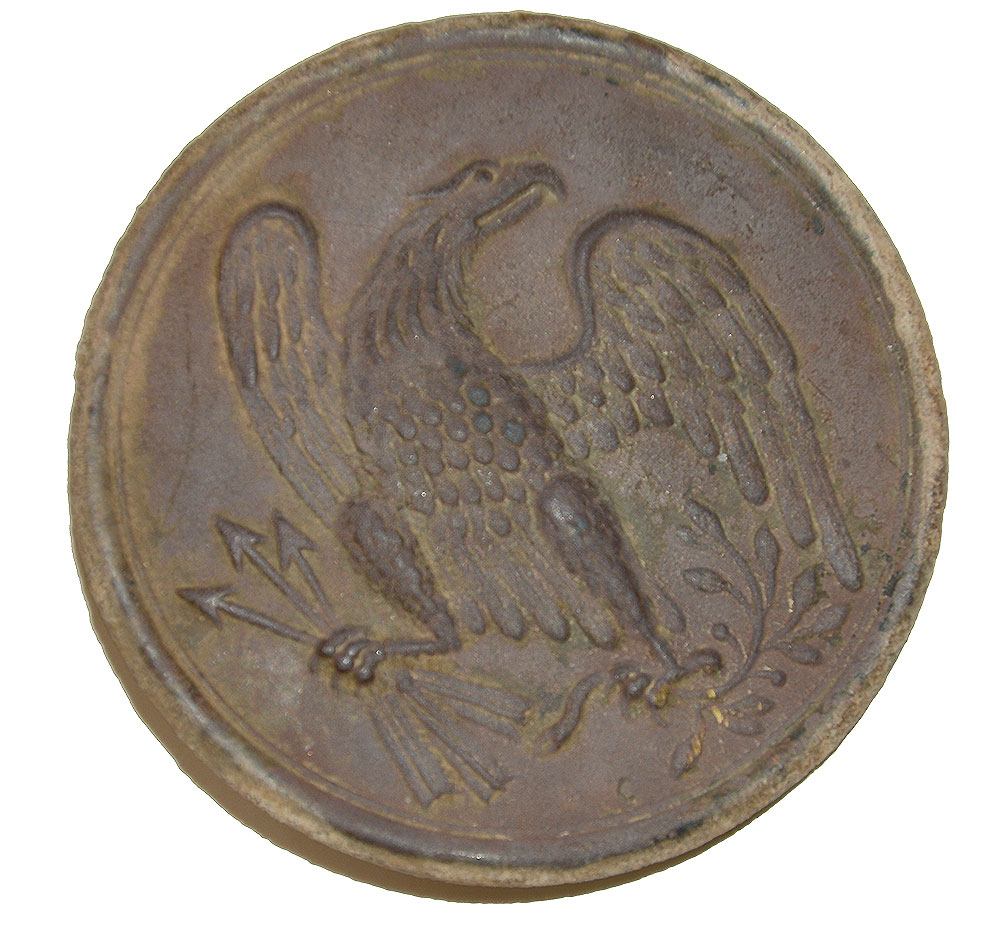
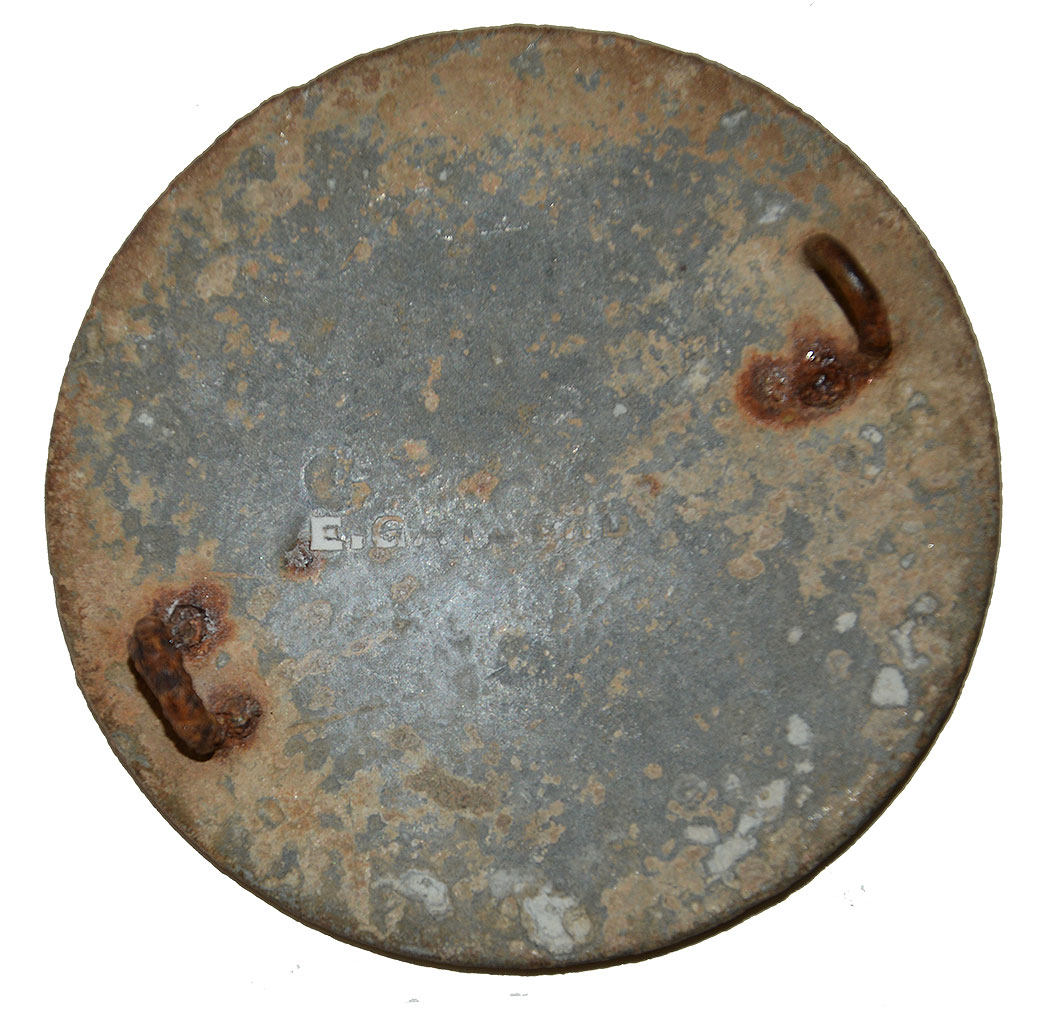
Worn on the shoulder belt of a Union infantryman’s cartridge box, this plate has very good definition to the central motif of the eagle clutching arrows and olive branch, and a good rim, showing some wear but no large dings or dents. The brass face is largely a light, chocolate brown, with some slightly darker tones to the eagle’s feathers and some light brown mixed with gray on the raised edge. The lead solder fill on the reverse has level gray surface showing some scattered white and brown areas. The iron wire loops are intact, showing brown rust with some brown staining to the lead-solder surface at their bases. “E. GAYLORD” is clearly stamped at an angle between them.
See O’Donnell and Campbell, American Military Belt Plates, Plate 463 for a similar Gaylord made plate. They note that after taking over the Ames accoutrement business in 1856, Gaylord became one of the larger US and state contractors for leather gear and belt plates, and note his characteristic die-strike on these plates where there arrows are rather short- the point of the arrow held closest by eagle being only level with the eagle’s knee for example.
These plates were adopted by the Army in 1826 with hooks on the reverse for the bayonet shoulder belt and made of brass for artillery and white metal for infantry. This was changed to brass for both services in 1831 and when the bayonet was moved to the waist belt around 1842, the plates were redesigned with two loops on the back for wear as fixed ornaments on the cartridge box sling and plates with hooks were relegated to the NCO and musician’s sword shoulder belts. (Some militia versions used hooks at a different angle for wear on the waist belt.) Although in theory the plate was dropped with introduction of the 1864 cartridge box rigs with no plates, the plate remained in use in the field and was not discontinued until the new 1872 sets of accouterments were distributed.
This is a very good condition and nicely marked example produced by a major supplier to the US government during the war comes from a significant battle in the climactic eastern campaign of the war, and has a tight provenance to the collection of a major author and collector. [sr][ph:L]
~~~~~~~~~~~~~~~~~~~~~~~~~~~~~~~~~~~
THIS ITEM, AS WITH ALL OTHER ITEMS AVAILABLE ON OUR WEB SITE,
MAY BE PURCHASED THROUGH OUR LAYAWAY PROGRAM.
CLICK HERE FOR OUR POLICIES AND TERMS.
THANK YOU!
Inquire About GAYLORD MARKED EAGLE CARTRIDGE BOX BELT PLATE FOUND NOVEMBER 1958 BY SID KERKSIS AT DREWRY’S BLUFF IN HECKMAN’S LINES
Most Popular
Historical Firearms Stolen From The National Civil War Museum In Harrisburg, Pa »
Theft From Gravesite Of Gen. John Reynolds »
Selection Of Unframed Prints By Don Troiani »
Fine Condition Brass Infantry Bugle Insignia »
featured item
JULY 1864 ALS – CS GENERAL ISAAC R. TRIMBLE (WOUNDED AT GETTYSBURG) TO CAPT. MCHENRY HOWARD – BOTH OF WHOM WERE BEING HELD AS PRISONERS OF WAR
This one page letter is a fine war dated missive, in ink on 7 ¾” x 9 ¼” lined paper. Dated “Johnson’s Island, July 14th 1864”; Johnson’s Island was a large prison where Confederate officers were held, near Sandusky, OH. The letter… (2025-3323). Learn More »
site search