


site search
online catalog
OTTOMAN RELICS FROM HUNGARY
Hover to zoom
$200.00 ON HOLD
Quantity Available: 1
Item Code: 236-1288
Offered here is a fine display of early relics recovered in Hungary.
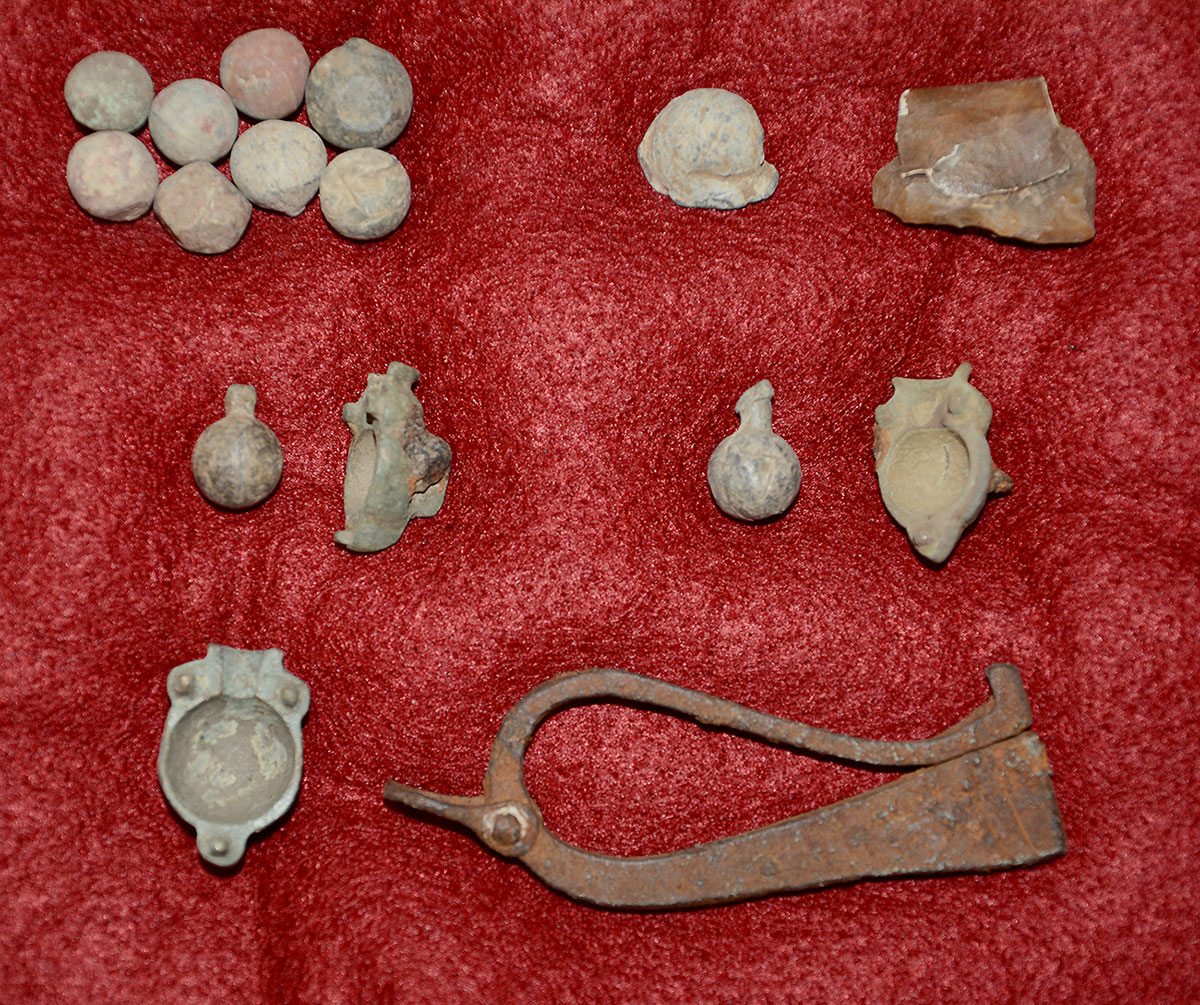
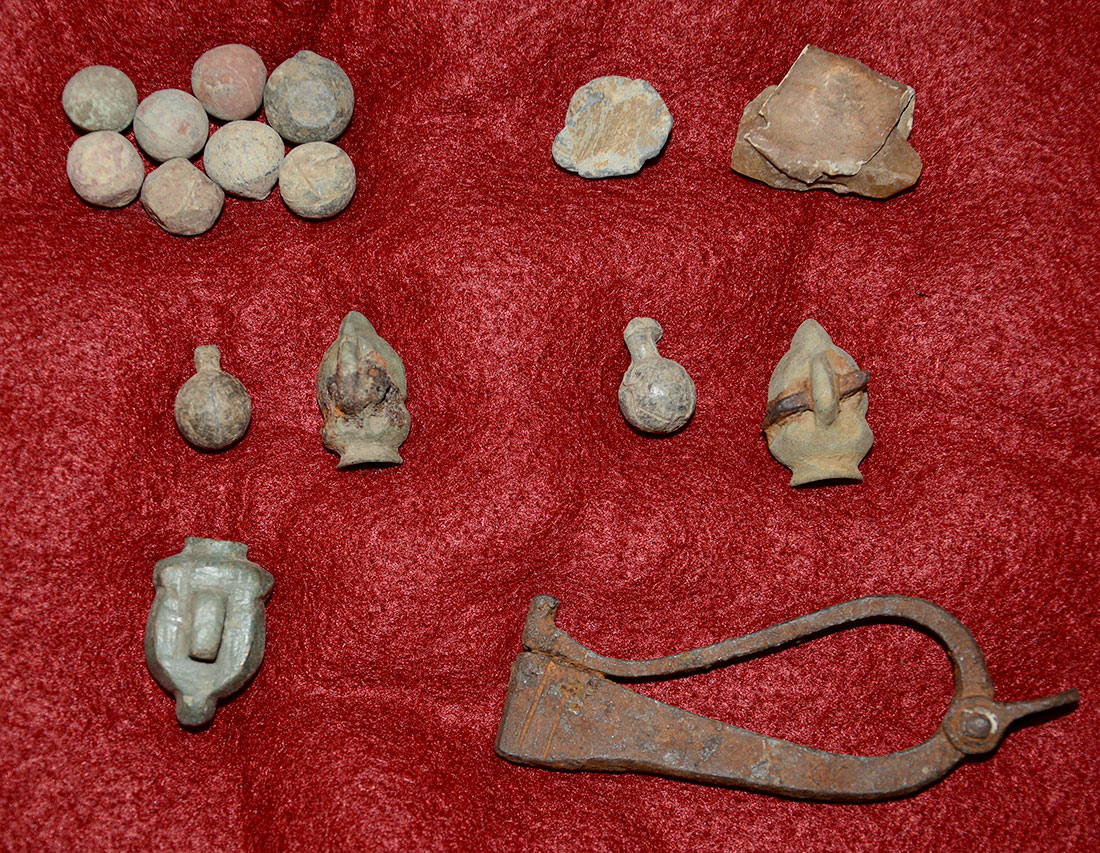
The 8.25” x 6.25” case holds eleven round shot, two retaining their cast sprues are matched with bronze mold halves. There is a total of three bronze Ottoman bullet mold halves in the display. A 3” iron “striker” and a lead wrapped musket flint are also included.
This style of early Ottoman bronze musket ball mold was used for casting spherical lead ammunition for smoothbore firearms. Firearms were adopted by the Ottoman military earlier and more systematically than by many contemporary states. By the 15th century, the Ottomans had integrated hand-held firearms into both infantry and auxiliary forces, and by the 16th–17th centuries, muskets were standard equipment across the empire. Musket ball molds such as this were essential tools for soldiers and irregular troops, allowing ammunition to be produced locally using melted lead. Bronze was favored for molds due to its resistance to heat, durability, and ability to produce uniform shot over repeated use. Ottoman molds are utilitarian in form, emphasizing function over decoration.
From the collection of author/publisher Dean Thomas who was researching the history and use of round shot around the world at the time of his death. A very nice collection of relics. [jet][ph:L]
~~~~~~~~~~~~~~~~~~~~~~~~~~~~~~~~~~~
THIS ITEM, AS WITH ALL OTHER ITEMS AVAILABLE ON OUR WEB SITE,
MAY BE PURCHASED THROUGH OUR LAYAWAY PROGRAM.
CLICK HERE FOR OUR POLICIES AND TERMS.
THANK YOU!
Inquire About OTTOMAN RELICS FROM HUNGARY
Most Popular
Historical Firearms Stolen From The National Civil War Museum In Harrisburg, Pa »
Theft From Gravesite Of Gen. John Reynolds »
Selection Of Unframed Prints By Don Troiani »
Fine Condition Brass Infantry Bugle Insignia »
Rare Identified 65Th Ny Sergeant’s Jacket, With Manscript Material: 1St U.s. Chasseurs »
featured item
VERY SCARCE 1799-1800 SWAN CONTRACT VIRGINIA MILITIA REGIMENTALLY MARKED MUSKET: 42nd REGIMENT, PITTSYLVANIA
This musket is stamped “42. VA. REGT. PITTSYLVANIA” on the barrel, was later altered to percussion and then shortened for use in the civilian market. It is a scarce survivor from muskets delivered to Virginia by Jame Swan of Boston in January… (1000-241). Learn More »
site search