


site search
online catalog
SECTIONED 3-INCH DYER CASE SHOT
Hover to zoom
$300.00 SOLD
Quantity Available: None
Item Code: 1202-1325
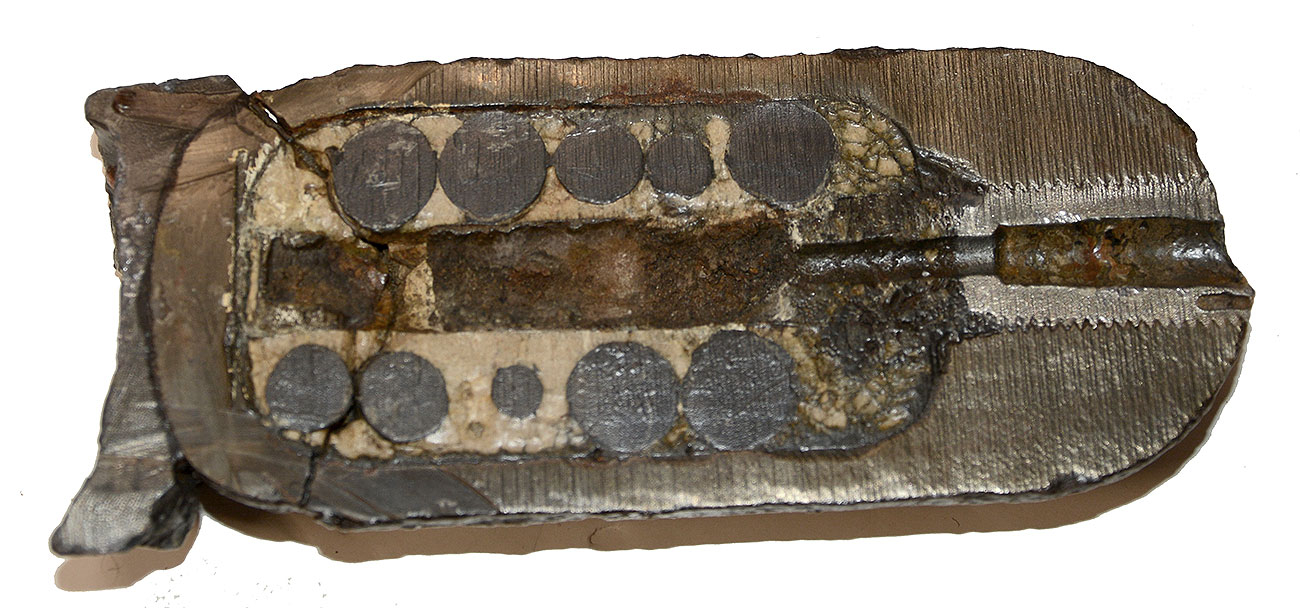
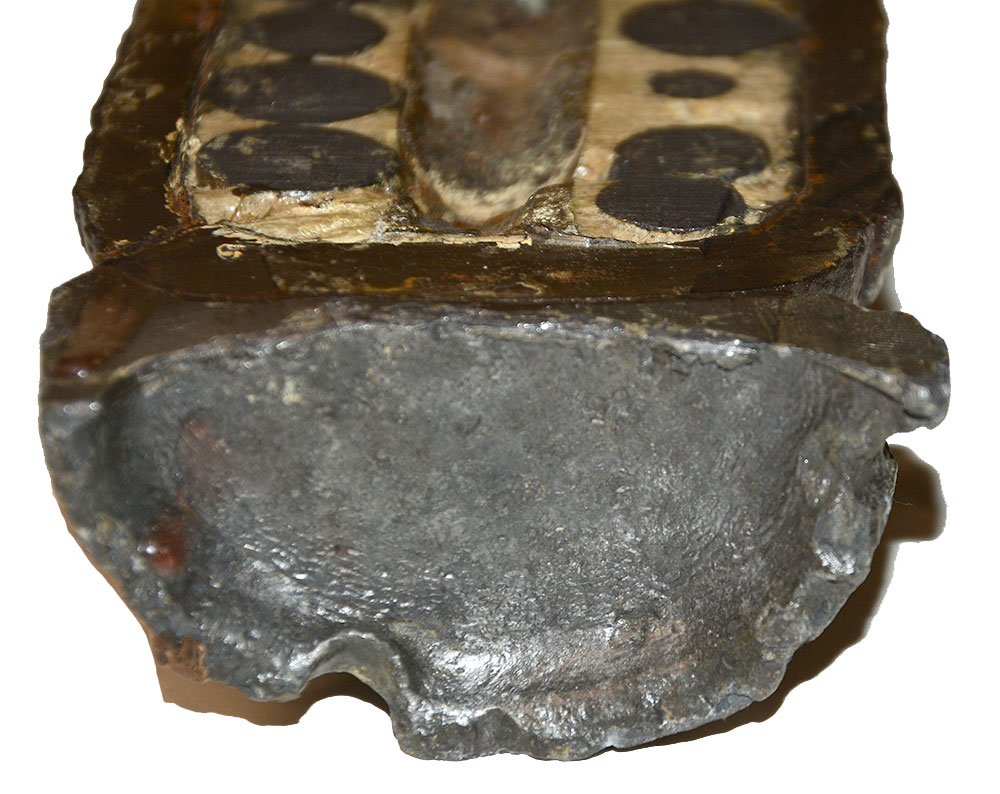
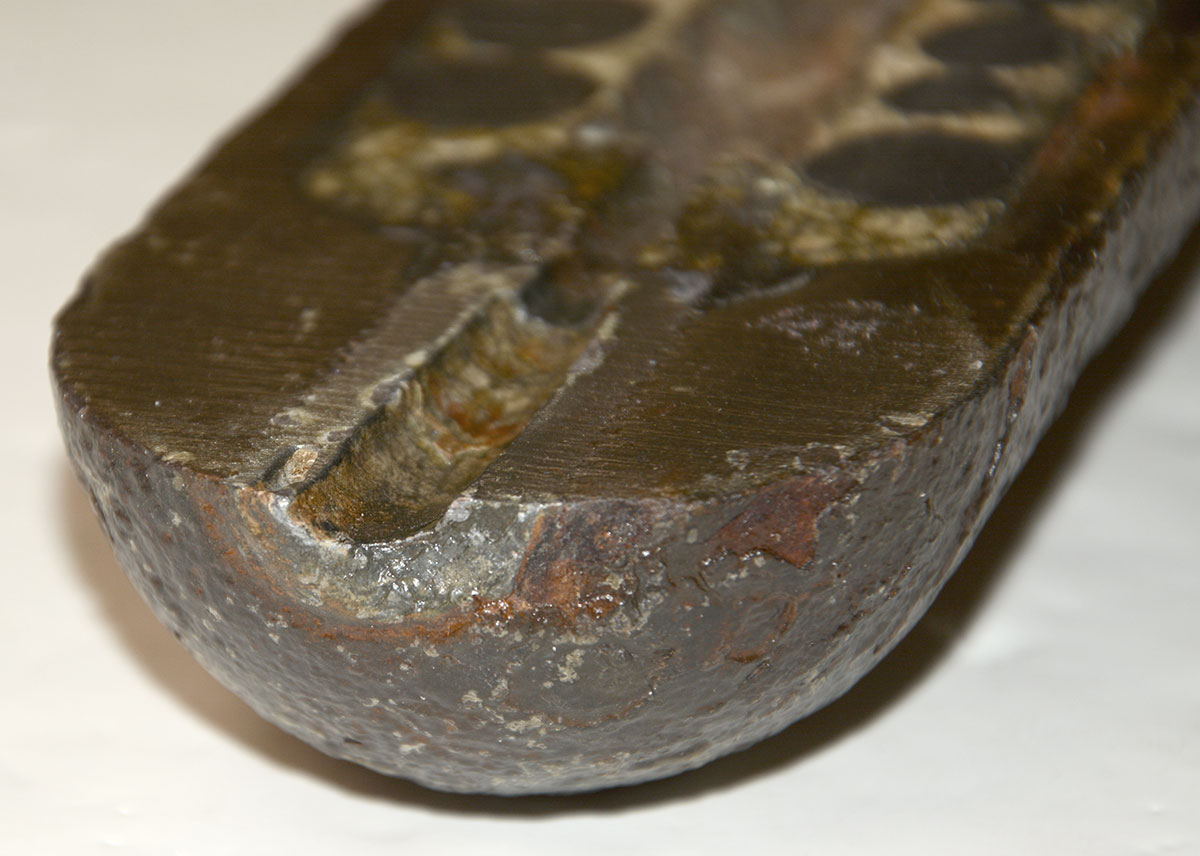
A Civil War 3-inch Dyer pattern case shot for the widely used 3-Inch Ordnance Rifle in the field artillery. This would be an educational addition to any Civil War artillery collection or display, having been sectioned lengthwise to show its construction and inner workings. The round is excavated, was clearly fired, but did not detonate and has been rendered inert. The shell body with rounded nose is intact, showing just a little damage on the nose, and a crack near the bottom that runs partially across the body and then partially up one side, but is stable. The zinc fuze adapter in the nose that held a time-fuze is in place. The varied-size shrapnel balls are also present, still embedded in the sulfur matrix used to hold them, which also shows the hollow central chamber that would have held the bursting charge.
This also retains part of its sabot skirt, attached to the base of the shell just below an expansion/lubrication groove. Made of a combination of zinc and lead, this would expand when the propellant charge was fired, taking the rifling of the cannon ball, and increasing the gun’s range and accuracy. The band shows some bending and distortion from firing and impact, but also shows some of the flame grooves cut in its side so that flame from the propellant charge could reach the nose of the round and ignite the time fuze. The latter would be cut according to the estimated distance to the target, ideally timing it to detonate the bursting while above and just in front of its target, showering it with shell fragments and the shrapnel balls it contained. In the case of advancing enemy troops the gun crews would use this until they closed to about 400 yards, at which point canister rounds would be employed.
The government purchased a total of 107,230 3-inch Dyer projectiles from William Sellers & Co. on contracts from September 26, 1861, to May 24, 1862. This may refer to contract rather than delivery dates. The round was widely used in all theatres from 1861 through 1864 and Dickey & George note they have also been excavated at the 1865 battle site of Fort Fisher. Interestingly, there were some complaints from the field that the sabot cups would detach in firing, affecting accuracy and the safety of nearby troops, but by late October 1864 a redesigned sabot cup had been proposed that remedied the problem. See Melton & Pawl and Dickey & George for more details. The first two authors include a photo of a Gettysburg recovered example. [sr][ph:L]
~~~~~~~~~~~~~~~~~~~~~~~~~~~~~~~~~~~
THIS ITEM, AS WITH ALL OTHER ITEMS AVAILABLE ON OUR WEB SITE,
MAY BE PURCHASED THROUGH OUR LAYAWAY PROGRAM.
CLICK HERE FOR OUR POLICIES AND TERMS.
THANK YOU!
Inquire About SECTIONED 3-INCH DYER CASE SHOT
Most Popular
Historical Firearms Stolen From The National Civil War Museum In Harrisburg, Pa »
Theft From Gravesite Of Gen. John Reynolds »
Selection Of Unframed Prints By Don Troiani »
Fine Condition Brass Infantry Bugle Insignia »
featured item
“SOFT TACK:” AERATED BREAD CRATE
This would make a nice addition to a camp, sutler, Sanitary Commission or even a hospital display. Constructed of thin, about ½” thick, unpainted, wide pine boards that are simply nailed together, this is about 18” X 13 ¾” X 12” and is… (1202-166). Learn More »
site search