


site search
online catalog
SMALL PATTERN “BURNSIDE” CARTRIDGE BOX BELT PLATE FROM ANTIETAM! FOUND DECEMBER 1954 BY SYD KERKSIS
Hover to zoom
$675.00 ON HOLD
Quantity Available: 1
Item Code: 2026-1735
Smaller size round eagle cartridge box plates are usually nicknamed “Burnside” pattern plates from their recovery in later war, 1864, sites associated with Burnside’s 9th Army Corps. O’Donnell and Campbell, however, in their caption to Plate 448, page 283, note that some of the smaller plates were likely from a state contract and date theirs, measuring 59mm and noted as one of the smallest, to 1861-63. This one is even slightly smaller- we measure it at 54mm. In support of a possible state contract they note an example similar to theirs on a J.B. Thaxter, Portland, Maine, marked contract cartridge box belt. We also note, however, that R.T. Huntington suggested these smaller plates might be leftover arsenal stock from prewar Hall Rifle bayonet scabbard belts, which were only 1.5-inches wide, for which the wider plates would have been out of scale. See Paul Johnson, CW Cartridge Boxes, p.284ff. for additional information.
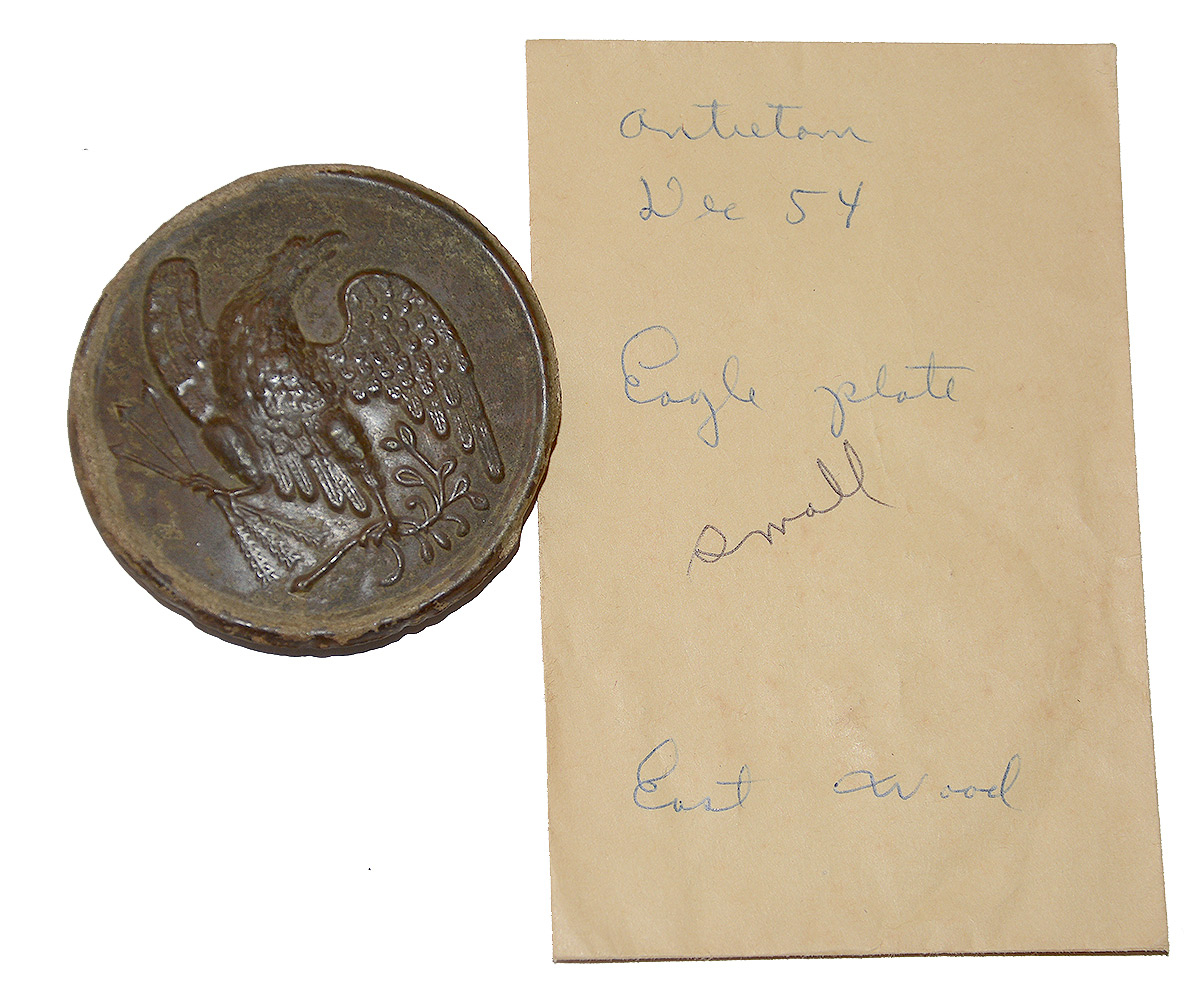
Whatever the precise origin, this has tight provenance indicating an early-war issue. It comes from the collection of esteemed early relic hunter and author Syd Kerksis and still has his collection envelope with it indicating he found it at Antietam in December 1954. The envelope reads: “Antietam / Dec 54 / Eagle Plate / Small / East Wood.” Kerksis clearly added “small” after he had cataloged it, but had a chance to look at it more closely.
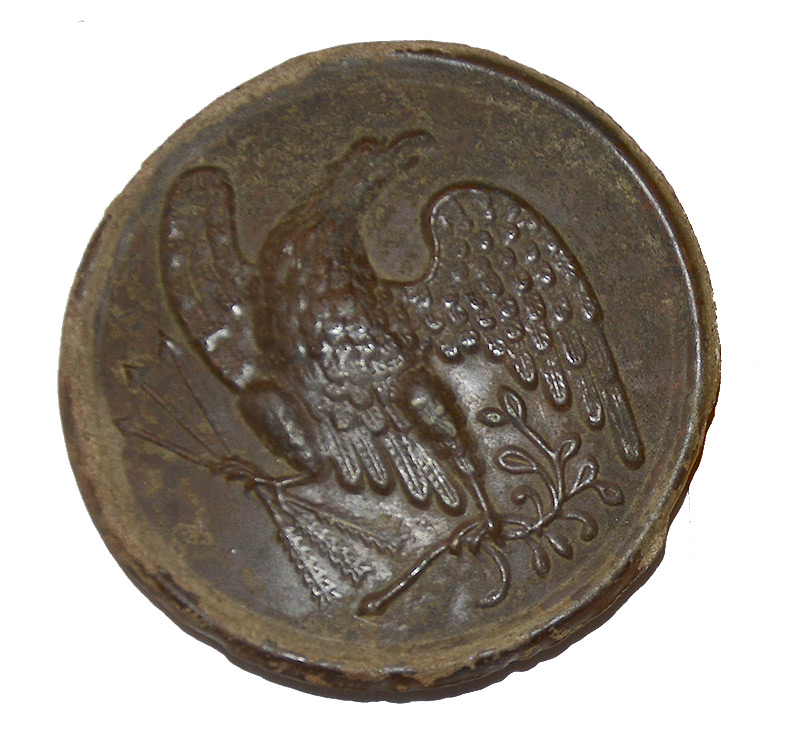
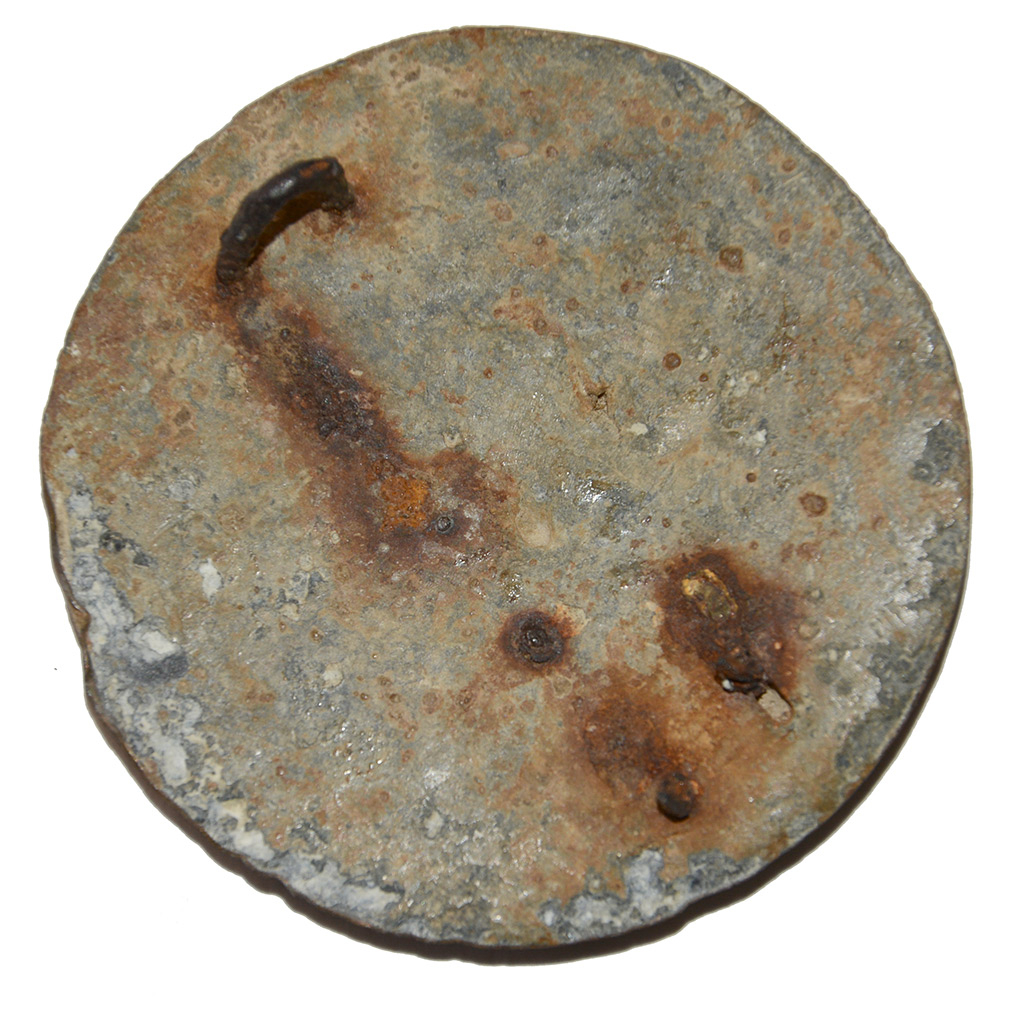
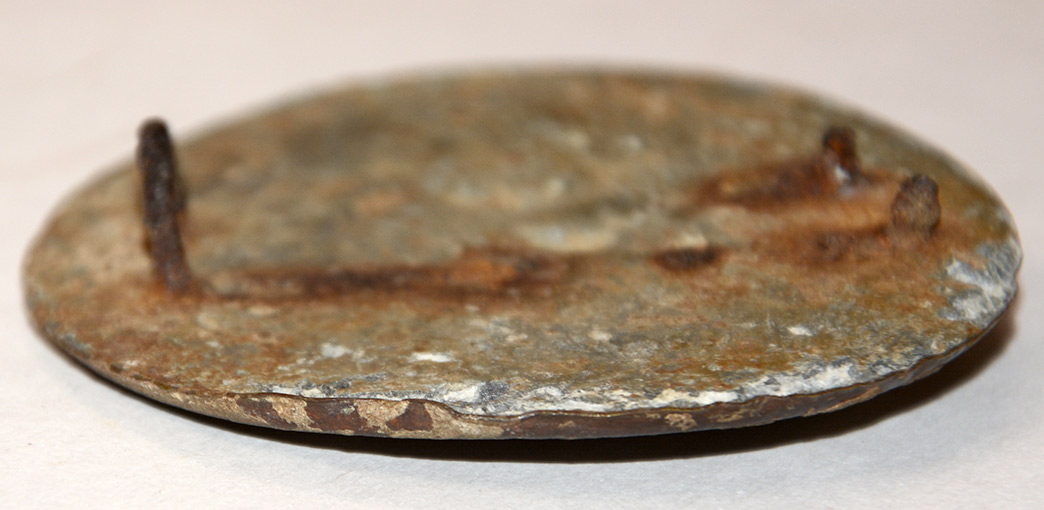
The plate preserves good detail to the central motif – the US eagle with arrows and olive branch- and a largely medium brown color to the face of the plate with light brown and gray on the rim, which also shows some small dings at lower right. The reverse preserves its lead-solder fill mostly intact, with just some shallow losses near the edge dings, mostly gray in tone, but with light brown stains from oxidation of the iron wire loops secured by the lead-solder fill. One of the fastening loops is gone, but the other is present, showing crustiness, but intact, with the lead underneath slightly stained, the color follow the course of the iron wire buried in it.
These plates were adopted in 1826 with hooks on the reverse for the bayonet shoulder belt and made of brass for artillery and white metal for infantry. This was changed to brass for both services in 1831 and when the bayonet was moved to the waist belt around 1842, the plates were redesigned with two loops on the back for wear as fixed ornaments on the cartridge box sling and plates with hooks were relegated to the NCO and musician’s sword shoulder belts. (Some militia versions used hooks at a different angle for wear on the waist belt.) Although in theory the plate was dropped with introduction of the 1864 cartridge box rigs with no plates, the plate remained in use in the field and was not discontinued until the new 1872 sets of accouterments were distributed.
As a well-documented early-war version of this plate, this a scarce variant. The East Wood find location also opens up the possibility for research on units perhaps issued it since it was largely troops from the 1st and 12th Corps fighting in this area of the battlefield. It also has a tight provenance from one of the great early relic hunters, scholars and authors. [sr][ph:L]
~~~~~~~~~~~~~~~~~~~~~~~~~~~~~~~~~~~
THIS ITEM, AS WITH ALL OTHER ITEMS AVAILABLE ON OUR WEB SITE,
MAY BE PURCHASED THROUGH OUR LAYAWAY PROGRAM.
CLICK HERE FOR OUR POLICIES AND TERMS.
THANK YOU!
Inquire About SMALL PATTERN “BURNSIDE” CARTRIDGE BOX BELT PLATE FROM ANTIETAM! FOUND DECEMBER 1954 BY SYD KERKSIS
Most Popular
Historical Firearms Stolen From The National Civil War Museum In Harrisburg, Pa »
Theft From Gravesite Of Gen. John Reynolds »
Selection Of Unframed Prints By Don Troiani »
Fine Condition Brass Infantry Bugle Insignia »
Rare Identified 65Th Ny Sergeant’s Jacket, With Manscript Material: 1St U.s. Chasseurs »
featured item
FROM LIFE CDV VIEW OF CUSTER BY GOLDIN
This is a very nice “from-life” view of Custer by John Goldin & Co. in May 1865, Katz #70 in his Custer in Photographs, taken in May 1865. Custer is shown seated, from mid-calf up, resting one arm on the back of the photographer’s chair,… (2024-450). Learn More »
site search