

site search
online catalog
Relics
Showing 81 to 90 out of 338
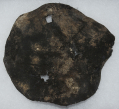
KEPI OR DRESS CAP STIFFENER FROM FORT PEMBINA
This comes from the excavations at Fort Pembina, ND, a small frontier army post in operation from 1870 to 1895, and is the stiffener from inside the top of a kepi a M1872 dress cap. It is black in… (1052-475). Learn More »
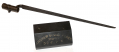
ANDREW GREGG TUCKER POST 52 G.A.R. PLINTH, LEWISBURG, PA, HONORING THE 142nd PA OFFICER KILLED AT GETTSYBURG, WITH A BATTLEFIELD PICKUP BAYONET
This “Black Granite” plinth is painted in gold with the name of the G.A.R. post in which it was used, along with the donor’s name, and the date and location where that post’s officer … (2024-1366). Learn More »

GETTYSBURG MICHIGAN CAVALRY BRIGADE SPENCER RIFLE: SECOND DELIVERY “COPELAND” SPENCER, SERIAL #1811 WITH CONFEDERATE “Q” CLEANED AND REPAIRED STAMP
M1860 Spencer Army Rifles are highly sought after and one falling in the serial number range for issue in Custer’s Michigan Cavalry Brigade before Gettysburg is a holy grail for many. This one has… (172-6073). Learn More »
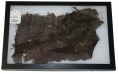
PIECE OF A U.S. FLAG FROM THE FRONTIER US ARMY FORT PEMBINA, NORTH DAKOTA
This piece of bunting comes from excavations at Fort Pembina, ND, conducted on private property with the owner’s permission, a fort established in 1870 by troops of the 20th US Infantry and… (1052-722). Learn More »
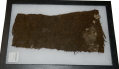
PIECE OF CIVIL WAR - INDIAN WAR FRONTIER US ARMY BLANKET FROM FORT PEMBINA, NORTH DAKOTA
This piece of a US Army military issue blanket comes from excavations at Fort Pembina, ND, conducted on private property with the owner’s permission, a fort established in 1870 by troops of the 20th… (1052-615). Learn More »
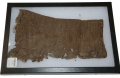
US ARMY SHIRT CUFF FROM FORT PEMBINA, NORTH DAKOTA
A relic from a small U.S. Army frontier post of the Indian Wars- part of a soldier’s shirt. This is the shirt cuff, still showing a small button near the corner, and a portion of the lower sleeve.… (1052-602). Learn More »
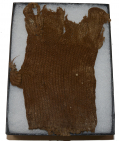
REMNANT OF SCARCE INDIAN WAR SOLDIER’S MITTEN FROM FORT PEMBINA, ND
This comes from the excavations at Fort Pembina, occupied 1870-1895, where cold weather in winter months might well be a concern. The army began issuing mittens in 1873. Before that men were left to… (1052-584). Learn More »
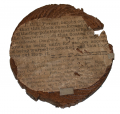
SLICE OF CONFEDERATE FLAG POLE FROM RICHMOND
Here is a 3/8” thick slice of wood that measures 4 ¼” in diameter. Glued to one side is the remains of an old, printed label: “Richmond, Va., May 20, 1890. I, C.L. Parker, hereby cer[tify] that… (1030-324). Learn More »
$625.00
Originally $780.00

KEPI CHINSTRAP AND SIDE BUTTONS FROM AN INDIAN WAR FRONTIER
This is a complete leather chinstrap from an army kepi or forage cap from excavations at Fort Pembina, ND. The chinstrap is a two-piece style with a fixed loop on the end of one strap and a fixed… (1052-486). Learn More »
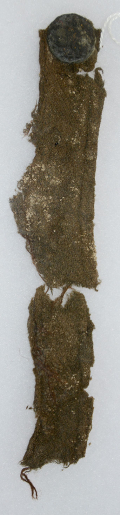
CIVIL WAR-INDIAN WAR UNIFORM COAT PIECE WITH BUTTON FROM FORT PEMBINA
This is part of the right lapel of a US army coat discarded by a soldier at Fort Pembina, ND, sometime between 1870 and 1895, and is from excavations in wet, anaerobic soil that has preserved leather… (1052-724). Learn More »
Showing 81 to 90 out of 338
Most Popular
Historical Firearms Stolen From The National Civil War Museum In Harrisburg, Pa »
Theft From Gravesite Of Gen. John Reynolds »
Selection Of Unframed Prints By Don Troiani »
Fine Condition Brass Infantry Bugle Insignia »
Large English Bowie Knife With Sheath 1870’S – 1880’S »
Imported (Clauberg) Us Model 1860 Light Cavalry Officer's Saber »
featured item
A CONFEDERATE SURGEON'S GREATCOAT, SASH AND SHIRT
Dr. J. P. Rasser was contracted by the Confederacy and among his duties in Georgia was the examination of Conscripts for the Army. THE OVERCOAT or army great coat is certainly "Homespun" that is a woven woolen fabric originally made from homespun… (1268-706). Learn More »
site search