

site search
online catalog
Relics
Showing 141 to 145 out of 321
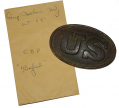
RELIC U.S. ENLISTEDMAN’S CARTRIDGE BOX PLATE MARKED “E. GAYLORD” FROM KENTUCKY, RECOVERED BY SYD KIRKSIS
This excavated Pattern 1839 US cartridge box plate has a smooth brown patina on the face. The oval brass face features a raised “US”. The plate’s reverse has 99% of the lead fill. The two iron… (490-6831). Learn More »
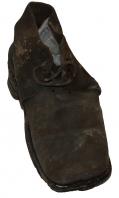
SCARCE CIVIL WAR ARMY ISSUE SHOE, A.K.A. BROGAN OR BOOTTEE
This Civil War US army issue shoe is typical wartime construction, using rough-side out black leather with reinforcing heel piece or “counter” sewn inside, four pairs of holes for a leather lace,… (1052-282). Learn More »
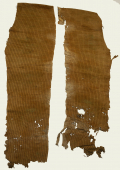
KNIT DRAWERS OR TROUSERS FROM FORT PEMBINA
These pieces are two legs from trousers or, more likely, drawers recovered in the excavations at Fort Pembina, ND, conducted on private property with the owner’s permission, where wet, anaerobic… (1052-446). Learn More »
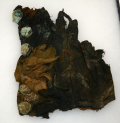
CIVIL WAR-INDIAN WAR UNIFORM COAT PIECE WITH BUTTONS FROM FORT PEMBINA
This comes from the right lapel of a US army coat discarded by a soldier at Fort Pembina, ND, sometime between 1870 and 1895, and is from excavations in wet, anaerobic soil that has preserved leather… (1052-580). Learn More »
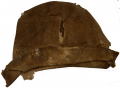
INDIAN WAR FIELD-USED CAMPAIGN HAT FROM FORT PEMBINA, NORTH DAKOTA
This is a real field-used Indian War campaign hat in relic condition excavated at Fort Pembina, ND, a small frontier army post in operation from 1870 to 1895. Anaerobic conditions of the dig have… (1052-253). Learn More »
Showing 141 to 145 out of 321
Most Popular
Historical Firearms Stolen From The National Civil War Museum In Harrisburg, Pa »
Theft From Gravesite Of Gen. John Reynolds »
Selection Of Unframed Prints By Don Troiani »
Fine Condition Brass Infantry Bugle Insignia »
featured item
AN IDENTIFIED GETTYSBURG PICKED-UP RICHMOND RIFLE-MUSKET
This is very good example of a Richmond rifle-musket that was made in 1863. It has the beveled "low-hump" lock plate introduced in the spring of 1862. It has the desirable brass butt plate and nose cap; the iron barrel bands are all Richmond made… (1268-076). Learn More »
site search