

site search
online catalog
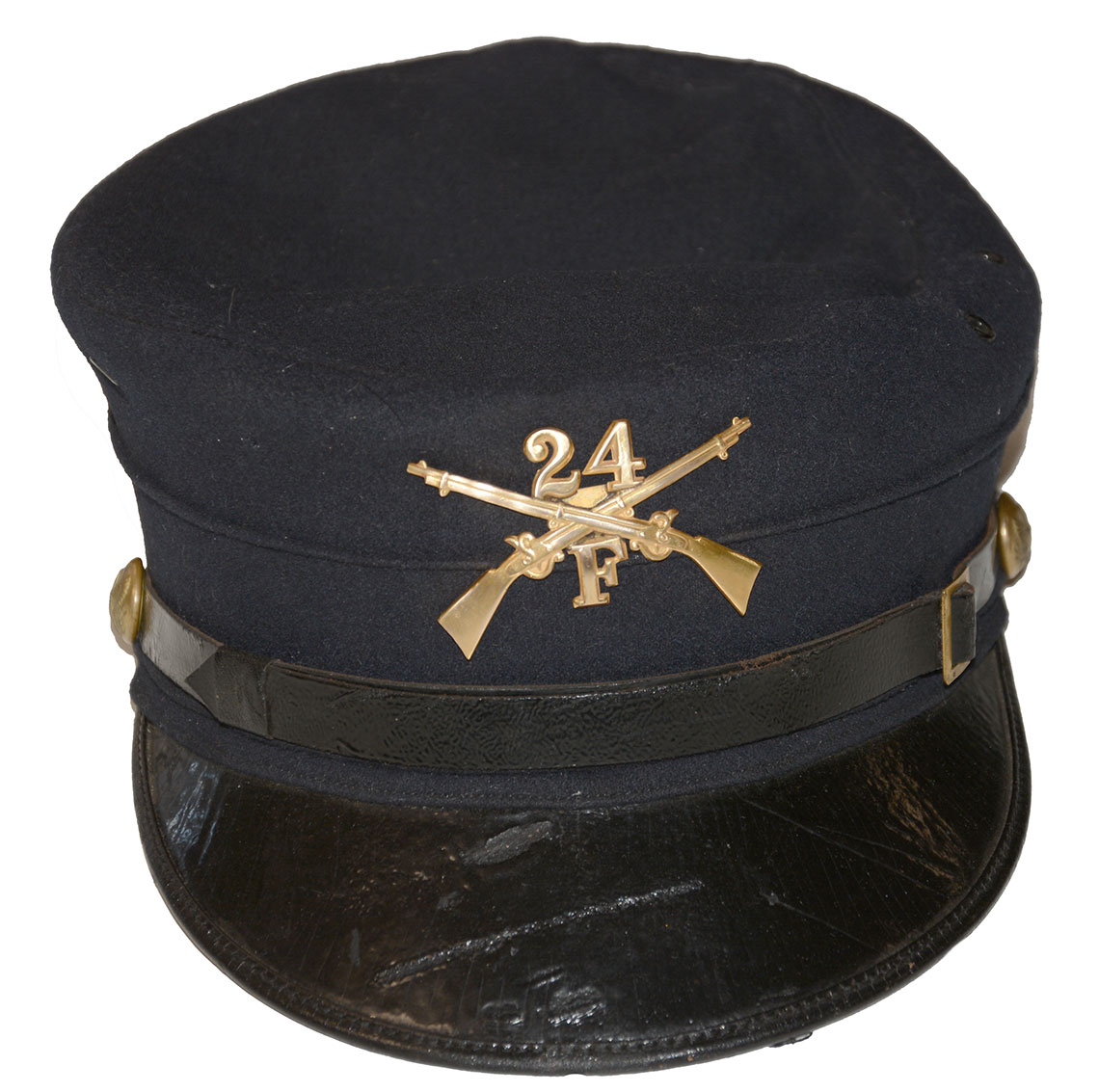
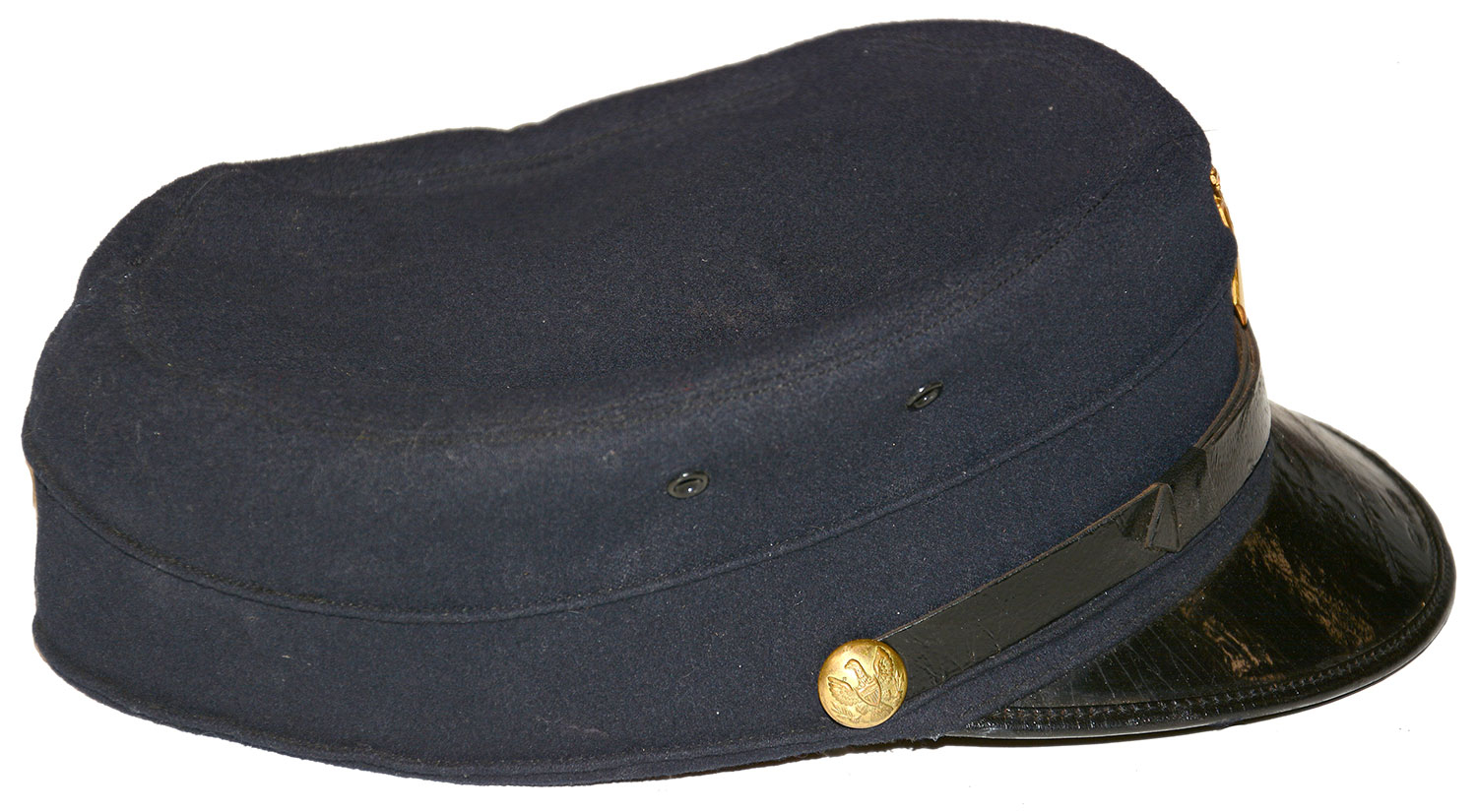
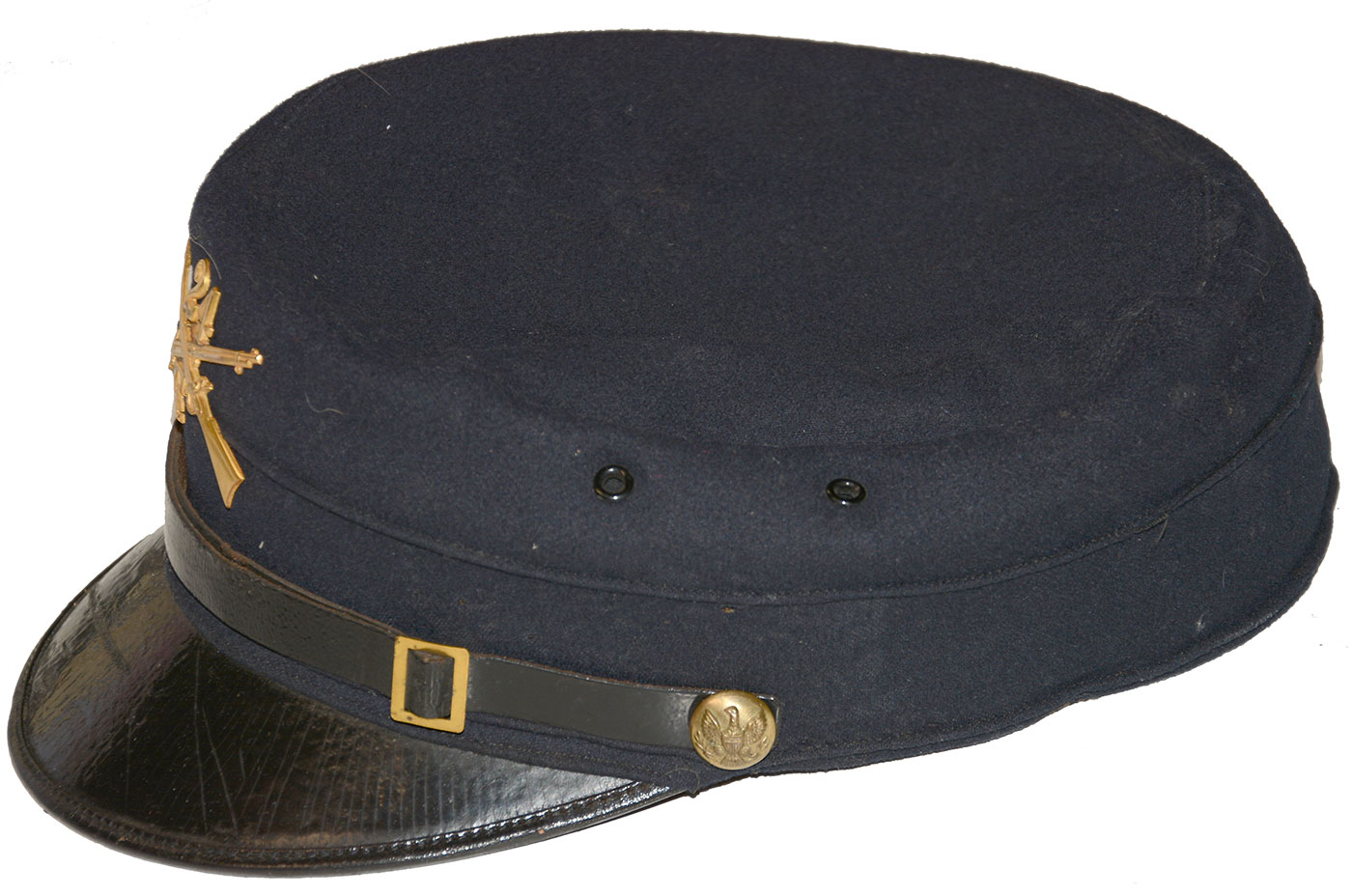
A REGULATION US MODEL 1895 ENLISTEDMAN'S CAP UNITED STATES COLORED INFANTRY
Hover to zoom
$295.00 SOLD
Quantity Available: None
Item Code: 1202-1279
This Spanish-American War issue cap, also called the Model 1896, was worn by a member of the 24th United States Infantry. The 24th Infantry Regiment was a regiment in the United States Army comprised of Black soldiers and commanded by White officers; it was authorized in 1869. It was one of four Black regiments in the army, along with the 25th Infantry, the 9th Cavalry, and the 10th Cavalry. Collectively, these regiments became known as the famous Buffalo Soldiers.
The 24th Infantry Regiment was first constituted by Act of Congress on 28 July 1866 as the 38th Infantry Regiment with African American enlisted personnel. The regiment was organized on 1 October 1866 at Jefferson Barracks Missouri. From 1866 to 1869 the 38th primarily provided security for the building of railroads in the southwest. In 1869 the U.S. Army was downsized by an Act of Congress. As part of the downsizing the 45 active infantry regiments were consolidated into 25 active infantry regiments. This resulted in the consolidation of the 38th Infantry Regiment and the 41st Infantry Regiment also manned by African American enlisted personnel. The 41st Infantry had also been constituted on 28 July 1866 and organized on 25 December 1866 at Baton Rouge, Louisiana. The commanding officer of the 41st was Colonel Ranald S. Mackenzie a famous hero of the Civil War with the executive officer being Lieutenant Colonel William R. Shafter who would lead the US Army in Cuba during the War with Spain. Prior to the consolidation, the 41st served in Louisiana and Texas. On 15 March 1869 in western Texas the two regiments were consolidated to form the 24th Infantry Regiment with Colonel Mackenzie as its commanding officer. Upon activation, the 24th Infantry was stationed at Forts McKavett, Davis, Concho and Stockton in west Texas. On 15 December 1870 Colonel Mackenzie left to take command of the 4th Cavalry Regiment. The 24th performed a variety of missions from fighting the Comanche Indians on the Staked Plains of northwestern Texas as well as other Indian tribes, providing security for settlers and Army installations and aiding in the establishment and the maintaining law and order. For over ten years the 24th Infantry played a significant role in defeating the Comanches and opening northwestern Texas to settlers. In 1880 the 24th moved to what is now the state of Oklahoma where it performed garrison duties until moving to the Department of Arizona in 1888 with the regiment split between garrisons in New Mexico and Arizona. In 1892 the regiment was consolidated at Fort Huachuca, Arizona. Then from 1896 to 1899 the regiment was stationed at Fort Douglas, Utah.
In June 1898 with the start of the War with Spain the 24th Infantry along with just about the entire US Army invaded Cuba. As part of the 3rd Brigade of the 1st Division, V Corps, the 24th Infantry distinguished itself in the gallant charge of the 3rd Brigade up the open slopes of San Juan Hill against heavy enemy fire and captured at 1200 hours on 1 July 1898, the Spanish blockhouse and entrenchments guarding the approach to the city of Santiago. The regiment’s courage under fire was specifically noted in the regimental commander’s after-action report. The 24th Infantry suffered 17 killed and 82 wounded in the assault with 16 members of the regiment cited for extraordinary valor. The tropical diseases such as malaria, yellow and typhoid fevers caused many more casualties in the US Army than combat. With a shortage of medical personnel to attend to the sick volunteers from the combat units were asked to tend to the sick. Upon the surrender of the Spanish forces defending Santiago some fifty members of the 24th Infantry volunteered as medical orderlies to serve the many soldiers who had contracted the tropical fevers resulting in many of the volunteers falling ill as well. In September 1898 the 24th Infantry returned to the United States with the regiment manning garrisons at Fort Douglas, Utah as well as in Wyoming, Washington, Montana and Alaska. In July 1899 the elements of the 24th stationed at Fort Douglas, Utah and in Wyoming arrived in the Philippine Islands to reinforce Army units which had captured the islands from the Spanish and were then under attack by Filipino insurgents resisting the American takeover. In what was to become officially known as the Philippine Insurrection, the 24th Infantry served on the main island of Luzon until August 1902. In 1902 a new pattern cap was introduced to the US Infantry.
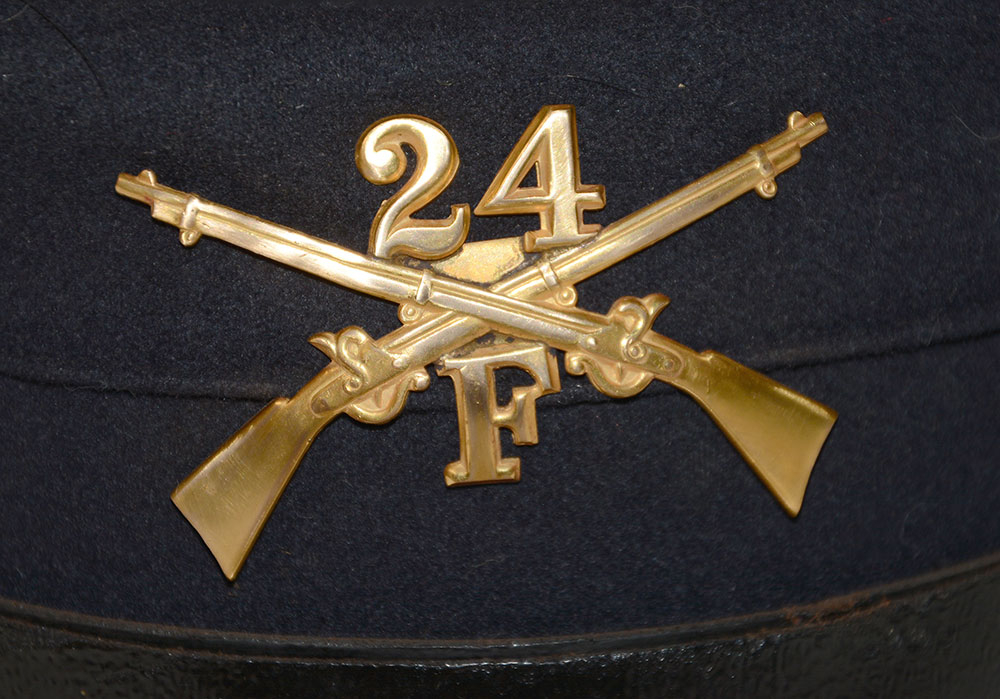
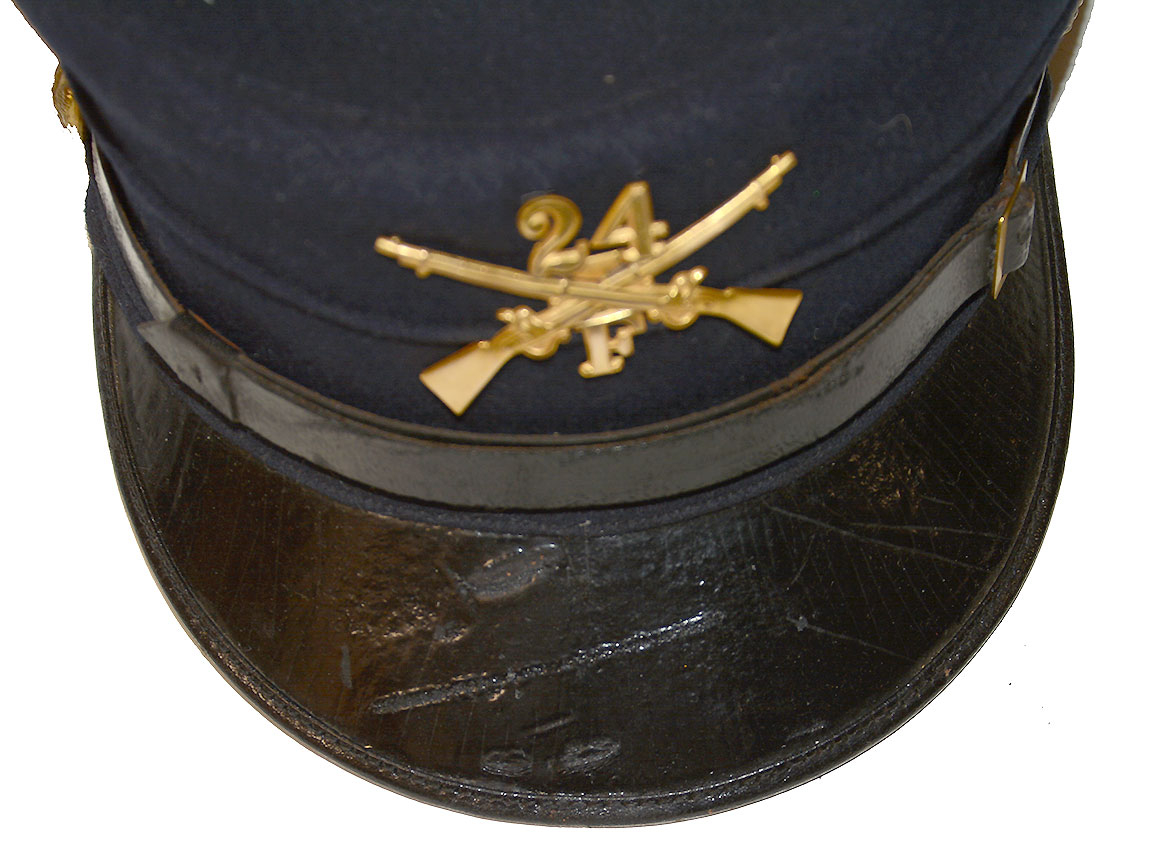
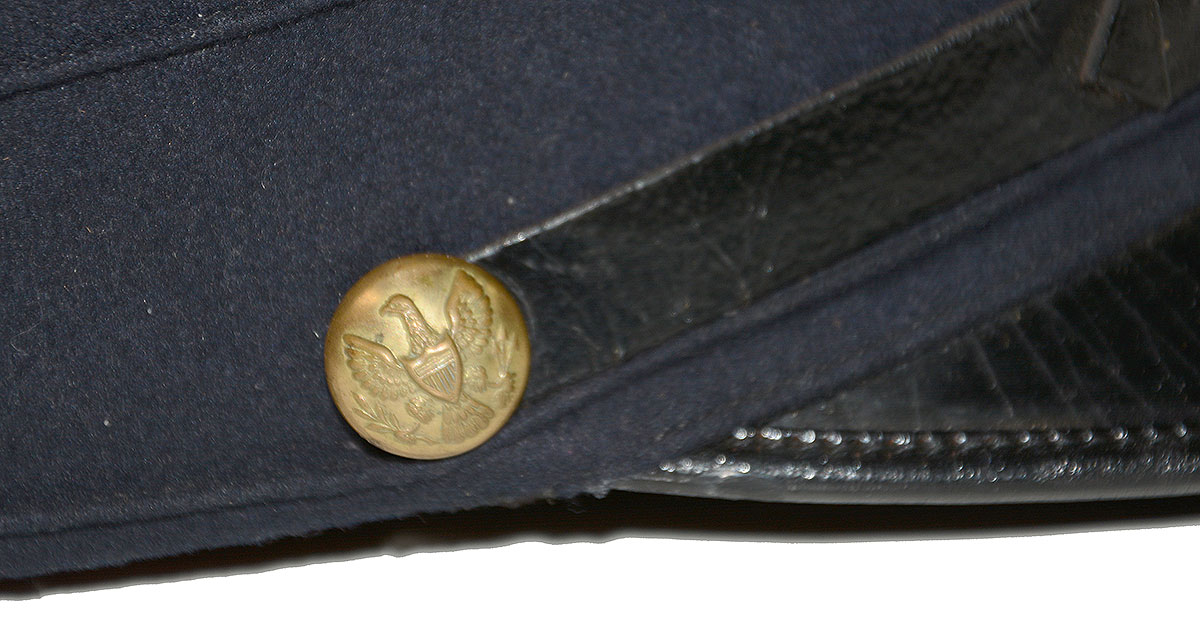
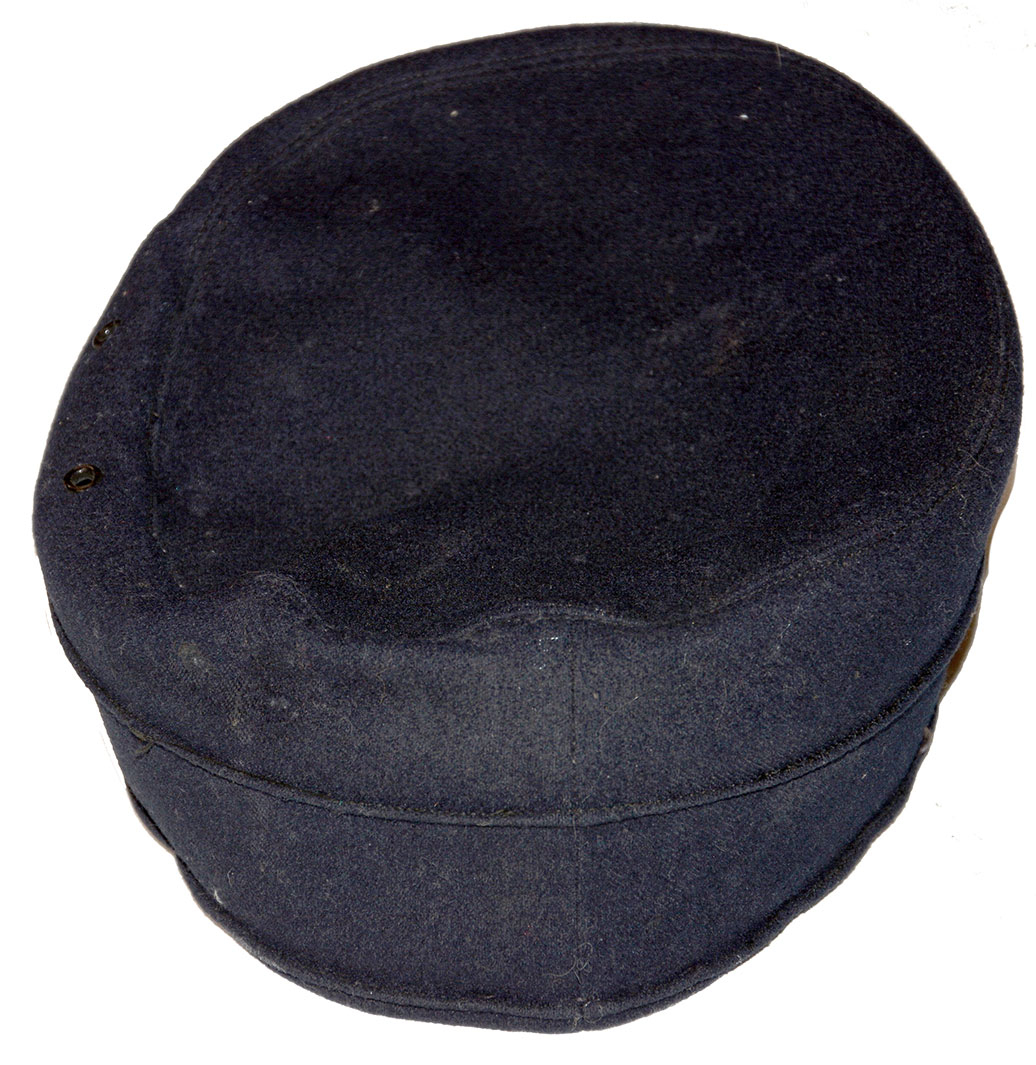
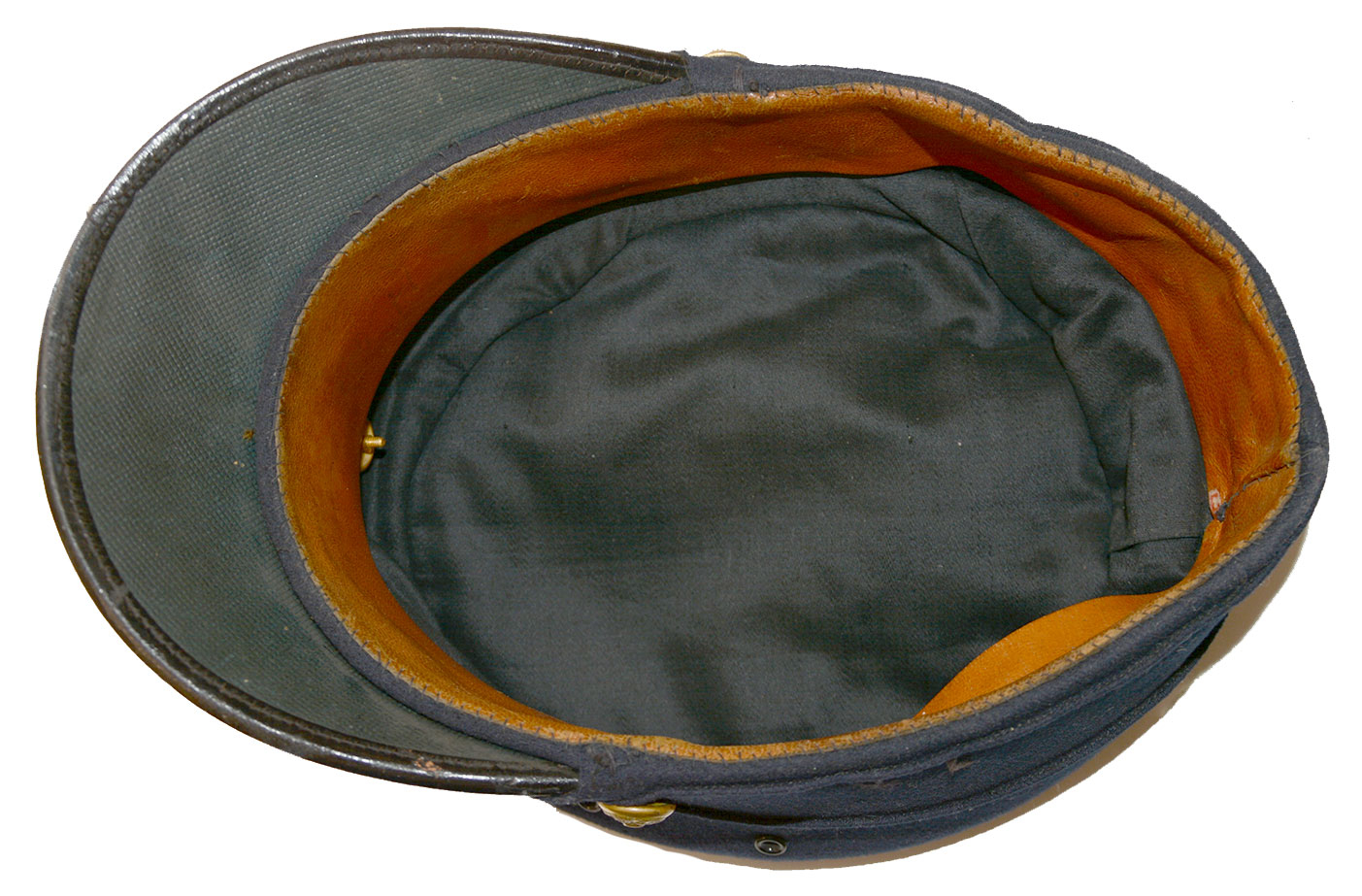
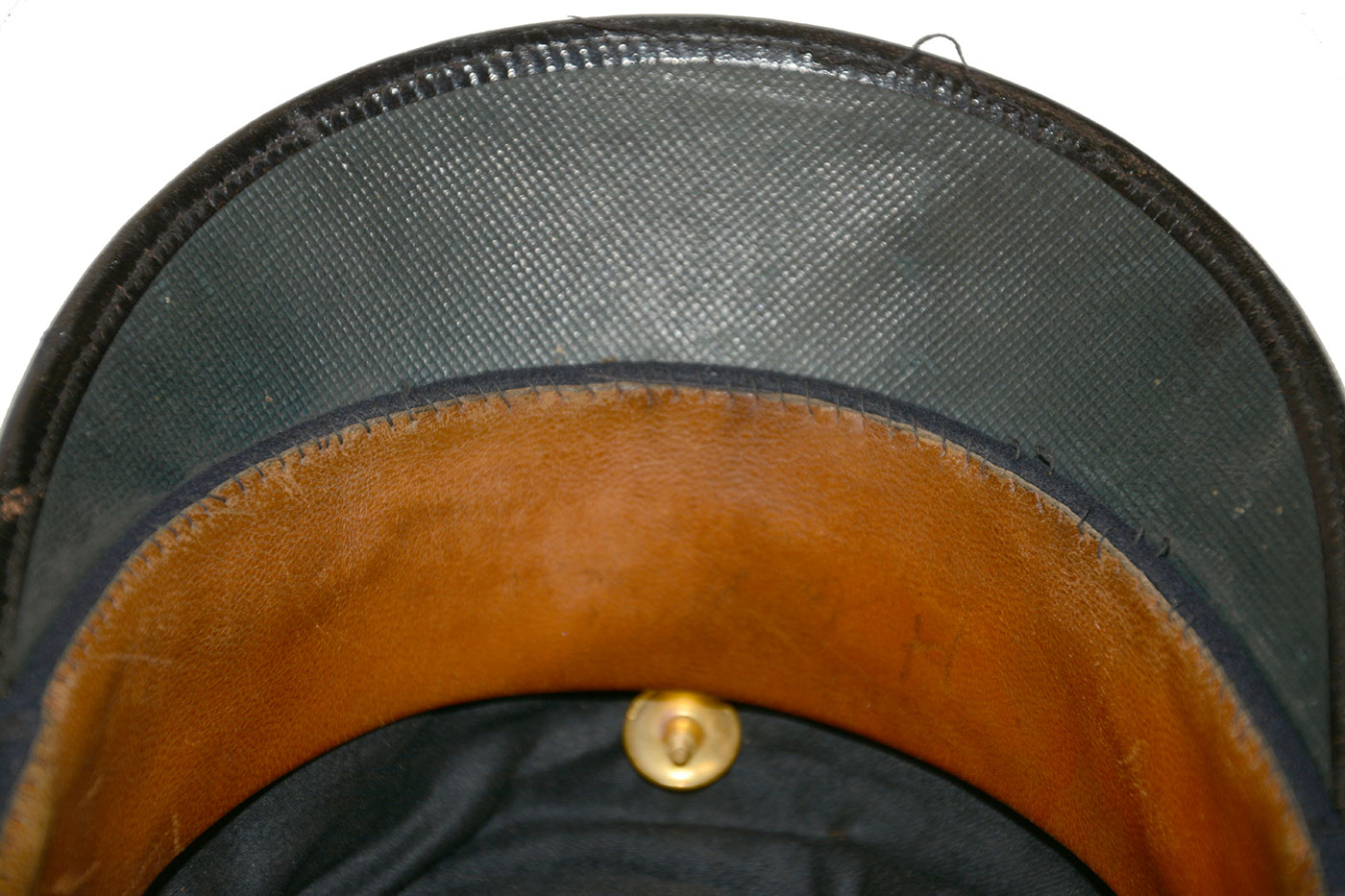
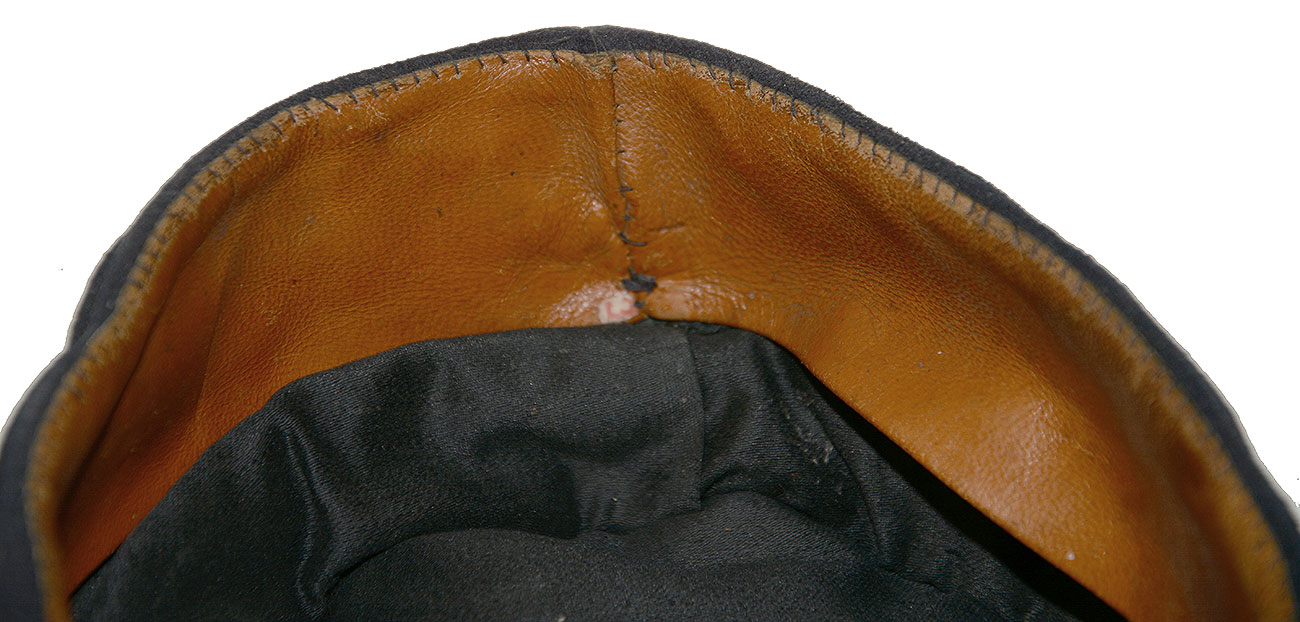
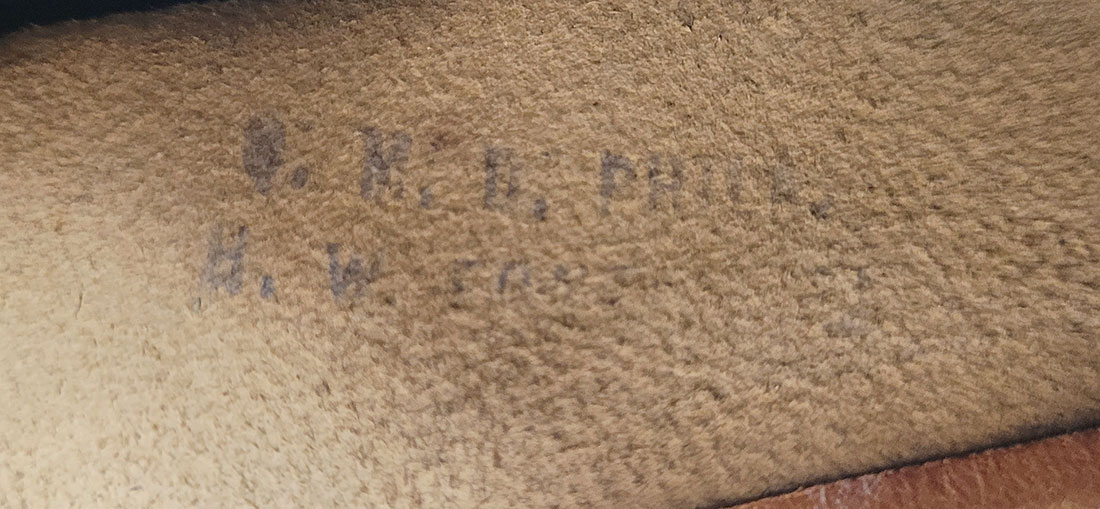
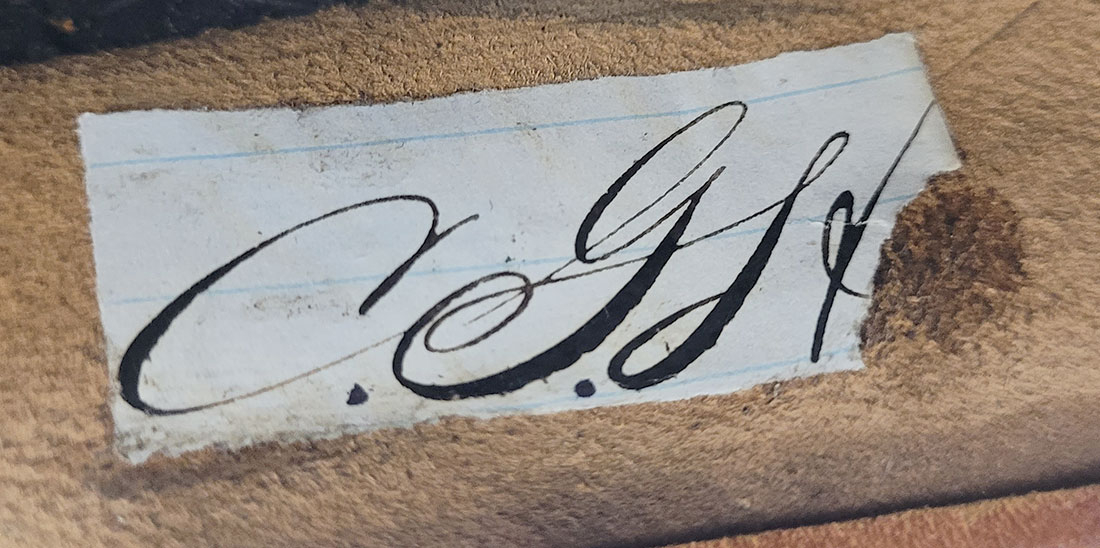
The cap is made of dark blue broadcloth. the top is 7 inches by 6 inches in diameter. The height is 3 inches. The Patent leather slopping peak is 2 inches deep and is bound. The chinstrap of Patent leather is 1/2 inch wide, is functional, has a small, stamped brass buckle and is held securely by 2 Indian war "Chicken Eagle" enlisted buttons. There are 2 metal vent holes on either side, these are painted black. 1/8-inch welts of broadcloth sit 1 1/2 inches apart and surround the cap. A stamped brass badge on front held by a single screw and nut reads: "24" over CROSSED RIFLES over "F" (Company F). The interior of the cap is fully lined in black polished cotton. The supple brown leather sweat band is 1 3/4 inches high; it is 100% intact. It is stamped inside left "R.M.D. PHILA" over "H.W. Co". Next to this on a piece of paper are the capital script initials " C.G. H.". This Spanish-American era cap in near mint condition would be a fine addition to a US martial collection. [pe][ph:L]
~~~~~~~~~~~~~~~~~~~~~~~~~~~~~~~~~~~
THIS ITEM, AS WITH ALL OTHER ITEMS AVAILABLE ON OUR WEB SITE,
MAY BE PURCHASED THROUGH OUR LAYAWAY PROGRAM.
CLICK HERE FOR OUR POLICIES AND TERMS.
THANK YOU!
Inquire About A REGULATION US MODEL 1895 ENLISTEDMAN'S CAP UNITED STATES COLORED INFANTRY
Most Popular
Historical Firearms Stolen From The National Civil War Museum In Harrisburg, Pa »
Theft From Gravesite Of Gen. John Reynolds »
Selection Of Unframed Prints By Don Troiani »
Fine Condition Brass Infantry Bugle Insignia »
Rare Identified 65Th Ny Sergeant’s Jacket, With Manscript Material: 1St U.s. Chasseurs »
featured item
JULY 1864 ALS – CS GENERAL ISAAC R. TRIMBLE (WOUNDED AT GETTYSBURG) TO CAPT. MCHENRY HOWARD – BOTH OF WHOM WERE BEING HELD AS PRISONERS OF WAR
This one page letter is a fine war dated missive, in ink on 7 ¾” x 9 ¼” lined paper. Dated “Johnson’s Island, July 14th 1864”; Johnson’s Island was a large prison where Confederate officers were held, near Sandusky, OH. The letter… (2025-3323). Learn More »
site search