

site search
online catalog
T.F. CARHART MAKER AND US INSPECTOR MARKED CIVIL WAR INFANTRY TROUSERS
Hover to zoom
$4,500.00 SOLD
Quantity Available: None
Item Code: 801-582
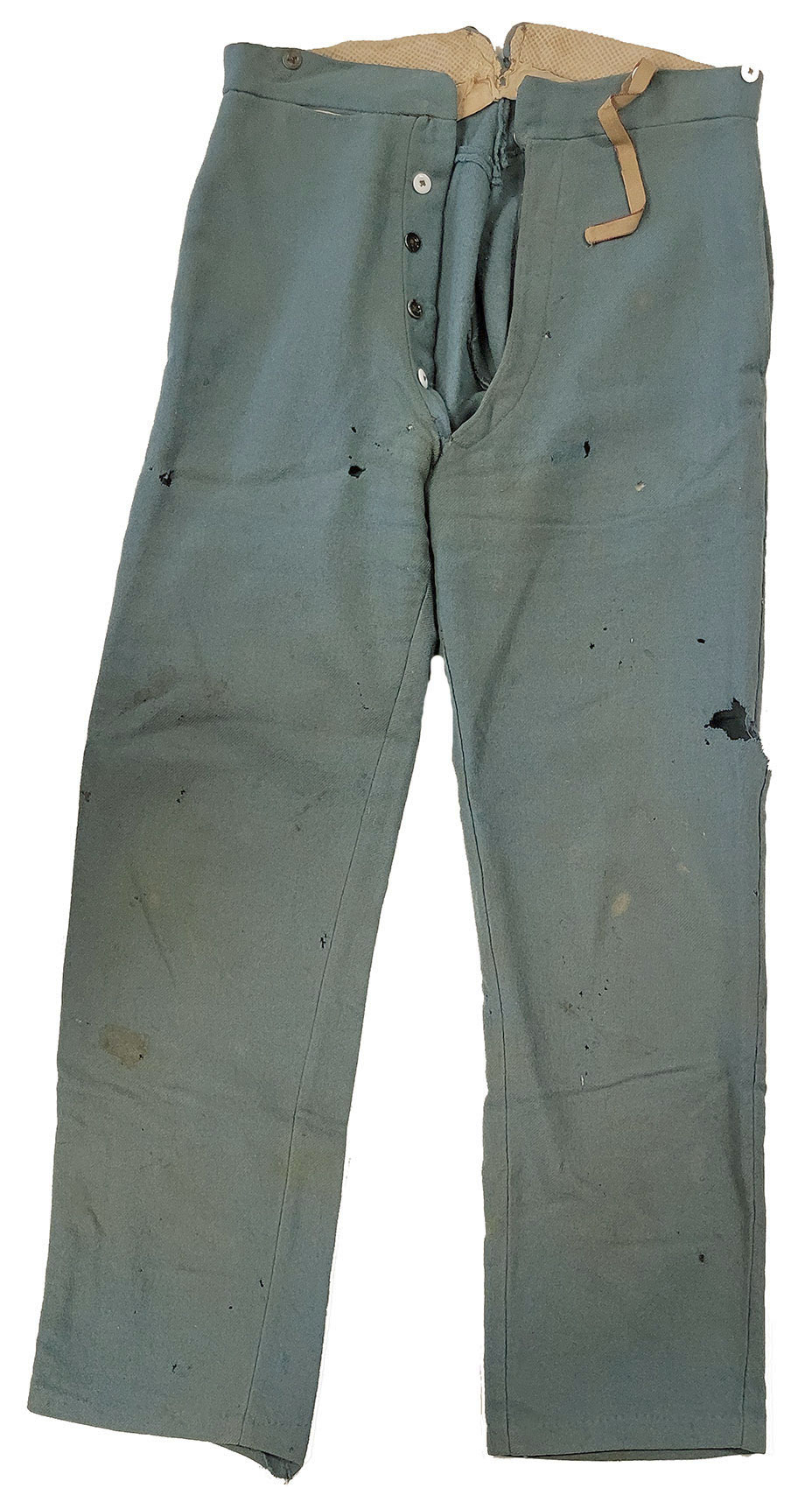
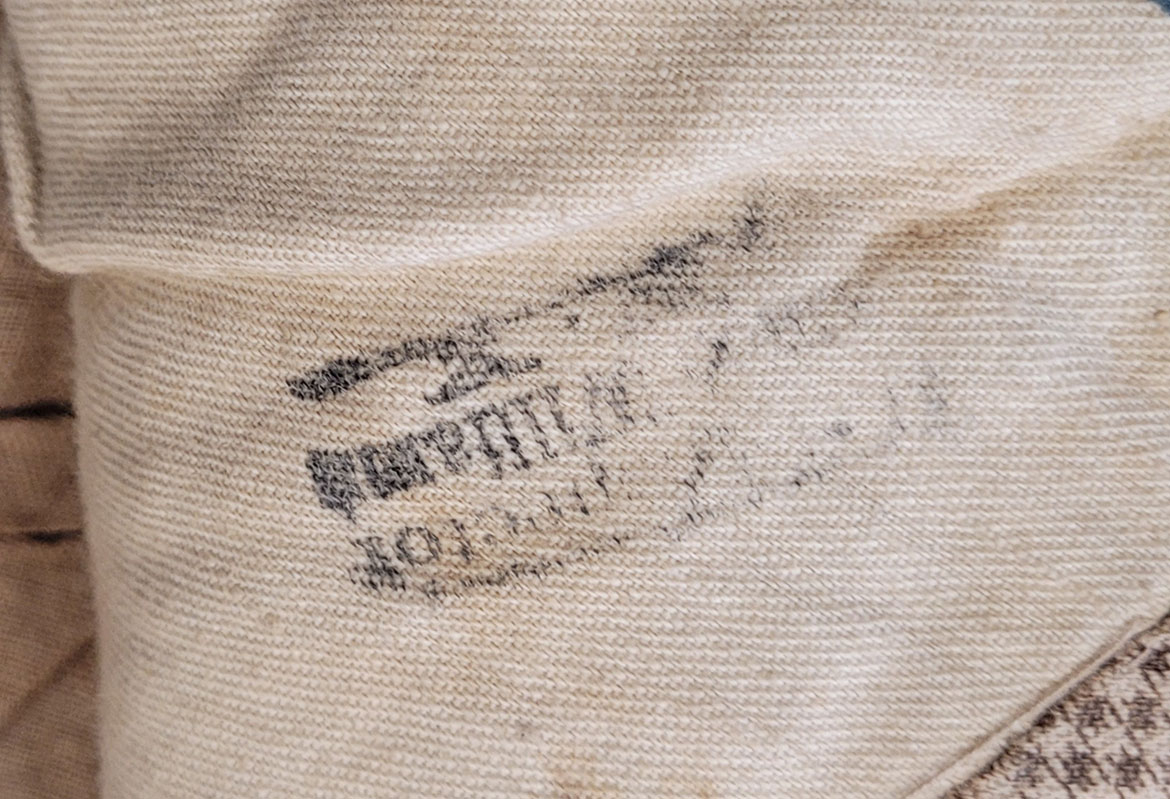
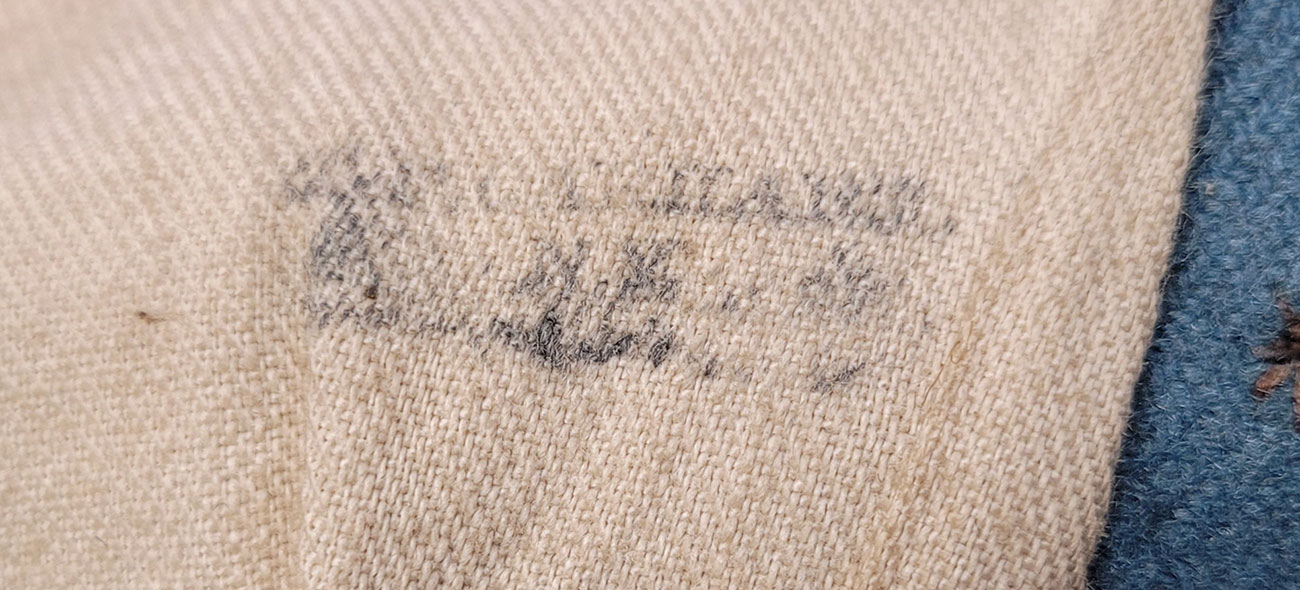
This is an interesting pair of Civil War infantry trousers carrying a partially legible inspector’s stamp, with the inspector’s name “WILLIAMS” and “NY” clearly visible on the back of the right front pocket bag, and a smaller maker’s stamp on the left pocket lining that is slightly blurred, but reads “T. F. CARHART / NYC.” Thomas F. Carhart was a large contractor of uniform clothing during the war. Bazelon notes that military contracts were in his name alone, but that he was a member of several firms, likely accounting for his impressive output: 71,400 infantry greatcoats (1862,) 325,000 sack coats (1862-63,) 60,000 infantry trowsers (Aug - Sep. 1862,) 22,500 cavalry trowsers, and 90,000 infantry coats (Sep – Oct 1862.)
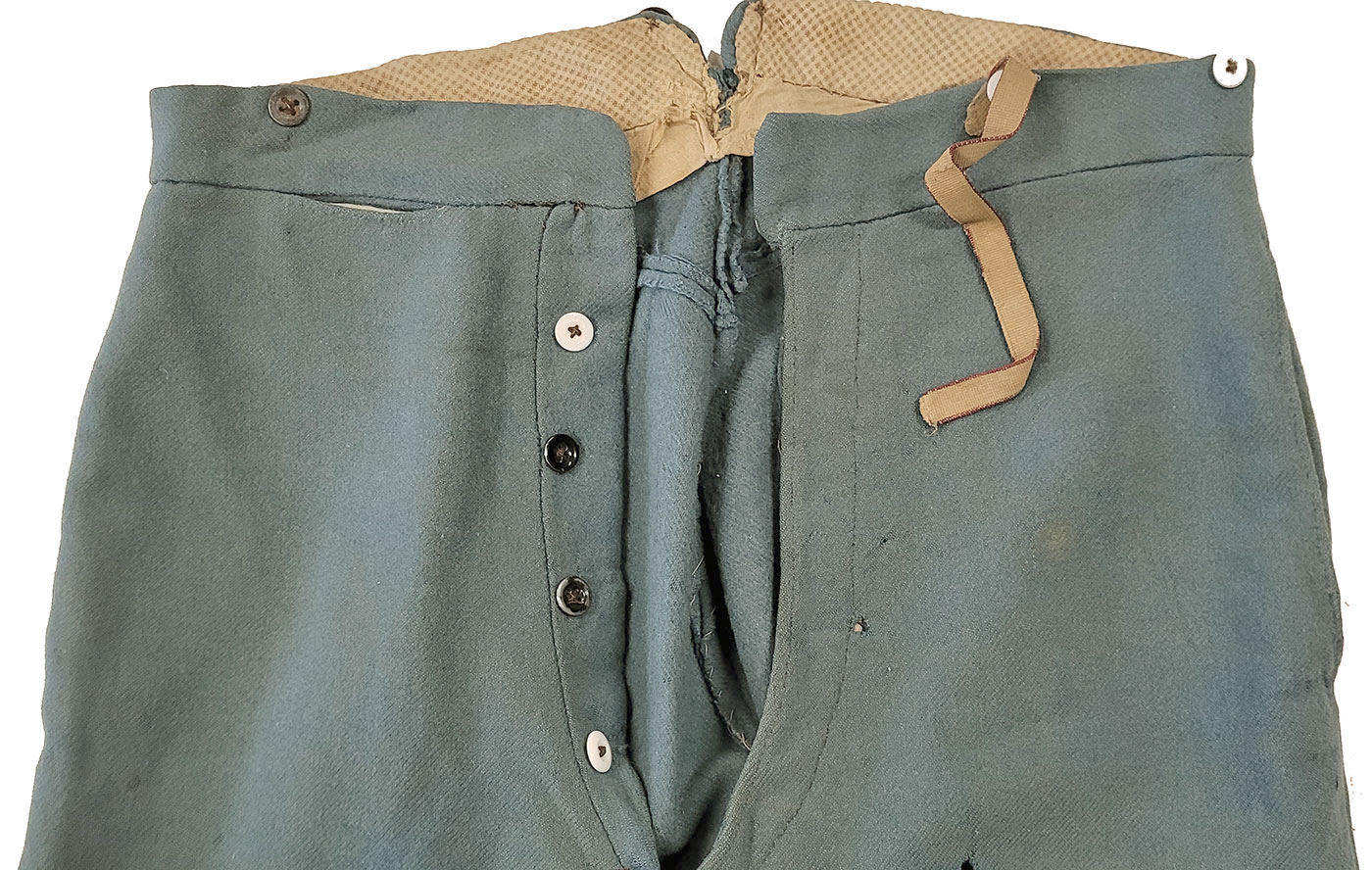
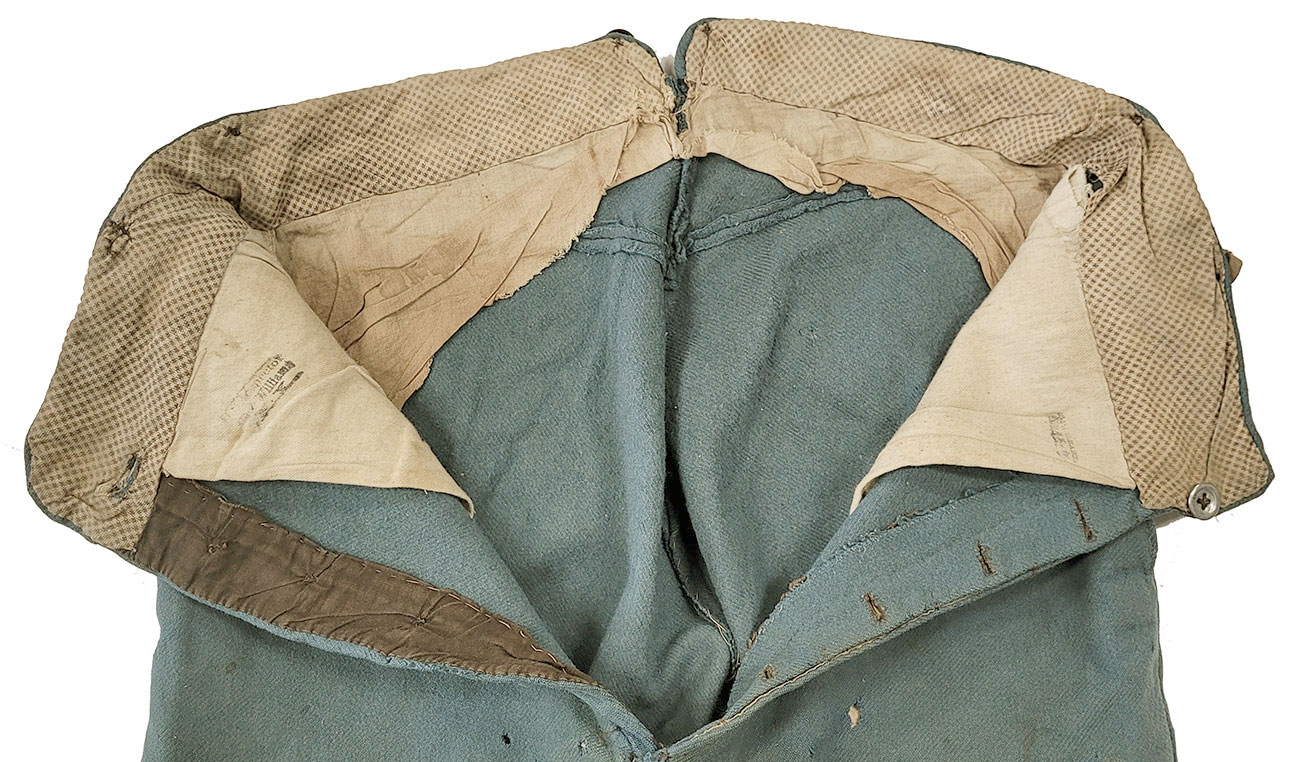
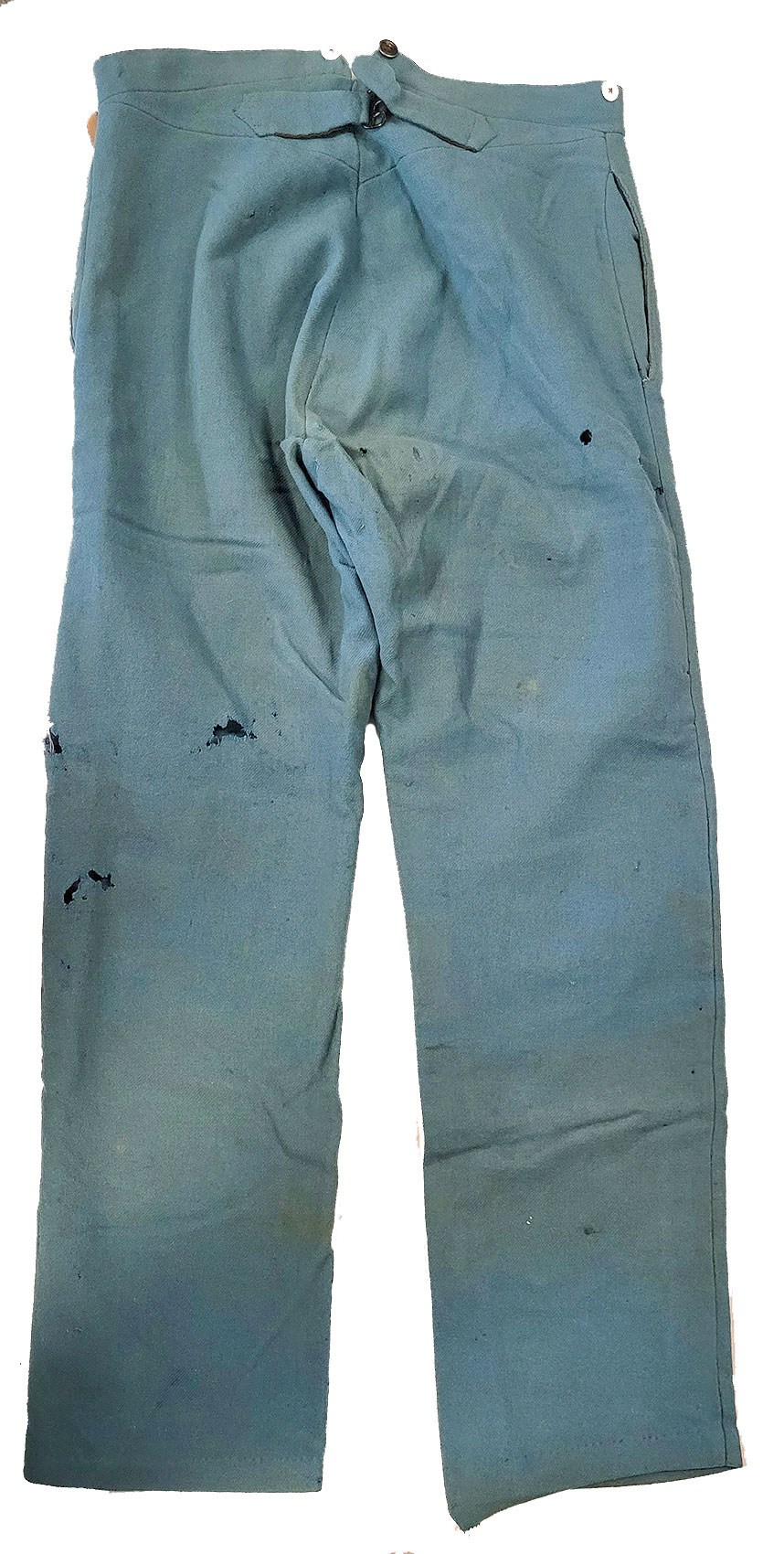
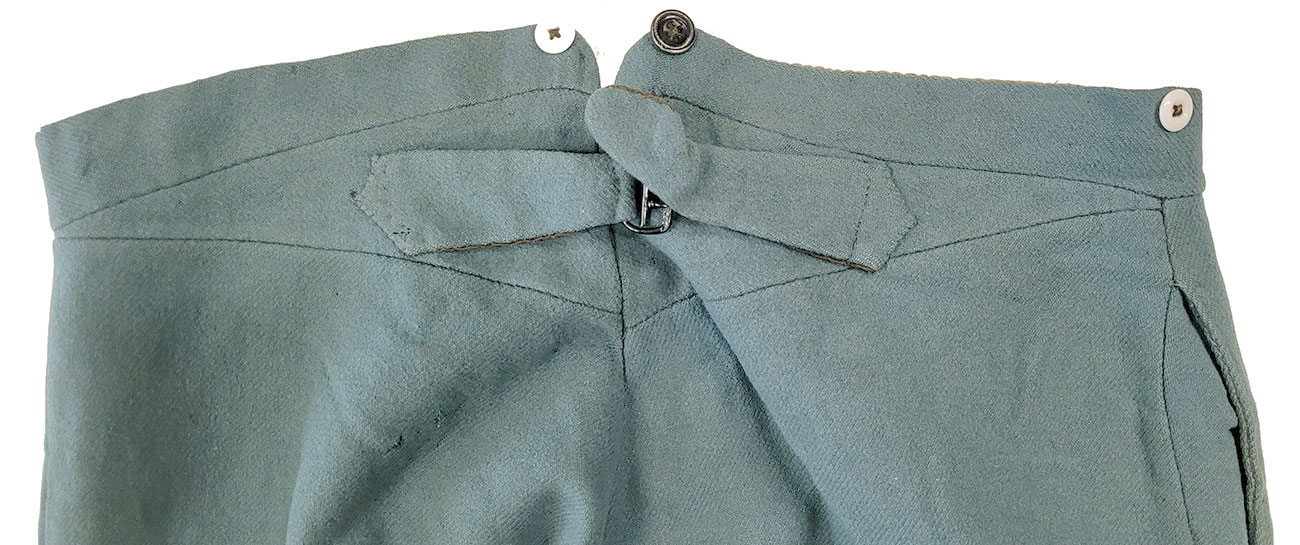
These are sky blue, with a waistband tapering from 2” in the front to 1” at the back vent. The waistband has a checked lining 2-1/4” deep at the front and 2” at the rear. A triangle of thinner material lines each side of the hip, sewn 7” down along the rear edge of either side pocket and along lower edge of the waistband lining, with the loose side angling up to the center rear where it ends 2” long from the bottom of the waistband lining at the rear vent. The fly is lined with brown polished cotton.
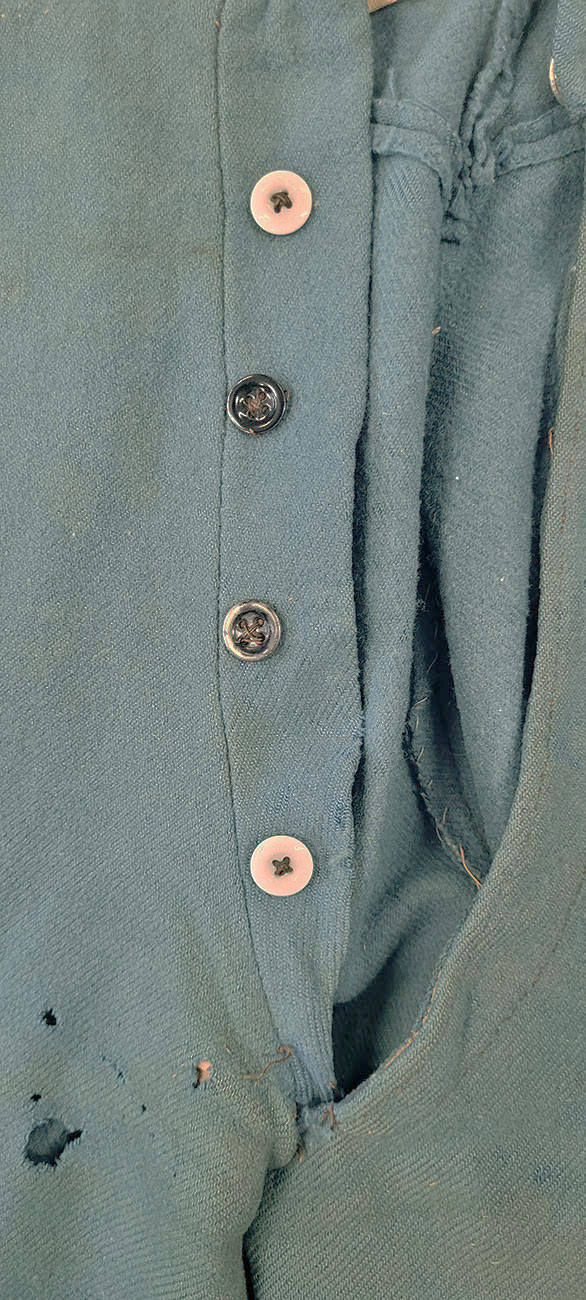
The fly is fastened by four small buttons and the waistband by one larger inward facing button on the lower seam of the waistband. Six suspender buttons are positioned along the waistband. The buttons are a mix of stamped tin and white ceramic, the latter clearly replacements. The pockets are side seam. We note that in attaching the pocket bag on the right, the stitching crossed the watch pocket inlet into the lower seam of the waist band, effectively rendering it non-functional, and that the rear seam of the pocket bag, attaching it to the pant leg apparently pulled out at some point and was crudely resewn.
The pants are adjusted at the back not by the usual lace and sewn grommet holes, but a two-piece cloth adjustment belt. Mike Cunningham, in his excellent CMH 72.3 article on soldier-modified garments notes a March 3, 1864, call by the Office of Army Clothing and Equipage, for proposals to supply pant buckles, so some contractors may have been ahead of the game in that method of adjusting the waist, as was common in commercial trousers. A modification is also possible. Cunningham illustrates a pair of J.T. Martin contract trousers altered by the soldier with the addition of just such an adjusting belt, rather crudely sewn, as this is.
The adjusting belt is made of the same light blue material as the trousers and is lined in brown polished cotton. The small, blackened frame adjusting buckle is unmarked. The belt tab on the wearer’s right is well contoured and sewn, though crossing the seam of the yoke and seat of the trousers. The left half of the belt is crudely cut at it base and crudely stitched. The vent reaches only the bottom seam of the waistband, as is seen on contract trousers by J.T. Martin, though the shape of the yoke differs here, extending down along the center seam, the left panel for 3-1/2” and the right 4”, with the pieces on both sides angling up to end at the side seams 1/8” below the lower waistband seam.
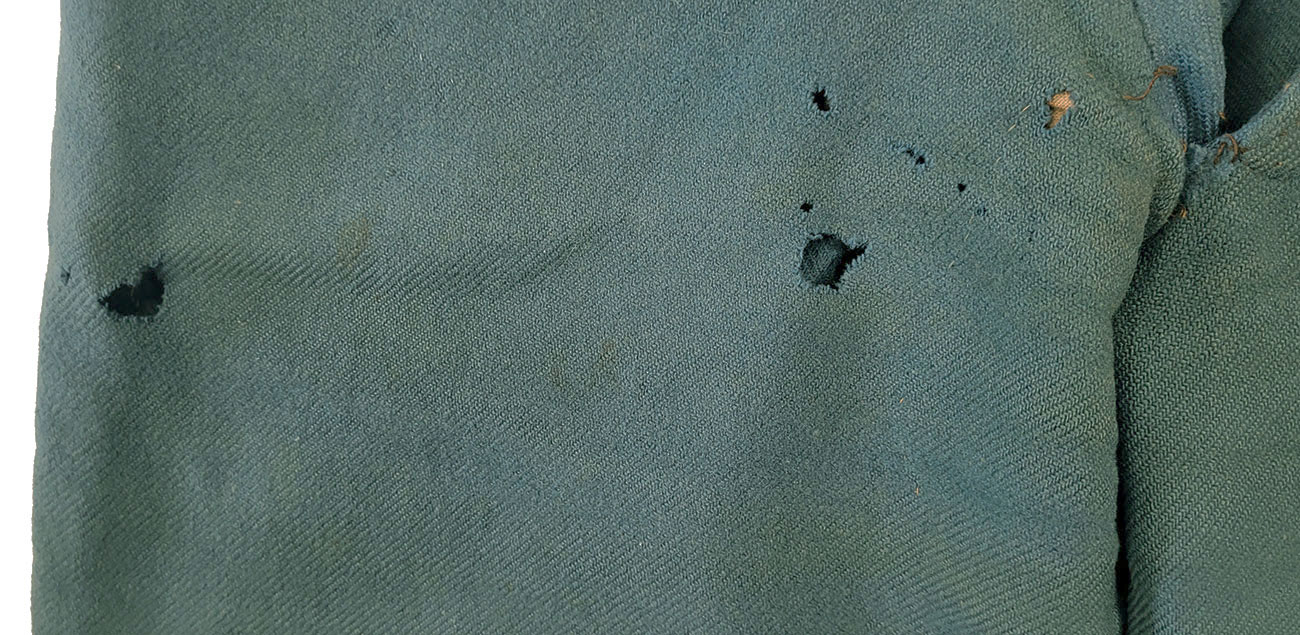
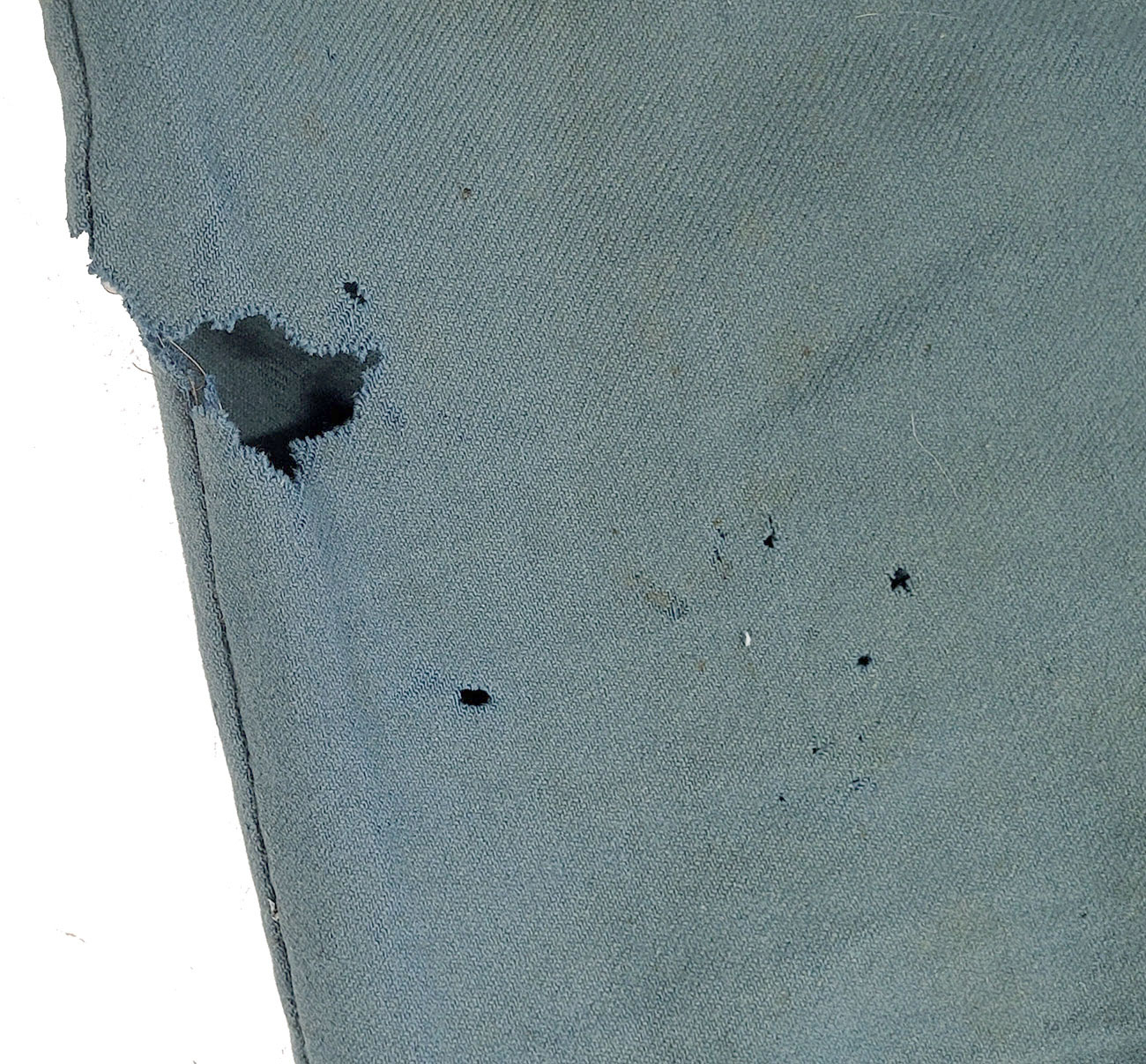
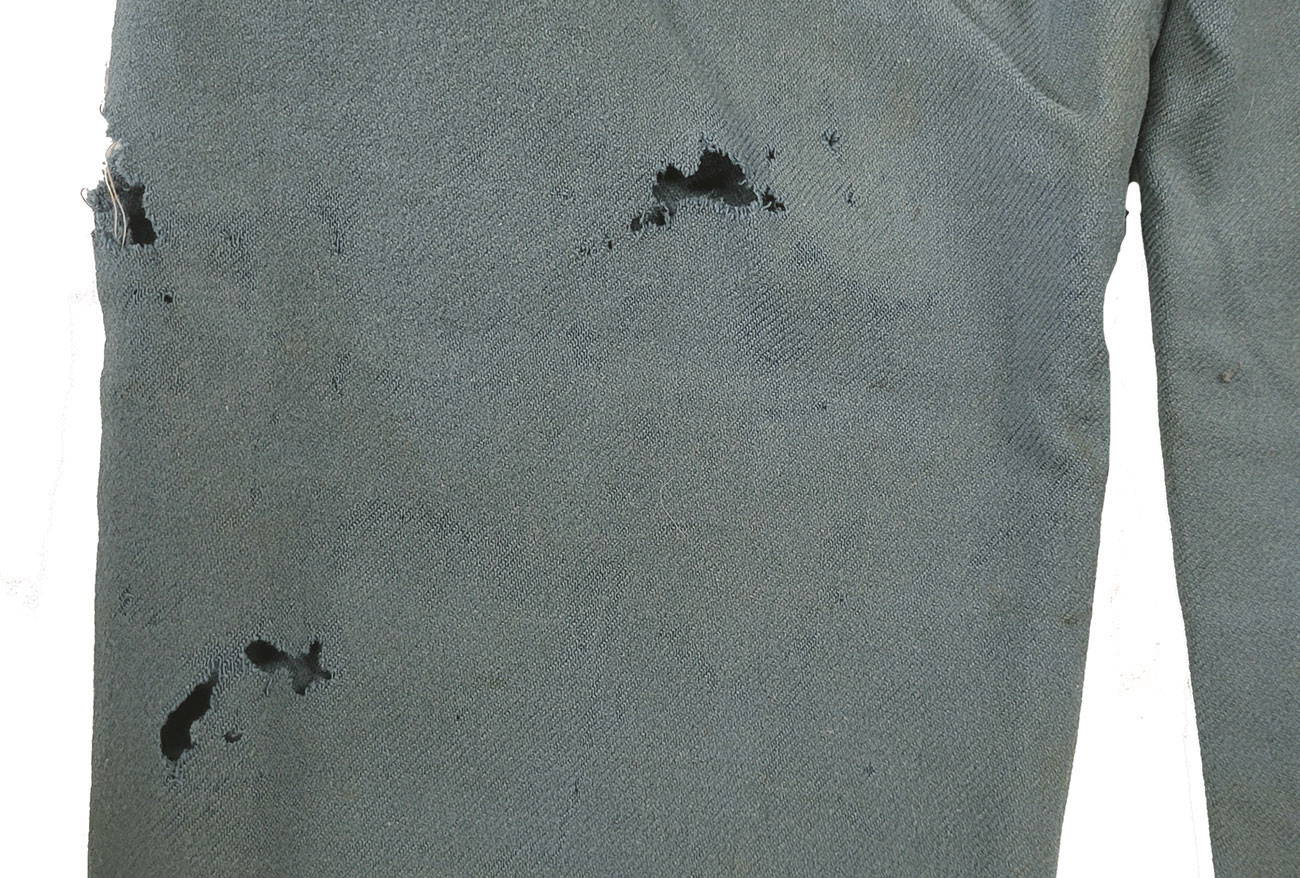
The trousers show wear and some soiling in places, a couple of repairs- a patch to a 1” by ¼” hole in the right seat, and a number of moth bites or other holes. Please see our photos. A band of six or seven ½” diameter moth holes runs around the seat of the pants at about crotch level, some of which seem to line up front and back indicating the trousers were laid flat for some time. There is a ragged hole about 3” long and 1” at its widest crossing the left outer seam at lower thigh level, and one about ½” wide and 1-1/2” long on the back of the leg at about the same position, and two more about ¼” by 1” about 4” below that just behind the outer seam. The right leg shows better, with a some pencil point nips. The edges of both cuffs were turned under for about ¾” and sewn down, with some of the stitching now gone. The lower portion of one suspender remains attached to the foremost ceramic suspender button on the wearer’s left.
Military trousers are always among the toughest uniform items to find in any condition, often being worn out in service and discarded once home, used up by the veteran as work clothes around the farm, or not deemed a worthy enough memento of service by descendants. This pair shows legitimate use, wear, some repair or alteration- not mint, but a real veteran. [sr][ph:L]
~~~~~~~~~~~~~~~~~~~~~~~~~~~~~~~~~~~
THIS ITEM, AS WITH ALL OTHER ITEMS AVAILABLE ON OUR WEB SITE,
MAY BE PURCHASED THROUGH OUR LAYAWAY PROGRAM.
CLICK HERE FOR OUR POLICIES AND TERMS.
THANK YOU!
Inquire About T.F. CARHART MAKER AND US INSPECTOR MARKED CIVIL WAR INFANTRY TROUSERS
Most Popular
Historical Firearms Stolen From The National Civil War Museum In Harrisburg, Pa »
Theft From Gravesite Of Gen. John Reynolds »
Selection Of Unframed Prints By Don Troiani »
Fine Condition Brass Infantry Bugle Insignia »
featured item
FINE ITALIAN SNAPHAUNCE BELT PISTOL CA. 1675
The snaphaunce is one of the earlier forms of flint and steel ignition and was introduced in the mid-16th century. It remained in use in Northern Italy into the mid-18th century giving it a particularly long period of use. Ornate pistols such as… (2026-657). Learn More »
site search
Upcoming Events
May 13 - 17: N-SSA Spring Nationals, Fort Shenandoah, Winchester, VA Learn More »