

site search
online catalog
VERY SCARCE EARLY-WAR UNION INFANTRY GREATCOAT WITH STENCILED SOLDIER’S INITIALS
Hover to zoom
$9,000.00
Quantity Available: 1
Item Code: 282-459
Shipping: Determined by Method & Location of buyer
To Order:
Call 717-334-0347,
Fax 717-334-5016, or E-mail
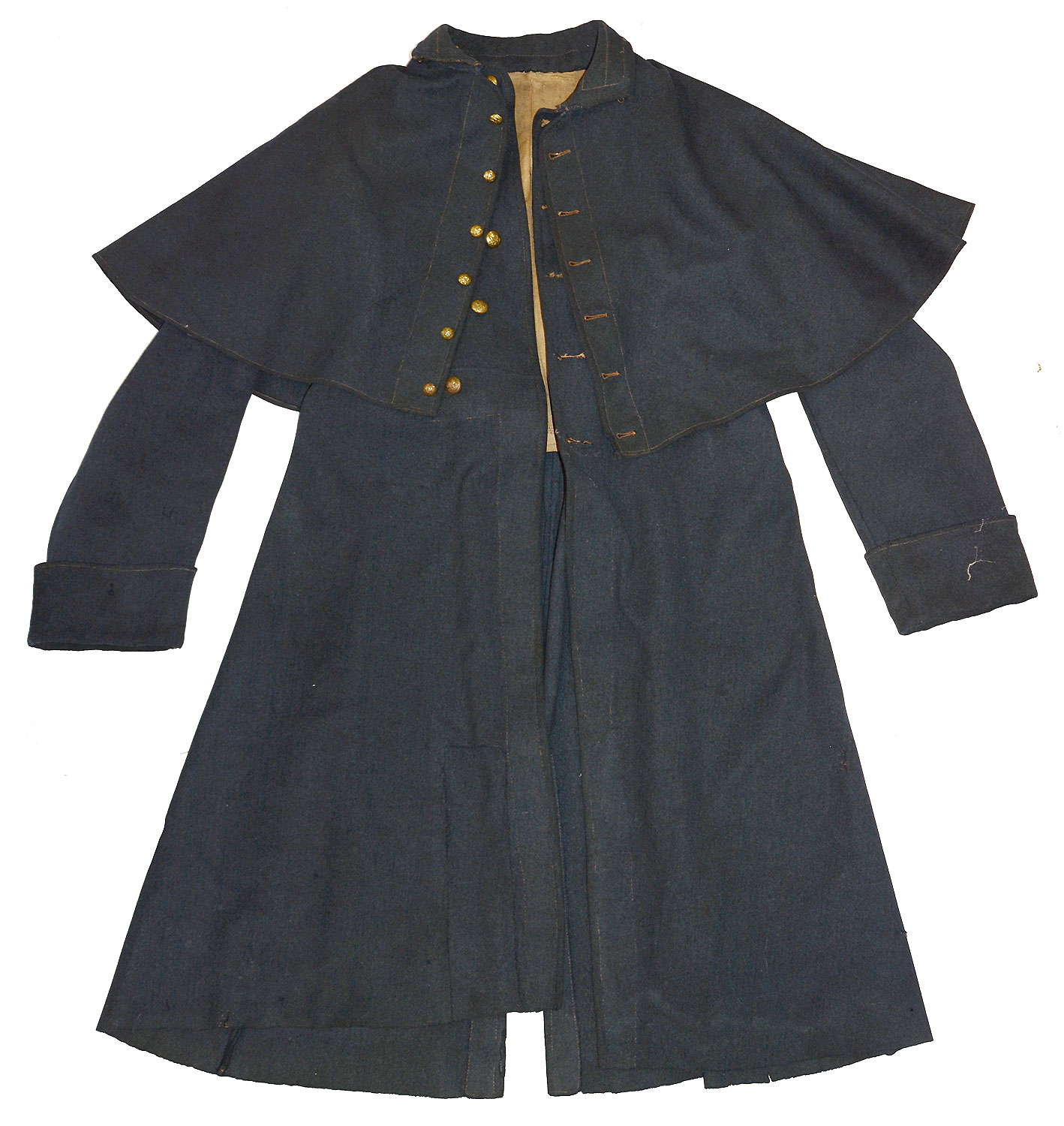
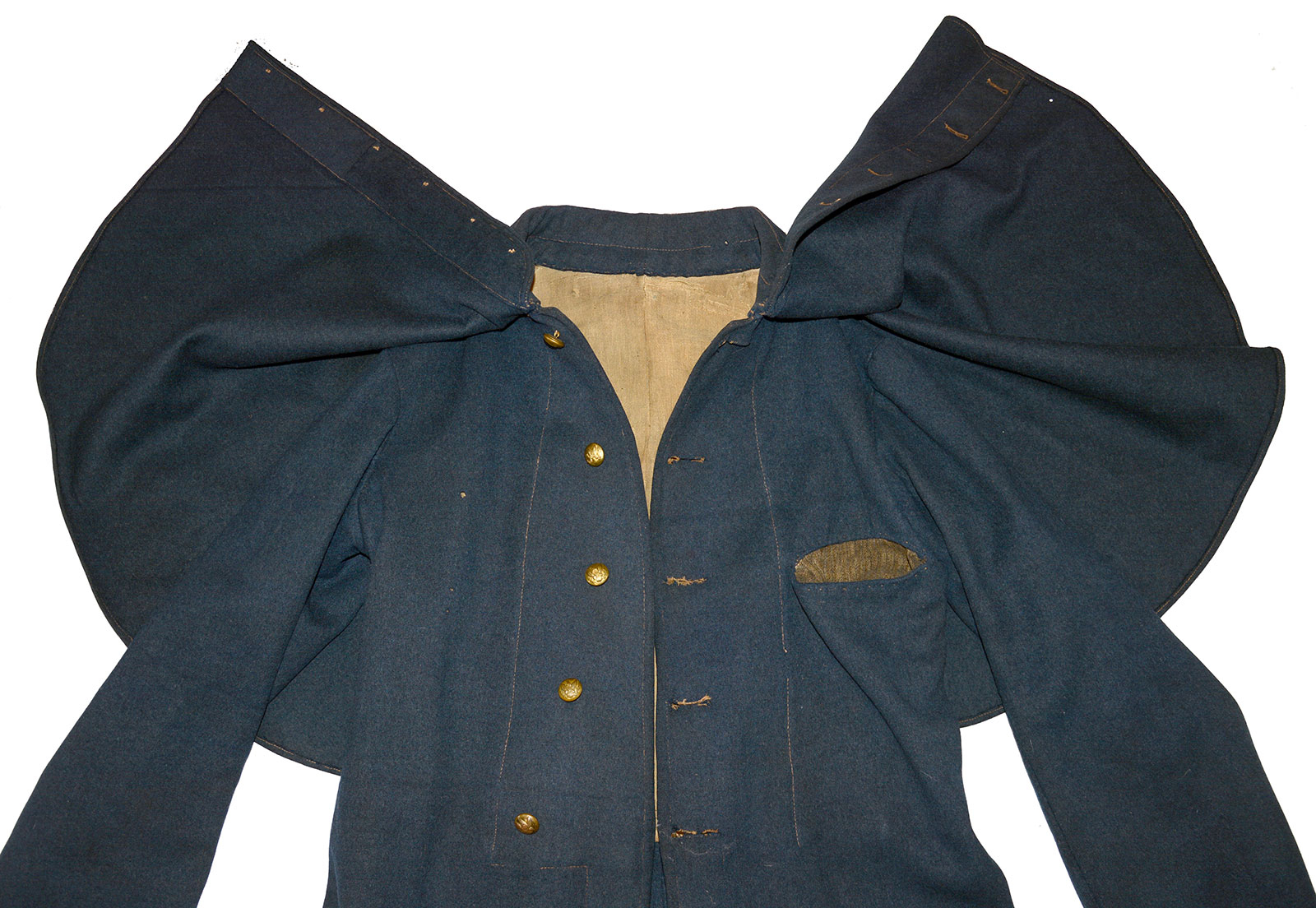
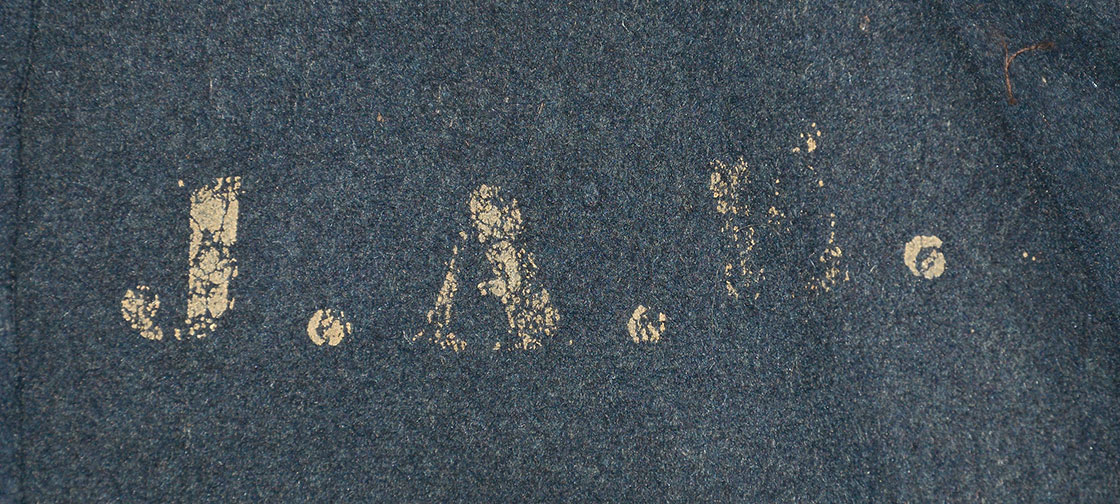
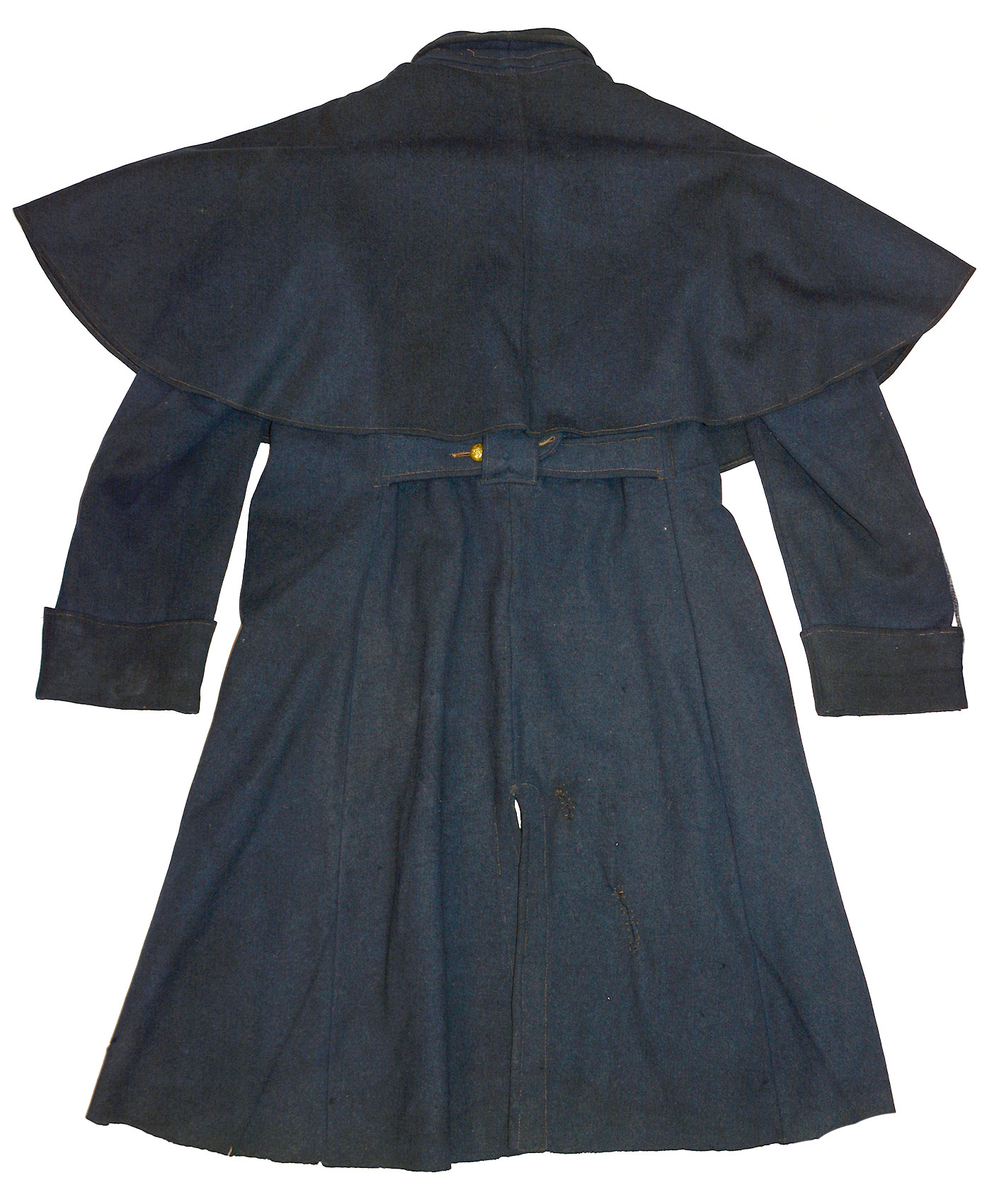
A very scarce, early-war Union infantry greatcoat, dating to Fall-Winter 1861, showing issue and use, but in great condition, complete, bearing maker’s and US inspector’s stamps, soldier’s initials stenciled in white paint inside the left skirt, and modified slightly by the soldier with the addition of a pocket in the left breast whose opening would be concealed by the cape. The pattern is the standard overcoat or greatcoat for enlisted foot troops from 1851 through the Civil War and several years thereafter and is described in detail in the 1865 Quartermaster’s Manual. This differs only in the use of dark blue kersey cloth in place of the regulation light blue, a color variation deemed acceptable in supplying federal contracts according to October 1861 letters by US Quartermaster General Montgomery Meigs, who accepted the reality of shortages of light blue kersey resulting from the large and rapid increase of the armed forces. See Mike McAfee’s article, “Greatcoats of Many Colors” in Military Images Magazine 35.1 (Winter 2017,) who cites Meig’s late October 1861 for, “ten-thousand overcoats. Light or Dark Blue, in fact any color will be acceptable. . . except grey.” And, note in particular his third photograph showing a soldier in a similar dark overcoat that McAfee specifies as, “undoubtedly one of the fall and winter 1861 issuances.” Another example in dark blue, and also using a variant fabric and lining color is illustrated in Echoes of Glory: Arms and Equipment of the Union, p. 129.
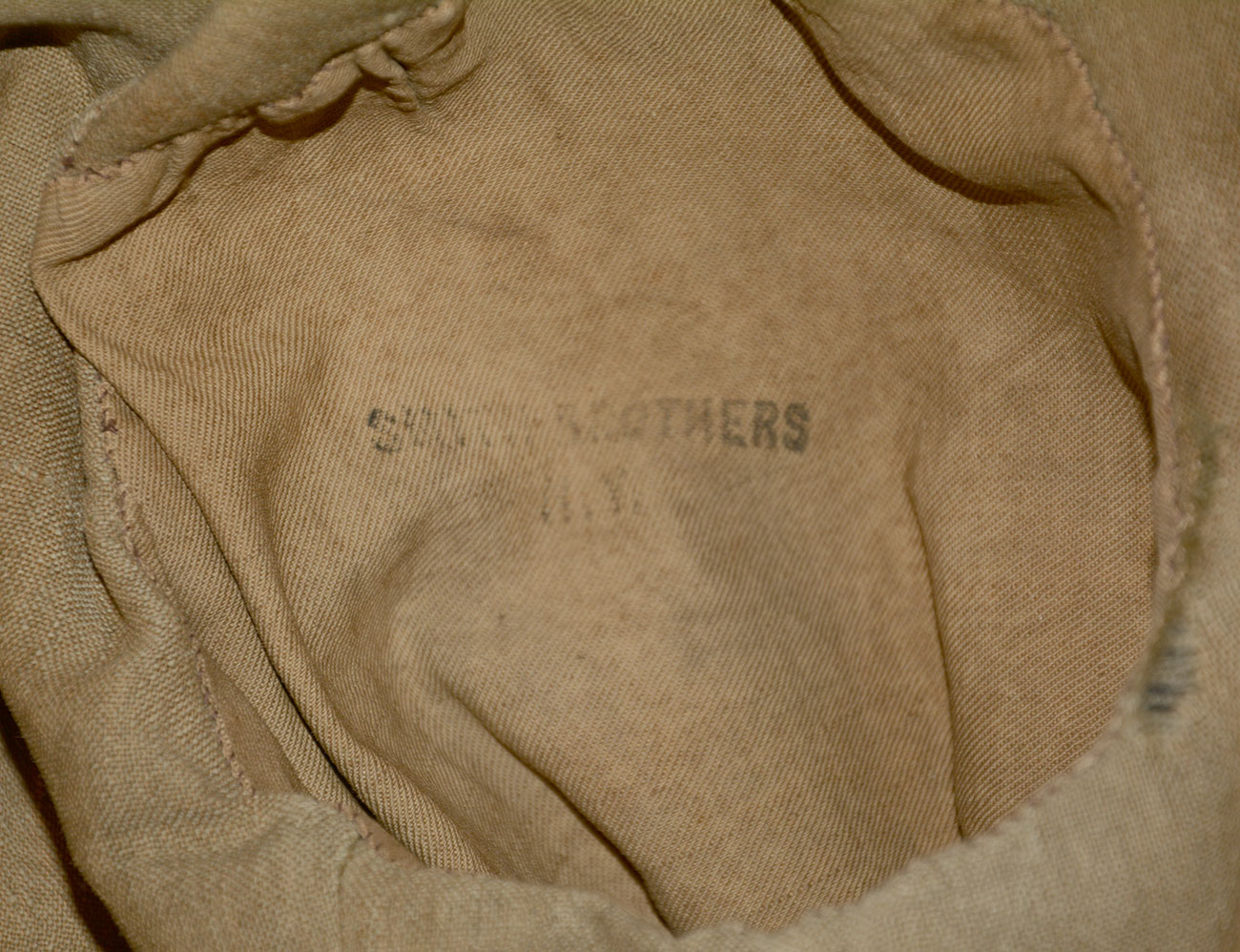
Both those sources include state and militia purchases among their examples. This coat is particularly rare in being a U.S. issue coat such as referred to by Meigs. The coat bears a maker’s stamp reading, “SMITH BROTHERS / N.Y.” in both sleeves near the shoulder and a U.S. sub-inspector’s stamp in the right sleeve that has rectangular border and is rubbed from wear, but clearly shows the “U.S.” at the upper left indicating this is a U.S. contract coat and not a state issue or militia purchase. All of this fits perfectly with a Fall/Winter 1861 date for the coat. Bazelon (Vol. 1) notes the Smith Brothers (listed as both Smith & Bro. and as Smith Brothers) are first listed in New York in1854-55 as clothiers on Fulton Street. He records that they had NY state contracts in April and July 1861 for jackets, trousers and overcoats, but more relevant here given the US inspector’s stamp, is the following: “They had US contracts in 1861: 7/27/1861 for uniforms for the Scott Rifles; 9/12/1861 for 2,000 cavalry greatcoats & 6,000 infantry overcoats; 9/25/61 & 10/31/61 for inf. & cav. overcoats. On 12/1861 & 1/1862 they had open-ended contracts for sack coats as well as other greatcoat open-ended contracts in fall 1861.”
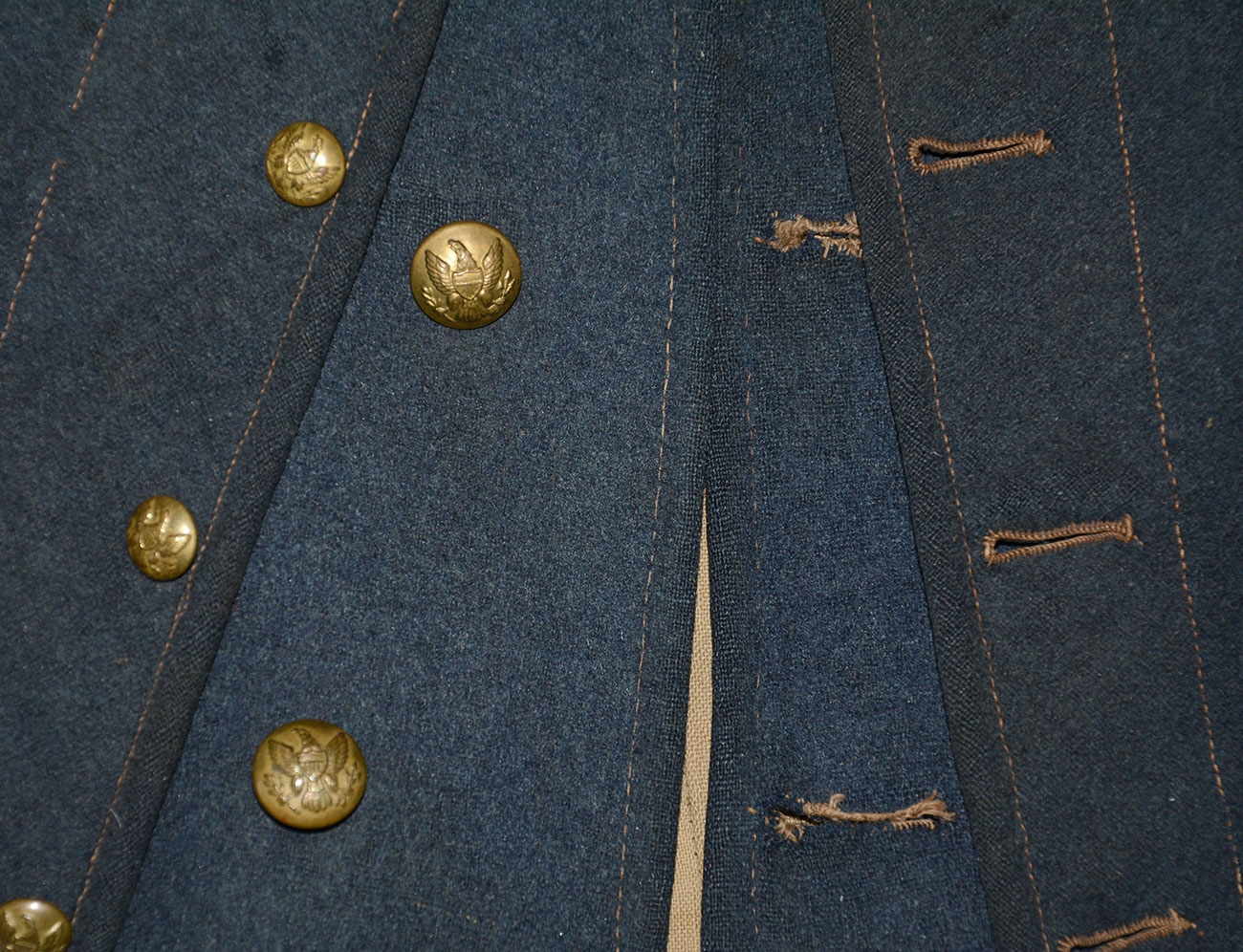
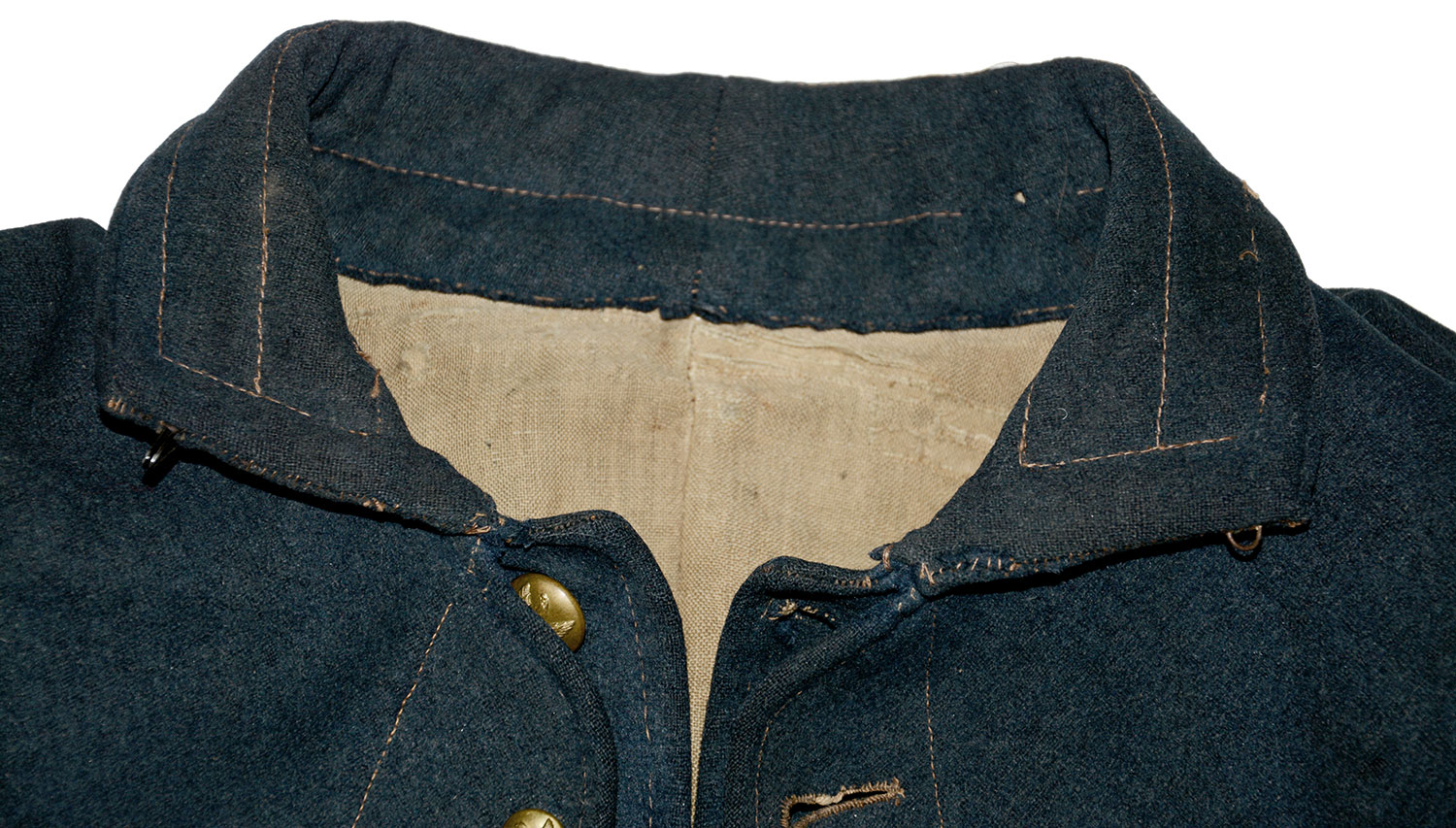
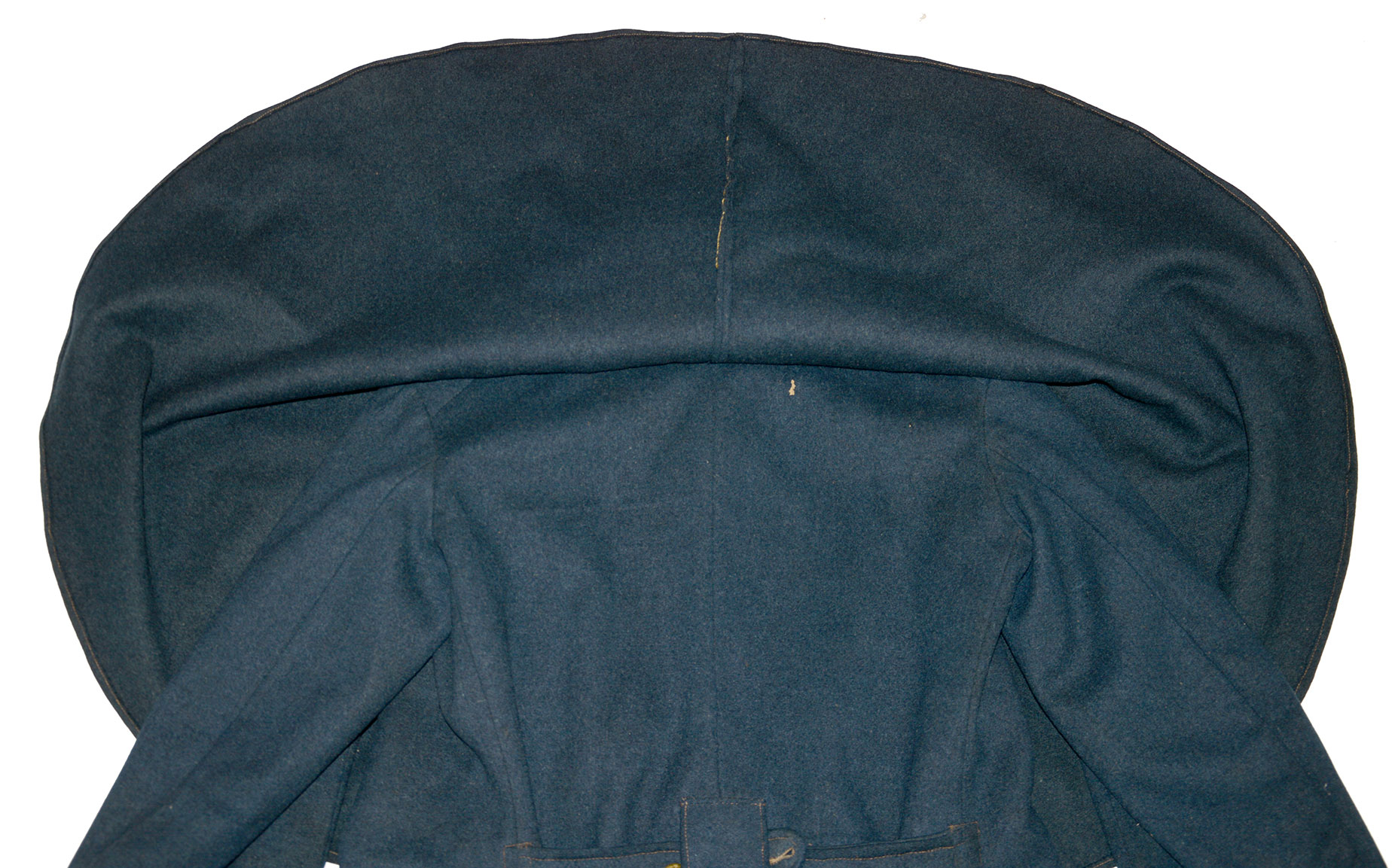
In all respects other than color the coat follows the standard U.S. pattern. The coat has a regulation standing collar made with interlining as a stiffener, about 3-1/2 inches tall on the back seam secured with three horizontal lines of stitching and fourth at the base, securing collar, cape and coat. The front edges of the collar are slanted and fitted at top with a hook and eye to close it shut. As is correct, the cape is roughly elbow length, sewn in place around the base of the collar, unlined and fasted by six small cuff-size general service eagle buttons. All these buttons are in place. The top buttonhole shows some minimal wear; the lower ones little, if any.
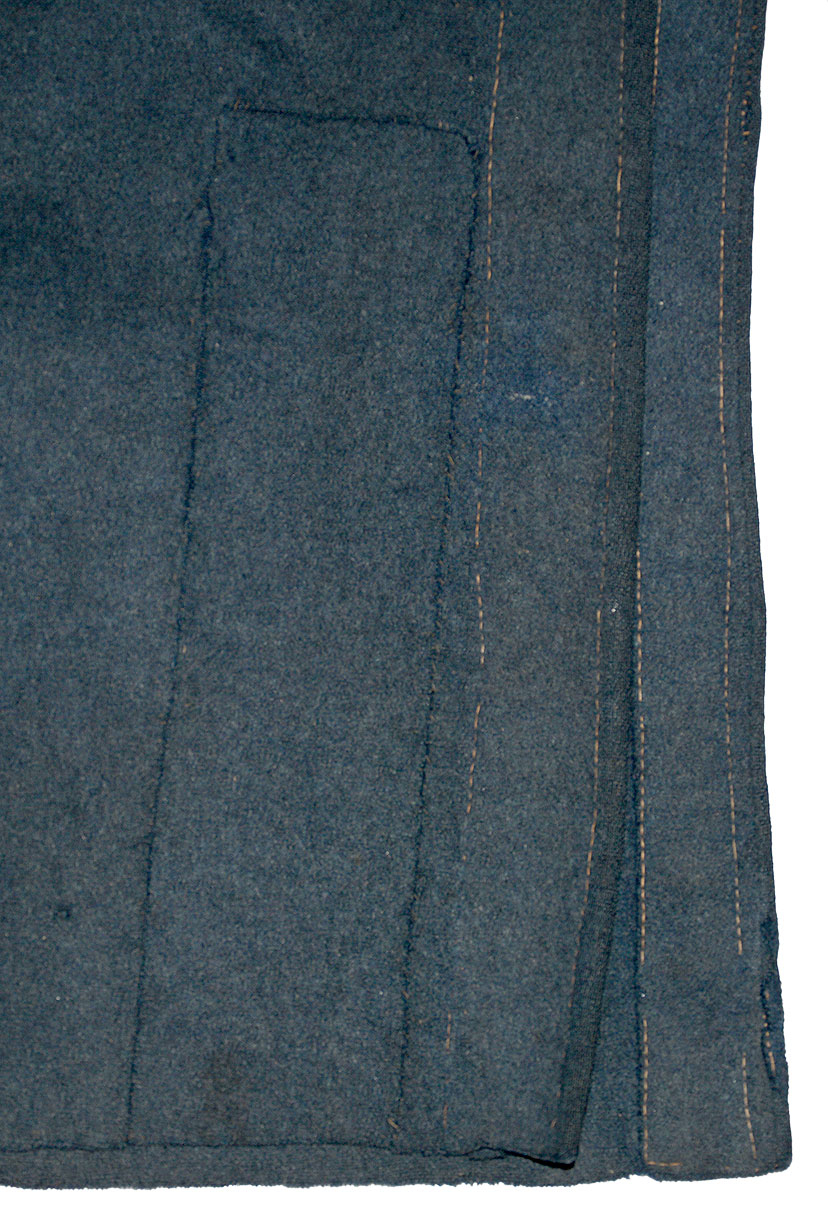
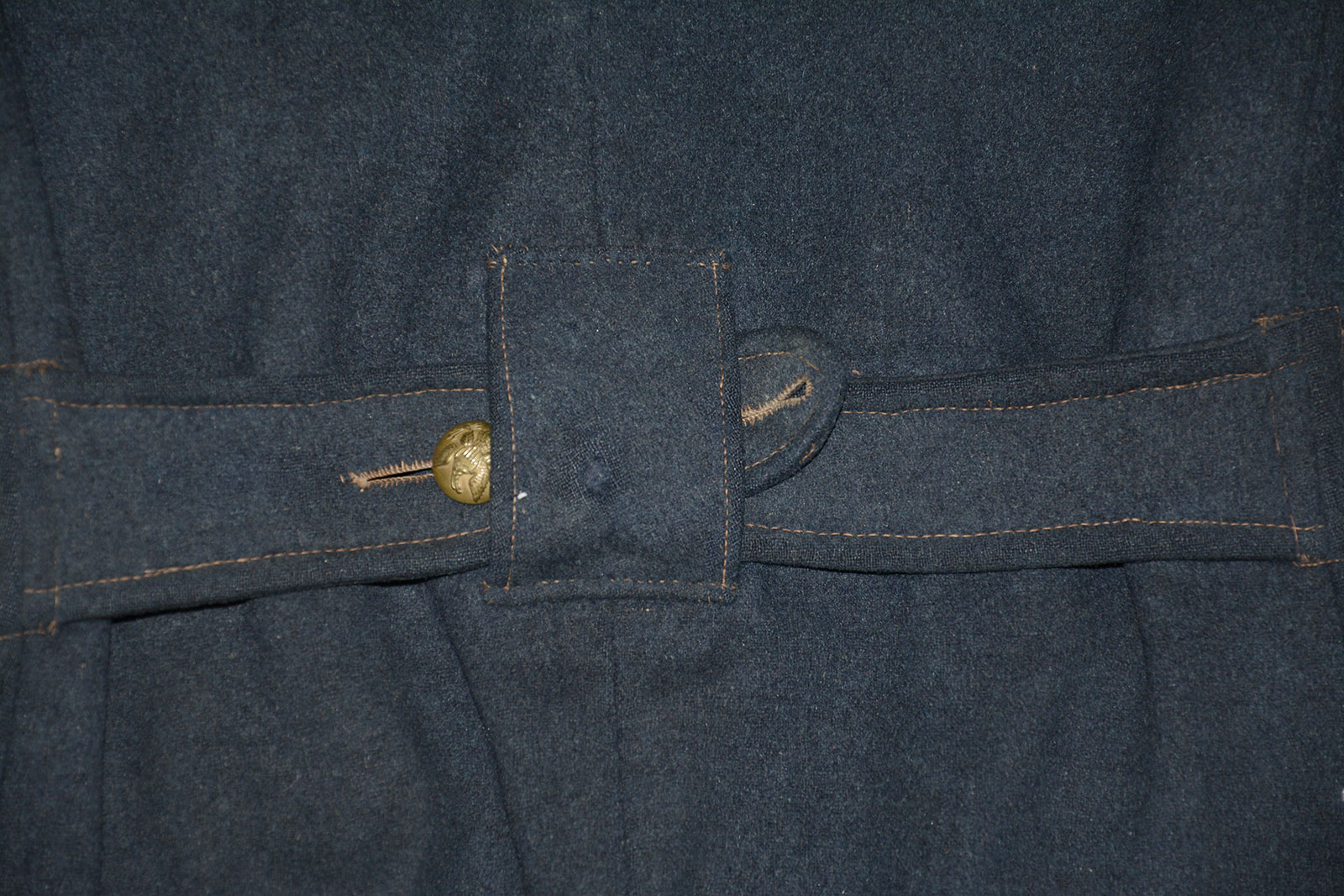
The body of the coat is single breasted and fastened by five coat-size general service eagle buttons, all in place, with the buttonholes showing wear to the stitching and loose threads from fastening and unfastening coat, but no tears to the fabric, The back of the coat is fitted the standard two-piece cloth belt fastened by a single coat-size general service eagle button and two adjusting holes with a vertical supporting loop at center. The bottom edge of the coat is, correctly, left unfinished. The rear of the skirt has a 14-inch vent with the edges turned under and sewn.
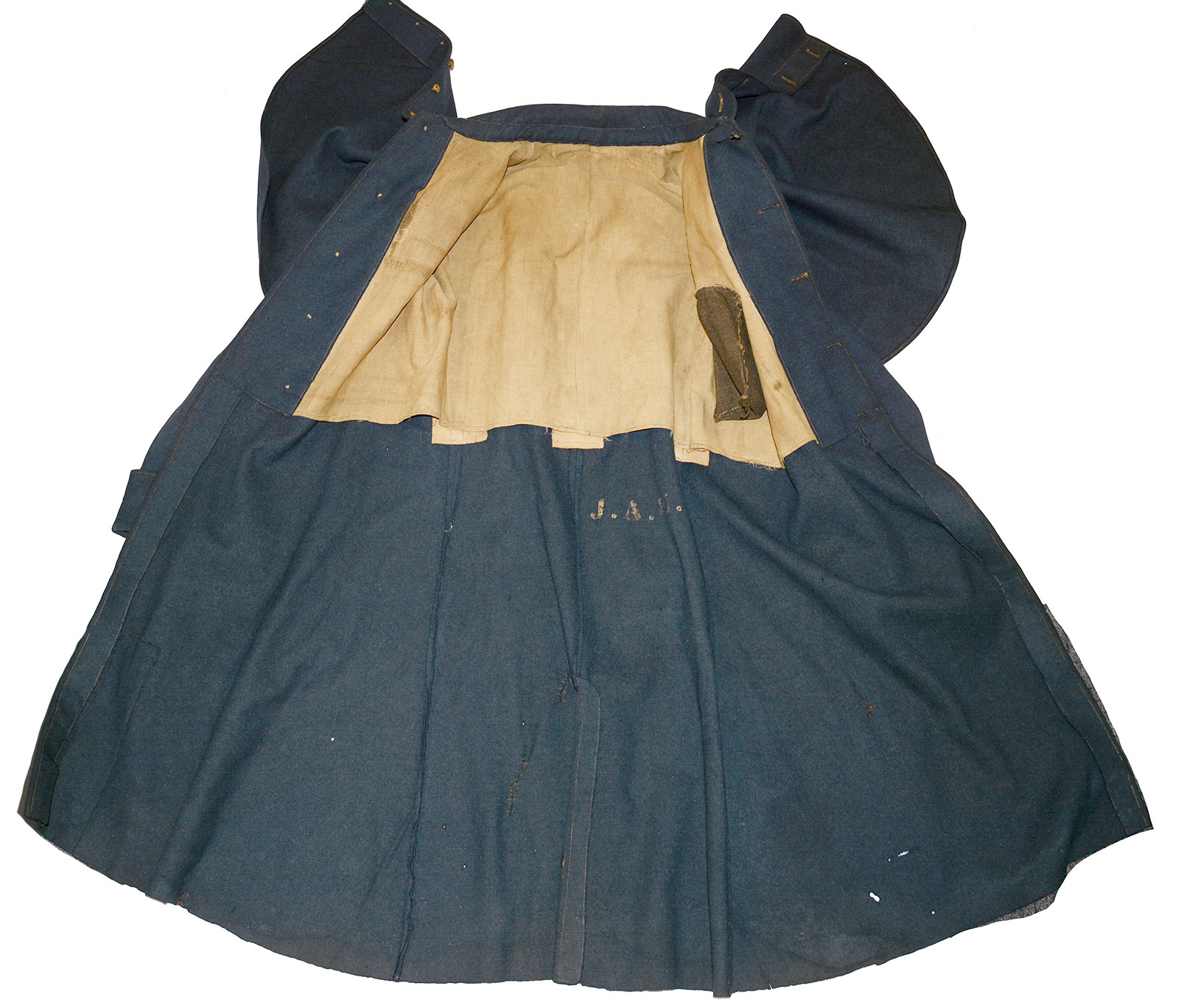
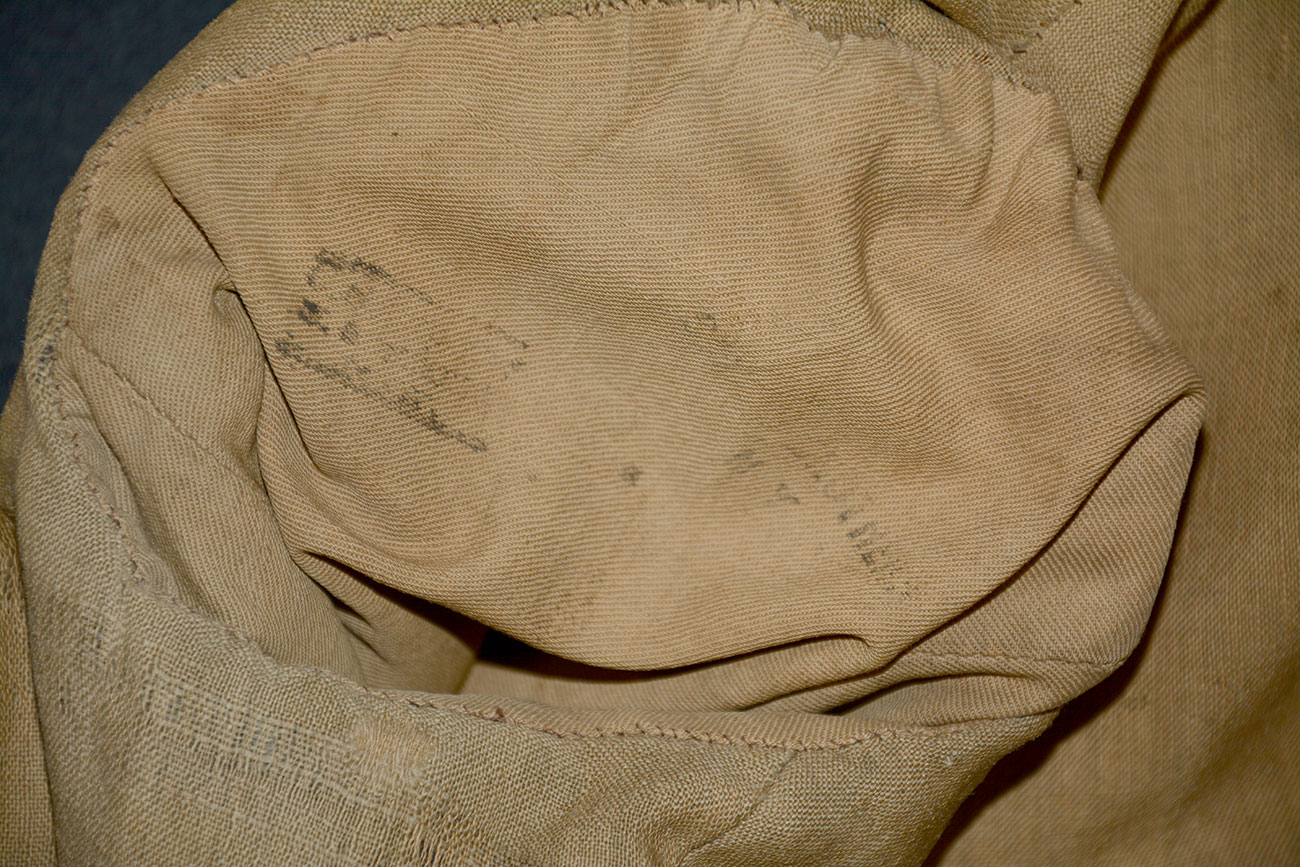
The coat is lined in the sleeves and the upper body from top of the coat to the waist, where it is unattached, but turned under and sewn to prevent unraveling. The lining is now an off-white or cream color, showing some slight wear along the shoulders at the back of the neck with period repair, and shows no holes. The lining in the sleeves extends to 1-3/4 inches of the opening and the separately applied cuffs are turned up for 3-3/4 inches, allowing them to be turned down over the hand, a consideration since the army did not yet issue winter gloves or mittens.
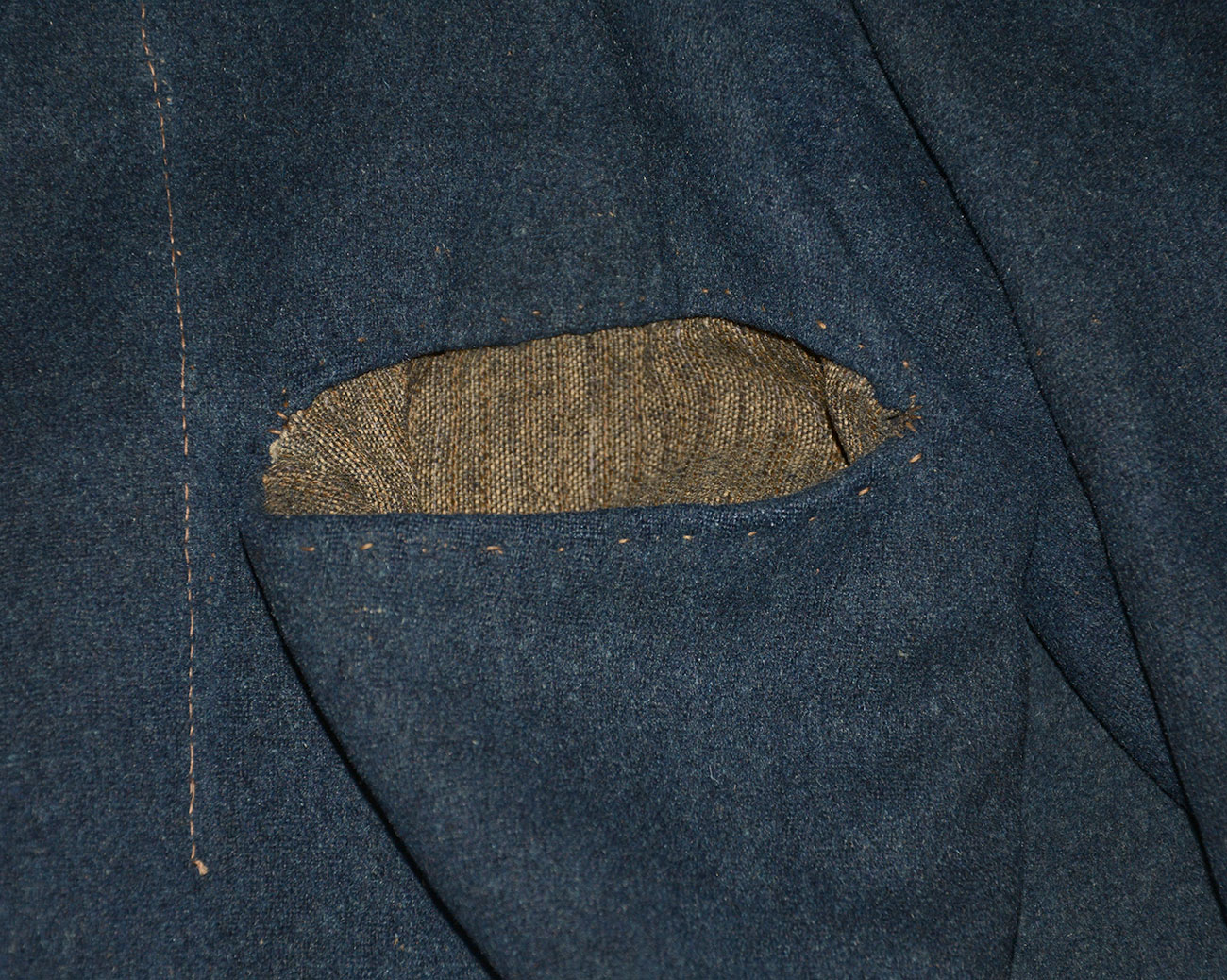
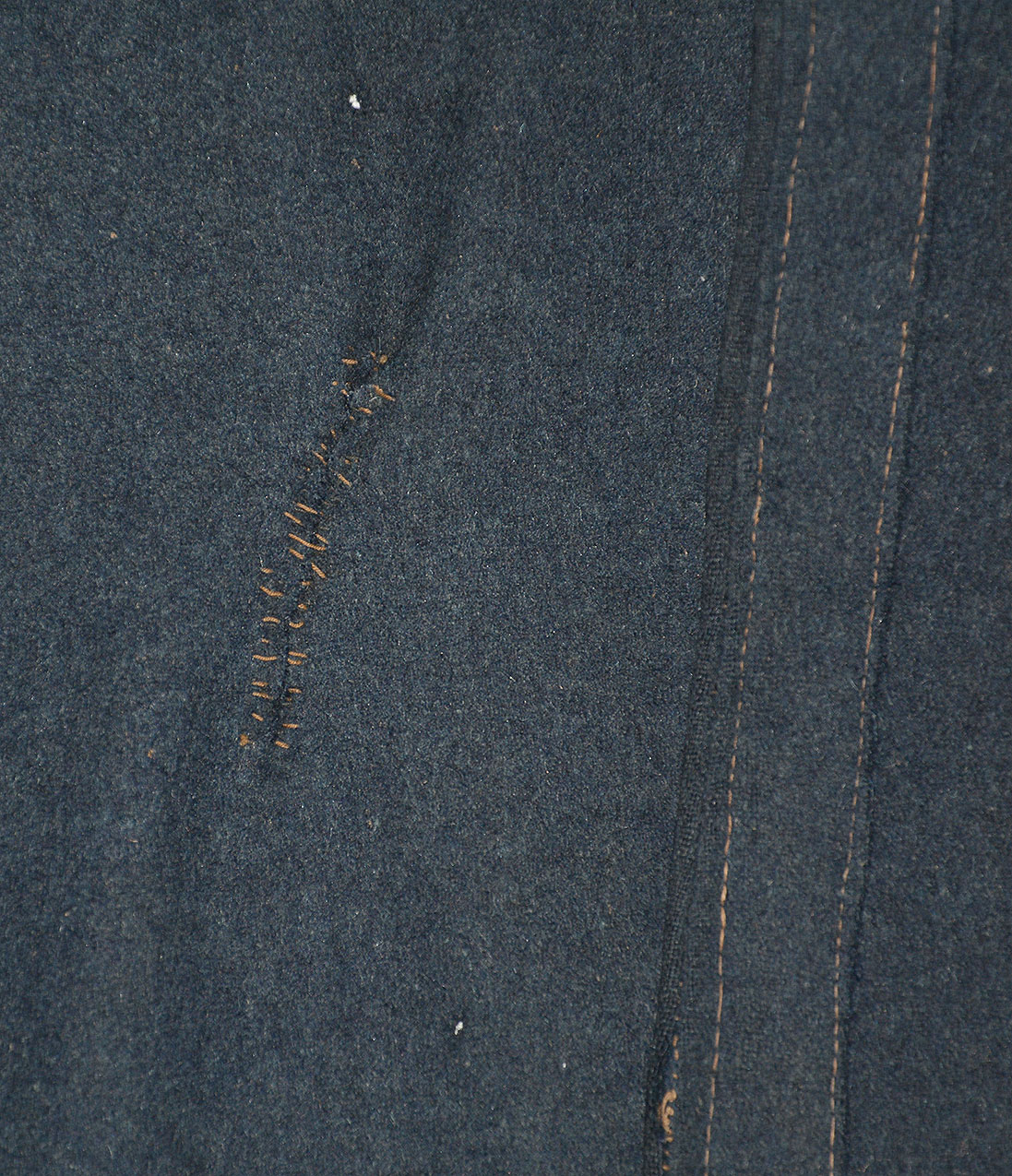
The coat was also nicely personalized in two ways by the soldier to whom it was issued. Inside the left skirt, at the hipe, he stenciled his initials in white paint letters 1-inch tall, “J.A.M.” and, since issue great coats were made without pockets, he also modified it by adding one in the left breast, opening to the outside through a 5-inch horizontal cut level with the middle button on the coat front and set far enough in from the lapel to be concealed by the cape. He then, somewhat crudely, sewed down the edges of the cut and attached a pocket bag approximately 6-inches wide and 7-inches deep, made of a loosely woven brown material. McAfee notes of these overcoats that, “Though they did not change the color of federal overcoats, soldiers found ways to ‘improve’ them. The most common alterations involved the removal of capes and the addition of outer pockets.” For a light blue overcoat so modified, see Michael Cunningham’s “Federal Soldier Modifications of Civil War Uniforms, Part 1: Jackets, Coats, Trousers and Headgear,” in The Military Collector and Historian 72.3 (Fall 2020) pp.195-209.
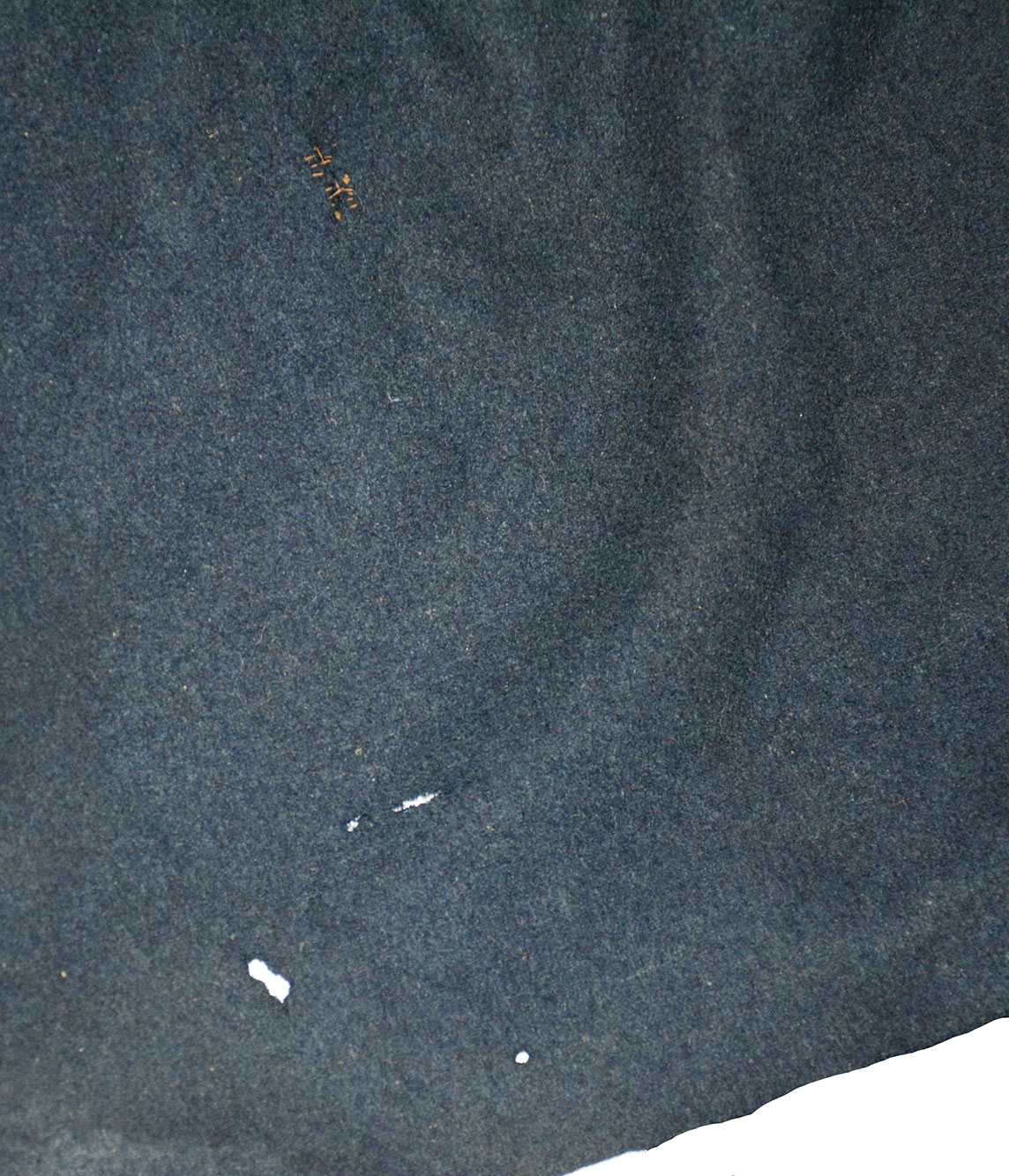
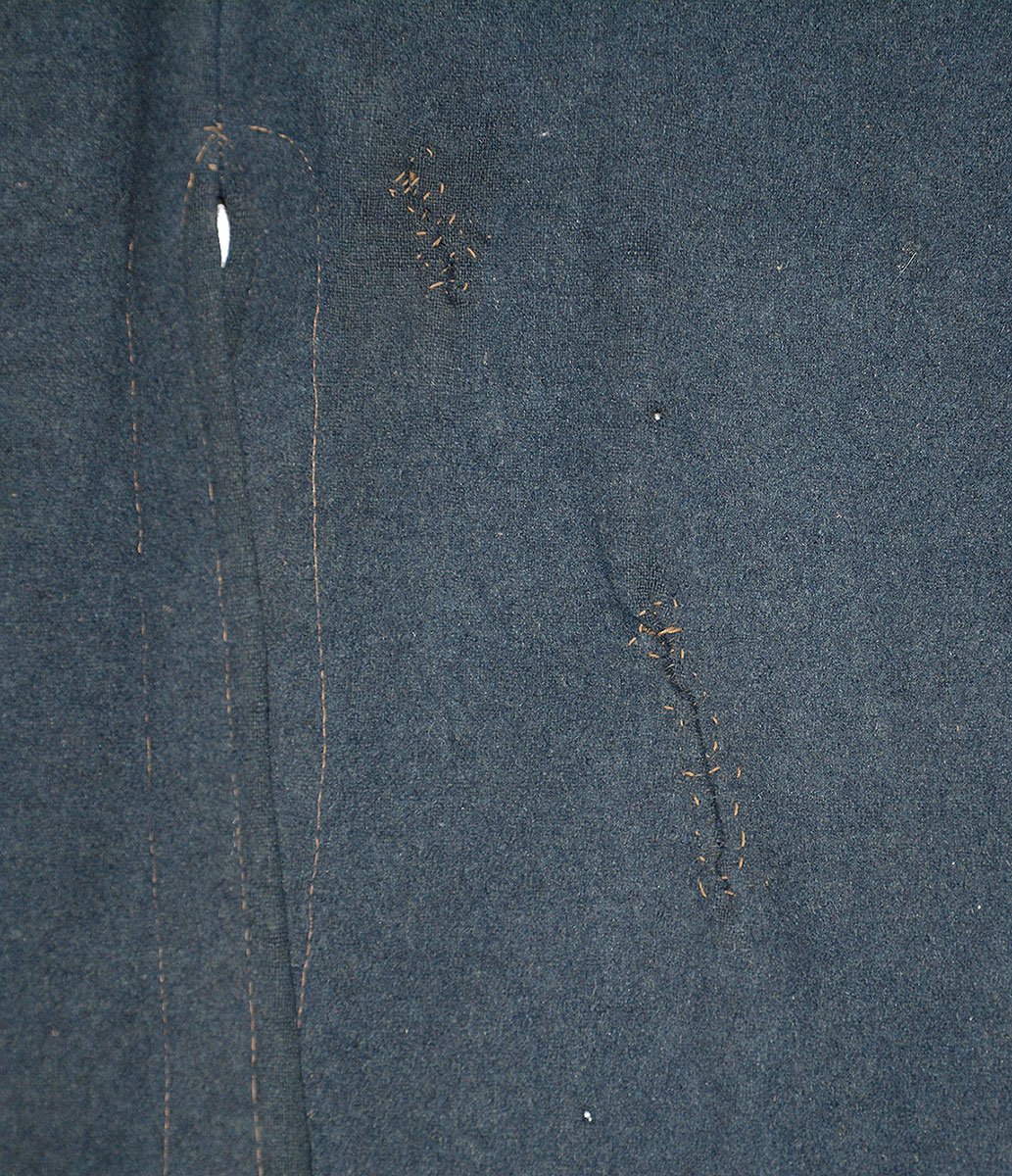
The coat is solid, has strong color, and little moth damage, none of which is obtrusive. We note five or six small moth bites on the upper right shoulder of the cape, with one or two more at upper center and on the left. The back of the coat shows two small moth nips on the right shoulder blade, one narrow and about ½-inch long, with two very small nips on the vertical loop supporting the waist belt. The lower right tail of the skirt, near the vent, show two tears crudely closed-up by the soldier: one about 1-inch long and the other, 2-3/4 inches long. The front of the coat is very good as well. We see just one 1-inch tear closed up by the soldier about 12 inches from the front edge and 11 inches from the bottom edge, with a similar 1-inch tear, a narrow 1/2-inch oblong hole with a pencil-eraser size moth nip about 7 inches below. The left skirt shows just three or four pencil-point size moth nips, and one ½-inch tear at the bottom edge the soldier sewed closed with the same brown thread he used elsewhere. More interesting in some ways is a 3-inch wide and 11-inch tall rectangle of perfectly matching material sewn very expertly into the bottom front edge of the right skirt next to the folded over 2-inch wide front edge. This insert matches so well as to be indistinguishable and perceptible only on minute inspection, and is so much better done than the soldier’s small repairs or pocket addition, that suspicion settles on the Smith Brothers as getting one by inspector or, given the exigencies also making the variant color acceptable, the inspector accepted the panel as affecting neither the appearance or the functionality of the coat. We have seen just such an inserted panel on a Civil War shelter half coming through the Cincinnati Depot.
This coat combines visual appeal and history in an exceptional combination of great condition with clear signs of U.S. issue, field use, and personalization by the soldier in the presence of his initials and his minor alteration in the addition of the pocket. [sr][[ph:L]
~~~~~~~~~~~~~~~~~~~~~~~~~~~~~~~~~~~
THIS ITEM, AS WITH ALL OTHER ITEMS AVAILABLE ON OUR WEB SITE,
MAY BE PURCHASED THROUGH OUR LAYAWAY PROGRAM.
CLICK HERE FOR OUR POLICIES AND TERMS.
THANK YOU!
Inquire About VERY SCARCE EARLY-WAR UNION INFANTRY GREATCOAT WITH STENCILED SOLDIER’S INITIALS
Most Popular
Historical Firearms Stolen From The National Civil War Museum In Harrisburg, Pa »
Theft From Gravesite Of Gen. John Reynolds »
Selection Of Unframed Prints By Don Troiani »
Fine Condition Brass Infantry Bugle Insignia »
featured item
THEFT FROM GRAVESITE OF GEN. JOHN REYNOLDS
A large artillery shell, one of pair that sit on either side of the grave of Gen. John F. Reynolds in Lancaster Cemetery, Lancaster, PA has been removed from the site. If anyone comes into contact with the shell or has any information regarding its… . Learn More »
site search
Upcoming Events
May 13 - 17: N-SSA Spring Nationals, Fort Shenandoah, Winchester, VA Learn More »